
Chapter 06 – Strategic Management: How Exceptional Managers Realize a Grand Design
6-21
1. What is the level of strategic thinking? Are you surprised by the results?
Student responses will differ based on assessment results. Many students
2. If you were meeting with an executive from the company you evaluated, what
advice would you provide based on the survey results and what you learned
about assessing current reality?
Some advice to provide includes reviewing long-term plans and discussing
Additional Activities:
You can also consult the Connect Instructors Manual for the post-assessment activity
and corresponding PowerPoint slides used for this Self-Assessment in Connect. In
Section 6.5 discusses the different types of strategies: growth, stability, or defensive.
Strategy formulation makes use of several concepts, including Porter’s four competitive
strategies, diversification and synergy, and the BCG matrix.
One way that you could begin your coverage of these topics is to have the students
read the Wall Street Journal article “P&G Faces up to Mistakes in Beauty Business.”
6.5 Formulating the Grand Strategy (pp. 175-179)
How can three techniques—Porter’s four competitive strategies,
diversification and synergy, and the BCG matrix—help me formulate
strategy?
Chapter 06 – Strategic Management: How Exceptional Managers Realize a Grand Design
Possible Topics for Discussion:
• Discuss the challenges of trying to implement each of Porter’s four competitive
strategies.
Major Idea Outline:
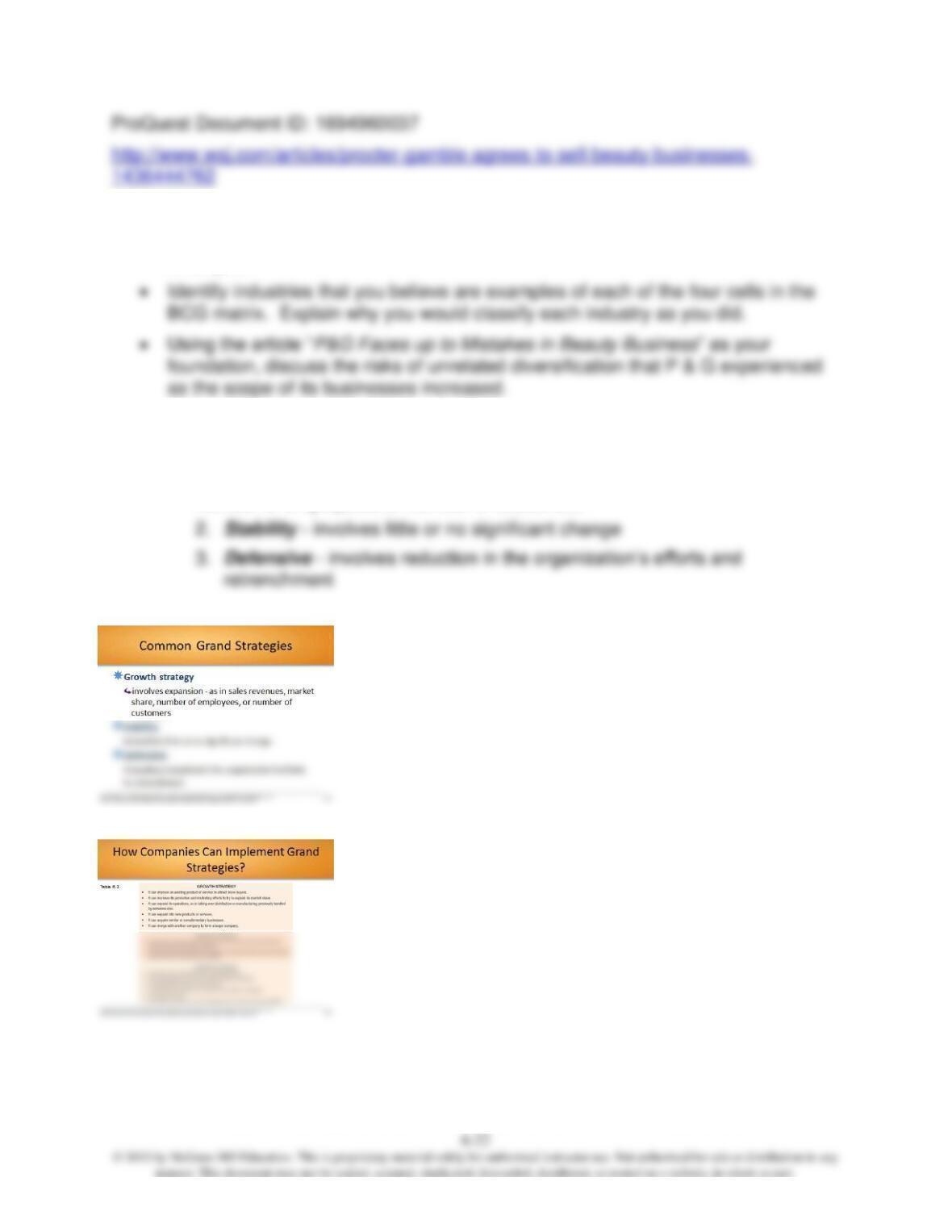
A. Three Common Grand Strategies
1. Growth – involves expansion – as in sales revenues, market share,
number of employees, or number of customers
B. Porter’s Four Competitive Strategies
1. Porter’s four competitive strategies (also called four generic strategies)
are leadership, differentiation, cost-focus and focused-differentiation.

Chapter 06 – Strategic Management: How Exceptional Managers Realize a Grand Design
6-23
2. The cost-leadership strategy targets a wide market.
a. It keeps the costs and (and thus prices) of a product or service below
those of competitors and to target a wide market.
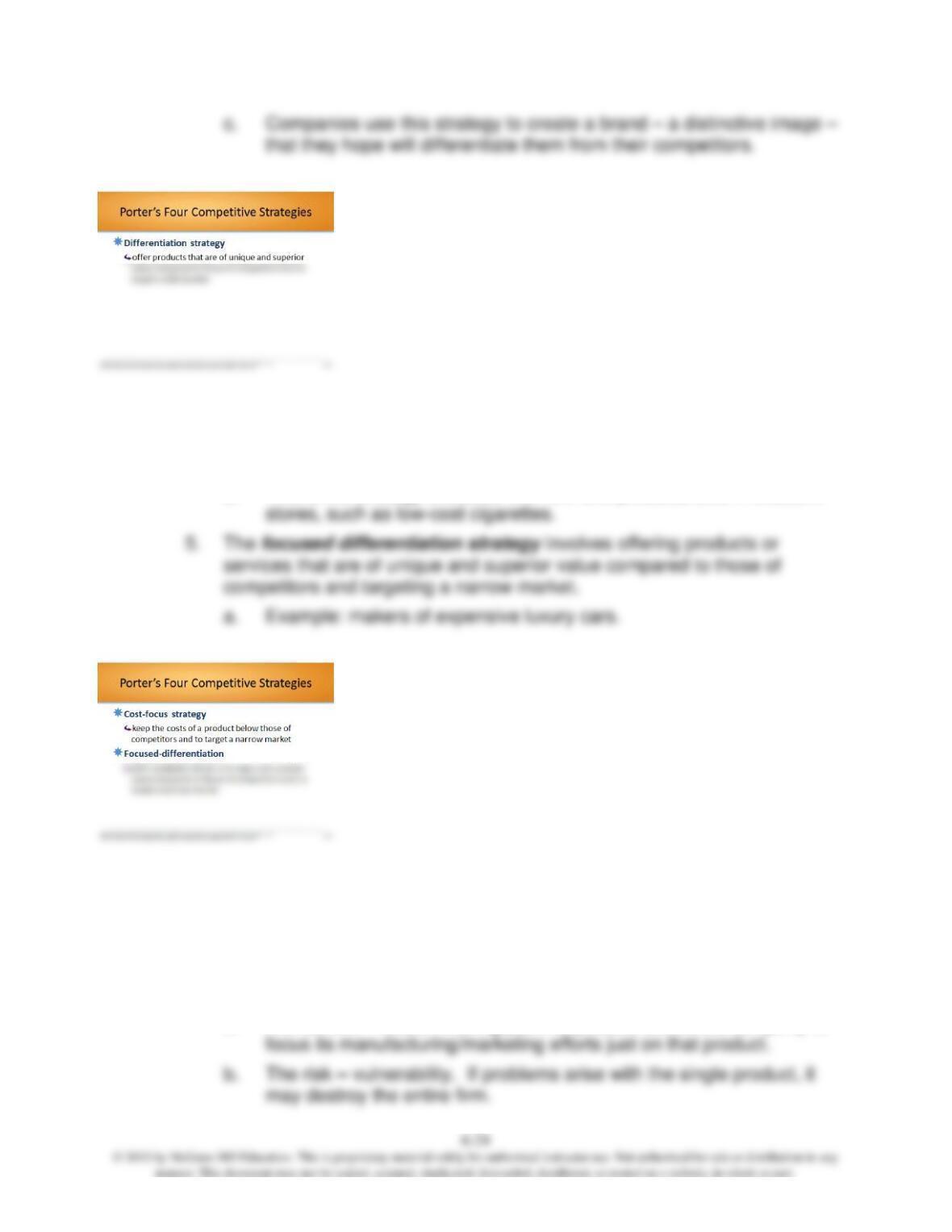
3. The differentiation strategy also targets a wide market.
a. It involves offering products or services that are of unique and
superior value compared to those of competitors and to target a wide
market.
Chapter 06 – Strategic Management: How Exceptional Managers Realize a Grand Design
4. The cost-focus strategy involves keeping costs (and thus prices) of a
product or service below those of competitors but it targets a narrow
market.
a. This is the strategy executed with low-end products sold in discount
C. Single-Product Strategy versus Diversification Strategy
1. A company needs to determine if it will have a single-product strategy or a
diversification strategy.
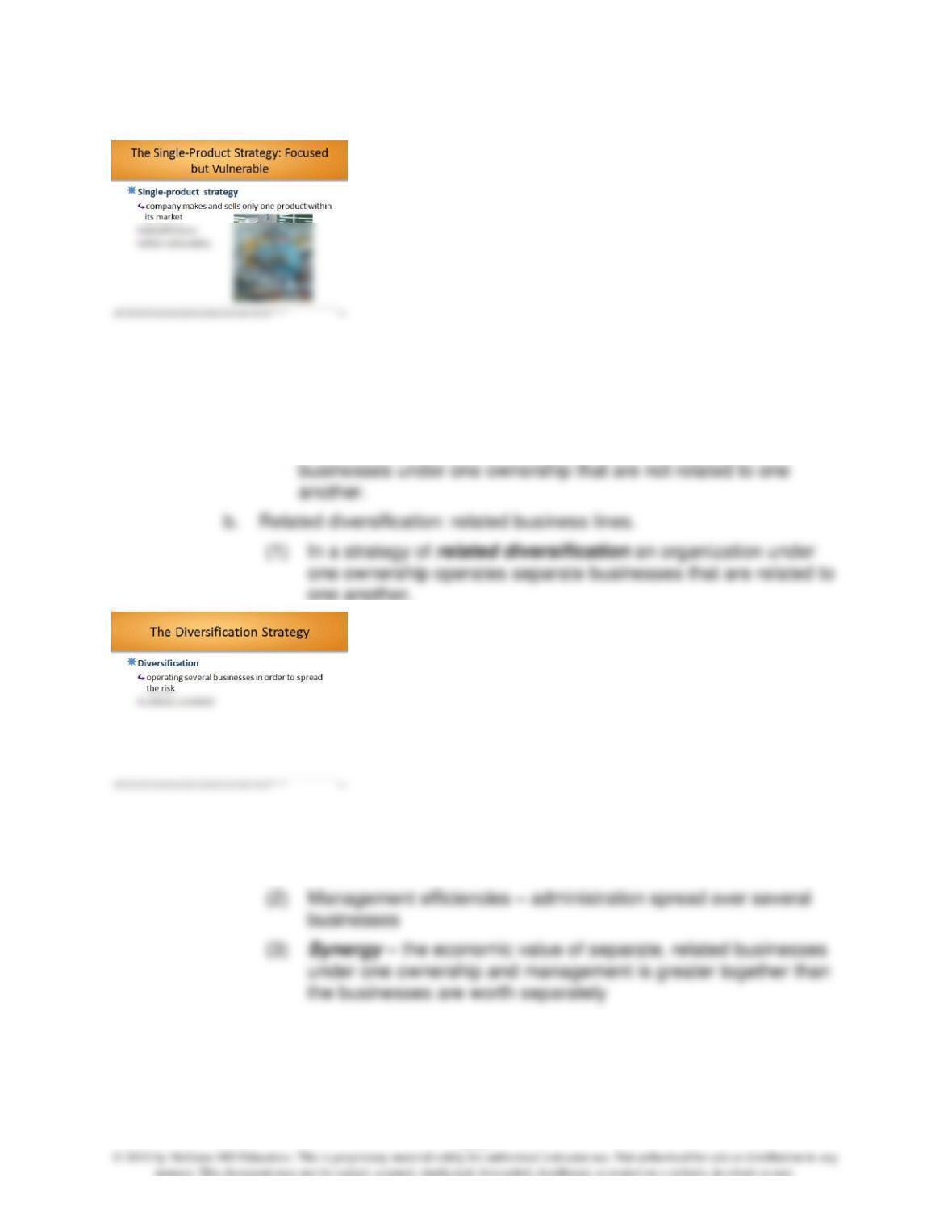
2. In a single-product strategy, a company makes and sells only one
product within its market.
a. The benefit – focus. Making just one product allows the company to
Chapter 06 – Strategic Management: How Exceptional Managers Realize a Grand Design
6-25
2. With a diversification strategy, the organization operates several
businesses in order to spread the risk. There are two kinds:
a. Unrelated diversification: independent business lines
(1) A strategy of unrelated diversification is operating several
one another.
c. Diversification has three advantages:
(1) Reduced risk with more than one product

Chapter 06 – Strategic Management: How Exceptional Managers Realize a Grand Design
6-26
D. The BCG Matrix
1. The BCG Matrix is a means of evaluating strategic business units on
the basis of their business growth rates and their share of the market.
2. Market growth is divided into two categories – low and high.

Chapter 06 – Strategic Management: How Exceptional Managers Realize a Grand Design
SELF-ASSESSMENT 6.2 (p. 179)
Core Skills Required for Strategic Planning
Go to connect.mheducation.com and take Self-Assessment 6.2.
Student Questions:
1. Do you have what it takes? Are you surprised by the results?
2. Based on the results, what are your top two strengths and deficiencies when it
comes to strategic planning?
Student responses will differ based on assessment results. Some students
3. Assuming you wanted to do strategic planning at some point in your career,
what can you do to improve your skills associated with strategic planning? Be
specific.
There are some skills that can obviously be improved, these include verbal
Additional Activities:
You can also consult the Connect Instructors Manual for the post-assessment activity
and corresponding PowerPoint slides used for this Self-Assessment in Connect. In
this activity, students should respond to the following questions:
1. Based on your results, do you think you would like to make a career out of

6-28
Section 6.6 discusses how strategic implementation is closely aligned with strategic
control. Execution is a process that helps align these two phases of the strategic–
management process.
One way that you could begin your coverage of these topics is to have the students
Possible Topics for Discussion:
• Describe the three processes that impact a firm’s ability to execute effectively.
• Describe the characteristics of a good strategic plan.
Major Idea Outline:
A. Strategic implementation is closely aligned with strategic control, and execution
is the process that helps align these two phases of the strategic-management
process.
B. Execution is not simply tactics; it is a central part of any company’s strategy.
6.6 Implementing & Controlling Strategy: Execution (pp.
180–182)
How does effective execution help managers during the strategic-
management process?

Chapter 06 – Strategic Management: How Exceptional Managers Realize a Grand Design
6-29
2. Execution consists of linking the three core processes of any business –
people, strategy and operations.
a. The first core process: people – who will benefit you in the future
(1) An effective leader tries to evaluate talent by:
i. linking people to particular strategic milestones
Chapter 06 – Strategic Management: How Exceptional Managers Realize a Grand Design
6-30
(2) A leader must take a critical view of the organization’s
capabilities and talent when considering how to execute the
strategic plan.
c. The third core process: operations – what path will be followed?
Interactive Classroom Material:
PRACTICAL ACTION: Building a Foundation of Execution (p. 182)
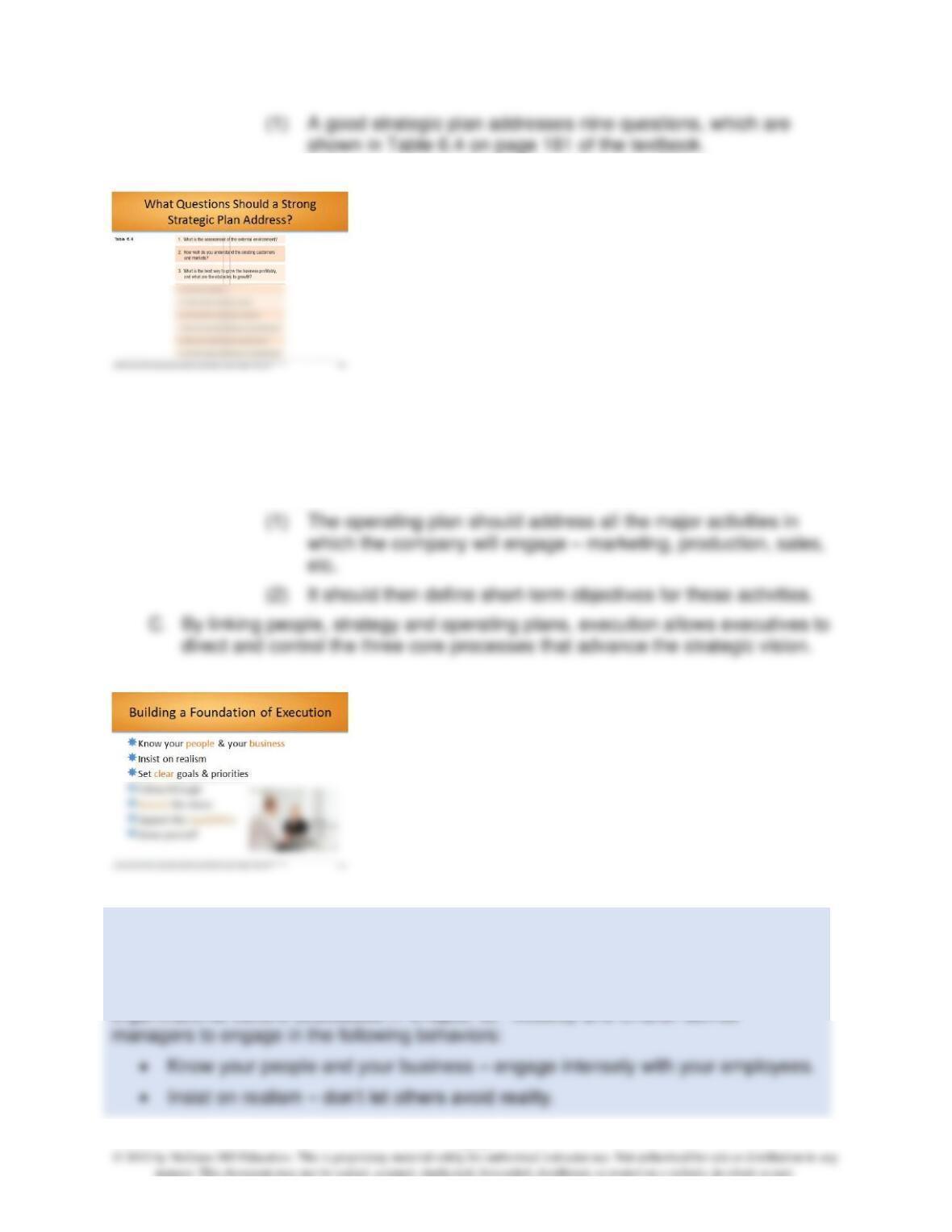
The foundation of execution is based on leadership (as we discuss in Chapter 14) and
organizational culture (discussed in Chapter 8). Bossidy and Charan advise

Chapter 06 – Strategic Management: How Exceptional Managers Realize a Grand Design
6-31
• Set clear priorities – focus on a few rather than many goals.
• Follow through – establish accountability and check on results.
Additional Activities:
One way that you could build on this Practical Action and to synthesize your coverage
of the strategic-management process is to have the students read the Harvard
Business Review article “Second Thoughts About a Strategy Shift.” This article is a
HBR Case Study and includes a fictional case (though it is based on events at J.C.
Penney) and case commentary by industry experts. This case looks at whether a
company should continue with its hablar claro or “straight talk” strategy, which does
away with discounts and special sales. Using this case study would be an excellent
way to review the stages of the strategic-management process. You can ask
students to read only the article or also ask them to read the professional
commentary. Consider using the following discussion questions:
Critique Emilia’s use of the strategic management process in the development and
SELF-ASSESSMENT 6.3 (p. 182)
Assessing the Obstacles to Strategic Execution
Go to connect.mheducation.com and take Self-Assessment 6.3.
Student Questions:
1. How does the company stand with respect to execution?
Student responses will differ based on assessment results. Students may be