
Chapter 06 – Strategic Management: How Exceptional Managers Realize a Grand Design
6-1
6
Chapter
Strategic Management:
How Exceptional Managers Realize a Grand Design
Major Questions the Student Should Be Able to Answer 2
Mapping the Class: Chapter Outline 3
Overview of the Chapter 4
Classroom Outline 5
CHAPTER CONTENTS
Chapter 06 – Strategic Management: How Exceptional Managers Realize a Grand Design
6-2
6.1 What Is Effective Strategy?
MAJOR QUESTION: What is strategic positioning, and what are the three principles that
underlie it?
6.4 Assessing the Current Reality
MAJOR QUESTION: What tools can help me describe where the organization stands
from a competitive point of view?
6.5 Formulating the Grand Strategy
MAJOR QUESTIONS THE STUDENT SHOULD BE ABLE TO ANSWER
Chapter 06 – Strategic Management: How Exceptional Managers Realize a Grand Design
6-3
6.1 What Is Effective Strategy?
6.2 The Strategic Management Process
6.3 Establishing the Mission & the Vision
6.4 Assessing the Current Reality
• Competitive Intelligence
6.5 Formulating the Grand Strategy
• Three Common Grand Strategies
6.6 Implementing and Controlling Strategy: Execution
• Implementing the Strategy
MAPPING THE CLASS: CHAPTER OUTLINE

Chapter 06 – Strategic Management: How Exceptional Managers Realize a Grand Design
6-4
6.1 What Is Effective Strategy?
Strategic positioning attempts to achieve sustainable competitive advantage by
6.2 The Strategic Management Process
The strategic-management process has five steps: 1) Establish the mission and
6.3 Establishing the Mission & the Vision
A mission statement should express the organization’s purpose or reason for
6.4 Assessing the Current Reality
To develop a grand strategy, you need to gather data and make projections, using
6.5 Formulating the Grand Strategy
Strategies may be growth, stability, or defensive strategies. Strategy formulation
6.6 Implementing and Controlling Strategy: Execution
Strategic implementation is closely aligned with strategic control. Execution is a
OVERVIEW OF THE CHAPTER

Chapter 06 – Strategic Management: How Exceptional Managers Realize a Grand Design
6-5
The Manager’s Toolbox: Being a Successful Manager: Look beyond the Fads, Be
Willing to Make Painful Decisions
In order to be a successful manager, you will need to look beyond fads and be willing to
make painful decisions. Fads are short-lived enthusiasms and they are often seen as
Possible Topics for Discussion:
• Do you think you would have an evidence-based management mind-set when
thinking about the overall direction of your organization or work unit?
• Describe a time a manager at your company (or a previous company)
implemented a management tool that you considered a fad. Describe how its
Section 6.1 discusses strategic positioning attempts to achieve sustainable competitive
advantage by preserving what is distinctive about a company. Three key principles
underlie strategic positioning: 1) strategy is the creation of a unique and valuable
position, 2) strategy requires trade-offs in competing, and 3) strategy involves creating a
“fit” among activities.
CLASSROOM OUTLINE
6.1 What Is Effective Strategy? (pp. 160-161)
What is strategic positioning, and what are the three principles underlying
it?
Chapter 06 – Strategic Management: How Exceptional Managers Realize a Grand Design
6-6
Possible Topics for Discussion:
• Considering either your current company or one for which you want to work after
graduation, discuss in what ways the company performs different activities from
its rivals or performs activities in different ways from its rivals.
Major Idea Outline:
A. What Is an Effective Strategy?
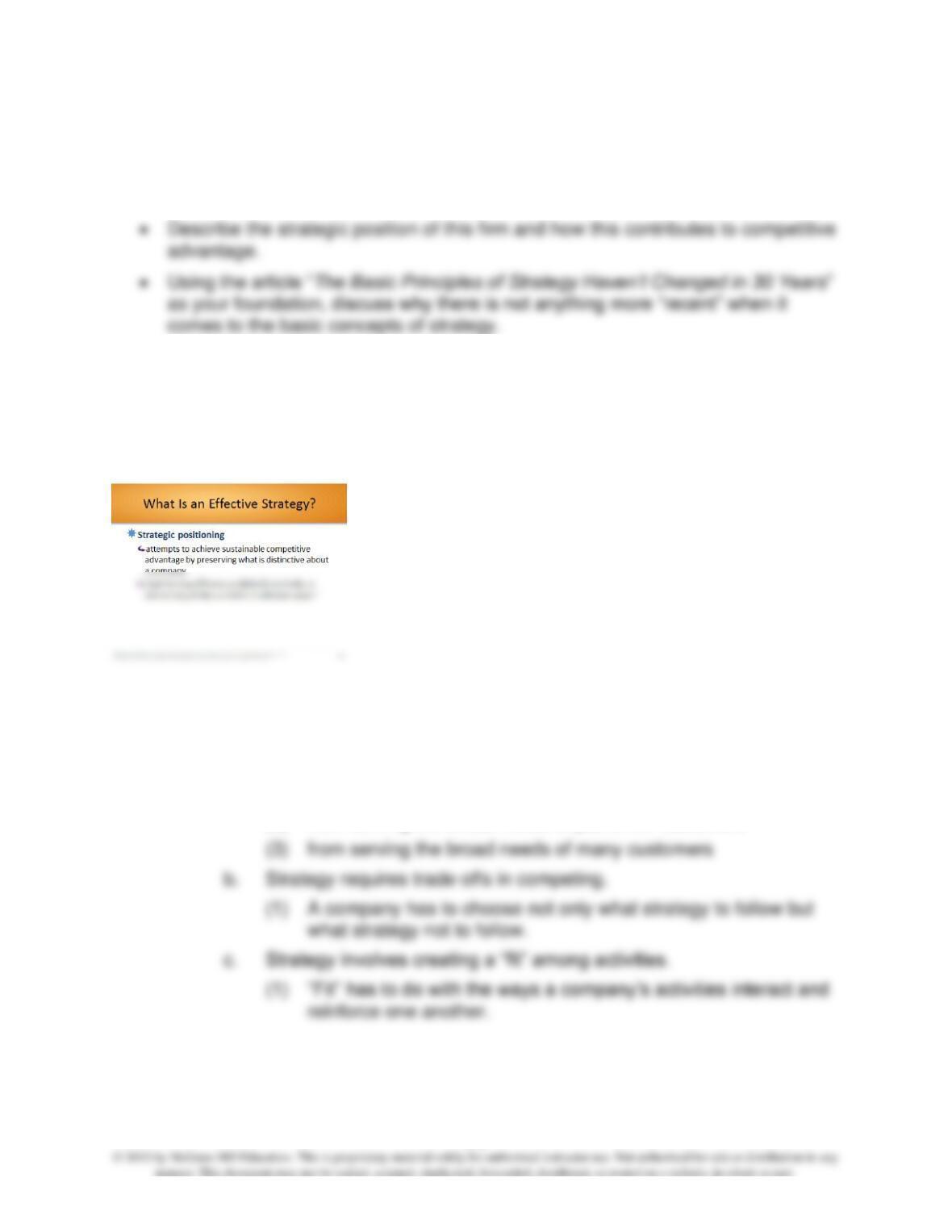
1. Strategic positioning attempts to achieve sustainable competitive
advantage by preserving what is distinctive about a company.
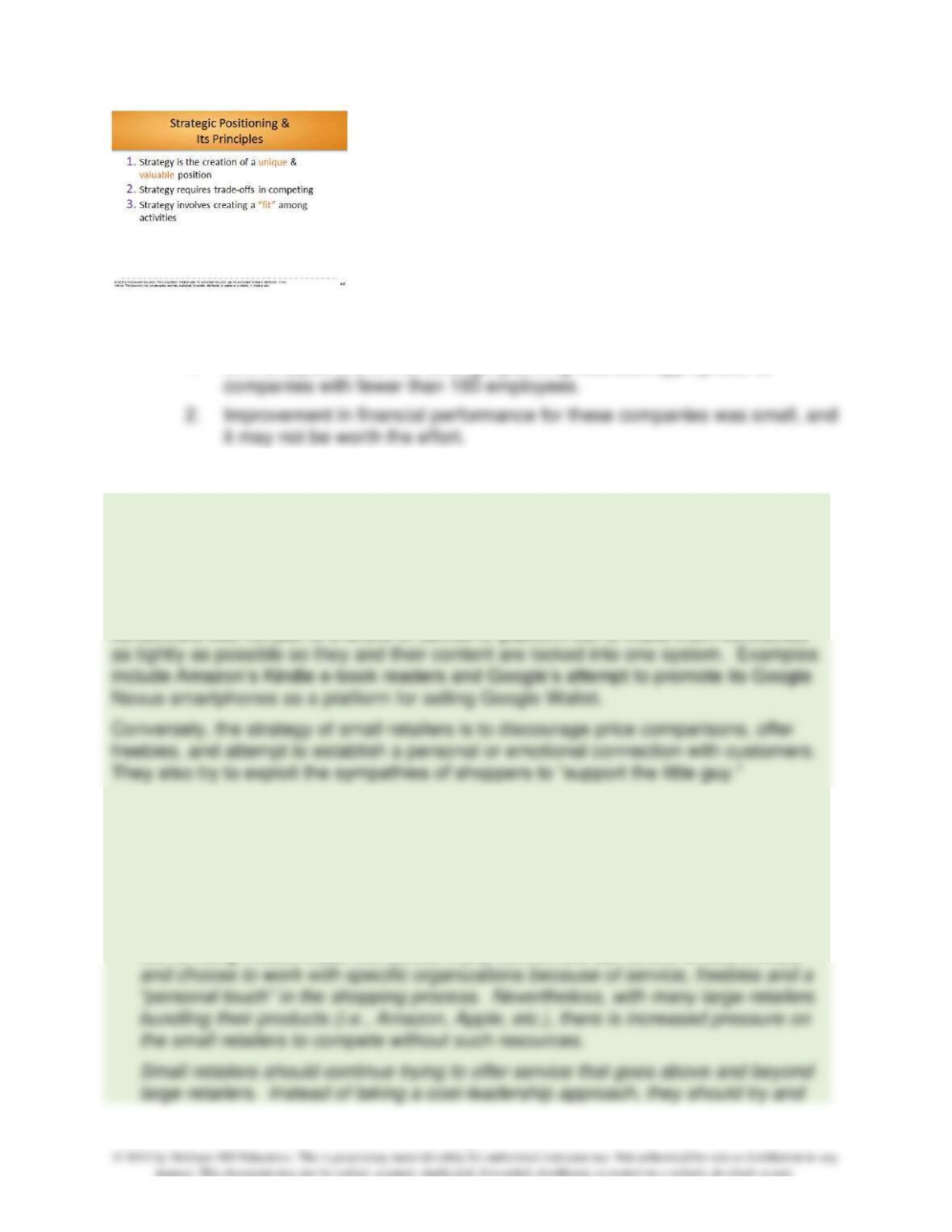
2. Three key principles underlie strategic positioning:
a. Strategy is the creation of a unique and valuable position. Strategic
position emerges from three sources:
(1) from serving the few needs of many customers
(2) from serving the broad needs of just a few customers
Chapter 06 – Strategic Management: How Exceptional Managers Realize a Grand Design
6-7
E. Does Strategic Management Work for Small as Well as Large Firms?
1. One analysis found that strategic planning was also appropriate for
Interactive Classroom Material:
EXAMPLE: Comparing Strategies: Big-Company “Make the Consumer a
Captive” versus Small–Firm “Offer Personal Connections” (p. 161)
The strategy of many big companies is to build a device, sell it to consumers, and
then sell them the content to play on it (and maybe some ads, too). The idea is to get
consumers tied not just to a brand or device or platform but to make them connected
YOUR CALL
Considering the proliferation of price comparison sites (Price-grabber.com,
Bizrate.com, FreePriceAlerts.com) that will usually direct consumers to big e-
commerce retailers, do you think low prices will always win in the end? Is there
any strategy a small retailer can take to maintain an advantage?
There is a certain demographic that will always trek towards low prices. However,
with a rising middle-class worldwide, many consumers can afford to discriminate

Chapter 06 – Strategic Management: How Exceptional Managers Realize a Grand Design
6-8
find their niche customer and provide a differentiation-based service or product.
Additional Activities:
One way to build on this Example is to profile “Small Business Saturday,” an initiative
started by American Express in 2010 to encourage consumers to shop at local stores
on the Saturday between Black Friday and Cyber Monday of the holiday shopping
season. The event is profiled in the 2-minute American Express video “Detroit:
Making the Most of Small Business Saturday,” which you could play for the students.
Consider using the following discussion questions:
If you as a consumer have participated in Small Business Saturday, explain the
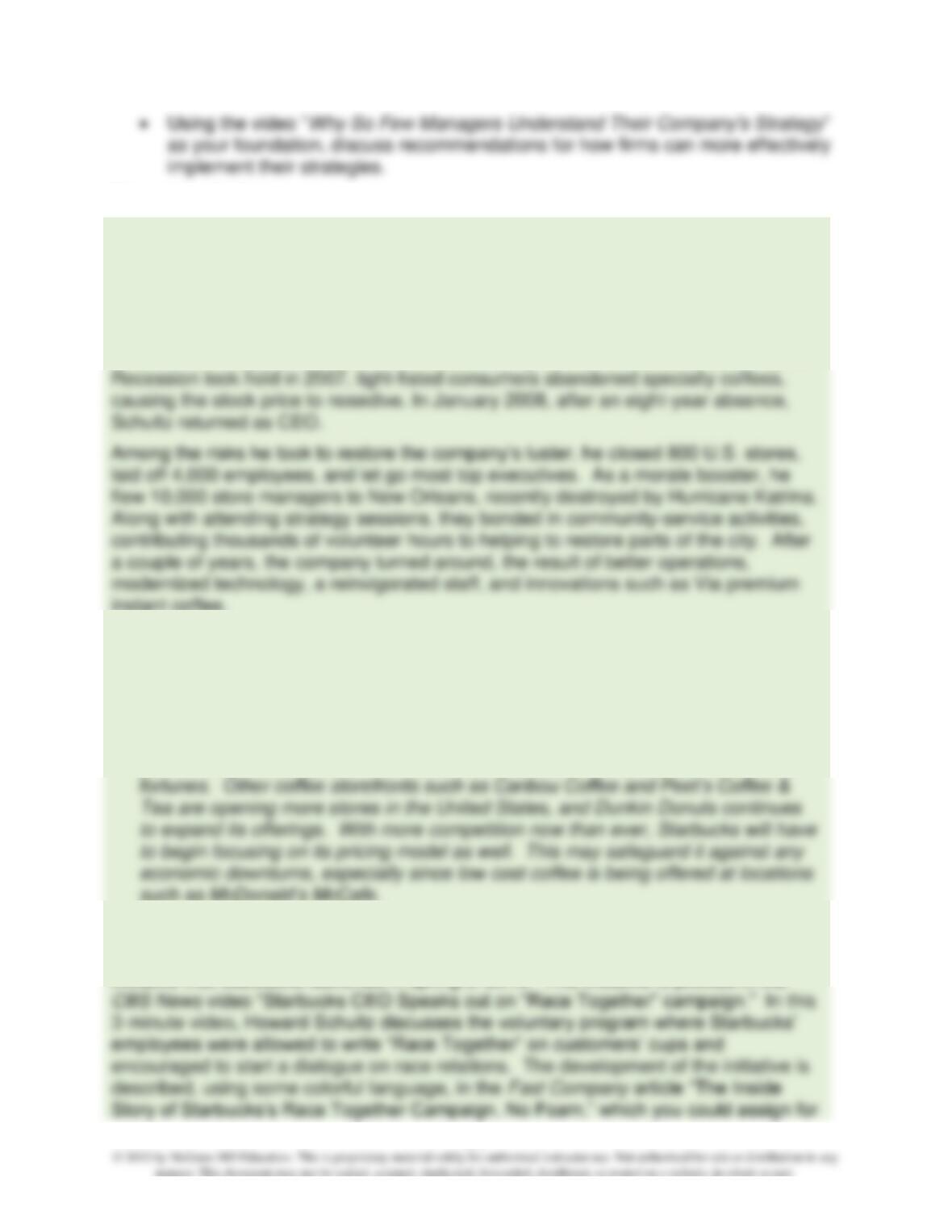
Section 6.2 discusses the strategic-management process. This process has five-steps:
1) Establish the mission and the vision; 2) Assess the current reality; 3) Formulate the
grand strategy; 4) Implement the strategy; and 5) Maintain strategic control. All the
steps may be affected by feedback that enables the taking of corrective action.
Possible Topics for Discussion:
• Describe the five steps of the strategic-management process.
• Which step of the strategic-management process do you believe is the most
important? Defend your position.
6.2 The Strategic-Management Process (pp. 162-164)
What’s the five-step recipe for the strategic-management process?
Chapter 06 – Strategic Management: How Exceptional Managers Realize a Grand Design
6-9
Major Idea Outline:
Interactive Classroom Material:
EXAMPLE: Crisis Leading to the Strategic-Management Process: Starbucks
Reclaims Its Soul (pp. 162-163)
After Starbucks’ CEO, Howard Schultz, stepped down in 2000, management became
more concerned with profits than store atmosphere and company values and
extended existing product lines rather than creating new ones. Second, as the Great
instant coffee.
YOUR CALL
Thus, despite the innovation in products, attempts to rekindle the cozy
neighborhood café, and emphasis on positive social values, do you think
another economic downturn could alter Starbucks’s fortunes?
Starbucks may have regained its focus, but its prices have increased year after
year in the process as well. An economic downturn could surely alter Starbucks’
such as McDonald’s McCafe.
Additional Activities:
One way to build on this Example is to have the students discuss the “Race Together”
initiative that Starbucks launched in spring of 2015. This initiative is profiled in the
Chapter 06 – Strategic Management: How Exceptional Managers Realize a Grand Design
6-10
A. The strategic-management process has five steps, plus a feedback loop.
1. Step 1: Establish the Mission & the Vision
a. The mission is the organization’s purpose or reason for being,
expressed in a mission statement.
2 Step 2: Assess the Current Reality
a. The second step is to do a current reality assessment, or

Chapter 06 – Strategic Management: How Exceptional Managers Realize a Grand Design
6-11
3. Step 3: Formulate the Grand Strategy
a. This means translating the broad mission and vision statements into a
4. Step 4: Implement the Strategy
a. Putting strategic plans into effect is strategy implementation.
5. Step 5: Maintain Strategic Control: The Feedback Loop.
a. Strategic control consists of monitoring the execution of strategy
and making adjustments, if necessary.

Chapter 06 – Strategic Management: How Exceptional Managers Realize a Grand Design
6-12
c. Corrective action constitutes a feedback loop.
Group Exercise: Strategizing for Real
There is a group exercise available at the end of this manual that will assist students
in further understanding the strategic-planning process.
Exercise Objectives
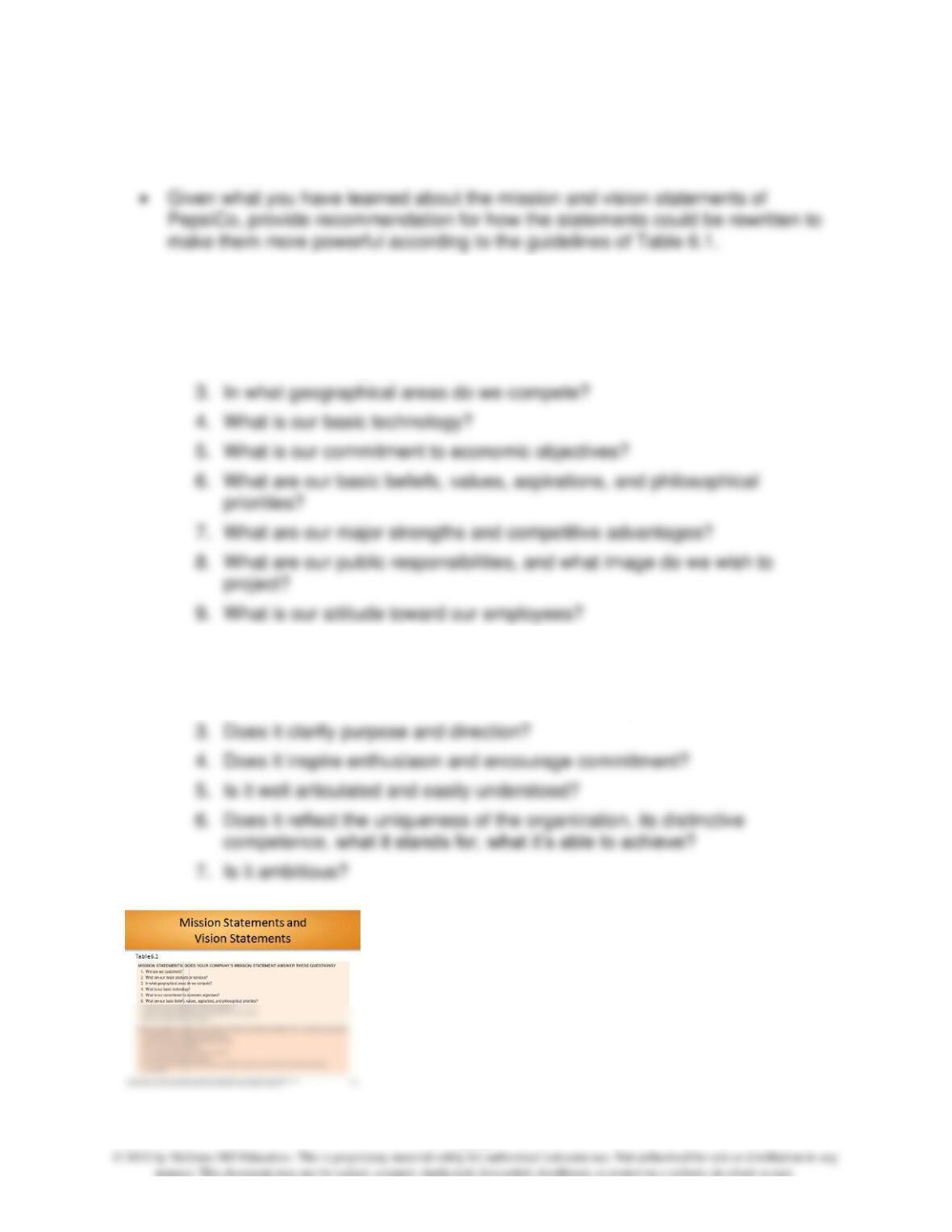
Section 6.3 discusses mission and vision statements. A mission statement should
express the organization’s purpose or reason for being. A vision statement should be
positive and inspiring, and it should stretch the organization and its employees to
achieve a desired future state that appears beyond its reach.
One way that you could begin your coverage of these topics is to have the students
critique the extent to which the mission and vision statements for PepsiCo meet the
6.3 Establishing the Mission & the Vision (pp. 165-166)
What are the characteristics of good mission and vision statements?
Chapter 06 – Strategic Management: How Exceptional Managers Realize a Grand Design
6-13
• Locate the mission and vision statements for your company or one for which you
would like to work after graduation. Evaluate the extent to which the statements
meet the guidelines for constructing powerful statements outlined in Table 6.1.
Major Idea Outline:
A. Characteristics of a good mission statement
1. Who are our customers?
2. What are our major products or services?
B. Characteristics of a good vision statement
1. Is it appropriate for the organization and for the times?
2. Does it set standards of excellence and reflect high ideals?

Chapter 06 – Strategic Management: How Exceptional Managers Realize a Grand Design
6-14
Section 6.4 discusses assessing the current reality in order to develop a grand strategy.
This includes gathering data and making projections by using the tools of competitive
intelligence, SWOT analysis, forecasting, benchmarking, and Porter’s five competitive
forces.
Possible Topics for Discussion:
• Perform a SWOT analysis on your current company or one for which you would
like to work after graduation.
• Assume you are an upper-level manager for Toyota. Discuss how you could
gather competitive intelligence to allow you to compete more effectively.
Describe any ethical considerations for competitive intelligence.
Major Idea Outline:
A. Competitive Intelligence
1. Competitive intelligence means gaining information about one’s
competitors’ activities so that you can anticipate their moves and react
appropriately.
2. Most sources of competitive intelligence are public, including:
6.4 Assessing the Current Reality (pp. 167-174)
What tools can help me describe where the organization stands from a
competitive point of view?

Chapter 06 – Strategic Management: How Exceptional Managers Realize a Grand Design
6-15
B. SWOT Analysis
1. Environment scanning is carefully monitoring of an organization’s
2. The process for doing this is SWOT analysis—also known as a
3. The SWOT analysis is divided into two parts: inside matters and outside
matters.
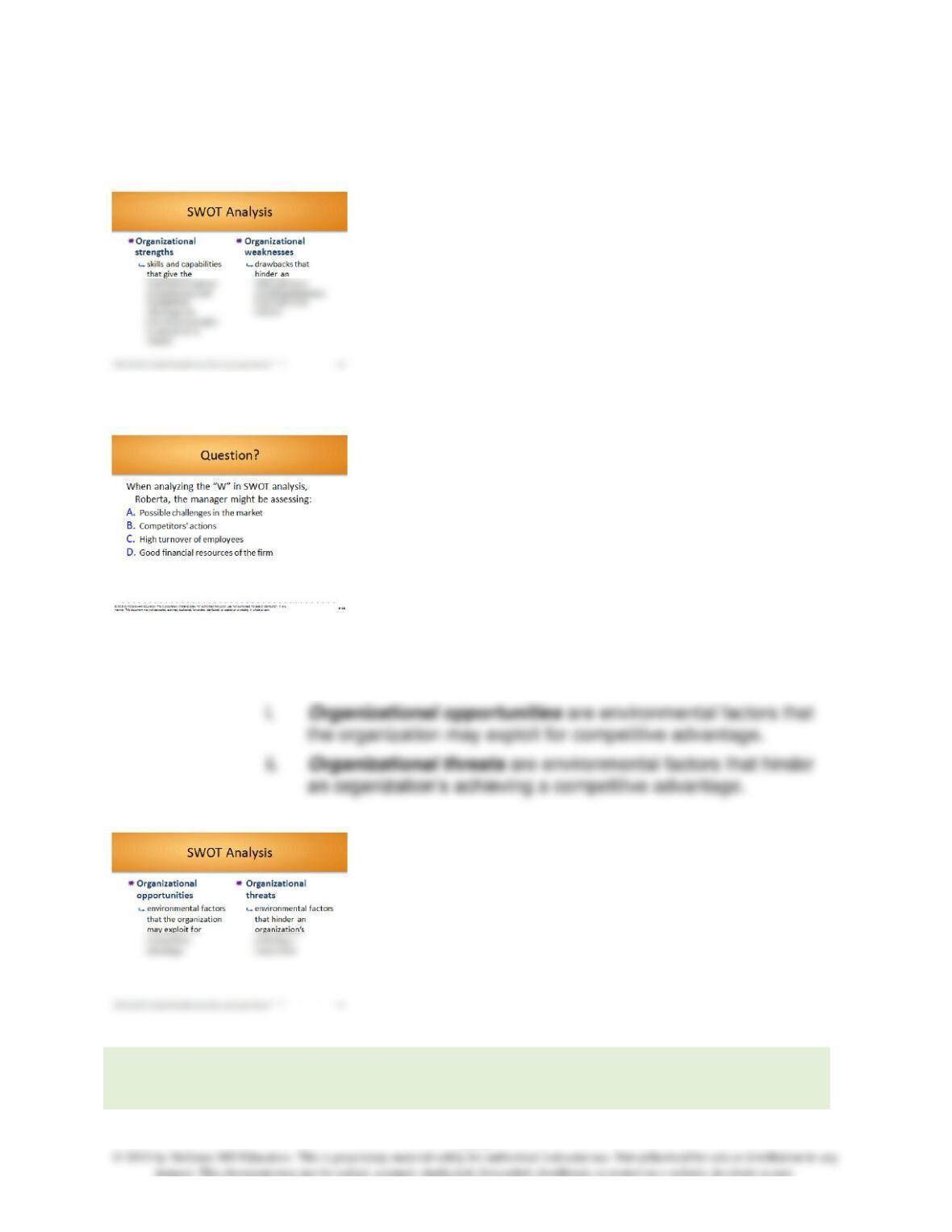
a. Inside matters involve an analysis of internal strengths and
weaknesses.
Chapter 06 – Strategic Management: How Exceptional Managers Realize a Grand Design
6-16
ii. Organizational weaknesses are the drawbacks that hinder an
organization in executing strategies in pursuit of its mission.
(Correct answer is C)
b. Outside matters involve an analysis of external opportunities and
threats.
Interactive Classroom Material:
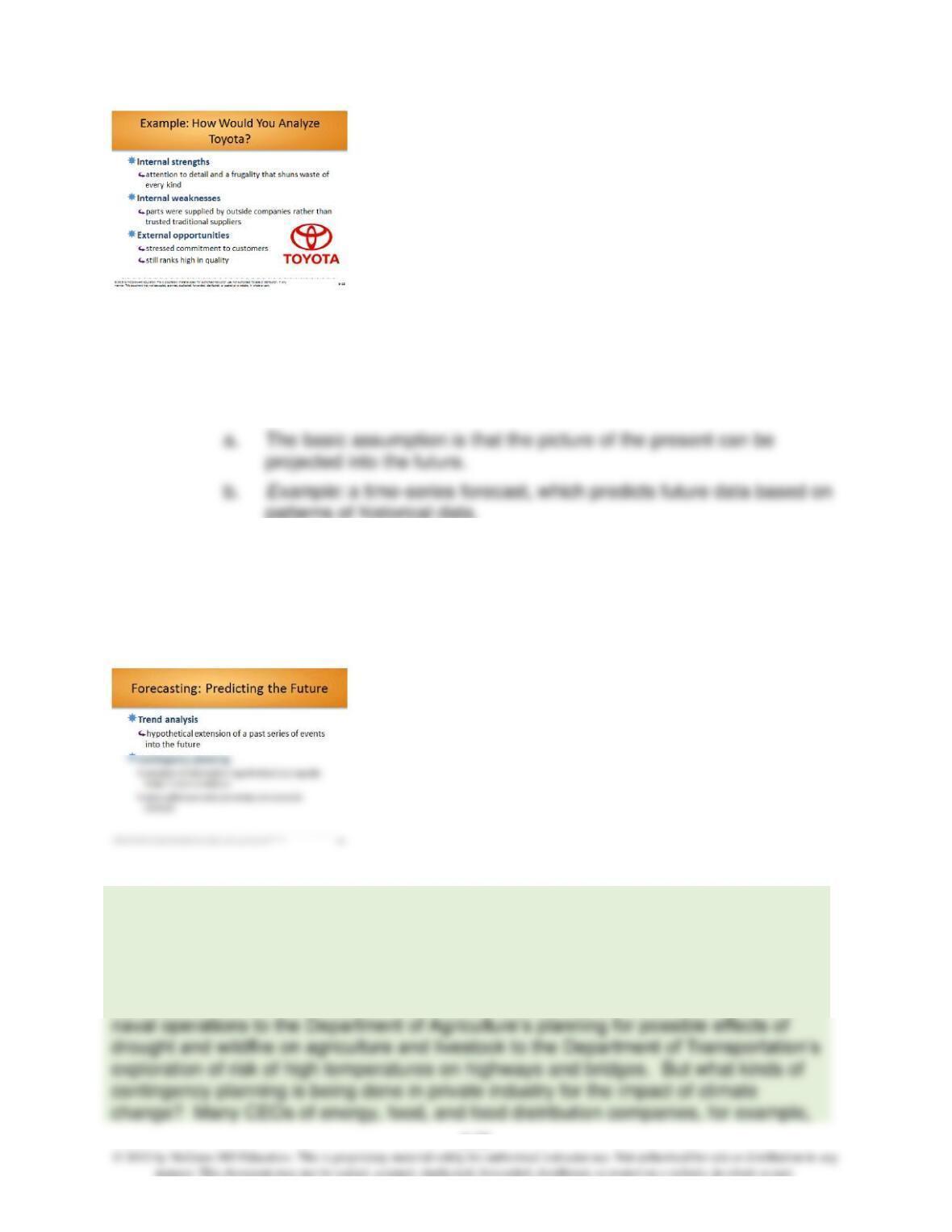
EXAMPLE: How Would You Analyze Toyota? (pp. 169-171)

Chapter 06 – Strategic Management: How Exceptional Managers Realize a Grand Design
6-17
This Example presents a sample SWOT analysis for Toyota—its Strengths,
Weaknesses, Opportunities, and Threats.
YOUR CALL
Do you agree? How well do you think Akio Toyoda is doing in dealing with
Toyota’s threats and opportunities, both internal and external?
Toyota is facing major external threats. Rivals have cut into market share; the
Great Recession damaged auto spending; natural disasters impacted plants in
Japan and Thailand; and the weak US dollar, compared to the Yen, reduced
revenues. Toyota is doing a good job focusing on its internal strengths, but should
Additional Activities:
One way to build on this Example is to have the students read the Wall Street Journal
article “Toyota Outshines Rivals in U.S. Market.” This article provides some
additional recent trends to consider for a SWOT analysis for Toyota. Consider using
the following discussion questions:
Discuss opportunities and threats for Toyota of falling gas prices.
Chapter 06 – Strategic Management: How Exceptional Managers Realize a Grand Design
6-18
C. Forecasting: Predicting the Future
1. A forecast is a vision or projecting of the future.
2. A trend analysis is a hypothetical extension of a past series of events into
the future.
patterns of historical data.
3. Contingency planning, also known as scenario planning and scenario
analysis is the creation of alternative hypothetical but equally likely future
conditions.
a. Because scenarios try to peer far into the future, they are written in
rather general terms.
Interactive Classroom Material:
EXAMPLE: Contingency Planning for Climate Change: Drought, Rain, & Fire (p.
172)
Several U.S. government agencies have launched contingency planning to prepare
for the effects of climate change—from the Navy studying the threat of rising seas to

Chapter 06 – Strategic Management: How Exceptional Managers Realize a Grand Design
6-19
YOUR CALL
Based on contingency planning for climate variability and volatility in every part
of the globe, what is the responsibility of insurance companies? Just try to
avoid catastrophic losses by raising premiums, adding exclusions, and
refusing to cover high-risk communities? Or try to educate consumers about
building more resilient structures in less risky areas?
Insurance companies are major players when it comes to such natural disasters.
For example natural catastrophes cost insurers $35 billion in privately insured
Additional Activities:
One way to build on this Example is to have the students watch the 60 Minutes
segment “Depleting the Water.” In this 14-minute video, correspondent Lesley Stahl
explores the implications of the fact the world’s groundwater is being depleted at
alarming rates. Consider using the following discussion questions:
Assume you are a business in California that is dependent on water (e.g., farmer,
D. Benchmarking: Comparing with the Best
1. Benchmarking is the process by which a company compares its
performance with that of high-performing organizations
Chapter 06 – Strategic Management: How Exceptional Managers Realize a Grand Design
E. Porter’s Five Competitive Forces
1. Porter’s model for industry analysis suggests that business-level
strategies originate in five primary competitive forces in the firm’s
environment, as follows:
a. Threats of new entrants – New competitors can affect an industry
by taking away customers from existing organizations.
b. Bargaining power of suppliers – Some companies can easily switch
suppliers, but others cannot.
SELF-ASSESSMENT 6.1 (p. 174)
Assessing Strategic Thinking
Student Questions: