Solutions for Chapter 6: Questions and Problems
CHAPTER 6
AN INTRODUCTION TO PORTFOLIO MANAGEMENT
Answers to Questions
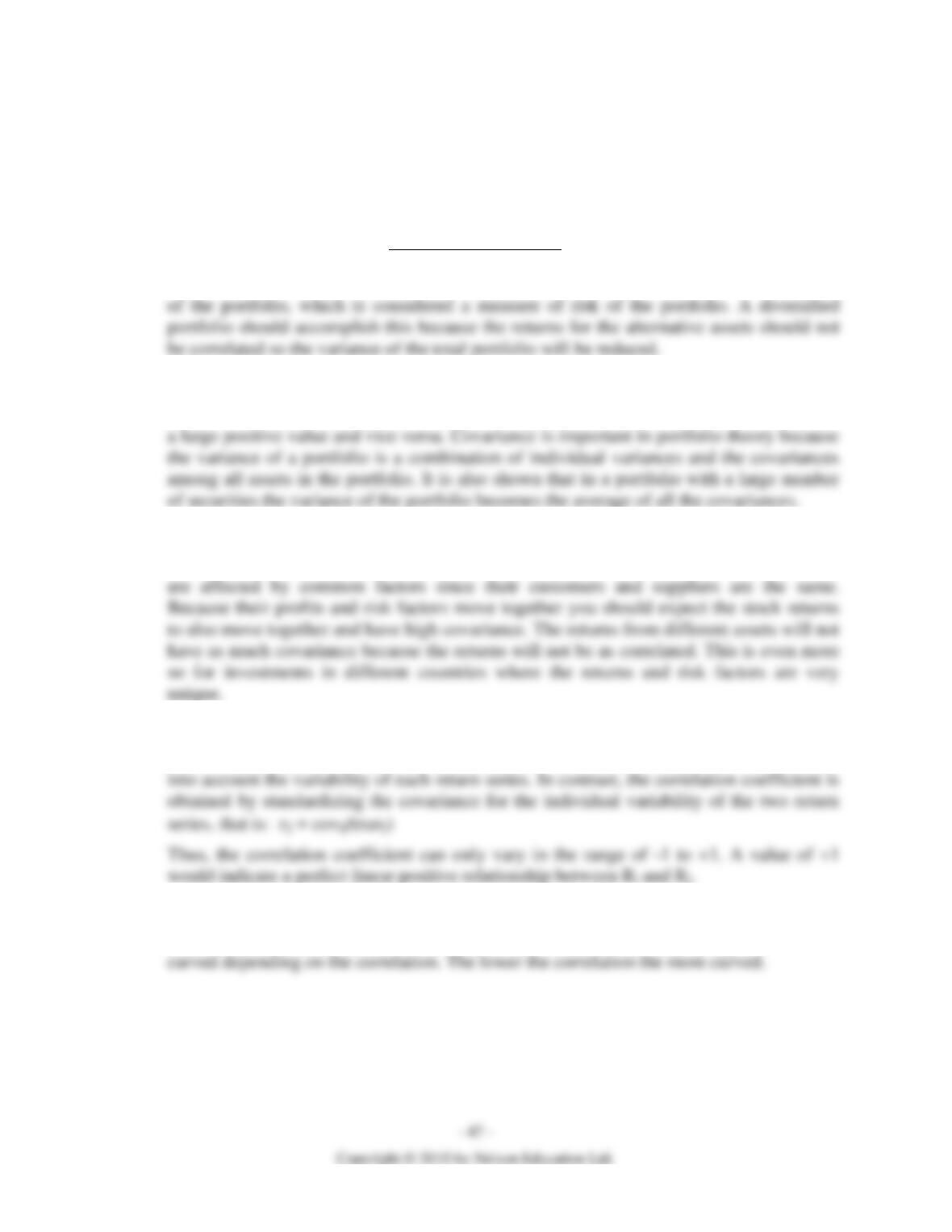
1. Investors hold diversified portfolios in order to reduce risk, that is, to lower the variance
2. The covariance is equal to E[(Ri – E(Ri))(Rj – E(Rj))] and shows the absolute amount of
comovement between two series. If they constantly move in the same direction, it will be
3. Similar assets like common stock or stock for companies in the same industry (e.g., auto
industry) will have high positive covariances because the sales and profits for the firms
4. The covariance between the returns of assets i and j is affected by the variability of these
two returns. Therefore, it is difficult to interpret the covariance figures without taking
5. The efficient frontier has a curvilinear shape because if the set of possible portfolios of
assets is not perfectly correlated the set of relations will not be a straight line, but is
Solutions for Chapter 6: Questions and Problems
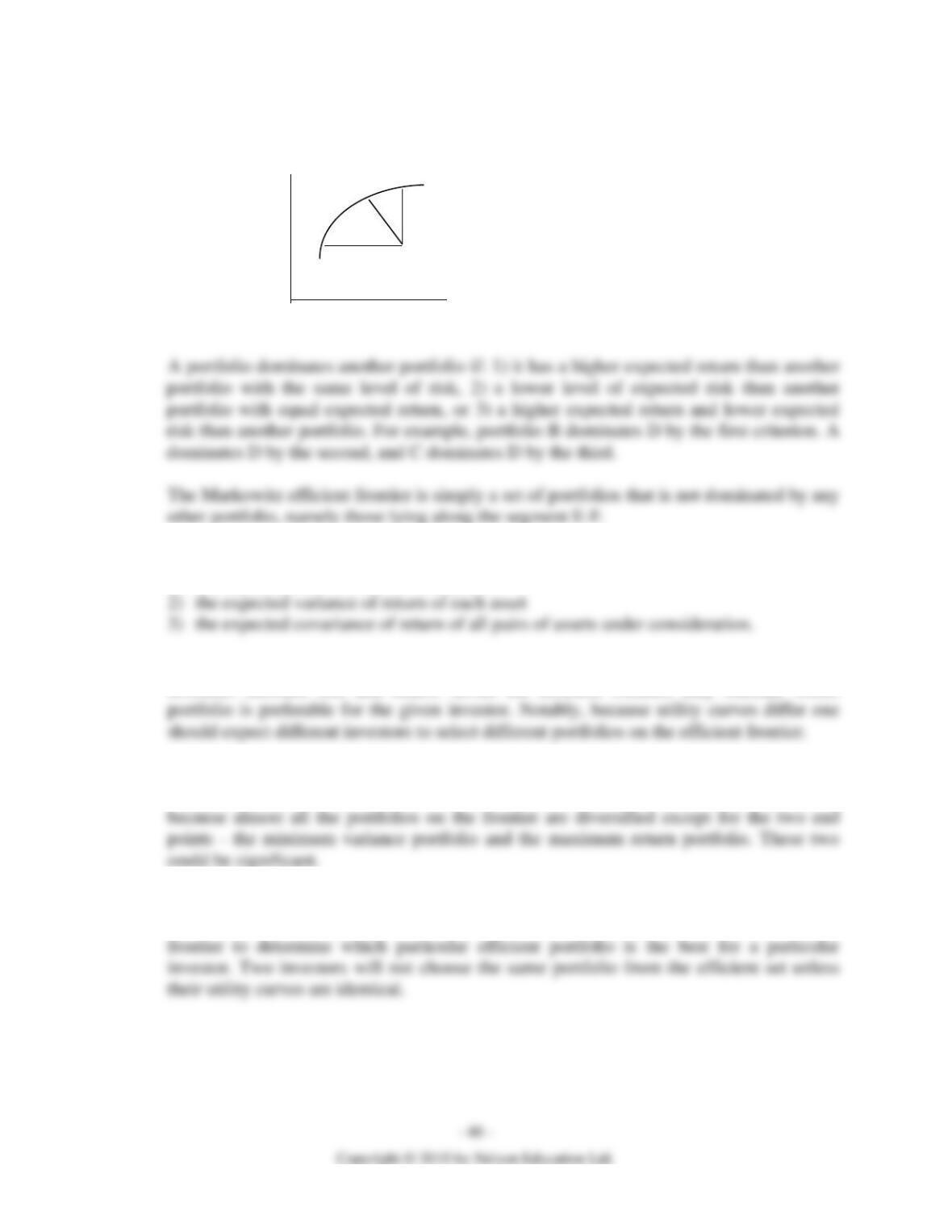
6. Expected Rate B
Of Return C F
A
D
E
Expected Risk ( of Return)
7. The necessary information for the program would be:
1) the expected rate of return of each asset
8. Investors’ utility curves are important because they indicate the desired tradeoff by
investors between risk and return. Given the efficient frontier, they indicate which
9. The optimal portfolio for a given investor is the point of tangency between his set of
utility curves and the efficient frontier. This will most likely be a diversified portfolio
10. The utility curves for an individual specify the trade-offs she is willing to make between
expected return and risk. These utility curves are used in conjunction with the efficient
Solutions for Chapter 6: Questions and Problems
– 49 –
11. The hypothetical graph of an efficient frontier of U.S. common stocks will have a curved
shape (see the graph in the answer to question 6, above). Adding U.S. bonds to the
12. The portfolio constructed containing stocks L and M would have the lowest standard
Solutions for Chapter 6: Questions and Problems
CHAPTER 6
Answers to Problems
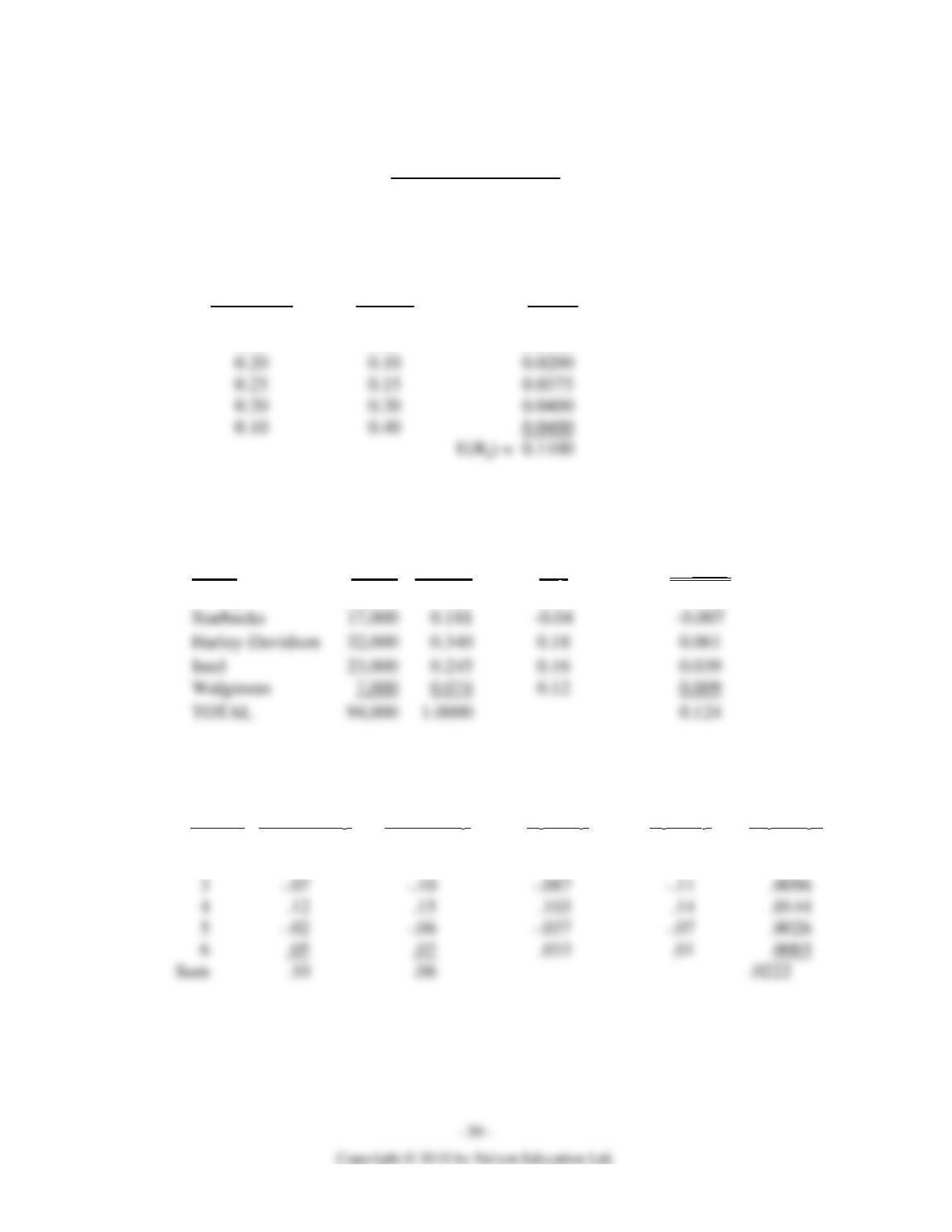
1. [E(Ri)] for Lauren Labs
Possible Expected
Probability Returns Return
0.10 -0.20 -0.0200
0.15 -0.05 -0.0075
2.
Market
Security Return
Portfolio Return
Stock
Value
Weight
(Ri)
Wi × Ri
Disney
$15,000
0.160
0.14
0.022
Starbucks
0.181
-0.04
Intel
0.245
0.16
0.039
Walgreens
0.074
0.12
0.009
TOTAL
0.124
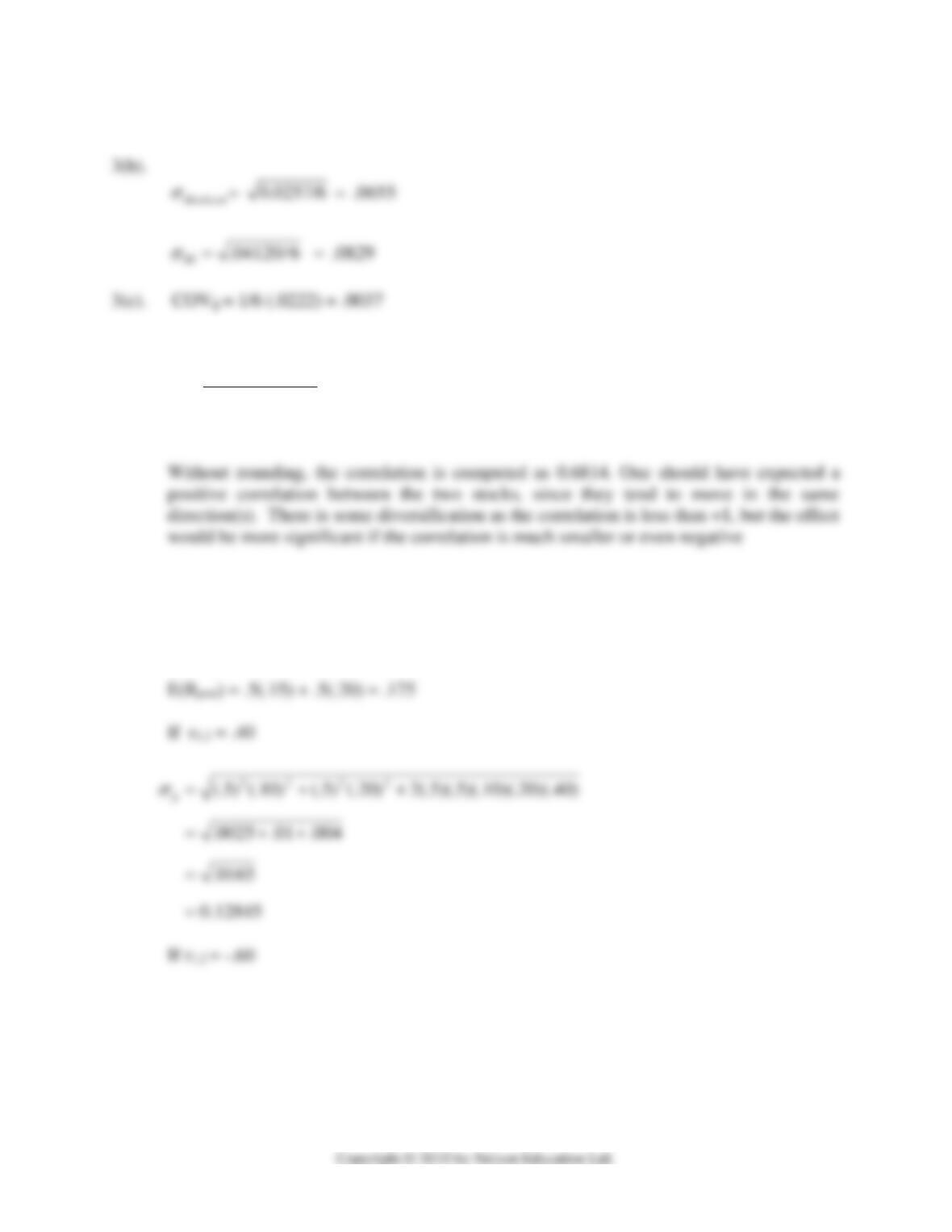
3. Sophie [Ri-E(Ri)] ×
Month Madison(Ri) Electric(Rj) Ri-E(Ri) Rj-E(Rj) [Rj-E(Rj)]
1 -.04 .07 -.057 .06 -.0034
2 .06 -.02 .043 -.03 -.0013
Solutions for Chapter 6: Questions and Problems
– 51 –
3(a). E(RMadison) = .10/6 = .0167 E(RSE) = .06/6 = .01
3(d).
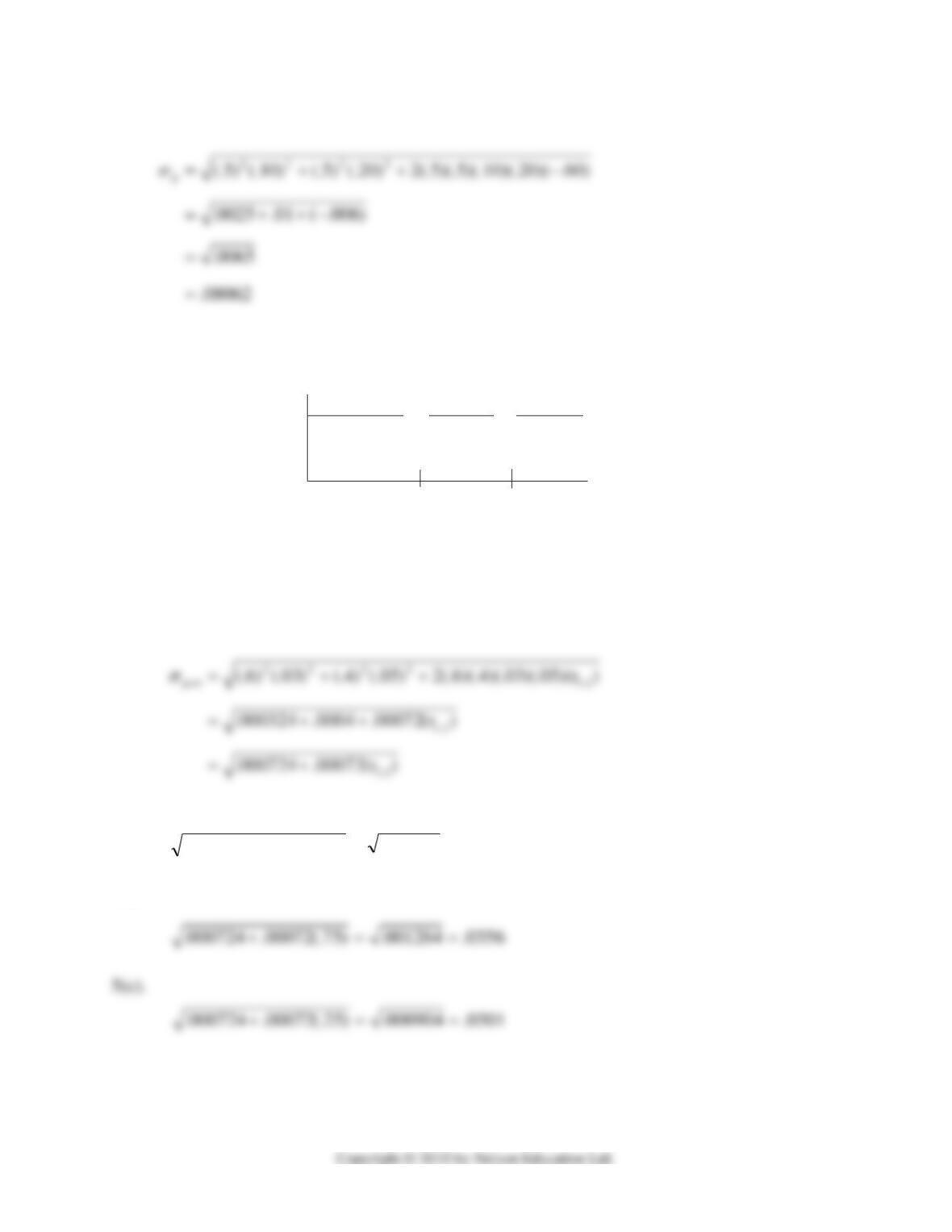
4. E(R1) = .15 E(1) = .10 w1 = .5
E(R2) = .20 E(2) = .20 w2 = .5
6814.
)0829(.)0655(.
0037.
rij
=
=
Solutions for Chapter 6: Questions and Problems
– 52 –
The negative correlation coefficient reduces risk without sacrificing return.
5. For all values of r1,2:
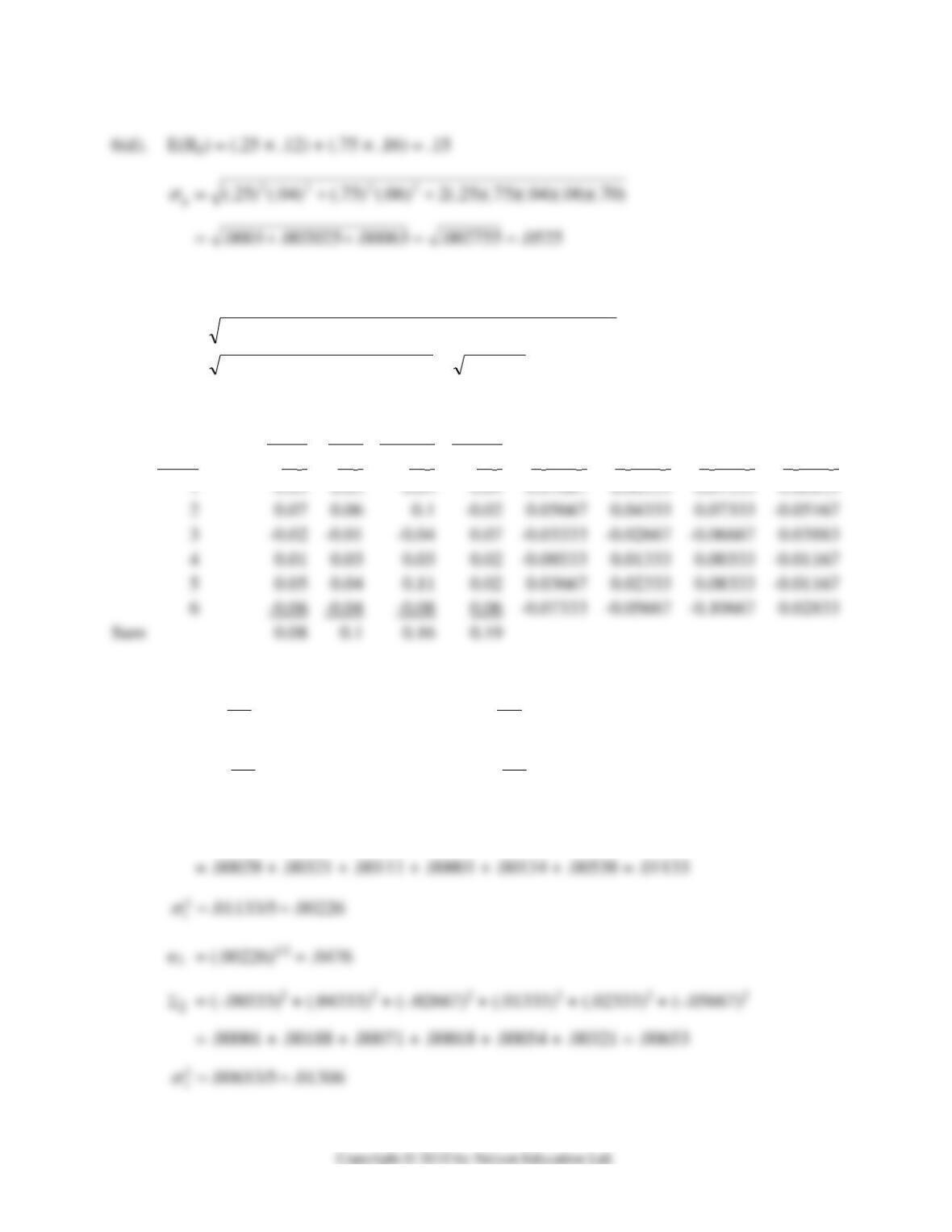
E(Rport) = (.6 × .10) + (.4 × .15) = .12
5(a).
5(b).
Expected
Return 17.5%
0
X X
8.06% 12.85% Risk (Standard deviation)
0380.001444.)0.1(00072.000724. ==+

Solutions for Chapter 6: Questions and Problems
– 53 –
5(d).
5(e).
6(a). E(Rp) = (1.00 × .12) + (.00 × .16) = .12
0269.000724.)00(.00072.000724. ==+
04.0016.000016.
)70)(.06)(.04)(.00)(.00.1(2)06(.)00(.)04(.)00.1( 2222
p
==++=
++=
Solutions for Chapter 6: Questions and Problems
– 54 –
6(e). E(Rp) = (.05 × .12) + (.95 × .16) = .158
0617.003809.00015960.003249.0004.
)70)(.06)(.04)(.95)(.05(.2)06(.)95(.)04(.)05(. 2222
p
==++=
++=
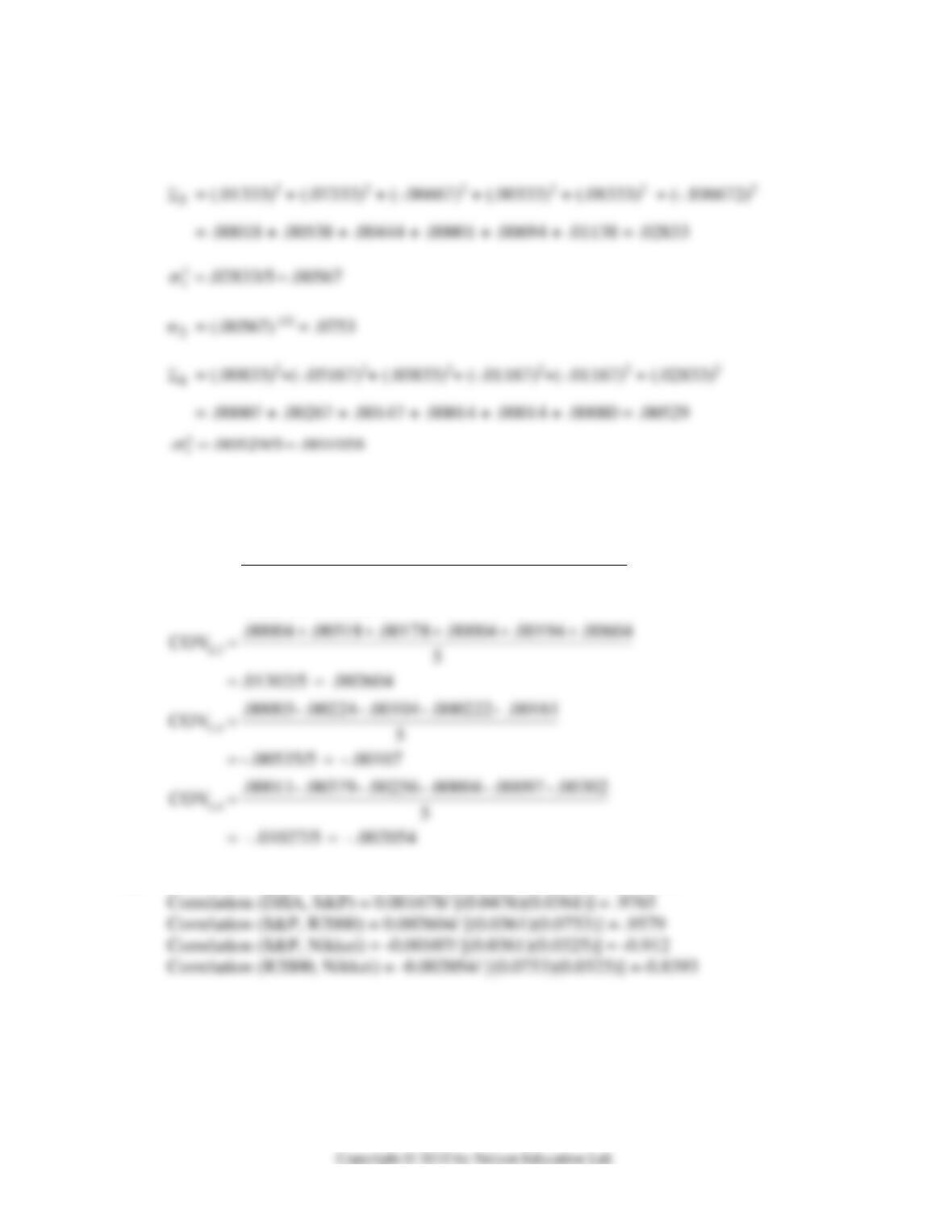
7
DJIA
S&P
Russell
Nikkei
Month
(R1)
(R2)
(R3)
(R4)
R1–E(R1)
R2–E(R2)
R3–E(R3)
R4–E(R4)
0.1
-0.05167
-0.01
-0.03333
-0.02667
-0.06667
-0.00333
-0.01167
-0.01167
-0.04
-0.07333
-0.05667
-0.10667
Sum
7(a).
7(b). 1 = (.01667)2+ (.05667)2+ (-.03333)2+ (-.00333)2+ (.03667)2 + (-.07333)2
03167.
6
.19
)E(R 02667.
6
.16
)E(R
01667.
6
.10
)E(R 01333.
6
.08
)E(R
43
21
====
====
Solutions for Chapter 6: Questions and Problems
– 55 –
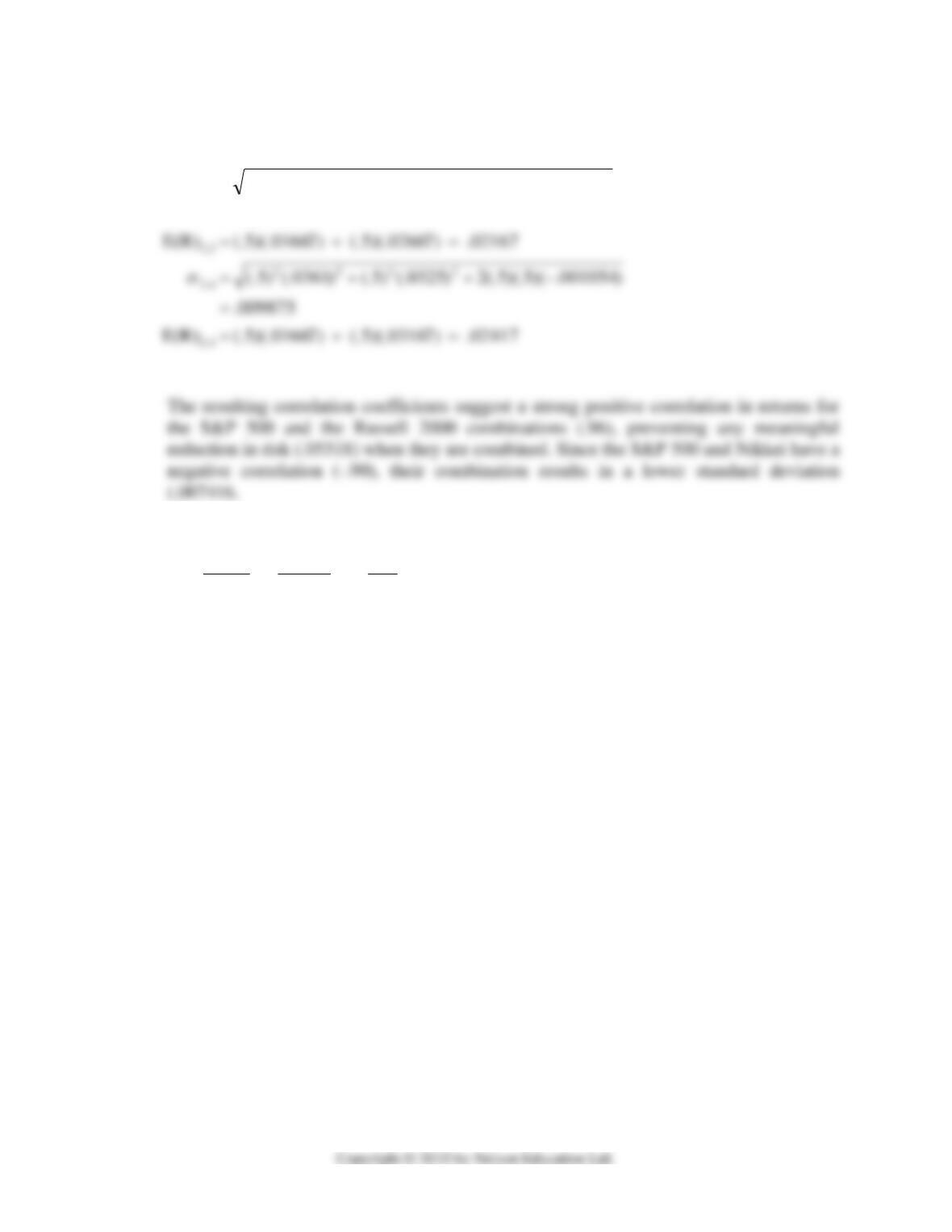
2 = (.01306)1/2 = .0361
4 = (.001058)1/2 = .0325
7(c).
7(d). Correlation equals the covariance divided by each standard deviation.
.001678 .00839/5 5
.00416 .00086 .00004 – .00089 .00246 .00006
COV
1,2
==
++++
=
Solutions for Chapter 6: Questions and Problems
– 56 –
7(e).
8.
007416.
)00107.)(5)(.5(.2)0753(.)5(.)0361(.(.5)
2222
2,3
=
−++=
0.3759
266
100
14 x 19
100
Cov
r
ji
ji,
ji, ====
Solutions for Chapter 6: Questions and Problems
– 57 –
APPENDIX 6
Answers to Problems
Appendix A: Proof that Minimum Portfolio Variance Occurs with Equal Weights when
Securities Have Equal Variance
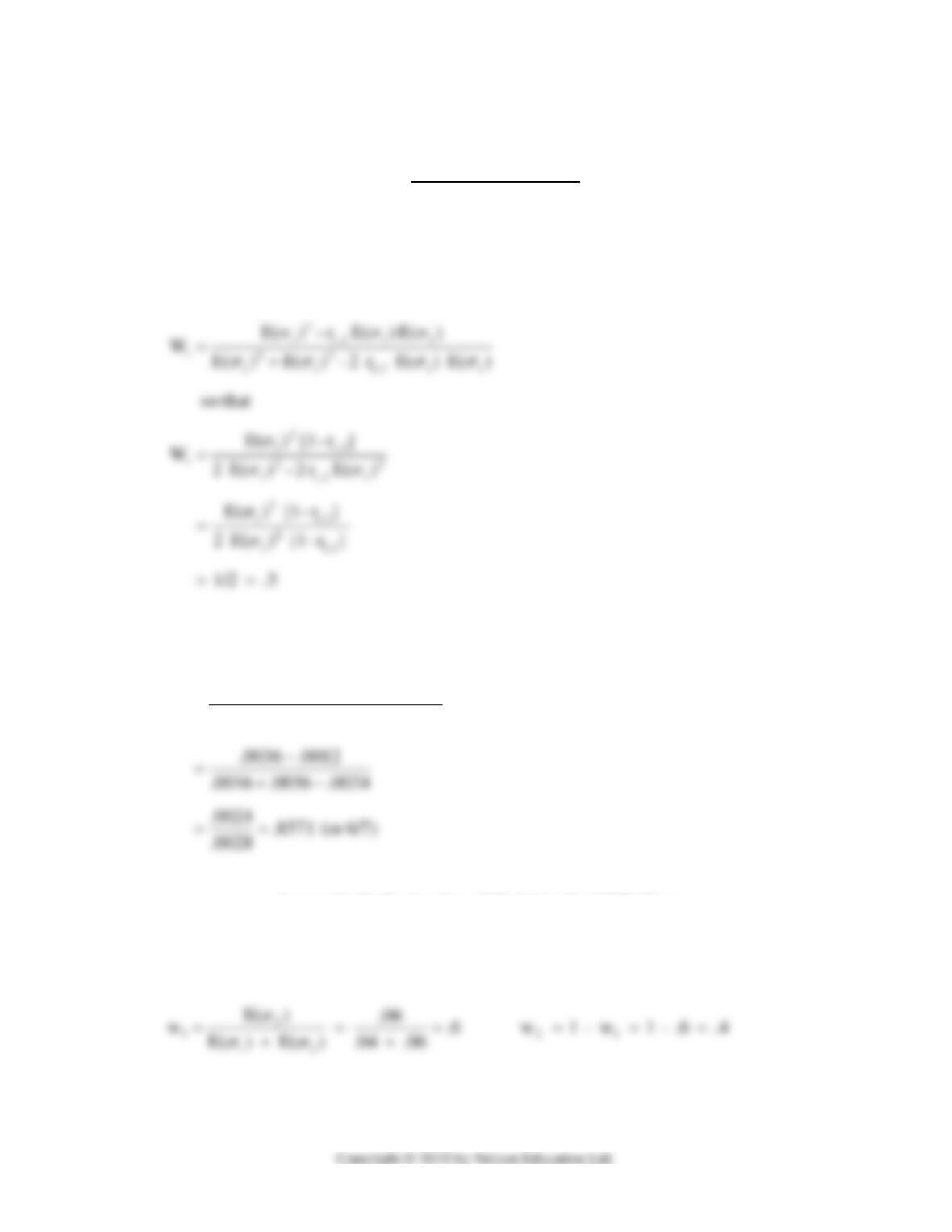
1(a). When E(1) = E(2), the problem can be solved by substitution,
1(b).
Appendix B: Derivation of Weights that Will Give
Zero Variance when Corrleation Equals -1.00
Variance of the portfolio is zero when:
)06)(.04)(.5(.2)06(.)04(.
)06)(.04)(.5(.(.06)
W 22
2
1
−+
−
=