Chapter 06 – Planning, Strategy, and Competitive Advantage
6-17
Lecturer Enhancer 6.1
THE IMPORTANCE OF MISSION STATEMENTS
Mission statements can be defined as “enduring statements of purpose that distinguish one organization
p. 11.
Lecturer Enhancer 6.2
SCENARIO PLANNING
Consider the horrors of 9/11 and the anthrax scares that followed, the Enron scandal, and the economic
jitters caused by heightened tensions in the Middle East. Each of these occurrences has contributed
significantly to the turbulence of the current business environment. If scenario planning was unable to
help managers foresee and prepare for these specific developments, does that mean that it should be
discredited as a managerial activity? Not if you understand what scenario planning is designed to do,
LECTURE ENHANCERS
Chapter 06 – Planning, Strategy, and Competitive Advantage
6-18
Below are a few examples of companies that have engaged in scenario planning. Past events have taught
them to prepare for the future by envisioning a variety of paths that may need to be traveled, given the
uncertainty in which we all live.
WHAT IF your risk profile shifts dramatically? U.S. insurers rethought risk-sharing in the wake of 1992’s
Hurricane Andrew, which caused a then-record $16.8 billion in losses. Primary insurers (think Allstate)
began to share risk more broadly among themselves and sell off more to reinsurers (think Lloyds of
WHAT IF demand suddenly falls off? How can a company quickly find allies who could help it
consolidate the industry and save jobs? Arrow Electronics (Melville, N.Y.), a distributor of electronic
WHAT IF global events disrupt your supply chain? Compare General Motors’ plight in the days after
September 11th to Dell’s. GM had to close down factories in Ontario due to parts delays at the Canadian
WHAT IF prices drop precipitously? The high-cost producer sets the price during boom times, and most
competitors make money. In difficult times, the low-cost producer sets the price, thereby controlling the
level of competitors’ profit margins. Intel has cut
Adapted from “Five Reasons why You Still Need Scenario Planning,” Harvard Management Update,
June 2002 and “How to Think Strategically in a Recession, Harvard Management Update, November
2001
Notes for Topics for Discussion and Action
DISCUSSION
MANAGEMENT IN ACTION
Chapter 06 – Planning, Strategy, and Competitive Advantage
6-19
The first step in planning involves determining the organization’s mission and goals. The second step is
2. What is the relationship among corporate-, business-, and functional-level strategies, and how do they
create value for an organization?
3. Pick an industry and identify four companies in the industry that pursue one of the four main business-
level strategies (low-cost, focused low-cost, etc.).
4. What is the difference between vertical integration and related diversification?
ACTION
6. Ask a manager about the kinds of planning exercises he or she regularly uses. What are the purposes of
these exercises, and what are their advantages or disadvantages?
Chapter 06 – Planning, Strategy, and Competitive Advantage
6-20
Copyright © 2017 McGraw-Hill Education. All rights reserved. No reproduction or distribution without the prior written consent of McGraw-Hill
Education.
Michael Porter created the Five Forces Model to help managers identify forces in the environment that are
potential threats. He identified five principal factors that are major threats because they affect how much
profit organizations competing with the same industry can expect to make. These five forces include:
1. The level of rivalry among organizations in an industry
3. The power of the suppliers
5. Substitute products.
7. Ask a manager to identify the corporate- and business-level strategies used by his or her organization.
(Note to Instructors: Students’ answers should include the following information.)
A corporate-level strategy is a plan of action concerning which industries and countries an organization
should invest its resources in to achieve its mission and goals. Corporate-level strategies that managers
use include: (1) concentration on a single business, (2) diversification, (3) international expansion, and (4)
vertical integration.
AACSB: Analytic
How to Analyze a Company’s Strategy
Pick a well-known business organization that has received recent press coverage and that provides its
annual reports at its Web site. From the information in the articles and annual reports, answer these
questions:
(Note to Instructors: Prior to assigning this activity, it would be beneficial to ensure that your
institution’s library maintains ten years of stockholder reports. Otherwise, it could be an extremely time
consuming process for your students to track down this information. An alternative is to reduce the length
of time covered by the assignment. Students’ answers will vary based on the company that they have
chosen.)
1. What is (are) the main industry(ies) in which the company competes ?
BUILDING MANAGEMENT SKILLS
6-21
2. What business-level strategy does the company seem to be pursuing in this industry? Why?
3. What corporate level strategies is the company pursuing? Why?
4. Have there been any major changes in its strategy recently? Why?
AACSB: Analytic
1. Either by yourself or in a group, decide if this business practice of paying bribes is ethical or unethical.
In a market economy, it is assumed that an organization’s ability to generate revenue is the result of its
2. Should IBM allow its foreign divisions to pay bribes if all other companies are doing so?
3. If bribery is common in a particular country, what effect would this likely have on the nation’s
economy and culture?
MANAGING ETHICALLY
Chapter 06 – Planning, Strategy, and Competitive Advantage
6-22
Bribery by its competitors, according to one U.S. government study, cost American business $11 billion
in a single year. In Germany, a legislator estimated that companies in his nation spend as much as $5.6
billion a year on bribes. Clearly, the diversion of such a large amount of any nation’s resources from its
production efforts creates inefficiency in its economy and is therefore counterproductive to growth.
Bribery also encourages a creeping erosion of honesty, trust, and other human values that rest at the
foundation of a healthy culture.
AACSB: Analytic
AACSB: Reflective Thinking
Low Cost or Differentiation?
1. Using SWOT analysis, analyze the pros and cons of each alternative.
A. Option #1: Buy abroad, lower prices, and pursue low cost strategy.
PROS:
We can effectively compete with the threats of Target and Wal-Mart, focus upon attracting a larger
volume of customers, and thereby increase our market share. Also, relationships we build with foreign
CONS:
A great deal of time must first be devoted to research, if this strategy is to be implemented effectively. To
make our low-cost clothing into a strength, we must first identify a reliable foreign manufacturer capable
of producing high quality clothing at a lower cost. We must then build a relationship with them and
determine a way of maintaining control over a manufacturing process that is occurring in a distant part of
Option #2: Differentiate and concentrate on high end of market.
PROS:
We can effectively compete with the threat of mall boutiques that are stealing our high-end customers.
We can charge premium prices and justify them with the superior quality of our products, thereby
CONS:
SMALL GROUP BREAKOUT EXERCISE
Chapter 06 – Planning, Strategy, and Competitive Advantage
6-23
This strategy is expensive. To make high-end clothing into a strength, we will have to increase spending
on product design or R&D to differentiate their product, forcing costs upward as a result. We must spend
more money on advertising, in an attempt to create a unique image for our store. In addition, it may prove
difficult to develop a competitive advantage that allows the consumer to perceive us as superior and
Option #3: Pursue a low cost and differentiation strategy.
PROS:
The ability to pursue both strategies simultaneously will result in maximum profitability, since we can
justify premium pricing while also enjoying low costs. Also, we can attract two very different categories
CONS:
We may be courting disaster, since it is very difficult to pursue both of these strategies at the same time.
Very few companies have successfully done so. Differentiation usually causes costs to rise, which makes
2. Think about the various clothing retailers in your local malls and city, and analyze the choices they
have made about how to compete with one another along the f low cost and differentiation dimensions.
One way high-end retailers attempt to differentiate themselves is by providing a great deal of customer
service. Salespersons are always available to assist customers and answer their questions. Their return
policy is usually very liberal. Other examples of personalized customer service include keeping track of
AACSB: Reflective Thinking
Questions
1. List the supermarket chains in your city and identify their strengths and weaknesses.
BE THE MANAGER
Chapter 06 – Planning, Strategy, and Competitive Advantage
6-24
Copyright © 2017 McGraw-Hill Education. All rights reserved. No reproduction or distribution without the prior written consent of McGraw-Hill
Education.
Answers to this question will vary, depending upon the area of the country in which the students reside
and the size of the local shopping area. You could recommend using a SWOT approach to compare the
various each of the competitors in your specific area. This industry has many different types of
competitors, ranging from mass merchandisers such as Meijers and Kmart to small mom-and-pop grocers
and farmers’ markets. After identifying all of the competitors, students can begin analysis of each using
the planning tools presented in the chapter.
2. What business-level strategies are these supermarkets currently pursuing?
3. What kind of supermarket would do best against the competition? What kind of business-level strategy
should it pursue?
AACSB: Analytic
Case Synopsis: Microsoft CEO Satya Nadella Looks to Future Beyond Windows
Microsoft had come to be perceived as an out-of-touch behemoth that relied too much on its
Windows operating system and failed to move into new markets, like mobile. The company’s
new CEO, Satya Nadella, has aggressively looked outside of Windows to develop new business
models. Since December, Microsoft has bought two small companies that focus on mobile
productivity apps. In Nadella’s first year, Microsoft stock rose 14 percent, and sales increased 12
percent. Also, the new CEO, unlike his predecessor Steve Ballmer, is popular with investors,
venture capitalists, and startups.
Nadella uses the Power BI dashboard to track and compile huge amounts of information on
product usage and financial performance to see what works and what doesn’t. Nadella also
measures and coordinates executive performance with metrics from the dashboard. Nadella has
also changed the way engineering teams are structured, eliminating testers to speed up software
releases and adding data scientists and designers to the teams.
BLOOMBERG BUSINESSWEEK CASE IN THE NEWS
Chapter 06 – Planning, Strategy, and Competitive Advantage
6-25
Questions
1. What kind of planning missteps helped cause Microsoft’s decline over the past few years?
2. How is Nadella trying to eliminate some of the bureaucracy that has hurt the company’s
ability to innovate?
3. What business strategies has Nadella implemented that will help revitalize the technology
giant?
AACSB: Analytic
Project Management: Steering the Committee
SUPPLEMENTAL FEATURES
MANAGER’S HOT SEAT (MHS)
Chapter 06 – Planning, Strategy, and Competitive Advantage
6-26
These Instructor’s PowerPoint slides can be used to supplement the lecture material.
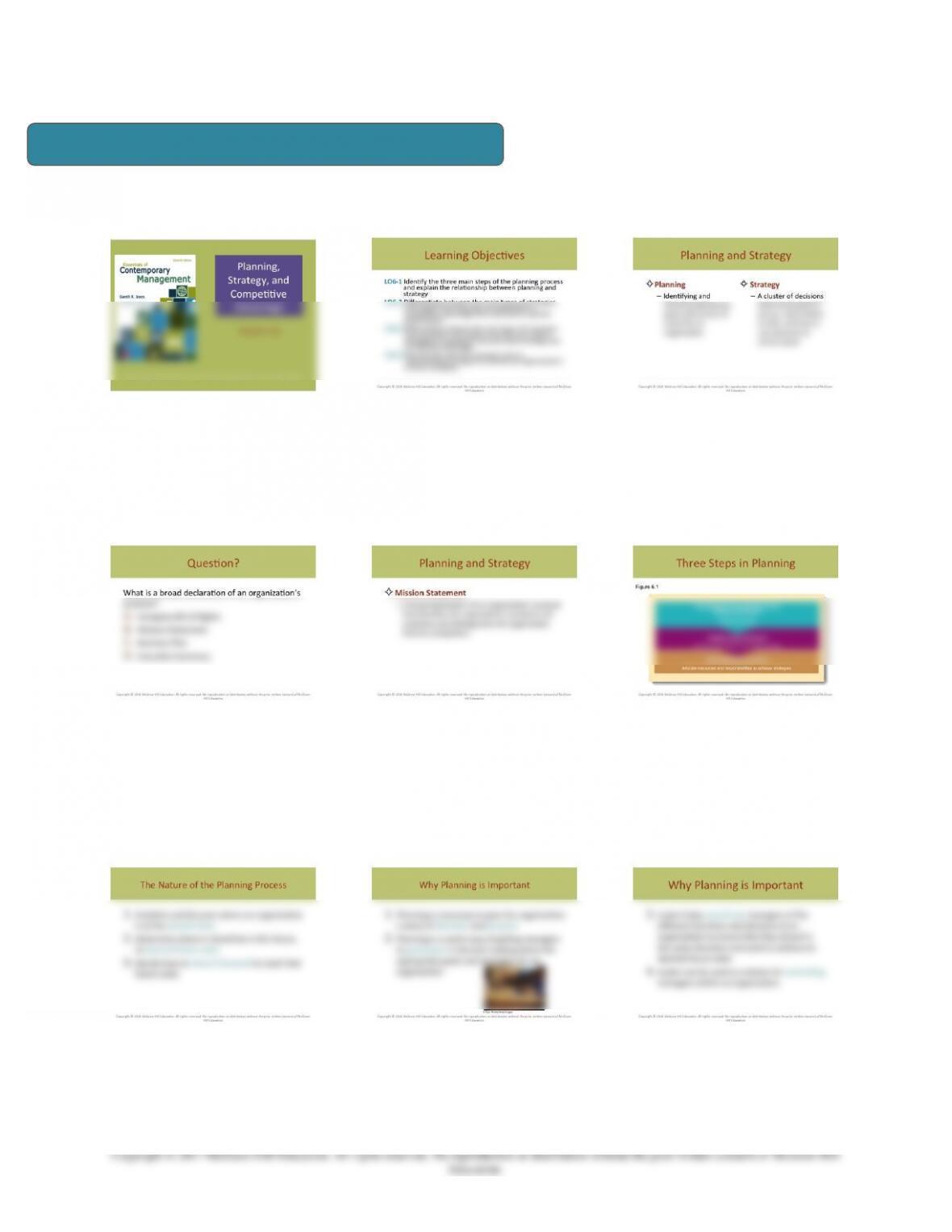
INSTRUCTOR’S
POWERPOINT SLIDE 1
Chapter Title
INSTRUCTOR’S
POWERPOINT SLIDE 2
Learning Objectives
INSTRUCTOR’S
POWERPOINT SLIDE 3
Planning and Strategy
INSTRUCTOR’S
POWERPOINT SLIDE 4
Question?
INSTRUCTOR’S
POWERPOINT SLIDE 5
Mission Statement
INSTRUCTOR’S
POWERPOINT SLIDE 6
Figure 6.1 – Three Steps in
Planning
INSTRUCTOR’S
POWERPOINT SLIDE 7
Why Planning is Important
INSTRUCTOR’S
POWERPOINT SLIDE 8
Why Planning is Important
INSTRUCTOR’S
POWERPOINT SLIDE 9
Why Planning is Important
INSTRUCTOR’S POWERPOINT SLIDES
Chapter 06 – Planning, Strategy, and Competitive Advantage
6-27
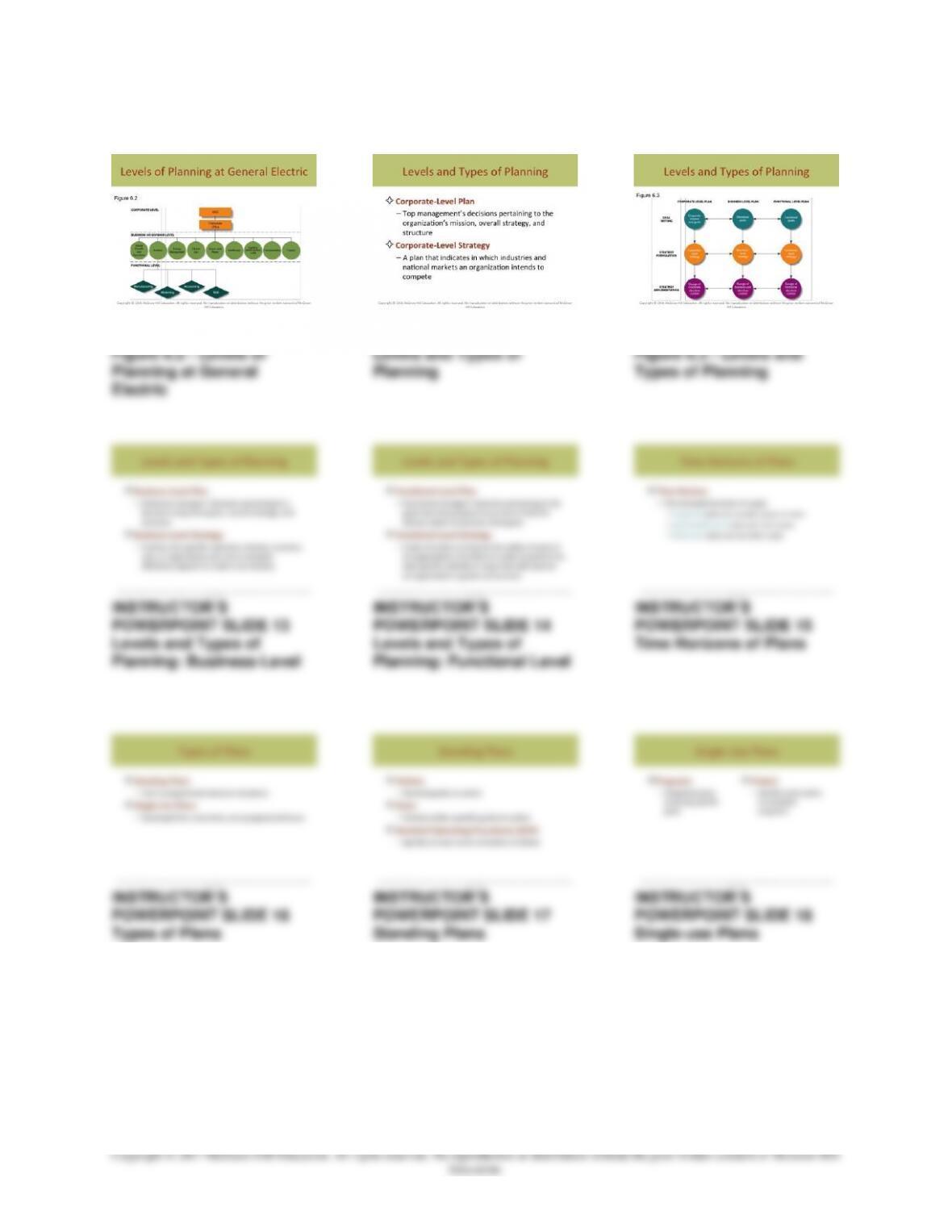
INSTRUCTOR’S
POWERPOINT SLIDE 10
INSTRUCTOR’S
POWERPOINT SLIDE 11
INSTRUCTOR’S
POWERPOINT SLIDE 12
Chapter 06 – Planning, Strategy, and Competitive Advantage
6-28
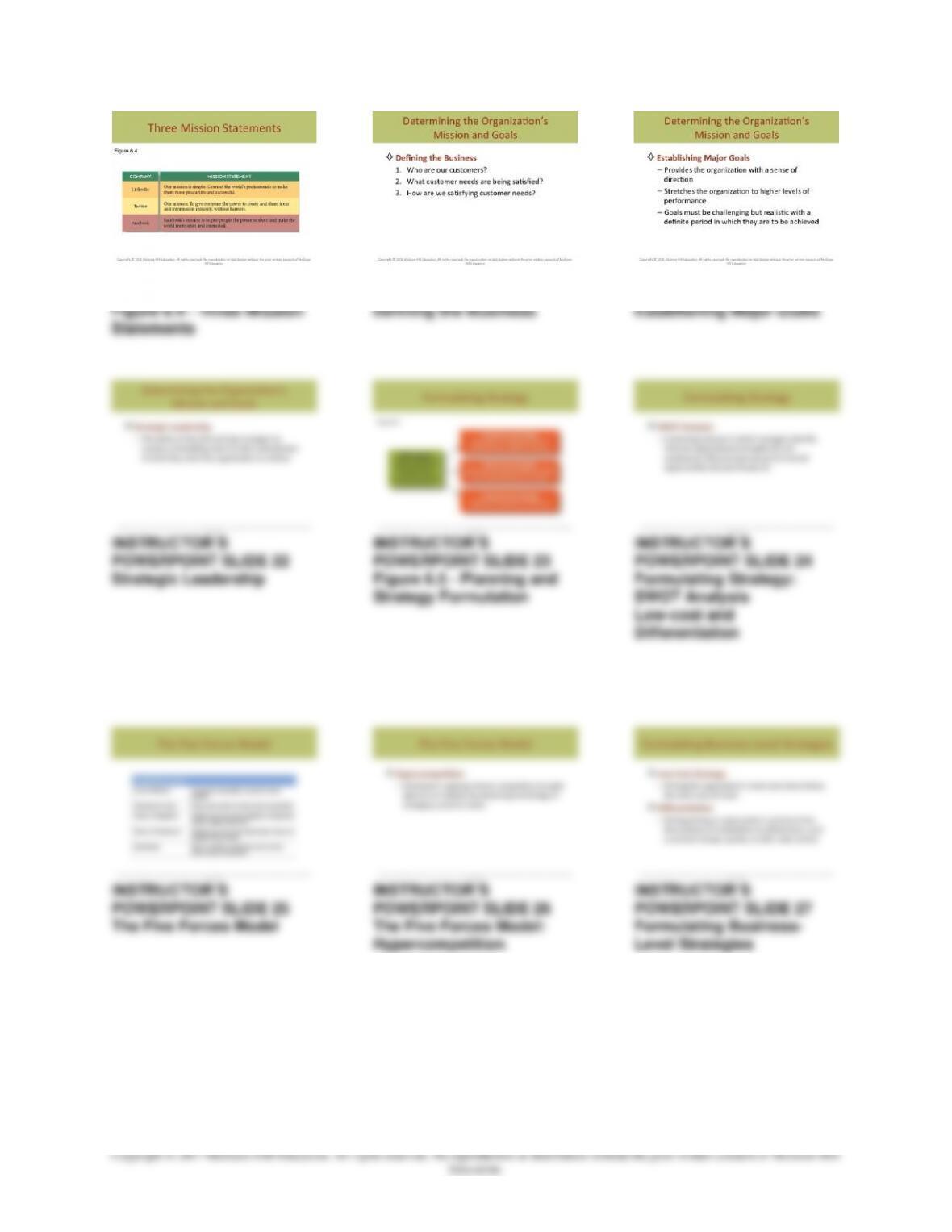
INSTRUCTOR’S
POWERPOINT SLIDE 19
INSTRUCTOR’S
POWERPOINT SLIDE 20
INSTRUCTOR’S
POWERPOINT SLIDE 21
Chapter 06 – Planning, Strategy, and Competitive Advantage
6-29
INSTRUCTOR’S
POWERPOINT SLIDE 28
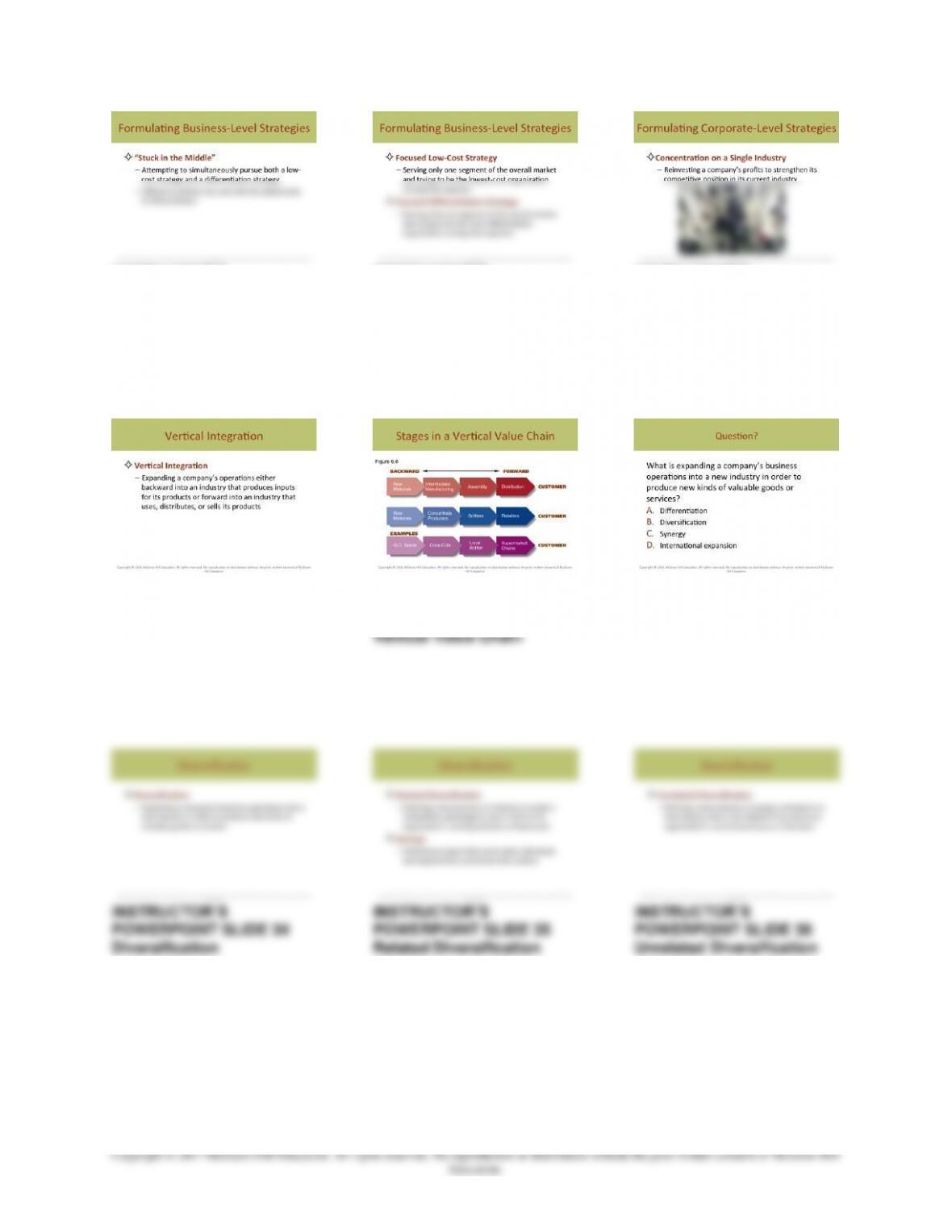
“Stuck in the Middle”
INSTRUCTOR’S
POWERPOINT SLIDE 29
Focused Low-cost and
Focused Differentiation
Strategy
INSTRUCTOR’S
POWERPOINT SLIDE 30
Formulating Corporate–
Level Strategies
INSTRUCTOR’S
POWERPOINT SLIDE 31
Vertical Integration
INSTRUCTOR’S
POWERPOINT SLIDE 32
Figure 6.6 – Stages in a
INSTRUCTOR’S
POWERPOINT SLIDE 33
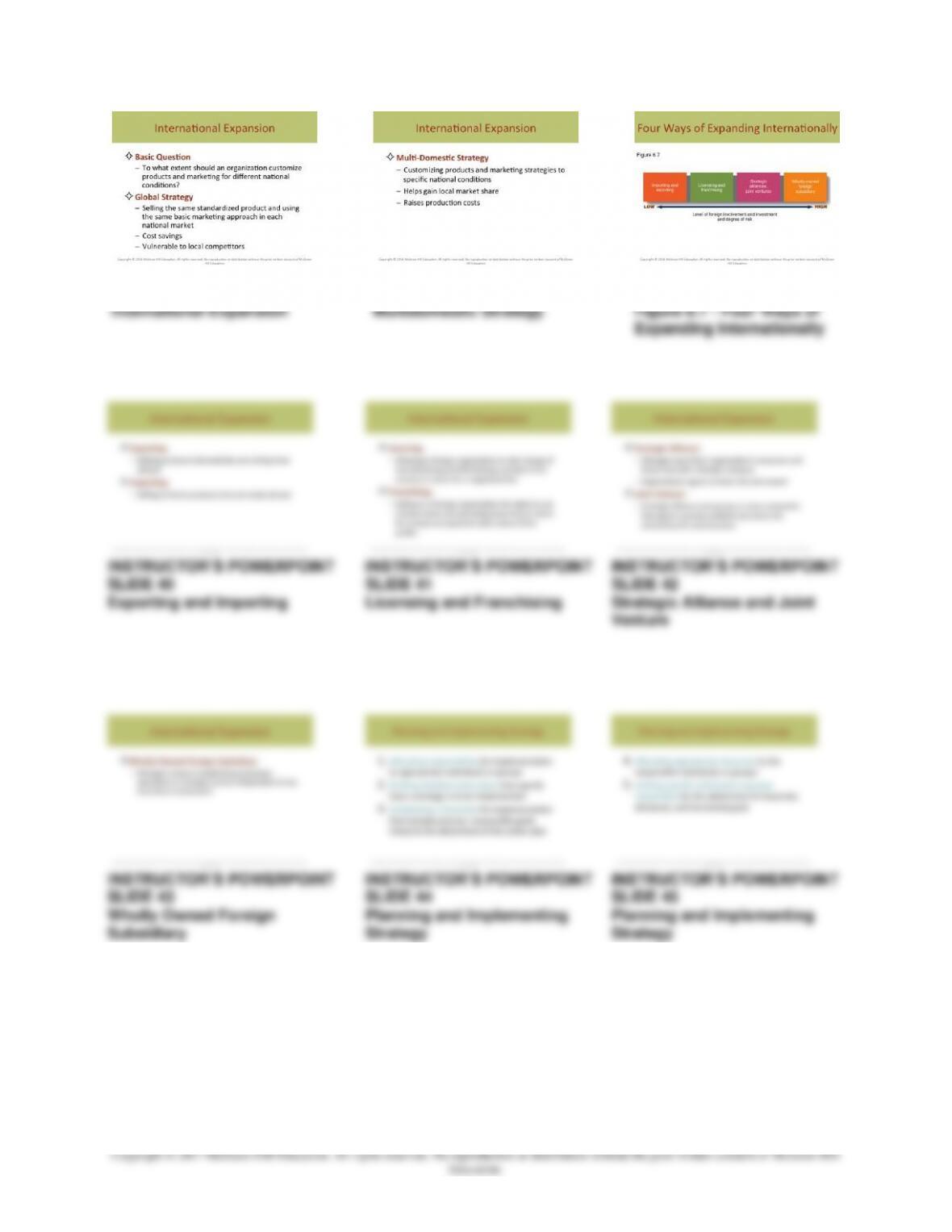
Question?Global Strategy
Chapter 06 – Planning, Strategy, and Competitive Advantage
INSTRUCTOR’S
POWERPOINT SLIDE 37
INSTRUCTOR’S
POWERPOINT SLIDE 38
INSTRUCTOR’S
POWERPOINT SLIDE 39
Chapter 06 – Planning, Strategy, and Competitive Advantage
INSTRUCTOR’S POWERPOINT
SLIDE 46
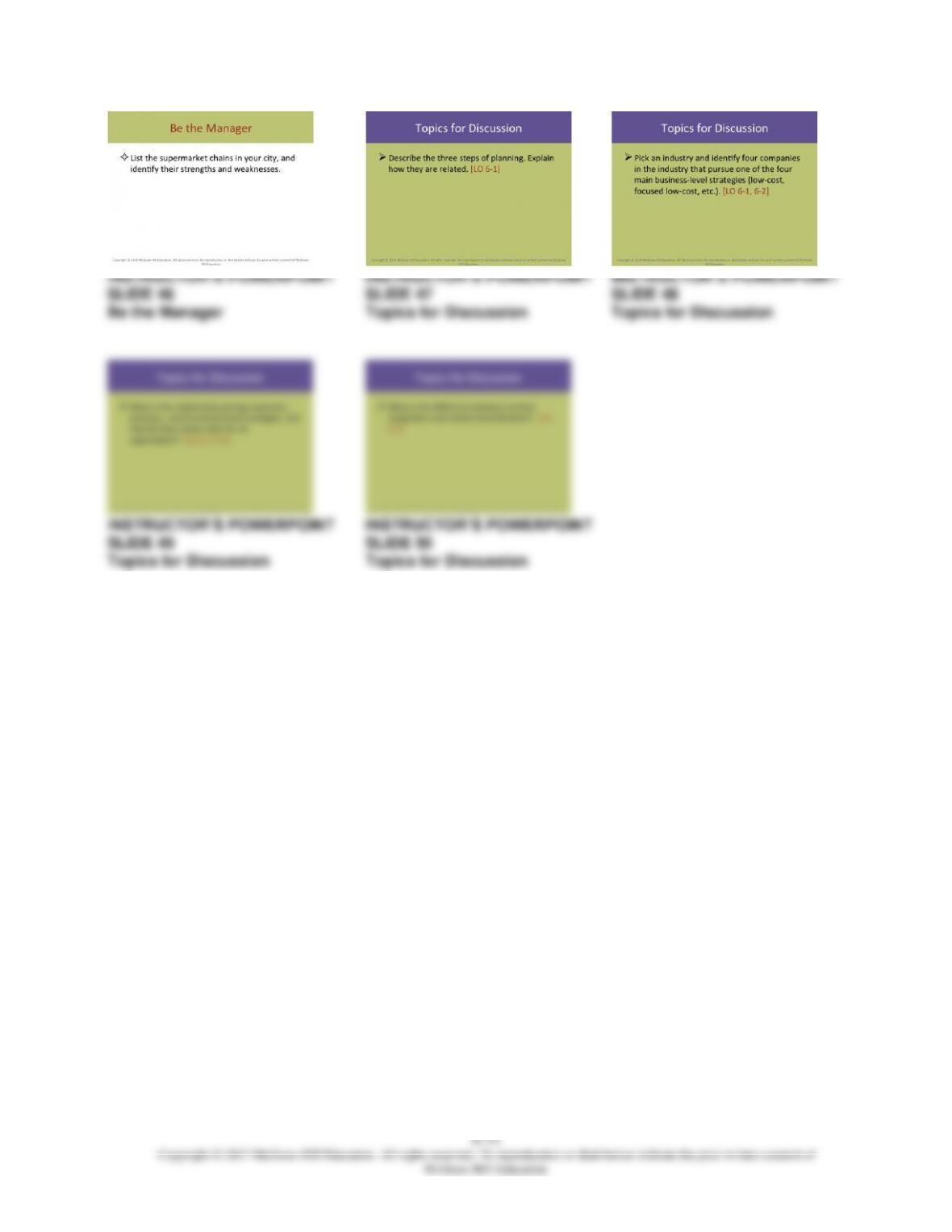
Be the Manager
INSTRUCTOR’S POWERPOINT
SLIDE 47
Topics for Discussion
INSTRUCTOR’S POWERPOINT
SLIDE 48
Topics for Discussion
INSTRUCTOR’S POWERPOINT
SLIDE 49
Topics for Discussion
INSTRUCTOR’S POWERPOINT
SLIDE 50
Topics for Discussion