Instructor’s Manual
6-1
CHAPTER SIX
Cost-Volume-Profit Analysis
This chapter discusses a set of tools that focus on the distinction between
fixed and variable costs. These tools include measures of a company’s
Key Concepts
• The contribution margin income statement is structured to emphasize
cost behavior as opposed to cost function.
• The contribution margin per unit and the contribution margin ratio will
• The payment of income taxes is an important variable in target profit
and other CVP decisions if managers are to understand the bottom-
line effect of their decisions.
Learning Objectives
LO1— Use the contribution margin in its various forms to determine the impact of
changes in sales on income.
LO4— Analyze target profit before and after the impact of income tax.
Instructor’s Manual
6-2
Lecture Outline
A. Introduction
1. Cost-volume-profit (CVP) analysis focuses on the relationship
among the following five factors and the overall profitability of a
company:
o The prices of products or services
2. The major assumptions of CVP analysis are as follows:
o The selling price is constant throughout the entire relevant
range.
o Costs are linear throughout the relevant range.
sold.
B. The Contribution Margin and its Uses (LO1)
A traditional income statement focuses on function (product costs versus
period costs) in calculating the cost of goods sold and gross profit (the
difference between sales and cost of goods sold). The contribution margin
income statement is structured by behavior rather than function.
Contribution margin is the difference between sales and variable costs.
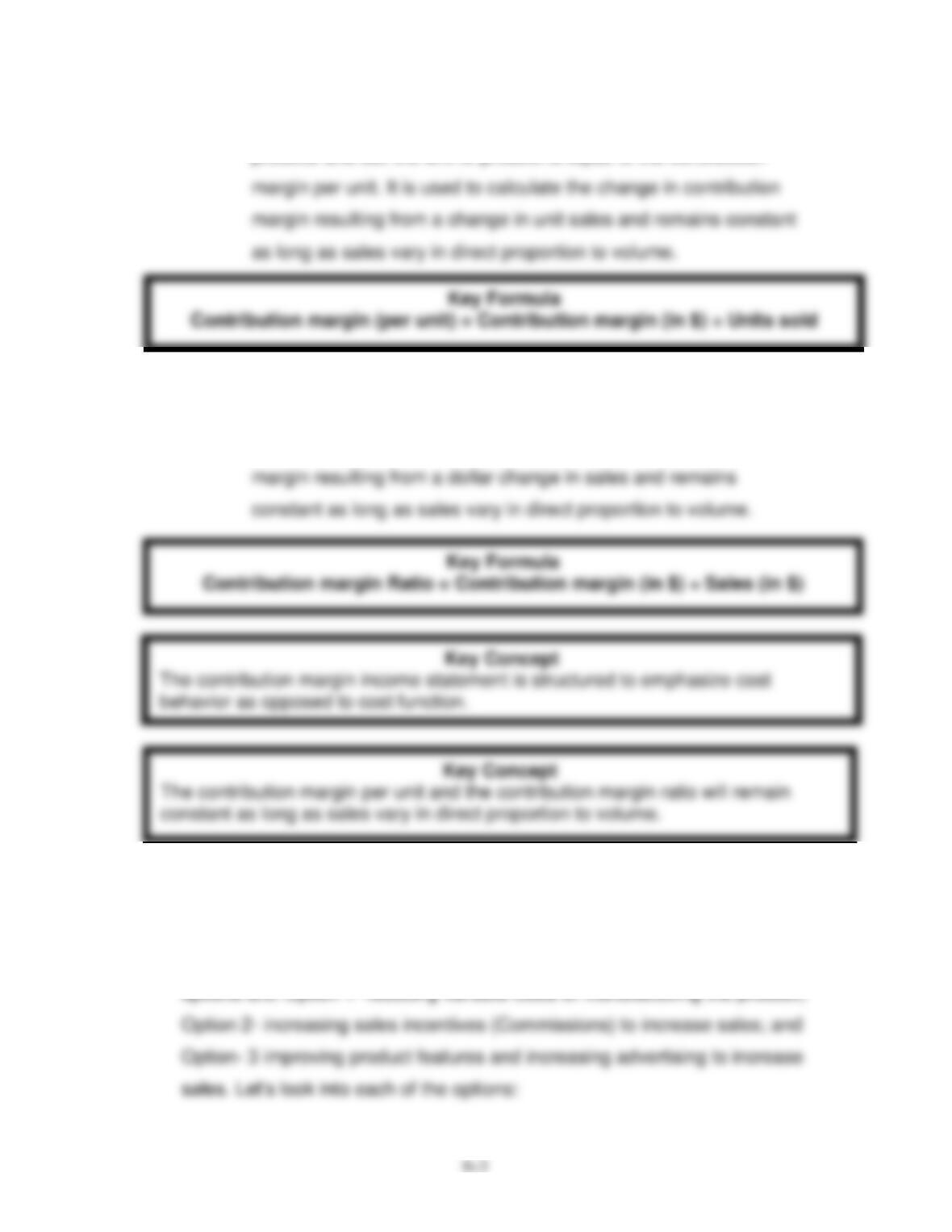
1. Contribution margin per unit
Instructor’s Manual
The sales price per unit of product, less all variable costs to
produce and sell the unit of product is equal to the contribution
2. Contribution Margin Ratio
The contribution margin divided by sales is equal to contribution
margin ratio. It is used to calculate the change in contribution
C. What-If Decisions Using CVP (LO2)
Let’s say a company is considering three options to increase the net
operating income while maintaining the high quality of its products. These
Instructor’s Manual
6-4
1. Option 1-Reduce Variable Costs
o When variable costs are reduced, the contribution margin
will increase.
2. Option 2-Increase Sales Incentives (Commissions)
3. Option 3- Improve Product Features and Increase Advertising
o Improving the product features and increasing advertising
will add to the cost but will also increase the sales volume.
From a quantitative perspective, the option which results in the
D. Break-Even Analysis (LO3)
Break-even analysis is just a variation of CVP analysis in which volume is
increased or decreased in an effort to find the point at which income is equal
to zero. A thorough understanding of fixed and variable costs is necessary
before a manager can calculate break-even point and understand break-
Key Formula
Instructor’s Manual
even analysis. Break-even point is the level of sales at which the
contribution margin just covers fixed costs and income is equal to zero.
1. Break-Even Calculations with Single Product
o The break-even point ($) is calculated by dividing fixed
costs by contribution margin ratio.
2. Break-Even Calculations with Multiple Products
An average (weighted average) contribution margin is needed to
Key Concept
A thorough understanding of fixed and variable costs is necessary before a
manager can calculate and understand a break-even analysis.
Instructor’s Manual
6-6
E. Target Profit Analysis (Before and After Tax) (LO4)
The goal of most businesses is not to break even but to earn a profit.
Luckily, we can easily modify the break-even formula to compute the
amount of sales needed to earn a target profit (before tax).
1. The single product break-even formula can be easily modified to
2. The multiple-product break-even formula can be modified in a
3. The Impact of Taxes
The payment of income taxes is an important variable in target
profit and other CVP decisions if managers are to understand the
bottom line effect of their decisions.
o The impact of income taxes on net profit must be
Instructor’s Manual
F. Cost Structure and Operating Leverage (LO5)
1. Cost structure refers to the relative proportion of fixed and variable
costs in a company.
o Highly automated manufacturing companies are likely to
have cost structures dominated by fixed costs.
2. Operating Leverage
Operating leverage is a measure of the proportion of fixed costs in
a company’s cost structure and is used as an indicator of how
sensitive profit is to changes in sales volume.
Key Concept
The payment of income taxes is an important variable in target profit and other
Instructor’s Manual
6-8
o Net income will be very sensitive to changes in sales
volume for the companies with high level of operating
End-of-Chapter Material
Brief exercises, exercises, problems, and cases based on different learning
objectives have been provided at the end of the chapter. These-end-of chapter
Key Concept
A company operating near the break-even point will have a high level of