
Chapter 06 – Leadership Attributes
6-32
Exercise 6-7
Exercise Title: The Egg Drop
Purpose: To demonstrate how leadership, communication, creativity, and organizational skills all play
important roles when manufacturing and marketing products.
Summary: Divide the class into five to six person teams and assign each team to separate breakout
rooms. Tell the teams they have two assignments; one is to build an egg delivery vehicle using only the
Once all questions about the two projects have been answered, instructors should tell the teams what time
to return to the classroom (i.e., 45 minutes) and dismiss them to their respective breakout rooms. During
the project construction and development time, instructors should visit each group to make sure they are
on track and to make observations on how the different teams are accomplishing the two tasks. Instructors
are to give teams one raw egg with five minutes remaining in the construction period.
Instructors should reassemble the teams at the end of the egg drop, administer the seven awards, and
spend 30 minutes processing the exercise. This exercise works best if every team receives at least one of
the awards. In terms of processing the exercise, typical questions might include:
• How did the groups organize themselves around the two tasks?
• Who played leader and follower roles in the teams?
Chapter 06 – Leadership Attributes
6-33
• How did the two tasks differ in terms of skills and abilities needed?
(Note: Teams of engineers often make fairly unaesthetic but highly successful egg delivery
• What was the level of communication between manufacturing and marketing?
• What unnecessary constraints did groups place on themselves (particularly with respect to
marketing)?
This exercise takes approximately two hours, and team packages will need to be assembled ahead of time.
Egg Delivery System Package: Marketing Package:
1 Accordion Folder (to hold supplies) 4 Pieces of Flip chart Paper
2 Balloons 5 Color Markers
1 Section of Newspaper

Chapter 06 – Leadership Attributes
Team Instructions for:
THE EGG DROP
Your team will be accountable for manufacturing an egg drop delivery system and a one minute
marketing pitch for your system. You may only use the materials listed below to create your egg drop
Egg Delivery System Package: Marketing Package:
1 Accordion Folder (to hold supplies) 4 Pieces of Flip chart Paper
2 Balloons 5 Color Markers
1 Section of Newspaper
1 2′ x 3′ Poster Board
Note: Only the materials listed in the egg drop delivery package can be used to create the egg drop
delivery system; the flip chart paper cannot be used as part of the delivery system.
Your egg will be given to you in the last five minutes of the construction and development phase. The egg
drop delivery systems and commercials will be judged on the following criteria:
1. Egg Accessibility

Chapter 06 – Leadership Attributes
4. Accuracy in Delivery
You have _____ minutes to create your egg drop delivery system and one minute marketing pitch. Return
to this room by _____ with your completed egg drop delivery system and marketing materials.

Chapter 06 – Leadership Attributes
6-36
Exercise 6-8
Exercise Title: Emotional Intelligence Scale
Purpose: To provide students with feedback on their personal standing on each of the four scales
included in the Wong and Law Emotional Intelligence Scale assessment.
Summary:
Emotional Intelligence
Among emotional intelligence researchers (e.g., Salovey & Mayer, 1990), emotional intelligence (EI) is
construed as a subset of social intelligence; therefore, it is an ability in the interpersonal realm, to monitor
one’s own and others’ feelings and emotions, to be able to discriminate among feelings, and to use this
Scoring Key:
Items 1 – 4 comprise the self-emotion appraisal (SEA) scale.
Normative sample data (see below) is from the initial scale development. The Wong & Law
(2002) article provides specific details, but the sample consists of undergraduate students
attending a Hong Kong University.
Mean Std Dev
SEA 4.70 .97
After students have completed and scored the assessment, instructors can facilitate a discussion regarding
what the various levels on each ability means and how they might be important and relevant to

6-37

Chapter 06 – Leadership Attributes
6-38
Key References
Law, K.S., Wong, C.S., & Wong, L. J. (2004). The construct and criterion validity of emotional
intelligence and its potential utility for management studies. Journal of Applied Psychology, 89, 483–
496.
Chapter 06 – Leadership Attributes
6-39
Wong & Law (2002) Emotional Intelligence Scale
Please indicate your agreement or disagreement with the following statements by using the rating scale
given below. You may circle the number that best represents your response.
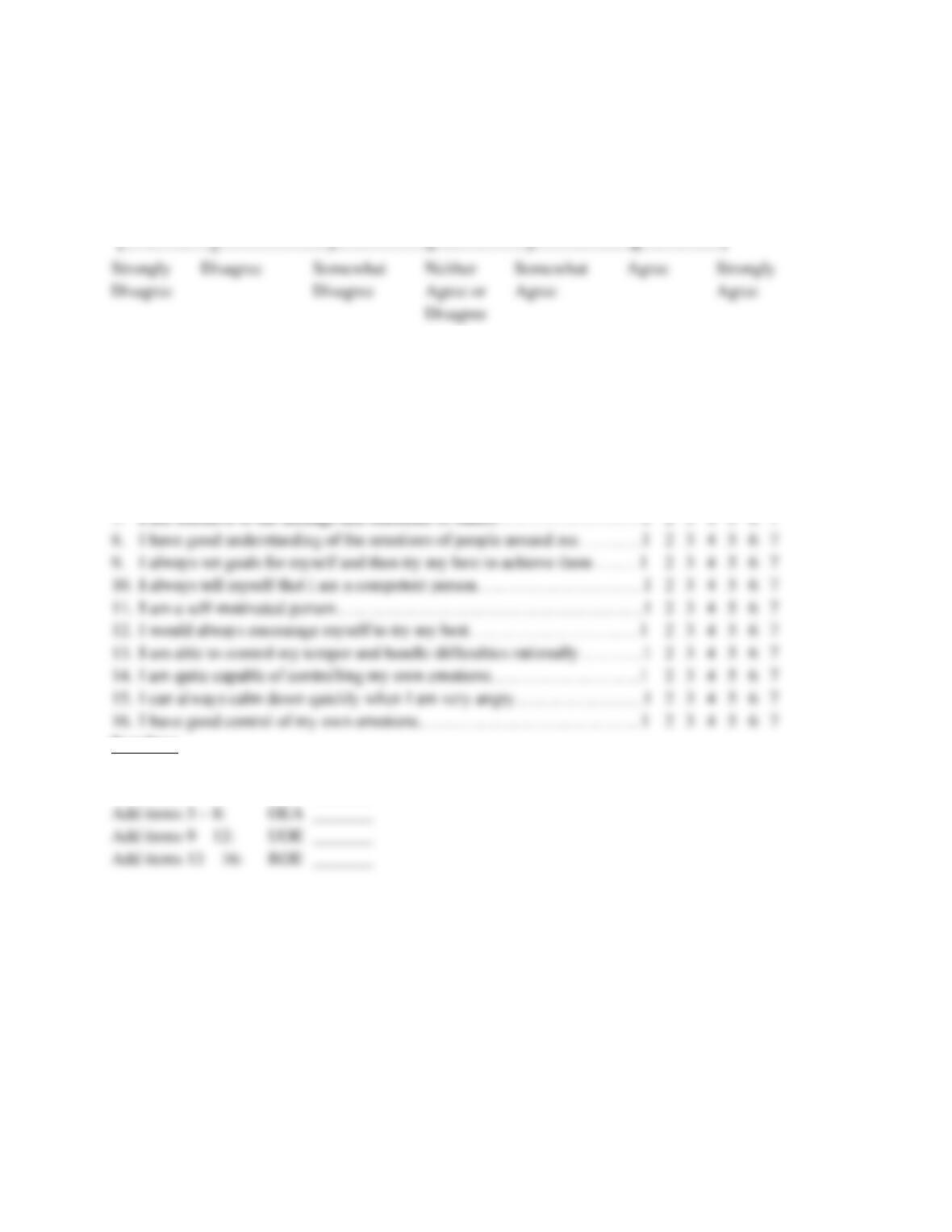
1. I have a good sense of why I have certain feelings most of the time…..… 1 2 3 4 5 6 7
2. I have good understanding of my own emotions…………………………..1 2 3 4 5 6 7
3. I really understand what I feel…………………………………………..…1 2 3 4 5 6 7
4. I always know whether or not I am happy…………………………………1 2 3 4 5 6 7
5. I always know my friends’ emotions from their behavior……………...…1 2 3 4 5 6 7
6. I am a good observer of others’ emotions……………………………..….1 2 3 4 5 6 7
Scoring:
Add items 1 – 4: SEA _______

Chapter 06 – Leadership Attributes
6-40
Additional References/Resources
Ames, D. R. & Flynn, F. J. (2007). What breaks a leader: The curvilinear relation between
assertiveness and leadership. Journal of Personality & Social Psychology, 92, 307–324.
Caldwell, C. & Hayes, L. A. (2007). Leadership, trustworthiness, and the mediating lens. Journal
of Management Development, 26, 261–281.
Ciampa, D. (2007). Taking advice: How leaders get good counsel and use it wisely. Boston:
Harvard Business School Press.
Hogan, R., Curphy, G.J., & Hogan, J. (1994). What we know about leadership: Effectiveness and
personality. American Psychologist, 49, 493–504.
Hogan, R.T. & Fernandez, J.E. (2002). Syndromes of mismanagement. The Journal for Quality
& Participation, Fall, 28–31.
Chapter 06 – Leadership Attributes
Judge, T.A., Bono, J.E., Ilies, R., & Gerhardt, M.W. (2002). Personality and leadership: A
qualitative and quantitative review. Journal of Applied Psychology, 87, 765–780.
Kellerman, B. (2004). Bad leadership. Boston, MA: Harvard Business School Press.
Kellerman, B. (2004). Leadership: Warts and all. Harvard Business Review, 82, 40–45.
Murphy, A.P. (2004). The cult of personality: How personality tests are leading us to miseducate
our children, mismanage our companies, and misunderstand ourselves. New York: Free
Press.
Rath, T. & Clifton, D.O. (2004). How full is your bucket? New York: Gallup Press.

Chapter 06 – Leadership Attributes
6-42
617–633.
Salovey, P. & Mayer, J.D. (1990). Emotional intelligence. Imagination, Cognition, and
Personality, 9, 185–211.
Vance, C. M., Groves, K. S., Yongsun Paik, & Kindler, H. (2007). Understanding and measuring
linear-NonLinear thinking style for enhanced management education and professional practice.
Academy of Management Learning & Education, 6, 167–185.
Websites
International Personality Item Pool: