Page 1 of 19
Chapter 6: The Voice of the Market
Chapter Outline
• Gaining Insight through Benchmarking
• Purposes of Benchmarking
• Difficulties in Monitoring and Measuring Performance
• Commonly Benchmarked Performance Measures
• Business Process Benchmarking
• Leading and Managing the Benchmarking Effort
• Base Lining and Re-engineering
• Problems with Benchmarking
Overview
Chapter 5 focused on the voice of the customer. Chapter 6 focuses on the voice of the
market. The market, or the marketplace, includes not only the customer, but also includes
the competitors, the customers of competitors, potential competitors, and potential
customers.
A major topic of this chapter is benchmarking. A benchmark is an organization
recognized for its exemplary operational performance.
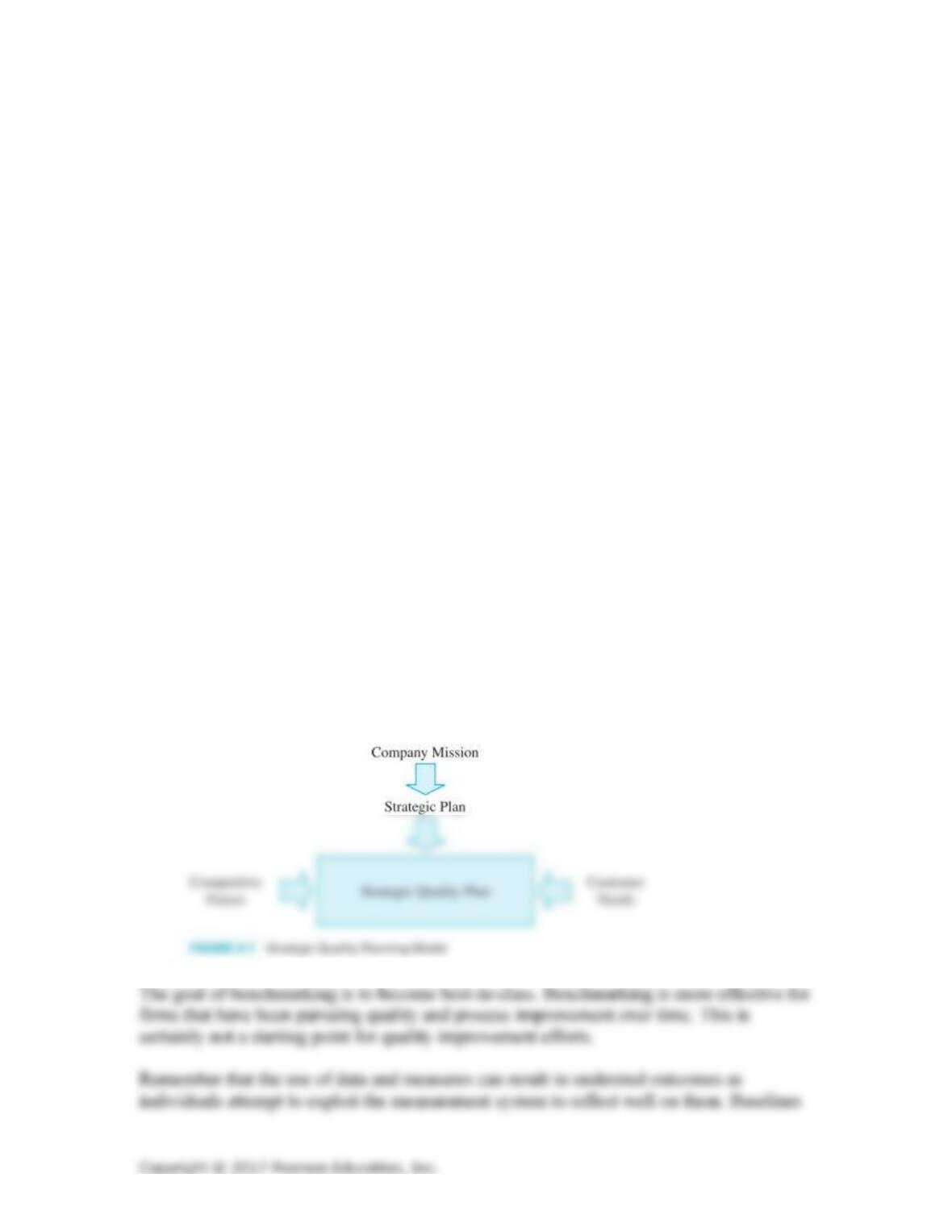
Figure 6-1 presents the driving forces that affect the strategic quality plan. Benchmarking
provides a way to evaluate the success of the process.
Page 2 of 19
and other measures should be implemented carefully with attention to the possibility of
unintended outcomes.
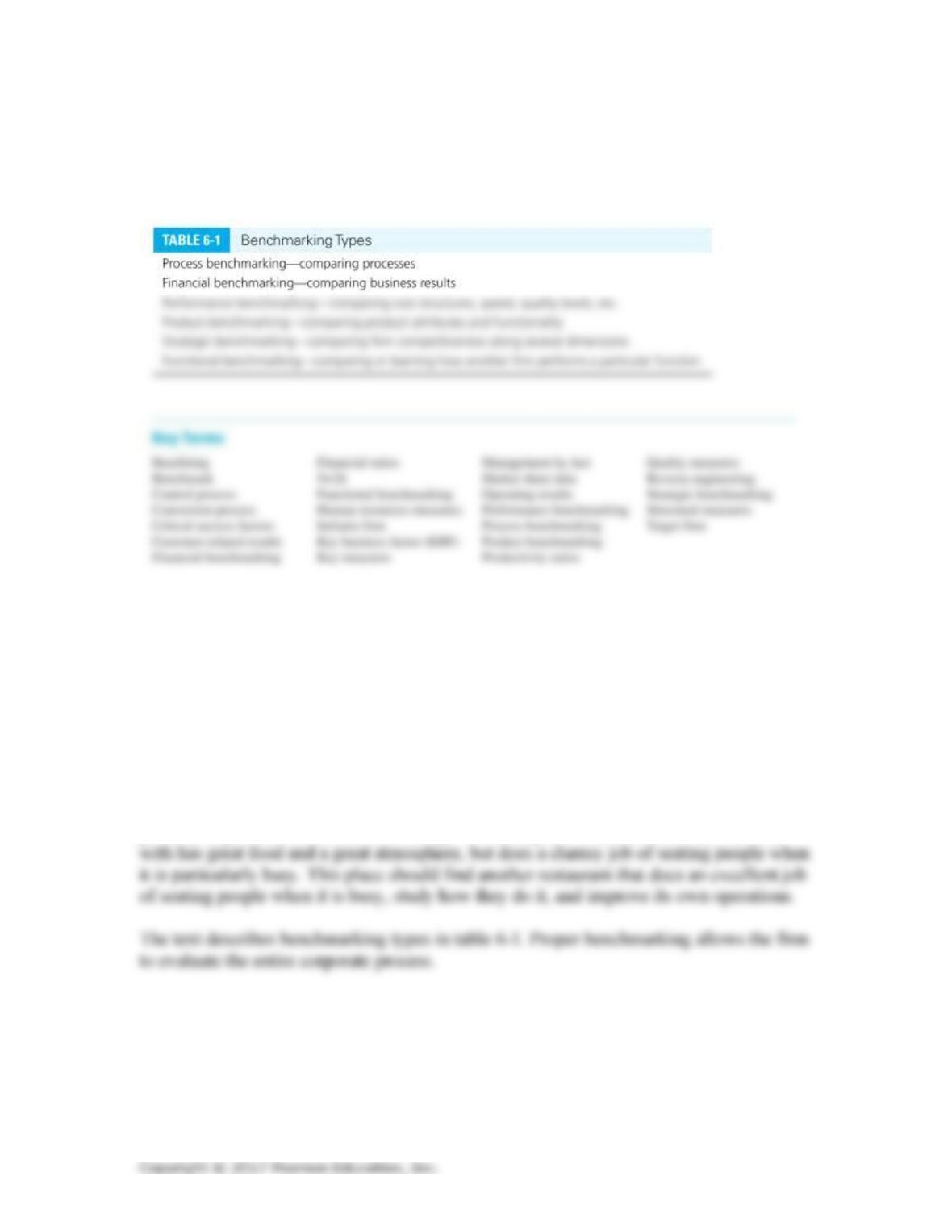
The chapter outlines a number of benchmarking types:
Discussion Questions
1. Describe the concept of benchmarking. Provide an example of how a restaurant
that you are familiar with could use benchmarking to improve its performance.
Benchmarking is the process of finding a company that is very good at a particular
activity, studying what it does, and gathering ideas for improving your own operation in
this area.
The second part of this question provides your students the opportunity to apply a
personal experience to a textbook concept. For example, a restaurant that I am familiar
2. What is a benchmark firm? Why is it good practice for a benchmark firm to open
its doors and allow others to view its operations and tour its facilities?
On page 131, the text tells us:
… Deming’s thought, “The worst thing for a business is a weak competitor.” Therefore,
strengthening the competition forces everyone to improve in order to maintain a
competitive edge. As such, openness provides an impetus to continual improvement.
3. What are the pros and cons of becoming a benchmark firm? If you were the
manager of a highly successful company, would you want other companies
benchmarking against your firm? Why or why not?
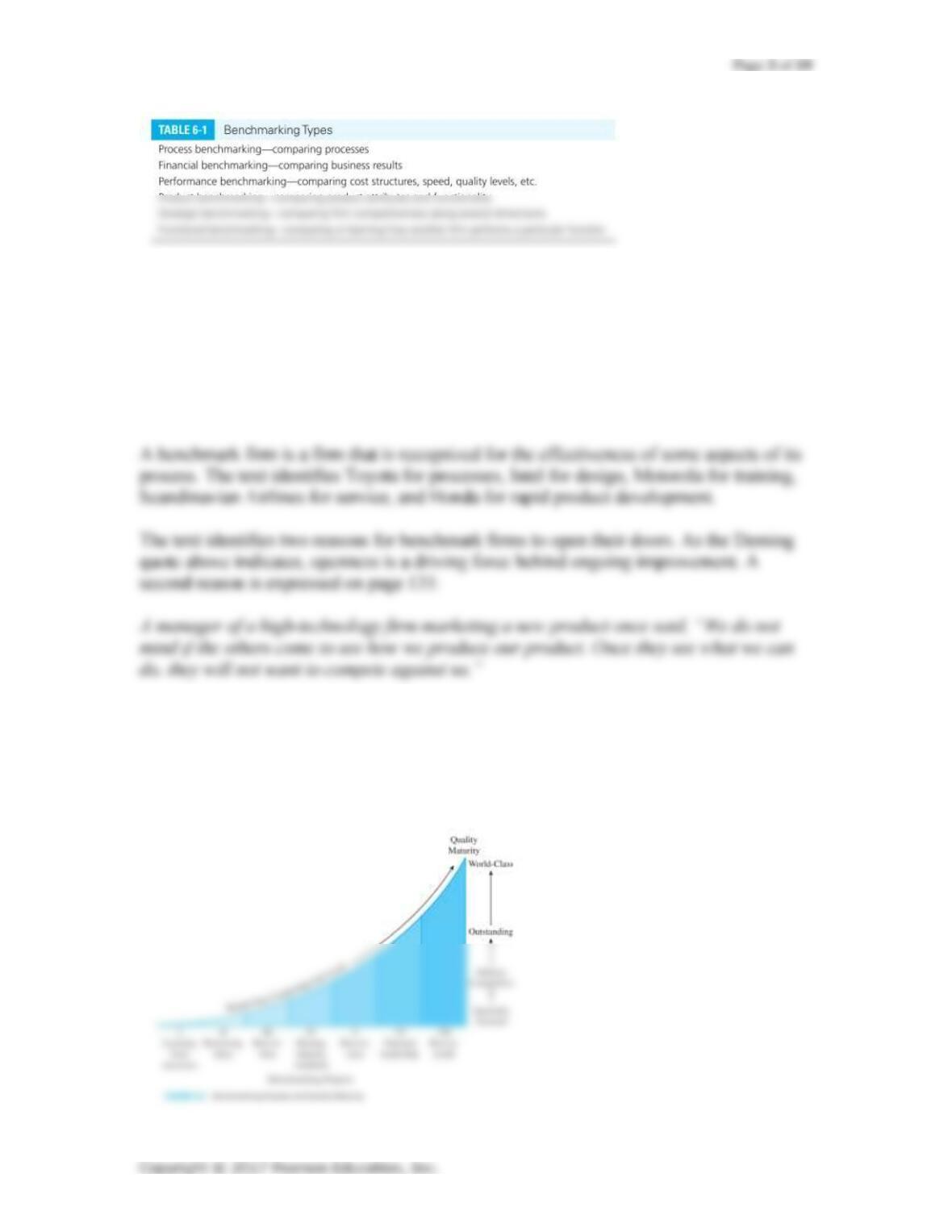
The text makes the point that being a benchmark firm encourages continuing
improvement. Figure 6-2 illustrates this point:

Page 4 of 19
However on page 139, the text also makes the point that:
4. In the context of benchmarking, describe the distinction between an initiator firm
and a target firm.
On page 132, the text defines the difference clearly:
5. Describe how benchmarking can be used by a firm to externally validate the value
of its present business practices.
Benchmarking allows the firm to compare its processes against other, successful firms.
The various benchmarking types allow a firm to identify the area where there are
weaknesses and to concentrate on resolving them.
Table 6-1 lists the benchmarking types and the areas of business that they address.
6. Describe the concept of process benchmarking. How does process benchmarking
improve a company’s overall business performance?
7. Is the growing popularity of the Internet a positive development or a negative
development for the future of benchmarking? Please explain your answer.
The Internet has vastly empowered communication. Research that used to involve
creating company libraries or spending days in public or school libraries can now be
8. Compare and contrast process benchmarking, product benchmarking, and
strategic benchmarking.
Process benchmarking compares process between the initiator and target firms. These
processes might include process flows, operating systems, and process technologies.
Product benchmarking looks at the product itself, not the process. This form of
9. When benchmarking, what is the primary hazard in comparing measures across
companies to gauge performance differences?
Different firms will have different methods of doing business, and different goals and
10. How does a firm’s key business factors help direct its benchmarking program?
Different firms in different industries use many different factors to evaluate their
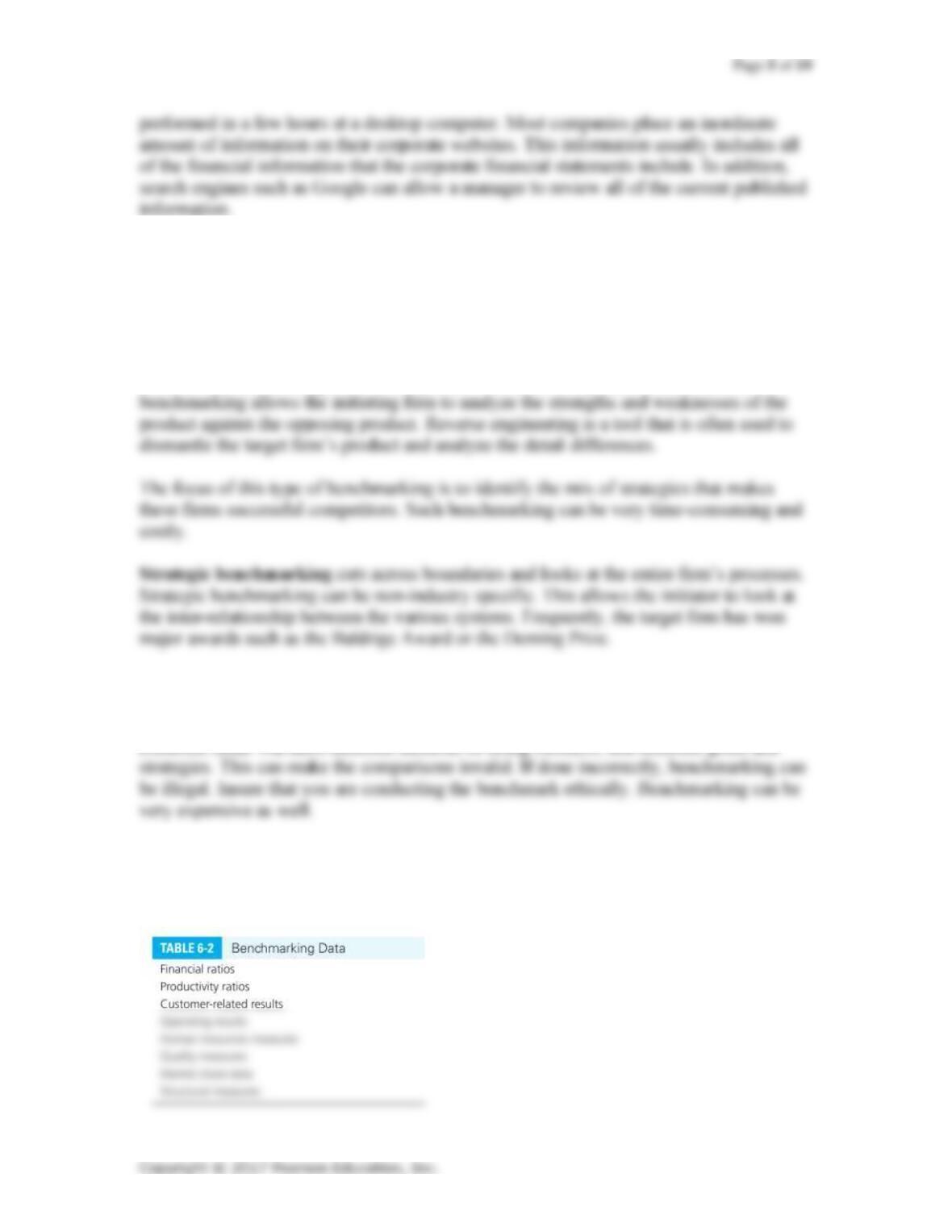
performance. Table 6-2 presents some of these factors.

11. Provide several examples of the types of measures that are often gathered in
benchmarking studies. How does a firm determine which measures should be
included in its benchmarking program?
12. Imagine yourself in the role of the CEO of a medium-sized auto parts company.
Briefly describe how you would set up a benchmarking program. Include in your
description an analysis of how you would determine “what” to benchmark and how
you would determine “whom” to benchmark against.
The chapter describes a procedure for benchmarking that Robert Camp established for
Xerox. The procedure is presented in ten steps, comprising five phases. Steps one and
two answer this question:
Step 1: Decide what to benchmark. There are innumerable areas for improvement
in every company. Obviously, not all of these can be tackled at once. Too many
13. Consider the following: “Despite its many advantages, benchmarking is not an
appropriate technique for all firms. Some firms are so unique that it is impossible
for them to find benchmark firms that experience the same challenges they do. As a
result, it is impractical for these firms to participate in benchmarking.” Do you
agree or disagree? Please explain your answer.
One of the greatest impediments to seeking a benchmarking relationship is the belief that
an initiating company or firm is so unique that it cannot learn from other firms because
they are different. However, employees entrenched in a process may have trouble

14. Many scholars believe that business process benchmarking is the most
important type of benchmarking. Do you agree with this particular belief? Why or
why not?
Most students will agree with this statement. The example that is provided in the chapter
to support this position is as follows. Suppose that you do a comparison of your customer
service with that of the competitor. You find out that your competitor is using a standard
15. Describe the concept of 5w2h.
The 5w2h concept is taken from work done by Alan Robinson (see page 139). The
concept states that a business benchmark must answer seven questions, five of which start
with the letter “w”:
• Who
• What
And two start with the letter “h”:
• How
16. What management activities can be undertaken to support a firm’s
benchmarking activities? Please make your answer as substantive as possible.
The chapter lists the following steps:
• Establishing, supporting, and sustaining the benchmarking program
• Developing a strategy statement that outlines the goals and strategies to be used to
17. What are some of the pluses and minuses of the benchmarking code of conduct?
Would you add any other points to the code? If so, what?
There are many pluses to the benchmarking code of conduct. The primary advantage is
that using a carefully crafted benchmarking code of conduct should help a firm maintain
18. Although benchmarking is a popular management technique, many firms are
not engaged in the benchmarking process. Why do you think that some firms avoid
benchmarking? Are any of the reasons valid? Why or why not?
• Benchmarking is expensive both in employee time and potential travel costs.
• Benchmarking is time consuming.

Case 6.1: Amgen Corporation: Using Benchmarking as a Means of
Coping with Rapid Growth
Discussion Questions
1. Why was benchmarking so important for Amgen at the point in the company’s
history when benchmarking was initiated? Do you believe that benchmarking will
contribute to Amgen’s long-term success?
Although Amgen was excelling in the development of pharmaceutical products, the
company needed help in some basic areas of management. Although the case does not
2. Was it a good idea for Amgen to solicit the help of the American Productivity and
Quality Center? Do you think that Amgen would have been successful without the
APQC’s involvement?
Most students will argue that it was a good idea for Amgen to solicit the help of the
American Productivity and Quality Center (APQC). The center provided Amgen
Case 6.2: AT&T Teleholdings: Making Benchmarking A Part of the
Process Improvement Toolkit
Discussion Questions
1. Is AT&T Teleholding’s Benchmarking Code of Conduct a good idea? What types
of ethical abuses could potentially occur in benchmarking if a firm did not follow a
strict code of conduct?
Most students will argue that AT&T Teleholding’s Benchmarking Code of Conduct is a
good idea. As mentioned in the case, the code provides a measure of continuity across the
company’s benchmarking efforts that are very helpful in developing a consistent set of
2. This case describes benchmarking as an important part of the company’s “tools”
of quality. What other tools of quality does benchmarking complement?
3. Telecommunications is a fast-paced, rapidly changing industry. Do you believe
that benchmarking is particularly important in a fast-paced industry? Why or why
not?
Most students will argue that benchmarking is particularly important in fast-paced

Page 11 of 19
Suggested Answers to End of Chapter Problems
1. A company has gathered the following financial information for itself and
a competing firm. They wish to compare productivity for the two firms (all
numbers in 000s).
Firm A Firm B
Labor $ 30,000 $ 16,000
a. Compute partial and total factor productivity measures for Firms A and B.
Firm A Firm B
Labor 1,200,000/30,000 = 40 900,000/16000 = 56.25
b. What is the picture you get of the two firms?
c. What would you suggest to the management of Firm B?
2. For the firms in problem 1, you have been asked to make a report to the
management of Firm A. What are some of the caveats relating to accounting
practices that you would include in the report? Which numbers should be
interpreted cautiously?
It is important to note that firms book different categories of costs differently. You

3. For the data in problem 1, suppose that Firm B is a foreign firm. What
additional caveats would you place on interpretation of the data?
4. A domestic company operating a subsidiary in an LDC (less-developed
country) has shown the following financial results:
Parent Subsidiary
(Domestic) (LDC)
a. Calculate partial labor and capital productivity numbers for the parent
and subsidiary. Interpret the results.
Parent Company Subsidiary
Partial Labor 200,000/40,000 = 5 80,000/60,000 = 1.33
b. Compute total labor productivity figures. Does your interpretation change?
capital utilization.
Total Labor Productivity
Page 13 of 19
c. If $1 = 10 FC units, calculate materials productivity figures. Explain your
finding.
Materials Productivity
5. Below are industry comparisons of the percent of sales spent on salaries
for marketing employees, manufacturing engineering employees, and supply
chain employees for several different industries. Rank these industries by the
amount spent in each of the areas and report your findings to management.
What can you infer from your findings about each of the industries?
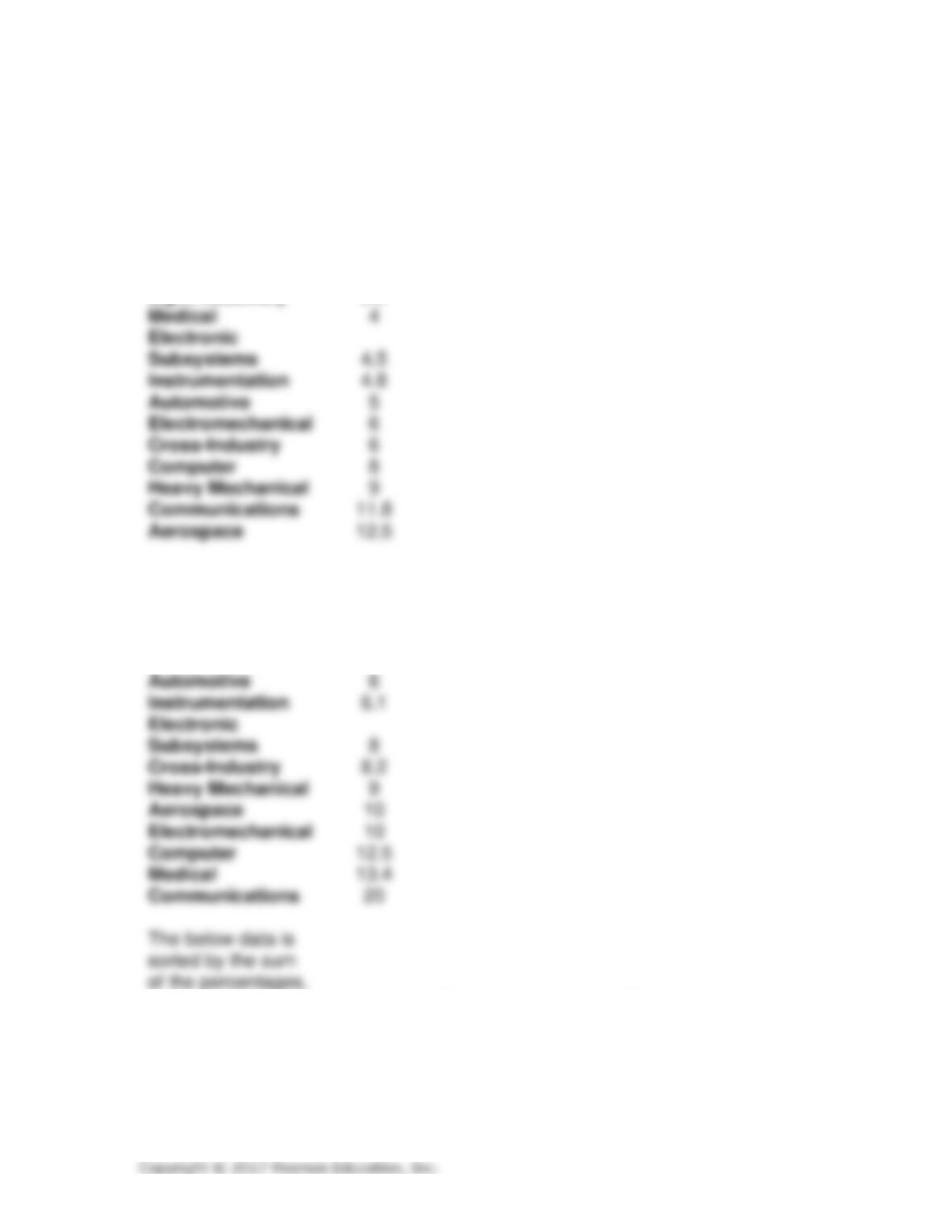
Marketing
Manufacturing
Engineering
Supply
Chain
Sum
Aerospace
4.8
12.5
10
27.3
Automotive
8.5
5
6
19.5
Communications
11.6
11.8
20
43.4
Components
3
10.9
Computer
5
8
25.5
Electromechanical
6.3
6
10
22.3
Electronic
Subsystems
4.2
8
16.7
Heavy Mechanical
6
9
9
Instrumentation
7.5
18.4
Light Assembly
2.8
Medical
3.8
4
21.2
Cross-Industry
4.9
6
19.1
Marketing
Light Assembly
2.8
This data is sorted
by marketing.
Components
3
Medical
3.8
Subsystems
4.2
Aerospace
4.8
Cross-Industry
4.9
Computer
5
Heavy Mechanical
6
Electromechanical
6.3
Instrumentation
7.5
Communications
11.6
Page 14 of 19
Manufacturing Engineering
Components
2.4
This data is sorted
by manufacturing
engineering
Light Assembly
2.5
Medical
Electronic
Subsystems
4.5
Automotive
Electromechanical
Cross-Industry
Computer
Heavy Mechanical
Communications
Aerospace
Supply Chain
Light Assembly
3.3
This data is sorted
by supply chain
expenditures.
Components
5.5
Automotive
Instrumentation
6.1
Electronic
Subsystems
Cross-Industry
8.2
Heavy Mechanical
Aerospace
Electromechanical
Computer
Medical
Communications
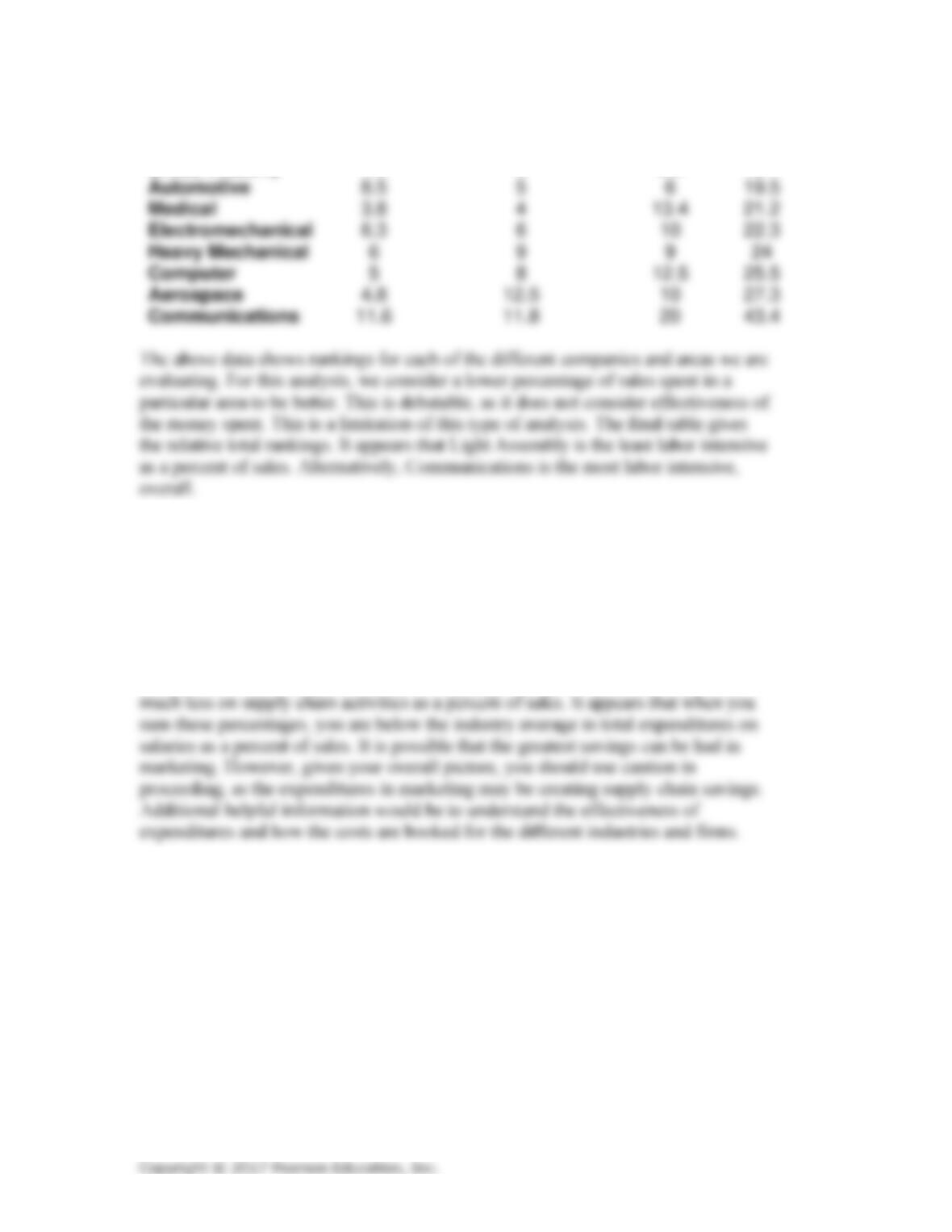
The below data is
sorted by the sum
of the percentages.
Marketing
Manufacturing
Engineering
Supply
Chain
Sum
Light Assembly
2.8
2.5
3.3
8.6
Components
3
2.4
5.5
10.9
Electronic
4.2
4.5
8
16.7
Page 15 of 19
Subsystems
Instrumentation
7.5
4.8
6.1
18.4
Cross-Industry
4.9
6
8.2
19.1
Automotive
8.5
5
19.5
Medical
3.8
4
21.2
Electromechanical
6.3
6
22.3
Heavy Mechanical
9
Computer
8
25.5
Aerospace
4.8
27.3
Communications
43.4
6. Using the data from Problem 5, suppose you are a computer company
who spends 9% on marketing staff, 6% on manufacturing engineering, and
8% on supply chain staff. Comparing your expenditures with the above
averages, what would you recommend to management? What more
information would you want?
It appears that you spend more on marketing as a percent of sales. You spend less
than the industry average on manufacturing engineering as a percent of sales and
7. Following is an announcement from a study for the Benchmarking
Network, Inc.
The Benchmarking Network and the Shared Service Benchmarking
Association announced they will be kicking off the fifth Annual Shared
Services Measures Benchmarking study. Now is the time to join and become
involved in setting the focus and direction of the study by attending the kickoff
meeting. The study will review Shared Services Measures including research
into:
Accounting
Finance and Treasury
Page 16 of 19
Human Resources
Information Technology
Procurement and Supply Chain
Legal
Regulatory
Auditing
Corporate communications/External Affairs
Facilities, Real Estate, Security
Environment
Fleet, and
Other Shared Service Measures
Put yourself in the place of the Benchmarking Network researchers. How
would you design this study? What would you have to consider in undertaking
such a study?
This question is designed to get the students to think about how to enter into a
benchmarking study. This is an actual case of a real organization. You would have
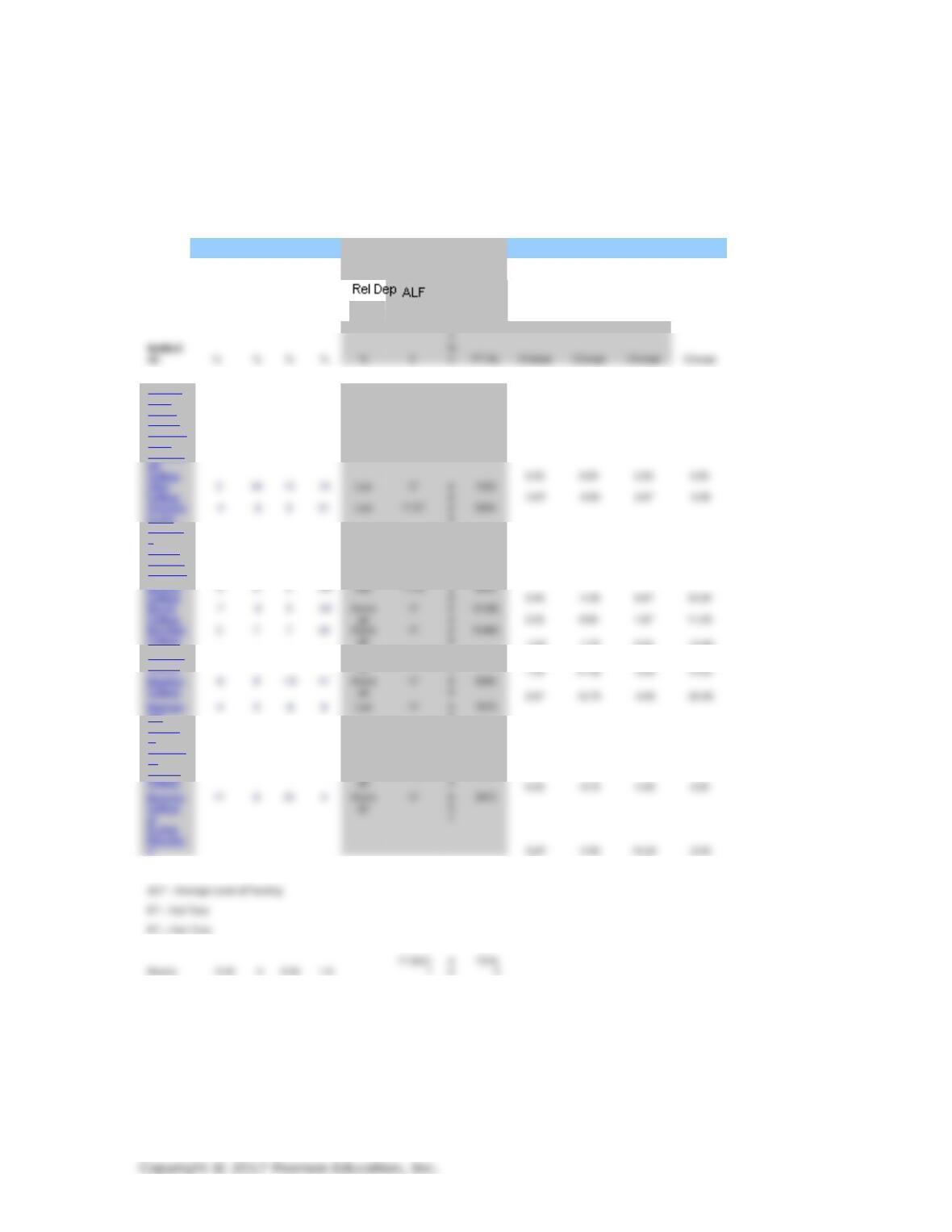
8. Below are enrollment data from several British universities:
Compare the data from these schools and present them in a way that is useful
Page 17 of 19
for the administrators from these schools.
Here is an example spreadsheet by a student who focused on average rates of
growth and wanted to compare the rates of growth with the averages. This is just
one example of a possible analysis. This is quite simple.
%
%
£
N
o
PT No
Change
Change
Change in student numbers
Supporting data
Change in student
99/2000 to 200
0/01
98/99 to 99/
2000
2000/01
FT
P
T
FT
PT
Student
numbers
FT%/Me
an
PT%/Me
an
FT%/
Mean
PT%/
Mean
F
Abingdo
n and
Witney
College
b
b
0
-7
Low
b
b
b
n/a
n/a
0
3.5
ale
5.33
0.25
2.33
0.50
Alton
#
#
-0.67
-8.50
3.67
-5.00
m and
#
#
Accringto
n and
Rossend
–16
-1
7
-1
Avera
ge
17.22
#
#
8896
Wycomb
e
College
1.33
1.50
1.67
-10.50
Aylesbur
y College
–14
11
-5
-2
Low
22.63
#
#
3117
4.67
-2.75
-1.67
1.00
Barking
#
#
2.00
-1.50
0.67
34.00
Barnet
Avera
#
#
2.33
0.50
1.67
11.00
College
ge
#
-1.00
-1.75
2.33
-12.00
Barnsley
College
-3
#
-9
–24
Avera
ge
17
#
#
6029
1.00
-3.00
12.00
College
ge
#
2.67
10.75
-4.00
-20.50
oke
College
of
Technolo
gy
#
1.33
-0.50
-2.00
-4.00
College
ge
#
0.33
-4.75
-1.00
3.50
of
Educatio
5
1
-5.67
-1.50
10.33
-2.00
Bedford
-1
19
-3
-7
Avera
17.32
#
8524
ALF = Average Level of Funding
FT = Full Time
PT = Part Time
Means
-1.8
#
3
9. Suppose the Chancellor from Bedford College asks you to infer

Page 18 of 19
meaning from the data in Problem 8. Put together a report for the chancellor
explaining how Bedford is performing relative to the other schools.
Institution
Change in student numbers
Supporting data
99/2000 to 2000/01
98/99 to 99/2000
2000/01
FT
PT
FT
PT
Student numbers
%
%
%
%
%
£
FT No
PT No
Bedford
College
-1
19
-3
-7
Average
17.32
1855
8524
10. Choose a company in your local area. Develop a list of five companies
among the best in class in their industry and the best of the best. Explain how
you chose the benchmarking targets you chose. Identify a list of 20
benchmarking questions. What kind of data would you select? How would you
contact the target firms?
Page 19 of 19
11. Following are financial statements from American Ecology. Studying
these figures, what are some possible financial benchmarks this firms might
want to develop?
American Ecology Corporation
Consolidated Statements of Operations:
Proforma and Unaudited ($ in 000s except per share amounts)
2003 2004 2005
Revenues 38,960 41,522 49,972
Impairment loss on long-lived assets — — 7,451
Loss from operations (287) (3,606) (15,237)
Investment income (618) (1,203) (932)
Gain (or loss) before income taxes (72) (136) (55)
12. Baseline the data from problem 11. Is the company’s performance
improving or worsening?
Several indicators would suggest declining performance. Consider the following
decline in ratios:
income, and loss available to shareholders.
Gross Profit /Revenue 2003 2004 2005