CHAPTER 6 REVIEW 6-93
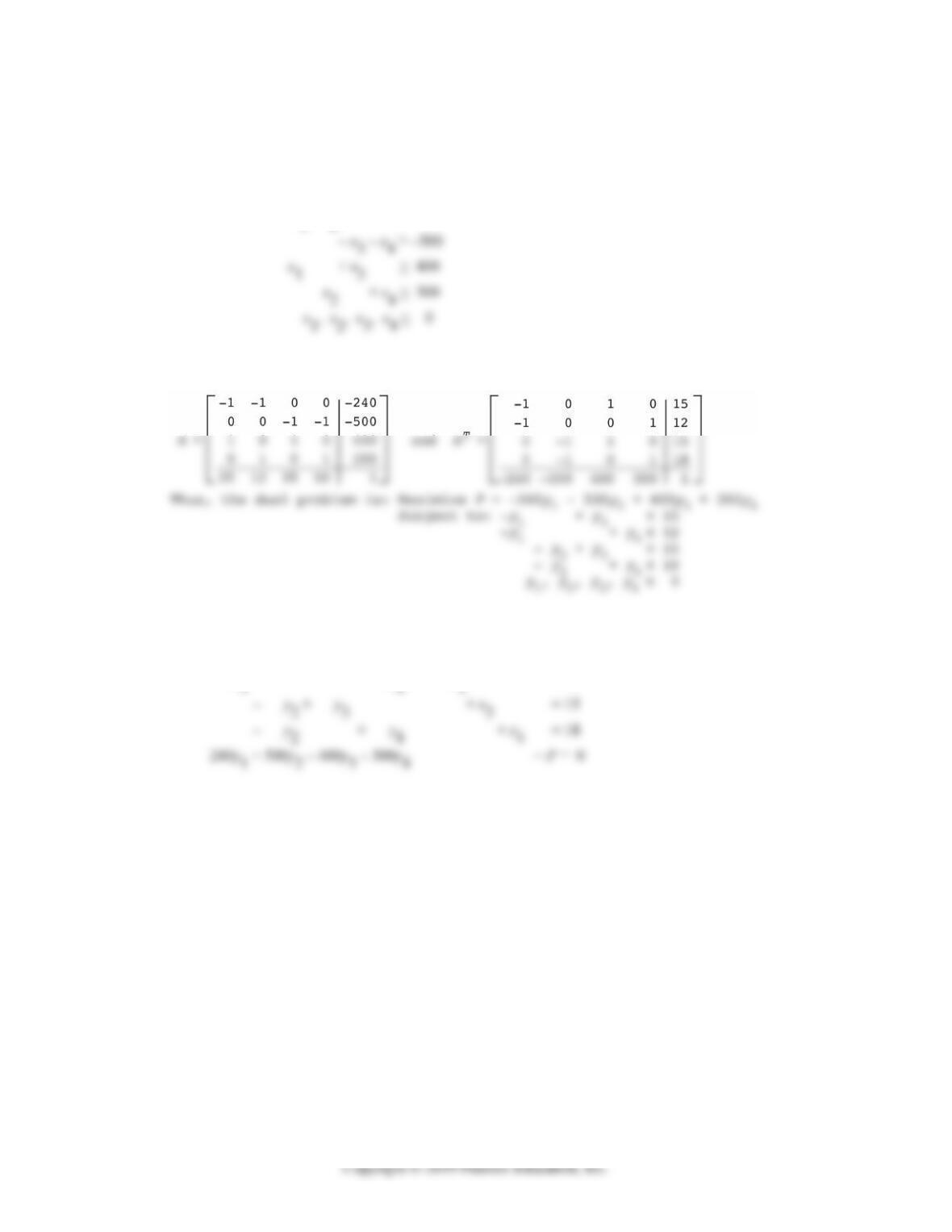
37. Multiply the first two constraint inequalities by –1 to transform them into ≥ inequalities.
The problem now is:
Minimize C = 15x1 + 12x2 + 15x3 + 18x4
Subject to: –x1 – x2 ≥ –240
The matrices corresponding to this problem and its dual are, respectively:
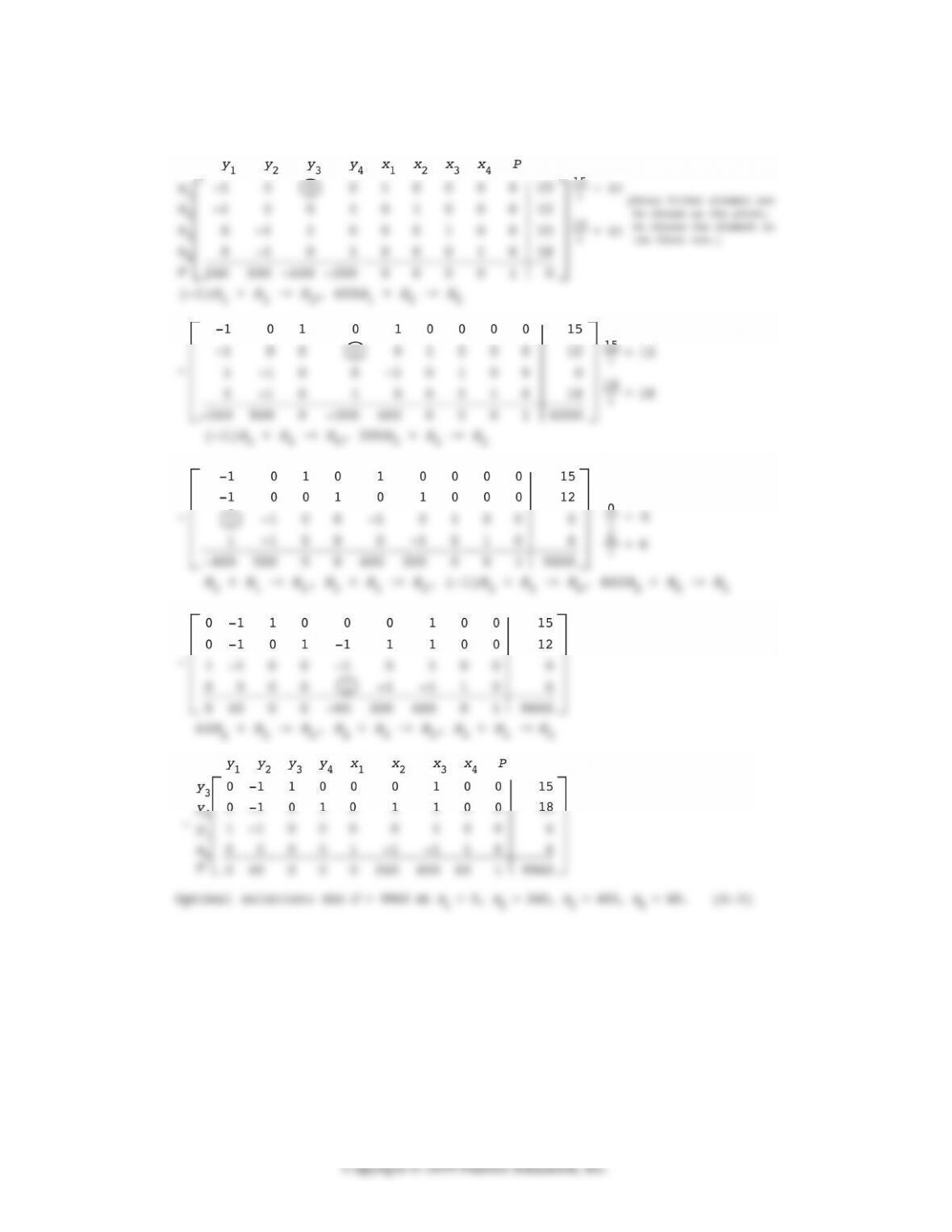
We introduce the slack variables x1, x2, x3, and x4 to obtain the initial system for the dual problem:
–y1+y3+x1 = 15
–y1+y4+x2 = 12
6-94 CHAPTER 6: SIMPLEX METHOD
The simplex tableau for this problem is:
38. (A) Let x1 = amount invested in oil stock
x2 = amount invested in steel stock
x3 = amount invested in government bonds
CHAPTER 6 REVIEW 6-95
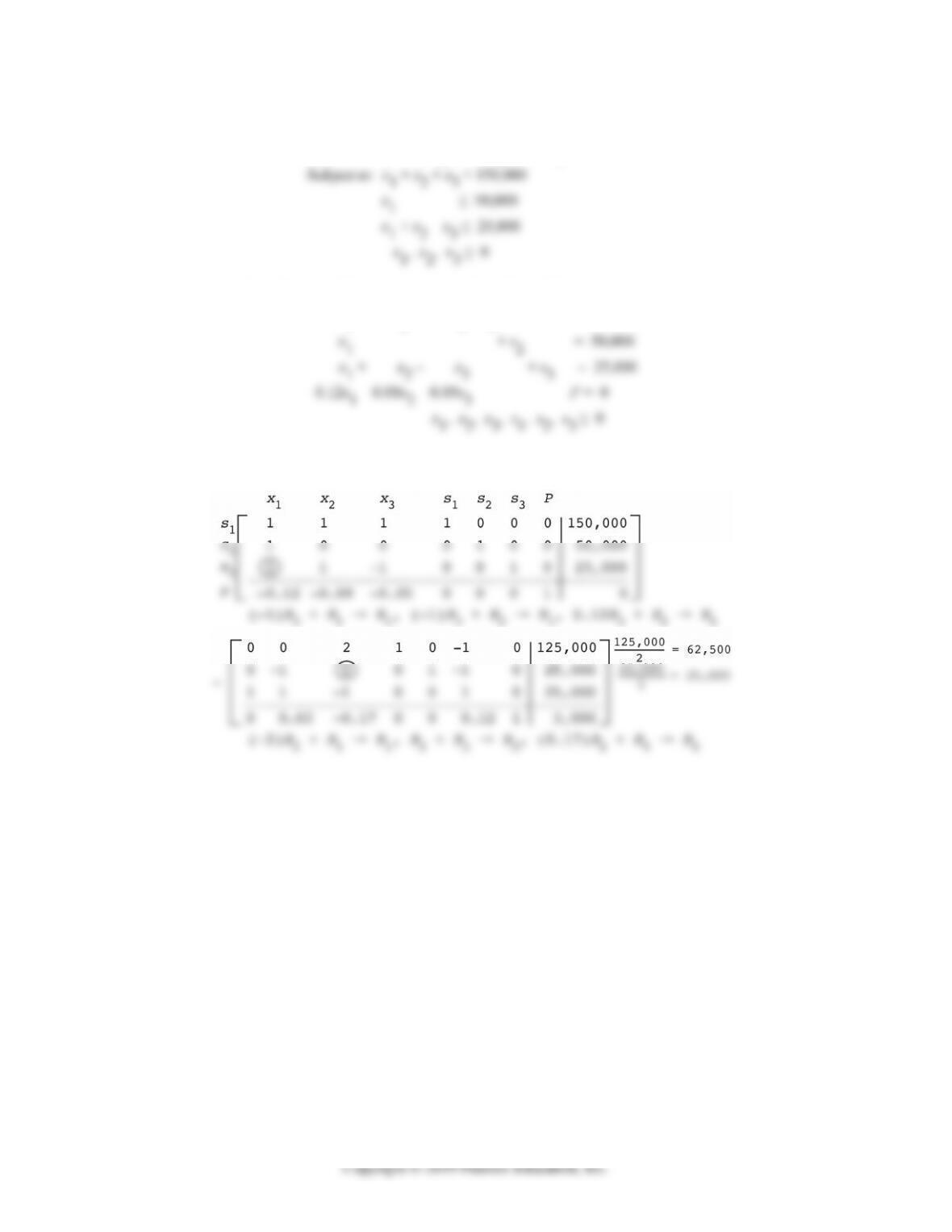
The mathematical model for this problem is:
Maximize P = 0.12x1 + 0.09x2 + 0.05x3
Introduce slack variables s1, s2, s3 to obtain the initial system:
x1 + x2 + x3 + s1 = 150,000
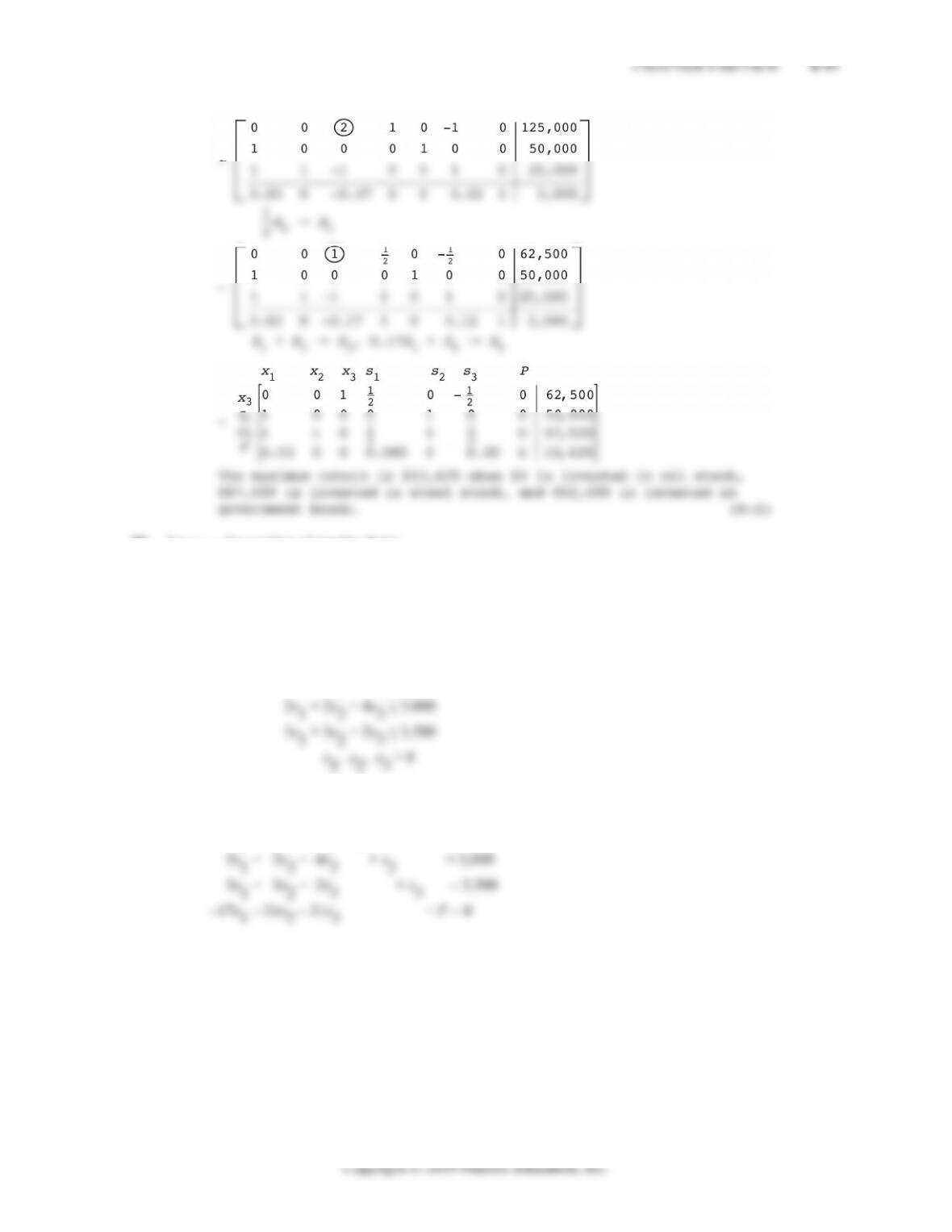
The simplex tableau for this problem is:
6-96 CHAPTER 6: SIMPLEX METHOD
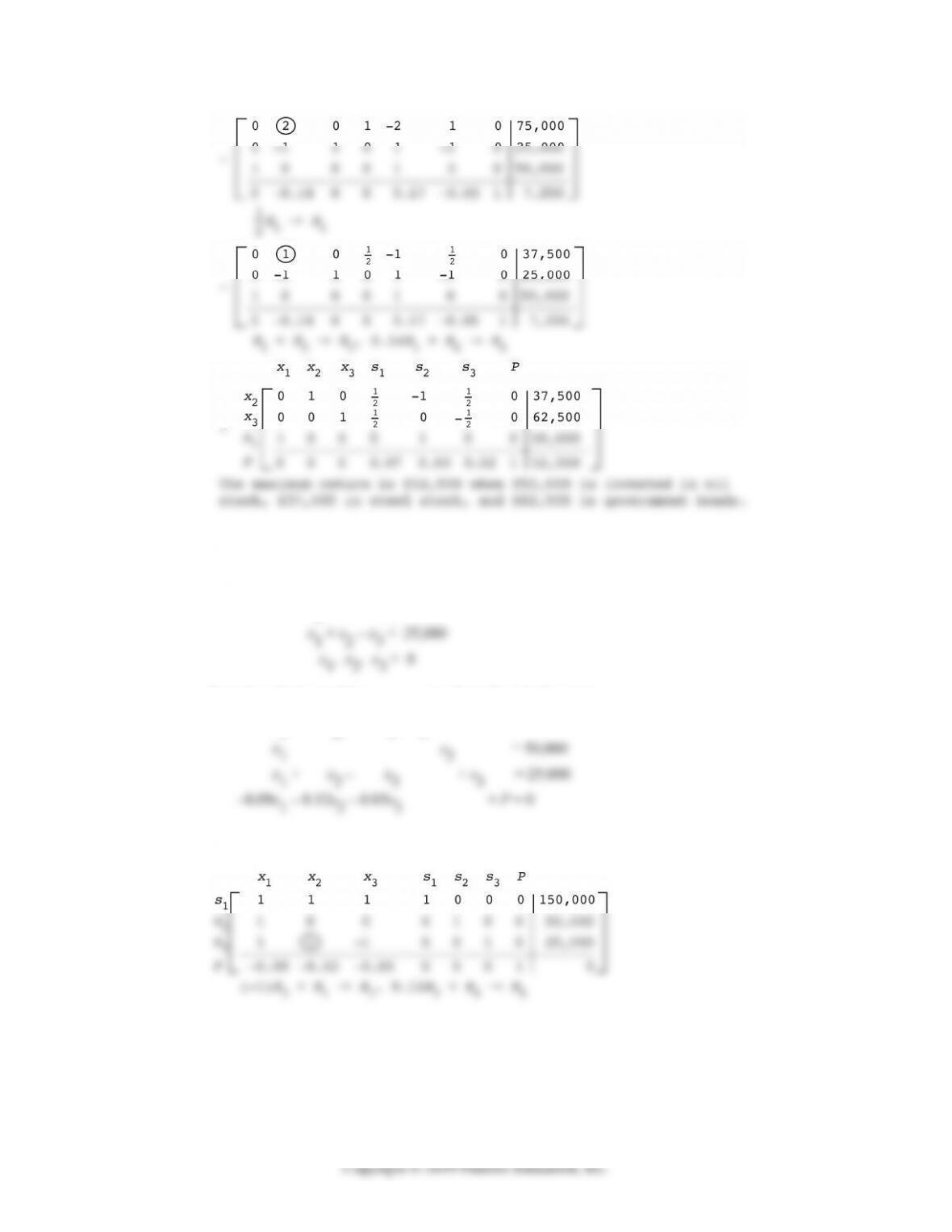
(B) The mathematical model for this problem is:
Maximize P = 0.09x1 + 0.12x2 + 0.05x3
Subject to: x1 + x2 + x3 ≤ 150,000
x1 ≤ 50,000
Introduce slack variables s1, s2, s3 to obtain the initial system:
x1 + x2 + x3 + s1 = 150,000
The simplex tableau for this problem is:
6-98 CHAPTER 6: SIMPLEX METHOD
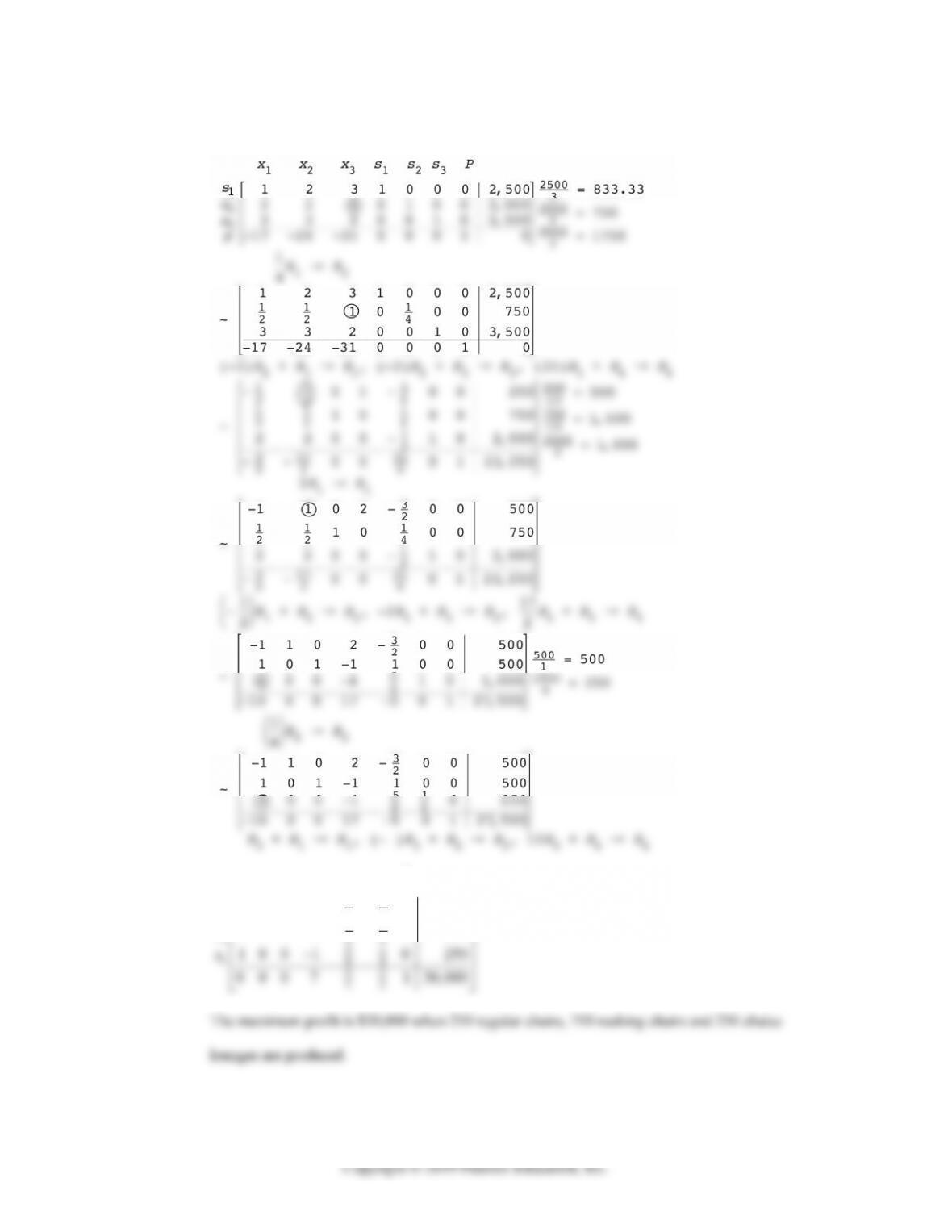
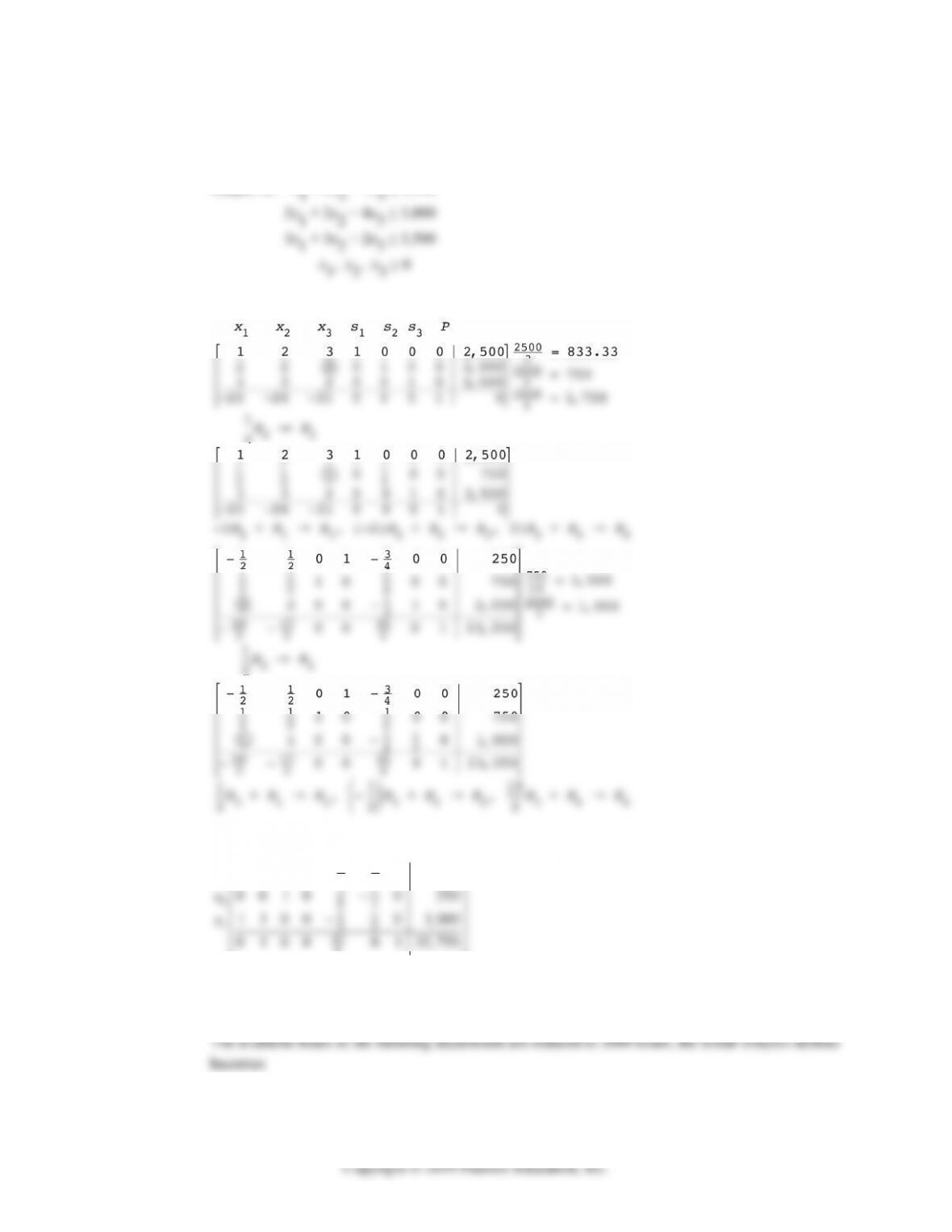
The simplex tableau for this problem is:
x1 x2 x3 s1s2s3 P
71
284
31
384
010 1 0 750
001 0 0 250
x
x
CHAPTER 6 REVIEW 6-99
(B) If the profit on a regular chair is increased to $25, the model becomes:
Maximize P = 25x1 + 24x2 + 31x3
Subject to: x1 + 2x2 + 3x3 ≤ 2,500
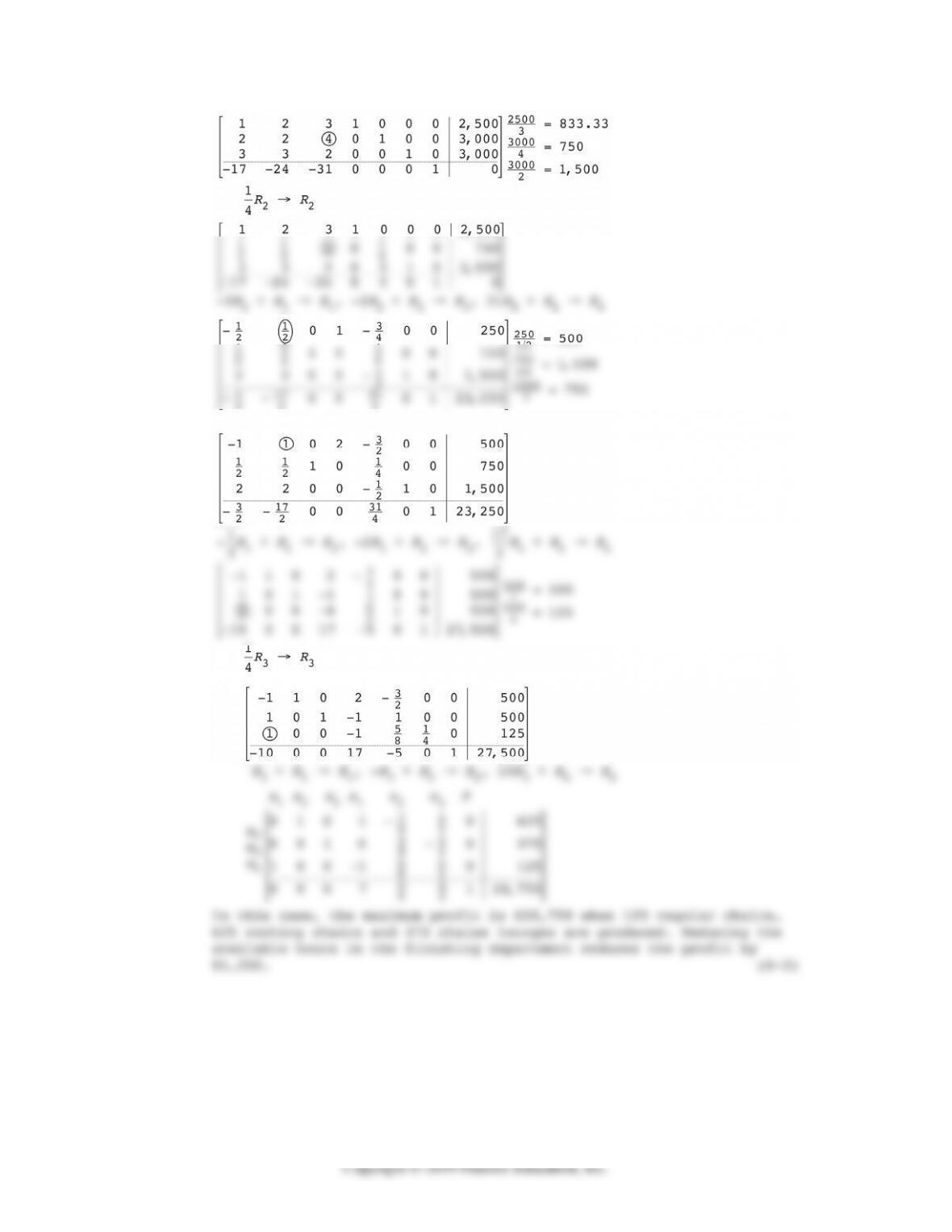
Introducing slack variables s1, s2, s3, we obtain the simplex tableau
x1 x2 x3 s1 s2s3 P
71
284
0101 0 250
x
The maximum profit is $32,750 when 1,000 regular chairs, 0 rocking chairs, and 250 chaise
lounges are produced.
6-100 CHAPTER 6: SIMPLEX METHOD
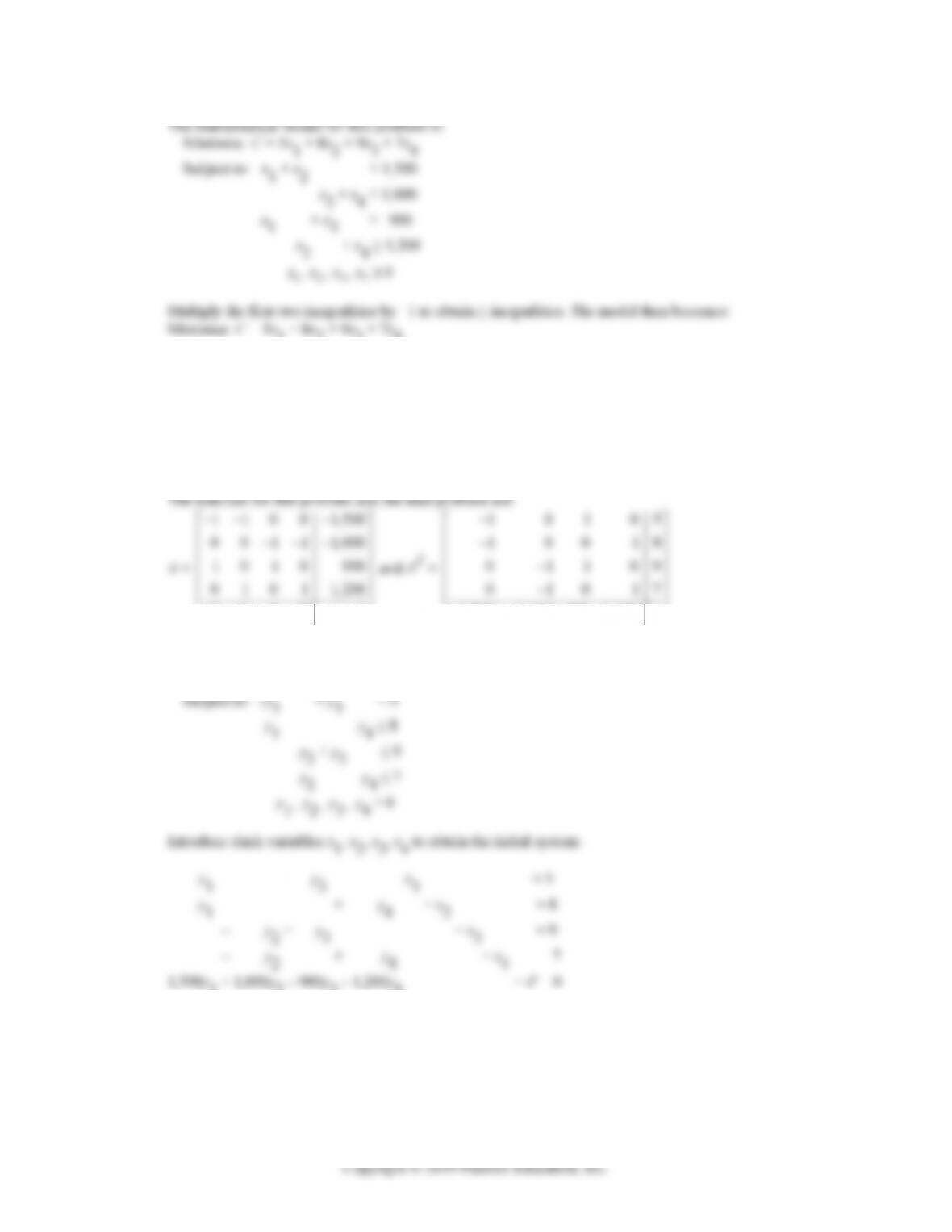
40. Let x1 = the number of motors from A to X,
x2 = the number of motors from A to Y,
x3 = the number of motors from B to X,
x4 = the number of motors from B to Y.
CHAPTER 6 REVIEW 6-101
Copyright © 2019 Pearson Education, Inc.
The mathematical model for this problem is:
Minimize C = 5x1 + 8x2 + 9x3 + 7x4
Subject to: x1 + x2 ≤ 1,500
x3 + x4 ≤ 1,000
x1+x3 ≥ 900
x2 + x4 ≥ 1,200
1234
,,, 0xx xx
Multiply the first two inequalities by –1 to obtain ≥ inequalities. The model then becomes:
Minimize C = 5x1 + 8x2 + 9x3 + 7x4
Subject to: –x1 – x2 ≥ –1,500
–x3 – x4 ≥ –1,000
x1+x3 ≥ 900
x2+x4 ≥ 1,200
x1, x2, x3, x4 ≥ 0
5897 1
1,500 1,000 900 1, 200 1
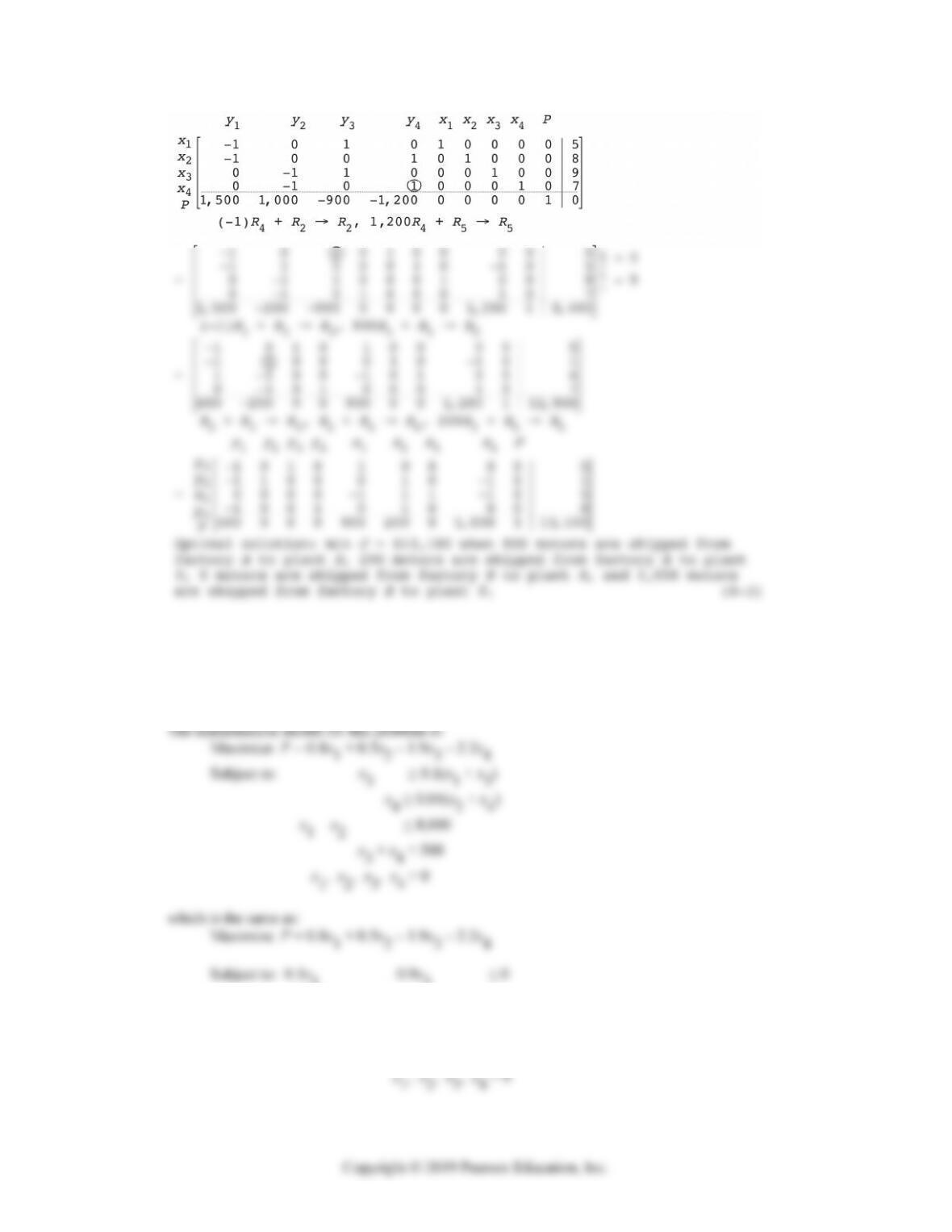
The dual problem is:
Maximize P = –1,500y1 – 1,000y2 + 900y3 + 1,200y4
6-102 CHAPTER 6: SIMPLEX METHOD
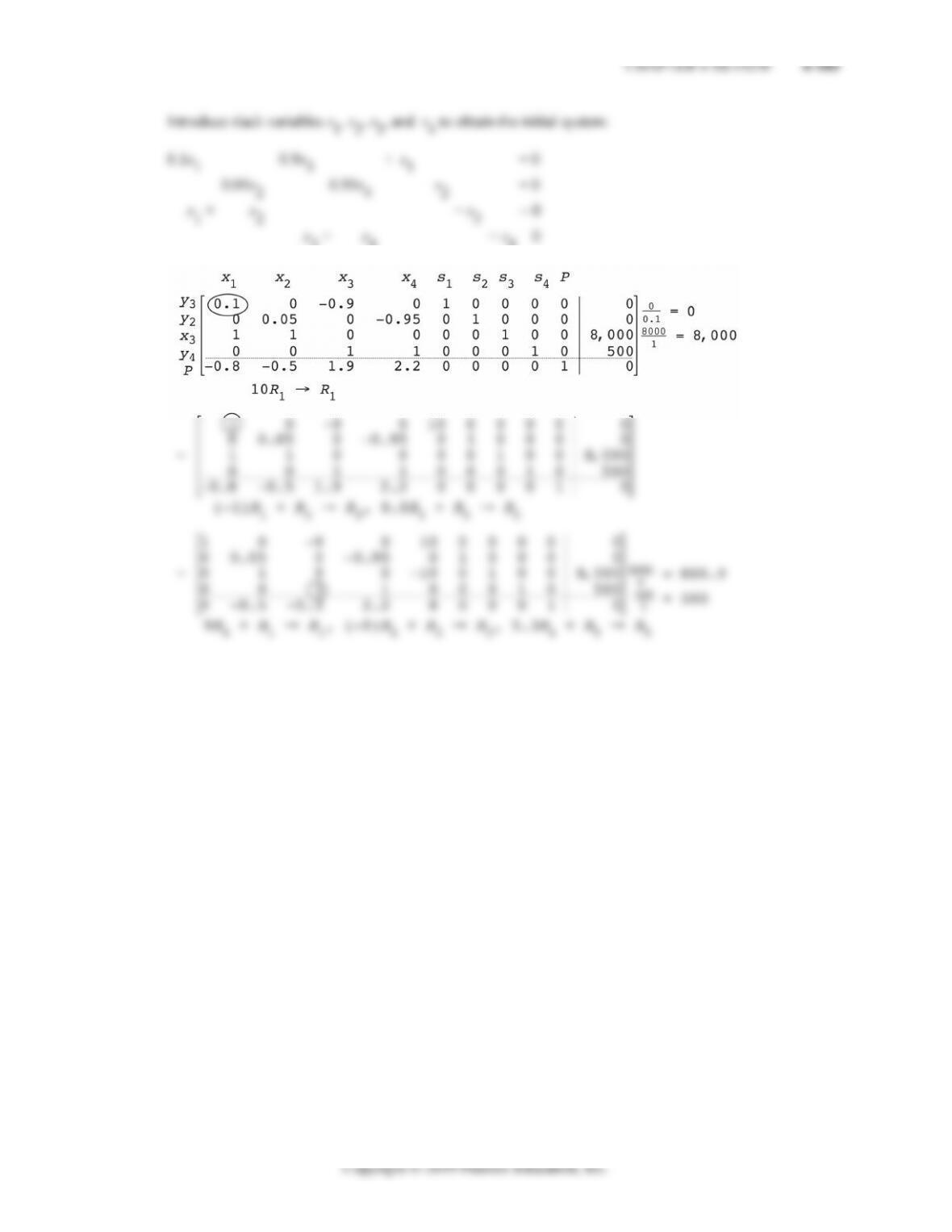
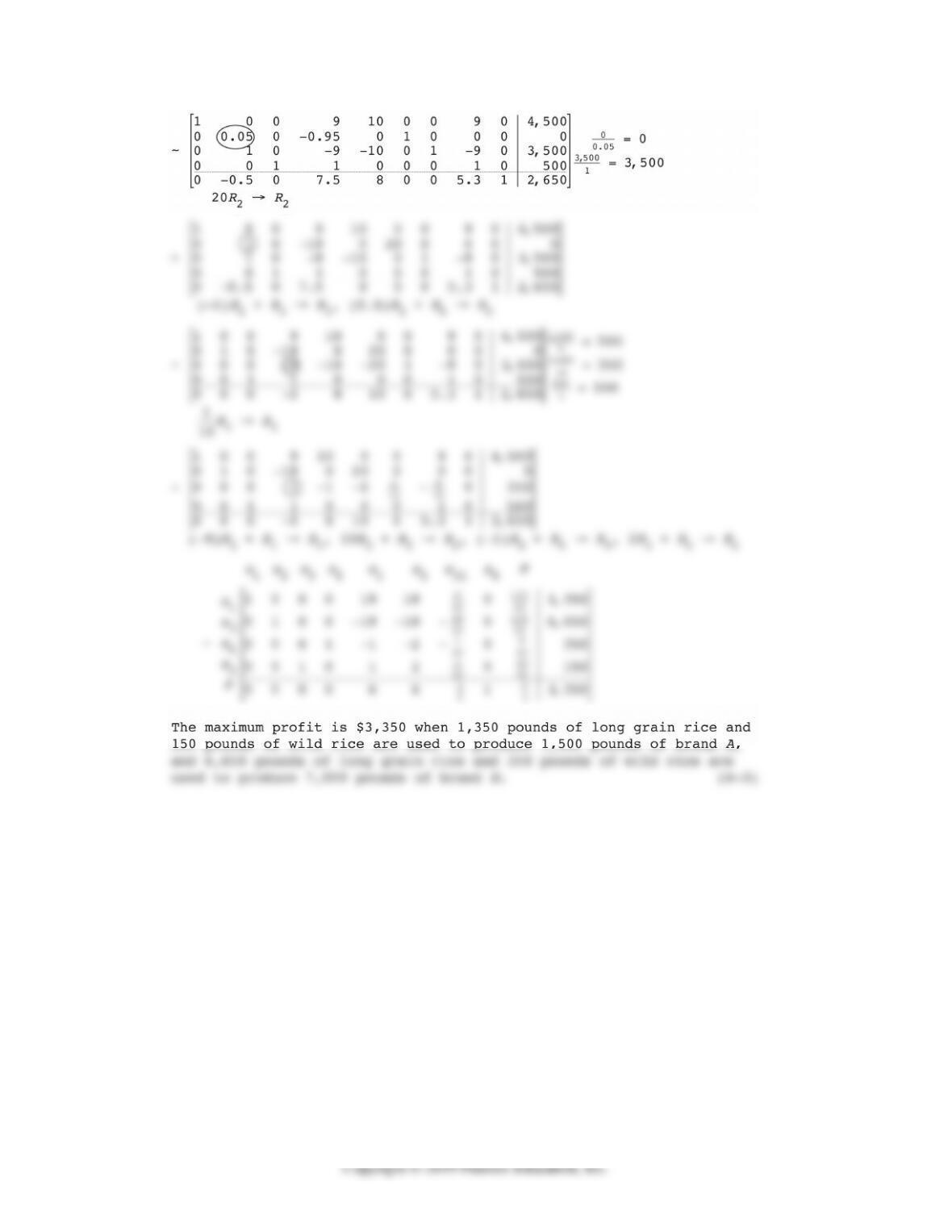
41. Let x1 = number of pounds of long grain rice in Brand A
x2 = number of pounds of long grain rice in Brand B
x3 = number of pounds of wild rice in Brand A
x4 = number of pounds of wild rice in Brand B
0.05x2–0.95x4 ≤ 0
x1 + x2 ≤ 8,000
x3 + x4 ≤ 500
Copyright © 2019 Pearson Education, Inc.
6-104 CHAPTER 6: SIMPLEX METHOD