21
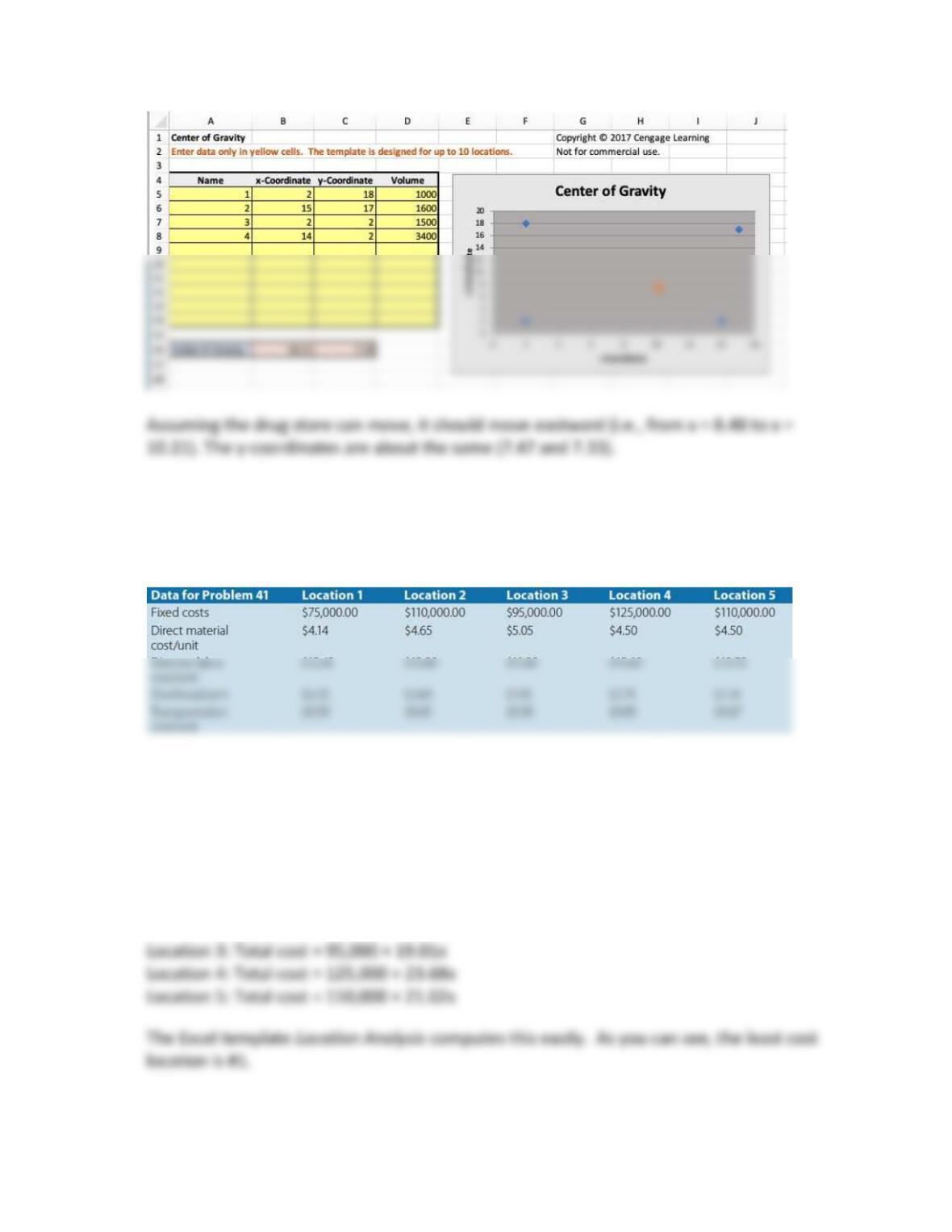
41. Cunningham Products is evaluating five possible locations to build a distribution center.
Data estimated from the accounting department are provided below. The annual
production is estimated to be 30,000 units.
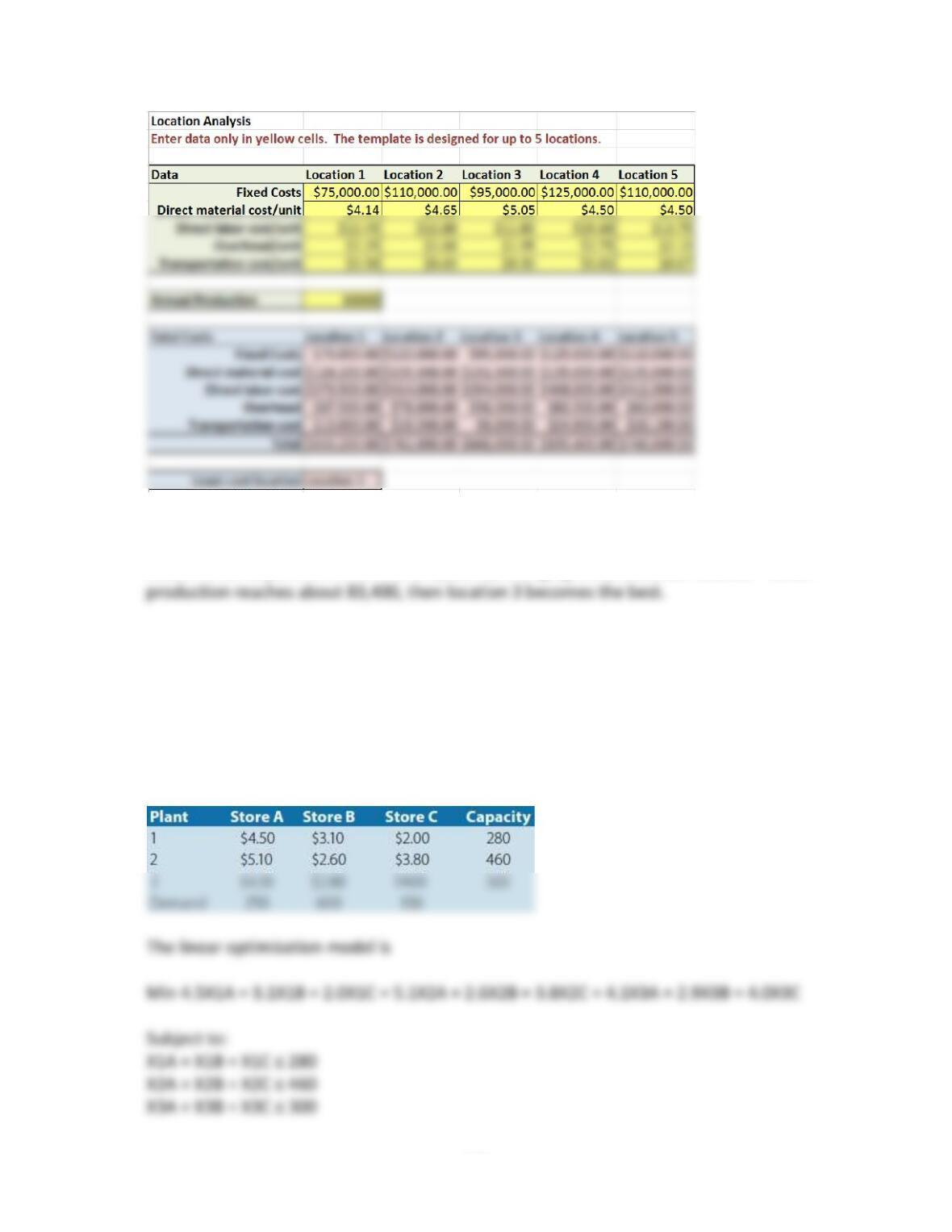
a. Use the Location Analysis Excel template to determine the location that provides the
least cost?
For each location, the total cost is equal to the fixed cost plus the variable cost per unit
times the annual volume.
Location 1: Total cost = 75,000 + 19.34x
Location 2: Total cost = 110,000 + 21.70x
22
b. How would your answer change as the production volume increases?
Students can experiment with the template by changing the production volume. When
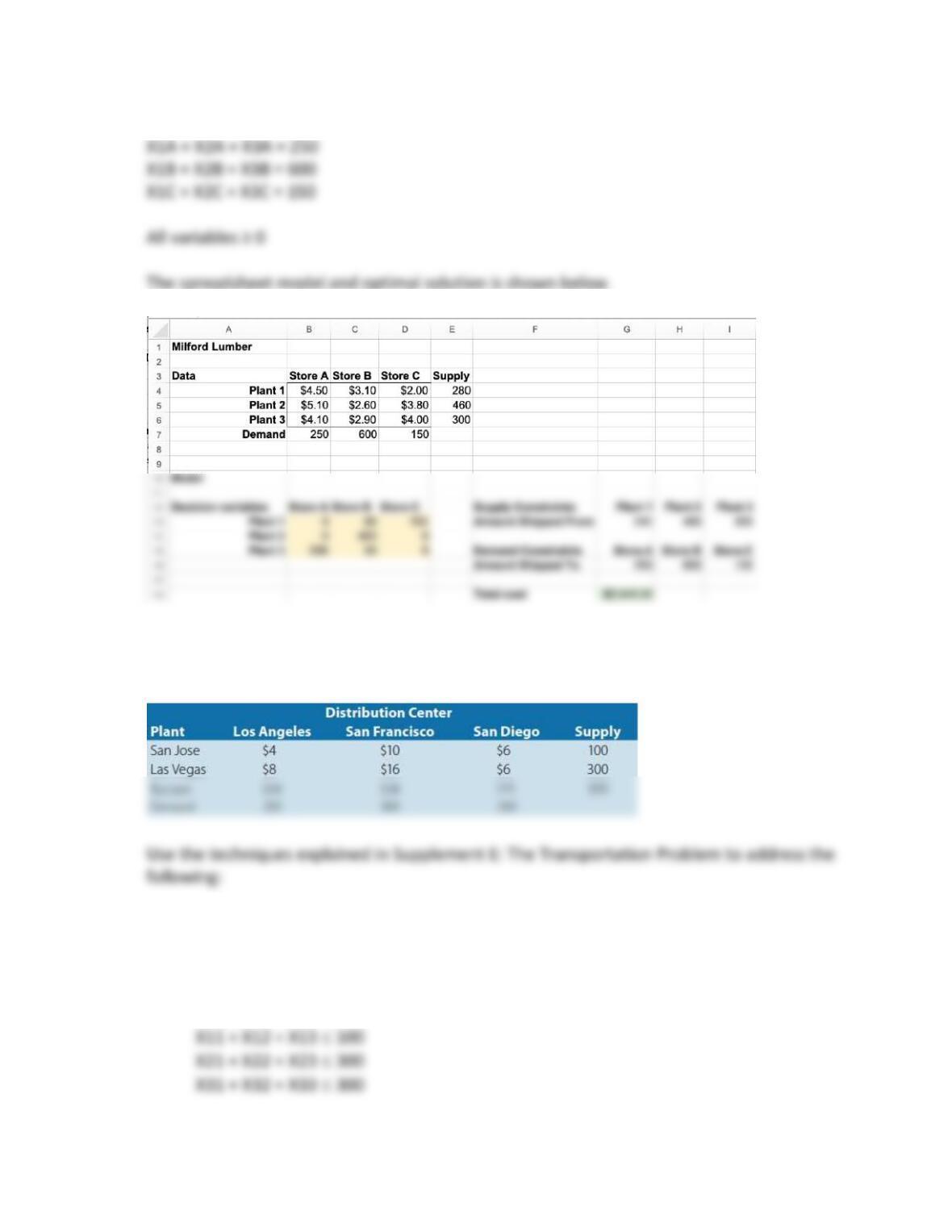
42. Milford Lumber Company ships construction materials from three wood-processing plants
to three retail stores. The shipping cost, monthly production capacities, and monthly
demand for framing lumber are given below (these data are available in the Excel
worksheet Milford Lumber in MindTap). Formulate a linear optimization model for this
problem, implement your model on a spreadsheet, and use Excel Solver to find a solution
that minimizes total distribution costs. See Supplement E for a discussion of modeling and
solving transportation problems.
23
43. Consider the following transportation problem data for Baker Industries (these data are
available in the Excel worksheet Baker Industries on MindTap):
a. Formulate the linear optimization model to minimize total cost.
Min 4X11 + 10X12 + 6X13 +8X21 + 16X22 + 6X23 + 14X31 + 18X32 + 10X33
Subject to:
24
X11 + X21 + X31 = 200
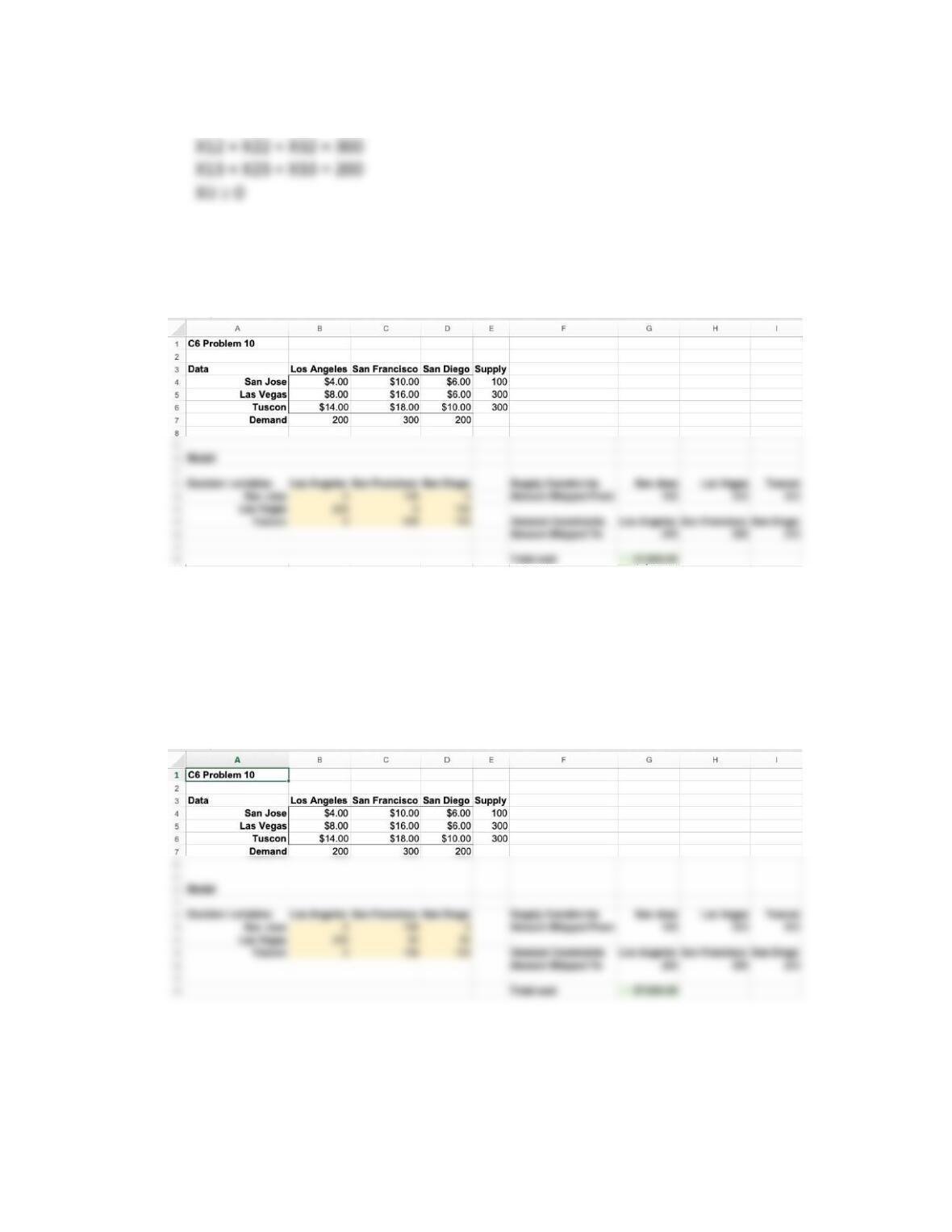
b. Implement your model on a spreadsheet and use Excel Solver to find an optimal solution.
One solution is
Total cost = $7800. Alternate solutions exist.
c. How would the optimal solution differ if we must ship 150 units on the Tucson to San
Diego route? Explain how you can modify the model to incorporate this new information.
Add a constraint: X33 = 150. This changes the solution to
Total cost is now $7900.
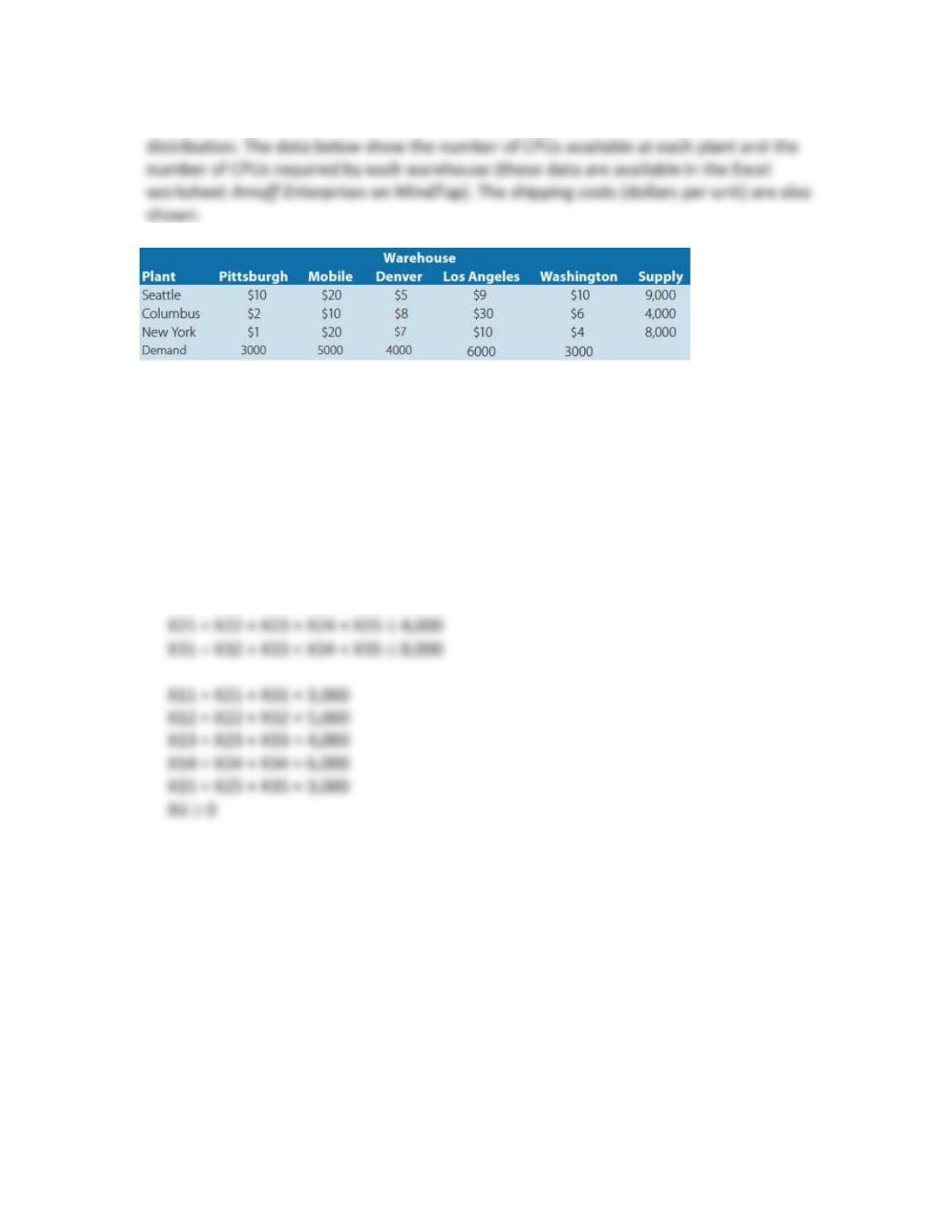
44. Arnoff Enterprises manufactures the central processing unit (CPU) for a line of personal
computers. The CPUs are manufactured in Seattle, Columbus, and New York and shipped
25
to warehouses in Pittsburgh, Mobile, Denver, Los Angeles, and Washington, DC for further
a. Formulate a linear optimization model for this problem, implement your model on a
spreadsheet, and use Excel Solver to find a solution to determine the number of CPUs that
should be shipped from each plant to each warehouse to minimize the total transportation
cost.
Min 10X11 + 20X12 + 5X13 + 9X14 +10X15 + 2X21 + 10X22 + 8X23 + 10X24 + 4X25 +
1X31 + 20X32 + 7X33 + 10X34 + 4X35
Subject to:
X11 + X12 + X13 + X14 + X15 9,000
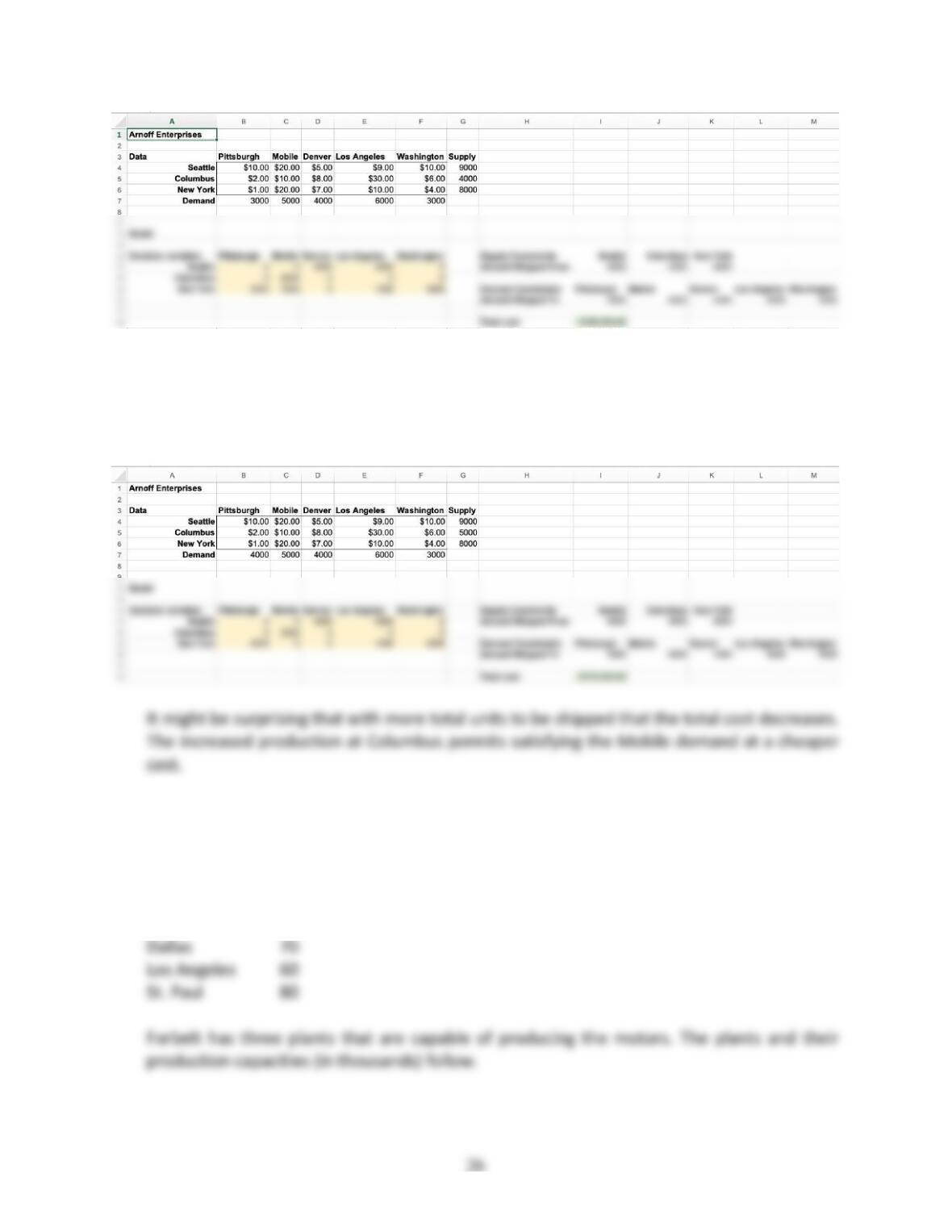
b. The Pittsburgh warehouse has just increased its order by 1,000 units, and Arnoff has
authorized the Columbus plant to increase its production by 1,000 units. Do you expect this
development to lead to an increase or a decrease in the total transportation cost? Solve for
the new optimal solution.
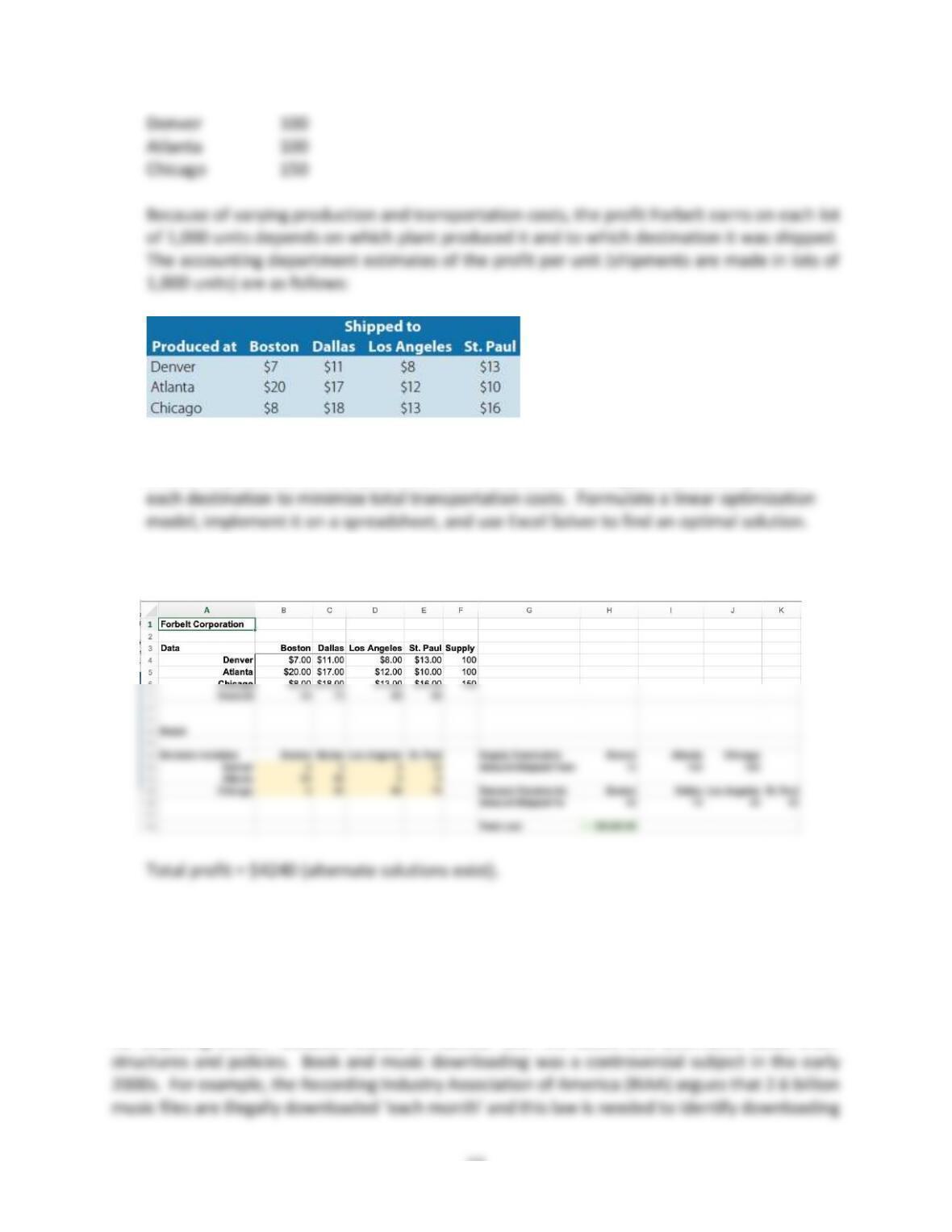
45. Forbelt Corporation has a one-year contract to supply motors for all refrigerators produced
by the Ice Age Corporation. Ice Age manufactures the refrigerators at four locations around
the country: Boston, Dallas, Los Angeles, and St. Paul. Plans call for these numbers (in
thousands) of refrigerators to be produced at the four locations.
Boston 50
27
Given profit maximization as a criterion, Forbelt would like to determine how many motors
should be produced at each plant and how many should be shipped from each plant to
In the Solver model, students much choose Max for the objective function!
Teaching Note: Bookmaster: Value Chain Design
Overview
The objective of the case is to study bricks and mortar versus internet-based value chain design
28
Case Questions for Discussion:
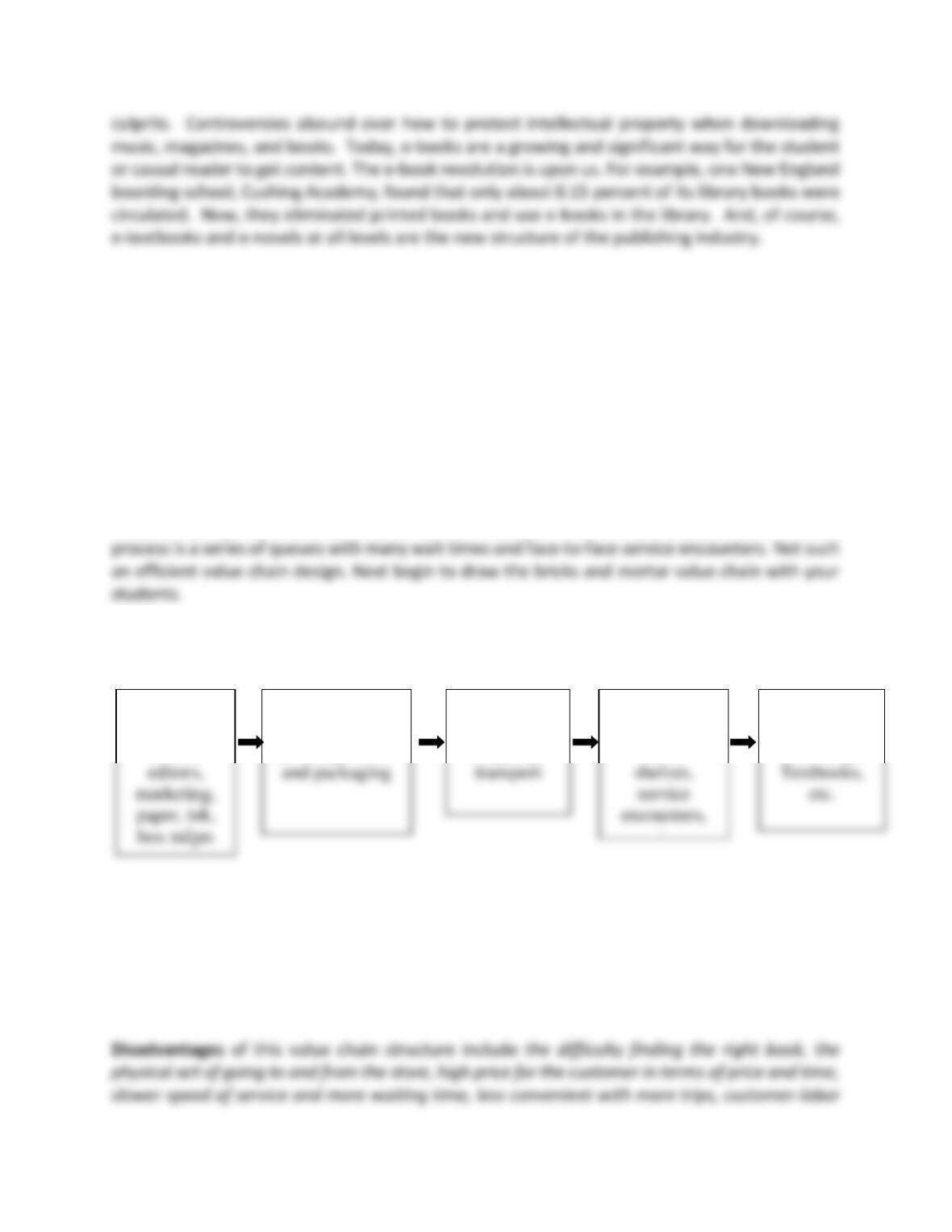
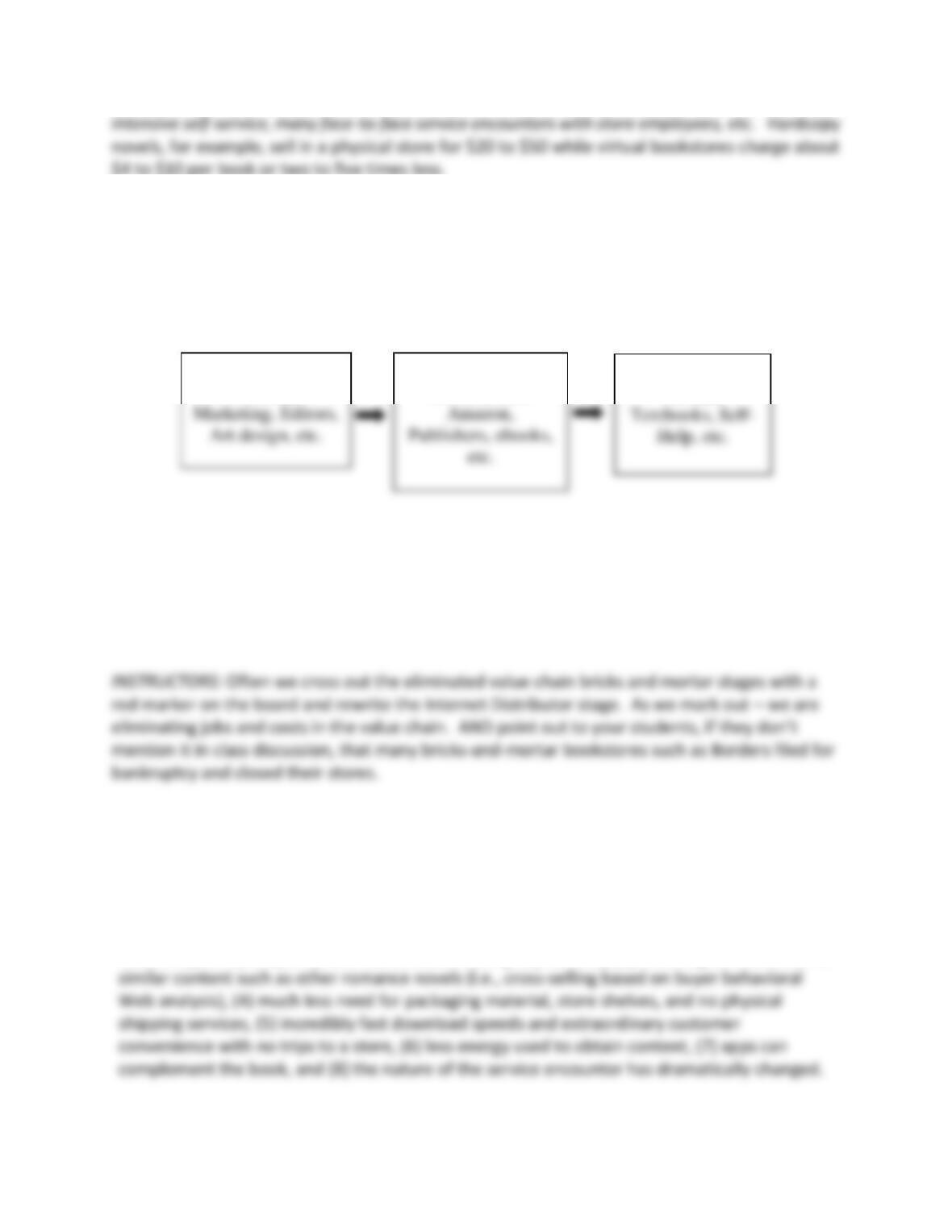
1. Draw the “bricks and mortar” process stages of the value chain by which hard copy books
are created, produced, distributed, and sold in retail stores. How does each player in the
value chain make money? (Hint: You can use the exhibits in previous chapters, such as
Exhibit 1.4, to help you identify major stages in the value chain. The value chain begins with
suppliers.)
The case begins by describing the huge number of physical and inconvenient tasks involved in a
customer going to a bookstore in your vehicle to search for and buy a physical book. Such a
Students can describe how the traditional (bricks and mortar) value chain works.
Advantages of this bricks and mortar value chain include control over the artistic content and
entire value chain, high prices for suppliers, distributors and retail stores; easier to catch cheaters
duplicating content, and control, control and control by management, etc.
Suppliers
Authors,
artists,
Distributors
Warehouses,
shipping,
Retail Stores
Books, help
desks,
Traditional Book Bricks and Mortar Value Chain (5 stage view)
Customers
Novels,
Self-Help,
Manufacturers
Factories for
printing books
29
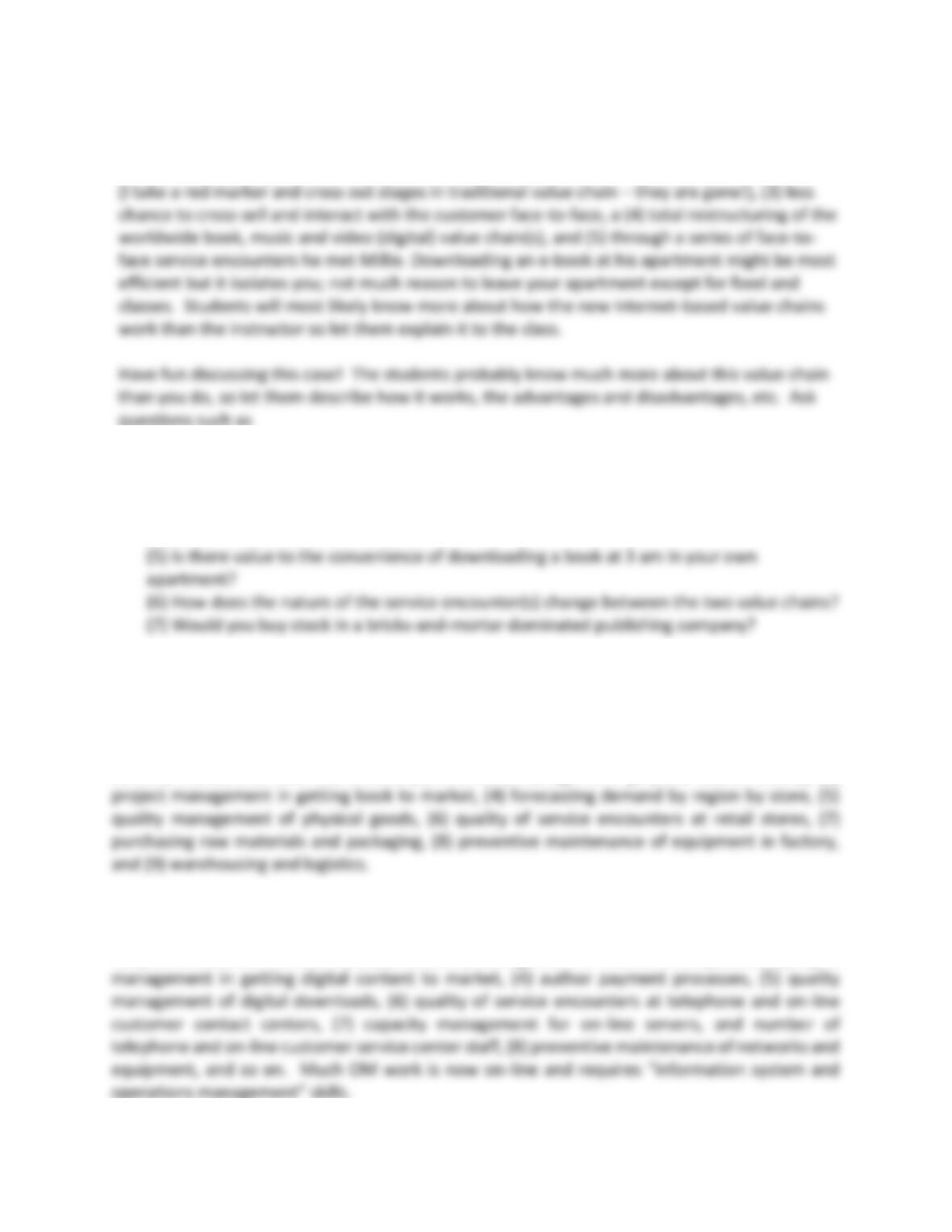
2. Draw the process stages for creating and downloading an e-book today. How does each
player in this new electronic/digital value chain make money?
In such an Internet-based on-line value chain, there is little need for expensive and physical
retail stores. Customers can download books in their homes, automobile, office, or when
walking around the wireless neighborhood or city at their convenience. The Internet is a
disruptive technology that is dramatically reducing the costs (price) as it restructures the value
chain.
3. Compare and contrast value chain design and structure in the previous two questions
from customer and management viewpoints. What are the advantages and disadvantage
to each value chain design?
Advantages of an Internet-based value chain include (1) much lower prices for suppliers,
distributors and customers, (2) ability to customize to meet individual tastes including selling a
novel chapter by chapter (mass customization using self-service), (3) referring the customer to
Suppliers
Authors,
Internet
Distributors
Today’s Book Internet-based (Digital) Value Chain (3 stages)
Customers
Novels,
30
Disadvantages of an Internet-based value chain focus on (1) eliminating the economic
incentive for artists to write books (Can e-providers protect the author’s intellectual
property?), (2) jobs lost at retail stores, factories, transportation firms all along the value chain
(1) How long does it take a customer to buy a book in a store?
(2) How long does it take you to download one book on-line?
(3) What is the percent improvement in processing time?
(4) What is the cost of a downloaded?
4. What is the role of operations in each of these value chain designs and structures?
What role does operations management play in this traditional bricks and mortar value chain?
Students may give examples and mention OM areas such as (1) scheduling recording sessions,
delivery trucks, and retail store staff, (2) inventory management (physical assets—books), (3)
What role does operations management play in an e-based value chain? Students may give
examples and mention OM areas such as (1) scheduling recording sessions and on-line and
telephone customer service staff, (2) inventory management of files on a computer, (3) project
31
Teaching Plan
You can read this case in class in ten minutes and then discuss. We put much of this on the
board especially the two drawing of a five versus three stages value chain, and advantages of
each. You can get prices of actual books on-line versus hardcopy to highlight prices. Some
general lessons include:
(a) A disruptive technology called the Internet is redefining the value chain in this industry,
“Publishers are selling drinks on the Titanic.”
(b) Price and cost and speed reductions are dramatic,
(c) The nature of the service encounters are greatly changed,
This case also ties to the Chapter 4 (Technology & OM) discussion of high or low scalability.
Today’s on-line downloading value chain is highly scalable (i.e., the incremental cost of one
additional book download is close to zero for the on-line provider). Have fun with this case!
Teaching Note: Boston Red Sox Spring Training Decision
Overview
The objective of case study is to introduce students to the complexity of location decisions and
32
Case Questions for Discussion:
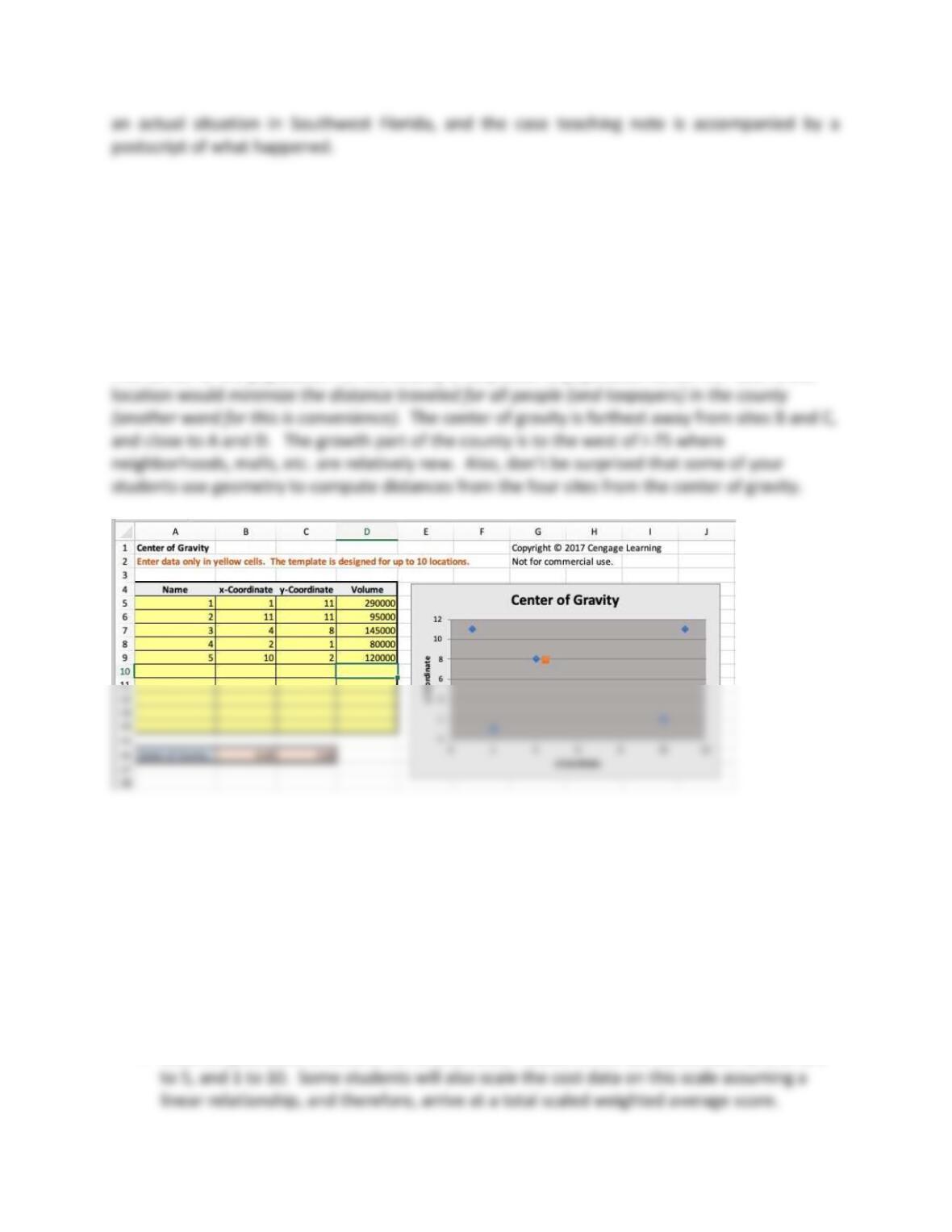
1. Using the center-of-gravity model and Exhibit 6.12, compute the center of gravity for the
population of the county. Show all computations, explain, and justify. Based solely on this
criterion, where is the best stadium location?
The exhibit at the end of this TN computes the center of gravity to be Cx = 4.49 and Cy = 7.83.
2. Using a weighted scoring model of your own design what are the summary scores for each
stadium site for the qualitative criteria in Exhibit 6.13. (You must decide how to scale and
weight each criterion and whether to include or not include cost estimates.) Show all
calculations and explain your approach. You might wish to use Excel to perform these
calculations. The data in Exhibit 6.12 are available in the Excel worksheet Red Sox Case
Data on MindTap.
A few characteristics of good scoring models include:
• Scale all qualitative criteria on an ordinal scale. Students will use scales such as 1 to 3, 1
33
3. How will you combine these results (your center–of-gravity results. cost, and qualitative
criteria analyses? How might you compute a summary score for each site using all three
criteria? Explain and justify.
Most undergraduate students will have difficulty confronting how to combine such data (i.e.,
the multiple criteria decision making problem) so expect a weak or incomplete answer here.
Assuming they have performed a good center of gravity analysis and a weighted average
analysis of qualitative criteria and costs. How might you combine these divergent performance
results?
Student approaches include:
• 1st use the center of gravity model to exclude (screen) any sites that are too far from the
center of the county’s population (i.e., sites B and C are quickly excluded)
4. Research and explain at least three ways a sports stadium can “go green” including at
least one work practice for stadium employees. Do jobs and processes have to change
too? Explain the role of OM.
Building Design
34
• Catch rain water and use irrigation (computer control systems)
• Solar panels and generate a high percentage of total stadium power (ideally the stadium
powers itself)
Supply Chain
• Use biodegradable cleaning chemicals (e-friendly)
• Use biodegradable and e-friendly fertilizer and grass seed
Work practices
• Pay all stadium employees using electronic methods (no paper or cash; use PayPal, e–
Pay)
• Employees collect plastic and other recyclables before, during, and after the game.
5. What is your final stadium recommendation? Explain and justify.
Most students will select Site A since it is close to the university, shopping mall Y, an existing
8,000 seat indoor arena, population center #3, and has the huge potential for a retail and
leisure service cluster that could host high school, state, and national sporting events. Based on
35
the case information this is a very good choice but in the real decision, Site A became City
Council’s second choice.
Postscript
The City Council decided on Site D arguing it would jump start development of the commercial
industrial park next to the airport, be close to the major population of the county, the county
Teaching Strategy
You can begin class by saying that the case involves a location decision of a leisure service
facility and you might want to read the quote — (A great servicescape and facility layout
36
Boston Red Sox Spring Training Decision Case Study Analysis
Center-of-Gravity Model
Location Coordinates
Total In and Outbound
Population Center No.
X
Y
Population
1
1
11
290,000
2
11
11
95,000
3
4
8
145,000
4
2
1
80,000
5
10
2
120,000
Total County Population
730,000
Population Center–of-Gravity
Cx =
4.49
Cy =
7.83
Cost per Site Model*
Weights
Site A
Site B
Site C
Site D
Stadium land cost
18
22
0
22
Additional utility cost
1
0.5
3
New road cost
2
15
2
Total cost (in million $)
Qualitative Model*
Weights
Site A
Site B
Site C
Site D
Gain envir endorsement
0.20
4
0
0
5
Traffic access congest
0.20
4
1
1
3
Shortest permit time
0.20
5
4
0
5
Long-term growth @ site
0.20
4
3
4
5
Chance to preserve
0.20
3
0
5
0
1.00
Weighted Average Site Score
1.60
3.60
*assume equal weights here
but read TN
$ Cost per Wt Ave Point =
$5,250,000
$14,375,000
$9,000,000
$6,805,556
Best
Integrative Case: Hudson Jewelers
A complete teaching note for all chapters is available in the Instructor Resources online.
Instructors should read the entire case and most of the case assignments at the end of each
chapter. Then decide if you want to assign all or part of the case questions.
Chapter 6 Case Questions for Discussion:
1. Explain whether the global diamond supply chain a push or pull system, and whether the
global diamond supply chain is an efficient or responsive system for make-to-order and
make-to-stock jewelry. Provide examples to justify your reasoning.
• A push system produces goods in advance of customer demand using a forecast of sales
and moves them through supply chain to points of sale where they are stored as finished
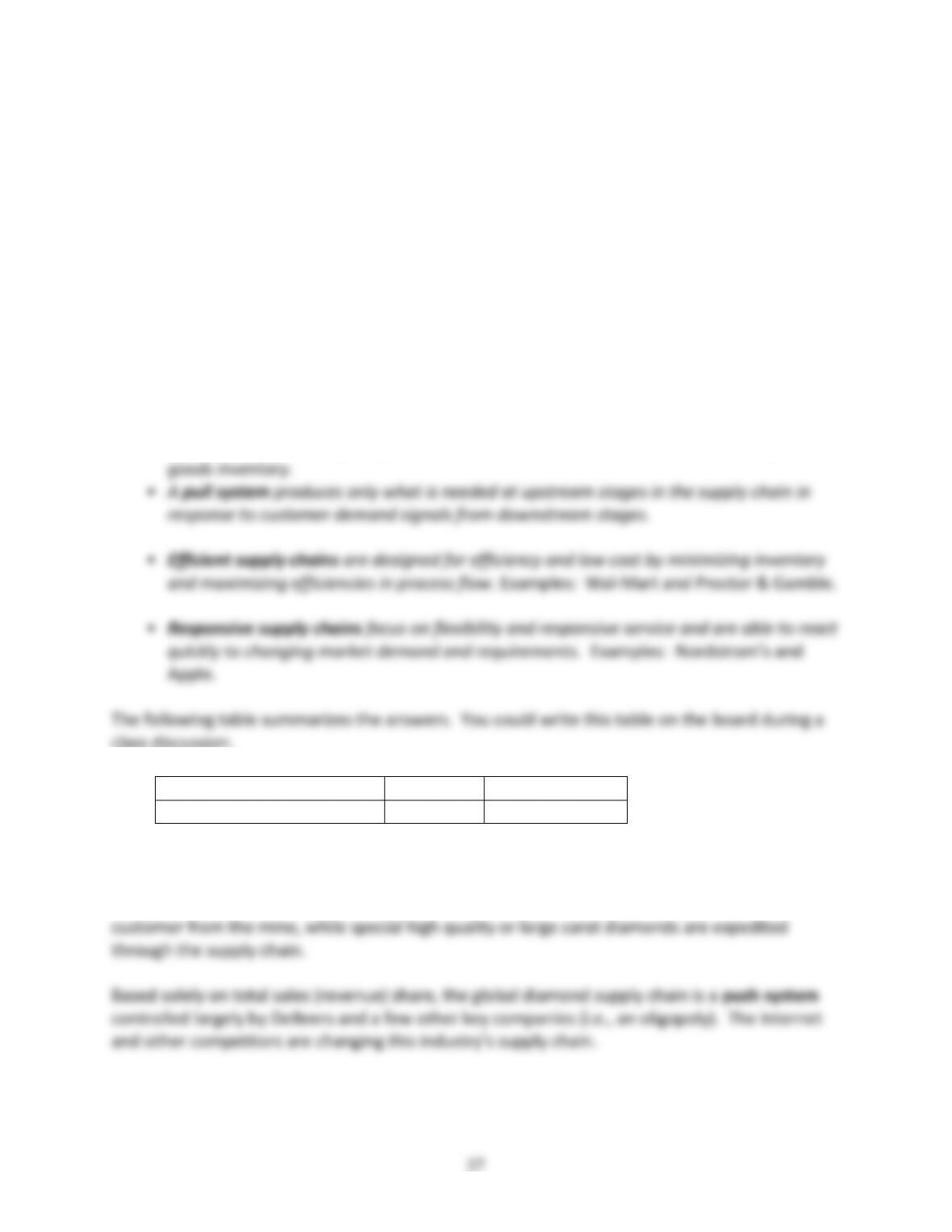
Make-to-Order (Custom)
Pull
Responsive
Make-to-Stock (Standard)
Push
Efficient
Standard and costume jewelry make up 80 to 95% of the total diamond market based on
market share or total sales. Customized jewelry is a much smaller part of the global diamond
market catering to high-end customers. Standard jewelry takes 18 to 36 months to reach the
38
2. Research the extent of vertical integration in the global (seven-stage) diamond supply
chain? Provide examples of forward and backward integration and the extent to which
this is practiced in today’s value chain? In this industry, what is the impact of vertical
integration?
• Vertical integration refers to the process of acquiring and consolidating elements of a
value chain to achieve more control.
You ask the class “What is the objectives of vertical integration?” Answer: To reduce costs,
speed things up, and control processes and their value chains.
The OM text cites firms like DuPont buying raw materials suppliers and integrating backwards
while firms like Delta Airlines integrated forward by buying a jet fuel refinery. The challenge for
students is to research the diamond value chain and its major stages (exploration, mining,
sorting and grading, cutting and polishing, trading centers, manufacturing jewelry, and retail
stores).
• The De Beers Group of Companies has a leading role in the diamond exploration,
diamond mining, sorting and grading, polishing and cutting, trading centers, and diamond
• DeBeers also has experimented with “diamond recycling” (reverse logistics) with a few
select retailers, where diamonds are cleaned up and recycled.
• Other competitors are much less integrated than DeBeers. For example, Tiffany’s has
39
• ALROSA, a Russian diamond company, with about 25-30% market share is also vertically
integrated by doing exploration, mining, manufacturing, and retailing.