EXERCISE 6-4 6-61
Copyright © 2019 Pearson Education, Inc.
31
0100012
22
3
2
R3 + R1 → R1,1
2
R3 + R2 → R2, 1
2
M
R3 + R4 → R4
0111 3 3 09
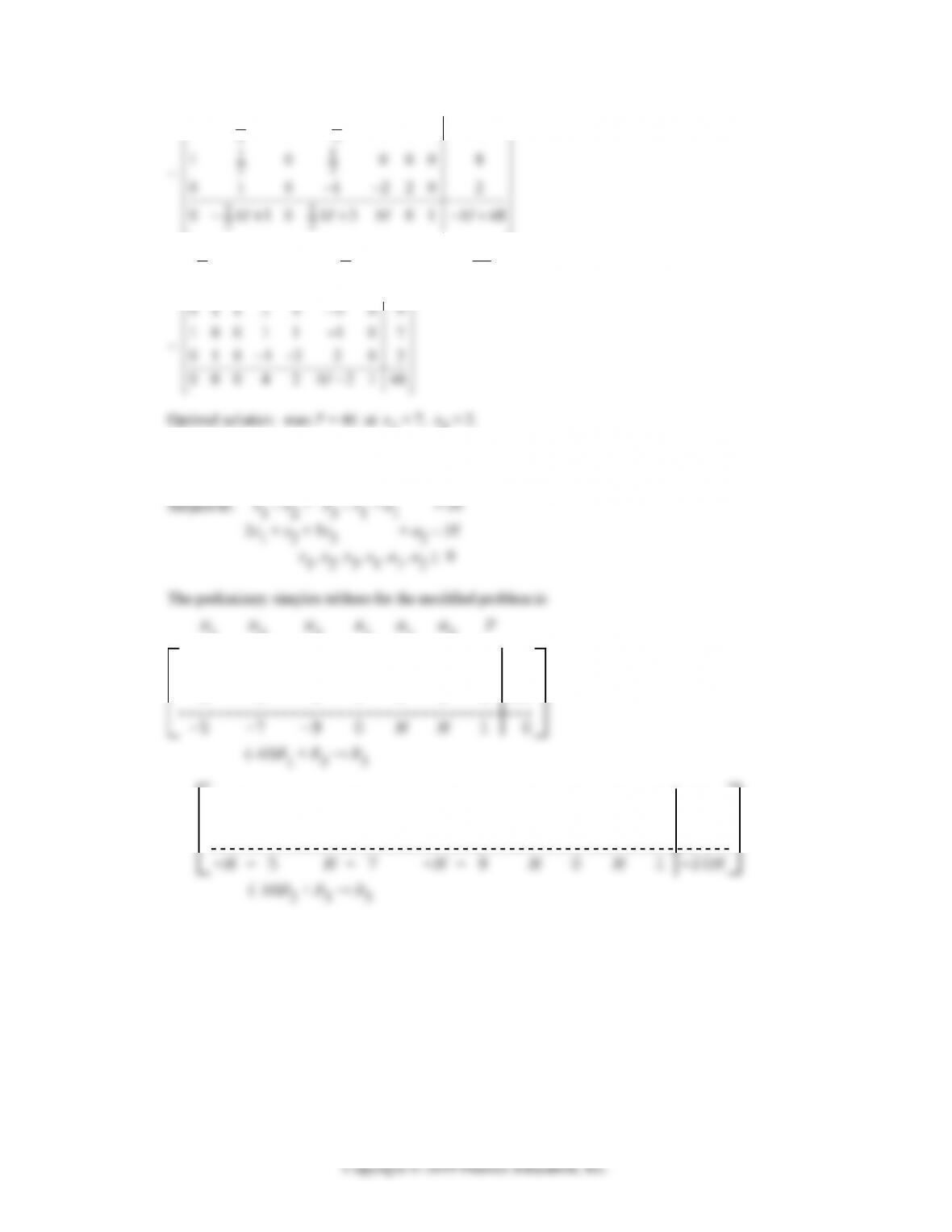
100 1 1 1 0 7
14. We introduce surplus and artificial variables to obtain the modified problem:
Maximize P = 5x1 + 7x2 + 9x3 – Ma1 – Ma2
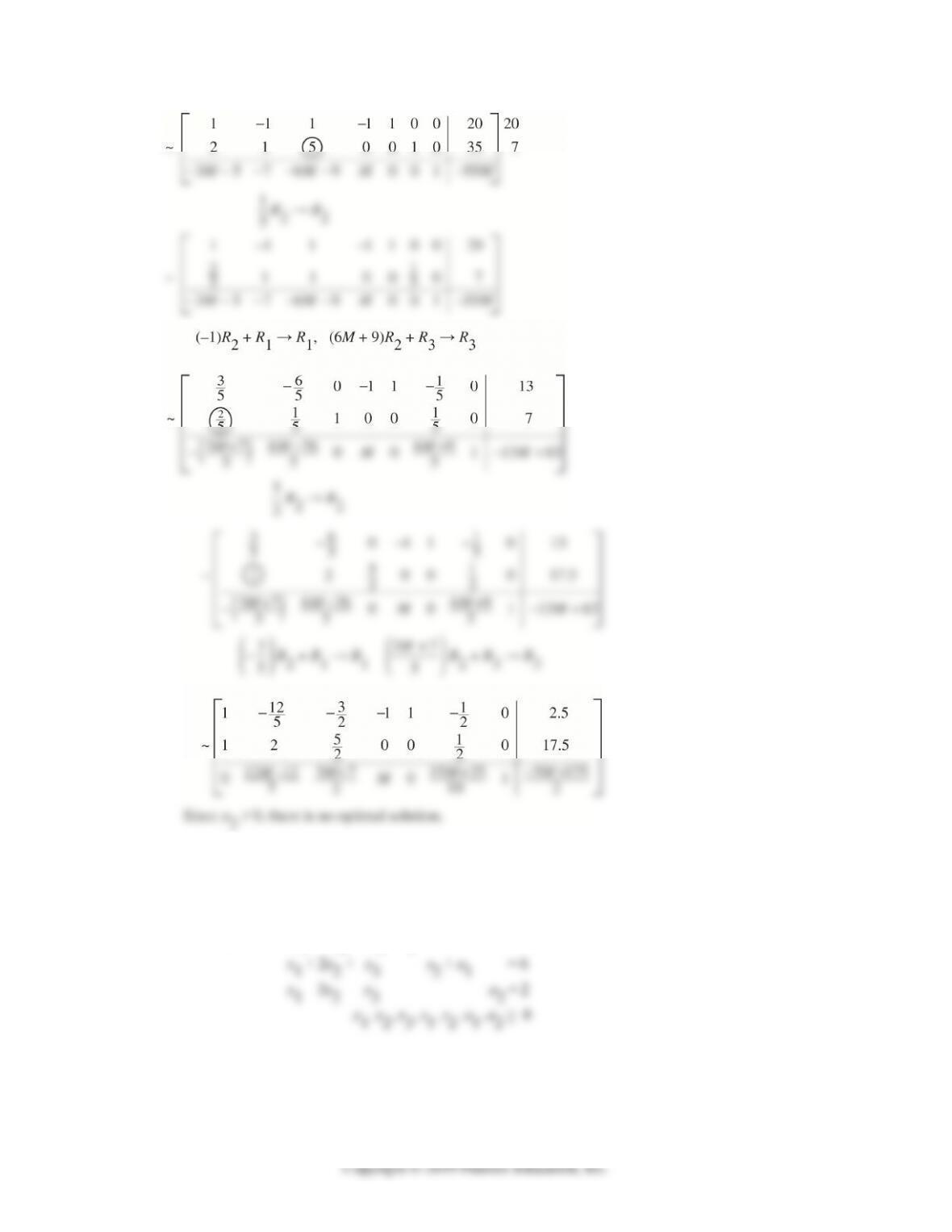
1-1 1–110020
215001035
1 –1 1 –110020
215 001035
~
6-62 CHAPTER 6: SIMPLEX METHOD
16. We will maximize P = –C = 3x1 – 15x2 + 4x3 subject to the given constraints. Introduce slack, surplus,
and artificial variables to obtain the modified problem:
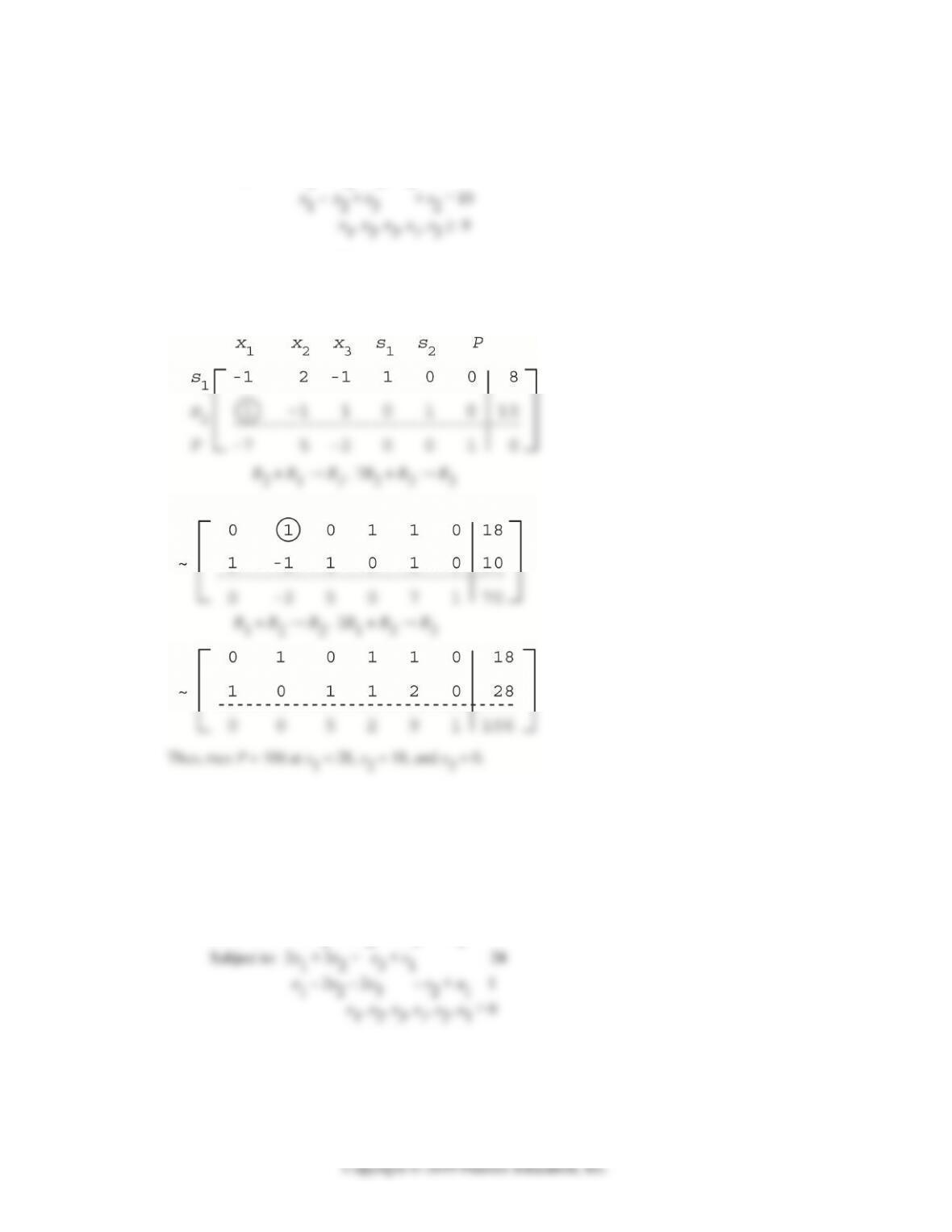
Maximize P = 3x1 – 15x2 + 4x3 – Ma1 – Ma2
Subject to: 2x1 + x2 + 3x3 + s1 = 24
EXERCISE 6-4 6-63
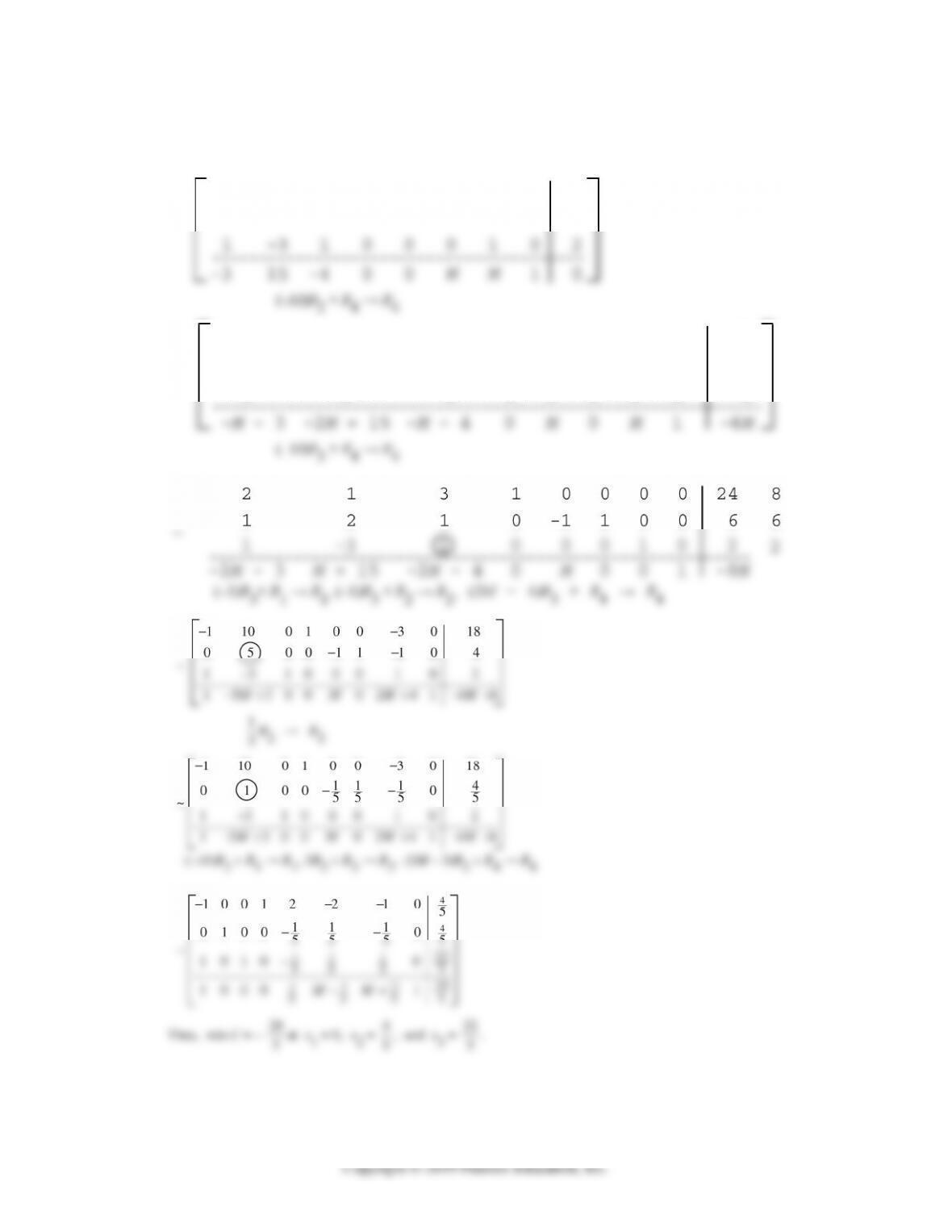
The preliminary simplex tableau for the modified problem is:
x1x2x3s1s2a1a2P
2 131000024
1 210–11006
~
2 1 3 10000 24
1 2 1 0–1100 6
1 –3 1 00010 2
6-64 CHAPTER 6: SIMPLEX METHOD
18. We introduce a slack and an artificial variable to obtain the modified problem:
Maximize P = 3x1 + 6x2 + 2x3 – Ma1
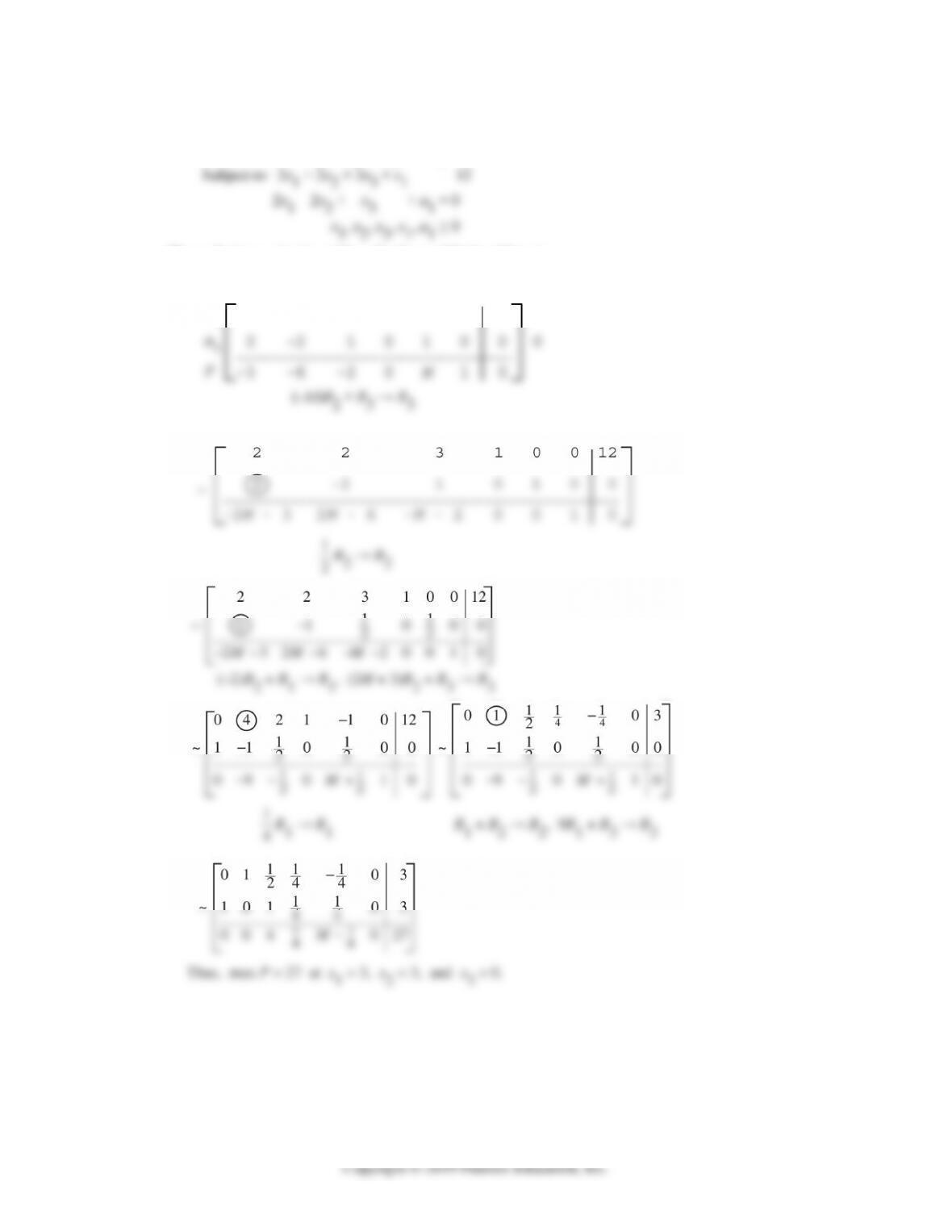
The preliminary simplex tableau for the modified problem is:
x1x2x3s1a1P
2 2 310012
s1
6
EXERCISE 6-4 6-65
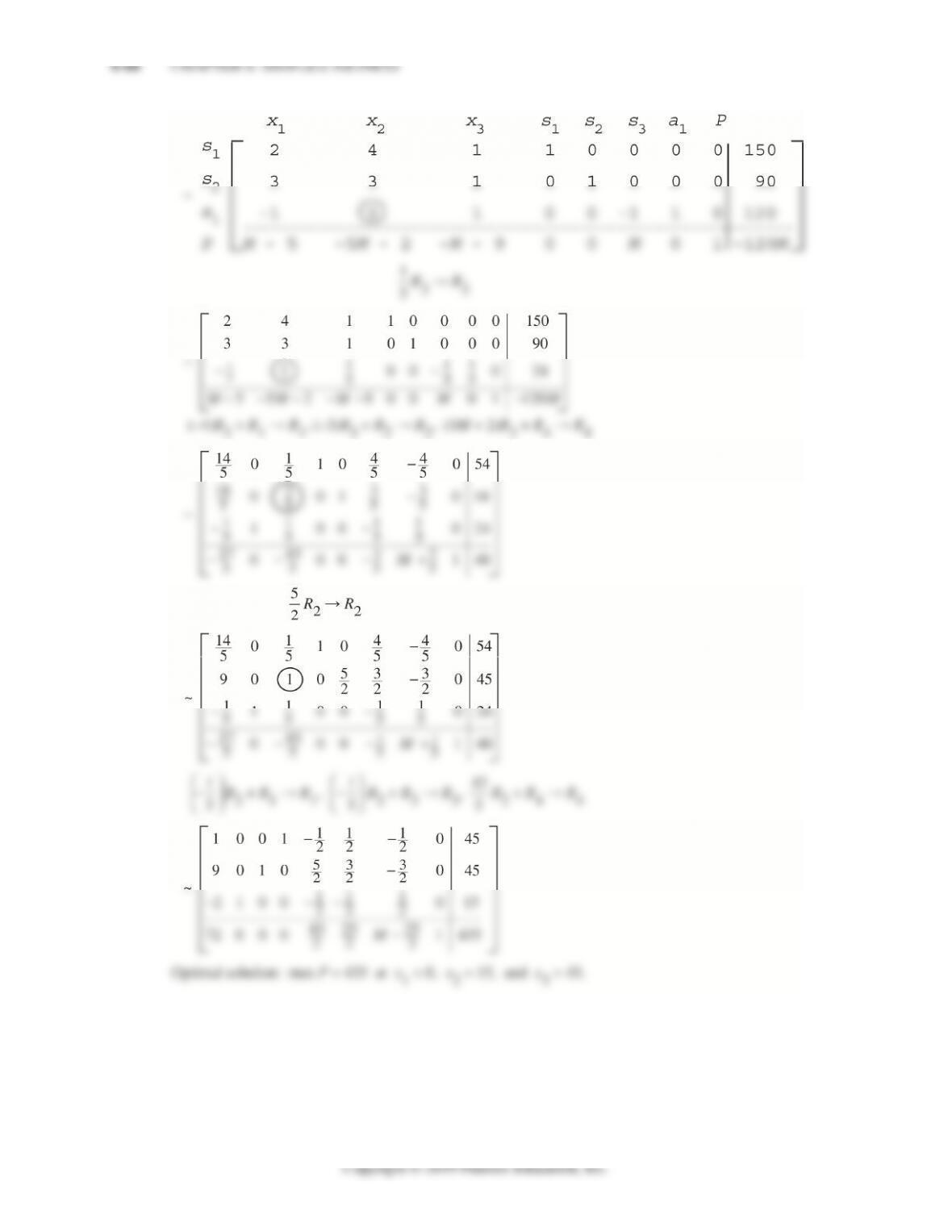
20. We introduce slack, surplus, and artificial variables to obtain the modified problem:
Maximize P = 5x1 + 2x2 + 9x3 – Ma1
Subject to: 2x1 + 4x2 + x3 + s1 = 150
The preliminary simplex tableau for the modified problem is:
x1x2x3s1s2s3a1P
24110000150
33101000 90
EXERCISE 6-4 6-67
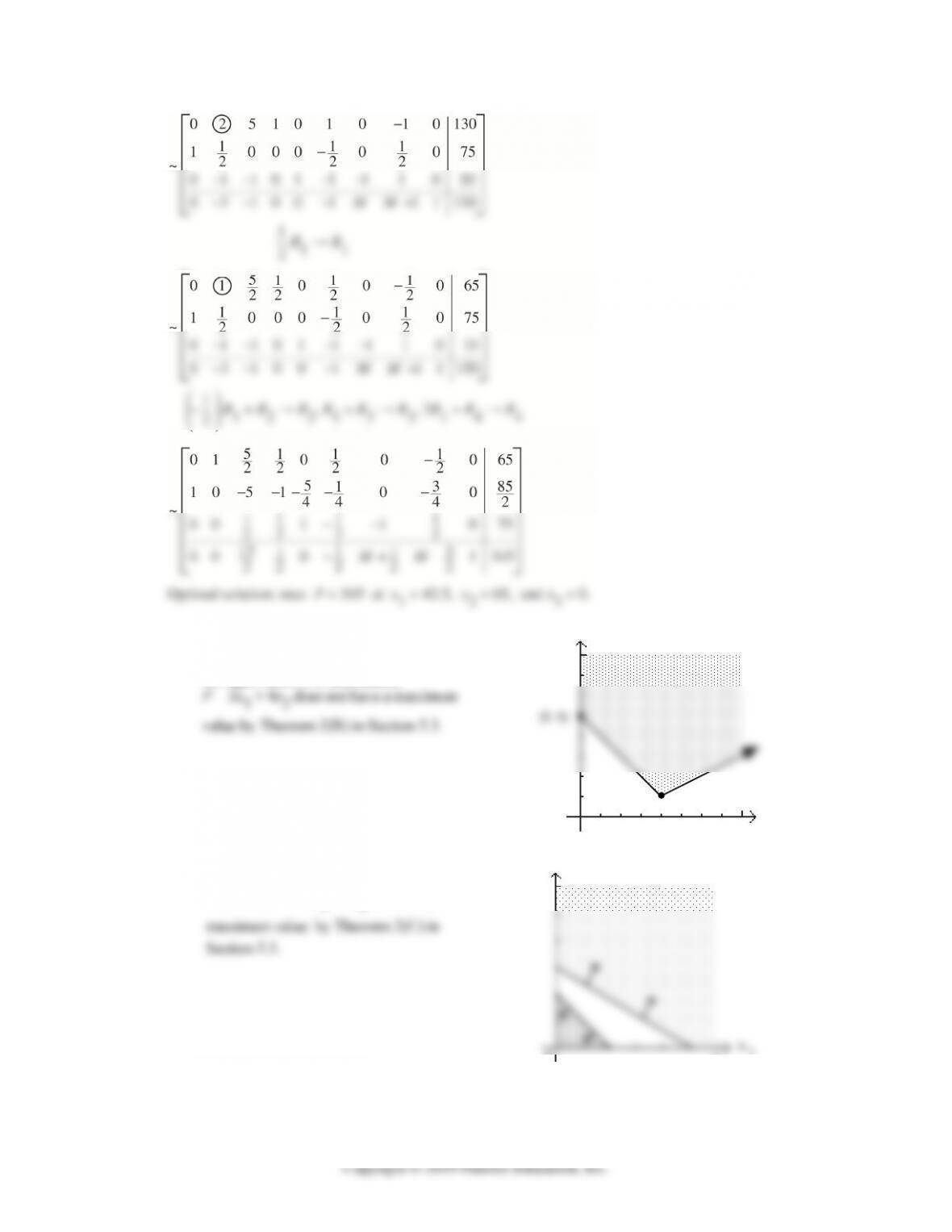
22. We introduce slack, surplus, and artificial variables to obtain the modified problem:
Maximize P = 2x1 + 4x2 + x3 – Ma1 – Ma2
Subject to: 2x1 + 3x2 + 5x3 + s1 = 280
The preliminary simplex tableau for the modified problem is:
6-68 CHAPTER 6: SIMPLEX METHOD
24. (A) Refer to Problem 6.
The graph of the feasible region is shown at
the right. Since it is unbounded,
8
8
x1
x2
(4, 1)
0
(B) Refer to Problem 8.
The graph of the feasible region is empty.
Therefore, P = 4x1 + 6x2 does not have a
6
6
x2
0
EXERCISE 6-4 6-69
26. Observe that the first constraint can be written as: –x1 + 2x2 – x3 ≤ 8.
We will maximize P = 7x1 – 5x2 + 2x3
Subject to: –x1 + 2x2 – x3 + s1 = 8
where
s1, s2 are slack variables.
The simplex tableau for this problem is:
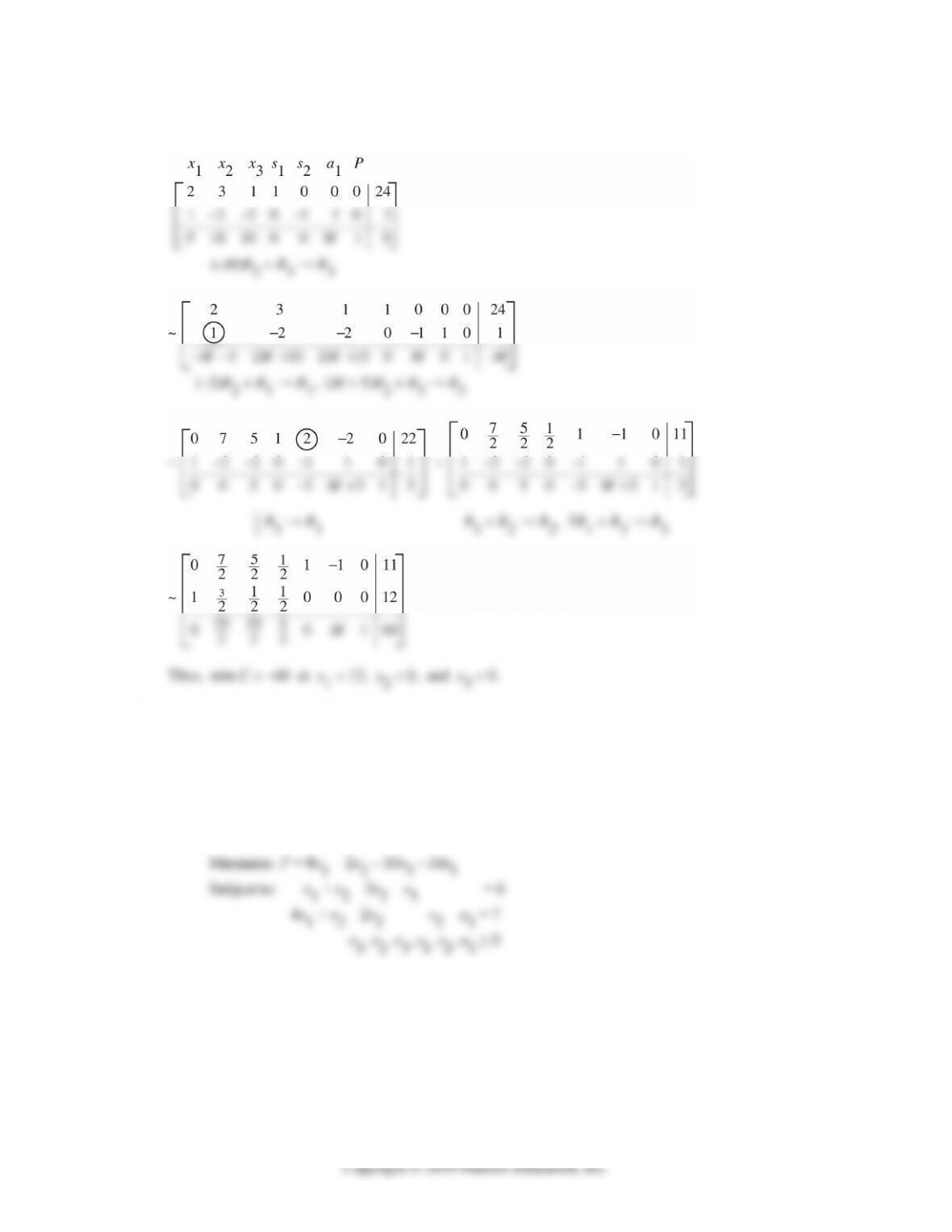
28. We will maximize P = –C = 5x1 – 10x2 – 15x3
Subject to: 2x1 + 3x2 + x3 ≤ 24
x1 – 2x2 – 2x3 ≥ 1
x1, x2, x3 ≥ 0
We introduce slack, surplus, and artificial variables to obtain the modified problem:
Maximize P = 5x1 – 10x2 – 15x3 – Ma1
6-70 CHAPTER 6: SIMPLEX METHOD
The preliminary simplex tableau for the modified problem is:
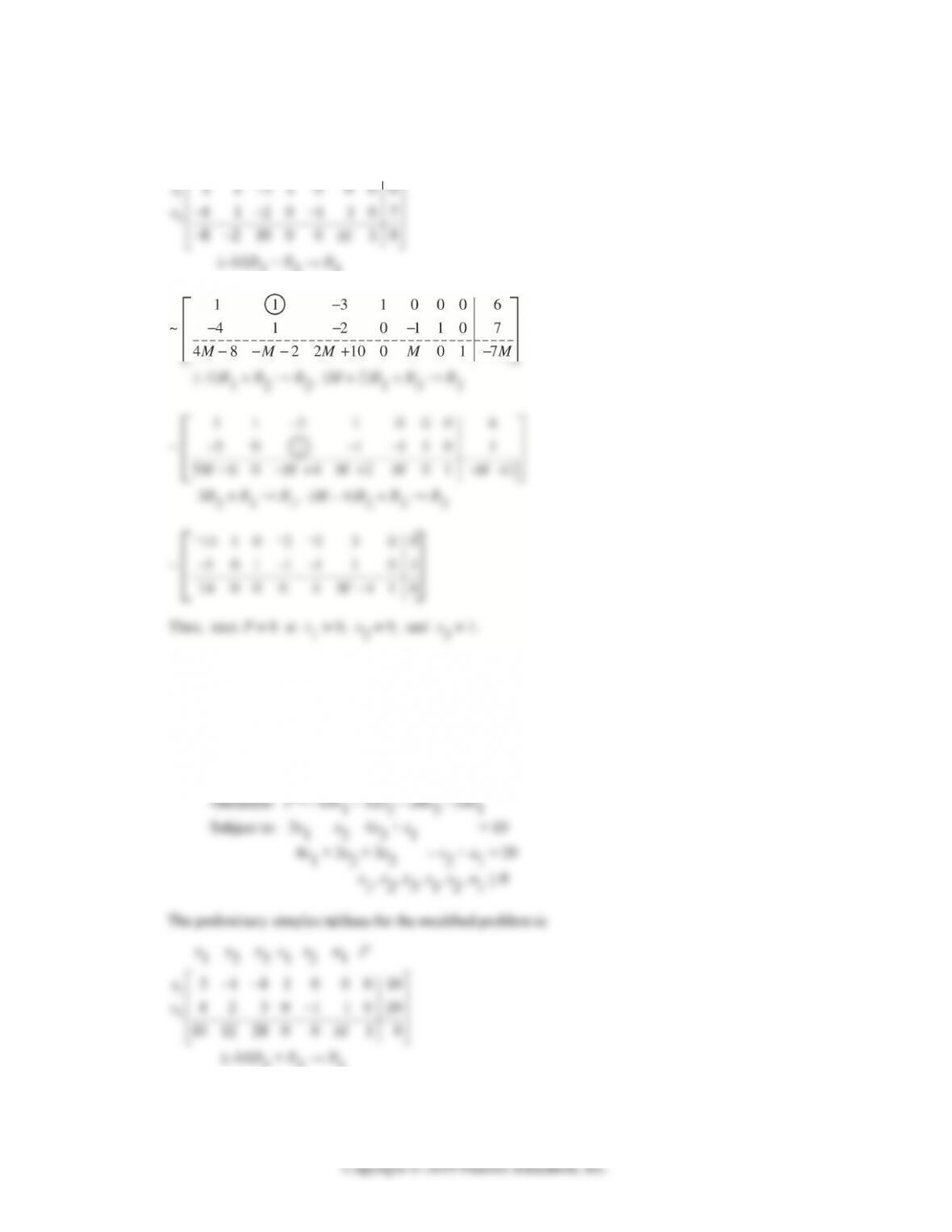
30. We maximize P = 8x1 + 2x2 – 10x3
Subject to: x1 + x2 – 3x3 ≤ 6
–4x1 + x2 – 2x3 ≥ 7
x1, x2, x3 ≥ 0
We introduce slack, surplus, and artificial variables to obtain the modified problem:
EXERCISE 6-4 6-71
The preliminary simplex tableau for the modified problem is:
x1 x2 x3 s1 s2
a1
P
11310006
s
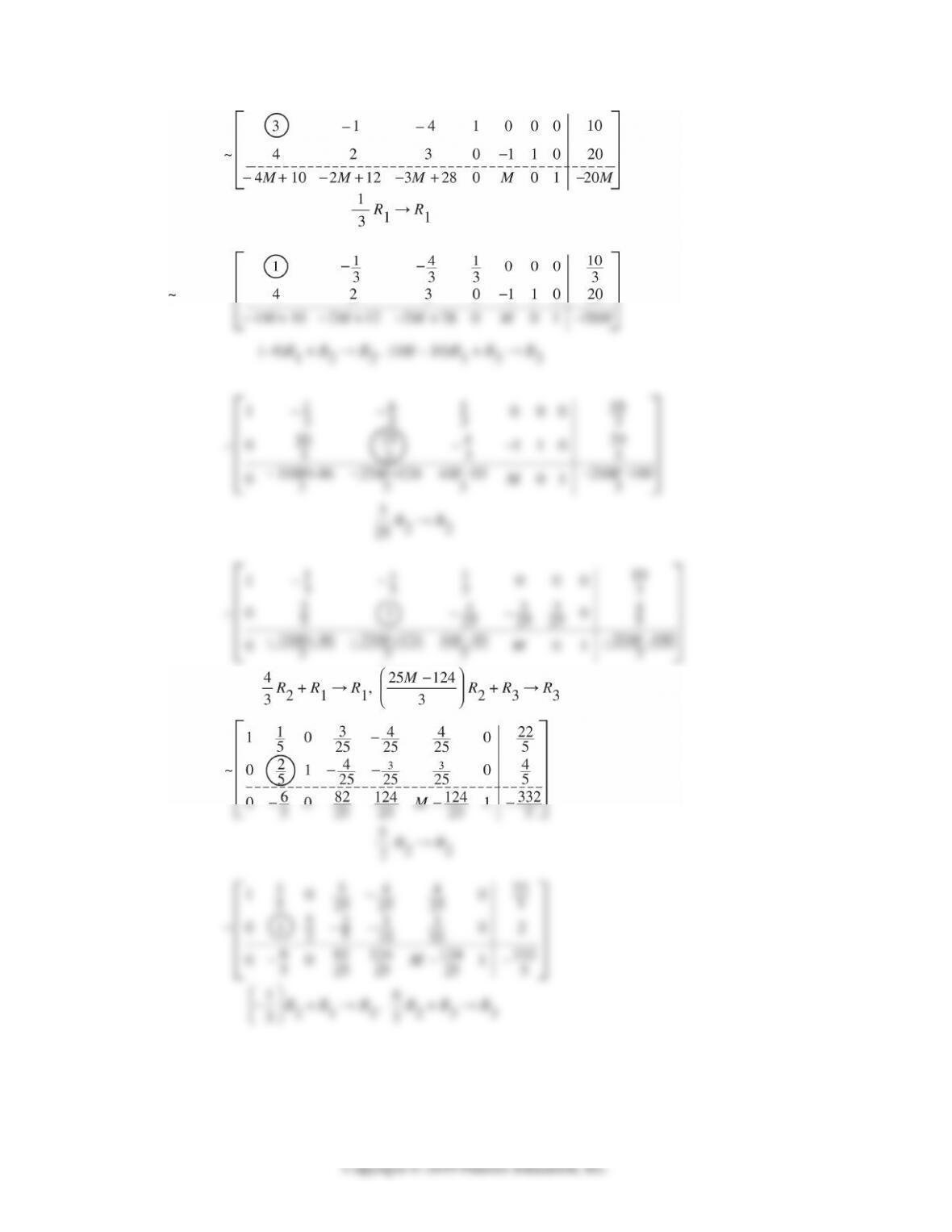
32. We will maximize P = –C = –10x1 – 12x2 – 28x3
Subject to: 3x1 – x2 – 4x3 ≤ 10
4x1 + 2x2 + 3x3 ≥ 20
x1, x2, x3 ≥ 0
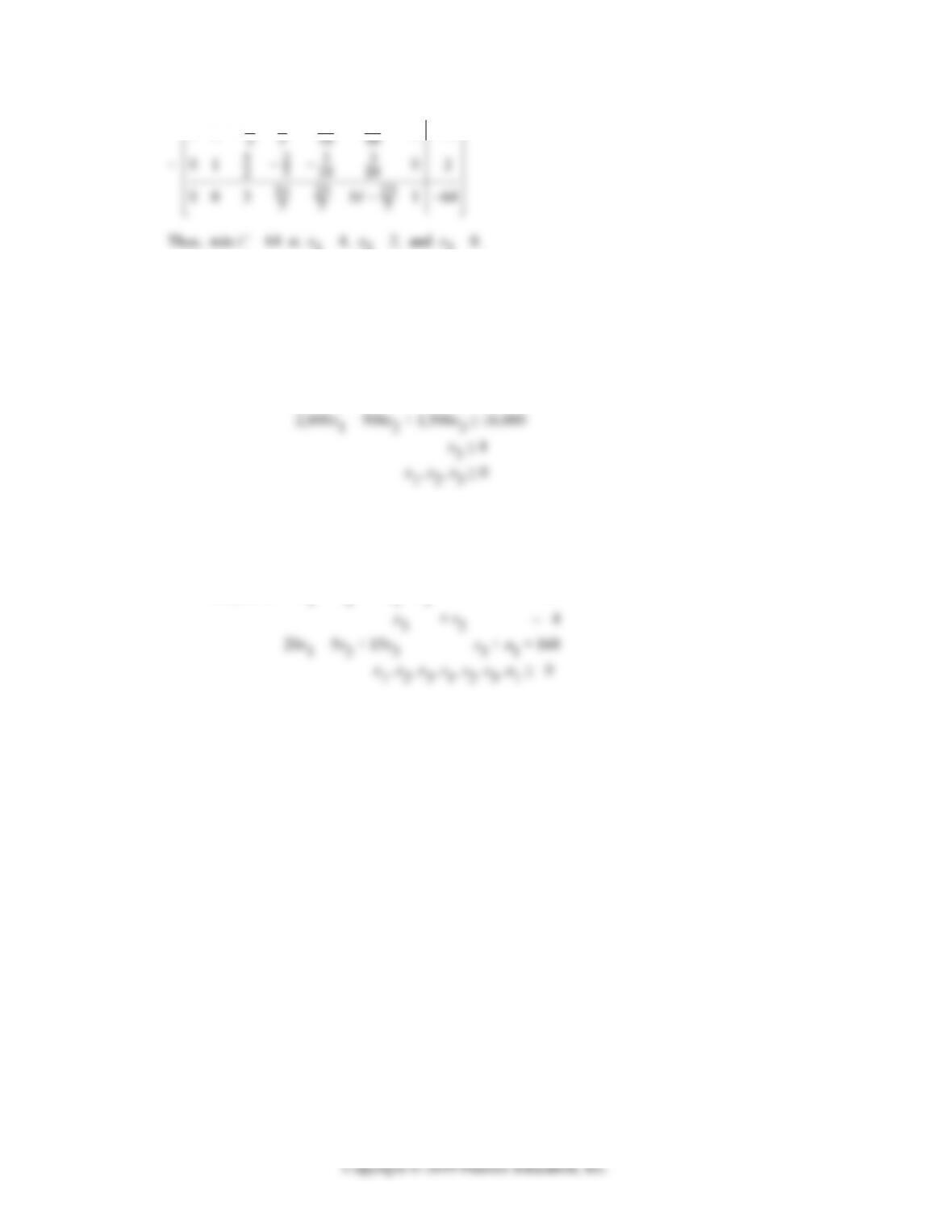
We introduce slack, surplus, and artificial variables to obtain the modified problem:
6-72 CHAPTER 6: SIMPLEX METHOD
EXERCISE 6-4 6-73
Copyright © 2019 Pearson Education, Inc.
11 1 1
10 0 4
34. Let x1 = the number of ads placed in the Sentinel,
x2 = the number of ads placed in the Journal,
x3 = the number of ads placed in the Tribune.
The mathematical model is: Minimize C = 200x1 + 200x2 + 100x3
Subject to: x1 + x2 + x3 ≤ 10
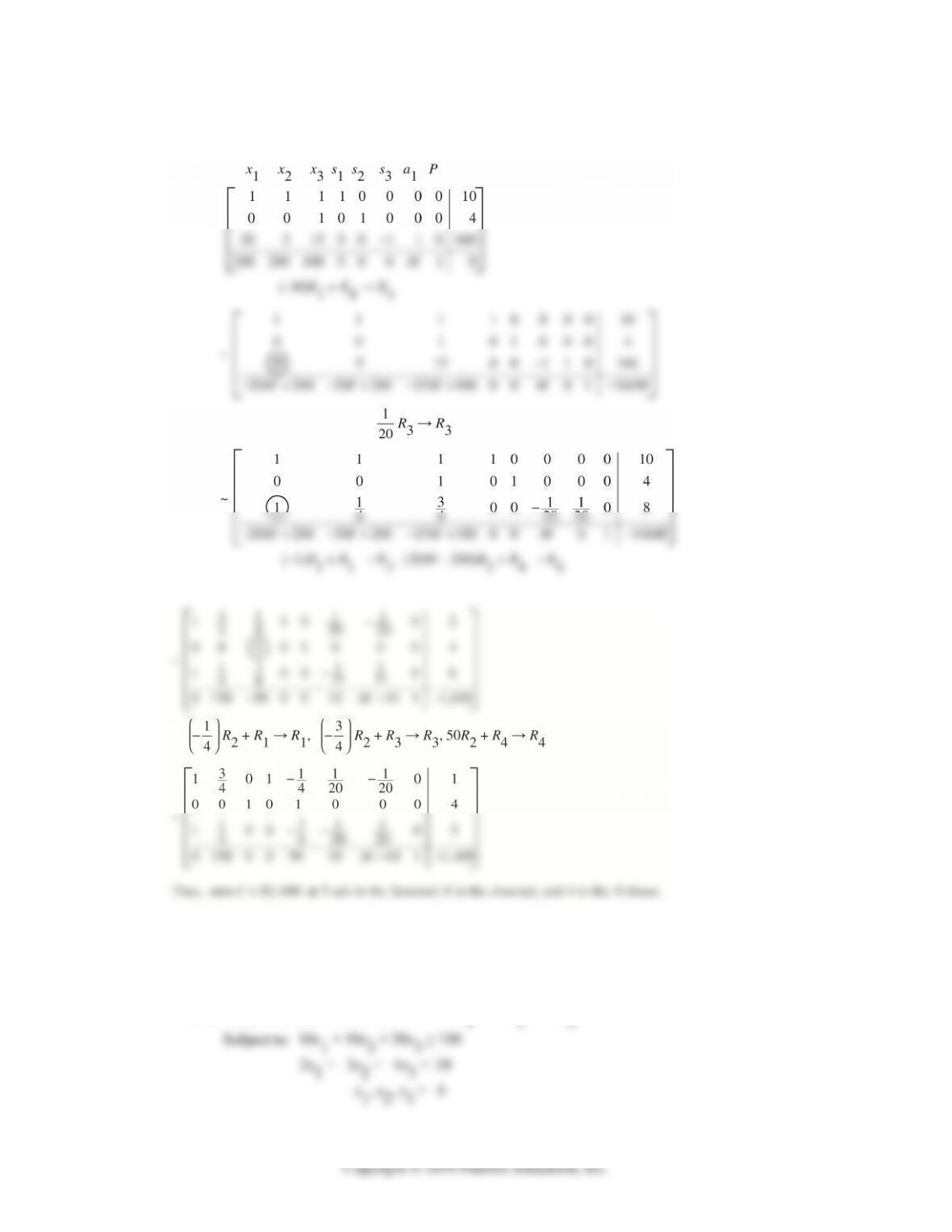
Divide the second constraint inequality by 100 to simplify the calculations, and introduce slack, surplus,
and artificial variables to obtain the equivalent form:
Maximize P = –C = –200x1 – 200x2 – 100x3 – Ma1
Subject to: x1 + x2 + x3 + s1 = 10
6-74 CHAPTER 6: SIMPLEX METHOD
The simplex tableau for the modified problem is:
36. Let x1 = the number of bottles of brand A,
x2 = the number of bottles of brand B,
x3 = the number of bottles of brand C.
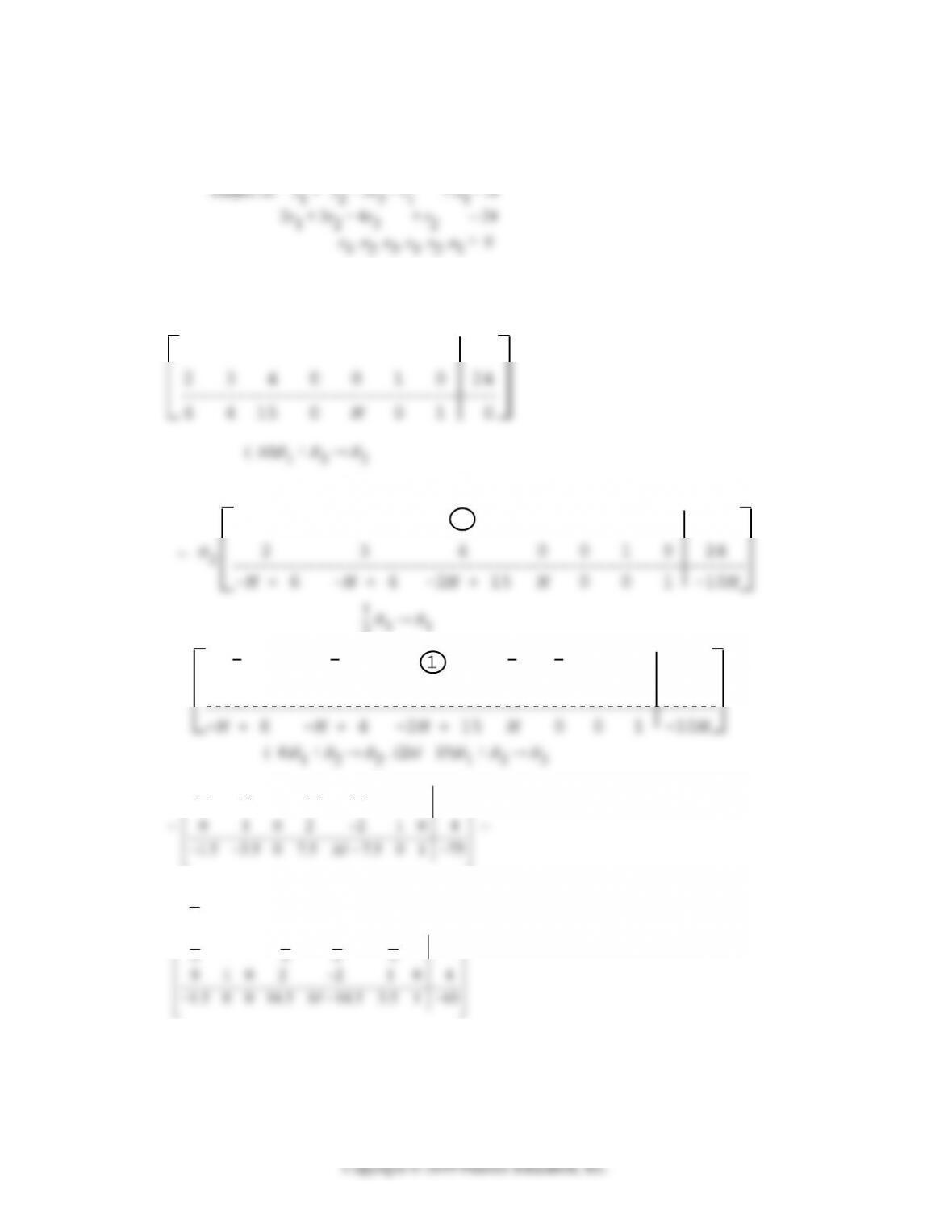
The mathematical model is: Minimize C = 0.6x1 + 0.4x2 + 1.5x3
EXERCISE 6-4 6-75
Divide the first inequality by 10, and introduce slack, surplus, and artificial variables to obtain the
equivalent form:
Maximize P = –10C = –6x1 – 4x2 – 15x3 – Ma1
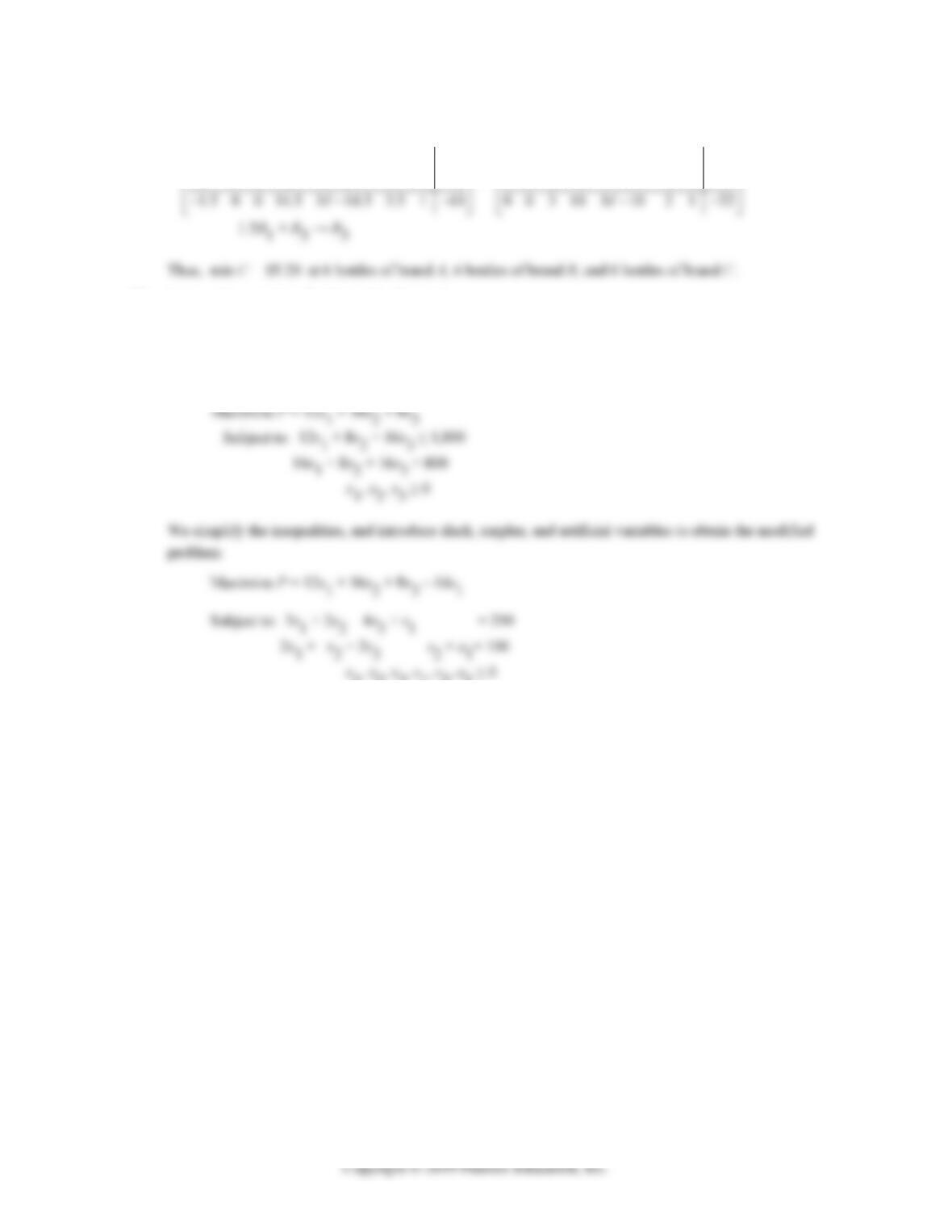
The simplex tableau for the modified problem is:
x1x2x3s1a1s2P
112–110010
1 1 2 –110010
–M + 6 –M + 4 -2M + 15 M0 0 1 -10M
a1
x1x2x3s1a1s2P
2
~
1
2
1
21-
1
20
1
20 5
234010 0 24
1
2
R2 + R1 → R1, 3.5R2 + R3 → R3
33
11
01 0 3
6-76 CHAPTER 6: SIMPLEX METHOD
2R1 → R1
102 3 3 106
0102 2 104
~
102 3 3 10 6
010 2 2 1 0 4
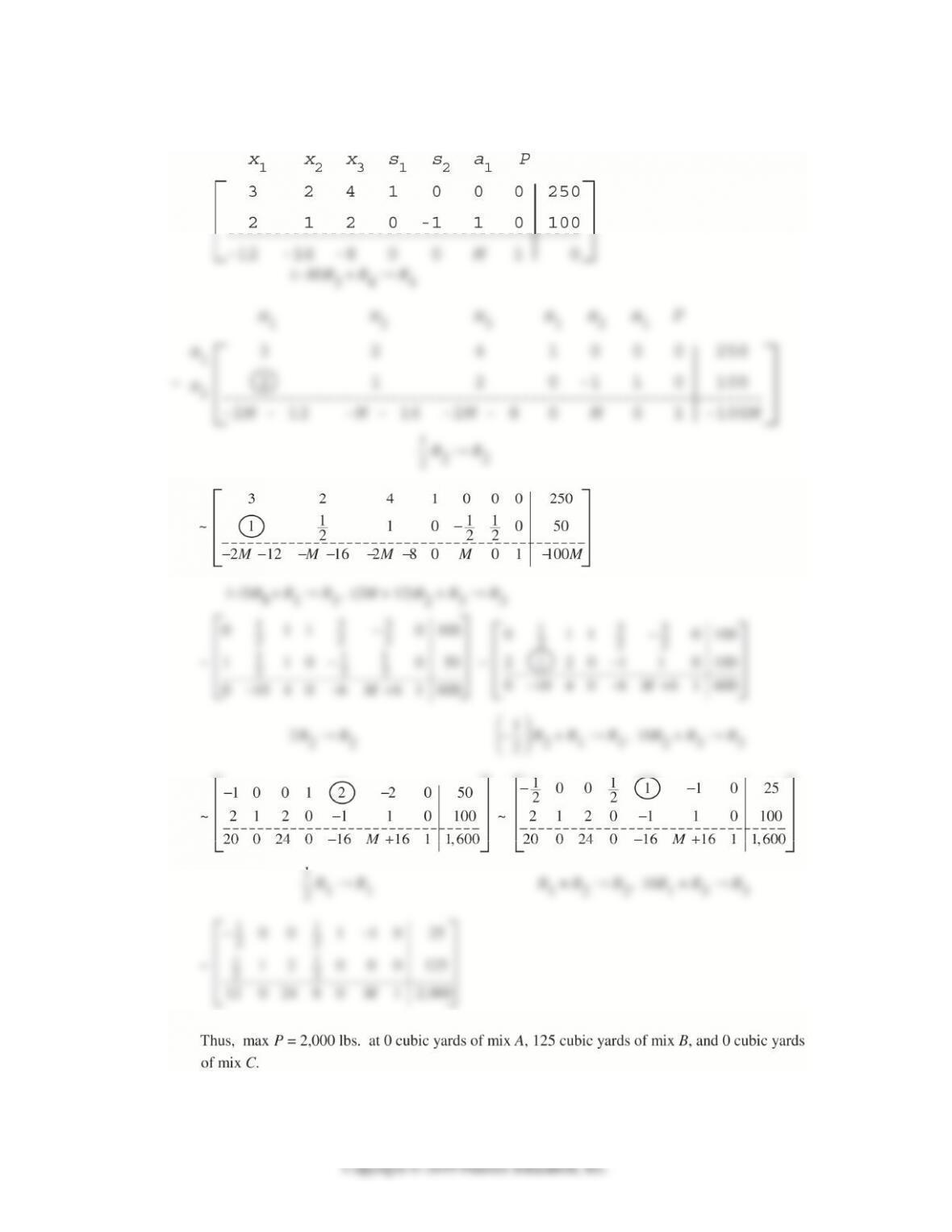
38. Let x1 = the number of cubic yards of mix A,
x2 = the number of cubic yards of mix B,
x3 = the number of cubic yards of mix C.
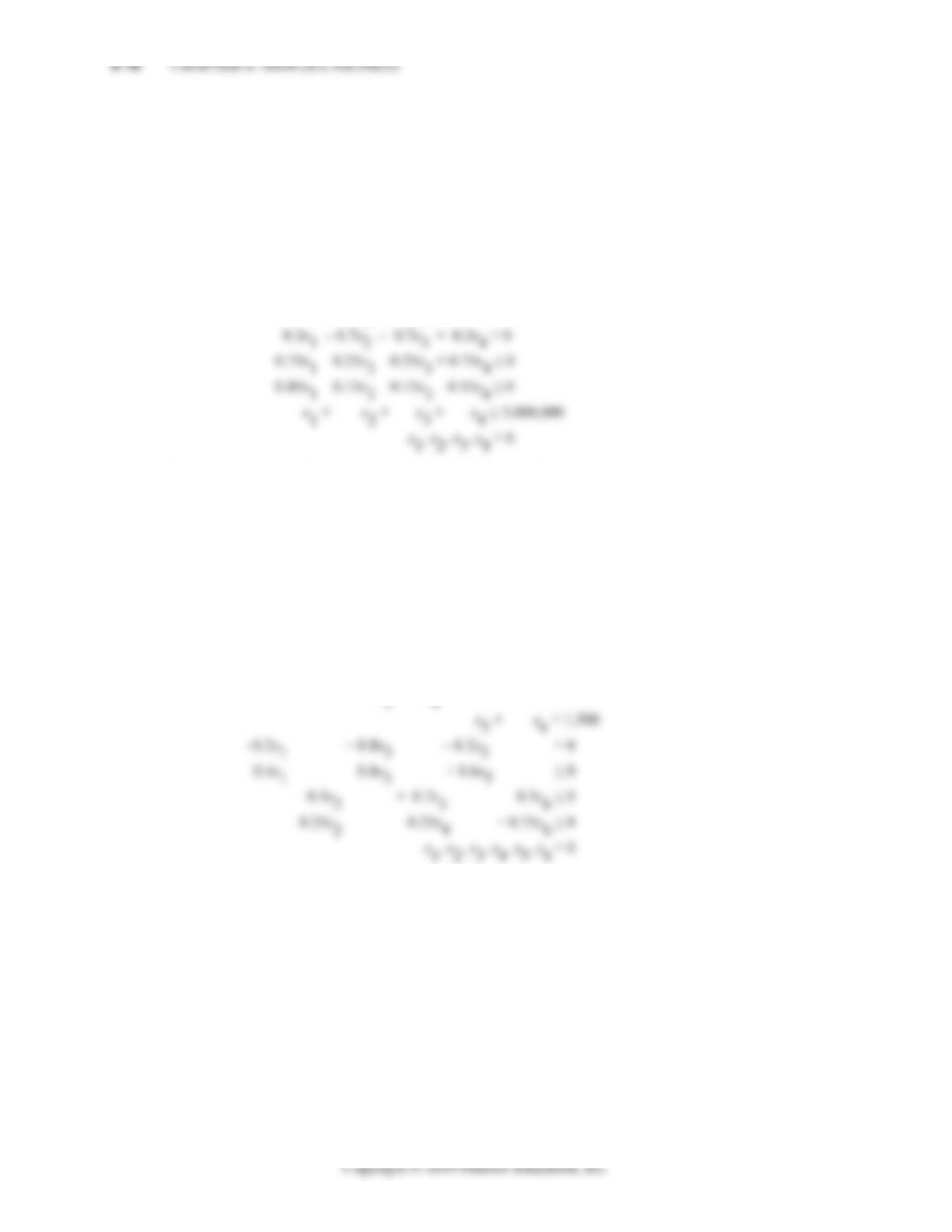
The mathematical model is:
EXERCISE 6-4 6-77
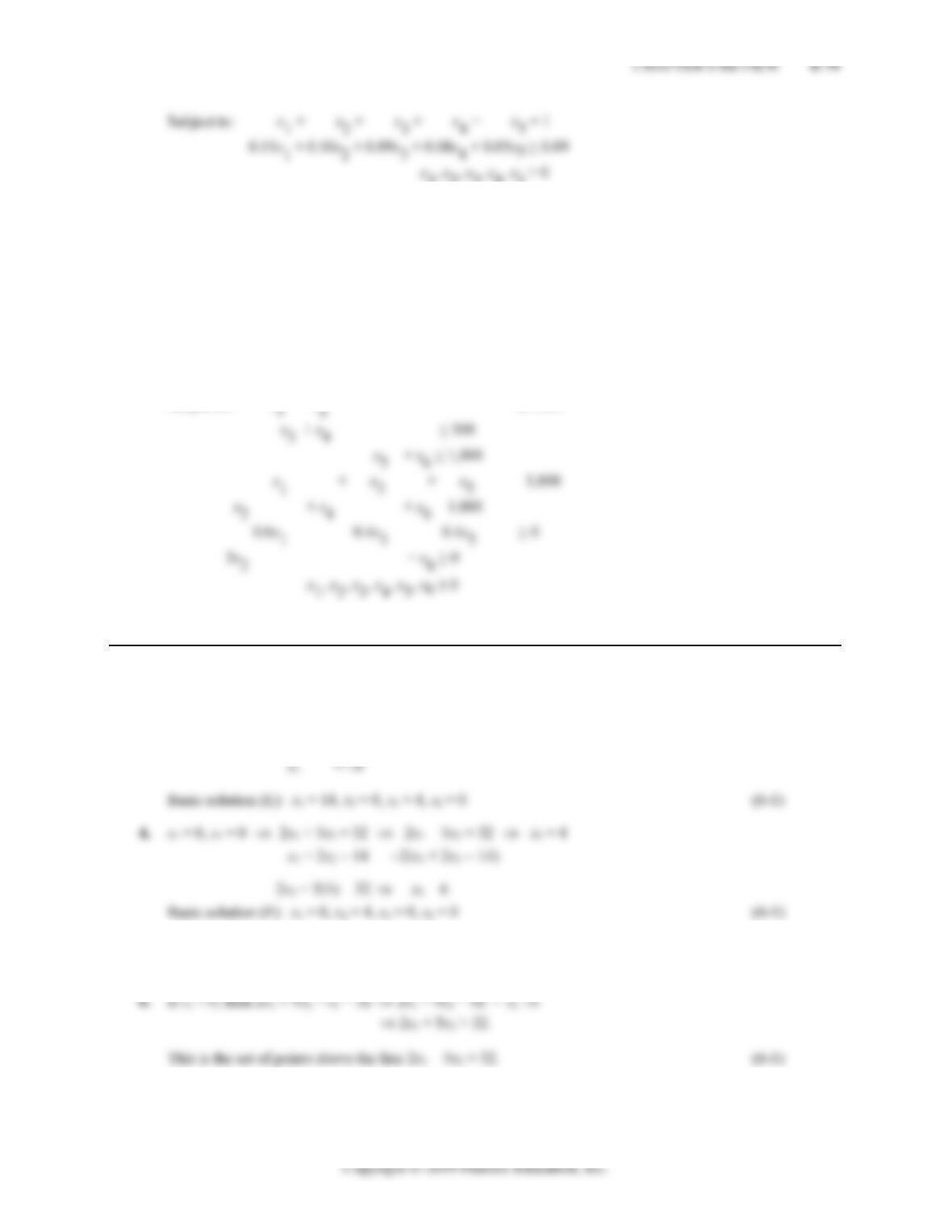
The simplex tableau for the modified problem is:
Copyright © 2019 Pearson Education, Inc.
46. Let x1 = Number of bushels of corn in the feed mix for cows
x2 = Number of bushels of corn in the feed mix for pigs
x3 = Number of bushels of oats in the feed mix for cows
x4 = Number of bushels of oats in the feed mix for pigs
x5 = Number of bushels of soybeans in the mix for cows
x6 = Number of bushels of soybeans in the mix for pigs
Minimize C = 4x1 + 4x2 + 3.5x3 + 3.5x4 + 3.25x5 + 3.25x6
Subject to: x1 + x2 ≤ 1,000
CHAPTER 6 REVIEW
1. The basic variables are the ones with a nonzero value: x2, s2(6-1)
2. The nonbasic variables are the ones with a zero value: x2, s1(6-1)
3. x2 = 0, s2 = 0 2x1 + s1 = 32 2(14) + s1 = 32 s1 = 4
5. The feasible solutions are (A), (B), (E), and (F).
Note: s1 and s2 must be nonnegative, which is not the case in (C) and (D). (6-1)
6-80 CHAPTER 6: SIMPLEX METHOD
Copyright © 2019 Pearson Education, Inc.
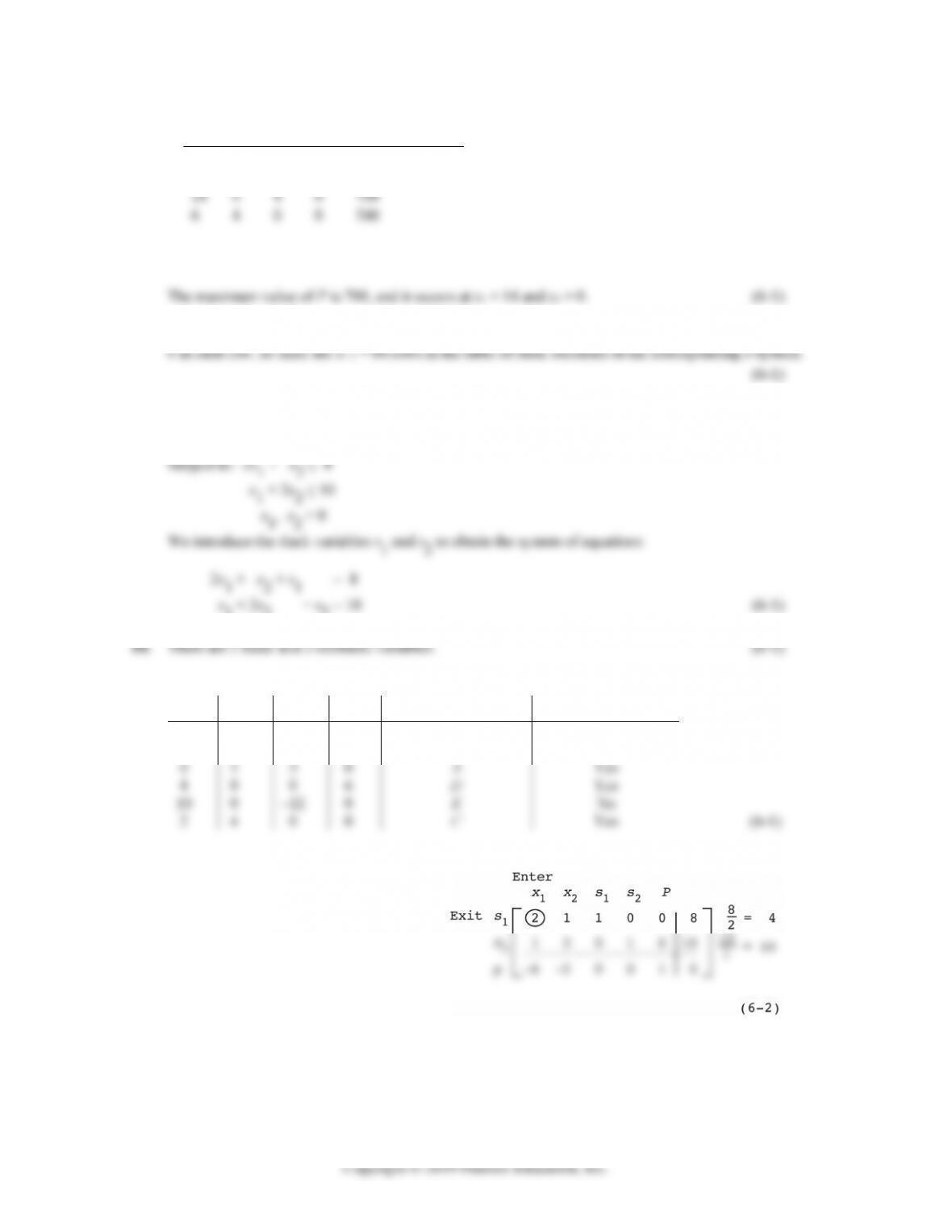
The maximum value of P is 700, and it occurs at x1 = 14 and x2 = 0. (6-1)
8. There are 6 decision variables and 3 slack variables for a total of 9 variables. Three of those 9 are assigned
9. Given the linear programming problem
Maximize P = 6x1 + 2x2
11. The basic solutions are given in the following table.
x1x2s1s2Intersection Point Feasible?
0 0 8 10
O
Yes
0 8 0
–
6B
N
o
A
–
N
C
12. The simplex tableau for Problem 9 is:
7. x
1 x2s1 s2 P = 50x1 + 60x2
0
032 14 0
0 6.4 0 1.2 384