EXERCISE 6-2 6-21
Copyright © 2019 Pearson Education, Inc.
~
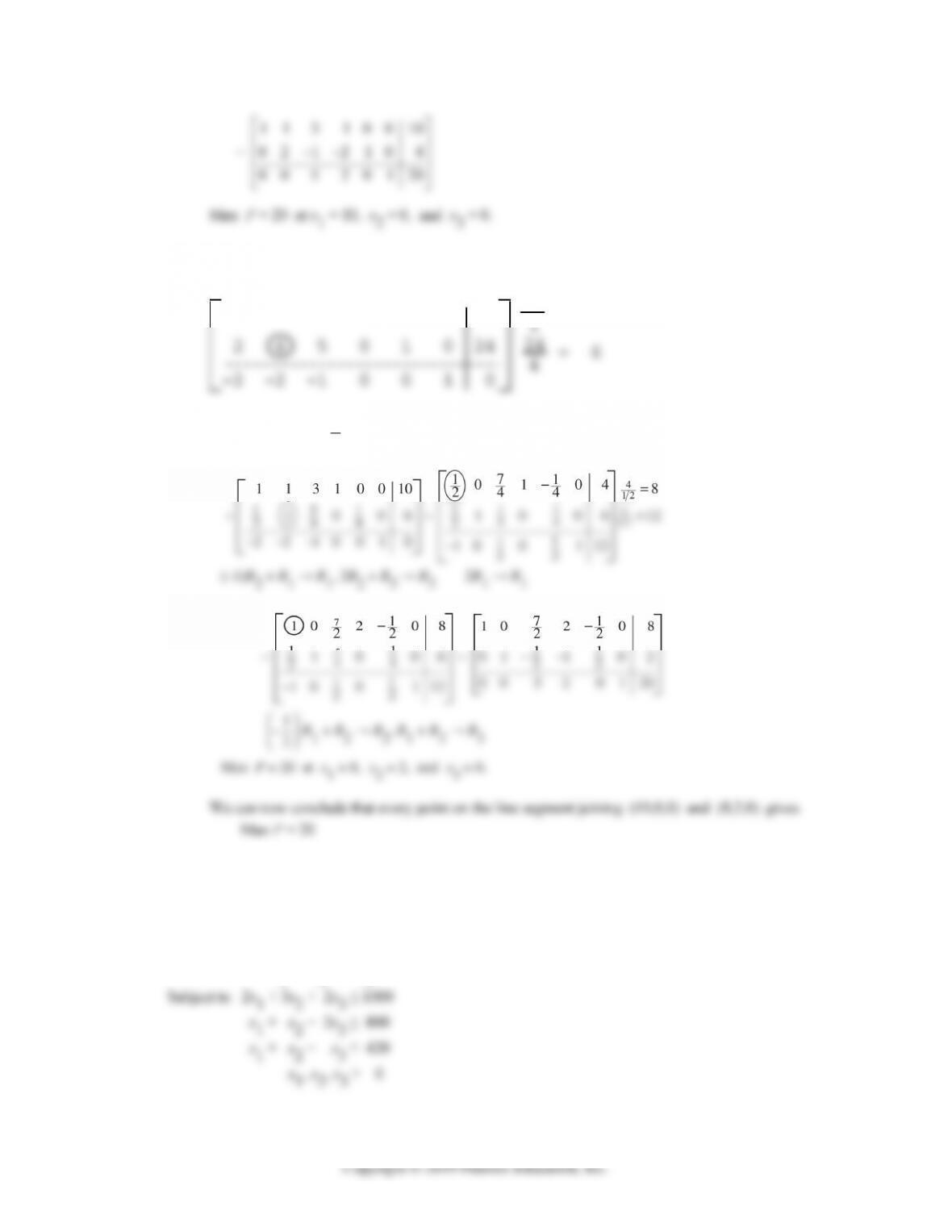
11 3 10010
02 1 210 4
00 5 20120
Max
P = 20 at x1 = 10, x2 = 0, and x3 = 0.
(B) Solution using second column as the pivot column:
x1x2x3s1s2P
11 310010
10
p
ivot column
1
4R2 → R2
42. Let x1 = the number of A components
x2 = the number of B components
x3 = the number of C components
The mathematical model for this problem is:
Maximize P = 7x1 + 8x2 + 10x3
6-22 CHAPTER 6: SIMPLEX METHOD
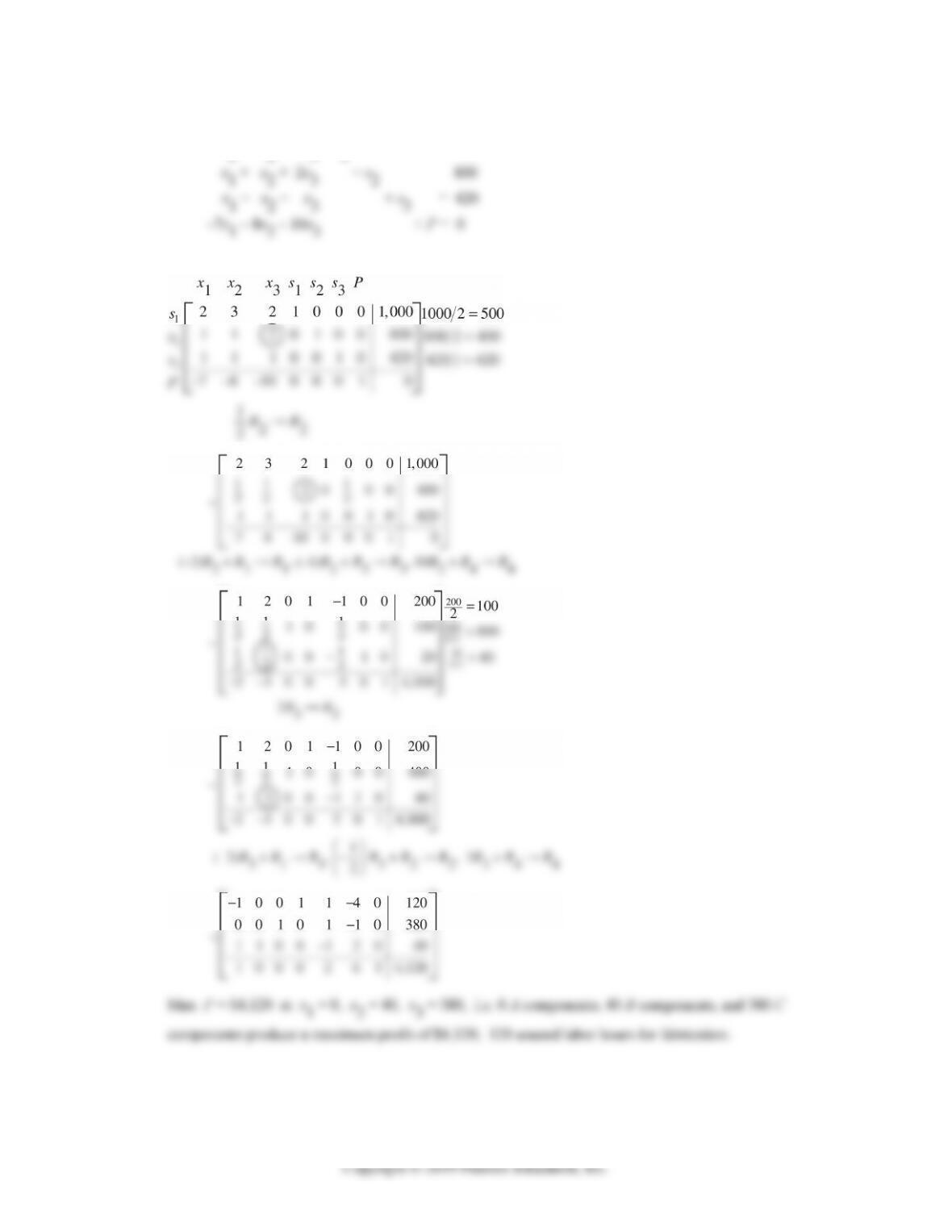
We introduce slack variables s1, s2, s3 to obtain the equivalent form:
2
x1 + 3x2 + 2x3 + s1 = 1000
The simplex tableau for this problem is:
6-24 CHAPTER 6: SIMPLEX METHOD
Copyright © 2019 Pearson Education, Inc.
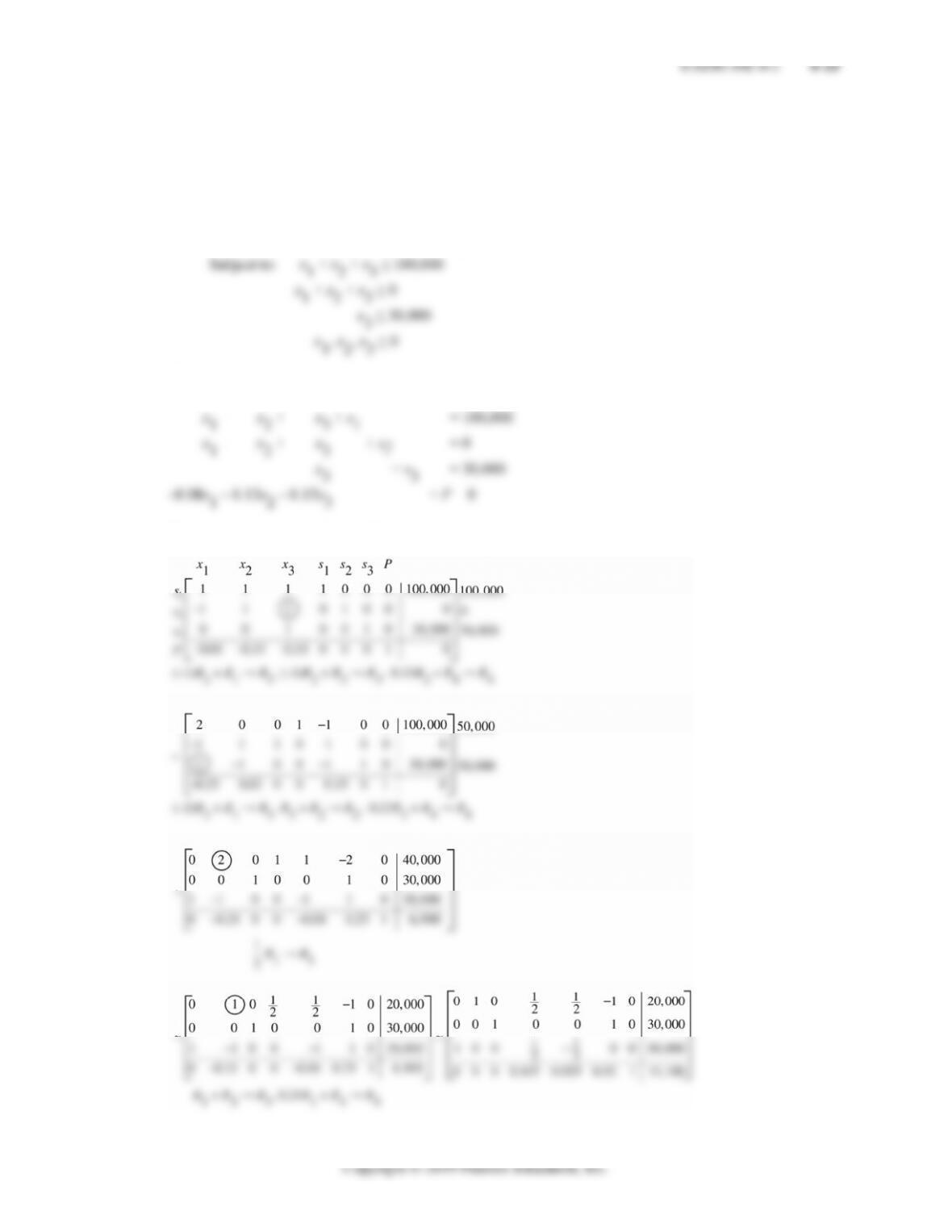
Max P = $11,100 at x1 = 50,000, x2 = 20,000, and x3 = 30,000; i.e. invest $50,000 in government
bonds, $20,000 in mutual funds, $30,000 in money market funds.
46. Let x1 = the number of ads placed in daytime shows,
x2 = the number of ads placed in prime-time shows,
x3 = the number of ads placed in late-night shows.
The mathematical model for this problem is:
EXERCISE 6-2 6-25
Copyright © 2019 Pearson Education, Inc.
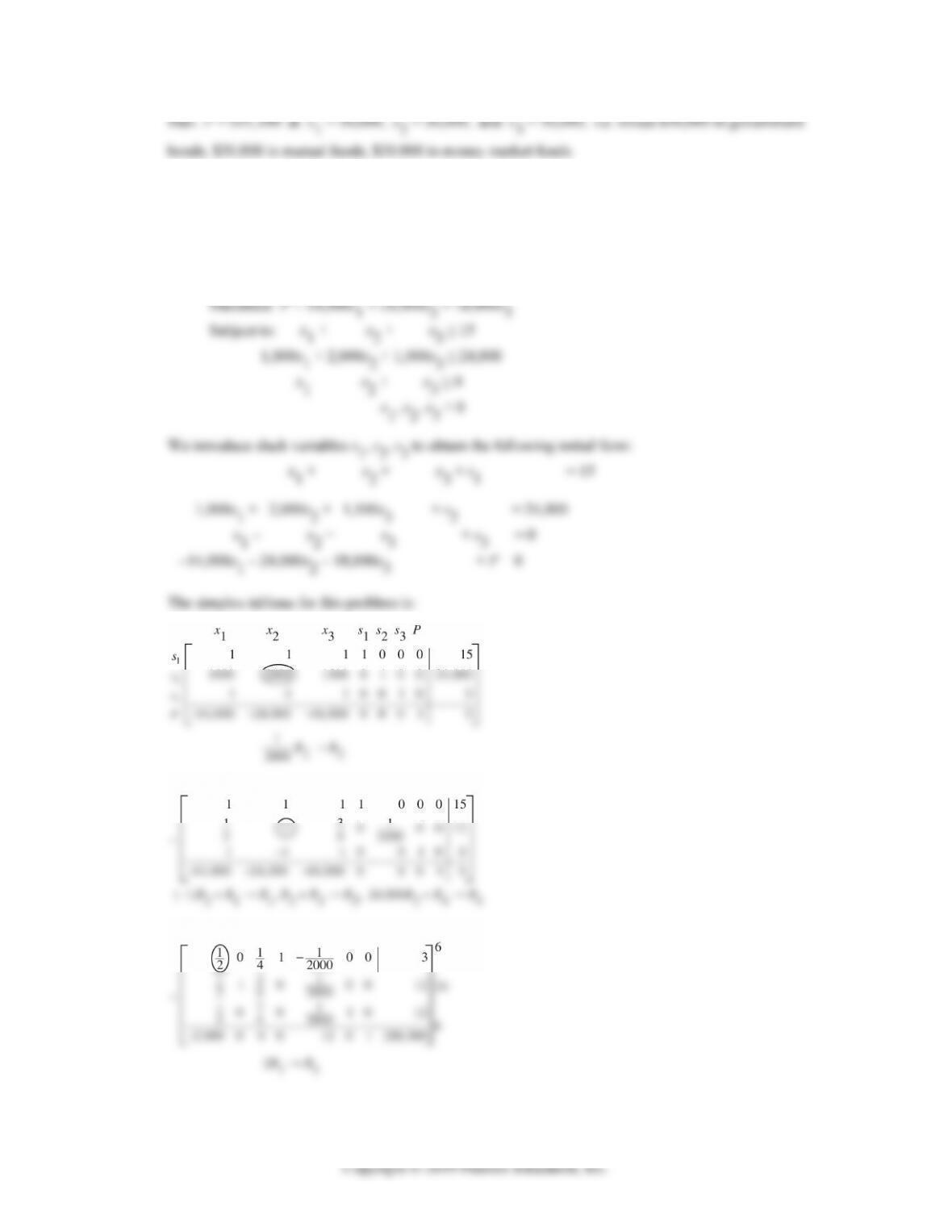
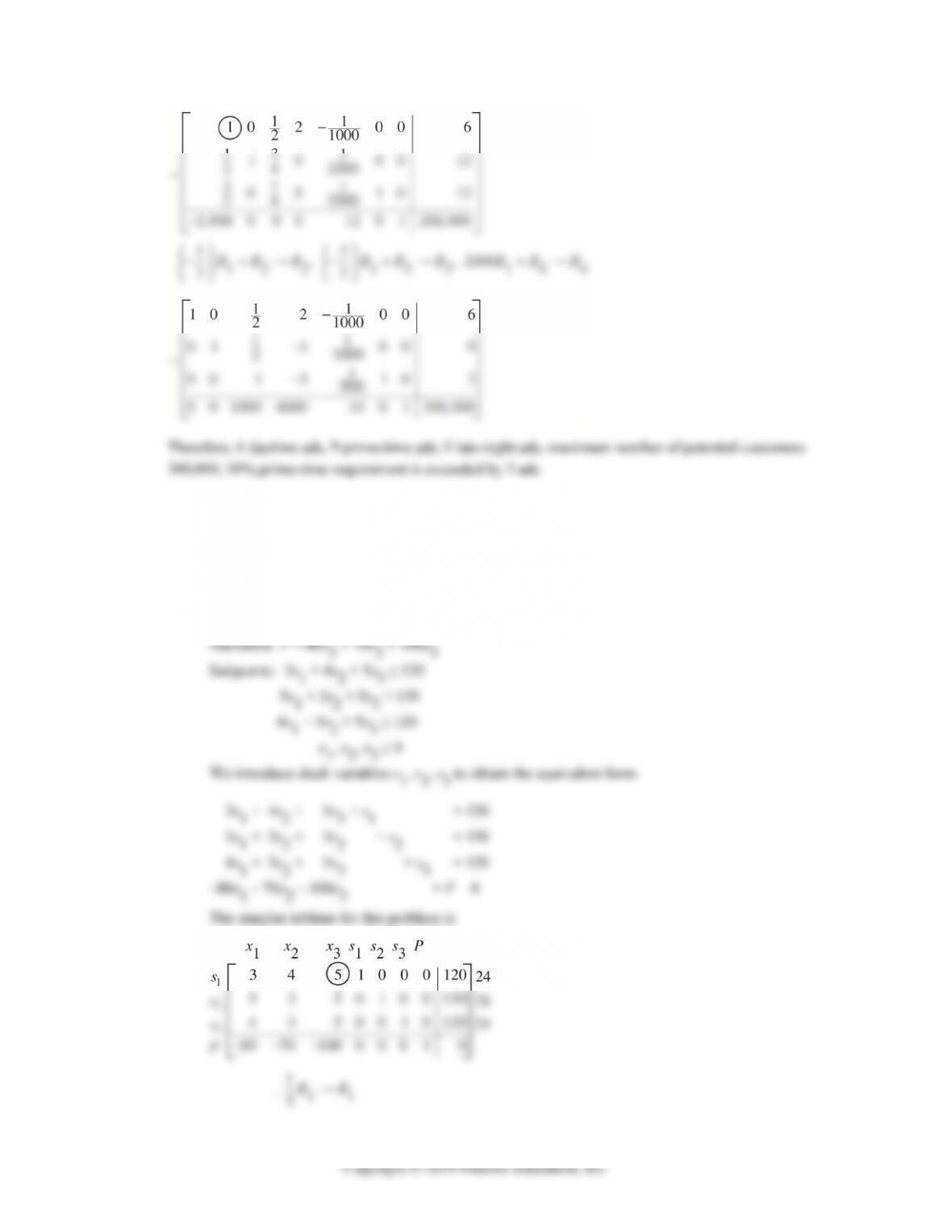
Therefore, 6 daytime ads, 9 prime-time ads, 0 late-night ads; maximum number of potential customers
300,000; 50% prime-time requirement is exceeded by 3 ads.
48. Let x1 = the number of three-speed bicycles,
x2 = the number of five-speed bicycles,
x3 = the number of ten-speed bicycles.
(A) The mathematical model for this problem is:
6-26 CHAPTER 6: SIMPLEX METHOD
Copyright © 2019 Pearson Education, Inc.
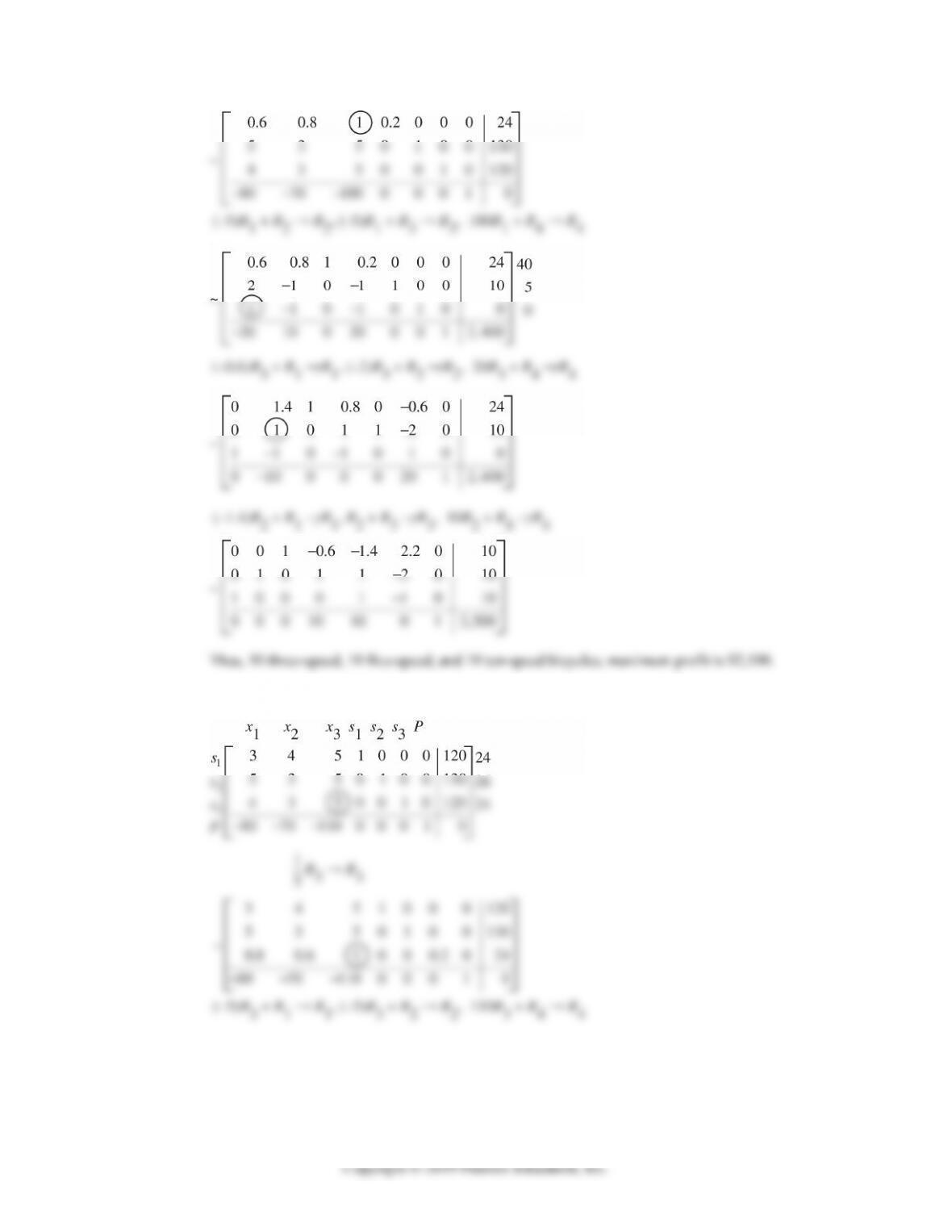
Thus, 10 three-speed, 10 five-speed, and 10 ten-speed bicycles; maximum profit is $2,500.
50. In this case, P = 80x1 + 70x2 + 110x3. The simplex tableau for this problem is:
EXERCISE 6-2 6-27
Copyright © 2019 Pearson Education, Inc.
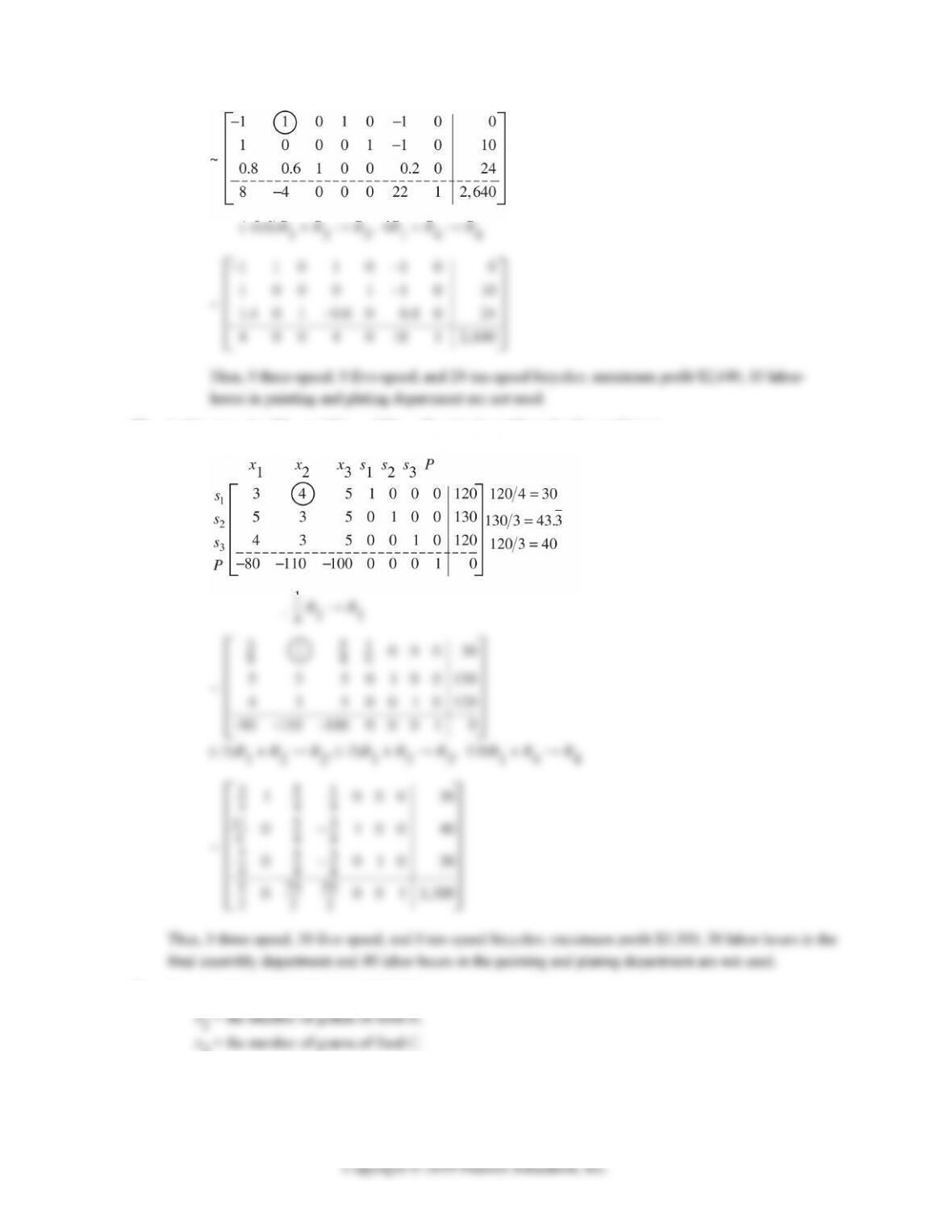
Thus, 0 three-speed, 0 five-speed, and 24 ten-speed bicycles; maximum profit $2,640; 10 labor-
hours in painting and plating department are not used.
52. In this case, P = 80x1 + 110x2 + 100x3. The simplex tableau for this problem is:
54. Let x1 = the number of grams of food A,
6-28 CHAPTER 6: SIMPLEX METHOD
The mathematical model for this problem is:
Maximize P = x1 + 3x2 + 2x3
Subject to: 2x1 + x2 + 2x3 ≤ 24
We introduce slack variables s1 and s2 to obtain the initial form:
2
x1 + x2 + 2x3 + s1 = 24
The simplex tableau for this problem is:
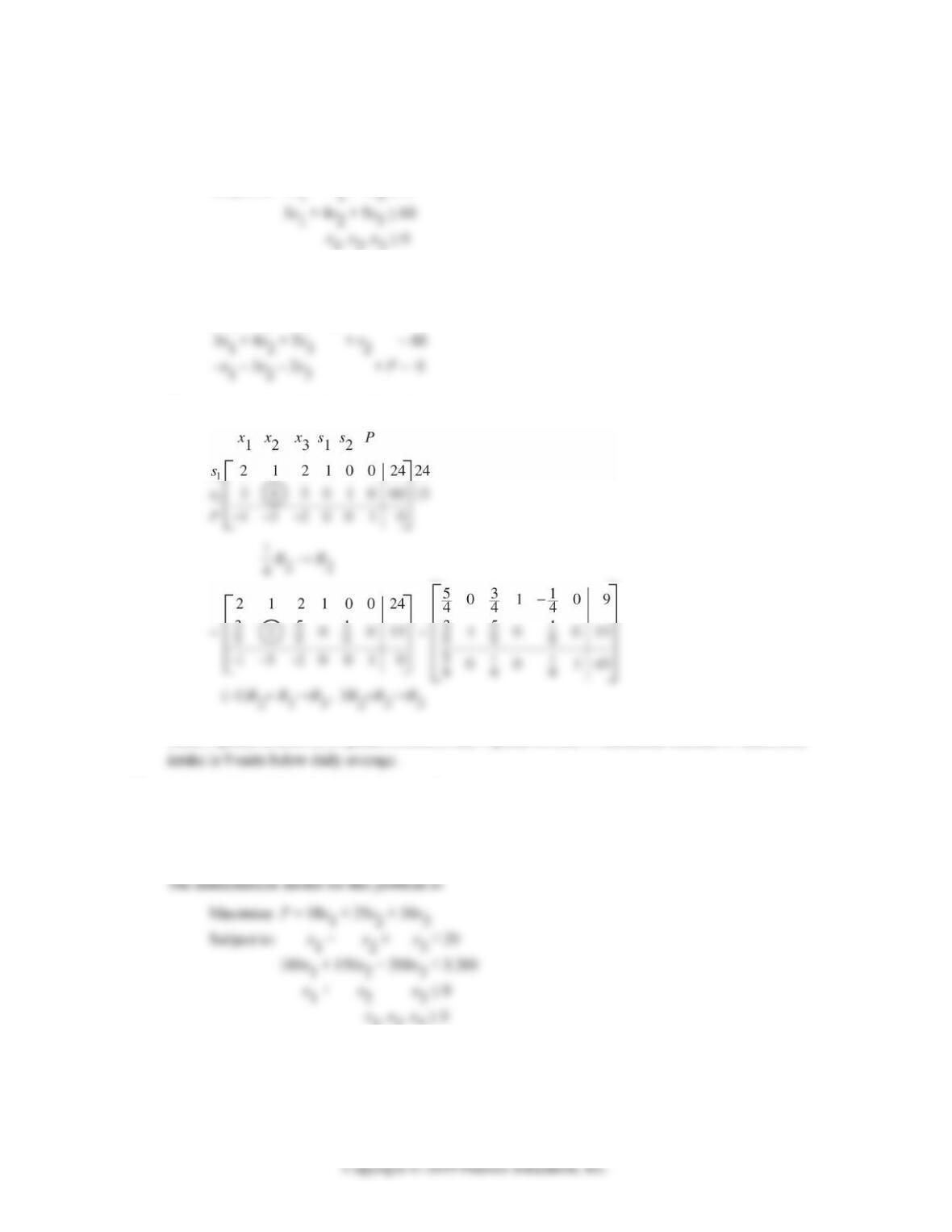
Thus, 0 grams of food A, 15 grams of food B, and 0 grams of food C; maximum calcium 45 units; iron
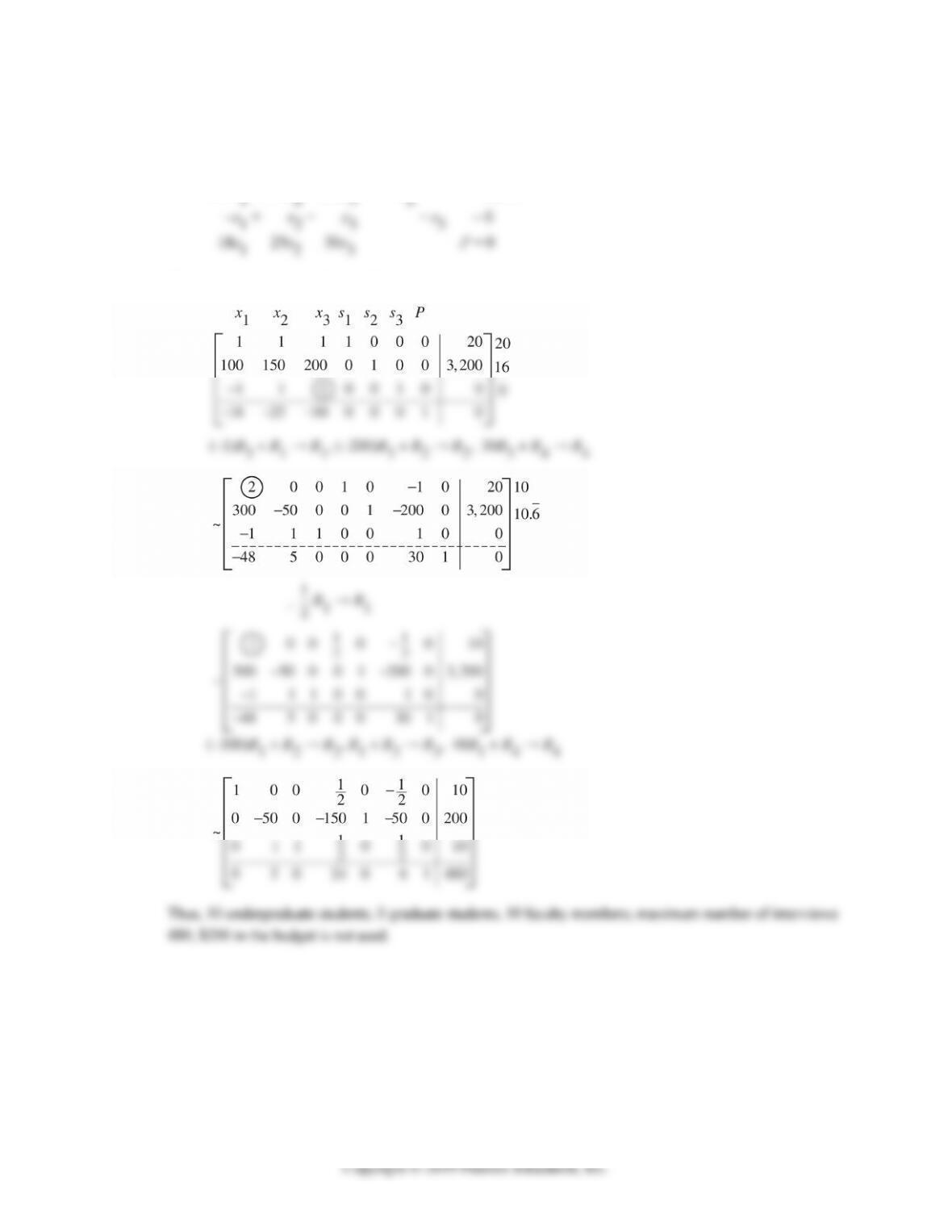
56. Let x1 = the number of undergraduate students,
x2 = the number of graduate students,
x3 = the number of faculty members.
EXERCISE 6-2 6-29
We introduce slack variables s1, s2, and s2 to obtain the initial form:
x1 + x2 + x3 + s1 = 20
100
x1 + 150x2 + 200x3 + s2 = 3,200
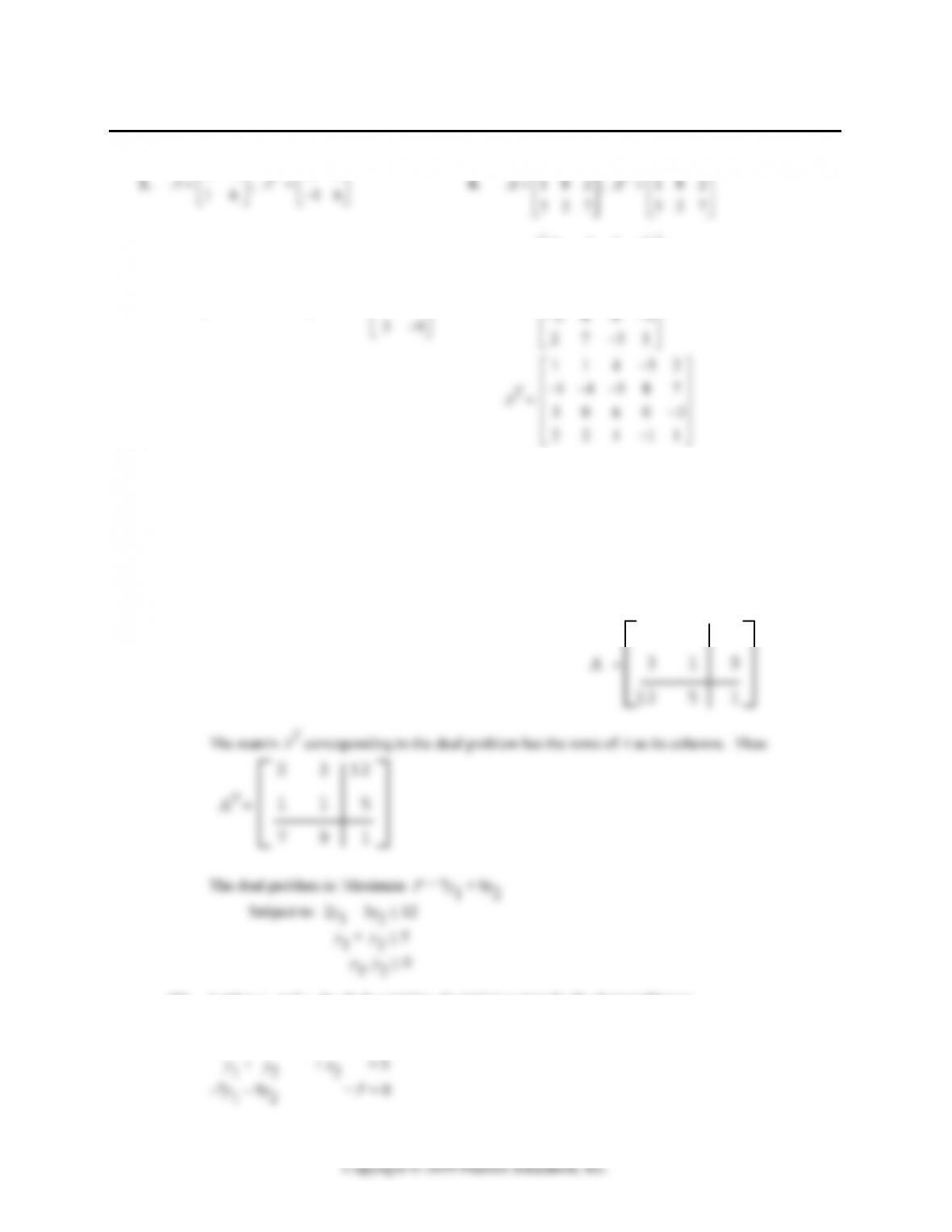
The simplex tableau for this problem is:
6-30 CHAPTER 6: SIMPLEX METHOD
EXERCISE 6-3
913 913
6. A = 73 13
61 0 9
; AT =
76
31
10
8. A =
1132
1402
4561
;
114 32
14587
10. (A) Given the minimization problem:
Minimize C = 12x1 + 5x2
Subject to: 2x1 + x2 ≥ 7
3x1 + x2 ≥ 9
x1, x2 ≥ 0
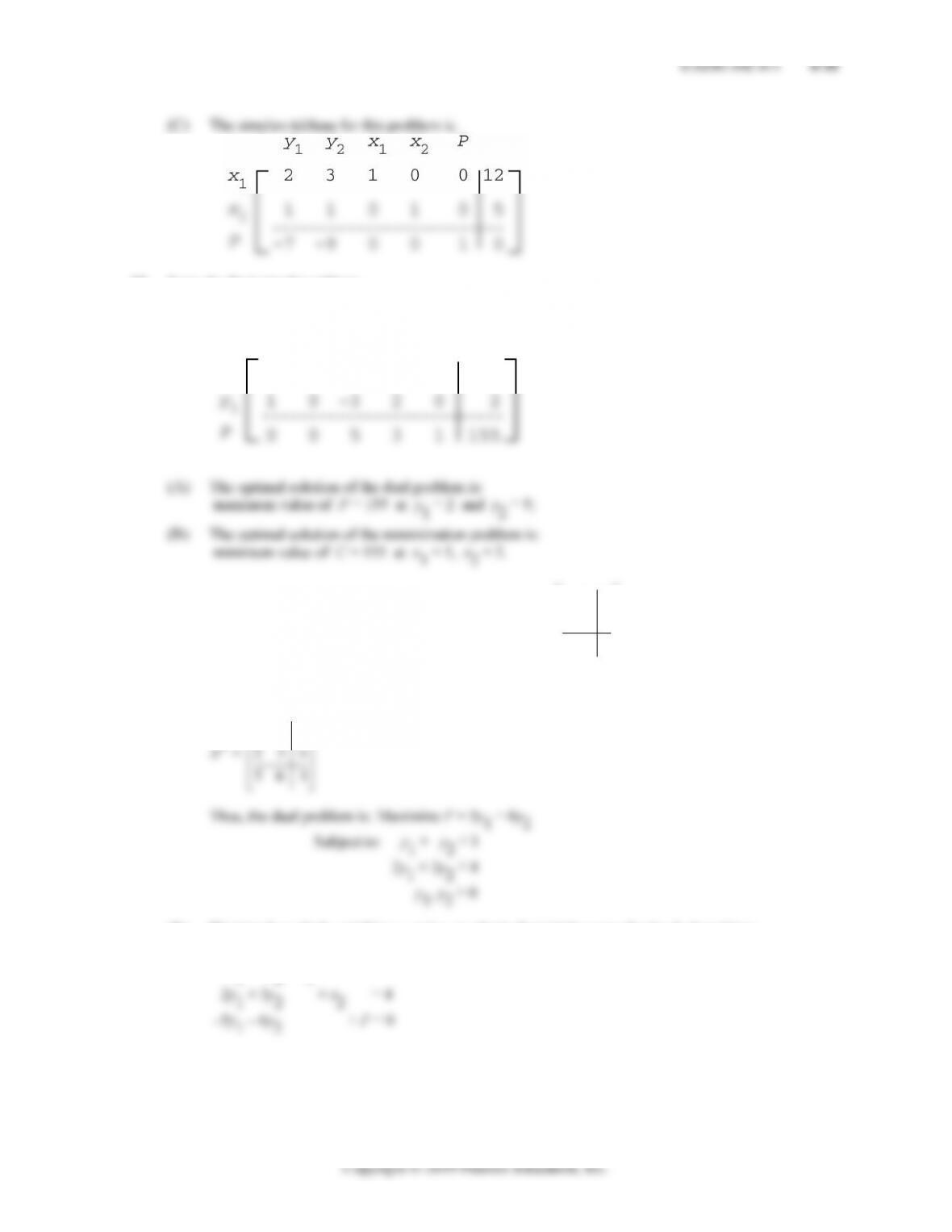
The matrix corresponding to this problem is:
217
(B) Letting x1 and x2 be slack variables, the initial system for the dual problem is:
2y1 + 3y2 + x1 = 12
Copyright © 2019 Pearson Education, Inc.
12. From the final simplex tableau,
y1y2x1x2P
015–30 5
y2
14. (A) The matrix corresponding to the given problem is: A =
125
136
14 1
The matrix AT corresponding to the dual problem has the rows of A as its columns, that is:
111
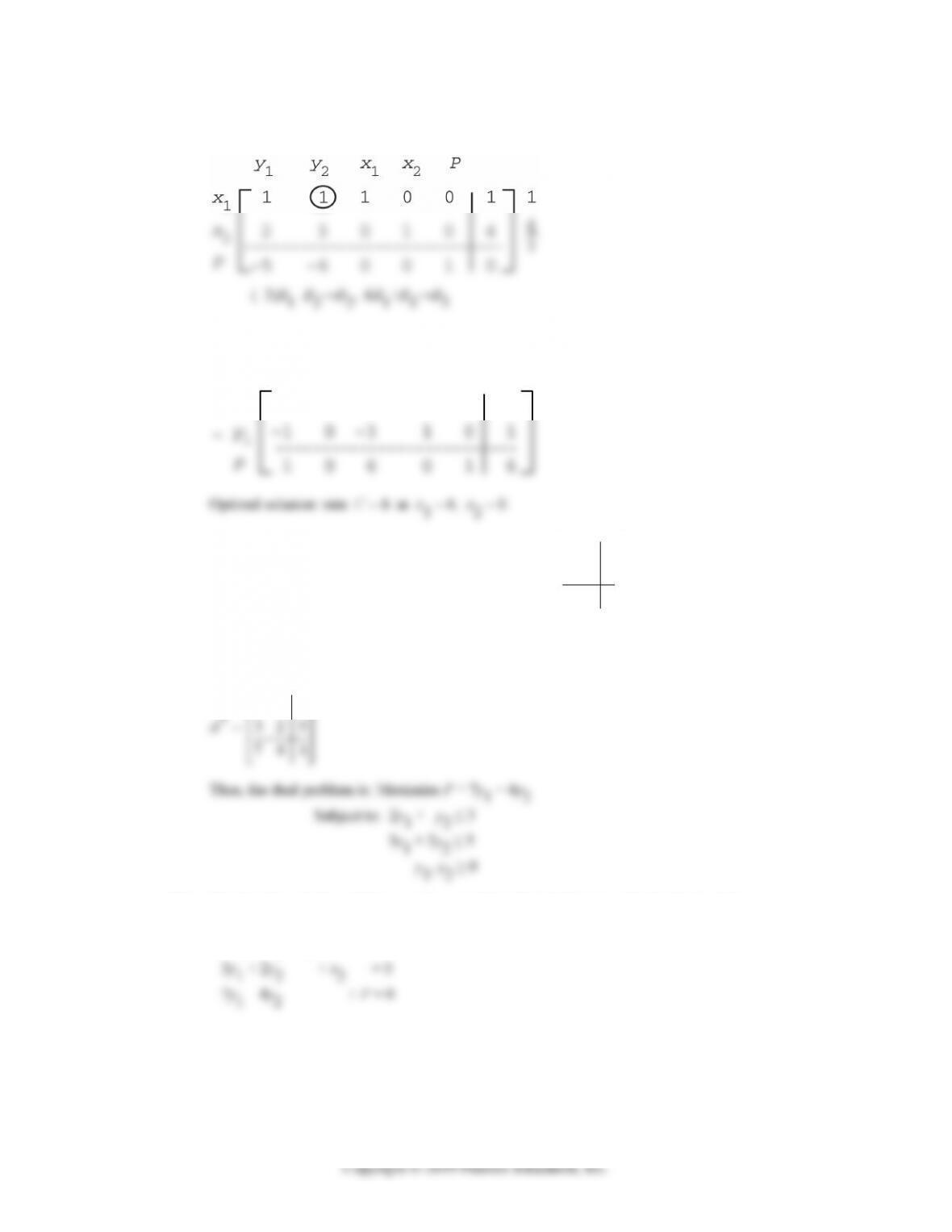
(B) We introduce slack variables x1 and x2 to obtain the initial system for the dual problem:
y1 + y2 + x1 = 1
6-32 CHAPTER 6: SIMPLEX METHOD
The simplex tableau for this problem is:
y1y2x1x2P
1 11 001
x1
16. (A) The matrix corresponding to the given problem is: A =
237
124
351
The matrix AT corresponding to the dual problem has the rows of
A as its columns, that is:
213
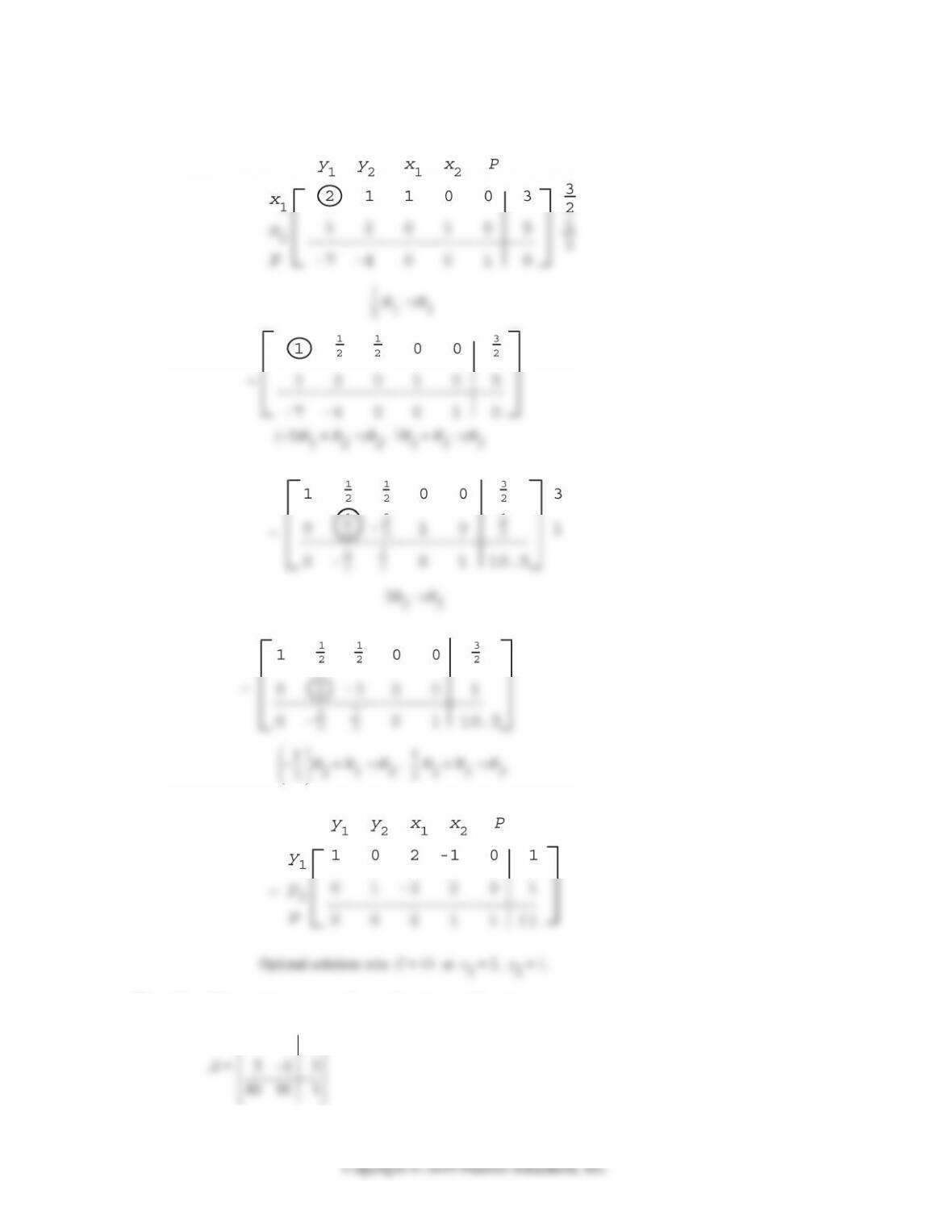
(B) We introduce slack variables x1 and x2 to obtain the initial system for the dual problem:
2y1 + y2 + x1 = 3
EXERCISE 6-3 6-33
The simplex tableau for this problem is:
18. (A) The matrix corresponding to the given problem is:
2112
6-34 CHAPTER 6: SIMPLEX METHOD
The matrix AT corresponding to the dual problem is:
2340
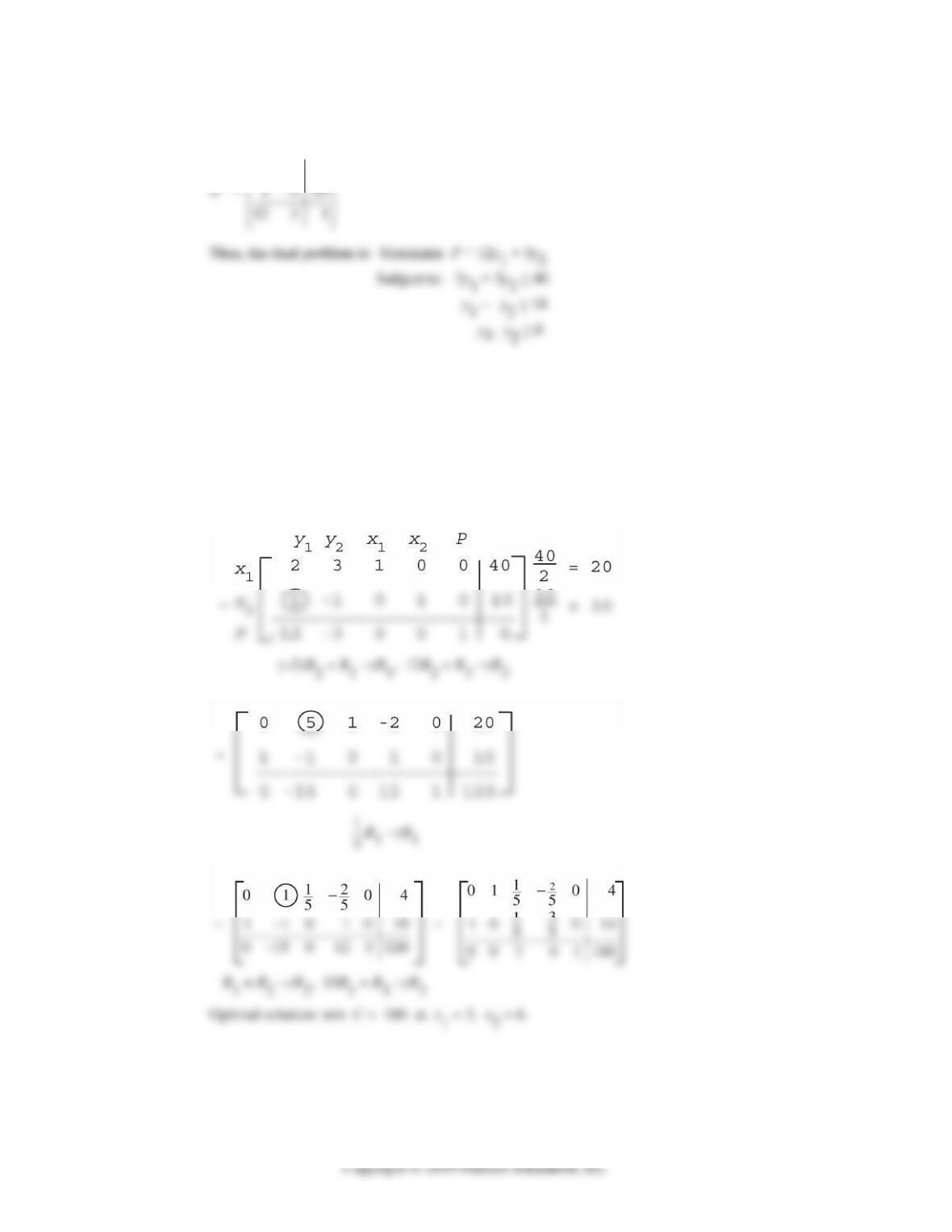
(B) We introduce slack variables x1 and x2 to obtain the initial system for the dual problem:
2y1 + 3y2 + x1 = 40
y1 – y2+x2 = 10
–
12y1 – 3y2+P = 0
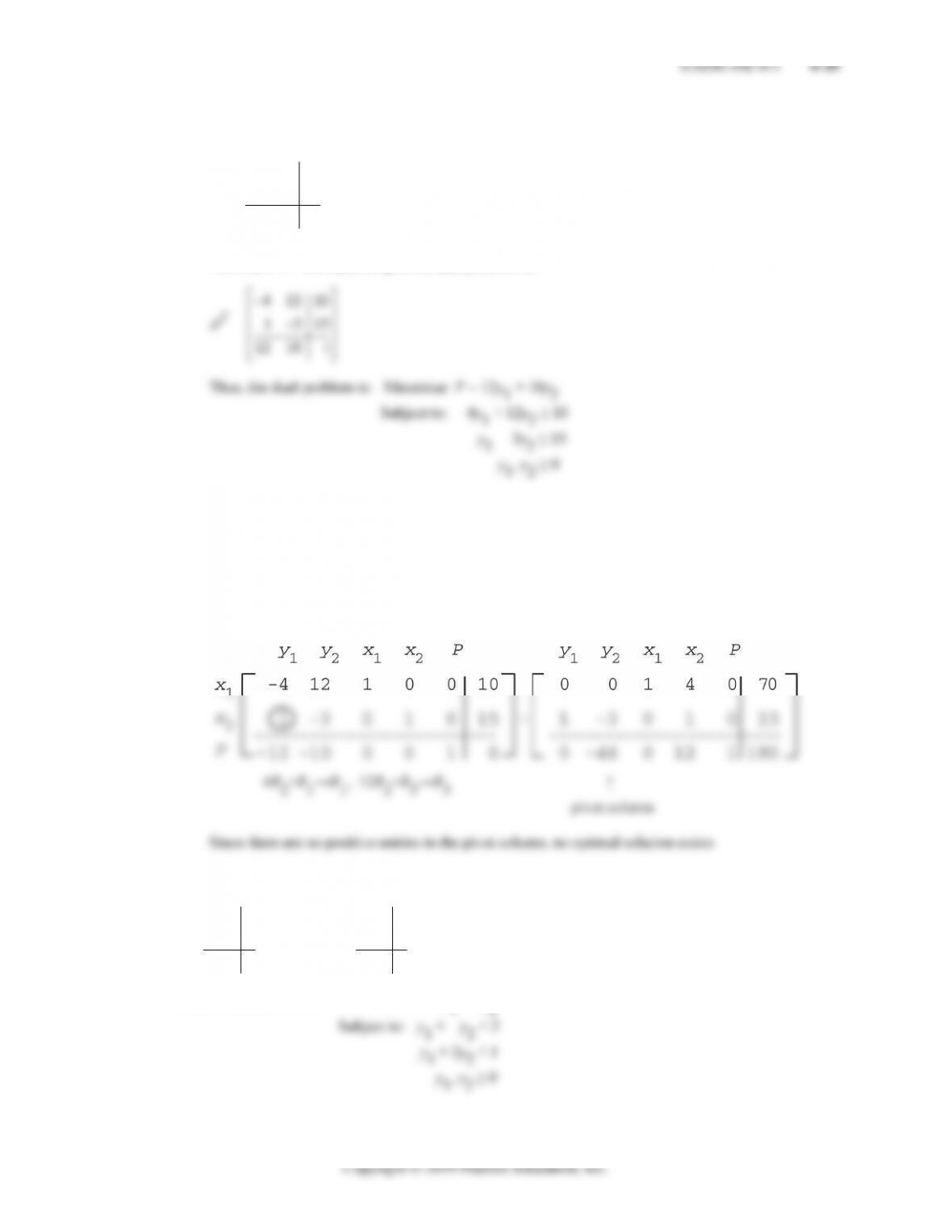
The simplex tableau for this problem is:
6-36 CHAPTER 6: SIMPLEX METHOD
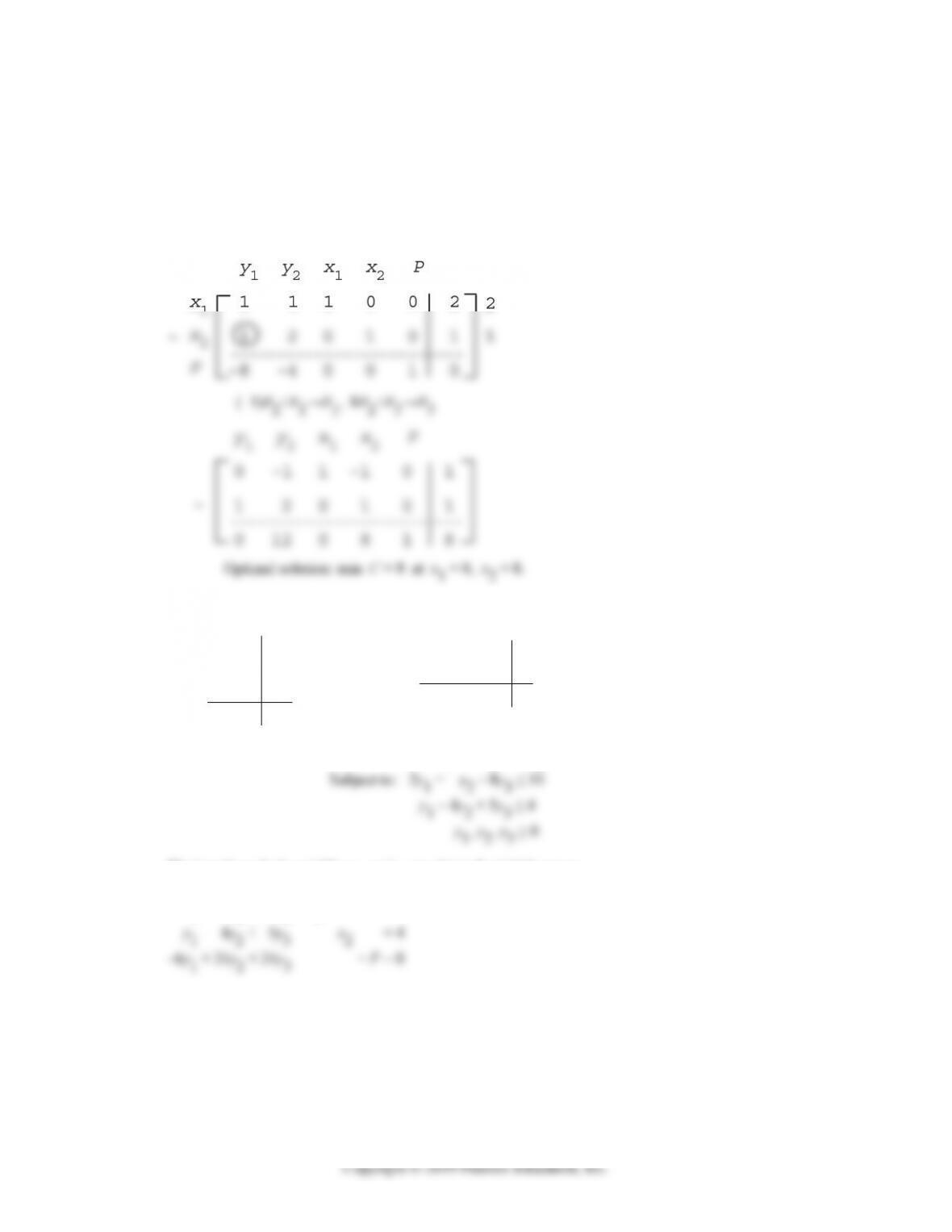
We introduce slack variables x1 and x2 to obtain the initial system:
y1 + y2 + x1 = 2
y1 + 2y2+x2 = 1
–8y1 – 4y2+P = 0
The simplex tableau for this problem is:
24. The matrices corresponding to the given problem and the dual problem are:
A =
21 6
1424
8524
10 4 1
and
21810
1 4 5 4 respectively.
624241
T
A
Thus, the dual problem is: Maximize P = 6y1 – 24y2 – 24y3
We introduce slack variables x1 and x2 to obtain the initial system:
2y1 + y2 – 8y3 + x1 = 10
EXERCISE 6-3 6-37
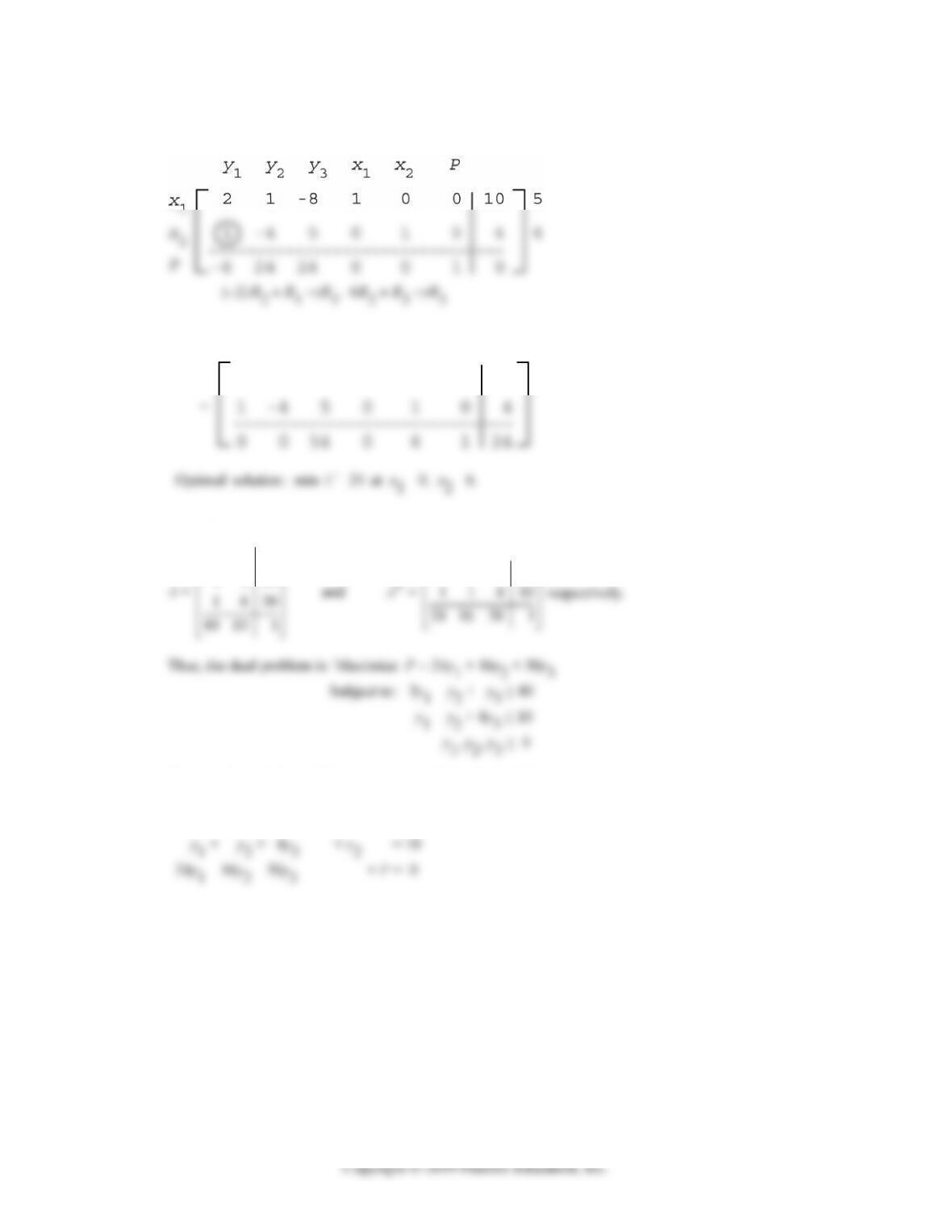
The simplex tableau for this problem is:
y1y2y3x1x2P
09–181–2 02
26. The matrices corresponding to the given problem and the dual problem are:
3124
1116
31140
We introduce slack variables x1 and x2 to obtain the initial system:
3y1 + y2 + y3 + x1 = 40
6-38 CHAPTER 6: SIMPLEX METHOD
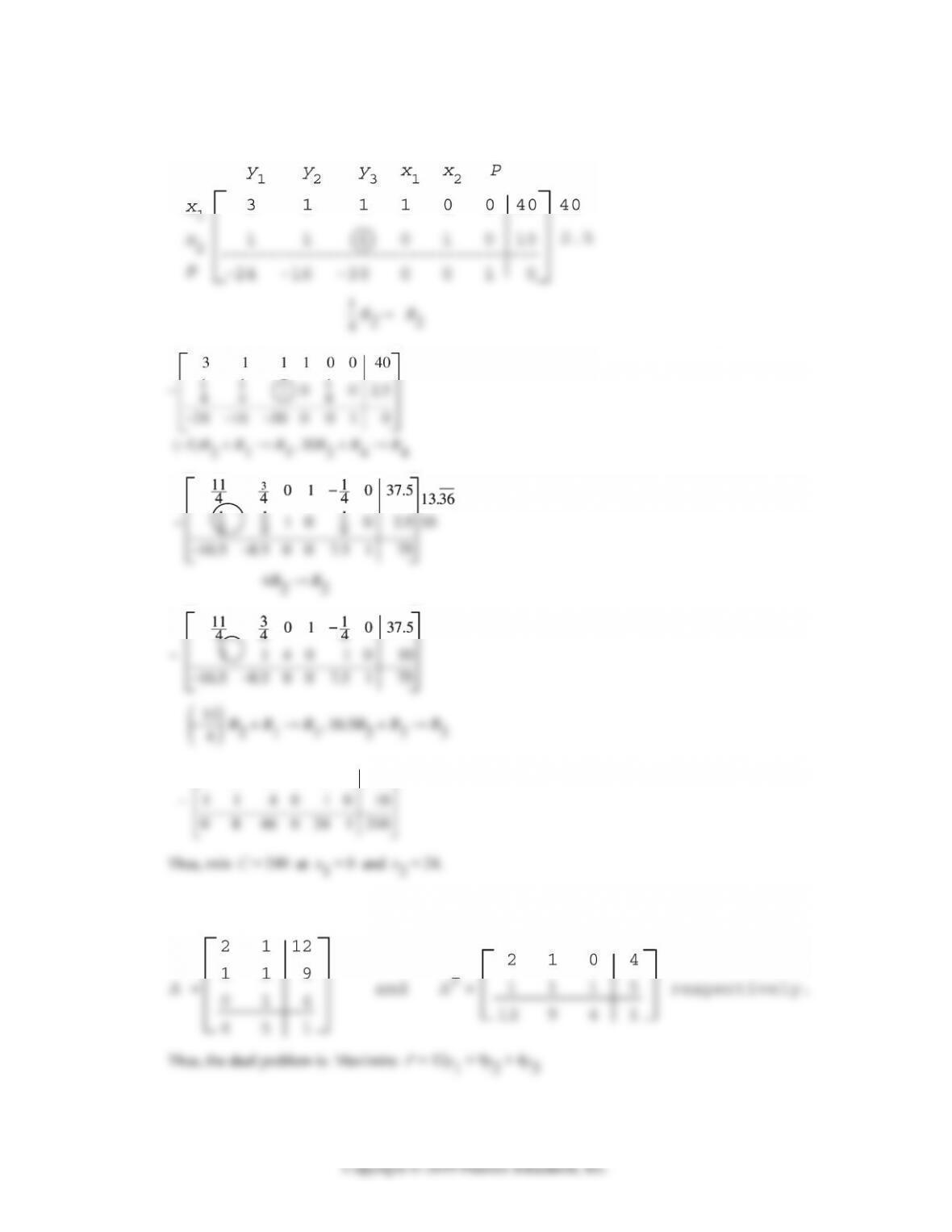
The simplex tableau for this problem is:
021113010
28. The matrices corresponding to the given problem and the dual problem are:
EXERCISE 6-3 6-39
Subject to: 2y1 + y2 ≤ 4
We introduce slack variables x1 and x2 to obtain the initial system:
2y1 + y2 + + x1 = 4
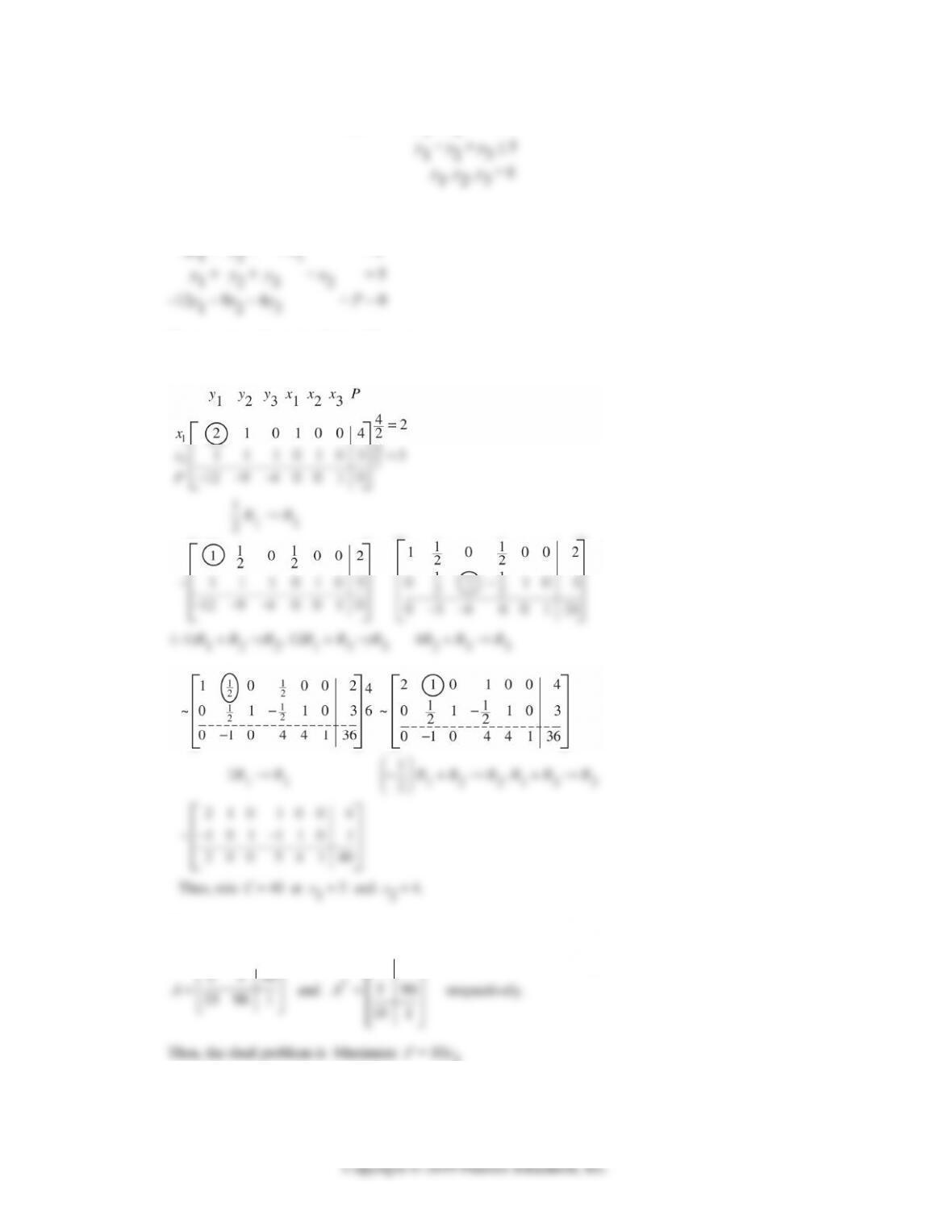
The simplex tableau for this problem is:
30. T h e m a t r i c e s c o r r e s p o n d i n g t o t h e g i v e n p r o b l e m a n d the dual problem are:
235
6-40 CHAPTER 6: SIMPLEX METHOD
Subject to: 2y1 ≤ 35
5 y1 ≤ 90
y1, y2 ≥ 0
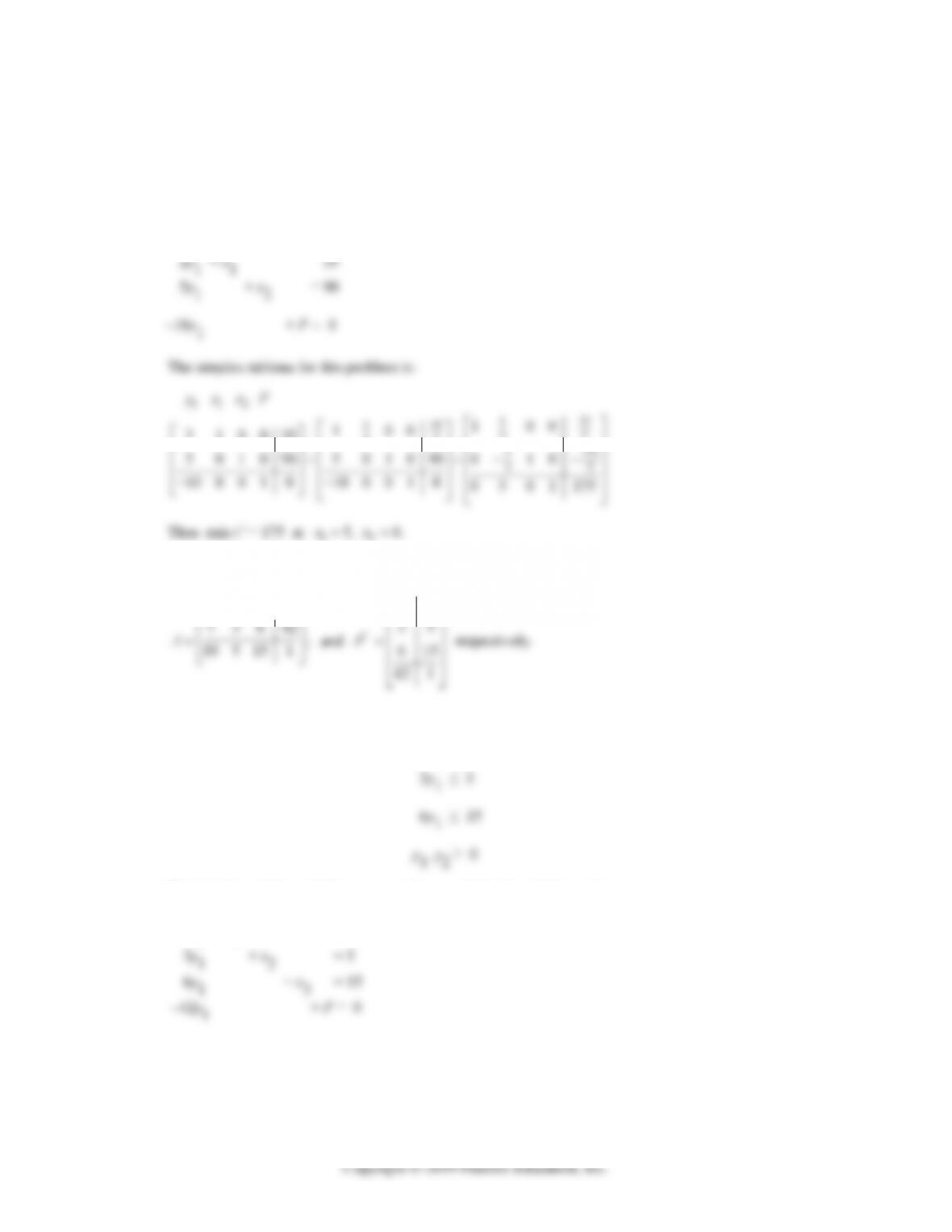
We introduce slack variables x1 and x2 to obtain the initial system:
22
22
100
2 10035
32. T h e m a t r i c e s c o r r e s p o n d i n g t o t h e g i v e n p r o b l e m a n d t h e d u a l p r o b l e m a r e :
710
10 5 15 1 6 15
42 1
Thus, the dual problem is Maximize P = 42y1
Subject to: 7y1 ≤ 10
We introduce slack variables x1, x2, and x3 to obtain the initial system:
7y1 + x1 = 10