1
Instructor’s Manual – OMSC2 – Collier/Evans – C6 Supply Chain Design
Chapter 6 introduces students to supply chain design. Topics covered include global supply
chains, supply chain design decisions and the impact of blockchain technology, outsourcing and
offshoring decisions, breakeven analysis for outsourcing decisions, a detailed description of
Inditex/Zara’s supply chain, location decisions and the center of gravity method, and the
transportation model for optimizing supply chain costs.
Questions and problems are provided in four categories:
1. Review questions
2. Discussion questions and experiential activities
The chapter has three cases:
1. Bookmaster: Value Chain Design is the first case study. This case requires students to
2. Boston Red Sox Spring Training Decision requires students to use the center of gravity
method along with other qualitative criteria to decide where to locate a ballpark. Students
3. The integrative case study, Hudson Jewelers, with case assignment questions in all chapters,
requires the student to determine whether the diamond supply chain is a push or pull system
and an efficient or responsive system. The second case question asks students to research the
degree of vertical integration in the global diamond supply chain.
KEY TERMS
Backward integration refers to acquiring capabilities toward suppliers.
Blockchain is a distributed database network that holds records of digital data and events in a
way that makes them tamper-resistant.
Forward integration refers to acquiring capabilities toward distribution, or even customers.
A multinational enterprise is an organization that sources, markets, and produces its goods and
services in several countries to minimize costs, and to maximize profit, customer satisfaction,
and social welfare.
Multisite management is the process of managing geographically dispersed service-providing
facilities.
A pull system produces only what is needed at upstream stages in the supply chain in response
to customer demand signals from downstream stages.
A push system produces goods in advance of customer demand using a forecast of sales and
moves them through the supply chain to points of sale, where they are stored as finished–goods
inventory.
Reshoring is the process of moving operations back to a company’s domestic location.
The transportation model is a linear optimization model that seeks to minimize the cost of
shipping from sources such as factories to destinations such as warehouses or customer zones.
Vertical integration refers to the process of acquiring and consolidating elements of a value
chain to achieve more control.
REVIEW QUESTIONS
1. Explain the concept of a global supply chain and describe the key design decisions.
Global supply chains are complex supply chains operated by multinational enterprises.
Their value chains can source, market, create, and deliver goods and services to customers
worldwide. Key design decisions shown in Exhibit 6.1 include:
● Strategy (does the supply chain support the organization’s mission and strategy?)
● Control (should the structure be centralized or decentralized?)
● Location (what impact does a particular location have on cost and customer service?)
2. Define operational structure and provide an example of centralized control and
decentralized control.
The operational structure of a supply chain is the configuration of resources such as
4
3. Define efficient and responsive supply chains and explain how they differ.
• Efficient supply chains are designed for efficiency and low cost by minimizing inventory
4. Define push and pull supply chains and explain how they differ.
• Push systems produce goods in advance of customer demand using a forecast of sales
5. Describe the ideas of vertical, forward, and backward integration.
• Vertical integration refers to the process of acquiring and consolidating elements of a
value chain to achieve more control.
6. What is a contract manufacturer? Provide some examples of contract manufacturers used
by Apple.
A contract manufacturer is a firm that specializes in certain types of goods producing
activities, such as customized design, manufacturing, assembly, and packaging, and works
7. What is a third-party logistics (3PL) provider? How does Amazon use 3PL providers?
Third-party logistics (3PL) providers are businesses that provide integrated services that
8. How can break-even analysis be used to help managers make outsourcing decisions?
In this chapter, the primary way is for managers to help evaluate producing a good or
9. Define outsourcing, offshoring, and reshoring and explain how they differ.
• Outsourcing: the company that outsources does not have ownership of the outsourced
process and function. The simplest outsourcing decision is “make versus buy,” based on
economics, using break-even analysis.
10. Describe how Inditex/Zara designs and operates its supply chain.
Reference Exhibit 6.1 and 6.6 and the description in the text. Inditex/Zara is used to
6
11. Define multisite management and provide one example of a company that must handle
this challenge.
Multisite management is the process of managing geographically dispersed service–
12. Explain the types of decisions required and criteria used to locate facilities in supply chains.
Many location related criteria are mentioned in the text (see Exhibit 6.7). Other criteria
13. Explain how the center of gravity method works.
The center-of-gravity method determines the x- and y-coordinates (location) for a single
14. Identify and explain the four EPIC dimensions to help location facilities around the world.
Exhibit 6.9 provides the details but the four dimensions are: Economy, Politics,
15. Explain supply chain optimization and how the transportation model can be used to help
optimize costs in supply chains.
Supply chain optimization is the process of ensuring that a supply chain operates at the
highest levels of efficiency and effectiveness. The transportation problem is a linear
DISCUSSION QUESTIONS AND EXPERIENTIAL ACTIVITIES
16. One study that focused on the impact of China trade on the U.S. textile industry noted that
19 U.S. textile factories were closed and 26,000 jobs lost in the early 2000s. If these
7
factories had not closed, it would have cost U.S. consumers $6 billion more in higher textile
prices. Assuming these facts are true, offer an argument for or against off-shoring U.S.
jobs.
This is a difficult issue with economic, social, and political consequences. How does one
trade off the loss of domestic jobs with global economics? This question can trigger a
17. How does globalization impact the supply chain design process?
Exhibit 6.1 and its discussion in the text is a good place for students to answer this
question. Integrated goods and service design for the global market can eliminate costly
18. If a small U.S. business with sales of $300 million wanted to expand into global markets,
develop a check sheet with a list of twenty questions (and decisions) they might have to
answer (make) regarding their supply chains. Be ready to present to the class.
Chapter 6 provides a good source to answer this question. Exhibit 6.1 lists ten typical
supply chain decisions and should get the students started on this assignment. Other topics
8
19. Explain why it is important for operations managers to understand the local culture and
practices of the countries in which a firm does business. What are some of the potential
consequences if they don’t?
Culture defines the unique lifestyle for a nation or region. Since businesses locate their
factories, call centers, warehouses, and offices around the world, operations managers
20. Research a U.S. company that recently moved a corporate headquarters or factory or
research and development center from the United States to another country. What were
the advantages and disadvantages for the company in their offshoring decision? Develop a
government-based incentive system to keep this offshoring from happening. Be ready to
present to the class.
“This decision is difficult and we recognize the impact on employees, their families and the
community. We are committed to ensuring that our employees are treated respectfully
and to working closely with their representatives throughout this transition,” Nelson
added.
9
21. Research the topic of “reshoring” in the United States and evaluate its impact. Develop an
incentive system for U.S. firms to bring work back to the United States. Be ready to present
to the class.
A primary topic in the 2016 U.S. Presidential election, and even now, is how to reshore jobs
back to the USA or prevent them from leaving in the first place. If students search
22. Define the principal criteria that might be used for locating each of the following facilities:
• hospital – minimize distance traveled, response time, labor supply and skills,
communications capability, and accessibility to target population and good roads
• chemical factory – water supply, transportation availability; labor costs and skills, tax
23. Select a firm such as Taco Bell (www.tacobell.com), Bank of America
(www.bankofamerica.com), Walmart (www.walmart.com), or another service-providing
organization of interest to you and write a short analysis and list of location and multisite
management decisions that the firm faces.
Most students will work in service-producing firms and this question asks them to think
about multisite management. OM value chains, processes, and decisions are far more
10
24. How can satellite-based global positioning systems improve the performance of supply
chains in the following industries: (a) trucking, (b) farming and food distribution, (c)
manufacturing, and (d) ambulance service?
All of these industries and their supply chains have benefited from GPS capabilities. Truck
and equipment routing, asset (and inventory) positioning and control, scheduling, real time
sequencing and priority dispatching rules, maintenance and repair services, field service,
(c) manufacturing – inventory tracking, less chance to lose parts, minimize in factory
travel and move times, tie to RFID capabilities, inventory item and equipment location,
and the Internet of Things
(d) ambulance service – minimize response times, similar to trucking where can reroute
on a moment’s notice, higher efficiency of ambulances, do more with less due to
smarter scheduling and dispatching, know ambulance location at all times, ambulance
can find nearest hospital quickly and identify fast route, what ambulance in route is
closest to a major accident and reroute
25. Find an article describing the application of optimization models in supply chain design and
summarize how the models are used and the benefits that resulted from them. A good
journal to search is Interfaces, which should be available in your school library, or Analytics
Magazine (analytics-magazine.org) which is available to the public.
COMPUTATIONAL PROBLEMS AND EXERCISES
These exercises require you to apply the formulas and methods described in the chapter. The
problems should be solved manually.
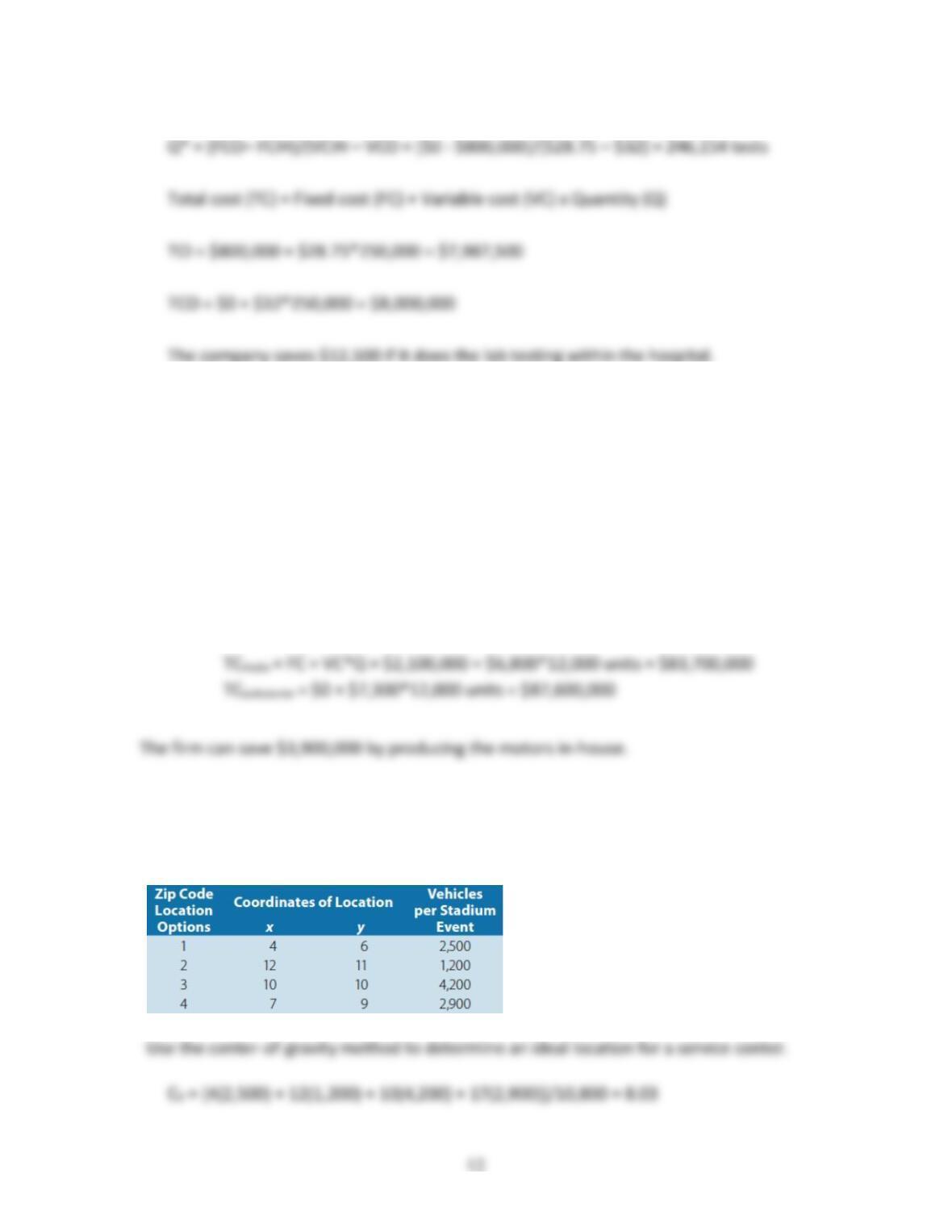
26. A company has two alternatives for meeting a customer requirement for 880,000 units of a
part used in office printers. If done in-house, fixed cost would be $1,400,000 with variable
cost at $1.90 per unit. Alternative two is to outsource for a total cost of $3.50 per unit.
Determine the break-even point and determine if they should make the item in-house or
outsource it.
On a total cost basis, the company should produce the part in-house and save $8,000.
Given that total costs are close, other supplier criteria such as delivery reliability, product
quality, and supplier sustainability practices may influence the final decision.
27. A hospital is evaluating whether to outsource or perform in-house a large set of blood and
urine laboratory tests. The fixed cost of the laboratory located in the hospital is $800,000
and the weighted average variable cost per test if performed in-house is $28.75. A third-
party lab located one city block from the hospital will perform the same tests and distribute
the results electronically to the hospital at a price of $32.00. If the annual volume last year
was 250,000 tests, should the hospital outsource or make-in-house?
28. Industrial Products, Inc. has two alternatives for manufacturing 12,000 industrial 100-horse
power electric motors per year. If done in-house, fixed cost would be $2,100,000 with
variable cost at $6,800 per unit. Alternative two is to outsource for a total cost of $7,300
per unit.
The relevant formulas can be found in Supplement C: Break-Even Analysis
a. What is the break-even quantity?
Q = FC/(C2 – C1) = ($2,100,000 – $0)/[$7,300/unit – $6,800/unit] = 4,200 motors
b. Should the firm make-in-house or outsource?
Total cost (TC) = FC + VC*Q
29. Using the information about customer vehicle traffic to and from a proposed new sports
stadium (not built yet), find the best location for the stadium that minimizes total distance
travelled using the center of gravity method.
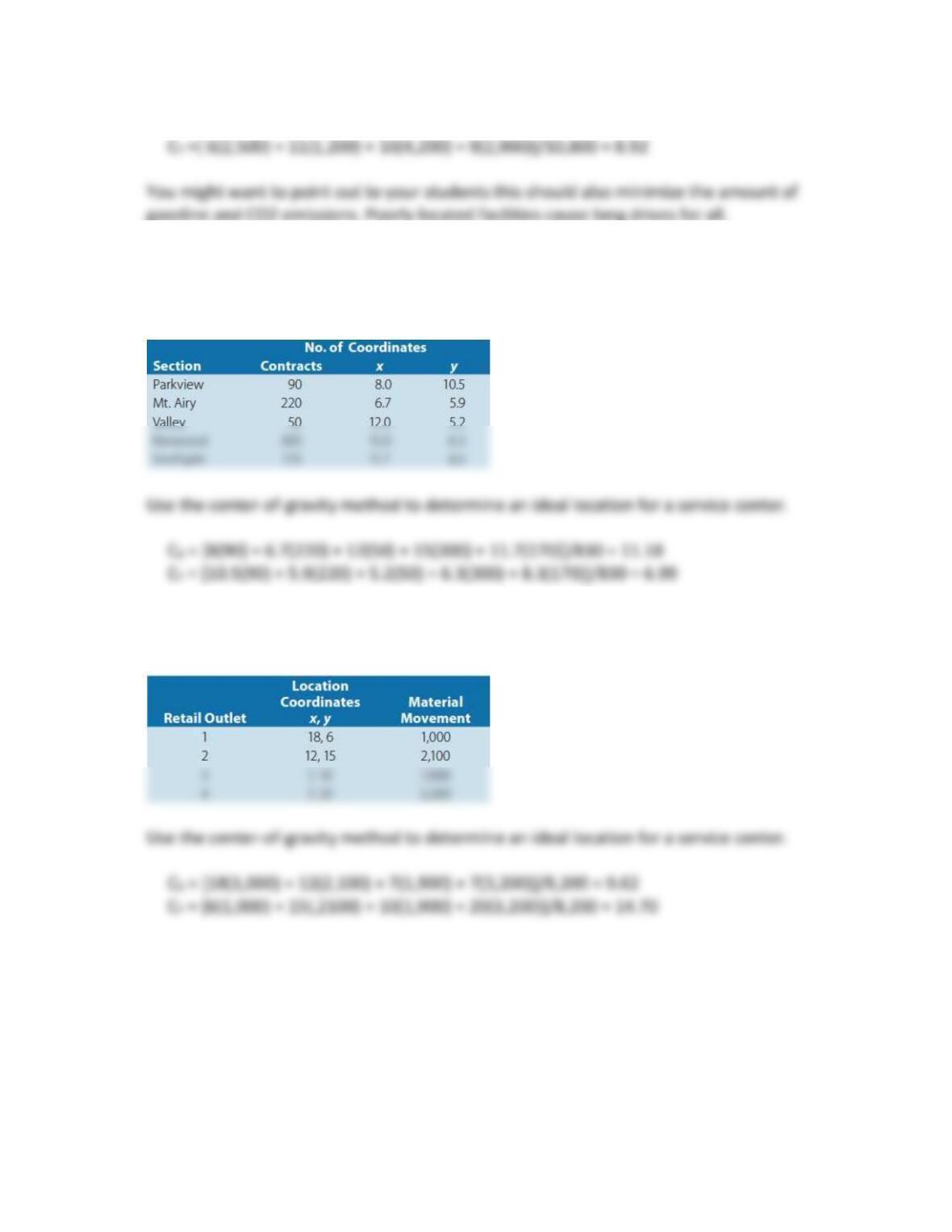
13
30. Microserve provides computer repair service on a contract basis to customers in five
sections of the city. The five sections, the number of service contracts in each section, and
the x and y coordinates of each section are as follows:
31. Using the following information about material volume shipped from a factory to four
retail outlets, find the best location for the factory using the center of gravity method.
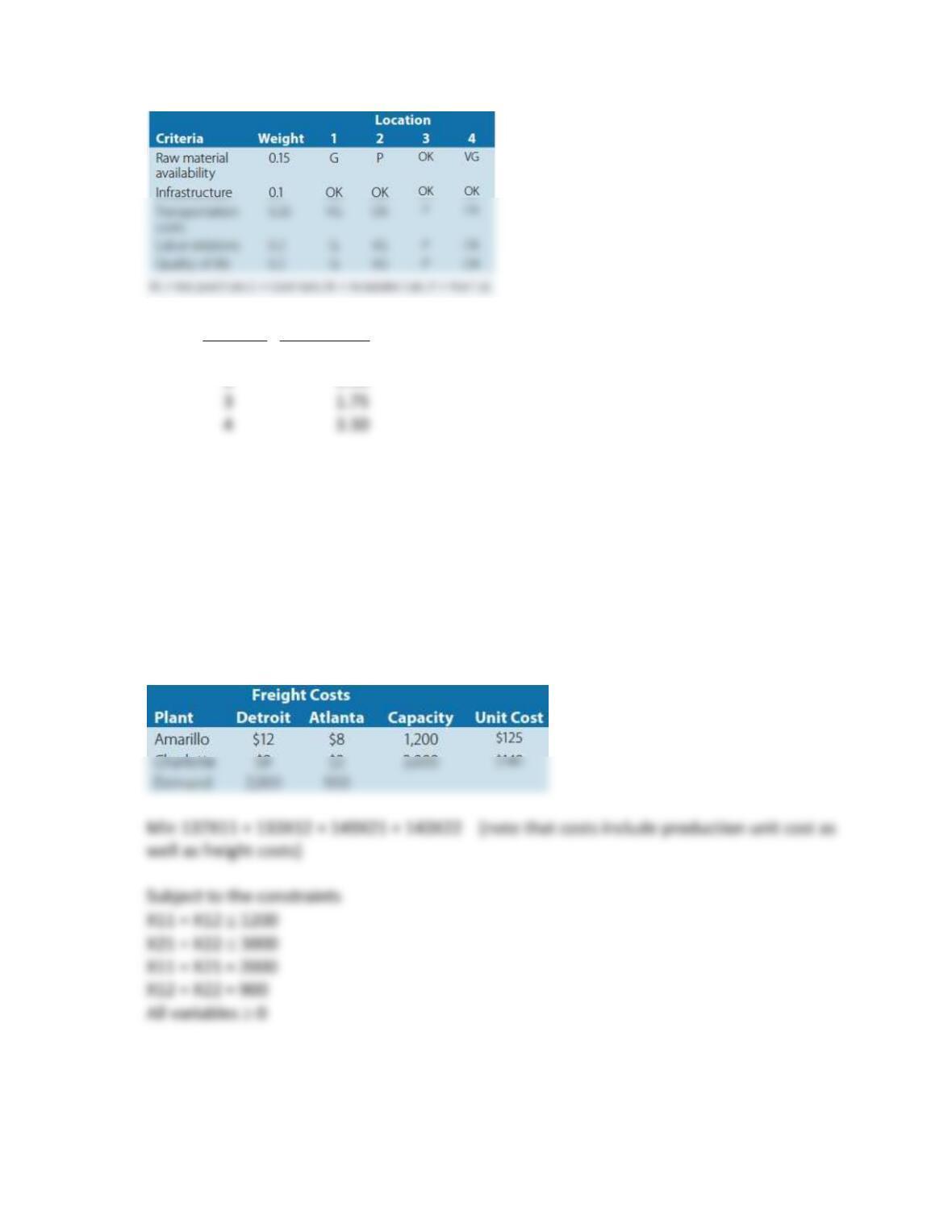
32. A supply chain manager faced with choosing among four possible locations has assessed
each location according to the following criteria, where the weights reflect the importance
of the criteria. How can he use this information to choose a location? Can you develop a
quantitative approach to do this?
14
Location Total Points
1 4.25
We would prefer locations in the order 1 (best), 2, 4, and 3 (worst). Most student
weighting systems will find 1 best and #3 location the worst. The key is that the student
weighting scheme and scales are logical and explainable.
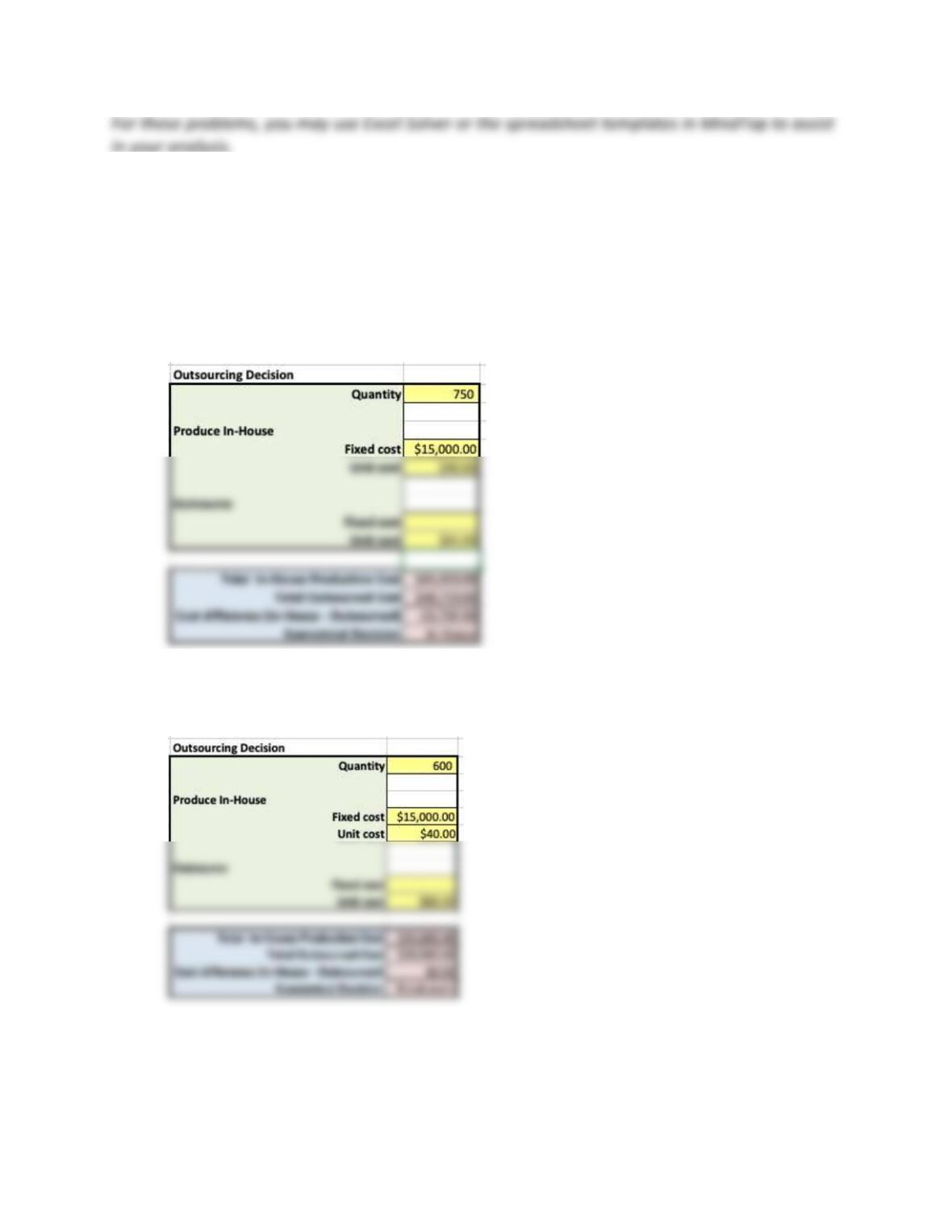
33. Supreme Auto Parts produces components for motorcycle engines. It has plants in
Amarillo, Texas, and Charlotte, North Carolina, and supply factories in Detroit and Atlanta.
Use the following production and cost data for a major component are as follows.
Formulate a transportation model to determine the best distribution plan. Do not attempt
to solve.
EXCEL-BASED PROBLEMS
15
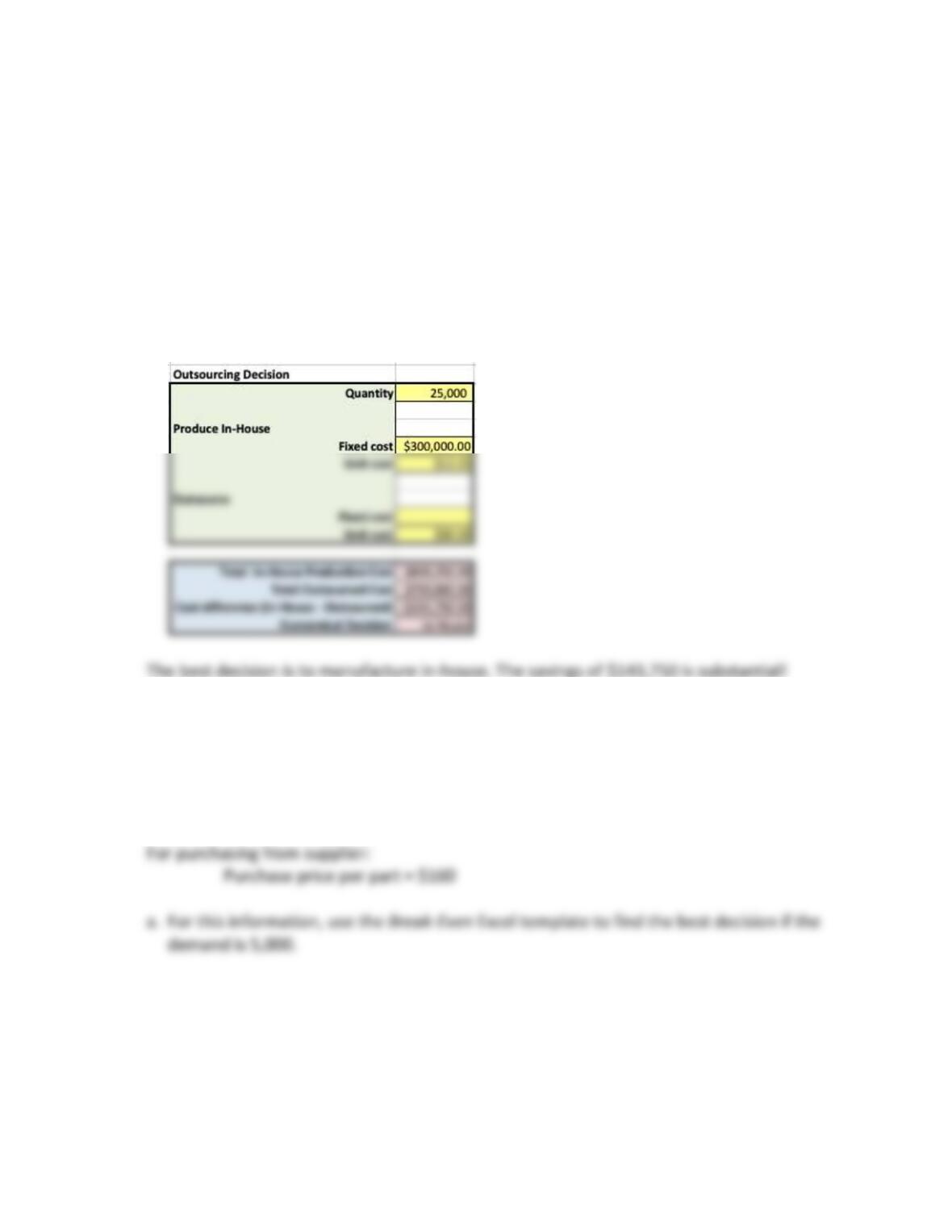
34. A university currently has a recycling program for paper waste. The fixed cost of running
this program is $15,000 per year. The variable cost for picking up and disposing of each
ton of recyclable paper is $40. If the work is outsourced to a recycling company, the cost
would be $65 per ton.
a. If the forecasted demand is 750 tons, what should the university do? Use the Break-
Even Excel template to find your answer.
b. Find the break-even point using the Excel Goal Seek tool.
Using Goal Seek:
If demand is larger than 600 tons, recycle in-house; if demand is less than 600 tons, then
outsource.
16
35. Marine International manufactures an aquarium pump and is trying to decide whether to
produce the filter system in-house or sign an outsourcing contract with Bayfront
Manufacturing to make the filter system. Marine’s expertise is producing the pumps
themselves but they are considering producing the filter systems also. To establish a filter
system production area at Marine International, the fixed costs is $300,000 per year and
they estimate their variable cost of production in-house at $12.25 per filter system. If
Marine outsources the production of the filter system to Bayfront, Bayfront will charge
Marine $30 per filter system. Use the Break-Even Excel template to determine if Marine
International should outsource the production of the filter system to Bayfront if the
demand is 25,000 pumps a year?
The best decision is to manufacture in-house. The savings of $143,750 is substantial!
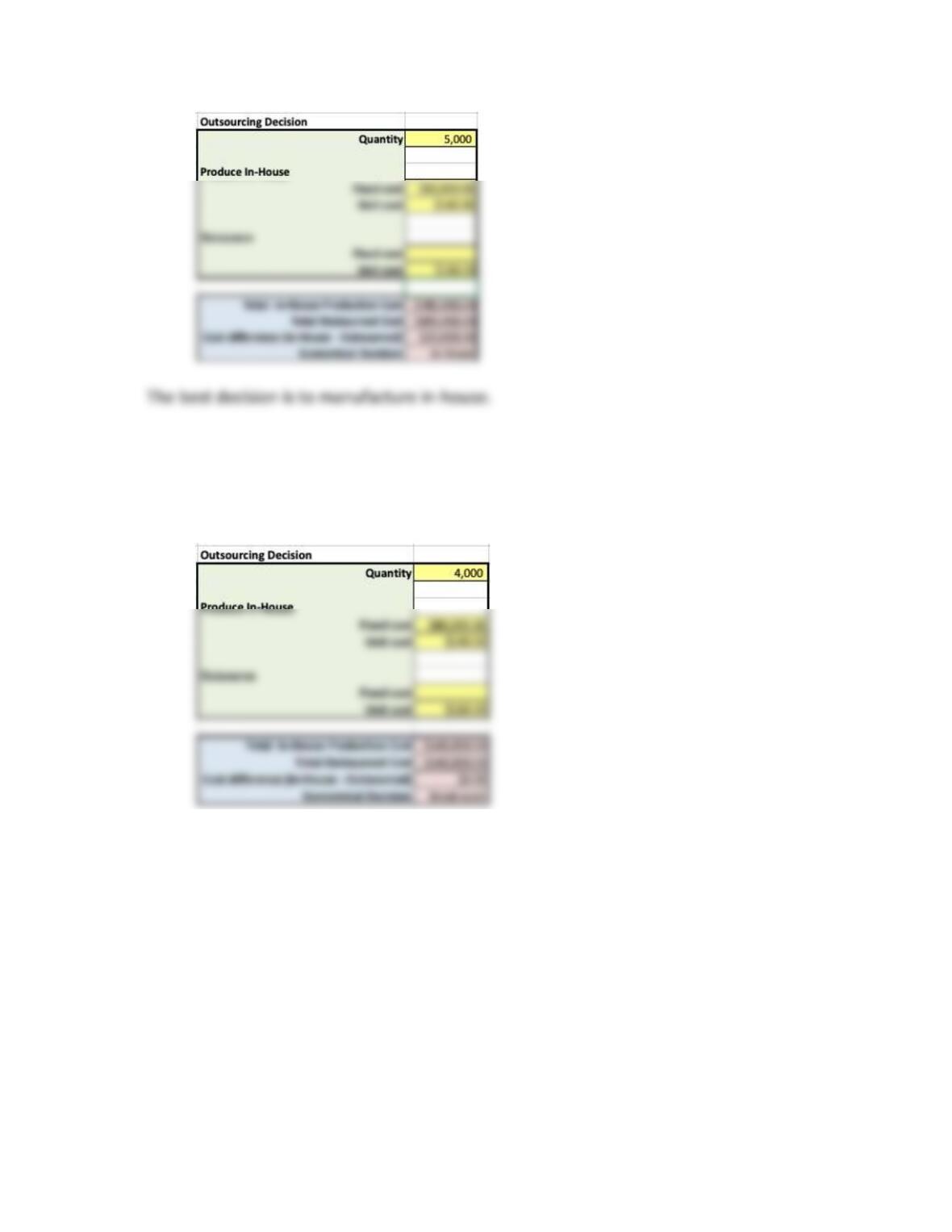
36. A firm is evaluating the alternative of manufacturing a part that is currently being
outsourced from a supplier. The relevant information is provided below:
For in-house manufacturing:
Annual fixed cost = $80,000
Variable cost per part = $140
17
b. Determine the break-even quantity for which the firm would be indifferent between
manufacturing the part in-house or outsourcing it. Use the Excel Goal Seek tool.
Using Goal Seek:
37. Refer to the information provided in Question 36 to answer the following questions using
the Break-Even Excel template.
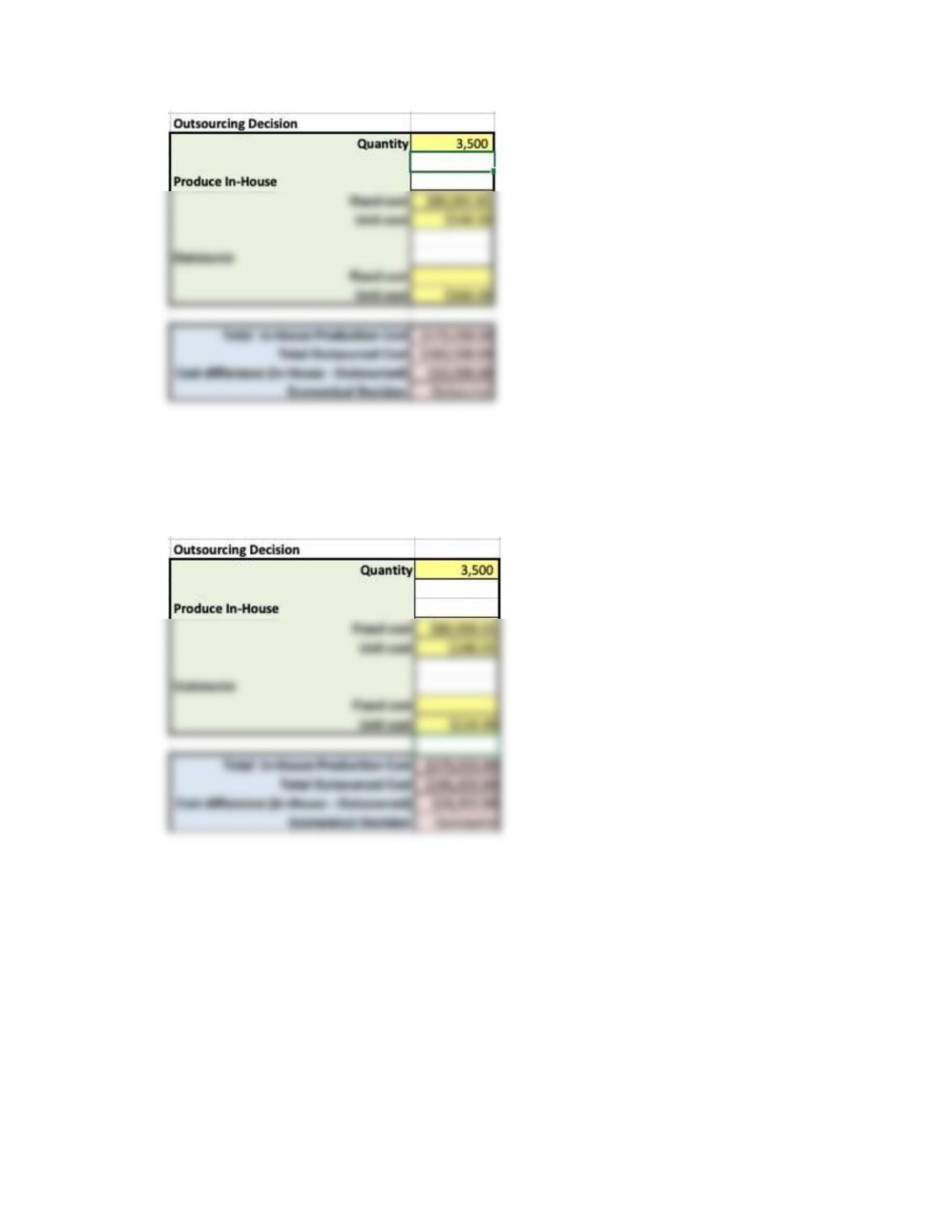
a. If demand is forecast to be 3,500 parts, should the firm make the part in-house or
purchase it from a supplier?
b. The marketing department forecasts that the upcoming year’s demand will be 3,500
parts. A new supplier offers to make the parts for $156 each. Should the company
accept the offer?
c. What is the maximum price per part the manufacturer should be willing to pay to the
supplier if the forecast is 3,500 parts?
a. Demand = 3,500:
18
b. The marketing department forecasts that the upcoming year’s demand will be 3,500 units.
A new supplier offers to make the parts for $156 each. Should the company accept the
offer? If so, how much can they save?
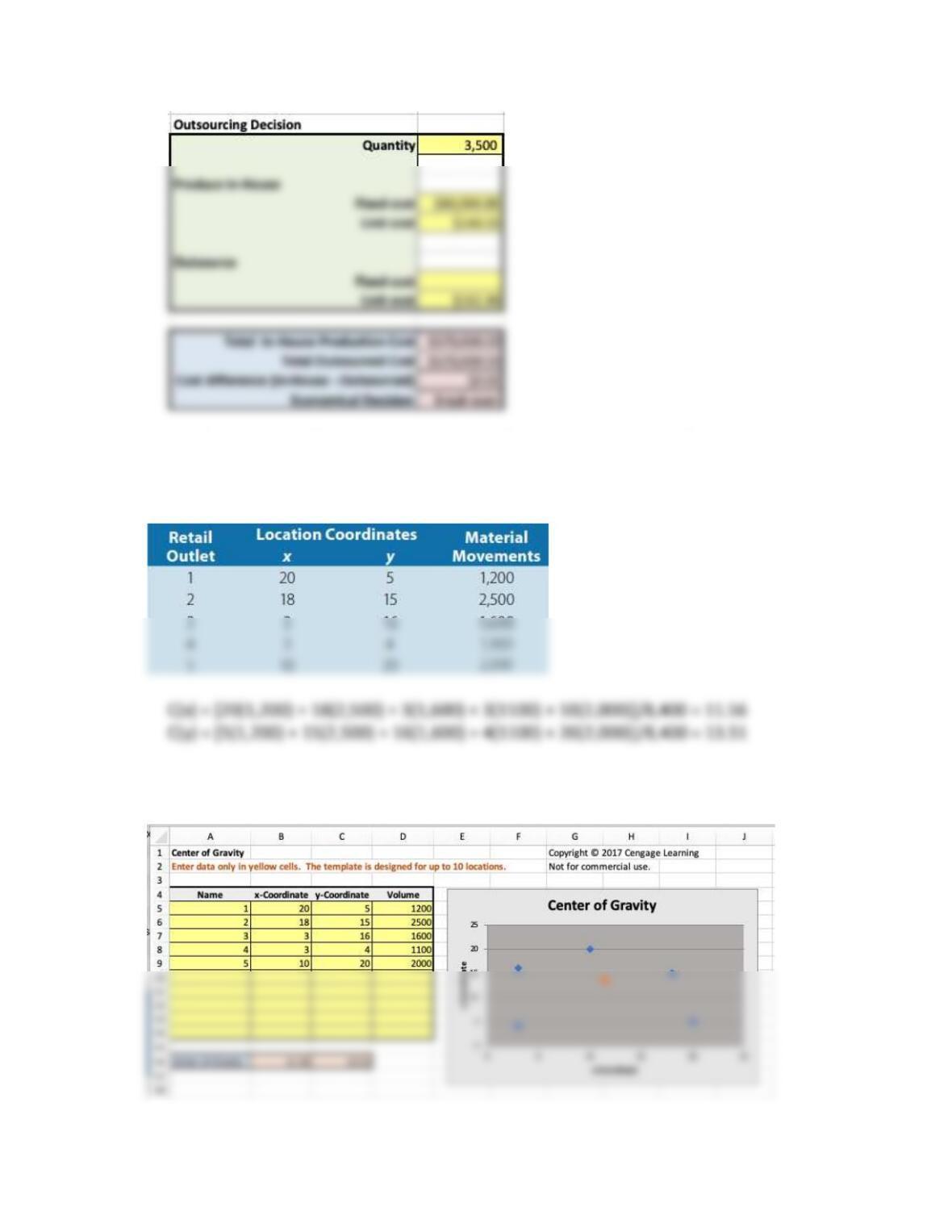
c. What is the maximum price per part the manufacturer should be willing to pay to the
supplier if the forecast is 3,500 parts?
Using Goal Seek with the changing cell E13 (outsourcing unit cost):
19
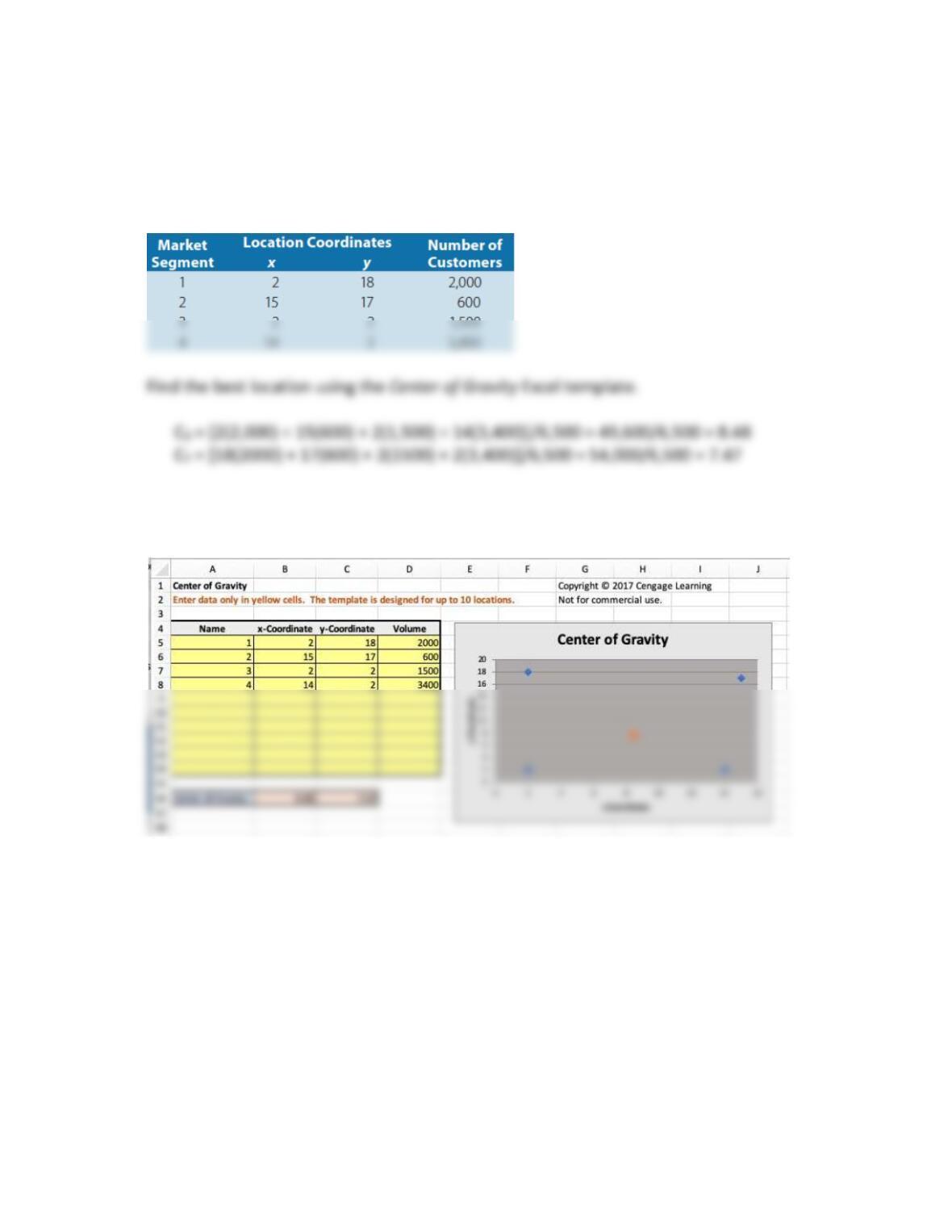
38. Given the location information and volume of material movements from a supply point
(warehouse) to several retail stores for Bourbon Hardware, find the optimal location for the
supply point using the Center of Gravity Excel template.
The Excel template solution is shown below.
20
39. The Davis national drugstore chain prefers to operate one outlet in a town that has four
major market segments. The number of potential customers in each segment along with
the coordinates are as follows:
The Excel template solution is shown below.
40. For the David drugstore chain in Problem 39, suppose that after five years, half the
customers from segment 1 are expected to move to segment 2. Where should the
drugstore shift, assuming the same criteria are adopted? Use the Center of Gravity Excel
template to answer this question.