Chapter 06 – Leadership Attributes
to experience. However, open and closed styles of thinking are useful in different environments. The
intellectual style of the open person may serve a professor well, but research has shown that closed
thinking is related to superior job performance in police work, sales, and a number of service occupations.
Domain/Facet……….. Score 0——-–10——–20——–30——–40—–—50——–60——–70—–—80—–—90——–99
OPENNESS TO EXPERIENCE..…56 ********************************************************
..Imagination…………..28 ****************************
Openness Facets
• Imagination. To imaginative individuals, the real world is often too plain and ordinary. High
scorers on this scale use fantasy as a way of creating a richer, more interesting world. Low
scorers are on this scale are more oriented to facts than fantasy. Your level of imagination is low.
• Artistic Interests. High scorers on this scale love beauty, both in art and in nature. They become
change and prefer familiar routines. Your level of adventurousness is average.
• Intellect. Intellect and artistic interests are the two most important, central aspects of openness to
experience. High scorers on Intellect love to play with ideas. They are open-minded to new and
unusual ideas, and like to debate intellectual issues. They enjoy riddles, puzzles, and brain
teasers. Low scorers on Intellect prefer dealing with people or things rather than ideas. They
Chapter 06 – Leadership Attributes
Chapter 06 – Leadership Attributes
Exercise 6-3b
Exercise Title: The Hogan Personality Inventory
Purpose: To provide students with personal feedback on seven personality traits related to the Five
Factor Model of personality.
Summary: The Hogan Personality Inventory (HPI) is a 206-item, on-line survey that provides normative
feedback on seven personality traits related to the Five Factor Model of personality described in Chapter
6. The HPI was developed in the mid-1970s, and over 1,000,000 people have taken the assessment. It will
take participants about 20 minutes to complete the assessment.
The Career Builder feedback report costs $40.00 per participant. Instructors/institutions will be billed the
week after the reports are delivered to the instructor.
Instructors wanting additional information about the HPI and how to use it in the classroom or in
Chapter 06 – Leadership Attributes
Exercise 6-4
Exercise Title: Estimating Psychological Preferences
Purpose: To personalize the discussion of psychological preferences by letting students complete a brief
instrument for heuristic (i.e., not diagnostic) purposes.
Summary: Distribute the “Brief Self-Test for Estimating Psychological Preferences (Form A)” to
This instrument should not be used to determine psychological type (i.e., a four-letter designation with the
attendant interpretation) for both practical and theoretical reasons. Practically speaking, there are too few
items on this instrument to provide a sufficient sampling of behavior to yield a psychometrically robust
understanding self and others.
Here is one technique we have tried with many different groups during discussions of psychological
preferences. After everyone has completed the brief self-test, discuss the meaning of each of the four
preference dimensions. Before each discussion, however, have the participants stand up and arrange
themselves in an imaginary continuum across the room ranging between endpoints on that particular
preference dimension; the neutral point would be in the center of the room. Each individual should stand
approximately where his or her score on that dimension would fall. People seem to enjoy seeing the
diversity of scores, and where particular individuals have placed themselves. Few people seem threatened

Chapter 06 – Leadership Attributes
Chapter 06 – Leadership Attributes
Chapter 6 A BRIEF SELF-TEST FOR ESTIMATING PSYCHOLOGICAL PREFERENCES (FORM A)
Working across the row, circle the word in each pair that most appeals to you or seems most characteristic of you. In some

Chapter 06 – Leadership Attributes
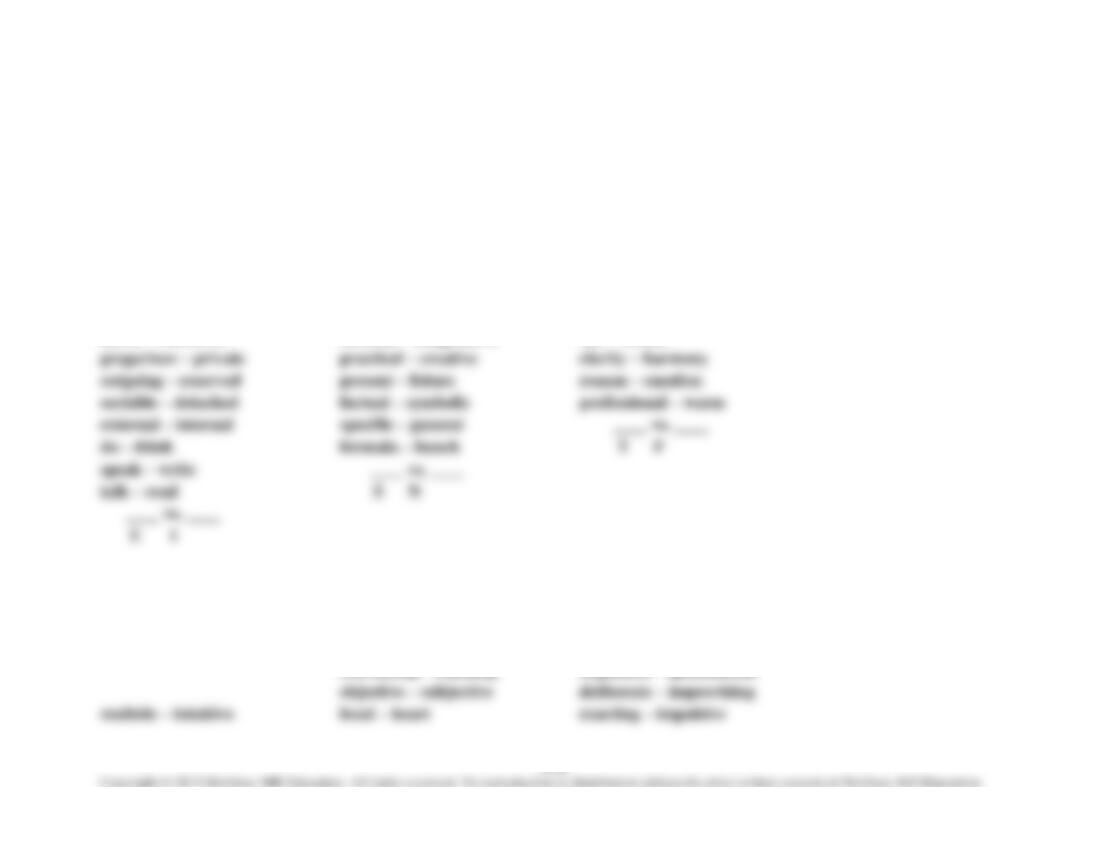
loud – quiet
active – reflective
gregarious – private
realistic – intuitive
blueprint – dream
details – pattern
just – humane
principal – passion
fair – tender
clarity – harmony
reason – emotion
professional – warm
exacting – impulsive
definite – tolerant
decisive – open-minded
Chapter 06 – Leadership Attributes
Chapter 6 A BRIEF SELF-TEST FOR ESTIMATING PSYCHOLOGICAL REFERENCES (FORM B)
Once one word in all of the word pairs has been circled, add up the total number of words circled in each of the six columns.
Write the total words circled in the blank at the bottom of each column. Circle the higher score in each pair (i.e., E vs. I, S vs.
N, T vs. F, J vs. P). Your personality type is identified by the 4 highest scores in the pairs, and should look something like
ENTJ, ISTP, INFJ, etc.
loud – quiet
active – reflective
blueprint – dream
details – pattern
sensible – imaginative
convincing – touching
just – humane
principal – passion
fair – tender
systematic – flexible
methodical – curious
organized – spontaneous
Chapter 06 – Leadership Attributes
definite – tolerant
decisive – open-minded

Chapter 06 – Leadership Attributes
Exercise 6-5
Exercise Title: Handcuffs
Purpose: To demonstrate divergent thinking.
Summary: For this exercise, you will need a pair of “handcuffs” for each student in class. The handcuffs
consist of a 30-inch piece of soft rope with two loops of 8 inches each tied at each end. Have students pair
up, and then have them put on the handcuffs so that they cannot escape from each other. In other words,
This exercise takes approximately 15 minutes.
Adapted from: The Center for Creative Leadership’s Outdoor Leadership Training Module.
Chapter 06 – Leadership Attributes
6-31
Exercise 6-6
Exercise Title: Nails
Purpose: To demonstrate creative thinking.
Summary: Break students into four groups. Give each group a 3 × 3 × 2 inch block of wood with a nail
pounded in the middle and ten extra nails. Instructors should then challenge each group to balance ten
nails on the head of the nail in the block of wood. The ten nails should be free standing and not be