6-1
Chapter 6
Cost–Volume–Profit Analysis
Concept Questions
1. (LO1—Traditional versus contribution margin income statements)
2. (LO1—Basic contribution margin)
The contribution margin will not change because a change in fixed cost does not
3. (LO1—Basic contribution margin)
The contribution margin is the sales price per unit minus all variable production
4. (LO2—Basic contribution margin)
5. (LO3—Basic break-even analysis)
The break-even point in units is equal to the total fixed costs divided by the
6. (LO3—Basic break-even analysis)
A company can decrease its break-even point by decreasing fixed costs and/or
7. (LO4—Income tax effects in CVP analysis)
If a company wants to compute an after-tax profit, then the company has to
Solutions Manual
6-2
8. (LO5—Break-even point and operating leverage)
As a company nears the break-even point and its income gets close to zero, the
Brief Exercises
1. (LO1—Contribution margin)
a. contribution margin
2. (LO2—What-if analysis)
Current
With
changes
Sales $800,000 $768,000
3. (LO3—Break-even analysis)
Chapter 6: Cost-Volume-Profit Analysis
6-3
4. (LO4—Target Profit Analysis)
5. (LO5—Operating leverage)
Operating leverage = Contribution margin/net operating income
Exercises
6. (LO2—CVP: The impact on income)
Increasing the sales price by 40 percent (to $49) without changing variable costs
7. (LO2—CVP: What-if analysis)
A contribution margin ratio of 30 percent will increase net operating income by
8. (LO2—What-if decisions with changing fixed costs)
This problem can be solved by using the contribution margin ratio or operating
Solutions Manual
9. (LO2 and 5—Operating leverage)
A.
10. (LO3—Break-even analysis)
At the break-even point,
Chapter 6: Cost-Volume-Profit Analysis
6-5
11. (LO3—Break-even analysis)
The company must sell an additional 1,000 logs if fixed costs increase by
$12,000. With a contribution margin of $12 per log ($18 – $6), each
12. (LO3—Break-even analysis: Multiproduct environment)
Calculating the break-even point with multiple products requires first calculating
the weighted-average contribution margin:
Glide Magic Slide Magic
Selling price $16.00 $12.00
13. (LO3—Break-even analysis: Multiproduct environment)
Calculating the break-even point with multiple products requires first calculating
the weighted-average contribution margin:
Green Compost
Selling price $16.00 $12.00
Solutions Manual
6-6
14. (LO4—Sales to reach after-tax profit)
Check:
Sales ($30 × 9,500) $ 285,000
15. (LO4—Target profit analysis)
In order to earn an after-tax profit of $60,000, Kingman must earn a before-tax
profit of $100,000 [$60,000/(1 – Tax rate)], or 60,000/0.6.
Chapter 6: Cost-Volume-Profit Analysis
Problems
16. (LO1 and 3—Multiproduct break-even analysis)
A. The weighted-average contribution margin per unit is $2.60:
Citronella DEET Mean Green
Selling price $11.00 $15.00 $17.00
If fixed costs are $260,000, the break-even point will be 100,000 total units:
B.
Citronella DEET Mean Green
Weight 0.2 0.4 0.4
Solutions Manual
6-8
17. (LO1, 2, and 3—CVP: What-if analysis)
* Calculation of CM per ton:
Sales $5,000,000
Less: Variable costs
C. The company should increase its advertising. Increasing sales by $200,000
will increase the contribution margin by $130,000. If fixed costs
(advertising) increase by $100,000, net income will increase by $30,000.
18. (LO1, 2, and 3—CVP and break-even analysis)
A. With the sales mix at 25 percent plastic frames (10,000/40,000) and
Chapter 6: Cost-Volume-Profit Analysis
6-9
B. If the direct material costs for plastic frames are reduced by $10, the CM
for plastic frames will increase to $30. Assuming the same sales mix as in
part A, we find that the new weighted-average CM is $37.50 ($30.00 for
the metal frames plus $7.50 for the plastic frames):
Plastic Frames Metal Frames
C. Changing the sales mix to 35 percent plastic frames and 65 percent metal
frames changes the weighted-average CM per unit to $33.00 ($26.00 for
the metal frames plus $7.00 for the plastic frames):
Plastic Frames Metal Frames
19. (LO1, 2, and 3—Decision focus: Basic CVP and break-even analysis)
A. In order to earn $30,000 of target profit ($100,000 × 0.30), the sales price
must be $11.00 per unit.
B. Assuming a sales price of $11 per unit, we find that the CM is $6 per unit.
If total fixed costs remain at $30,000, the break-even point is 5,000 units
($30,000/$6).
Solutions Manual
6-10
20. (LO1, 2, 3, and 4—Break-even and target profit)
C. Sales (700 × $75) $52,500
Variable costs (700 × $25) 17,500
Contribution margin $35,000
E. If variable costs decrease by 40 percent, to $15 (and the sales price is
unchanged), the new contribution margin will be $60 and the break-even
point will be 500 units ($30,000/$60).
F. If fixed costs are $50,000 rather than $30,000, the break-even point will be
1,000 units ($50,000/$50).
Chapter 6: Cost-Volume-Profit Analysis
6-11
21. (LO1, 2, 3, and 4—Decision focus: Break-even and target profit)
*The contribution margin ratio of 0.35 is equal to the contribution margin of $1,050,000
divided by sales of $3,000,000. The contribution margin is equal to sales of $3,000,000
minus variable expenses of $1,950,000.
B. If ZIA wants to generate net income of $700,000, the company must
increase its sales to $4,000,000:
22. (LO4—Decision focus: Multiproduct break-even analysis)
A. The weighted-average contribution margin per unit is $9.60. If fixed costs
are $300,000, the break-even point will be 31,250 total units, as the
following analysis shows:
Daily
Wash
Mud
Mask
Face
Cleanser
Solutions Manual
6-12
$9.60 =31,250 total units
B.
Daily Wash Mud Mask
Face
Cleanser
C. One way to reduce the break-even point is to sell more Mud Mask.
Cases
23. (LO1, 2, and 4—CVP analysis: Target profit with constraints)
A. Current annual fixed costs = $4,000,000, calculated as follows:
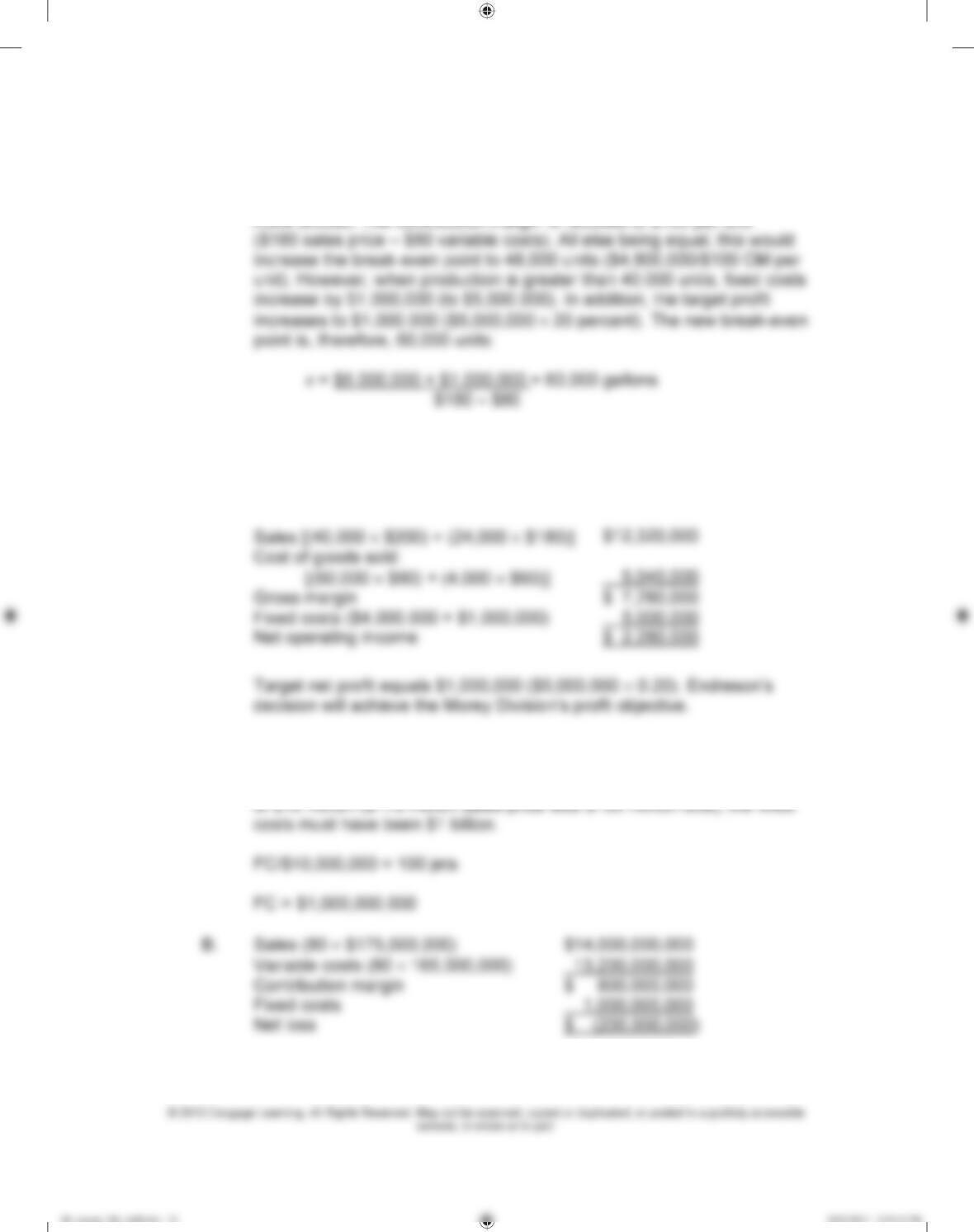
B. With a selling price of $200, the Morey Division must sell 40,000 units to
reach its target profit objective:
Chapter 6: Cost-Volume-Profit Analysis
6-13
If the selling price is reduced to $180, sales must increase to 60,000 units.
If the selling price is reduced to $180, the calculation gets a little
C.
Moore, Inc.
Income Statement (Pro Forma)
24. (LO1, 2, 3, and 4—Break-even and target profit analysis)
A. Given the break-even point of 100 jets and the contribution margin per jet
Solutions Manual
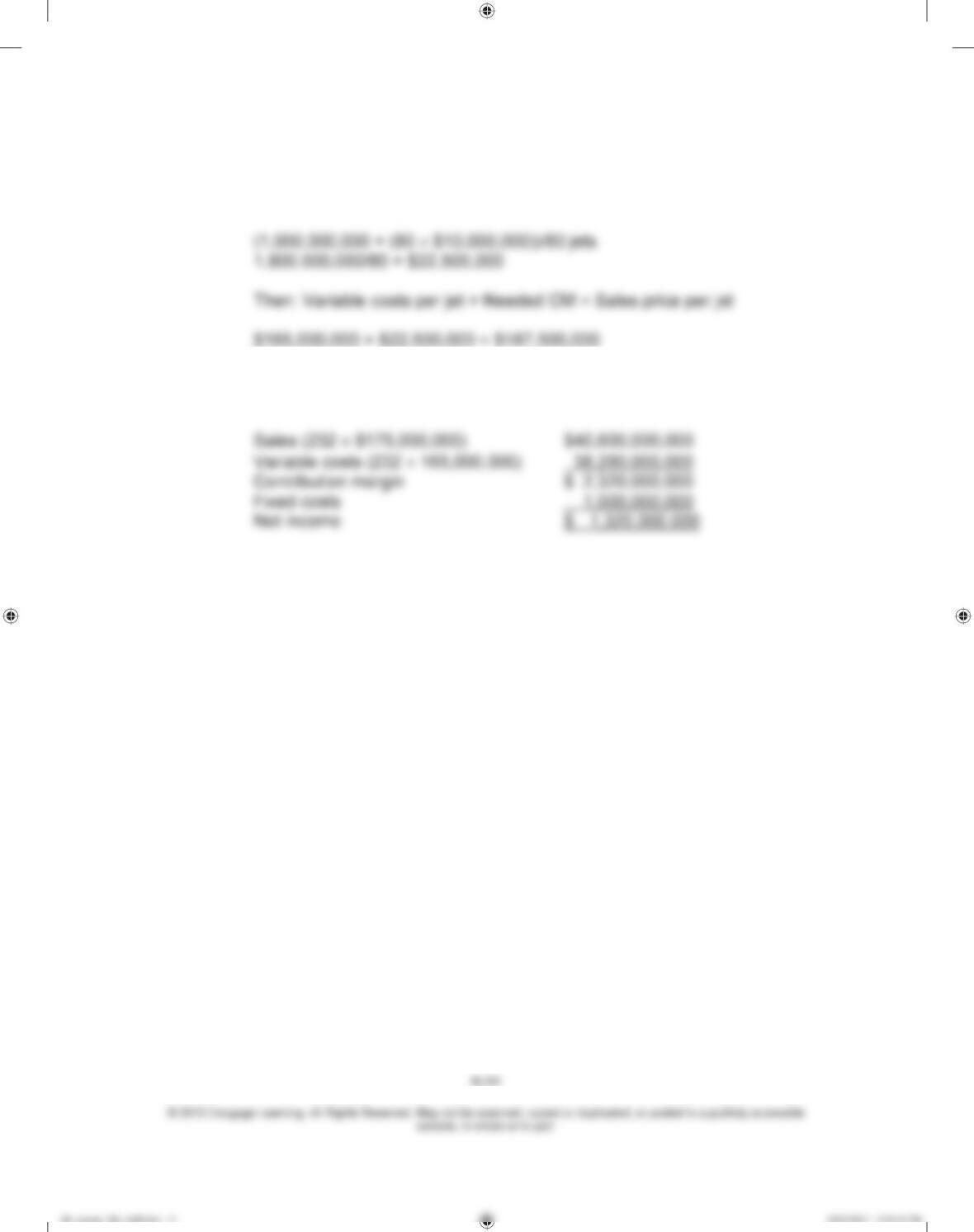
C. First, calculate the CM needed per jet:
(Fixed costs + Target profit)/80 jets = Contribution margin per jet
D. Over the years, the companies have made $1.32 billion of income on
sales of the jet.