5-1
Chapter 5
Cost Behavior
Concept Questions
1. (LO1—Cost behavior of direct material)
2. (LO1—Cost behavior and the relevant range)
3. (LO1—Cost behavior of fixed costs)
When volume increases, fixed costs per unit will decrease. Likewise, when
4. (LO1—Equation for mixed costs)
5. (LO2—Regression analysis)
When used to estimate the fixed and variable components of a mixed cost, the
6. (LO2—Regression analysis)
R2 is a measure of the goodness of fit, or how well the regression line
7. (LO2—High/low method)
If the high or low activity level is unusual (an outlier), the cost estimate provided
by the high/low method is likely to be inaccurate.
Solutions Manual
8. (LO3—Relevant costs and decision making)
9. (LO3—Relevant costs and decision making)
Irrelevant costs relate to the past or do not differ under different alternatives in
10. (LO4—Impact of taxes on costs)
11. (LO1—Absorption costing versus variable costing)
If production exceeds sales, absorption costing will always show higher net
12. (LO1—Absorption costing versus variable costing)
If sales exceed production, variable costing will show higher net operating
13. (LO1—Absorption costing versus variable costing)
When production equals sales, variable costing and absorption costing will show
14. (LO1—Absorption costing versus variable costing)
Chapter 5: Cost Behavior
5-3
15. (LO2—Income statement impact of absorption costing)
Under absorption costing, net operating income can be increased by increasing
16. (LO2—Income statement impact of absorption costing)
Fixed costs are part of product costs under absorption costing and thus are
17. (LO2—Impact of absorption costing on income statement)
Under absorption costing, net operating income can be increased by increasing
18. (LO2—Impact of absorption costing on income statement)
Selling and administrative costs are always expensed in each period but are
Brief Exercises
1. (LO1—Understanding fixed and variable costs)
a. False
2. (LO2—Mixed costs using high/low method)
Solutions Manual
5-4
3. (LO3—The impact of income taxes)
Note to Instructors: The entire table is reproduced here. Answers to missing
values are shown in boldface type.
Before-Tax Revenue Tax Rate After-Tax Revenue
$ 90,000 30% $ 63,000
4. (LO4—Absorption versus variable costing)
Item Absorption
Costing
Variable
Costing
Direct materials Product cost Product cost
5. (LO5—Calculating unit cost under absorption costing and variable costing)
Absorption costing:
Variable costing:
Chapter 5: Cost Behavior
6. (LO6—Comparing income under absorption and variable costing)
Absorption costing:
Sales $231,000
Variable costing:
Sales $231,000
Exercises
7. (LO1—Cost behavior)
a. FC e. VC
Solutions Manual
5-6
8. (LO1—Calculation of total costs)
9. (LO1—Cost behavior analysis)
A. Erin must have committed herself to a greater amount of fixed cost than
Teresa did. For example, Erin may have rented office space or a copy
10. (LO1—Mixed costs and the cost equation)
11. (LO1—Cost behavior: Step costs)
A. The cost of the lease is a step cost. Rather than varying in direct proportion to
12. (LO1—Fixed and variable cost behavior)
A. If the company makes the planned changes, variable costs will decrease to
$5.50 per unit and fixed costs will decrease to $6,300. The new cost equation
13. (LO2—Regression analysis: calculation of total cost)
Chapter 5: Cost Behavior
5-7
14. (LO2—Mixed costs using high/low method)
15. (LO2—Mixed costs using high/low method)
16. (LO2—Calculate variable cost using high/low method)
A.
Solutions Manual
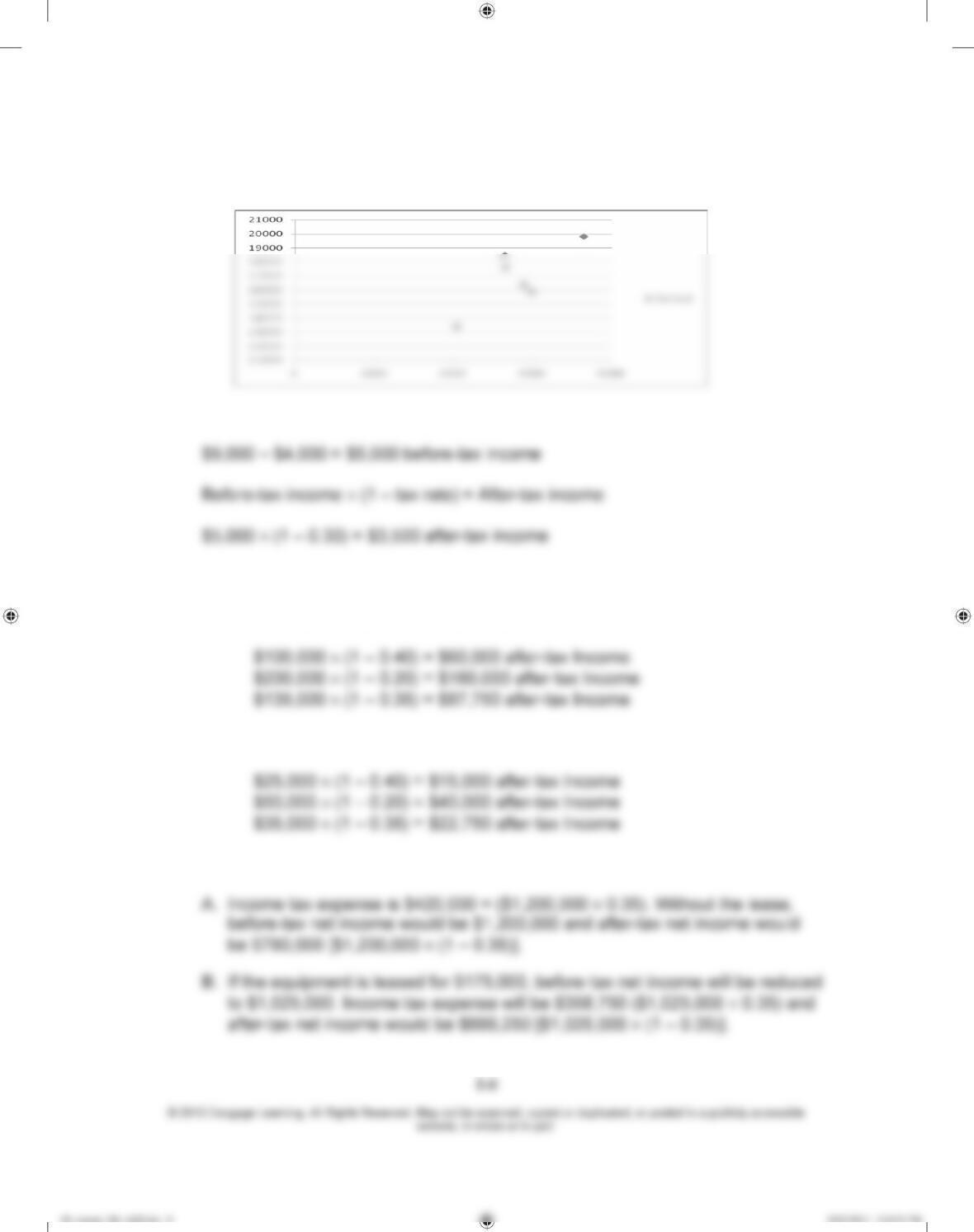
B. As the graph shows, although the cost of steam increases with labor hours
worked, it is not a straight-line relationship.
17. (LO3—Impact of income taxes)
18. (LO3—Impact of income taxes)
Before-tax income × (1 – Tax rate) = After-tax income
Before-tax cost × (1 – Tax rate) = After-tax cost
19. (LO3—Impact of income taxes)
5-9
20. (LO4, 5—Variable costing: Calculation of unit variable cost)
21. (LO4, 5, and 6—Absorption costing versus variable costing)
Variable Costing Absorption Costing
Direct materials $ 40.00 $40.00
22. (LO5—Absorption costing: Calculation of unit variable cost)
23. (LO4, 5, and 6—Absorption costing versus variable costing: Calculation of net
operating income)
A.
Variable Costing Absorption Costing
Sales $1,800,000 Sales $1,800,000
Solutions Manual
5-10
B. Because production is greater than sales, absorption costing will have
C. When sales exceed production, variable costing will result in net operating
Variable Costing Absorption Costing
Sales $2,100,000 Sales $2,100,000
24. (LO4, 5, and 6—Absorption costing versus variable costing: Calculation of net
operating income)
A. Variable costing
Sales $660,000
Variable costs ($13 × 11,000) (143,000)
Chapter 5: Cost Behavior
5-11
B. Absorption costing
Sales $660,000
C. Absorption costing must be used in order to comply with generally accepted
accounting principles (GAAP).
25. (LO4, 5—Absorption costing versus variable costing)
A. $10 per unit of variable production costs
Solutions Manual
5-12
26. (LO5—Variable costing: Calculation of net operating income)
The answer is $2,000, calculated as follows:
27. (LO 5—Absorption costing: Calculation of net operating income)
Absorption cost per unit:
Direct material $12
28. (LO5, 6—Absorption costing versus variable costing: Calculation of net
income)
Cost per unit: variable costing
Direct material $ 4
A. Income Statement (variable costing)
Sales $ 138,000 (4,600 × 30)
Chapter 5: Cost Behavior
B. Income statement (absorption costing)
Sales $ 138,000
29. (LO5, 6—Variable costing and absorption costing: Calculation of net income)
A. The answer is $400,000, calculated as follows:
Sales $2,000,000
B. The answer is $480,000, calculated as follows:
Sales $ 2,000,000
30. (LO5, 6—Variable costing and absorption costing: Calculation of net income)
A. Under variable costing, income would be $28,800, calculated as follows:
Sales $ 63,000
B. Under absorption costing, income would be higher than under variable
costing.