Chapter 05 – Planning: The Foundation of Successful Management
5-21
Interactive Classroom Material:
EXAMPLE: Strategic, Tactical, & Operational Goals: Southwest Airlines (p. 144)
Southwest Airlines was ranked as one of Fortune’s Most Admired Companies of
2014. The goal of Southwest’s top managers is to ensure that the airline is highly
YOUR CALL
Do you think recent changes will allow the company to continue to achieve its
strategic goals?
Southwest will have to adapt in order to reach its strategic goals based on some of
the recent changes. Though its strategic goals may not have changed, its tactical
Additional Activities:
One way to build on this Example is to have the students watch the CNBC video
“Southwest goes International, Charts Expansion.” This 3-minute video profiles some
of the challenges Southwest will face in its international expansion. Consider using
the following discussion questions:
Analyze the advantages and disadvantages for Southwest Airlines of pursuing
international expansion.
Chapter 05 – Planning: The Foundation of Successful Management
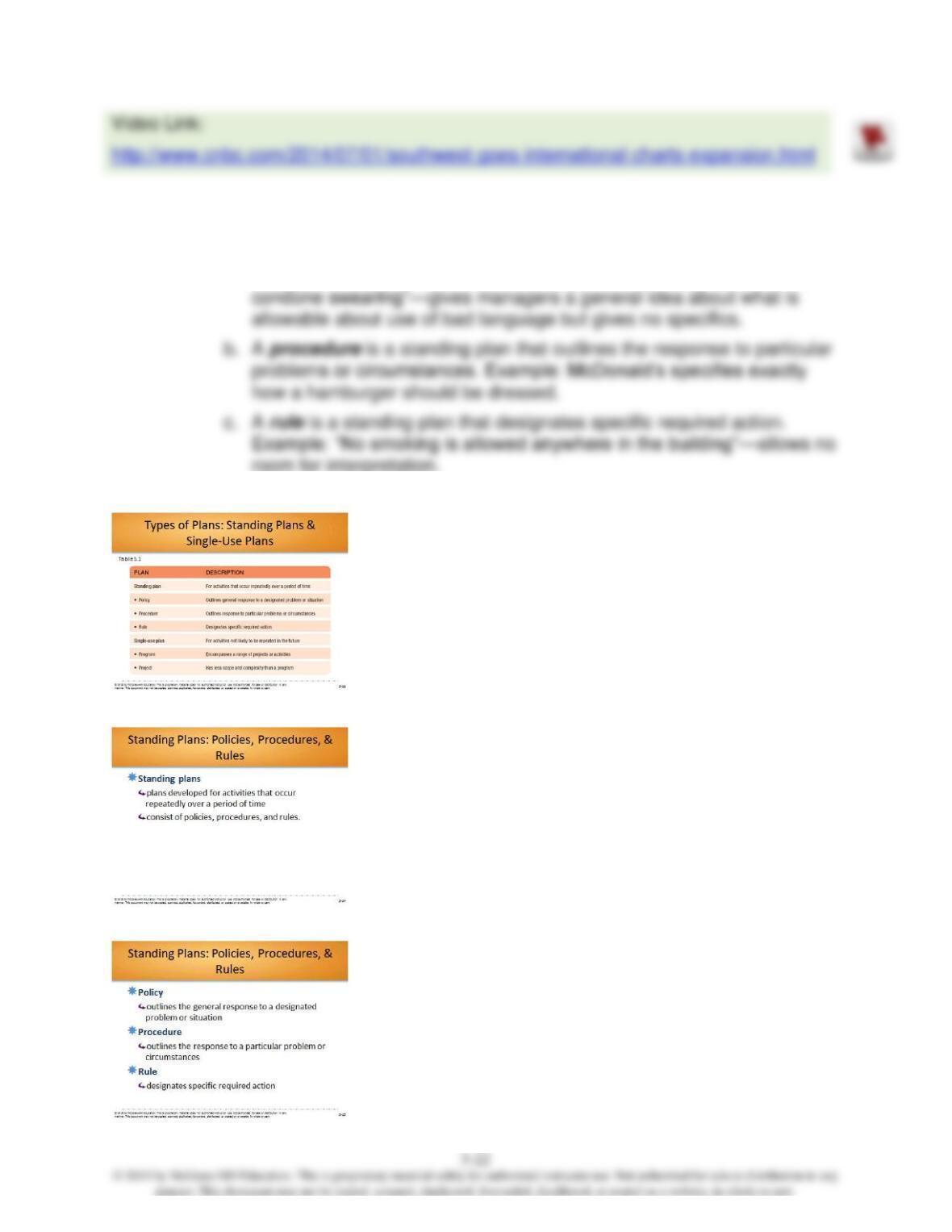
3. Standing plans consist of policies, procedures, and rules.
a. A policy is a standing plan that outlines the general response to a
designated problem or situation. Example: “This workplace does not
Chapter 05 – Planning: The Foundation of Successful Management
4. Single-use plans are plans developed for activities that are not likely to
be repeated in the future.
5. Single-use plans can be programs or projects.
a. A program is a single-use plan encompassing a range of projects or
Group Exercise #2: Using SMART Goals to Plan a Student Organization
Exercise Objectives
• To engage in planning by writing SMART goals and action plans for a new
student organization.
Chapter 05 – Planning: The Foundation of Successful Management
5-24
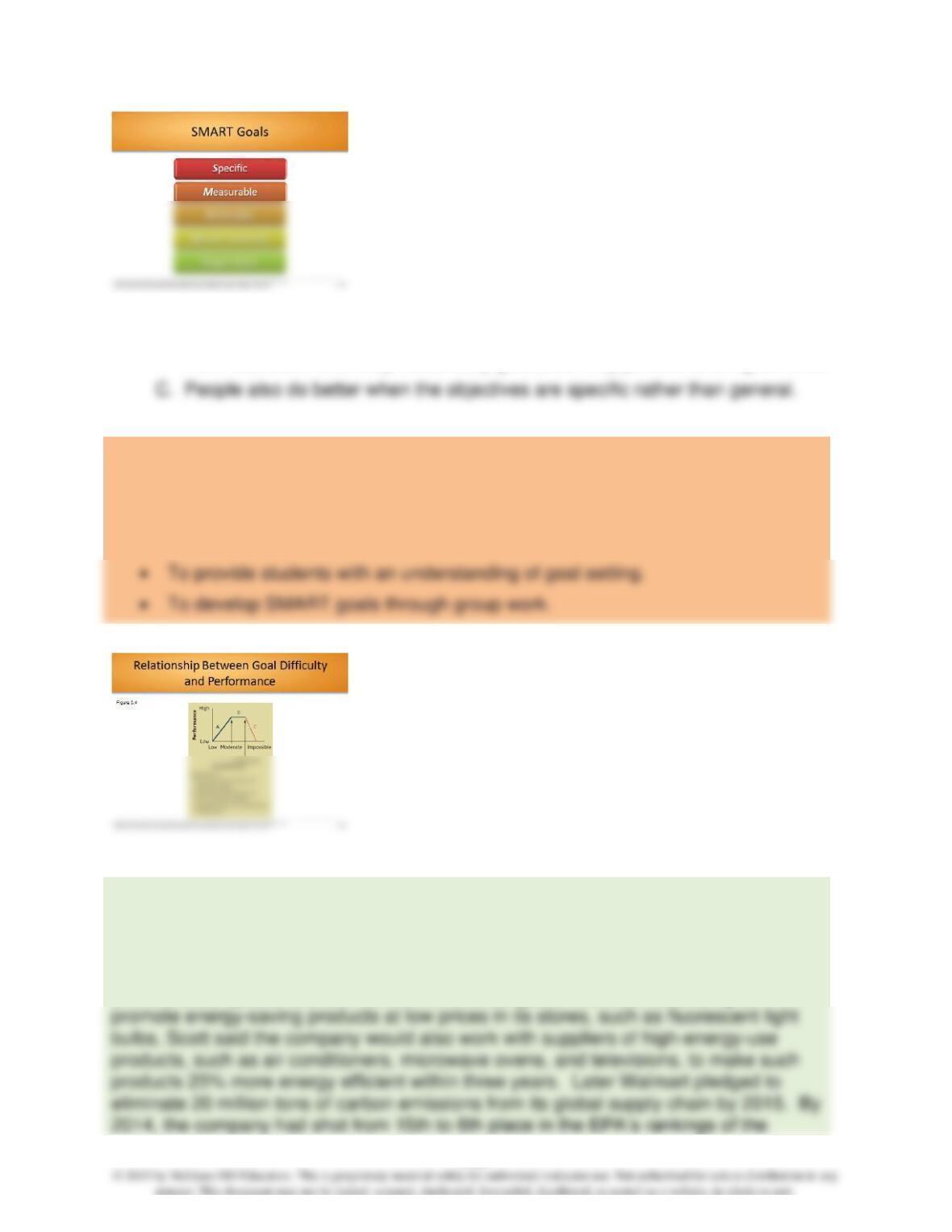
Section 5.4 discusses SMART goals, or goals that are Specific, Measurable, Attainable,
Results-oriented, and have Target dates. A technique that assists in setting goals is
Possible Topics for Discussion:
• Create at least 3 examples of SMART goals pertaining to your schoolwork that
you could focus on this academic term. Evaluate the extent to which the goals
you created meet the SMART criteria.
Major Idea Outline:
A. A SMART goal is one that is Specific, Measurable, Attainable, Results
oriented, and has Target dates.
1. Specific – Goals should be stated in specific rather than vague terms.
5.4 Promoting Goal Setting: SMART Goals & Management
by Objectives (pp. 147-151)
What are SMART goals and MBO and how can they be implemented?
Chapter 05 – Planning: The Foundation of Successful Management
5-25
B. Research has shown that, if goals are made more difficult, people may achieve
them less often than they would easy goals, but they perform at a higher level.
Group Exercise #3: Writing SMART Goals
There is a group exercise available at the end of this manual that allows students to
explore writing SMART goals and understand goal-setting.
Exercise Objectives
Interactive Classroom Material:
EXAMPLE: Setting Goals: Walmart Lays Out an Agenda for Environmental
Change (p. 148)
Tired of criticism of Walmart’s business practices, its CEO at the time, H. Lee Scott
Jr., in a 2008 speech laid out new environmental goals. Besides continuing to
Chapter 05 – Planning: The Foundation of Successful Management
5-26
country’s top purchasers of green power.
YOUR CALL
Whether or not Walmart has included all the sources of emissions in its
calculation, as critics assert, how do the objectives outlined above reflect the
criteria for SMART goals?
Specific – At its 2013 Global Sustainability Milestone Meeting, the company listed
the two following goals, to be achieved by the end of 2020: (1) a 600% increase
(over 2010 levels) in power purchases of renewable energy globally every year,
and (2) a reduction by 20% globally (compared to 2010) in kilowatts required to
power Walmart buildings.
Additional Activities:
One way to build on this Example is to profile Walmart’s new positions around animal
welfare and the responsible use of antibiotics in farm animals that the firm announced
in May of 2015. Among the initiatives are that Walmart’s food suppliers must treat
Evaluate the extent to which Walmart’s positions on animal welfare meet the
criteria for SMART goals.
Assume Walmart wants to make its positions on animal welfare more
“measurable” using the SMART criteria. Provide examples of how the firm’s
position statements should be revised.
Chapter 05 – Planning: The Foundation of Successful Management
5-27
D. What Is MBO? The Four-Step Process for Motivating Employees
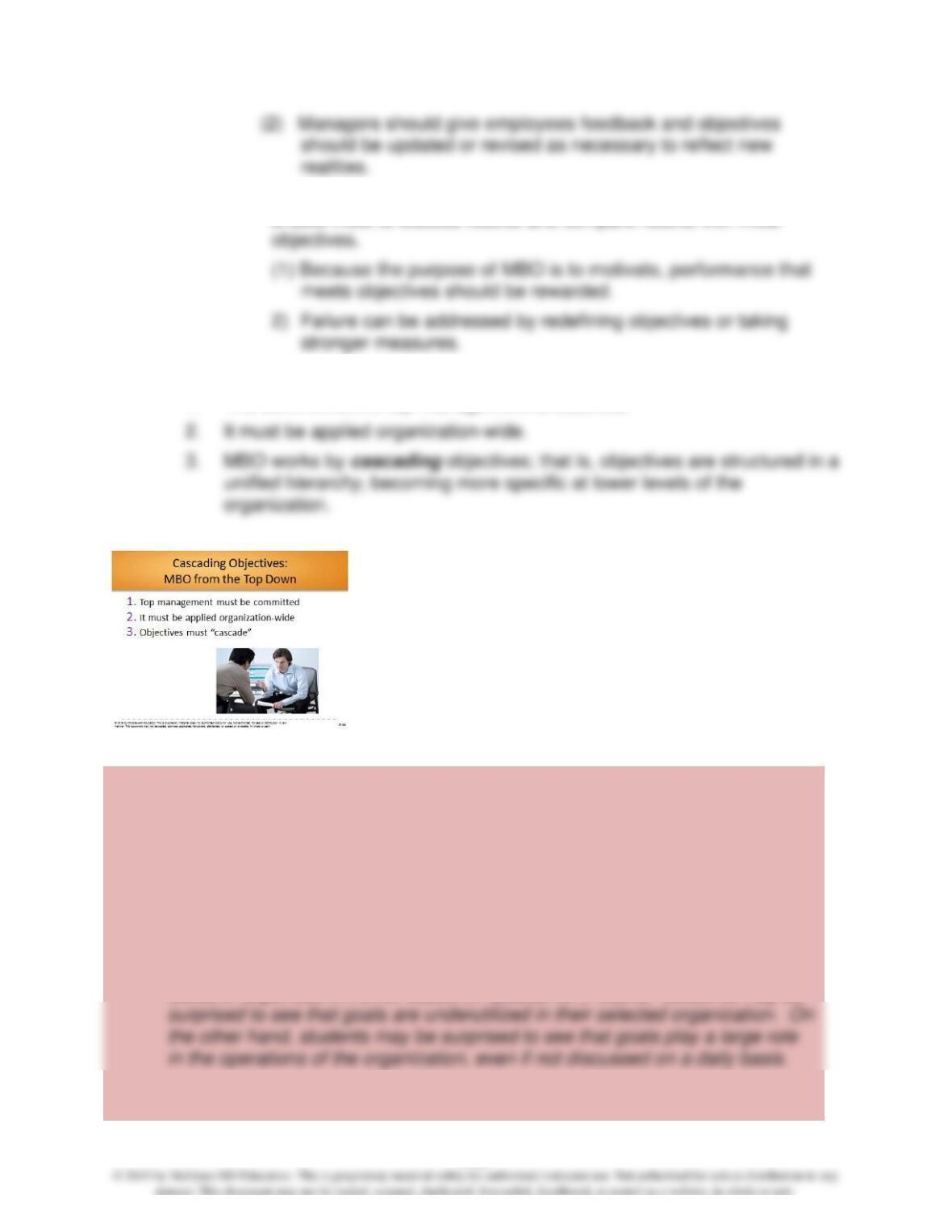
1. Management by objectives (MBO) is a four-step process, and its
purpose is to motivate rather than control subordinates.
a. Step 1: The employee and manager meet and jointly set objectives to
be attained by the employee.
(1) There are three types of objectives: improvement objectives,
personal development objectives, and maintenance objectives.
b. Step 2: Managers at each level must prepare an action plan for
attaining them.
(1) These may be prepared for both individuals and work units such
Chapter 05 – Planning: The Foundation of Successful Management
5-28
d. Step 4: At the end of 6-12 months, the employee and manager
should meet to discuss results and compare results with initial
E. Cascading Objectives: MBO from the Top Down
1. The commitment of top management is essential.
SELF-ASSESSMENT 5.2 (p. 149)
What Is the Quality of Goal Setting within a Current or Past
Employer?
Go to connect.mheducation.com and take Self-Assessment 5.2.
Student Questions:
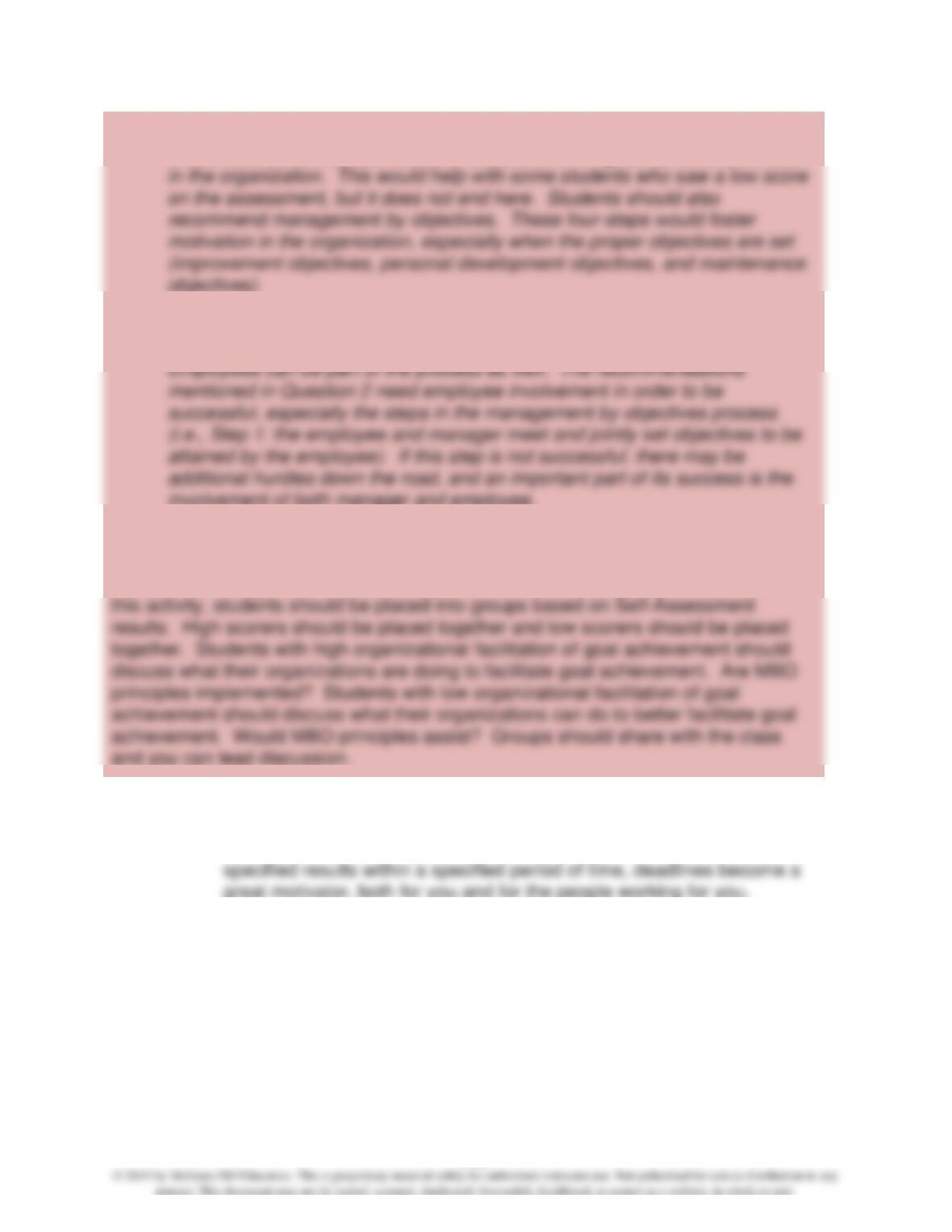
1. What are the strengths and weaknesses of goal setting in the company you
selected?
Student responses will differ based on assessment results. Students may be
2. Based on your results, what recommendations would you provide to senior
management about improving the goal-setting process in this company?
Chapter 05 – Planning: The Foundation of Successful Management
5-29
Explain.
Students should recommend that as a start, SMART goals should be utilized
objectives).
3. What actions could you take to improve the goal-setting process in this
company? Be specific.
involvement of both manager and employee.
Additional Activities:
You can also consult the Connect Instructors Manual for the post-assessment activity
and corresponding PowerPoint slides used for this Self-Assessment in Connect. In
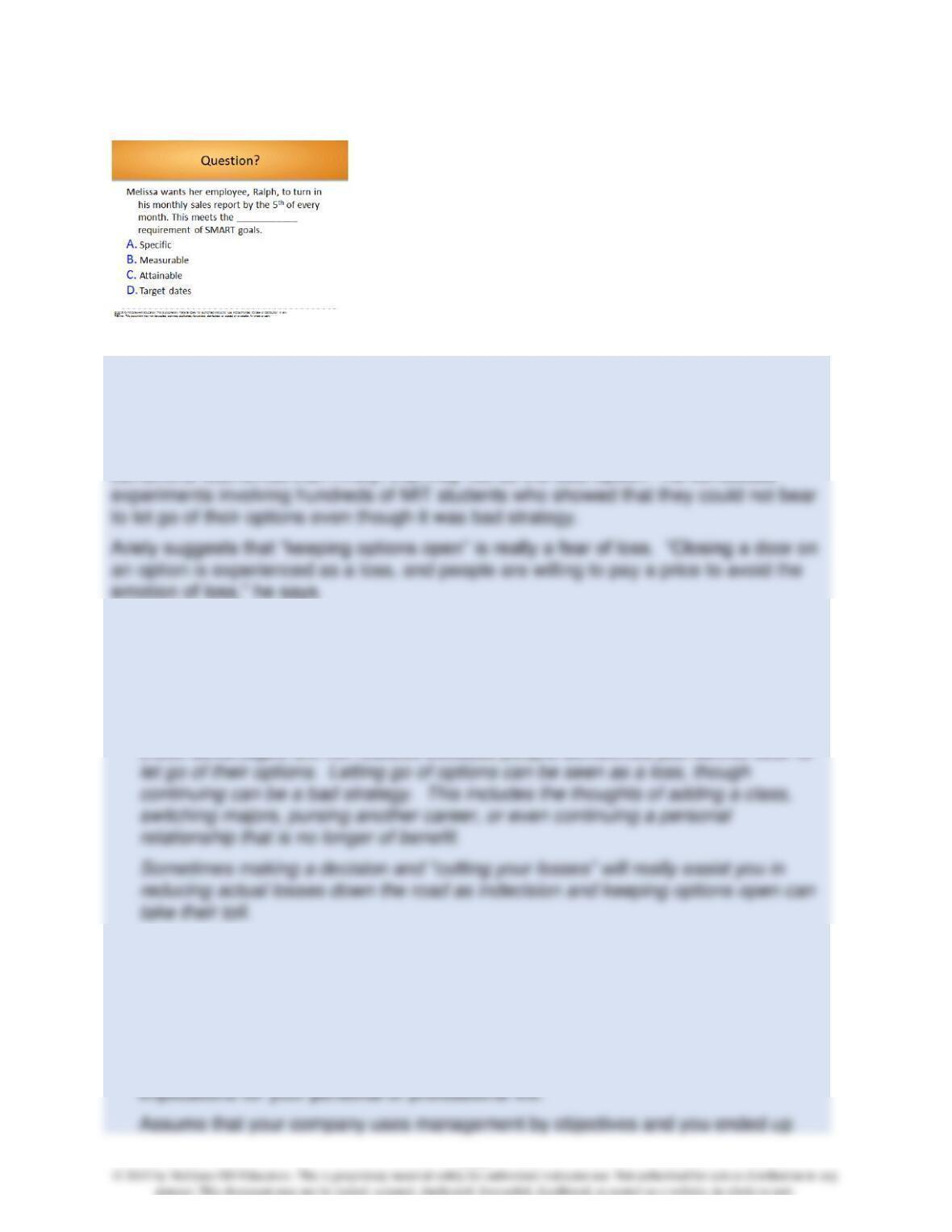
F. The Importance of Deadlines
1. Because the whole purpose of planning and goals is to deliver to a client
2. Deadlines help you ignore extraneous matters in favor of focusing on
what’s important.
Chapter 05 – Planning: The Foundation of Successful Management
5-30
(Correct answer is D)
Interactive Classroom Material:
PRACTICAL ACTION: How to Achieve Your Important Goals: Don’t Keep Every
Option Open (p. 151)
We’ve all been told that it’s important to keep our options open, but according to
behavioral economist Dan Ariely, that may not be the best option! He conducted
YOUR CALL
Are you presently considering adding a class, switching majors, or pursuing another
career? Are you wondering whether to continue a personal relationship that no longer
benefits you? What would be the advantages of just saying no?
Based on Ariely’s work, there are advantages to sometimes just saying no, but
those advantages are not realized because people sometimes just cannot bear to
Additional Activities:
One way that you could build on this Practical Action is to show the students the video
“Professor Dan Ariely Talking about FOMO.” In this 5-minute video, Professor Ariely
discusses the “Fear of Missing Out” and how anticipatory regret can impact the
decision-making process. Consider using the following discussion questions:
Provide examples of how your own “fear of missing out” has had negative

Chapter 05 – Planning: The Foundation of Successful Management
5-31
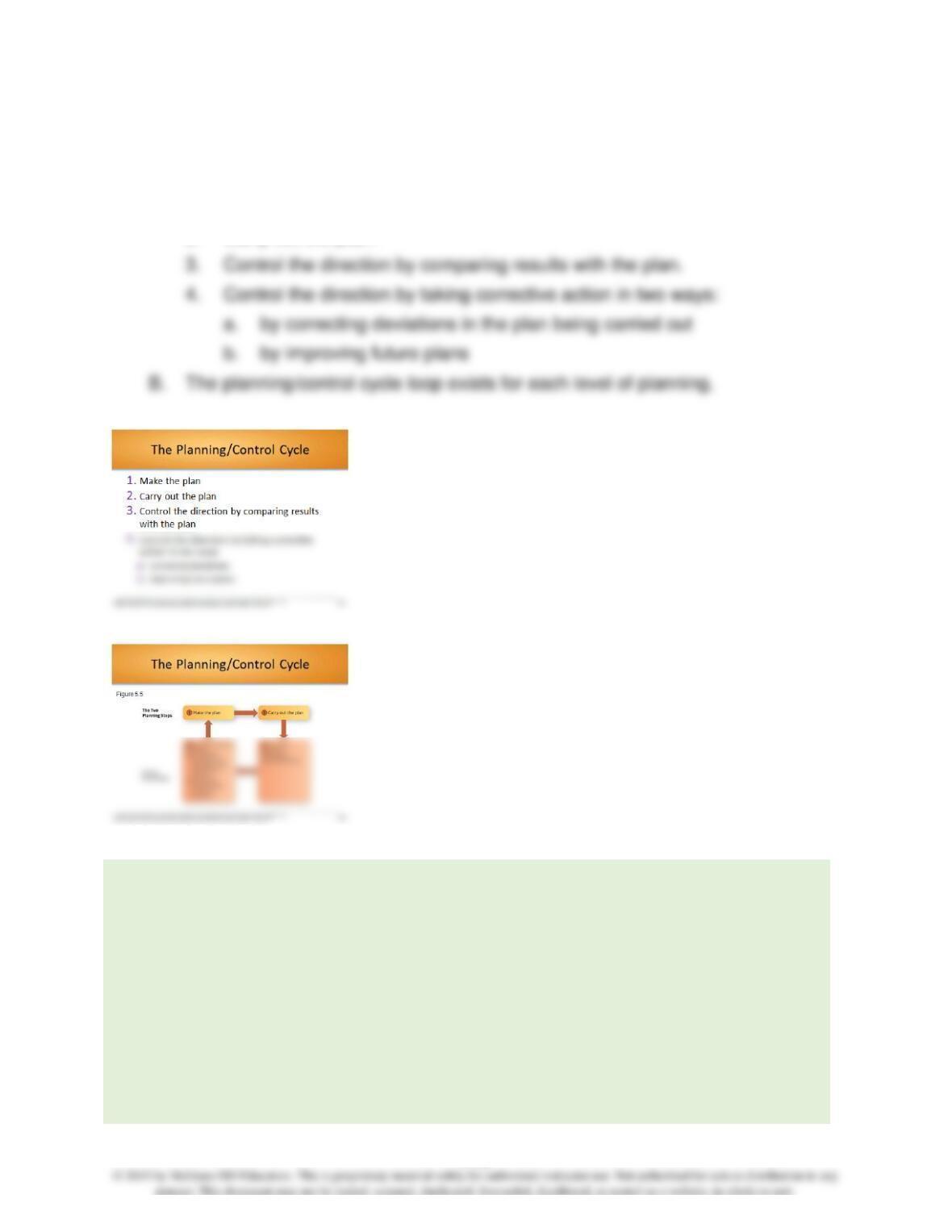
Section 5.5 discusses the planning/control cycle, which includes the following four
steps: (1) Make the plan. (2) Carry out the plan. (3) Control the direction by comparing
results with the plan. (4) Control the direction by taking corrective action in two ways—
namely (a) by correcting deviations in the plan being carried out or (b) by improving
future plans.
Possible Topics for Discussion:
• Critique the effectiveness of the planning and control processes at your company
(or a previous one).
• Using the article “Daughter Knows Best: Inside the 84 Lumber Saga” as your
foundation, describe the weaknesses of the firm’s planning and control
processes.
5.5 The Planning/Control Cycle (pp. 152-153)
How does the planning/control cycle help keep a manager’s plans headed
in the right direction?
Chapter 05 – Planning: The Foundation of Successful Management
5-32
Major Idea Outline:
A. The planning/control cycle has two planning steps (1 and 2) and two control
steps (3 and 4), as follows:
1. Make the plan.
2. Carry out the plan.
Interactive Classroom Material:
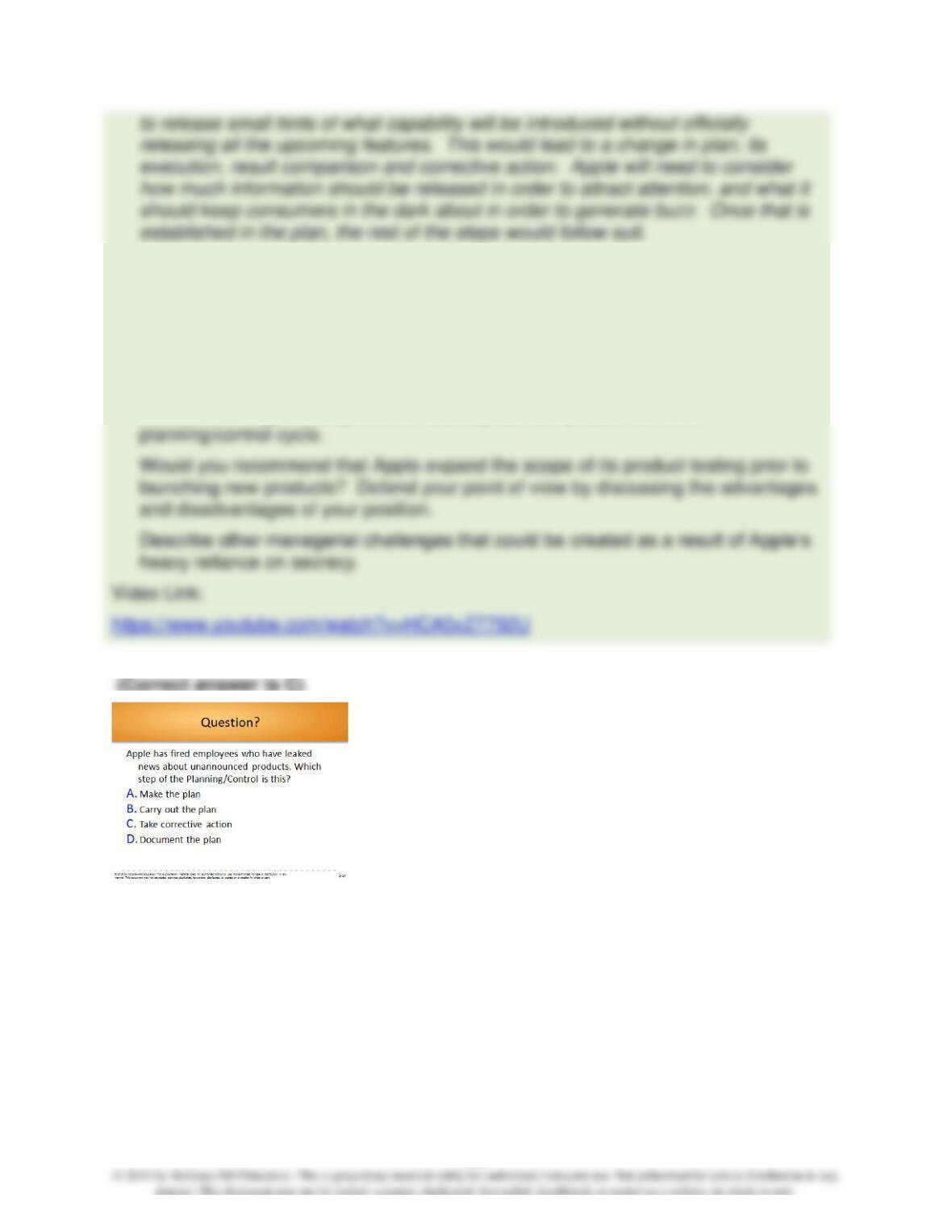
EXAMPLE: The Planning/Control Cycle: Apple Keeps Its Products Secret to
Generate Buzz (p. 153)
This Example describes how Apple uses planning and control as part of its marketing
strategy.
YOUR CALL
Can you think of a more effective way to generate consumer interest in a
forthcoming product than just keeping it secret? What kind of planning/control
cycle issues would it raise?
One way a company can generate consumer interest in a forthcoming product is
Chapter 05 – Planning: The Foundation of Successful Management
5-33
Additional Activities:
One way to build on this Example is to have the students watch the Bloomberg
Business video “Apple’s iPhone 6 Failures Should Be Blamed on Secrecy.” In this 6–
minute video from September of 2014, Bloomberg Contributing Editor Paul Kedrosky
discusses Apple’s product snafus that he contends were caused by the firm’s
overemphasis on secrecy. Consider using the following discussion questions:
Discuss how Apple’s emphasis on secrecy can complicate the firm’s
Chapter 05 – Planning: The Foundation of Successful Management
5-34
5.1 What are planning, strategy, and strategic management, and why are they
important to me as a manager?
Planning is defined as setting goals and deciding how to achieve them. When you
make a plan, you make a blueprint for action that describes what you need to do to
5.2 What are mission and vision statements, and what are three types of
planning and goals?
A mission statement expresses the purpose of the organization, whereas a vision
5.3 What are the three types of goals, and what are different kinds of plans?
Three types of goals are strategic, tactical and operational. Strategic goals are set
by and for top management and focus on objectives for the organization as a
CHALLENGE: MAJOR QUESTIONS
Chapter 05 – Planning: The Foundation of Successful Management
5.4 What are SMART goals and MBO and how can they be implemented?
A SMART goal is one that is Specific, Measurable, Attainable, Results-oriented,
and has Target dates. Management by objectives (MBO) is a four-step process in
5.5 How does the planning/control cycle help keep a manager’s plans headed in
the right direction?
Once plans are made, managers must stay in control using the planning/control