37
CHAPTER 5: FLOW RATE AND CAPACITY ANALYSIS
5.1 Objective
Chapter 3 introduced the three basic building blocks of process flow namely the (average) flow time,
5.2 Additional Suggested Readings
As in the case of the previous chapter, we assign Pizza Pazza (Kellogg case) as the major case for this
module. (The Kristen Cookie Company, (HBR case #9-686-093) is a fine alternative; see problem 2 at
end of chapter). The case is simple and accessible to most students, yet allows a rich discussion of the
Suggested Questions:
1. Draw a detailed process flow map of the current process at Receiving Plant #1. What is the capacity
of each operation in the process?
2. What is the maximum long-term achievable throughput rate of Receiving Plant #1? What factors
affect this throughput rate?
3. Currently what is (are) the major reason(s) for trucks waiting and excessive overtime?
NCC.xls to analyze this case. We have allowed the students to use the spreadsheet. In class we illustrate
how one could analyze the case (without the spreadsheet) using inventory build-up diagrams.
5.3 Answers to Questions
5.1
a. At 50% product mix, the Unit load at each department is given
Unit Load
Shopping
(hrs per contract)
Unit Load
Medical
(hours per contract)
Unit Load
Mix
(hours per contract
The capacity of the various departments is :
Unit Load (hrs
per contract)
Hours Available
(hours per day)
Capacity
(units per day)
Paralegal
5
24
4.8
The capacity of the process is 4.8 contracts per day.
b. Assuming 20 working days in a month, the capacity is not sufficient
c. The number of professionals required is given by:
Unit Load
(hrs per contract)
Hours required
(hours per 150
contracts
Hours Available
(hours per
professional per
month)
Number of
Professionals
required
Paralegal
5
750
120
6.25
1
150
These could be rounded up to 7, 2 and 2 professionals respectively.
5.2
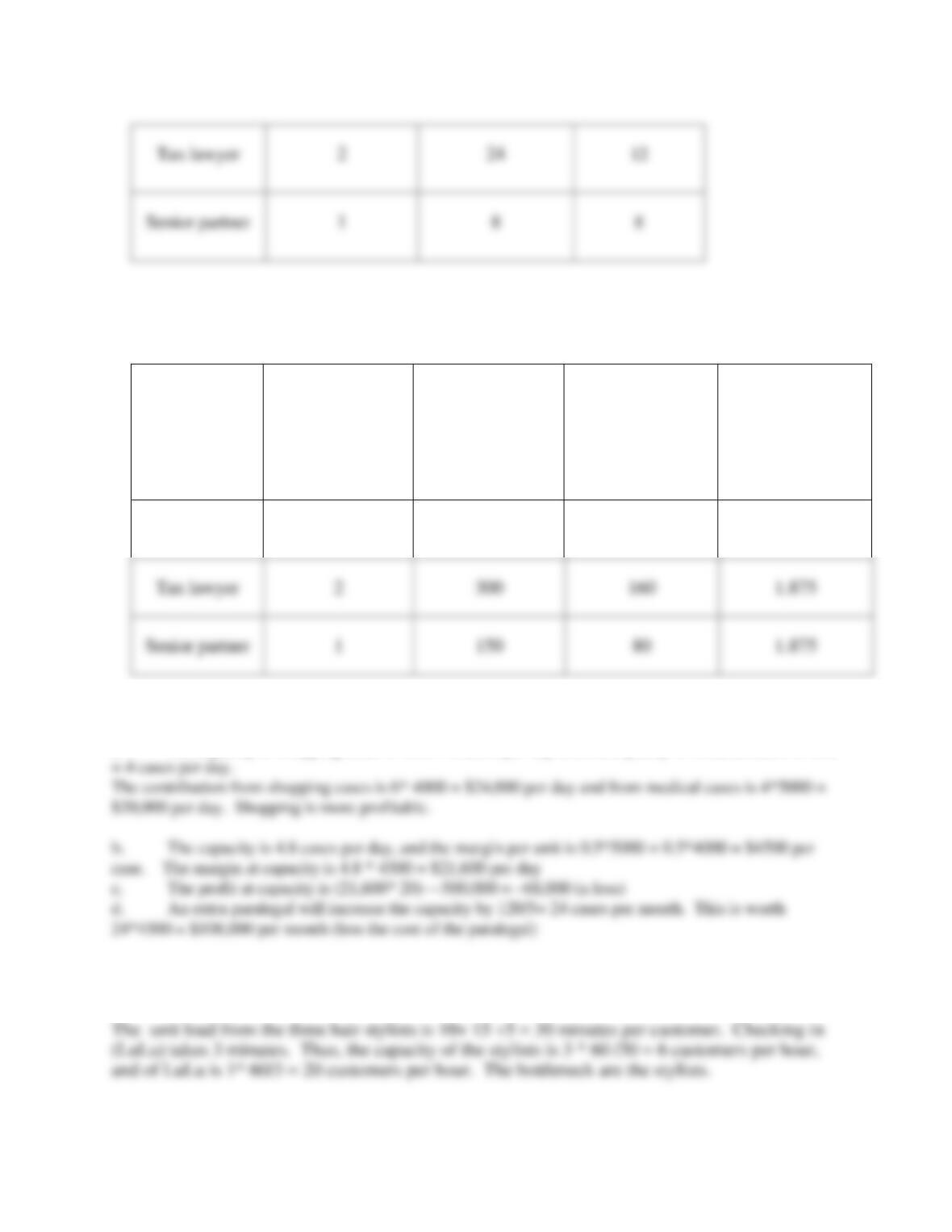
a. The capacity of shopping cases is 24/4 = 6 cases per day and the capacity of medical cases is 24/6
5.3
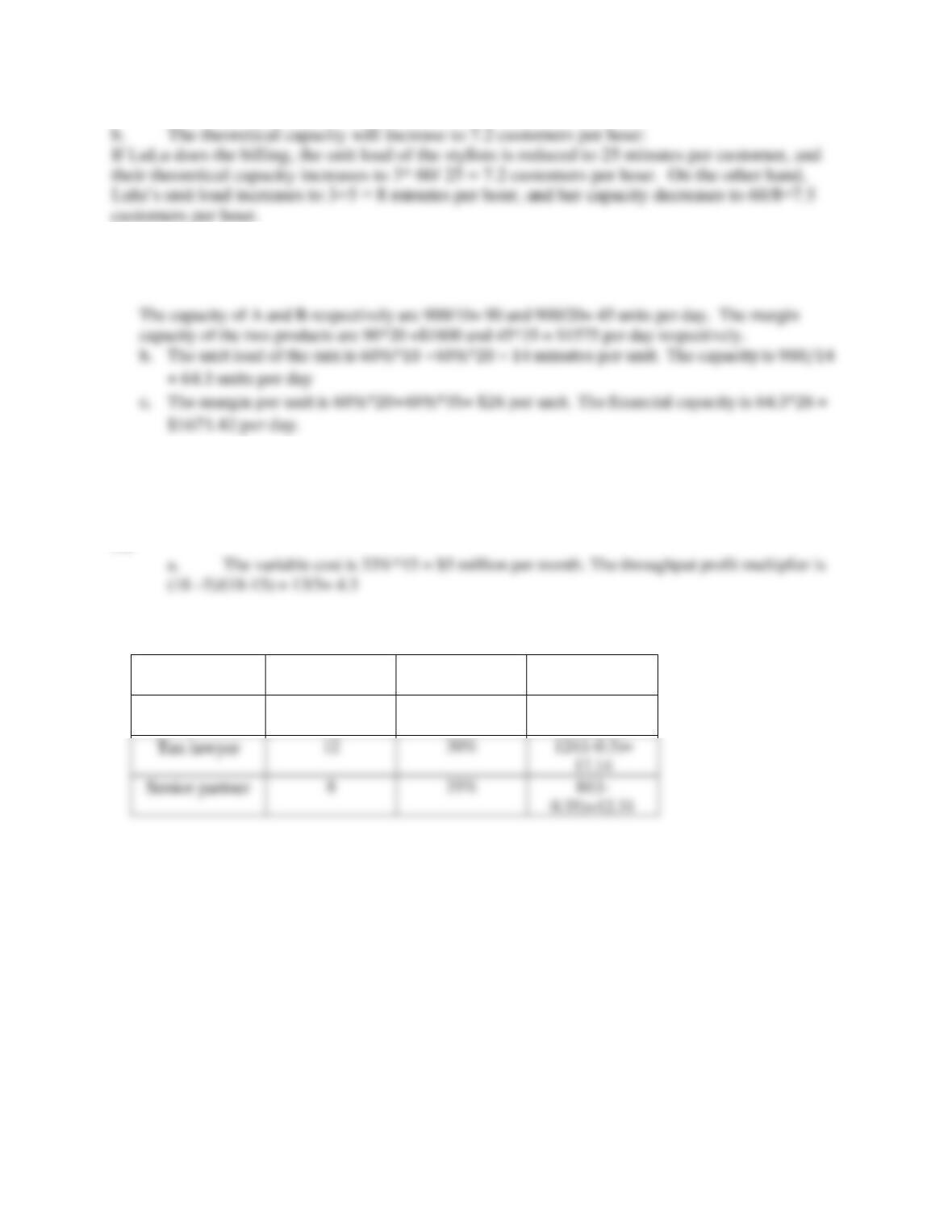
a. The capacity is 6 customers per hour:
5.4
a. A is more profitable :
5.5 Insurance Company
One should average the reciprocal of the capacities :
(500 + 1000)/2 = 1500/2 = 750
5.6 a. The variable cost is 33%*15 = $5 million per month. The throughput profit multiplier is
5.7
a. The theoretical capacity is 6.00 cases per day:
Capacity
(units per day)
Waste
Theoretical
capacity
Paralegal
4.8
20%
4.8/(1-0.2)=
6.00
30%
12/(1-0.3)=
35%