
1
Chapter 5: Individual/Organization Relations and Retention
Chapter 5:
Individual/Organization Relations and Retention
Table of Contents
Chapter Summary
1
Learning Objectives
1
Lecture Outline
2
Critical Thinking Challenges
12
Case: Giving Time to Get Employees Engaged
14
Supplemental Cases
15
Extra Teaching Video
18
Chapter Summary
Chapter 5 focuses on creating and maintaining a strong relationship between an organization and
its employees. Motivating workers is the first step in forming a good relationship. The
psychological contract between an employer and its employees can be affected by HR activities.
Problems can be caused by absenteeism, but several methods can be used to control it. Turnover
can be good or bad, and organizations should measure it and control it when necessary. When
employees leave, organizations should determine why they left and make improvements, if
necessary, to retain the top performers and valuable employees.
Learning Objectives
After students have read this chapter, they should be able to accomplish the following objectives:
• Discuss five different views of motivation at work.
• Explain the nature of the psychological contract.
• Define the difference between job satisfaction and engagement.
• Identify a system for controlling absenteeism.
Lecture Outline
2
Chapter 5: Individual/Organization Relations and Retention
5-1. Individuals at Work
• The relationship between individuals and their employers helps explain why people might
choose to leave particular jobs or stay.
5-1a. Individual Performance Factors
• The three major factors that affect how a given individual performs are as follows:
o Ability to do the work
o Effort expended
5-1b. Individual Motivation
• Motivation is the desire that exists within a person that causes that individual to act.
• Four approaches to motivation are the need theory, the two-factor theory, the
HR Headline: Starwood Hotels’ Employees Create Guest Experience
The idea, called the “employee-customer-profit model,” shows that the connections
between employees and customers will drive profits for the company. This approach
also emphasizes the importance of hiring, motivating, and retaining workers who can
deliver that superior service. The HR team at Starwood Hotels teamed up with the
company’s Guest Intelligence Team (that measures guest feedback) to better understand
exactly what customers expect of the hotel experience and how employees could ensure
that they meet those expectations. Starwood Hotels HR team, in partnership with the
customer service team, created an environment that fostered individual performance and
positive organizational outcomes, demonstrating the multiplier effect of investing in
employee engagement initiatives.
3
Chapter 5: Individual/Organization Relations and Retention
o Maslow classified human needs into five categories that ascend in a definite order.
o Until the more basic needs are adequately met, a person will not fully strive to
meet higher needs.
• Maslow’s well-known hierarchy of needs theory specifies the following five levels of
human needs:
o Physiological needs
Teaching Tip: Use Figure 5-2 to show the hierarchy of need theory. Understanding this
hierarchy will make it easier to understand the motivators and hygiene factors in the two-
factor theory. Continue to use Figure 5-2 when introducing the two-factor theory. This will
help in comparing the need theory and the two-factor theory.
• Frederick Herzberg’s motivation/hygiene theory assumes that one group of factors,
• The expectancy theory of motivation suggests that motivation is influenced by what
people expect.
• The underlying theme embedded in the equity theory is that people want to be treated
fairly at work.
o Equity is defined as the perceived fairness of what the person does compared with
what the person receives for doing it.
HR Ethics: Working with Slackers Hurts Motivation
Slacking is a common problem in businesses. HR must train employees to deal successfully
with slackers by confronting them.
1. What kinds of signs might you look for when determining whether slacking is a
problem? How should you encourage employees to report such poor performance?
Students’ answers regarding the kinds of signs will vary. Students could consider
incomplete assignments, missed deadlines, and lack of preparation for meetings as the
signs of a slacking problem.
Students’ answers regarding how to report slackers will vary. Students could consider
© 2020 Cengage Learning®. May not be scanned, copied or duplicated, or posted to a publicly accessible website, in whole or in part.
5
Chapter 5: Individual/Organization Relations and Retention
HR Perspective: Getting Engaged at PwC
At the auditing and consulting firm of PwC, Millennials make up a growing percentage of
the workforce. PwC is working to create an environment that offers employees a way to
merge their personal values, skills, and desires into the organizational setting. Flexible career
options, continuous communication and input, and nonfinancial rewards have helped the firm
reduce turnover and improve employee engagement.
1. As an HR professional, how would you prepare managers for the flexible work options
and adjustments in career planning for new employees? How would you help longer–
service employees to work effectively with workers in these flexible roles?
Students’ answers will vary. Training and development efforts can be designed to
prepare managers. Supervisory/management support and coworker relations can help
employees work effectively. Work-related friendships, which do not appear on
employee records, can be an important signal that a workplace is positive.
2. What can organizations do to ensure that their strategies and decisions align with their
values? How would you demonstrate this to employees?
Students’ answers will vary. Organizations can collect inputs from the employees and
managers to ensure that their strategies and decisions align with their values. Top-
level management can consider redesigning employees’ jobs to make them more
engaging to the employees.
5-2c. Employee Engagement, Loyalty, and Organizational Citizenship
• Employee engagement is the extent to which an employee’s thoughts and behaviors are
focused on his or her work and their employer’s success.
• Organizational trust is an employee’s feeling of confidence that the organization will
act in a way that benefits rather than harms him or her.
• Trust is a visible reflection of the ethical culture of an organization.
© 2020 Cengage Learning®. May not be scanned, copied or duplicated, or posted to a publicly accessible website, in whole or in part.
5-3. Employee Absenteeism
5-3a. Types of Absenteeism
• Employees can be tardy or absent from work for several reasons.
causes and the associated costs.
HR Ethics: The Formula for Building Trust
One particularly powerful element of organizational culture is trust. Regardless of whether an
organization is a private sector firm or a public sector agency, trust is tied to organization
performance. Organizations that foster a trusting culture can see great results because their
employees find leaders trustworthy, and they themselves feel empowered and challenged.
This leads to a win-win situation where positive outcomes are more likely.
1. What steps can you take as an individual contributor to enable your supervisor to trust
you? How can managers begin to establish trust with their employees?
Students’ answers will vary. Some might say that sharing information frequently and
broadly can help individuals build trust. Intentionally building relationships with
coworkers and allowing employees to be vulnerable and not punishing them for making
mistakes can help managers establish trust with their employees.
2. What HR practices would be recommended to institute some of the recommendations
here for building organizational trust?
Students’ answers will vary. Some might say that transparency in HR practices can
ensure organizational trust.
7
Chapter 5: Individual/Organization Relations and Retention
o Figure 5-8 shows some of the direct and indirect costs associated with
absenteeism.
• Companies use methods such as the following to address absenteeism:
o Disciplinary approach: People who are absent in excess of policy limits receive
warnings and more severe discipline if their attendance does not improve.
o Positive reinforcement: Positive reinforcement includes actions such as giving
5-3c. Measuring Absenteeism
• A major step in reducing absenteeism is deciding how the organization will record and
calculate absences and then how to benchmark those rates.
• Various methods of measuring or computing absenteeism exist.
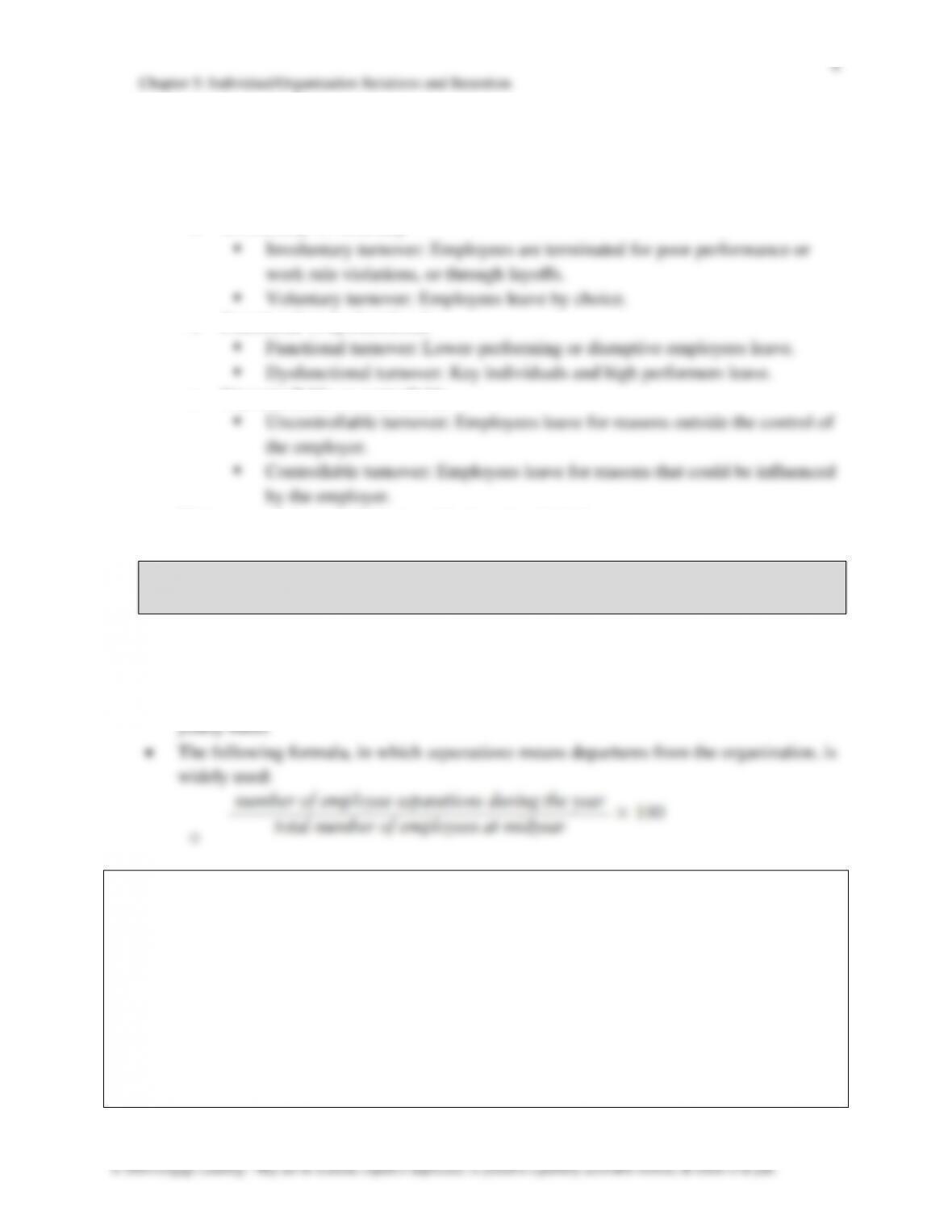
o One formula suggested by the U.S. Department of Labor follows:
5-4. Employee Turnover
• Turnover is the process in which employees leave an organization and have to be
replaced.
5-6. Retaining Talent
• Retaining top talent is a concern for many employers, and understanding retention is the
11
Chapter 5: Individual/Organization Relations and Retention
o Measurement and assessment
• A stay interview is an interview that focuses on why employees want to continue
working for the organization.
• Turnover is often high in an employee’s first year. Focus on first-year retention and
5-7b. Retention Evaluation and Follow-Up
HR Competencies & Applications: Conducting Exit Interviews
Key Competencies: Communication (Behavioral Competency) and Organization
(Technical Competency)
A skilled HR interviewer doing an exit interview may be able to gain useful
information that couldn’t be gathered any other way.
1. How would you conduct useful exit interviews?
Students’ answers will vary. They should consider the environment and timing of
the interview. For example, a quiet location where the interview won’t be
interrupted would be a good location.
2. What kinds of questions would you ask?
Students’ answers will vary. They should consider questions that will reveal
problems or weaknesses about the company that could be corrected. For
example, questions about the training program could reveal duties that aren’t
covered in the current training program.
12
Chapter 5: Individual/Organization Relations and Retention
© 2020 Cengage Learning®. May not be scanned, copied or duplicated, or posted to a publicly accessible website, in whole or in part.
• Tracking intervention results and adjusting intervention efforts should be part of
retention evaluation and follow-up.
Critical Thinking Challenges
1. Describe your expectations for a job. How well does your employer meet the expectations
you hold about the psychological contract?
2. If you became the new manager at a restaurant with high employee turnover, what actions
would you take to increase retention of employees?
Students’ answers will vary. Employee turnover poses an immediate problem for most
14
Chapter 5: Individual/Organization Relations and Retention
© 2020 Cengage Learning®. May not be scanned, copied or duplicated, or posted to a publicly accessible website, in whole or in part.
looking at demographic data on employees to determine the key issues. If a large
number of employees are dealing with the same work–life balance issue, then it
typically becomes a high priority.
B. How will you present a business case to gain management support for addressing
those issues to help retain existing workers and to fill the positions vacated by
retiring employees?
Case: Giving Time to Get Employees Engaged
Cadence Design Systems demonstrates how, apart from extrinsic rewards, providing employees
with avenues to fulfill their social service needs and the contentment derived from that can go a
long way in increasing their commitment to the company.
1. Identify other companies that offer volunteer programs and compare their programs to that
at Cadence. What are some of the outcomes those companies have achieved regarding
employee recruiting, engagement, or retention?
2. As a future job seeker, how important would a company’s charitable work be in your job
search decision? Research this aspect of recruiting and retention to learn if workers in the
Millennial generation and Generation Z value this more than Generation X or Baby
Boomer workers. How might this affect companies in the future?
15
Chapter 5: Individual/Organization Relations and Retention
© 2020 Cengage Learning®. May not be scanned, copied or duplicated, or posted to a publicly accessible website, in whole or in part.
workers are seen to be more productive, exhibit greater dedication, perform at higher
levels, and have higher retention than do unengaged workers.
Students may also provide data on the generation of workers that is most receptive to the
concept of engagement and support the claim with adequate examples. They may add that
companies attracting more Millennials through their engagement programs would
probably experience a workplace environment that exhibits more fun, energy, and
creativity.
Supplemental Cases
Carolina Biological Uses Survey to Assess Worker Engagement
This case describes a company that introduced a survey platform, Net Promoter System, to learn
about customers’ impressions of the company’s service level. However, the company went a
step further and used the same platform to determine employee engagement levels and took
1. Since surveys can be important tools for obtaining employee feedback, how can HR
professionals use them more effectively? What else could Carolina Biological do to get
useful feedback from its employees?
2. What is your opinion of the Net Promoter System? What do you think are the advantages
associated with this survey system? What are the potential disadvantages?
The Clothing Store
This case describes one firm’s approach to improving employee retention. (For the case, visit
1. Discuss how the culture of the Clothing Store is fostered by the HR activities and practices
used.
16
Chapter 5: Individual/Organization Relations and Retention
2. Compare the culture at your present employer to the culture suggested by the examples at
the Clothing Store. Then identify recommendations you would make to the executives
where you work.
Comments
HR spent an enormous amount of time figuring out exactly what kind of future employee would
fit the company’s culture and values. By paying more than the norm, the Clothing Store has more
applicants to choose from, which results in less compromise on the “fit” they are seeking. In
Accenture: Retaining for Itself
This case describes what a large consulting company does to help retain a virtual workforce. (For
1. Identify how some Accenture-type efforts have and have not occurred in your current and
previous workplaces. Also, discuss why focusing on employee retention pays off for
Accenture clients, not just for Accenture itself.
© 2020 Cengage Learning®. May not be scanned, copied or duplicated, or posted to a publicly accessible website, in whole or in part.
2. Go to the Accenture website, www.accenture.com, to research and gather job- and career-
related information that might need to be adapted by other employers. As part of this
research, examine how Accenture markets itself to current and potential employees.
Alegent Health
This case discusses how Alegent, a large nonprofit health care system, improved employee
1. Discuss how Alegent’s practices match with the recommended retention practices covered
in the chapter.
The text discusses the drivers of retention—characteristics of the employer, job design,
career opportunities, rewards, and employee relationships. Regarding the characteristics
© 2020 Cengage Learning®. May not be scanned, copied or duplicated, or posted to a publicly accessible website, in whole or in part.
3. Given what you saw in the video, would you expect Money Desktop to have high or low
absenteeism? Why?