34
• technology and information support systems; and
• organizational structure.
Integrating these elements is necessary to design a service that provides value to customers
and can create a competitive advantage. A poor choice on any one of these components,
such as technology or job design, can degrade service system efficiency and effectiveness.
Service encounter design
The principal dimensions are:
• customer contact behavior and skills;
These elements are necessary to support excellent performance and create customer value and
satisfaction. The case is really about service delivery system design, and especially service
encounter design.
Regardless of how students analyze the survey data, the key issue is whether they identify the
Case Questions for Discussion:
1. Define and draw the customer benefit package and state TASs mission, strategy, and rank
order of competitive priorities.
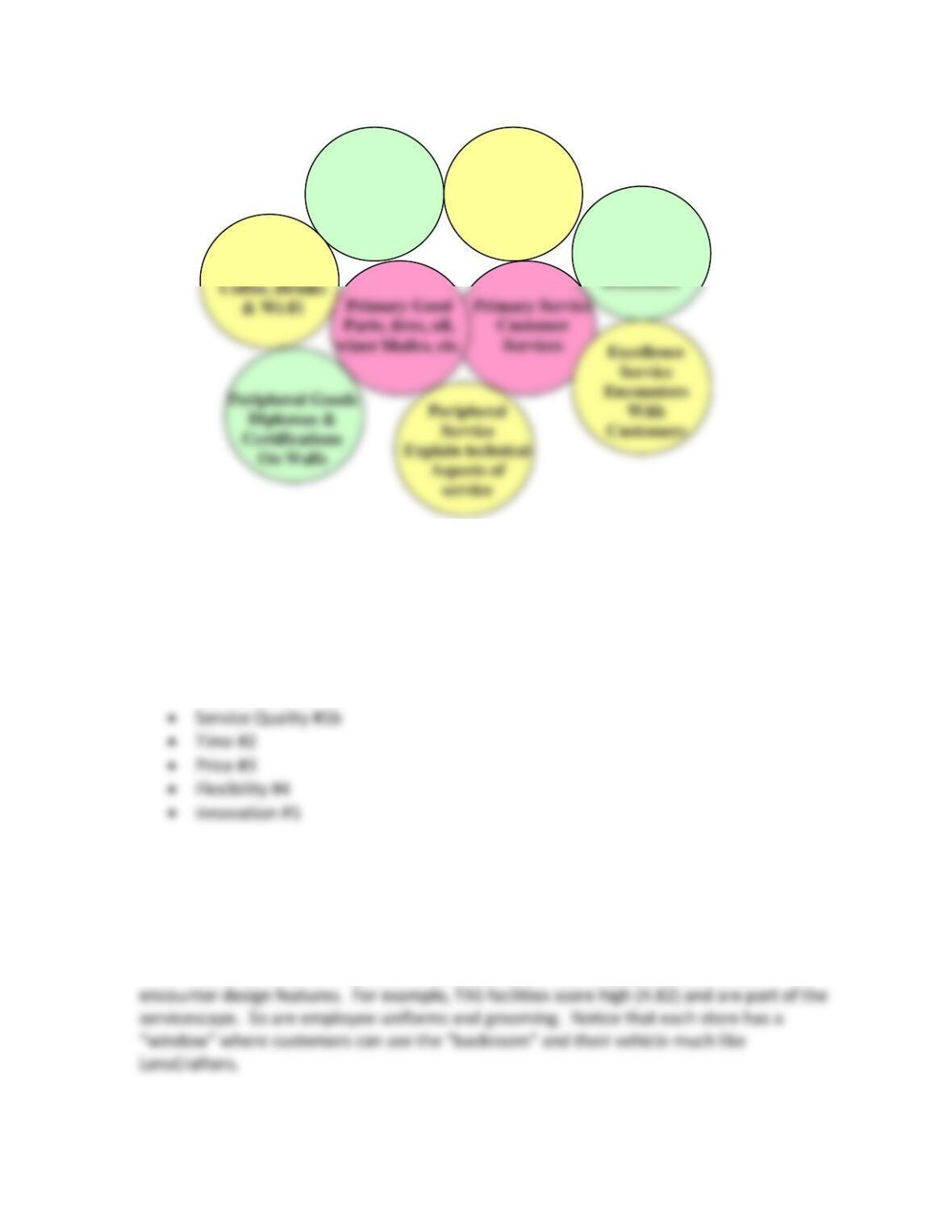
A typical student dual CBP might be as follows:
35
Strategy – Offer friendly customer service in a clean and professional environment to repair
and maintain customer vehicles at multiple service centers.
One ranking of competitive priorities might be
• Product Quality #1a
What differentiates TAS from competitors?
2. Identify and briefly describe the eight “design” features, described in Sectiuons 5.4 and
5.5, of the (a) service delivery system and (b) service encounters.
Use the case information to discuss each of the service delivery system and service
Excellence
Peripheral Good
Bill and
Warranty
Peripheral
Service
90 Day Guarantee
Peripheral Goods
Sofas &
Peripheral
Services
36
3. Identify and briefly describe five processes TAS stores use and their relative importance.
Remember – they have 32 stores – multi-site management and consistent performance
across all stores – not easy to do – must “standardize” all processes and systems.
• Hiring process
• Promotion process and annual employee reviews
• Parts ordering (purchasing) process
• Inventory management process
• Green process for disposal of oils and lubricants
4. Given your analysis of the survey data, what opportunities for improvement, if any, do
you recommend?
TN Exhibit 1 Tom’s Auto
Service
Store Managers
Q1
4.36
Q2
3.87
Q3
Standards of Work
Performance
Q4
4.66
Q5
4.43
Q6
4.13
Q7
4.54
37
Employees
Q9
3.8
Q11
3.88
Average
Facilities
Q12
4.84
Q13
4.79
Average
Overall Experience
Q14
4.59
Q15
3.94
Q16
4.45
Average
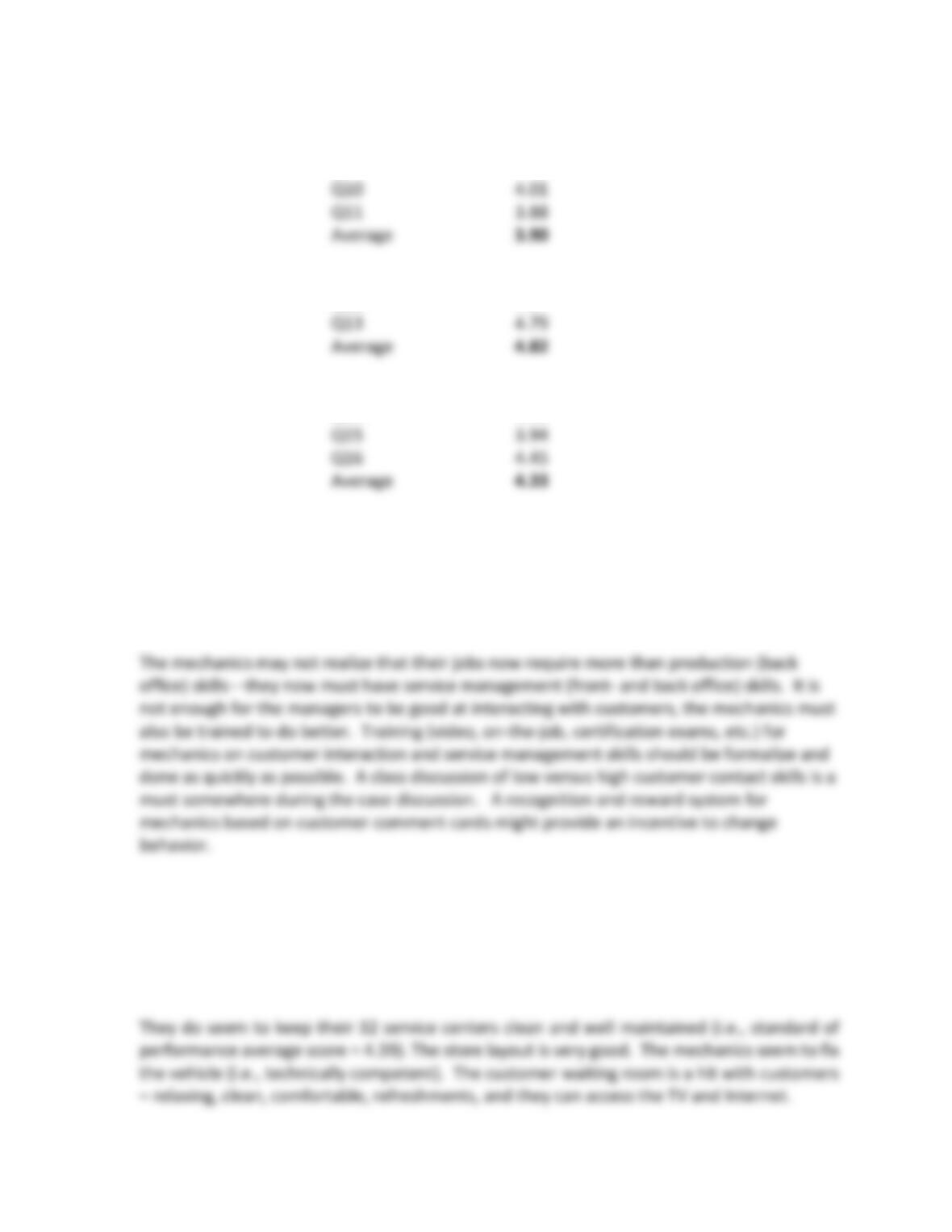
There is an interaction/communication problem between mechanics and customers (see
employee average score = 3.90; the lowest of all scores). More training on service
management skills is required, and possibly change the hiring process to employ customer
friendly mechanics. The ten written comments reinforce the survey results.
It is also evident that customers like the facility and servicescape (4.82; the highest average
score). The beverages, television, current magazines, comfortable sofas and chairs, blue
employee uniforms, signs, maintenance brochures, and employee and facility cleanliness are
all part of the servicescape. You might ask the students to define the servicescape during
class discussion.
38
5. Summarize your final recommendation to the CEO.
Main recommendation
Everyone – managers and mechanics – need service management skills and training if they
are to differentiate themselves from competitors.
(Or you can’t hire for backroom mechanic skills and then move part of their job to front
room interactions with customers without service management training.)
Other questions you might discuss
1. What is the “service window” for this service delivery system? (short, 18 + 9 minutes or
27 minutes, this short service window places demands on the operating systems such as
staff and facility capacity, scheduling, etc.) The same is true for airplane gate turnaround
time at the airport.
2. What is the content of a service management-training program? (technical skills, human
interaction and behavior skills, and marketing and cross- and up-selling skills)
3. Would you close the window bay so customers cannot see out into the backroom?
Teaching Plan
Students have experience with this service delivery system so let them begin class by describing
good and bad experiences. The instructor must often manage the classroom discussion to
Integrative Case: Hudson Jewelers
We suggest that you examine the break-even analysis solutions and see if this assignment is
decide!

39
Chapter 5 Case Questions for Discussion:
1. Hudson Jeweler’s current layout displays jewelry designs from the CAD system on a screen
in the front of the store. However, customers have little privacy when designing jewelry
there. What are the economic and non-economic advantages and disadvantages of the
following options: (a) keep the current layout; (b) move the CAD system into a new
private room; and (c) use option (b), buy a second CAD system, and build another private
room. Data are provided in the case study.
(a) Keep the Current Layout
Fixed Cost = $5,000 based on CAD square footage to total store square footage.
(b) Move Current CAD into a Single New Private Design Room
Fixed Cost = $12,000 to build a new CAD design room inside store and move current CAD
system to the new room and furnish.
(c) Do Option b Plus Build a Second CAD Design Room & Buy a Second CAD System
Fixed Cost = $27,000 to build two new CAD design rooms inside the store and move current
CAD system into one new room, and buy a second new CAD system and install in the second
room.
40
Students may use the following breakeven analysis equations:
F1 + VC1 x Q = F2 + VC2 x Q or Q = (F2 – F1)/(VC1 – VC2)
As the exhibit below shows Option II is best to maximize profit/revenue.
Option #
Variable
Cost/Visit
Fixed Cost
Break
Even
Qty
(Visits)
Total
Cost*
Extra
Revenue+
Net Profit
(Loss)
a
0.20
$5,000
25,000
$7,621
$0
($7,621)
b
0.24
$12,000
50,000
$15,145
c
0.38
$27,000
71,053
$37,260
Marginal Cost Comparisons of 3 Options
Option #
Change in Fixed
Cost
Abs Change in
Variable Cost
Marginal Breakeven
Quantity (Q)
a versus b
$7,000
(0.2 – 0.24) = 0.04
$7,000/.04 =
175,000
(0.24 – 0.38) = 0.14
The exhibit above attempts to do a marginal (incremental) cost breakeven quantity.
Students may make other assumptions such as the percent of total customers that actually
do CAD (i.e., CAD yield rate) or the average number of visits per CAD customer. All that is
41
second exhibit analysis does not consider potential new revenue. Also, some student
Non-Economic Advantages & Disadvantages
(a) Keep the Current Layout
• Front room CAD Display attracts customers into store (part of the servicescape!). Sign,
symbols, and artifacts! Order winner! Differentiator!
(b) Move Current CAD into a Single New Private Design Room
• Adds display area worth $421,000 in potential revenue (and display more mid and lower
priced jewelry).
(c) Do Option b Plus Build a Second CAD Design Room & Buy a Second CAD System
• Eliminates celebration area (no wine racks, no sofa seating, etc.). Now wine would
come from backroom but no place in front room to sit and build customer relationships.
Most students will recommend Option b. Option b “fits” the economic and non-economic
criteria of their current strategy. Option a is not aggressive and limits revenue growth while
Option c is too radical a change from current strategy of a friendly family owned business that is
different than corporate chains. Here, strategy dominates economics!
42
This case question is a good opportunity to apply the following OM concepts/paradigms:
• High versus low contact
2. Define (a) the servicescape for Hudson Jewelers using the three dimensions as
subheadings, and (b) the nature of Hudson Jewelers’ service encounters.
Ambient Conditions Made manifest by sight, sound, smell, touch, and temperature; to please
the five human senses such as the aroma of a cup of coffee.
• Lighting that makes the jewelry sparkle (in street side displays and in-store)
Spatial layout and functionality How furniture, equipment, and office spaces are arranged; it
also includes location, building facades and footprints, streets, and parking lots.
• The high definition television with rotating 3D pictures of wedding rings is stunning and
Signs, symbols, and artifacts Explicit signals that help communicate an image of the firm such
as mission statements, diplomas and certifications, company logos, trophy case, an aquarium,
art, letterhead, and company uniforms and dress and grooming.
43
• Security company logos and cameras
(b) Service encounter design focuses in the interaction, directly or indirectly, between the
service provider(s) and the customer. Four key elements of Hudson Jeweler’s service encounter
design are:
Customer contact behavior and skills
• High-contact system in the front-room especially co-designing jewelry (a very personal
buyer-seller relationship built on trust and moments of truth)
Service-provider selection, development, and empowerment
• Hudson Jewelers is a family owned business and that contributes to the customer’s
sense of trust. The customer is not dealing with a corporate chain store.
Recognition and reward
• Family pride in obvious once the customer interacts with store employees.
Service recovery and guarantees
• When things go wrong we have no evidence as to what Hudson Jewelers will do.
The service encounter activity sequences at Hudson Jewelers are customer-routed (see Exhibit
7.3). That is, management has a low degree of control over the sequence of service
encounters, the encounters are unique, never to be repeated, and the customer commands a
high degree of freedom and decision-making power throughout the sales, design and buying
experience.
44
3. Propose a “service guarantee” for Hudson Jewelers. What exactly will you guarantee?
Should it be explicit in writing or simply an implicit, non-written guarantee? Or is it better
not to do it at all? Explain and justify your logic.
Notice the question asks to explain your logic and justify. Chapter 5 (Goods and Service Design)
provides the following definitions.
The role of a service guarantee is to reduce customer risks, increase value, and build trust in
buying jewelry, and especially diamonds. Customers absorb the risk of customized jewelry.
Most students will recommend an implicit guarantee focused on one or more of the following:
• Free lifetime appraisals (or some time limit like 90 days)
• Free lifetime jewelry cleanings
• Free lifetime resizing (or some time limit like one year)