Chapter 5
Decision Making
DISCUSSION QUESTIONS
5-1. Q: Give some examples of each of the three “occasions for decision” cited by Chester Barnard.
Explain in your own words why Barnard thought the third category was most important.
A: Examples should be of occasions for decision stemming from (1) delegation from superiors,
5-2. Q: (a) Explain the difference between “optimizing” and “satisficing” in making decisions, and
(b) distinguish between routine and nonroutine decisions.
A: (a) The idealistic approach to decision making is to produce the single best alternative, but
5-3. Q: Use a concrete example showing the five-step process by which management science uses a
simulation model to solve real world problems.
5-4. Q: From another reference, provide the problem statement and solution to a typical queuing
(waiting-line) problem.
5-5. Q: Describe an example from an organization you know or have read about where a common
database is used for a number of different purposes. Also, can you describe an example where a
common database is not used for a number of different purposes?
PROBLEMS
5-1. Q: You operate a small wooden toy company making two products: alphabet blocks and wooden
trucks. Your profit is $30 per box of blocks and $40 per box of trucks. Producing a box of blocks
requires one hour of woodworking and two hours of painting; producing a box of trucks takes
three hours of woodworking but only one hour of painting. You employ three wood workers and
two painters, each working 40 hours per week. How many boxes of blocks (B) and trucks (T)
should you make each week to maximize profit? Solve graphically as a linear program and
confirm analytically.
A: The problem is to choose the number of boxes of blocks B and trucks T to maximize weekly
5-2. Q. A commercial orchard grows, picks, and packs apples and pears. A peck (quarter bushel) of
apples takes four minutes to pick and five minutes to pack; a peck of pears takes five minutes to
pick and four minutes to pack. Only one picker and one packer are available. How many pecks
each of apples and pears should be picked and packed every hour (60 minutes) if the profit is
$3/peck for apples and $2/peck for pears? Solve graphically as a linear program and confirm
analytically.
A: As the graph below show, the solution for pecks of (apples a, pears p) must be: (12,0), for a profit P =
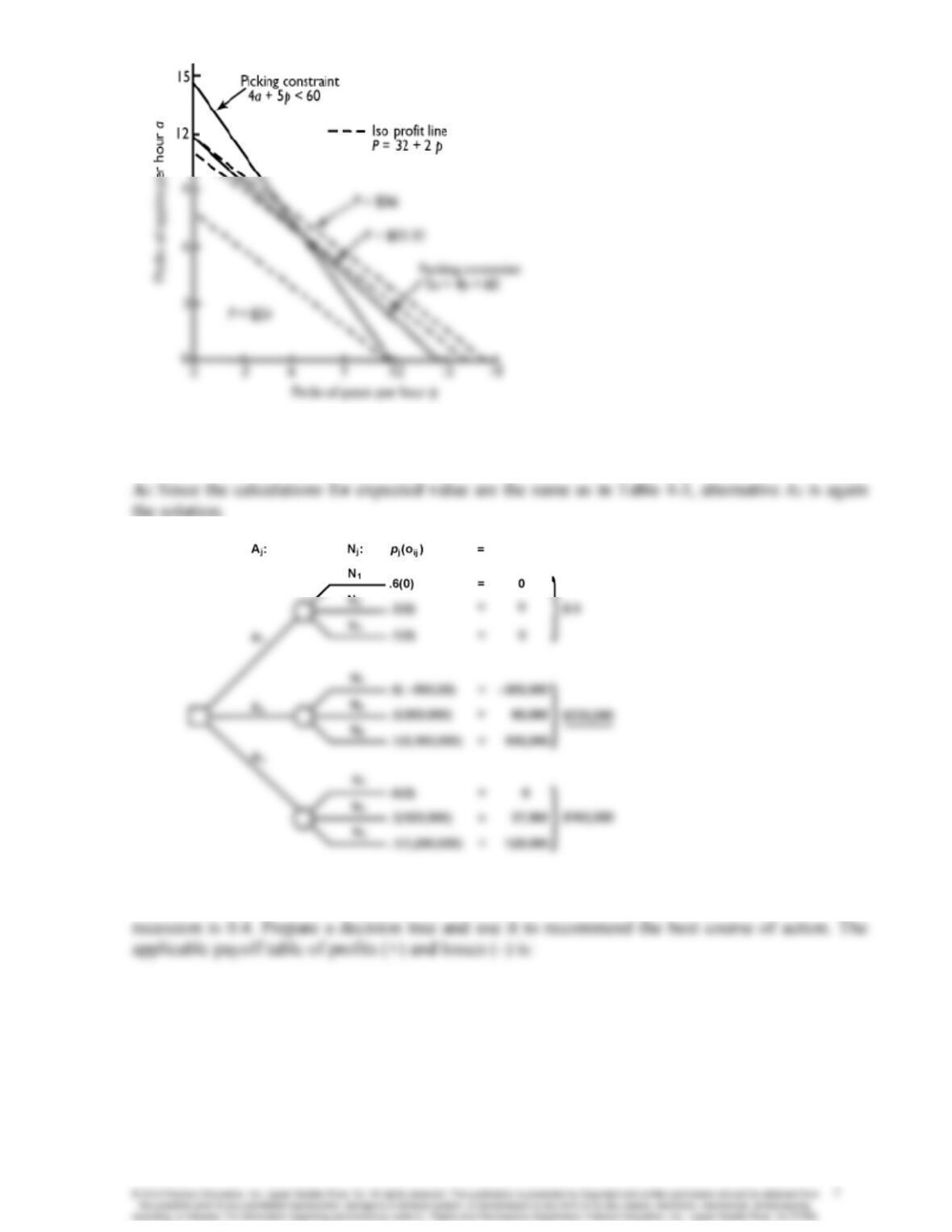
5-3. Q: Solve the drilling problem (Table 4-3) using a decision tree.
5-4. Q: You must decide whether to buy new machinery to produce product X or to modify existing
machinery. You believe the probability of a prosperous economy next year is 0.6 and of a
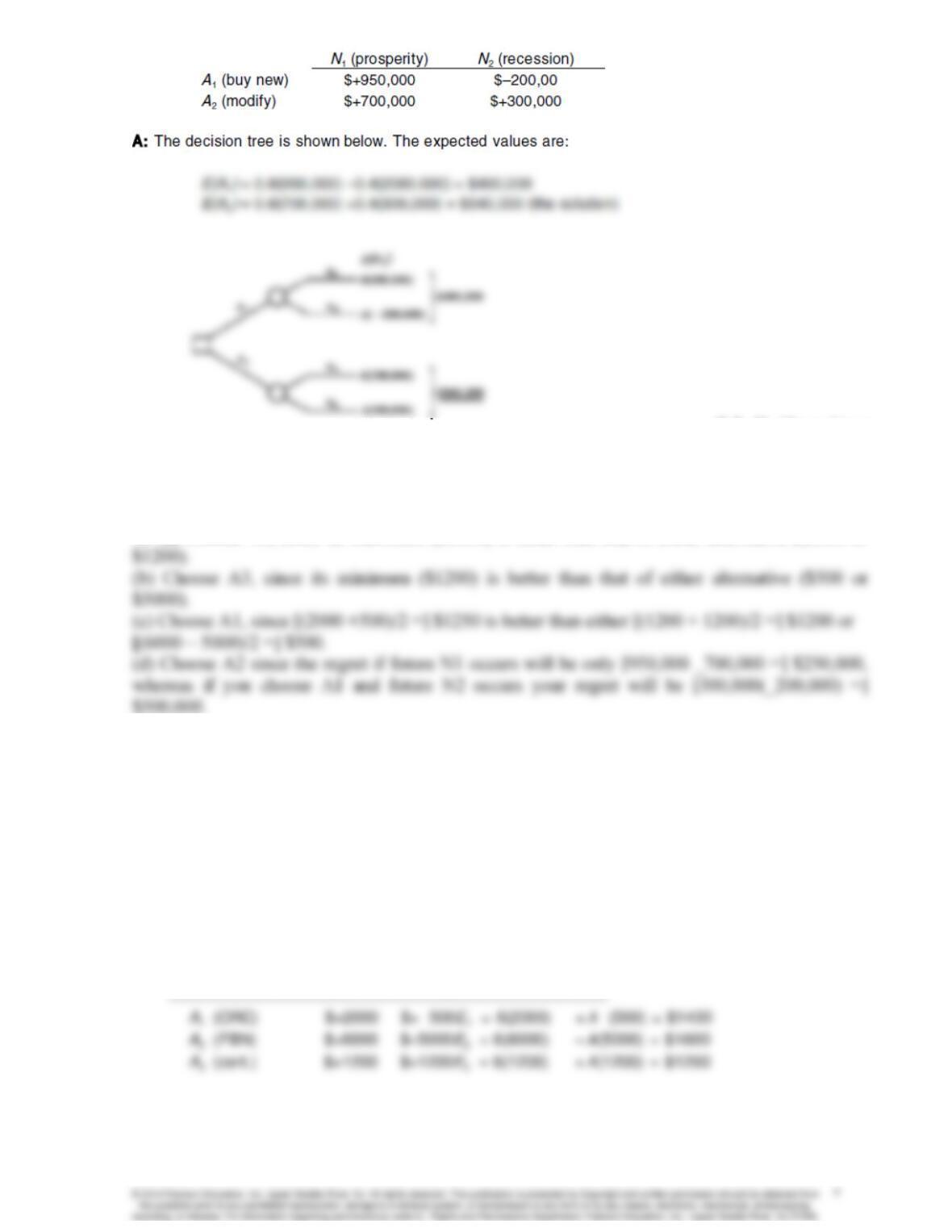
5-5. Q: If you have
no idea of the economic probabilities pj in question 4-7, what would be your decision based on
uncertainty using (a) maximax, (b) maximin, (c) equally likely, and (d) mini-max regret
assumptions?
A: (a) Choose A2, since its maximum ($6000) is better than that of either alternative ($2000 or
5-6. Q: You are considering three investment alternatives for some spare cash: Old Reliable
Corporation stock (A1), Fly-By-Nite Cargo Company stock (A2), and a federally insured savings
certificate (A3). You expect the economy will either “boom” (N1) or “bust” (N2), and you expect
that a boom is more likely (p1 = 0.6) than a bust (p2 = 0.4). Outcomes for the three alternatives are
expected to be: (1) $2000 in boom and $500 in bust for ORC; (2) $6000 in boom but $-5000
(loss) in bust for FBN; and (3) $1200 for the certificate in either case. Set up a payoff Table
(decision matrix for this problem and show which alternative maximizes expected value.
A: Alternative A2 provides the maximum expected value of $1600, as shown below:
Future
N
1
Future
N
2
Alternative
p1 =
0.6
p2 = 0.4 Expected
value
______________________________________________________________________________
5-7. Q: If you have no idea of the economic probabilities pj in question 5-4, what would be your
decision based on uncertainty using (a) maximax, (b) maximin, (c) equally likely, and (d)
minimax regret assumptions?
A: (a) Choose A2, since its maximum ($6000) is better than that of either alternative ($2000 or
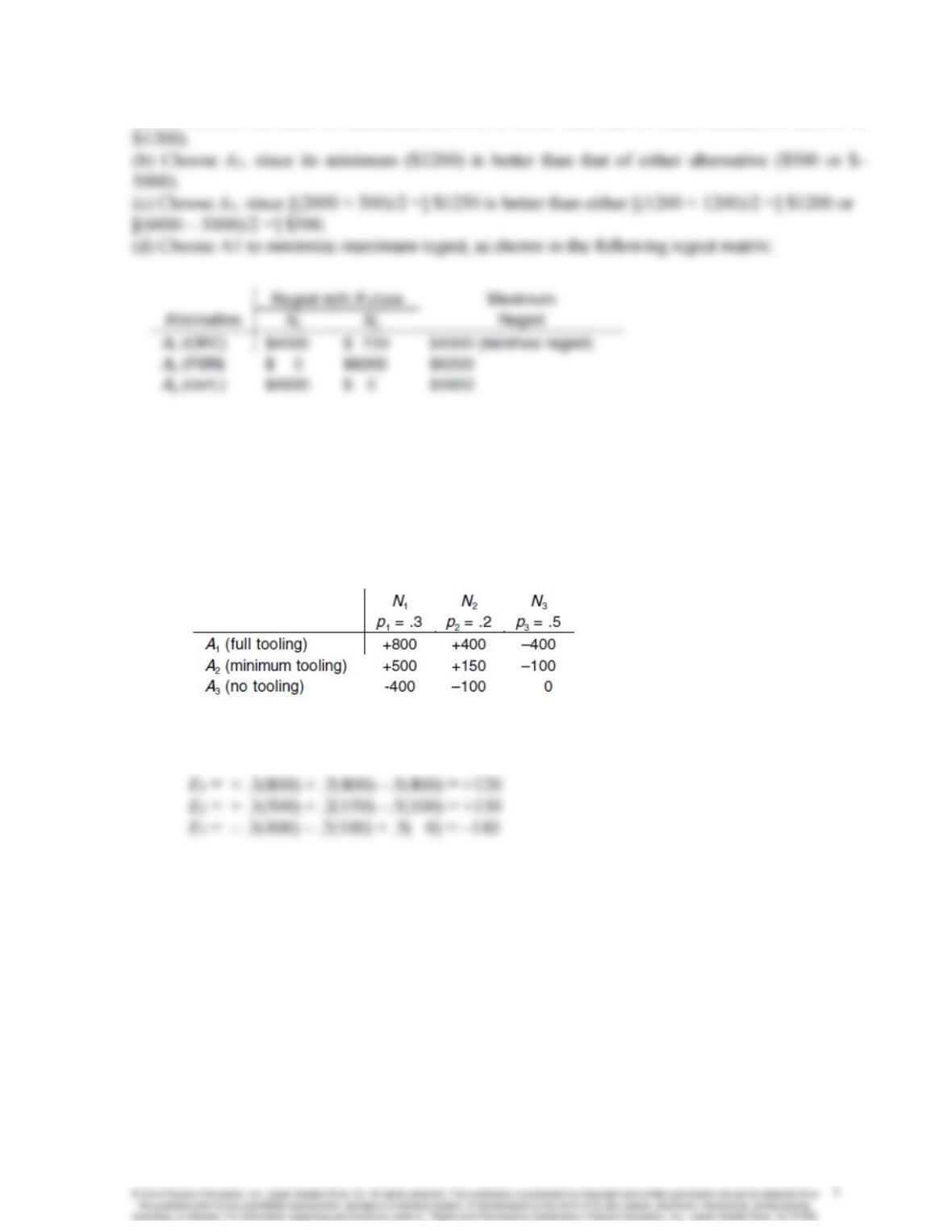
5-8. Q: Your company has proposed to produce a component for an automobile plant, but it will not
have a decision from that plant for six months. You estimate the possible future states and their
probabilities as: receive full contract (N1, with probability P1 = 0.3); receive partial contract (N2,
P2 = 0.2); and lose award (N3, P3 = 0.5). Any tooling you use on the contract must be ordered
now. If your alternatives and their outcomes (in thousands of dollars) are as shown in the
following table, what should be your decision?
A: Choose A2 to maximize expected value: