Process Focus 21
components of any control system are a standard or goal, a means of measurement of accomplishment,
and a way to compare actual results with the standard, along with an appropriate method of feedback of
results to form the basis for corrective action. Legal Sea Foods’ process seems to be designed to ensure
control.
8. The Cincinnati WaterWorks (CWW)… Discuss how technology has affected the processes of
CWW. What specific types of improvements (quality, cycle time, etc.) were these applications
designed to address? Can you think of similar uses of these technologies in other service
applications?
The billing and service information system at Cincinnati Water Works appears to be extremely
sophisticated and comprehensive for a utility, such as a water department. The technology that they
designed has removed many of the most obvious hassles and delays for customers, while providing the
opportunity for extensive productivity improvement for the department. It appears that the system
would contribute to quality, time, and productivity improvements, simultaneously. It has individualized
9. The president of Circle H assigned you to perform a complete investigation to determine the
causes of certain quality problems and to recommend appropriate corrective action….
a. What types of data would be most useful to review for clues as to why the three major
customer complaints occurred?
b. How would you investigate whether the change in the order approval process had a significant
effect on order processing time?
c. Given your knowledge of problems in both order processing and accounts receivable, what
should you do?
This Circle H scenario is designed to give students a feel for the types of challenges that are faced by
quality auditors, who must act as detectives to determine what problem exists before they can
recommend how it is to be fixed. In this case, there are many questions raised by the data from the
customer survey. The main question in this case is “how to define the problem.” A number of questions
about the problem must be raised, and appropriate data must be gathered inside and outside the
company, before the solution can be found. Among these are:

Process Focus 22
• If detailed information on complaint categories is available from the customers, what data can they
provide on the way in which the packaging was inconvenient (wrong sizes, way the order was packed
and shipped from the plant, etc.)? What data is available on delivery and restocking time? Has this
changed recently, or was it always “too slow”? What information can be provided about the lack of
availability of preferred items? Was their customer representative aware that this was a problem? What
was done to communicate and handle the problems?
• What internal company information is available from the shipping department on the way the product
is packed before sending the product to the customer? Have customer preferences in packaging been
communicated to shipping?
• What information is available from the ordering and production control departments on the former
customers‘ preferences for certain products versus production scheduling and run sizes? Are these
products running into capacity bottlenecks, constantly sold out, or delayed during production due to
chronic production problems?
10. The kaizen philosophy seeks to encourage suggestions, not to find excuses for failing to
improve. Typical excuses are “If it’s not broken, don’t fix it,” “I’m too busy to work on it,” and
“It’s not in the budget.” Think of at least five other excuses why people don’ t try to improve.
Some other examples include: “We’ve tried that before and it didn’t work;” “I’m not paid to improve
the process – it’s not my job;” “We never do it that way twice, so it can’t be improved;” “The boss
won’t let us change it;” “Government regulations prohibit that from being changed (maybe they do, but
no one has ever looked up the regulation!)” Instructors might wish to engage students in a discussion
about why this typically happens (good way to go back to the Deming philosophy!).
ANSWERS TO PROBLEMS
1. Consider the following list of generic business processes. Identify each as a value creation
process or a support process. Then discuss the logical sequence that the value creation
processes should follow.
a. invoice customers
b. manage information
c. market and sell products and services
d. manage improvement and organizational change
Process Focus 23
e. manage financial and physical resources
f. understand markets and customers
g. manage supplier relationships
h. provide customer service
i. produce and deliver manufactured goods
j. management environmental and corporate social responsibility programs
k. produce and deliver services
l. design goods and services
m. manage human resources
Answers:
a. invoice customers – support
b. manage information – support
c. market and sell products and services – value creation
d. manage improvement and organizational change – support
e. manage financial and physical resources – support
Logical sequence
f. understand markets and customers
l. design goods and services
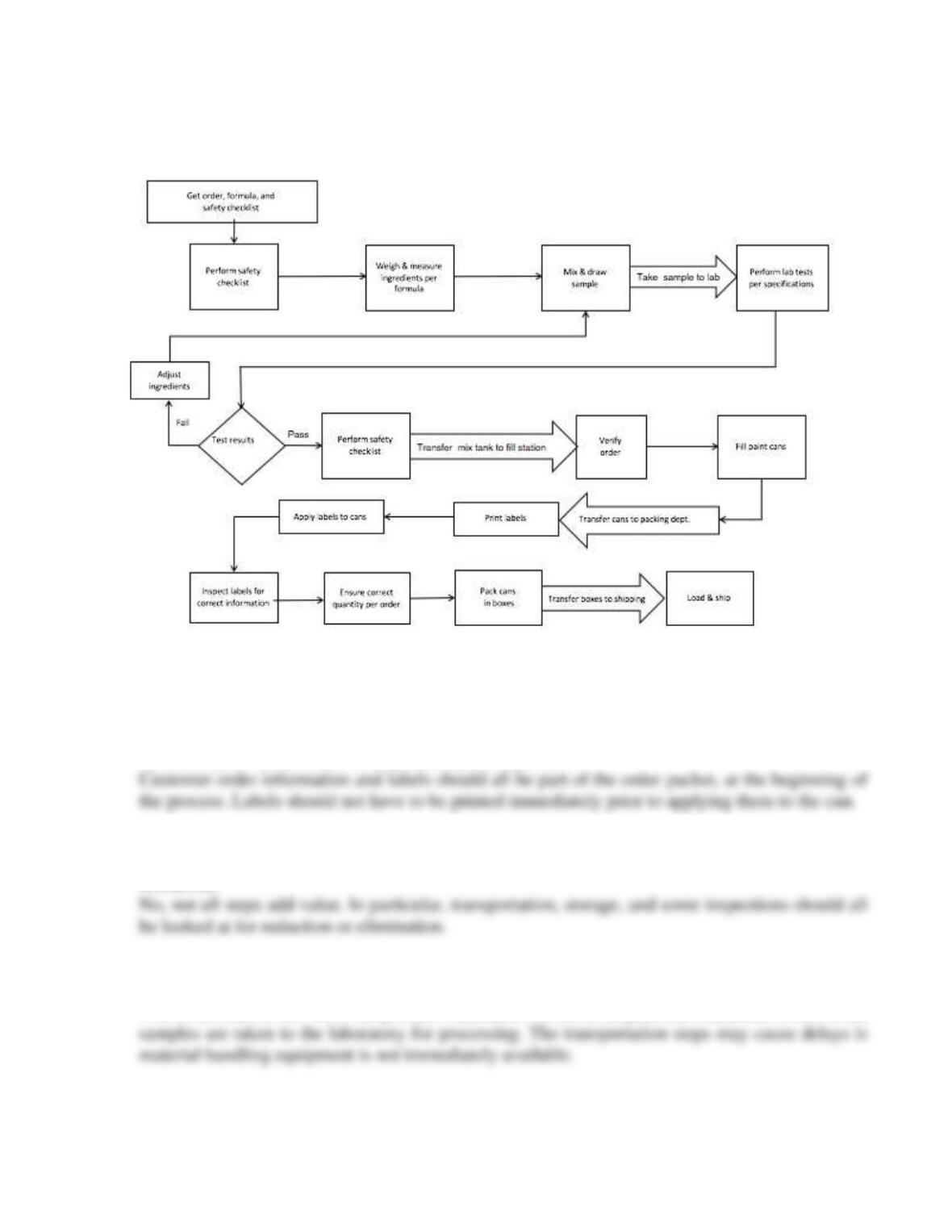
2. The process of making a batch of paint at the Peter’s Paint Products (PPP) paint
factory consists of the following steps. First the correct amount of raw materials must be mixed
in the proper sequence. The operator must follow specified safety instructions. After mixing, a
sample is drawn and taken to a laboratory, where the sample is tested to ensure conformance
to customer requirements and specifications. Next, the mixing tank is taken to a filling station
and verified to be the correct one prior to filling individual cans of paint. The filled cans go to
the packing department where labels are printed and applied to the cans. They are inspected
to ensure that the labels are correct and the proper quantity was produced for the customer’s
order. The cans are packed in boxes and moved to shipping.
a. Develop a flowchart that maps out PPP’s process.
b. Enrich the flowchart by adding detailed steps, which may not have been described in
detail.
c. Determine if any opportunities exist for improving PPP’s process using the questions posed
in the chapter.
Process Focus 24
a. and b. See the flowchart that follows.
c. Opportunities for improving APP’s process may be explored by answering the following
questions. They may serve to help create a more effective design:
Are the steps in the process arranged in logical sequence?
Do all steps add value? Can some steps be eliminated and should others be added in order to
improve quality or operational performance? Can some be combined? Should some be
reordered?
Are capacities of each step in balance; that is, do bottlenecks exist for which customers will
incur excessive waiting time?
This is difficult to tell from the problem statement. However, a potential bottleneck exists when
What skills, equipment, and tools are required at each step of the process? Should some steps be
Process Focus 25
automated?
Operators must be skilled in using the mixing and filling equipment, taking and handling
samples, adjusting the batch – depending on sample results, using computers that print the labels,
At which points in the system might errors occur that would result in customer dissatisfaction,
and how might these errors be corrected?
Errors could occur in any of the steps in the process, which might affect customers and impact
their level of satisfaction or dissatisfaction. A number of things could go wrong, just in the
At which point or points should quality be measured?
Quality should probably be measured after mixing and before filling.
Where interaction with the customer occurs, what procedures and guidelines should employees
follow to present a positive image?
Employees who work with customers should be technically knowledgeable, have good computer
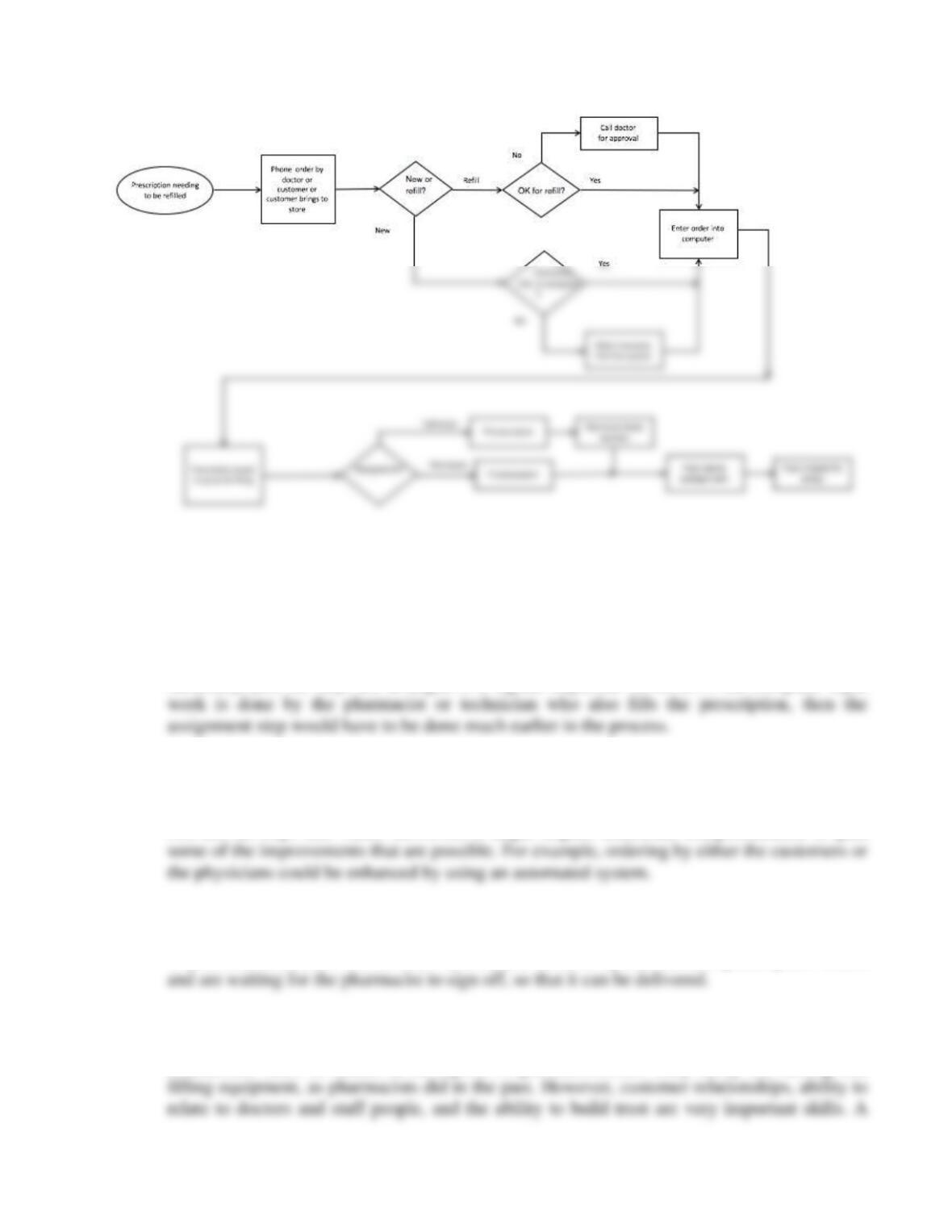
3. The process for filling a prescription at a pharmacy begins when a customer’s physician
calls the pharmacy or the customer drops off a written prescription. Sometimes the customer
needs to refill a prescription and if no refills remain, the pharmacist will call the physician for
approval. The prescription information is entered into a computer, insurance information is
checked or solicited from the customer, and the prescription is put in a queue for either a
pharmacist or a technician to count out the number of pills or pull some other medicine from
inventory. A label is prepared and printed, and affixed to the bottle. If the prescription is
prepared by a technician, then a pharmacist must check and verify it. The completed
prescription is placed in a basket for pickup.
a. Develop a flowchart that maps out this process.
b. Enrich the flowchart by adding detailed steps, which may not have been described in detail.
c. Determine if any opportunities exist for improving the process using the questions posed in
the chapter. For example, how might technology, such as an automated telephone system or
the Internet be incorporated into the process to improve customer satisfaction?
a. & b. The flowchart depicting the prescription filling process is shown below.
Process Focus 26
c. Opportunities for improving the process may be explored by answering the following questions.
They may serve to help create a more effective and customer-friendly process:
Are the steps in the process arranged in logical sequence?
Generally, yes, the steps are arranged in a logical sequence. However, if the computer input
Do all steps add value? Can some steps be eliminated and should others be added in order to
improve quality or operational performance? Can some be combined? Should some be
reordered?
No, not all steps add value. However, it might require additional computerization to gain
Are capacities of each step in balance; that is, do bottlenecks exist for which customers will
incur excessive waiting time?
A potential bottleneck exists when technicians have completed several prescription orders
What skills, equipment, and tools are required at each step of the process? Should some steps
be automated?
Pharmacists must be skilled in all aspects of pharmaceuticals. They rarely use mixing and
Process Focus 27
secondary skill that is required includes using computers. Some steps to be considered for
automation include those relating to order entry.
At which points in the system might errors occur that would result in customer
dissatisfaction, and how might these errors be corrected?
Errors could occur in any of the steps in the process, which might affect customers and
impact their level of satisfaction or dissatisfaction. Of course any errors in filling
At which point or points should quality be measured?
Where interaction with the customer occurs, what procedures and guidelines should
employees follow to present a positive image?
Employees who work with customers should be technically knowledgeable, have good
4. Maintaining accuracy of books on the shelves in a college library is an important task.
Consider the following problems that are often observed:
• Books are not placed in the correct shelf position, which includes those books that have
been checked out and returned, as well as those taken off the shelves for use within the
library by patrons.
• New or returned books are not checked in and consequently, the online catalog does not
show their availability.
What procedures or poka-yokes might you suggest for mitigating these problems? You might
wish to talk to some librarians or administrators at your college library to see how they
address such problems.
These are not easy problems for libraries to solve. Some low-tech approaches might include sorting
books on carts according to the sections where they must be returned to, providing a checklist to
shelvers to remind them of steps needed to ensure proper placement, and/or providing marking on
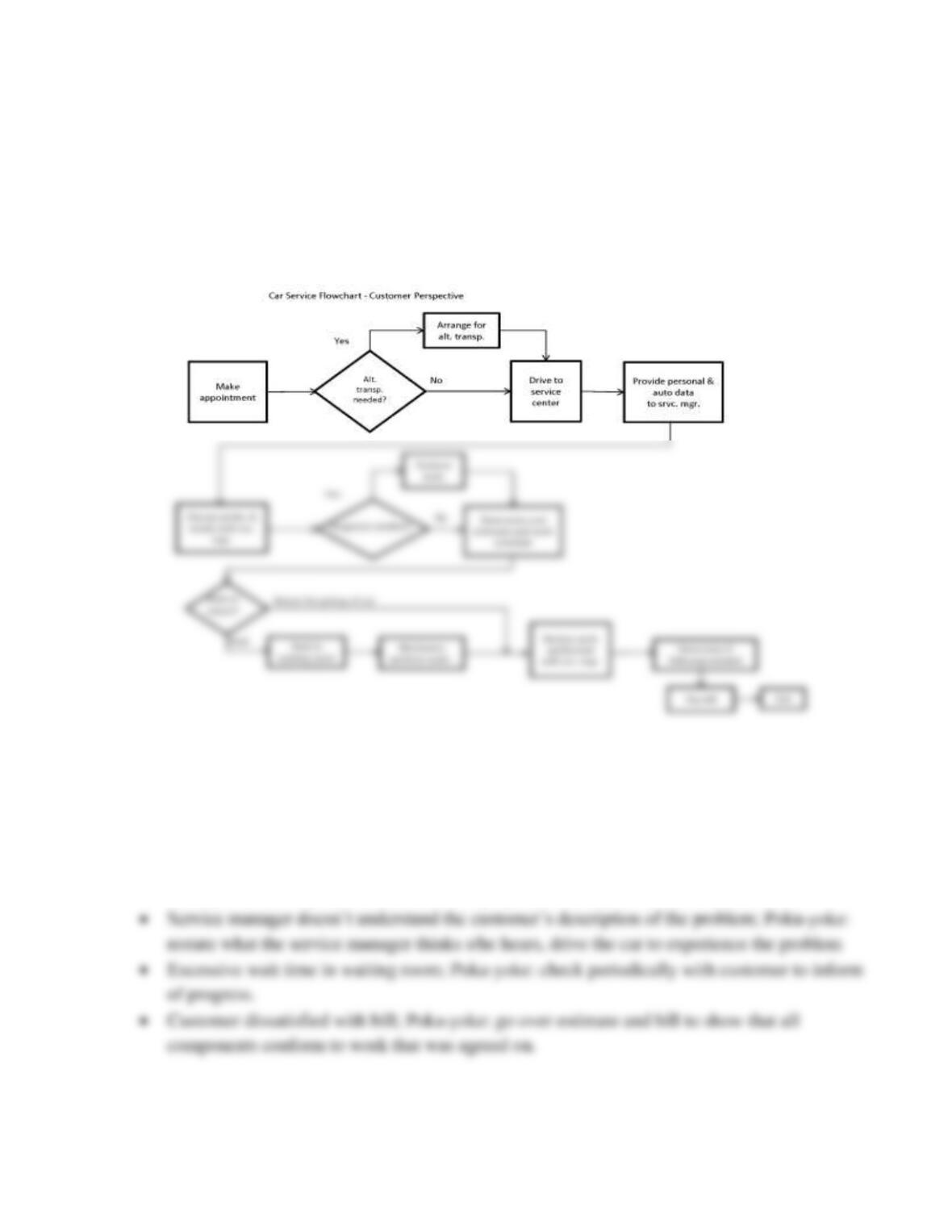
5. You have most likely taken your car for service at an automobile dealership. Typical
activities in servicing a customer’s automobile include making an appointment, meeting with a
service advisor to discuss the service or problem, waiting for the work to be performed, paying
Process Focus 28
the bill, and receiving the vehicle. Draw a flowchart for this process with detailed activities for
these steps. Identify potential failures that customers may experience and discuss possible
poke-yokes that the dealership might use to prevent such failures and ensure customer
satisfaction.
See flowchart below:
Potential areas for failures and customer dissatisfaction that students might suggest are:
• Appointment scheduled for wrong time or date; Poka-yoke: service manager might repeat the
date and time to the customer for verification
• Not retrieving the correct VIN number; Poka-yoke: check that the VIN matches the vehicle
description in the system database, or use preprinted cards before the customer arrives
Process Focus 29
We suggest that the instructor read the article: Richard B. Chase and Douglas M. Stewart, “Make
your service fail-safe,” Sloan Management Review, 1994, pp. 41-42. This paper addresses similar
issues and provides additional perspectives.
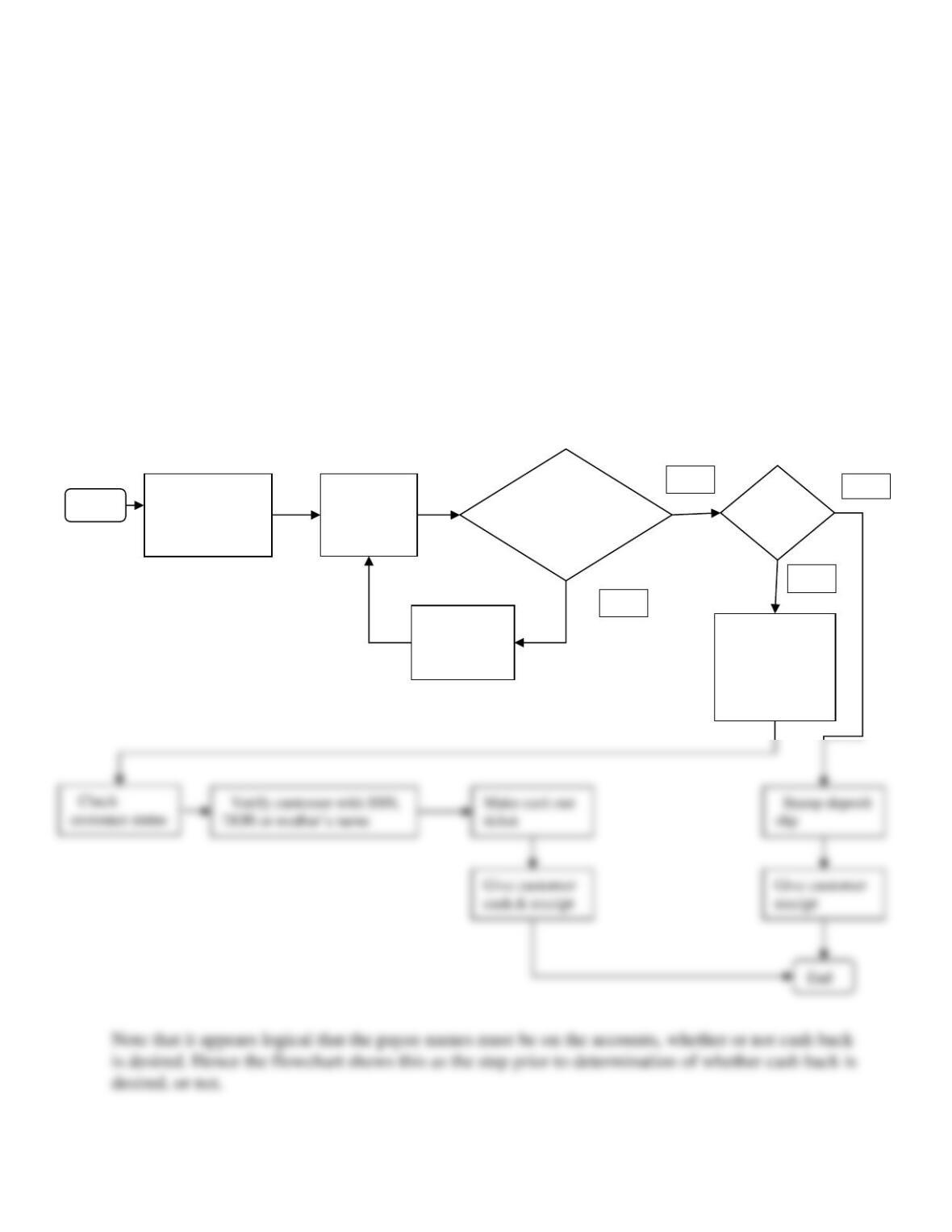
6. The process for depositing a check at Better Banking, Inc. begins with the teller determining
if the customer wants to receive any cash back. If not, the teller checks to see if the payee’s
name is on the account, stamps the deposit slip, and gives the customer a receipt. If there is
cash back, the teller adds the checks and subtracts the net deposit to verify the cash amount on
the deposit slip, checks and verifies the customer’s account, makes a “cash out” ticket for bank
accounting, and gives the customer back the cash and receipt. Draw a flowchart for Better
Banking’s process and identify potential sources of error and poka-yokes that might be used to
mitigate these errors.
The flowchart for this process of depositing a check is as follows:
Customer
presents
checks for
deposit
Request
payee name
on account
Add checks on
calculator &
subtract out net
deposit to verify
cash back
Start
First available
teller asks,”May
I help you?”
Cash
back
Are payee
names on
accounts?
Yes
No
No
Yes

Process Focus 30
Possible sources of error include customer error, teller error, or processing error.1
Some Poke-Yokes are:
• Check addition and subtraction with calculator, regardless of cash back, or not
• Check cash-out ticket to verify correct account number and amount
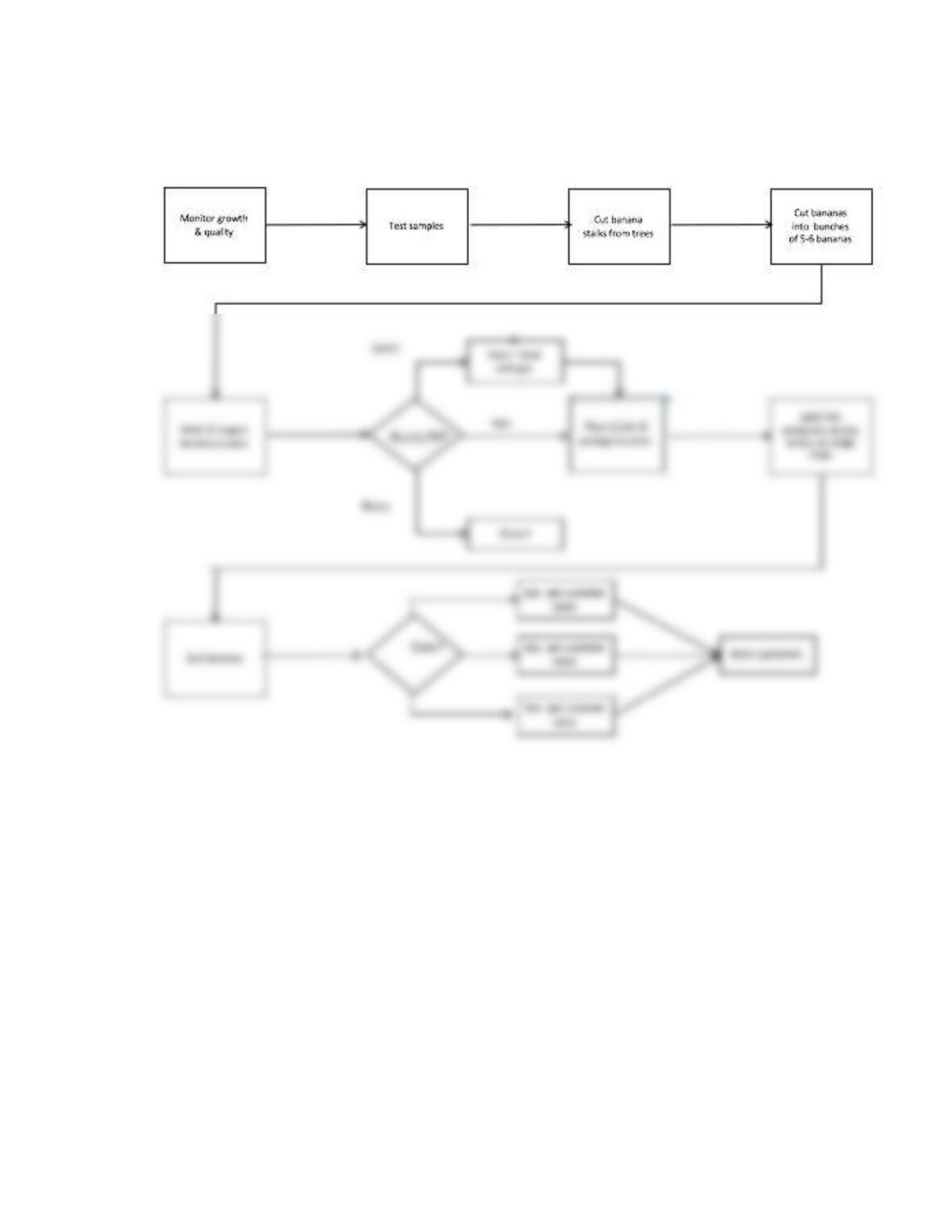
7. Global food supply chains consist of many processes. Bananas, for example, are grown on
farms in South or Central America. At the farm, the growth and quality are monitored
continuously, and samples are tested periodically. Once the bananas in a cluster reaches a
certain size, it is cut from the tree. Workers cut the cluster into smaller clusters of five to six
bananas. The bananas are rinsed, and then inspected. If the fruit is approved, the importer’s
sticker is placed on the bananas and the fruit is packaged to avoid bruising. Boxes of bananas
are loaded into containers and shipped via cargo ships to a port in the United States. If the
bananas are not ripe enough, they can be treated with a gas to hasten ripening. Bananas are
sorted by color, as different customers have different requirements (for example, green,
yellow, or brown). They are then boxed per customer specifications and sent to the customer
(retailer, restaurant, hotel, and so on).
a. Construct a flowchart depicting the supply chain for bananas.
b. Describe the principal processes in this supply chain.
c. What types of supplier management activities might the importer use to help control the
quality of the bananas?
31
a.
32
SUGGESTIONS FOR PROJECTS, ETC.
1. Interview a plant manager at a local factory to determine his or her philosophy on process
management. What techniques does the company use?
This exercise is designed to further students‘ awareness of the breadth of the “quality movement” and
help them confirm how and whether the theory of quality is being applied in a practical setting in
2. Design a process for the following activities:
a. Preparing for an exam
b. Writing a term paper
c. Planning a vacation
d. Making breakfast for your family
e. Washing your car
Discuss ways in which both quality and cycle time might be improved.
Answers will vary depending on the individual/group efforts of the students.
3. Design an instrument for evaluating the “process focus” of an organization. For example, what
characteristics would you look for in firms that have a strong process orientation?
Answers will vary, depending on the individual processes of the students. Such an instrument for
evaluating the process orientation of an organization might be built on leading process management
practices including:
• Translating customer requirements into product and service design requirements, taking into
account linkages between product design requirements and manufacturing process
requirements, supplier capabilities, and legal and environmental issues.
• Ensuring that quality is built into products using appropriate engineering and quantitative
tools
Process Focus 33
• Controlling quality and operational performance of all key business processes, using
systematic methods to identify significant variations in operational performance and output
quality, determine root causes, make corrections, and verify results.
4. Barker is a small custom producer of equipment used in various process industries such as
chemicals and beverages. Each piece of equipment is customer designed from customer
specifications. The process generally consists of five steps:
a. Customer quote creation
b. Preproduction planning (if awarded the contract)
c. Quality assurance plan
d. Manufacturing
e. Inspection and delivery
Develop a process manual for this company that outlines specific activities that should be
performed within each of these process steps. Be sure to clearly describe how design, control, and
improvement are integrated into this process, and also consider other issues discussed in this
chapter, such as the project nature of this process.
This project is designed to encourage students to consider what steps are required to develop a process
5. Think of a casual dining restaurant that you frequent. The process of fulfilling customer’ s
needs and creating a satisfying dining experience begins when the customer walks through the
door and ends when the customer leaves. Using process mapping, poka-yoke, and other
process management techniques described in this chapter, design the overall process and
subprocesses that would create a good customer experience.
In examining the processes for fulfilling customer’s needs and creating a satisfying dining
experience in casual dining restaurants, students will gain hands-on experience in using process
management techniques. Using process mapping, poka-yoke and other process management
6. Identify several sources of errors as a student or in your personal life. Develop some poka–
yokes that might prevent them.
Students can often identify a number of objectives for improvement when they do a personal TQM
project in this or a related course (see Chapter 1 for details). Some typical objectives are get up on
Process Focus 34
7. Interview a plant manager or quality professional at one or more local companies to see
whether they use any poka-yoke approaches to mistake-proof their operations.
Results will vary, depending on the manager who is interviewed and the type of company or industry
that is chosen.
8. Find some examples of supplier certification processes used by major companies and
summarize your findings, focusing on the criteria used and how the processes are
implemented.
ANSWERS TO CASE QUESTIONS
Harbour Community College – Food Service Program
Discussion Questions
1. If you were Christina, how would you design a process control plan to ensure that these
requirements were met?
For Christina Clark to design a process control plan and to ensure that these requirements were met,
she must mistake-proof these steps in each process. It will require the application of poke-yoke
principles. Also, a flow process chart could be developed, showing each step of the process. For
example, the Receiving and Storage steps could be mistake-proofed by putting a clipboard on the
refrigerator door as a reminder of the requirement to check the temperature of incoming hotdogs and
Process Focus 35
• Establish preventive measures with critical limits for each control point. For a
cooked food, for example, this might include setting the minimum cooking temperature
and time required to ensure the elimination of any harmful microbes.
• Establish procedures to monitor the critical control points. Such procedures might
include determining how and by whom cooking time and temperature should be
monitored.
• Establish corrective actions to be taken when monitoring shows that a critical limit
has not been met—for example, reprocessing or disposing of food if the minimum
cooking temperature is not met.
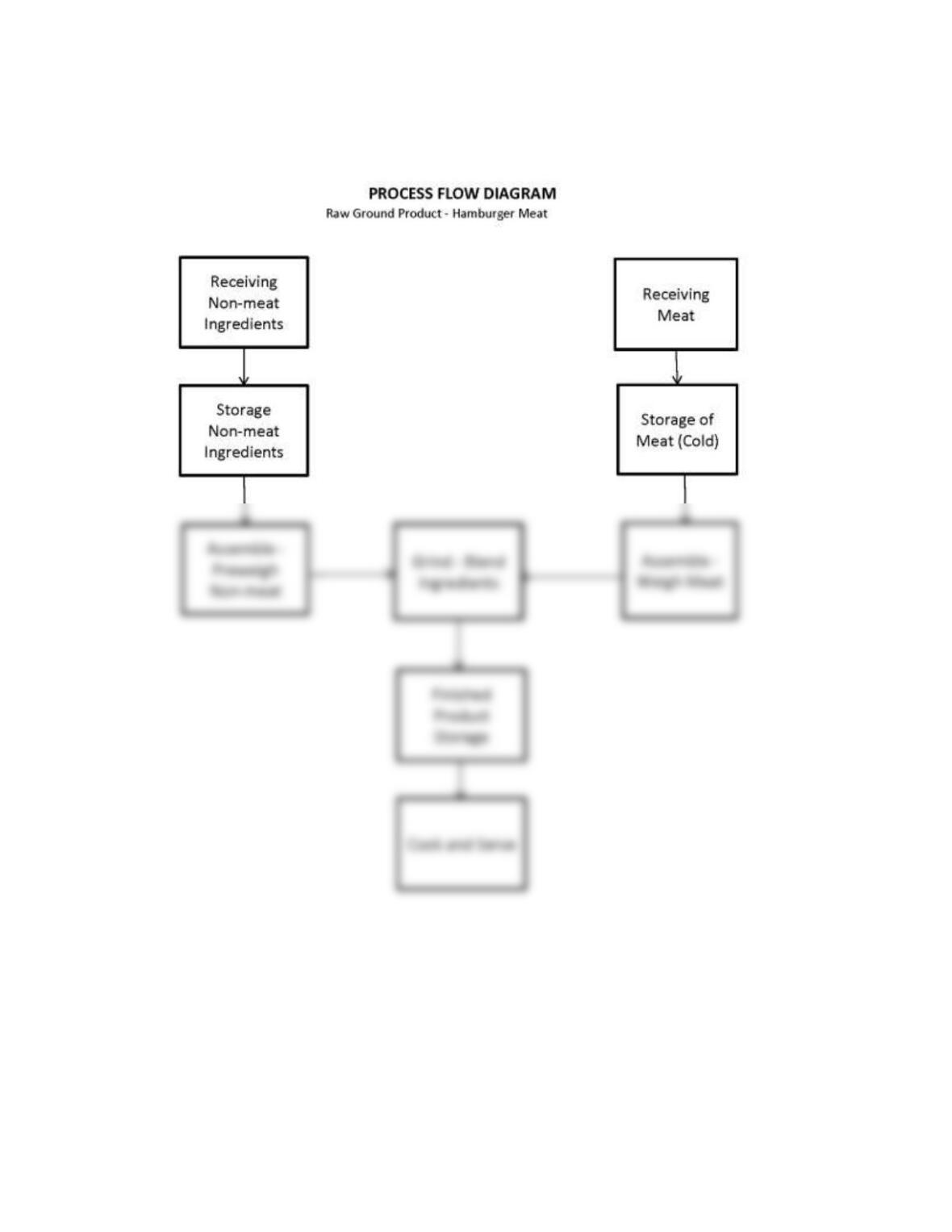
2. Design a flowchart and specific forms or “standard operating procedures” that you think
would be helpful in implementing your plan, specifically for the example of hot dogs.
A flowchart is shown below. Standard operating might be:
• Receiving: Refrigerated hot dogs should be between 40°F and 34°F when received.
• Storage: Storage temperature should be between 40°F and 34°F.
• Cooking: Hot dogs should be heated to a temperature of 145 5°F within 30 minutes of
placing on the grill.
Process Focus 36
Process Focus 37
3. How might the process control plan have to be modified to deal with handling ground,
uncooked meat, such as hamburger or pork sausage, keeping in mind that the risk of bacterial
contamination is much higher for such products?
The process control plan might have to be modified to deal with handling ground, uncooked meat,
such as hamburger or pork sausage, because the risk of bacterial contamination is much higher for
The State University Experience
Discussion Questions
1. What breakdowns in service processes has this student experienced?
The prospective student experienced a number of service quality defects in trying to navigate the system
at State University. First, the tour guide was not well trained, thus creating a poor initial impression. The
admissions process obviously needed improvement. The application form was confusing, a transcript
2. What types of process management activities should State University administrators
undertake?
To fix the problems with the systems at State University, administrators should begin with customer
focus. They need to understand the problems of the average 18-25 year old prospective student, and
design their processes to be user-friendly. This would require them to chart the processes (such as
Gold Star Chili: Process Management
Using the information provided, develop a process management plan for this company. Be
specific in your recommendations of how they should address process design, control, and
improvement activities.
The Gold Star Chili, Inc.’s organization chart is quite unique in that it links processes and customers
together, but is remarkably similar to Deming’s view of a production system in Chapter 1. In both, the
Process Focus 38
those processes don’t explicitly appear in the diagram. The three classes of customers: franchisees,
retail/wholesale, and restaurant customers receive products and services, and consumer research is done
for design/redesign of the product or service.
Core and support processes have been identified, but a process management plan should first
define requirements for these processes, specify metrics to monitor achievements of requirements,
develop flowcharts, suggest poka-yokes, and develop procedures for controlling performance and for
improvement. That means that they must constantly examine their processes to determine whether their
IBM’s Integrated Supply Chain
Discussion Questions
1. How are quality management principles directly or indirectly related to IBM’s ISC?
Process improvement results from a disciplined and structured application of quality management
principles. Fundamental TQ principles include: focusing on the customer, fact-based decisions,
continual improvement, empowerment, the right leadership structure, and an understanding of work
processes.
In IBM’s supply chain management, they are focused on end–to-end total quality. For
example, a manager said: “We must not forget the other functions in the organization, such as
quality, being achieved at every stage of the supply chain; marketing, finance and accounting are
also a key element in our strategy.” The key values that IBM employees espouse are: dedication to
every client’s success, innovation that matters, and trust and personal responsibility in all
Process Focus 39
Core Principles:
Customer Focus: IBM clearly focuses on their competitiveness in the market. By improving
competitiveness, they attract new customers, server customers better, and provide monetary value to
shareholders. One of IBM’s core values is “dedication to every client’s success, which directly
relates to the quality management principle of customer focus. Through continuous change efforts
mentioned below, IBM was working towards their goal of achieving “#1 in customer satisfaction”.
Teamwork: Three core teams make up a good amount of productivity at IBM, they are divided into
operations, strategy and talent. Their effectiveness directly affects the success of the organization.
IBM’s core value of “Trust and personal responsibility in all relationships” directly demonstrates the
Table 2.2:
• Customer Focus – IBM’s goal is to achieve #1 in customer satisfaction. Through their ISC
they focus on improving the customer experience. One way they do this through ISC is by
having an area dedicated to customer fulfillment. In addition, ISC cuts out wasted effort,
improves inventory, and deliveries. These indirectly make a positive impact on the customer.
• Leadership – Leaders at IBM understand the importance of ISC, and use it as a competitive
advantage. They have been instrumental in dividing the ISC into its 4 different areas.
Through their leadership, goals and objectives are set to different areas of the business in
areas like inventory and accounts payable.
• Engagement of People – The ISC encompasses the entire organization up and down, not just
the top managers. The levels of people aren’t the only things that are important, their job
Process Focus 40
• Relationship Management – Through ISC, IBM needs to carry superior supplier relationships
in order to meets its needs as a business. An unhealthy relationship can take hard work by all
and make it useless. Goals in areas like sales and inventory can take a huge hit if a supplier
doesn’t deliver on time.
2. Discuss the role that process management plays in supply chains, using any information in
this case to support your arguments.
Process management consists of three major activities: design, control, and improvement. Design,
control, and improvement are all evidenced by the principal objectives of the ISC which are
underpinned by the strategic quality principle of managing variation, hence cutting costs in the
various activities of the supply chain, and engaging in continuous reinvention. These principles have
led to specific objectives for IBM’s On-Demand Supply Chain, which are to: deliver competitive
cost advantage and reduce the variability in the cost and expense structure; improve sales
• Design. IBM began with a good design, starting with communication of their key values,
which set the stage for making fast decisions that impact supplier performance and customer
satisfaction. The process is designed by being organized into four areas: customer fulfillment,
global logistics, manufacturing, and procurement. The overall process is further designed
with three core teams of operations, strategy, and talent. The design also focuses on a trained
workforce, which is shown by how IBM aligned their leadership style with their culture, and
hiring new leaders who fit into that culture.
• Control. This focuses on maintaining consistency in output by assessing and correcting