• One option contract represents ₤31,250.
a. Construct a worksheet for a long strangle using these options.
b. Determine the break-even point(s) for a strangle.
c. If the spot price of the pound at option expiration is $1.55, what is the total profit or loss to the
strangle buyer?
d. If the spot price of the pound at option expiration is $1.50, what is the total profit or loss to the
strangle writer?
ANSWER:
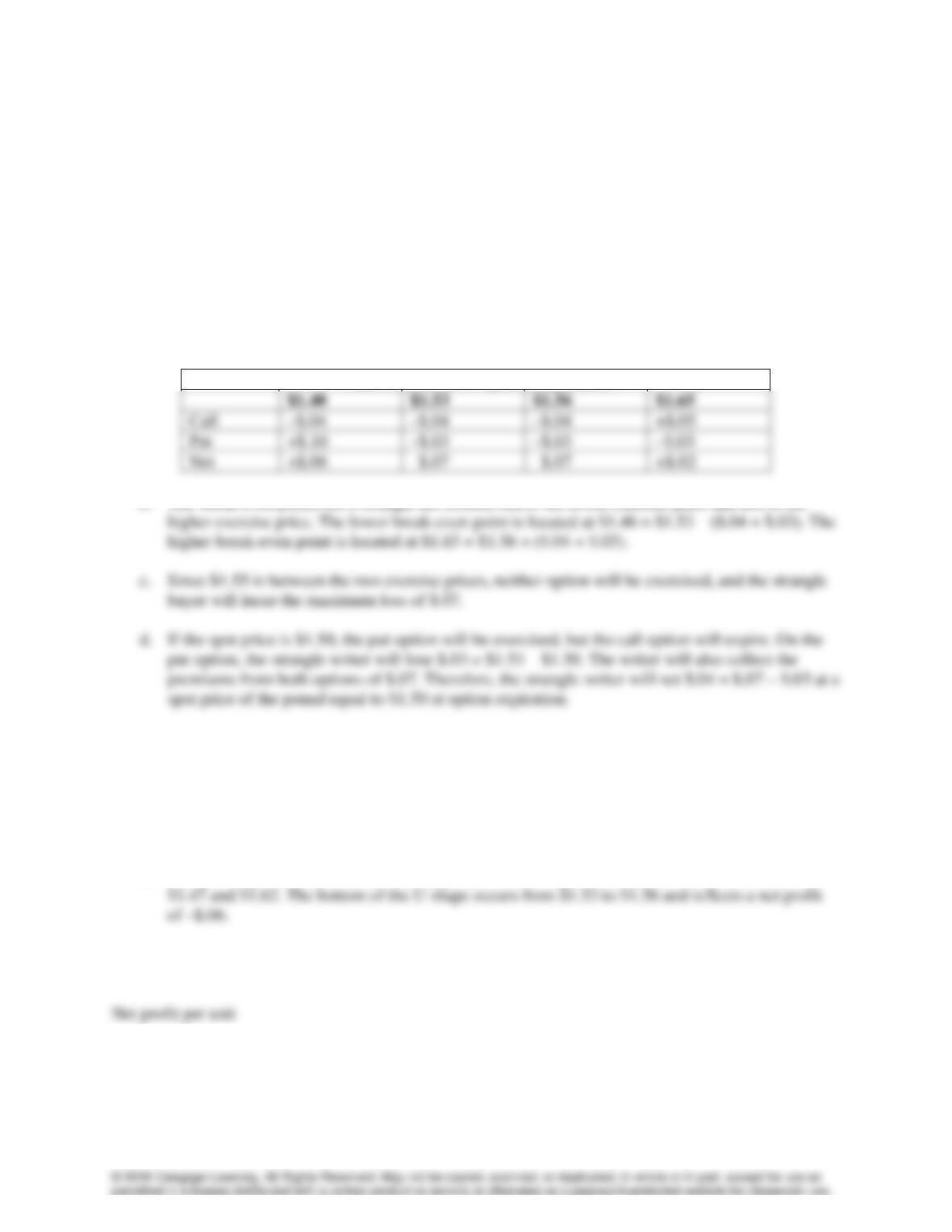
a. Many different worksheets are possible, but one worksheet is shown below.
Value of Pound at Option Expiration
b. The break-even points for a strangle are located below the lower exercise price and above the
32. Currency Strangles. Refer to the previous question, but assume that the call and put option
premiums are $.035 per unit and $.025 per unit, respectively. (See Appendix B in this chapter.)
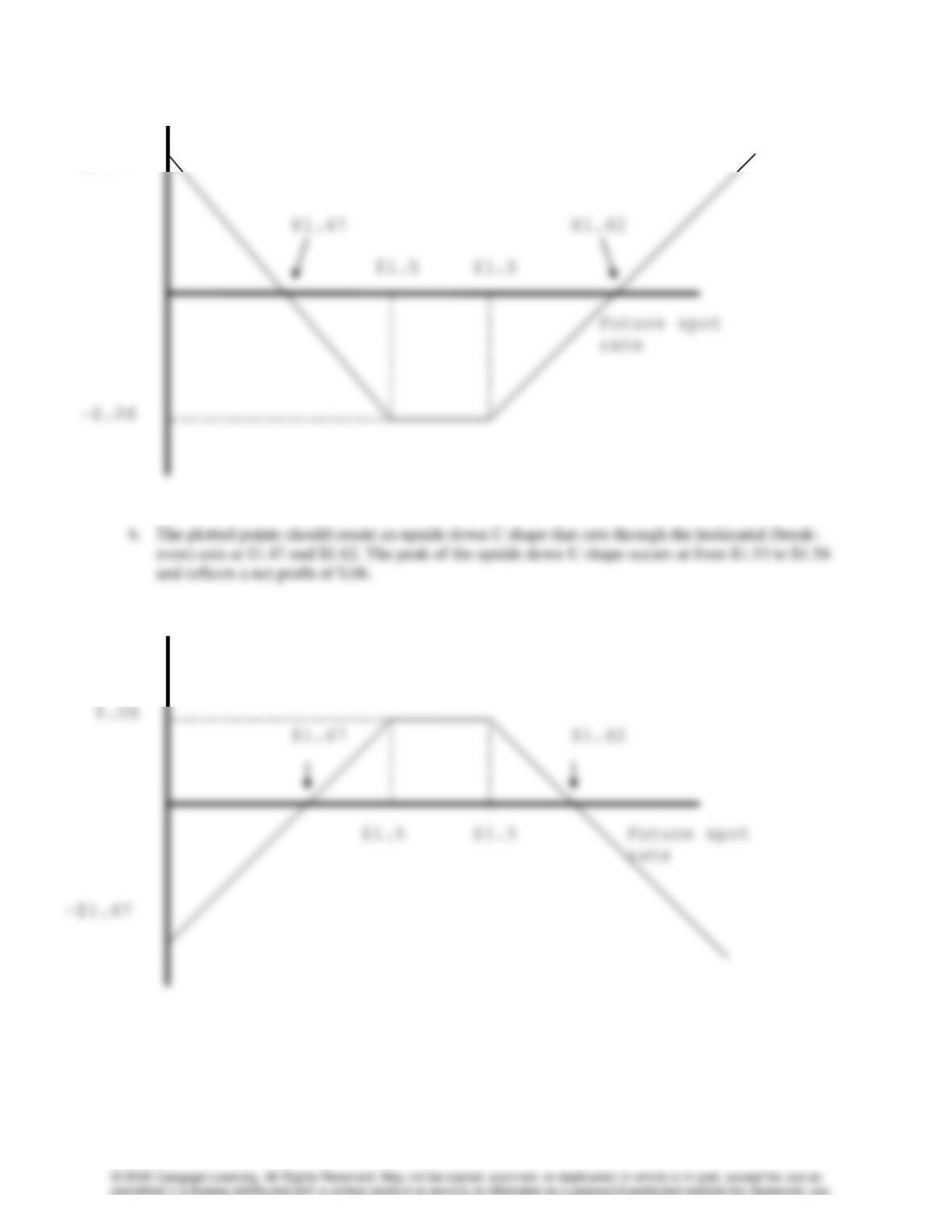
a. Construct a contingency graph for a long pound strangle.
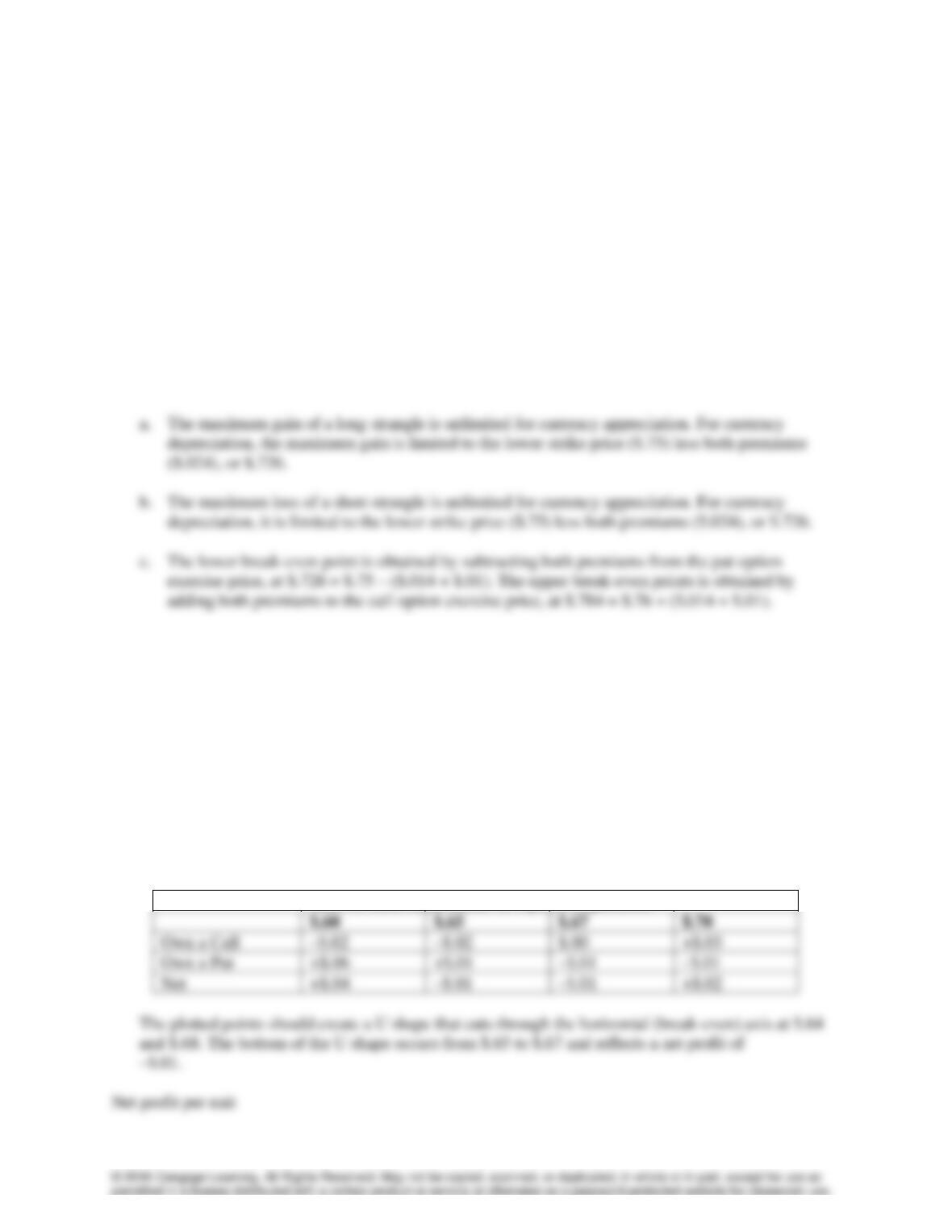
b. Construct a contingency graph for a short pound strangle.
ANSWER:
a. The plotted points should create a U shape that cuts through the horizontal (break-even) axis at
Net profit per unit
$.06
$1.47
33. Currency Strangles. The following information is currently available for Canadian dollar (C$)
options (see Appendix B in this chapter):
• Put option exercise price = $.75
• Put option premium = $.014 per unit
• Call option exercise price = $.76
• Call option premium = $.01 per unit
• One option contract represents C$50,000
a. What is the maximum possible gain the purchaser of a strangle can achieve using these options?
b. What is the maximum possible loss the writer of a strangle can incur?
c. Locate the break-even point(s) of the strangle.
ANSWER:
34. Currency Strangles. For the following options available on Australian dollars (A$), construct a
worksheet and contingency graph for a long strangle. Locate the break-even points for this strangle.
(See Appendix B in this chapter.)
• Put option strike price = $.67
• Call option strike price = $.65
• Put option premium = $.01 per unit
• Call option premium = $.02 per unit
ANSWER:
Note that the put strike price exceeds the call strike price in this case.
Value of Australian dollar at Option Expiration
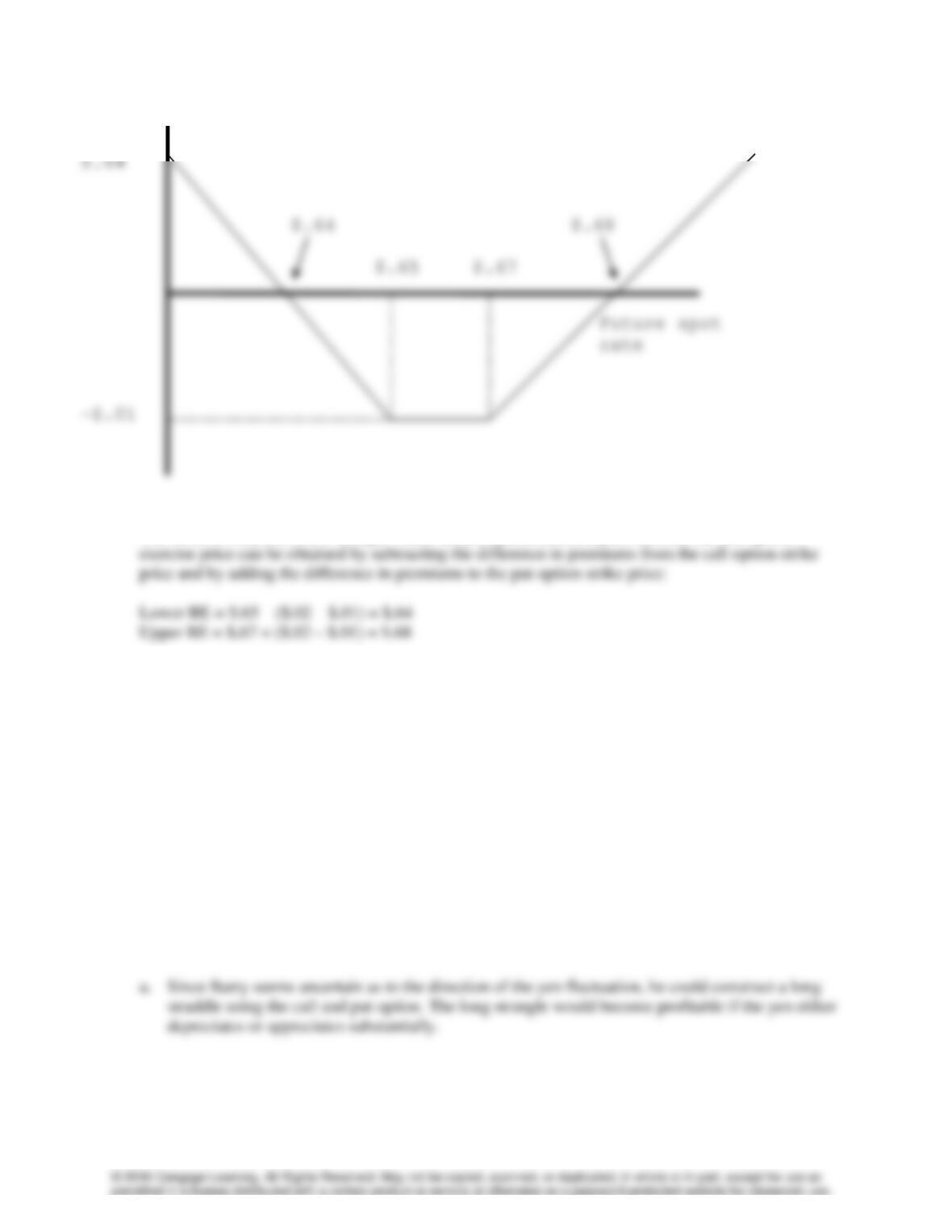
The break-even points for a strangle where the put option exercise price exceeds the call option
35. Speculating with Currency Options. Barry Egan is a currency speculator. Barry believes that the
Japanese yen will fluctuate widely against the U.S. dollar in the coming month. Currently, one-month
call options on Japanese yen (¥) are available with a strike price of $.0085 and a premium of $.0007
per unit. One-month put options on Japanese yen are available with a strike price of $.0084 and a
premium of $.0005 per unit. One option contract on Japanese yen contains 6.25 million yen. (See
Appendix B in this chapter.)
a. Describe how Barry Egan could utilize these options to speculate on the movement of the
Japanese yen.
b. Assume Barry decides to construct a long strangle in yen. What are the break-even points of this
strangle?
c. What is Barry’s total profit or loss if the value of the yen in one month is $.0070?
d. What is Barry’s total profit or loss if the value of the yen in one month is $.0090?
ANSWER:
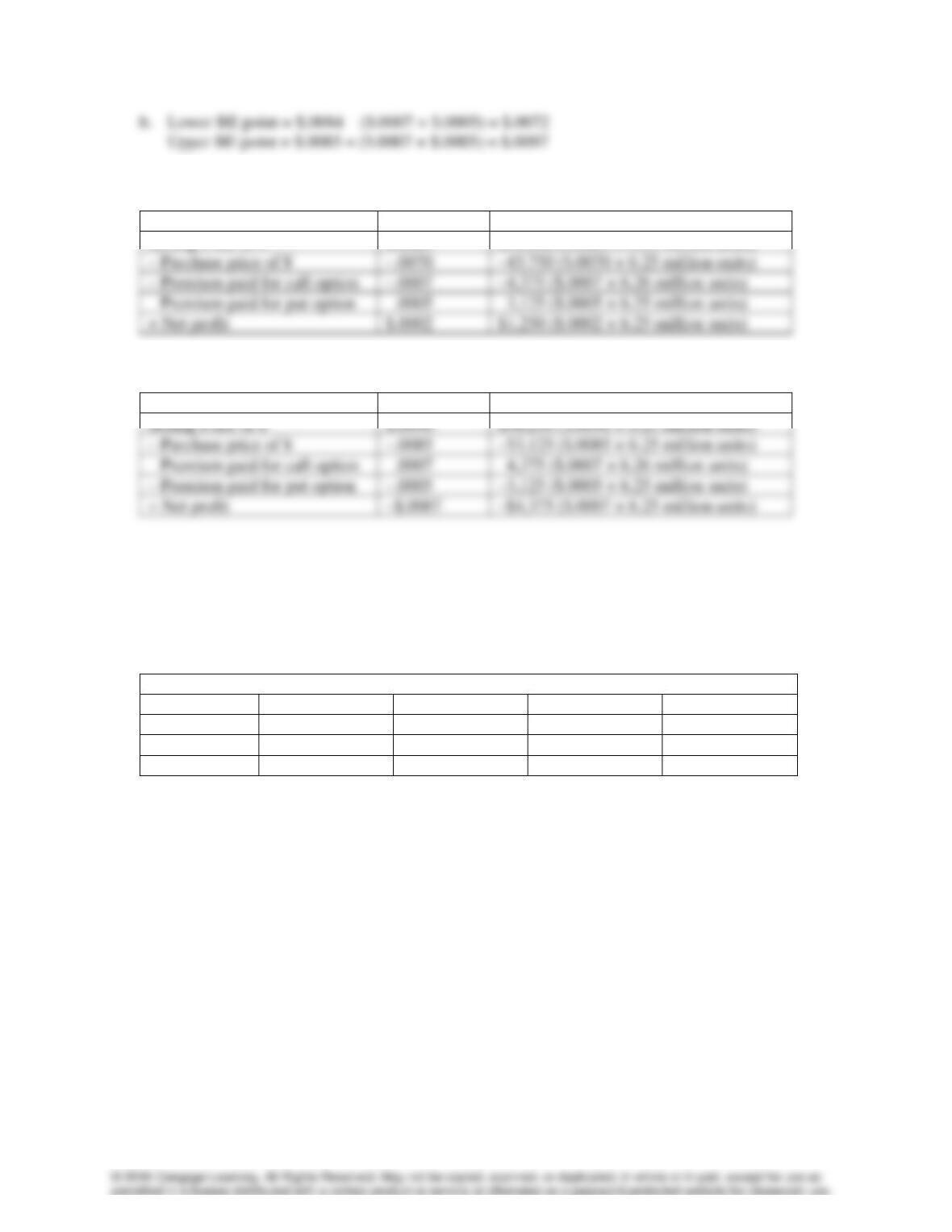
c.
Per Unit
Per Contract
Selling Price of ¥
$.0084
$52,500 ($.0084 × 6.25 million units)
= Net profit
$.0002
$1,250 ($.0002 × 6.25 million units)
d.
Per Unit
Per Contract
Selling Price of ¥
$.0090
$56,250 ($.0090 × 6.25 million units)
= Net profit
36. Currency Bullspreads and Bearspreads. A call option on British pounds (₤) exists with a strike
price of $1.56 and a premium of $.08 per unit. Another call option on British pounds has a strike price
of $1.59 and a premium of $.06 per unit. (See Appendix B in this chapter.)
a. Complete the worksheet for a bullspread below.
Value of British Pound at Option Expiration
$1.50
$1.56
$1.59
$1.65
Call @ $1.56
Call @ $1.59
Net
b. What is the breakeven point for this bullspread?
c. What is the maximum profit of this bullspread? What is the maximum loss?
d. If the British pound spot rate is $1.58 at option expiration, what is the total profit or loss for the
bullspread?
e. If the British pound spot rate is $1.55 at option expiration, what is the total profit or loss for a
bearspread?
ANSWER:
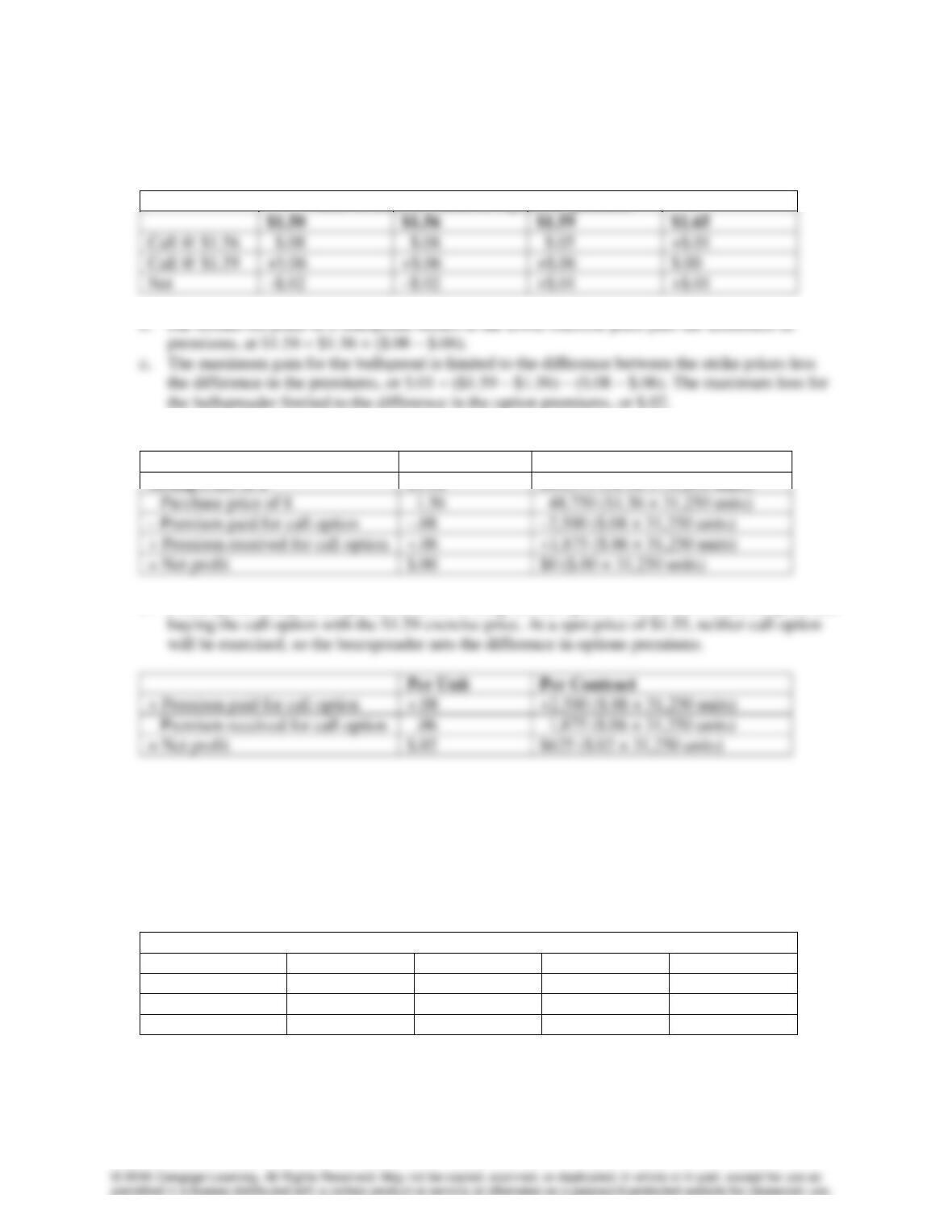
a.
Value of British Pound at Option Expiration
$1.50
$1.56
$1.59
$1.65
Call @ $1.56
+$.01
Call @ $1.59
+$.06
+$.06
+$.06
$.00
+$.01
+$.01
d.
Per Unit
Per Contract
Selling Price of ₤
$1.58
$49,375 ($1.58 × 31,250 units)
+ Premium received for call option
+.06
+1,875 ($.06 × 31,250 units)
= Net profit
$.00
$0 ($.00 × 31,250 units)
e. A bearspread using these options involves writing the call option with the $1.56 exercise price and
+ Premium paid for call option
+.08
+2,500 ($.08 × 31,250 units)
= Net profit
$.02
$625 ($.02 × 31,250 units)
37. Bullspreads and Bearspreads. Two British pound (₤) put options are available with exercise prices
of $1.60 and $1.62. The premiums associated with these options are $.03 and $.04 per unit,
respectively. (See Appendix B in this chapter.)
a. Describe how a bullspread can be constructed using these put options. What is the difference
between using put options versus call options to construct a bullspread?
b. Complete the following worksheet.
Value of British Pound at Option Expiration
$1.55
$1.60
$1.62
$1.67
Put @ $1.60
Put @ $1.62
Net
c. At option expiration, the spot rate of the pound is $1.60. What is the bullspreader’s total gain or
loss?
d. At option expiration, the spot rate of the pound is $1.58. What is the bearspreader’s total gain or
loss?
ANSWER:
a. Using put options to construct a bullspread involves exactly the same actions as constructing a
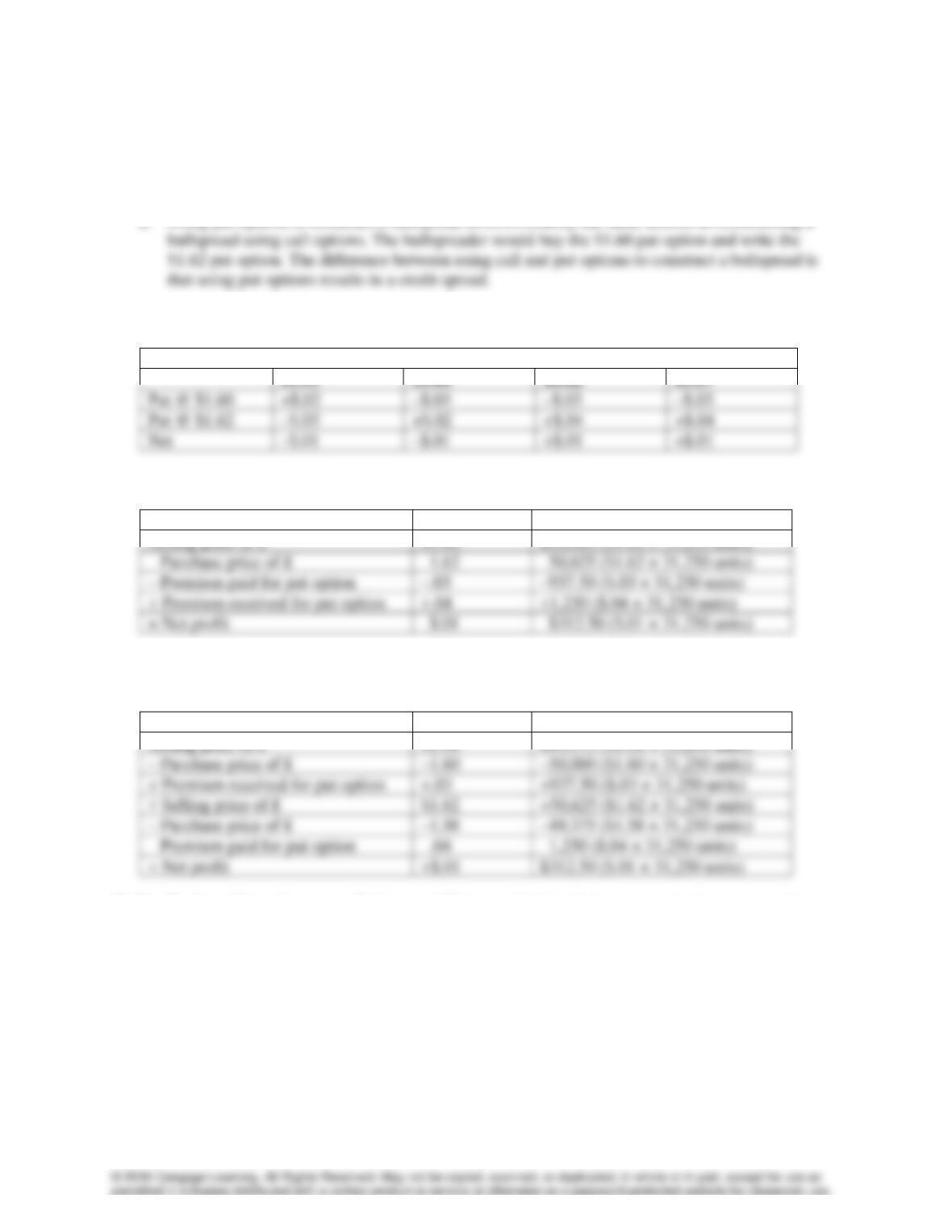
b.
Value of British Pound at Option Expiration
$1.55
$1.60
$1.62
$1.67
Put @ $1.60
+$.02
Put @ $1.62
+$.02
+$.04
+$.04
Net
+$.01
c.
Per Unit
Per Contract
$1.60
$50,000 ($1.60 × 31,250 units)
+ Premium received for put option
+.04
+1,250 ($.04 × 31,250 units)
= Net profit
d. A bearspread using these put options would be constructed by writing the $1.60 put option and
buying the $1.62 put option.
Per Unit
Per Contract
$1.58
$49,375 ($1.58 × 31,250 units)
+ Premium received for put option
+.03
+937.50 ($.03 × 31,250 units)
$1.62
+50,625 ($1.62 × 31,250 units)
= Net profit
+$.01
$312.50 ($.01 × 31,250 units)
38. Profits from Using Currency Options and Futures. On July 2, the two-month futures rate of the
Mexican peso contained a 2 percent discount (unannualized). There was a call option on pesos with
an exercise price that was equal to the spot rate. There was also a put option on pesos with an exercise
price equal to the spot rate. The premium on each of these options was 3 percent of the spot rate at
that time. On September 2, the option expired. Go to the oanda.com website (or any site that has
foreign exchange rate quotations) and determine the direct quote of the Mexican peso. You exercised
the option on this date if it was feasible to do so.
a. What was your net profit per unit if you had purchased the call option?
b. What was your net profit per unit if you had purchased the put option?
c. What was your net profit per unit if you had purchased a futures contract on July 2 that had a
settlement date of September 2?
d. What was your net profit per unit if you sold a futures contract on July 2 that had a settlement
date of September 2?
39. Uncertainty and Option Premiums. This morning, a Canadian dollar call option contract has a
$.71 strike price, a premium of $.02, and expiration date of one month from now. This afternoon,
news about international economic conditions increased the level of uncertainty surrounding the
Canadian dollar. However, the spot rate of the Canadian dollar was still $.71. Would the premium of
the call option contract be higher than, lower than, or equal to $.02 this afternoon? Explain.
40. Uncertainty and Option Premiums. At 10:30 a.m., the media reported news that the Mexican
government‘s political problems were reduced, which reduced the expected volatility of the Mexican
peso against the dollar over the next month. The spot rate of the Mexican peso was $.13 as of 10 a.m.
and remained at that level all morning. At 10 a.m., Hilton Head Co. purchased a call option at the
money on 1 million Mexican pesos with an expiration date one month from now. At 11:00 a.m.,
Rhode Island Co. purchased a call option at the money on 1 million pesos with a December expiration
date one month from now. Did Hilton Head Co. pay more, less, or the same as Rhode Island Co. for
the options? Briefly explain.
41. Speculating with Currency Futures. Assume that one year ago, the spot rate of the British
pound was $1.70. One year ago, the one-year futures contract of the British pound exhibited a
discount of 6%. At that time, you sold futures contracts on pounds, representing a total of 1,000,000
pounds. From one year ago to today, the pound’s value depreciated against the dollar by 4 percent.
Determine the total dollar amount of your profit or loss from your futures contract.
ANSWER: Spot rate 1 year ago = $1.70
42. Speculating with Currency Options. The spot rate of the New Zealand dollar is $.77. A call option
on New Zealand dollars with a one-year expiration date has an exercise price of $.78 and a premium
of $.04. A put option on New Zealand dollars at the money with a one-year expiration date has a
premium of $.03. You expect that the New Zealand dollar’s spot rate will decline over time and will
be $.71 in one year.
a. Today, Dawn purchased call options on New Zealand dollars with a one-year expiration date.
Estimate the profit or loss per unit at the end of one year. [Assume that the options would be
exercised on the expiration date or not at all.]
b. Today, Mark sold put options on New Zealand dollars at the money with a one-year
expiration date. Estimate the profit or loss per unit for Mark at the end of one year. [Assume
that the options would be exercised on the expiration date or not at all.]
ANSWER:
43. Impact of Expected Volatility on Currency Option Premiums. Assume that Australia’s
central bank announced plans to stabilize the Australian dollar (A$) in the foreign exchange
markets. In response to this announcement, the expected volatility of the A$ declined
immediately. However, the spot rate of the A$ remained at $.89 on this day, and was not
affected by the announcement. The one-year forward rate of the A$ remained at $.89 on this
day and was not affected by the announcement. Do you think the premium charged on a one-
year A$ currency option increased, decreased, or remained the same on this day in response
to the announcement? Briefly explain.
Solution to Continuing Case Problem: Blades, Inc.
1. If Blades uses call options to hedge its yen payables, should it use the call option with the exercise
price of $0.00756 or the call option with the exercise price of $0.00792? Describe the tradeoff.
ANSWER: The table shows how the option choices have changed for Blades. If it wants to ensure
paying no more than 5 percent above the spot rate, the option with the exercise price of $0.00756
2. Should Blades allow its yen position to be unhedged? Describe the tradeoff.
3. Assume there are speculators who attempt to capitalize on their expectation of the yen’s movement
over the two months between the order and delivery dates by either buying or selling yen futures now
and buying or selling yen at the future spot rate. Given this information, what is the expectation on
the order date of the yen spot rate by the delivery date? (Your answer should consist of one number.)
ANSWER: If there are speculators who attempt to capitalize on their expectation of the yen’s future
movement, then the expectation of the future spot rate would be equal to the futures rate. For
4. Assume that the firm shares the market consensus of the future yen spot rate. Given this expectation
and given that the firm makes a decision (i.e., option, futures contract, remain unhedged) purely on a
cost basis, what would be its optimal choice?
ANSWER: (See spreadsheet attached.) The optimal choice, given the expected future spot rate in
5. Will the choice you made as to the optimal hedging strategy in question 4 definitely turn out to be the
lowest-cost alternative in terms of actual costs incurred? Why or why not?
ANSWER: No, as mentioned in the case, the yen is very volatile and, therefore, the actual costs
Alternative 1—Remain Unhedged
Expected Spot Rate $ 0.006912
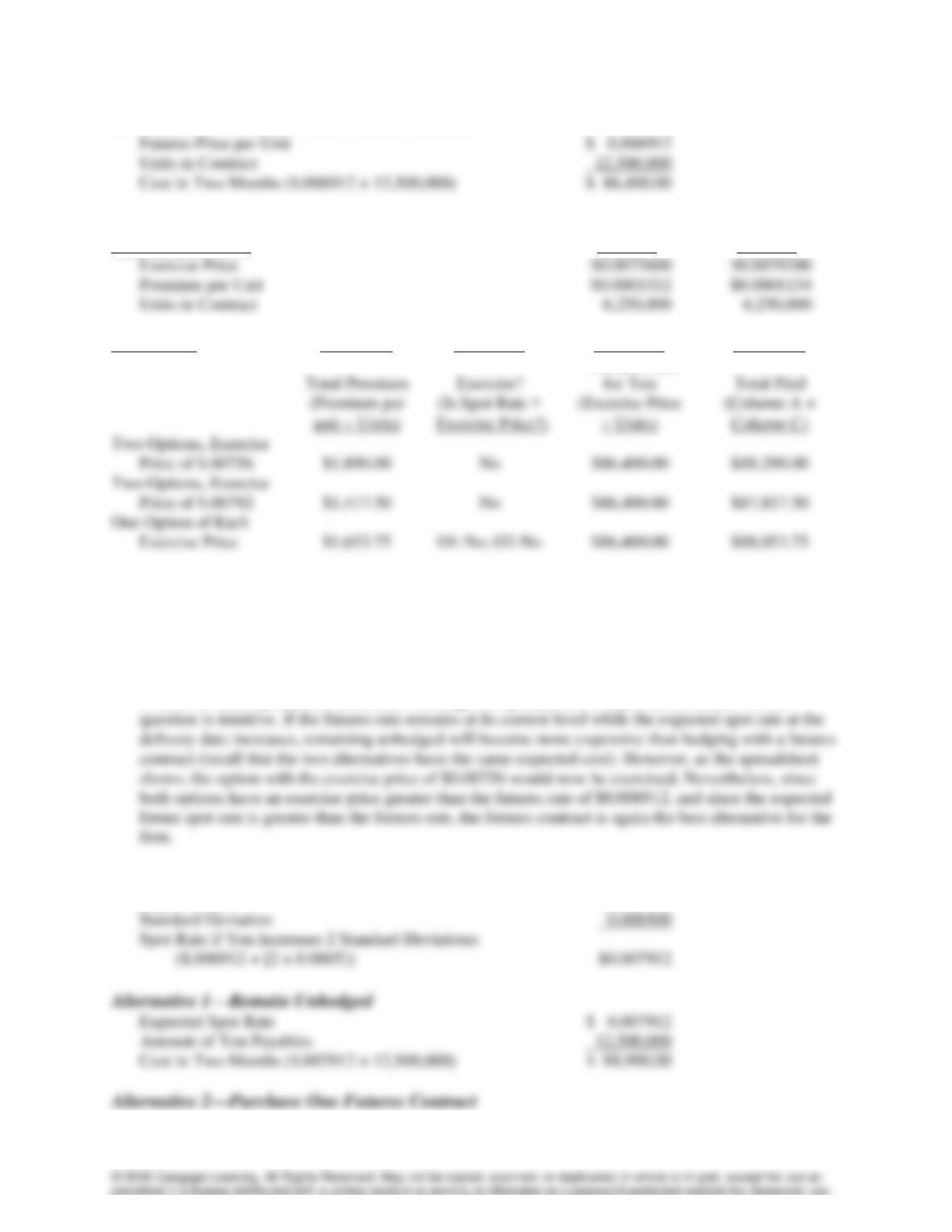
Alternative 2—Purchase One Futures Contract
Alternative 3—Purchase Two Options
Options Information Option 1 Option 2
Calculations Column A Column B Column C Column D
Amount Paid
6. Now assume that you have determined that the historical standard deviation of the yen is about
$0.0005. Based on your assessment, you believe it is highly unlikely that the future spot rate will be
more than two standard deviations above the expected spot rate by the delivery date. Also assume that
the futures price remains at its current level of $0.006912. Based on this expectation of the future spot
rate, what is the optimal hedge for the firm?
ANSWER: (See spreadsheet attached.) Although the spreadsheet is required, the answer to this
Calculation of Highest Forecasted Spot Rate
Expected Spot $0.006912
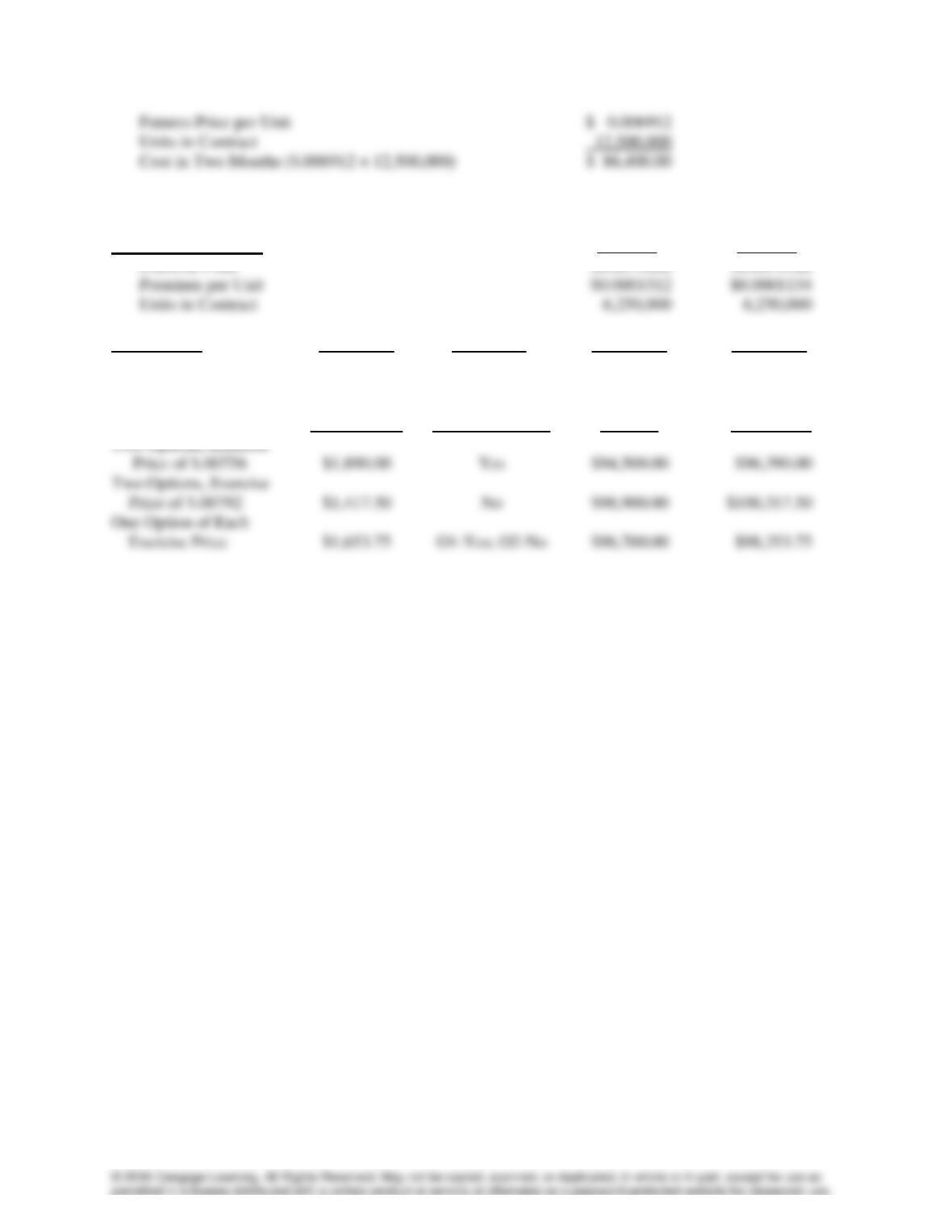
Alternative 3—Purchase Two Options
Options Information Option 1 Option 2
Calculations Column A Column B Column C Column D
Amount Paid
Total Premium Exercise? for Yen Total Paid
(Premium per (Is Spot Rate > (Exercise Price (Column A +
unit Units) Exercise Price?) Units) Column C)
Solution to Supplemental Case: Capital Crystal, Inc.
This case is designed to give students more insight on the advantages and disadvantages of currency
futures and options. More comprehensive questions on this subject are offered in Chapter 11.
a. To hedge with futures, the cost of the imports will be $795 million ($1.59 × £500 million). To hedge
with call options, the cost per unit (including the premium paid) is $1.61, so that the cost of the
imports if the option is exercised is $805 million. Since the pound’s spot rate is expected to be above
the call option’s exercise price, the call option would likely be exercised. In this case, hedging with
futures will cost $10 million less than hedging with call options.
b. Since the future spot rate is likely to exceed the futures price, hedging with futures would likely be less
costly than not hedging. Even if it was more costly, it might be wise to hedge in keeping with the
conservative management style of Capital Crystal, Inc.
This part of the case illustrates that currency call options may not always be the best choice, even
though they offer more flexibility than currency futures.
Based on the new information, the cost of importing when using futures is still $795 million. When
using the call option, if the forecast of the pound’s future spot rate is correct, the option would not be
exercised. Thus, the amount paid per unit would be the future spot rate of $1.57 plus the $.01
premium paid per unit for the option. Therefore, the cost of imports would be $790 million, or $5
million less than when using the futures hedge.
Small Business Dilemma
Use of Currency Futures and Options by the Sports Exports Company
1. How can the Sports Exports Company use currency futures contracts to hedge against exchange rate
risk? Are there any limitations of using currency futures contracts that would prevent the Sports
Exports Company from locking in a specific exchange rate at which it can sell all the pounds it
expects to receive in each of the upcoming months?
2. How can the Sports Exports Company use currency options to hedge against exchange rate risk? Are
there any limitations of using currency options contracts that would prevent the Sports Exports
Company from locking in a specific exchange rate at which it can sell all the pounds it expects to
receive in each of the upcoming months?
3. Jim Logan, owner of the Sports Exports Company, is concerned that the pound may depreciate
substantially over the next month, but he also believes that the pound could appreciate substantially if
specific situations occur. Should Jim use currency futures or currency options to hedge the exchange
rate risk? Is there any disadvantage of selecting this method for hedging?
Part 1—Integrative Problem
The International Financial Environment
Mesa Company specializes in the production of small fancy picture frames, which are exported from the
U.S. to the United Kingdom. Mesa invoices the exports in pounds and converts the pounds to dollars
when they are received. The British demand for these frames is positively related to economic conditions
in the United Kingdom. Assume that British inflation and interest rates are similar to the rates in the U.S.
Mesa believes that the U.S. balance-of-trade deficit from trade between the U.S. and the United Kingdom
will adjust to changing prices between the two countries, while capital flows will adjust to interest rate
differentials. Mesa believes that the value of the pound is very sensitive to changing international capital
flows, and is moderately sensitive to international trade flows. Mesa is considering the following
information:
• The U.K. inflation rate is expected to decline, while U.S. inflation rate is expected to rise.
• British interest rates are expected to decline, while U.S. interest rates are expected to increase.
1. Explain how the international trade flows should initially adjust in response to the changes in inflation
(holding exchange rates constant). Explain how the international capital flows should adjust in
response to the changes in interest rates (holding exchange rates constant).
ANSWER: The U.S. balance-of-trade deficit should increase in response to the changes in inflation,
2. Using the information provided, will Mesa expect the pound to appreciate or depreciate in the future?
Explain.
ANSWER: The pound’s equilibrium value will change in response to changes in the capital flows
3. Mesa believes international capital flows shift in response to changing interest rate differentials. Is
there any reason why the changing interest rate differentials in this example will not necessarily cause
international capital flows to change significantly? Explain.
4. Based on your answer to question 2, how would Mesa’s cash flows be affected by the expected
exchange rate movements? Explain.
5. Based on your answer to question 4, should Mesa consider hedging its exchange rate risk? If so,
explain how it could hedge using forward contracts, futures contracts, and currency options.
ANSWER: Mesa should consider hedging exchange rate risk. It could use forward contracts to sell