1
Instructor’s Manual – OMSC2 – Collier/Evans – C5 Goods and Service Design
Chapter 5 introduces students to goods and service design. Key topics covered include
prototype testing, house of quality, Taguchi designs and loss function, reliability, design for
Questions and problems are provided in four categories:
1. Review questions
2. Discussion questions and experiential activities
Two Excel spreadsheet templates – Taguchi and Systems Reliability, available in MindTap, are
illustrated in solved problems.
The chapter has three cases:
1. Gulf Coast Bank: Service Guarantees focuses on the objectives of service guarantees, payout
2. Tom’s Auto Service requires students to evaluate the firm’s customer benefit package rank
order competitive priorities and evaluate service delivery and service encounter design features
3. The integrative case study, Hudson Jewelers, with case assignment questions in all chapters,
requires the student to evaluate the current store layout, perform a breakeven analysis on a CAD
system used to custom design diamond rings, and propose a service guarantee.
KEY TERMS
Customer-contact requirements are measurable performance levels or expectations that
define the quality of customer contact with representatives of an organization.
Elaborate servicescape environments provide service using more complicated designs and
service systems (e.g., hospitals, airports, and universities).
Empowerment means giving people authority to make decisions based on what they feel is
right, to have control over their work, to take risks and learn from mistakes, and to promote
change.
Systems in which the percentage of customer contact is low are called high-contact systems.
Quality function deployment (QFD) is an approach to guide the design, creation, and marketing
of goods and services by integrating the voice of the customer into all decisions.
Reliability is the probability that a manufactured good, piece of equipment, or system performs
its intended function for a stated period of time under specified
Service-delivery system design includes facility location and layout, the servicescape, service
process and job design, technology and information support systems, and organizational
structure.
3
Service process design is the activity of developing an efficient sequence of activities to satisfy
both internal and external customers.
Customer requirements, as expressed in the customer’s own words, are called the voice of the
customer.
.
REVIEW QUESTIONS
1. Explain the importance of new product design and development.
Decisions about what goods and services to offer and how to position them in the
2. What are the six major steps in designing goods and services?
1 and 2. Strategic Mission, Analysis, and Competitive Priorities
3. Customer Benefit Package Design and Configuration
These are summarized in Exhibit 5.1. Students should be able to explain these.
3. What is prototype testing? Why is it used?
Prototype testing is the process by which a model (real or simulated) is constructed to test
4. Explain the concept and application of quality function deployment.
QFD focuses on turning the voice of the customer into specific technical requirements that
5. Describe the goal-post view of conforming to specifications.
For most manufactured goods, design blueprints specify a target dimension (called the
6. Describe how the Taguchi loss function is used for designing manufactured goods.
The loss function is represented by L(x) = k(x – T)2 [5.1]
The Taguchi loss function is a reaction to the goal post model of conforming to
7. Describe how reliability is used for designing manufactured goods.
Reliability is the probability that a manufactured good, piece of equipment, or system
performs its intended function for a stated period of time under specified operating
conditions. Many goods are configured using a series of components, parallel (redundant)
8. Describe how design for manufacturability (DFM) and design for sustainability are used for
designing manufactured goods.
Another useful approach is DFM, or design for manufacturability, which is intended to
9. What is the rationale for product and process simplification?
Product and process simplification is the process of trying to simplify designs to reduce
10. Explain the five elements of service-delivery system design.
Service-delivery system design includes facility location and layout, the servicescape,
service process and job design, technology and information support systems, and
organizational structure. A servicescape has three principal dimensions:
6
11. What is customer contact?
Customer contact refers to the physical or virtual presence of the customer in the service
12. Define high- and low-contact systems and provide examples of each.
Systems in which the percentage of customer contact is high are called high-contact
13. Describe the four elements of service-encounter design.
The principal elements of service-encounter design are customer-contact behavior and
14. Define a service guarantee and provide one example.
A service guarantee is a promise to reward and compensate a customer if a service upset
15. Define a service upset and provide one example from your personal experiences.
A service upset is any problem a customer has—real or perceived—with the service-
16. Explain how goods and service design concepts are integrated at LensCrafters.
7
DISCUSSION QUESTIONS AND EXPERIENTIAL ACTIVITIES
17. How might modern technology, such as the Internet, be used to understand the voice of
the customer?
Consumers provide a lot of “free” information in the form of blogs, discussion groups, web
site product reviews, web page click and order analysis, and so on. Companies can
leverage this information by carefully monitoring comments about their products as well as
18. What lessons can be learned from the LaRosa’s Pizzeria boxed example?
Customer requirements, as expressed in the customer’s own terms, are called the voice of
19. In building a House of Quality, what departments or functions should be involved in each
step of the process?
Voice of the customer: Marketing
20. Explain how the goal post view of conforming to specifications differs from Taguchi’s loss
function. Would you rather buy an automobile where suppliers used the goal-post or
Taguchi models? Why?
Adopters of the Taguchi model try to design processes to hit the target value where any
deviation from perfection results in an economic loss. Adopters of the goal post model try
8
21. Research and write a short paper (maximum two typed pages) illustrating an example of
how a company applies concepts of Design for Environment (DfE).
A Google search for “design for environment” results in over 1.5 million hits so the
students have plenty to write about. According to Wikipedia there are three main
concepts that fall under the Design for Environment umbrella:
• Design for environmental processing and manufacturing: This ensures that raw
material extraction (mining, drilling, etc.), processing (processing reusable materials,
Life cycle assessment (LCA) is employed to forecast the impacts of different (production)
alternatives of the product in question, thus being able to choose the most
environmentally friendly. A life cycle analysis can serve as a tool when determining the
environmental impact of a product or process. Proper LCAs can help a designer compare
several different products according to several categories, such as energy use, toxicity,
acidification, CO2 emissions, ozone depletion, resource depletion and many others. By
9
22. Choose a servicescape for a business with which you are familiar and list key physical
attributes of the servicescape and their impact on customer service and value. Explain how
the servicescape establishes the behavioral setting for your example.
The servicescape is all the physical evidence a customer might use to form an impression.
23. Define lean and elaborate servicescapes and give an example not in the textbook.
Some servicescapes, termed lean servicescape environments, are very simple. Ticketron
outlets and Federal Express drop-off kiosks would qualify as lean servicescape
24. Select a service at your school, such as financial aid, bookstore, curriculum advising, and so
on. Propose a redesign of this service and its service delivery system. First, baseline the
current service and system and then suggest how to redesign and improve it. Make use of
chapter ideas as best you can.
Most students will certainly understand the flaws in the current systems they encounter.
Students often have better ideas for improvement than the people who work in these
10
25. Identify a job in an organization and describe how the four elements of service-encounter
design are designed and managed for this job. (The job you select could be in a
professional organization such as a dentist or tax advisor, or in a routine service
organization such as a hotel check-in desk clerk or airline flight attendant.)
The student should focus on the following four service encounter design elements: (a)
26. Propose an explicit service guarantee for a fast-food restaurant. Clearly explain why you
included the features of your service guarantee (maximum of one page). Do you think that
a restaurant would adopt it? Why or why not?
At one extreme, students may write something like “XYZ Restaurant will give you a full
credit on current or future dinners if we do not provide 100% customer satisfaction.” To
Most restaurants have implicit or explicit service guarantees somewhere in between these
two extremes subject to corporate policy and legal and government regulations.
27. Identify a service-provider job and associated service encounters and design and write a
job description for it. (Consider desired customer-contact skills and behaviors, education
and training requirements, empowerment capabilities, hiring criteria, and so on.)
Student will (and should) select jobs they have experience with such as being a waiter,
11
28. Is it easier to management a high- or low-customer-contact business? Explain.
If you have good examples of low versus high contact processes, ask the students “Which
would you rather manage and why?” Most students using the basic differences between
29. Characterize the following goods and services on the low-high-customer-contact
continuum and justify your answer in a sentence or two.
a) participating in a case study classroom discussion – high contact
b) listening and taking notes in a classroom lecture – low contact
30. Find an example of a service guarantee and explain its strengths and weaknesses.
Students will describe examples that they are familiar with, such as restaurants and food
31. How would you rate the following service encounter experience? Negative and positive
reactions?
You are going on a trip to see a play in New York City. Your airline flight sits at the gate
awaiting the pilot and co-pilot at 8 am in the morning. You sit and you sit. After one hour,
all passengers are asked to leave the plane, take all carry-on bags, and are informed that
12
Describe your negative and positive reactions to this experience.
Negative Reactions
• Angry but will still make the play in NYC.
• Why can’t the airline schedule its pilots better? Don’t they have backup (float pool)
Positive Reactions
• Service recovery is good (full ticket refund so flight is zero cost to customer)
32. Do you think you will be working in manufacturing or services when you graduate? What
do you think will be the role of manufacturing in the U.S. economy in the future?
Chapter 5 introduces students to both goods and service design. By reading this chapter
they begin to understand ‘service design’ and the terminology that accompanies it. Exhibit
1.11 highlights that goods-producing jobs in the United States account for no more than 20
13
COMPUTATIONAL PROBLEMS AND EXERCISES
These exercises require you to apply the formulas and methods described in the chapter. The
problems should be solved manually.
33. Given the following customer requirements and technical requirements for an automobile,
construct a partial House of Quality. Use your own preferences to denote relationship
strengths.
34. Develop a House of Quality for a manufactured good or service based on current or past
work experience or something else you are familiar with. Some ideas might be a quick
service oil change, a fast-food restaurant, a DVD player, a new car, or a fitness club.
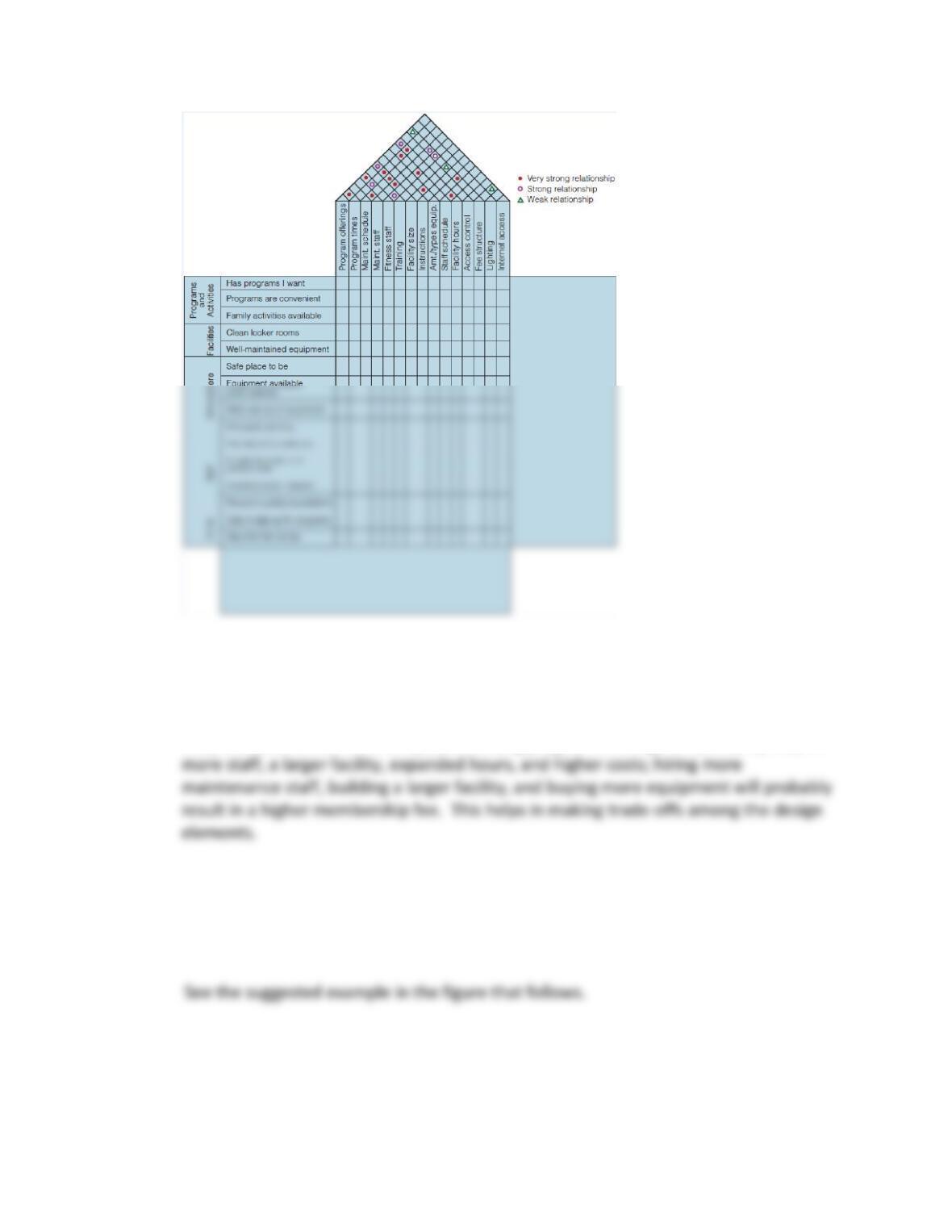
35. The following exhibit shows a partially completed House of Quality for a proposed fitness
center.
14
a. Examine the relationships in the roof of the House of Quality. Explain why they make
sense (or if you think they do not, explain why. How would this assessment help in
the design activity?
They do make sense. For example, increasing program offerings will probably require
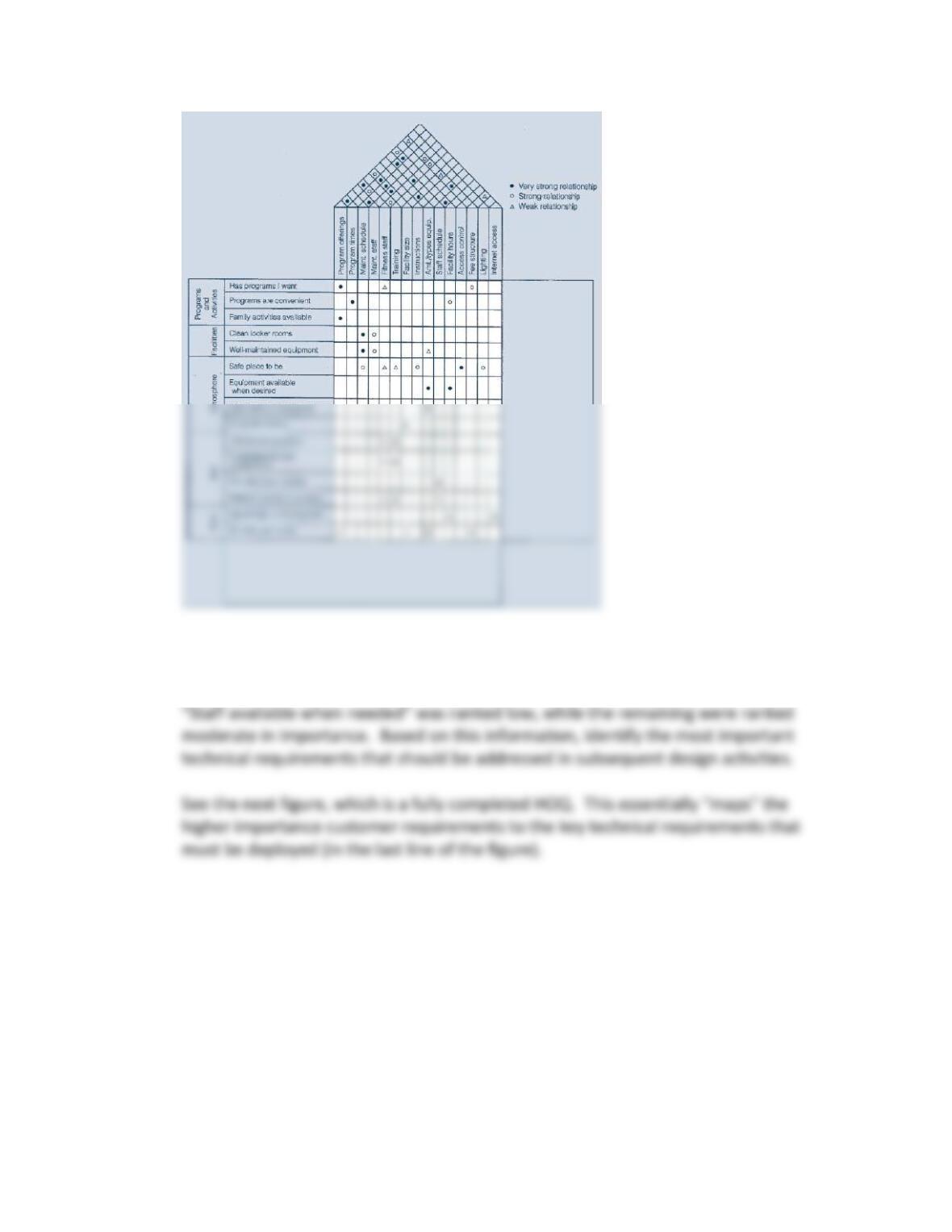
b. Complete the matrix in the body of the House of Quality. That is, examine each pair or
customer and technical requirements and determine if there is a very strong
relationship, a strong relationship, a weak relationship, or no relationship, and fill in
the appropriate symbols in the matrix.
15
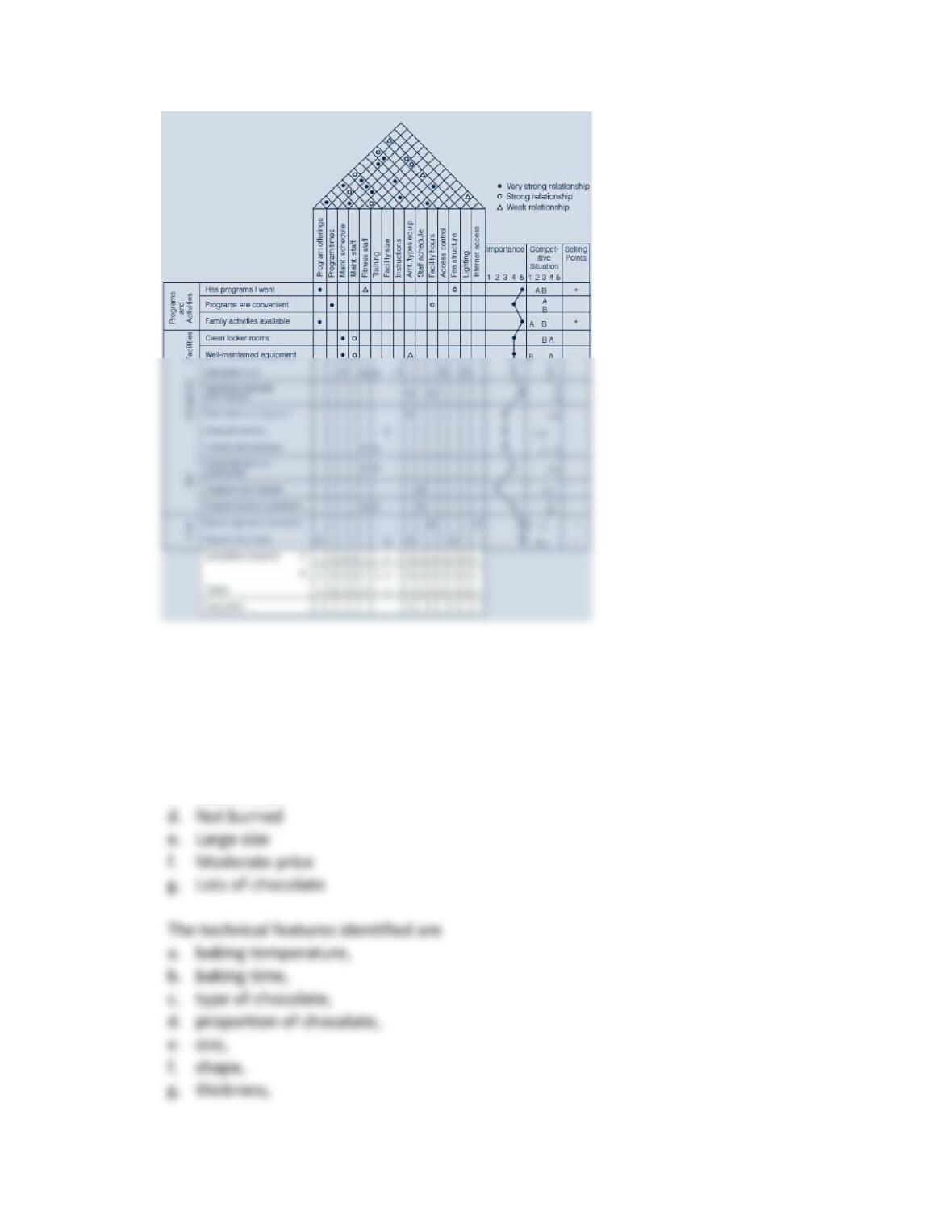
c. Suppose that the most important customer requirements identified through surveys
and focus groups are “Has programs I want,” “Family activities available,” “Equipment
available when desired,” “Easy to sign up for programs,” and “Value for your money.”
16
36. Build a House of Quality (showing only the Voice of the customer, Technical features,
Interrelationships, and Relationship matrix from Exhibit 5.2) for designing and producing
chocolate chip cookies. The voice of the customer consists of the following:
a. Soft
b. Fresh
c. Bittersweet
17
h. batch size, and
i. amount of preservatives.
Clearly explain your reasoning for your ratings of the interrelationships and relationship
matrix. Can you think of other technical features that should be included to better address
the voice of the customer?
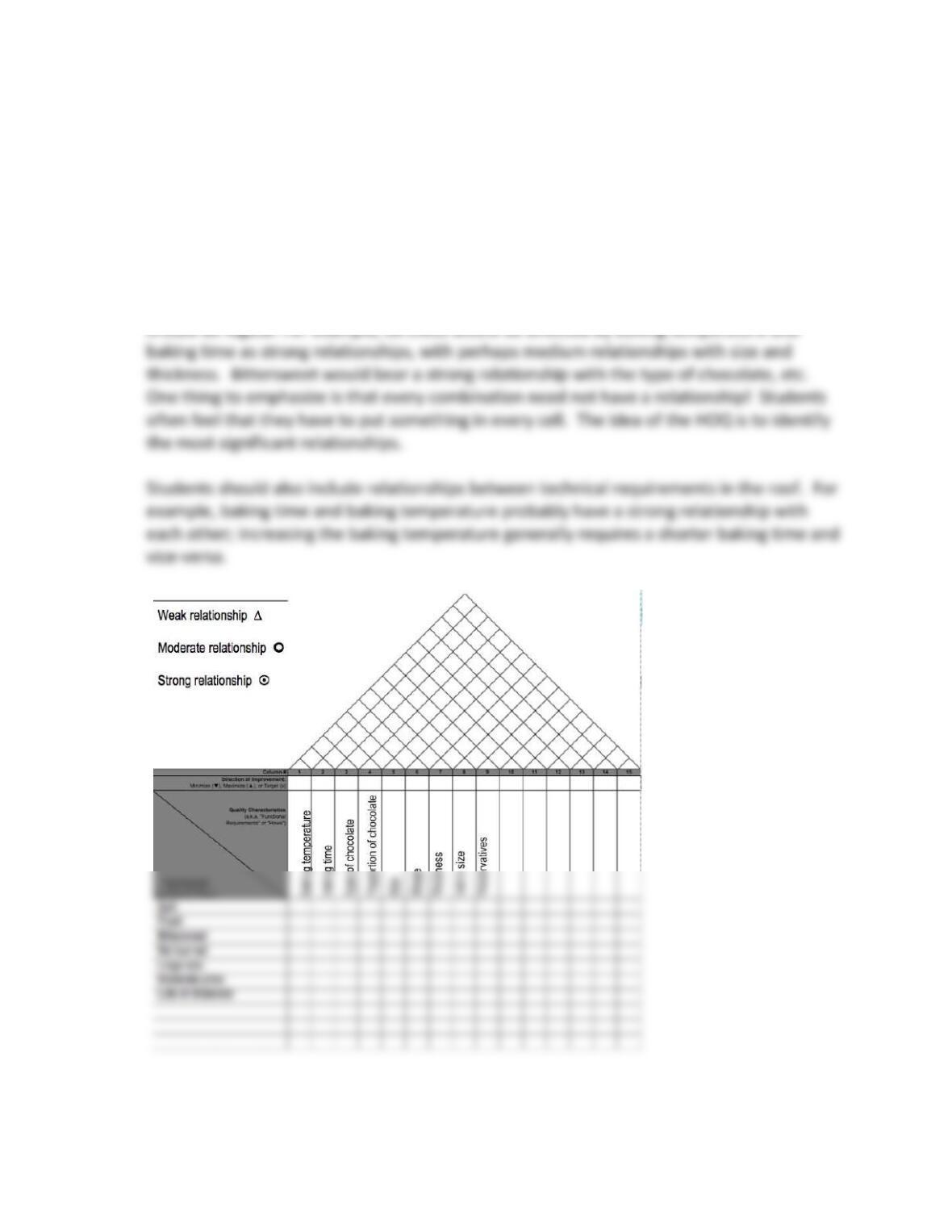
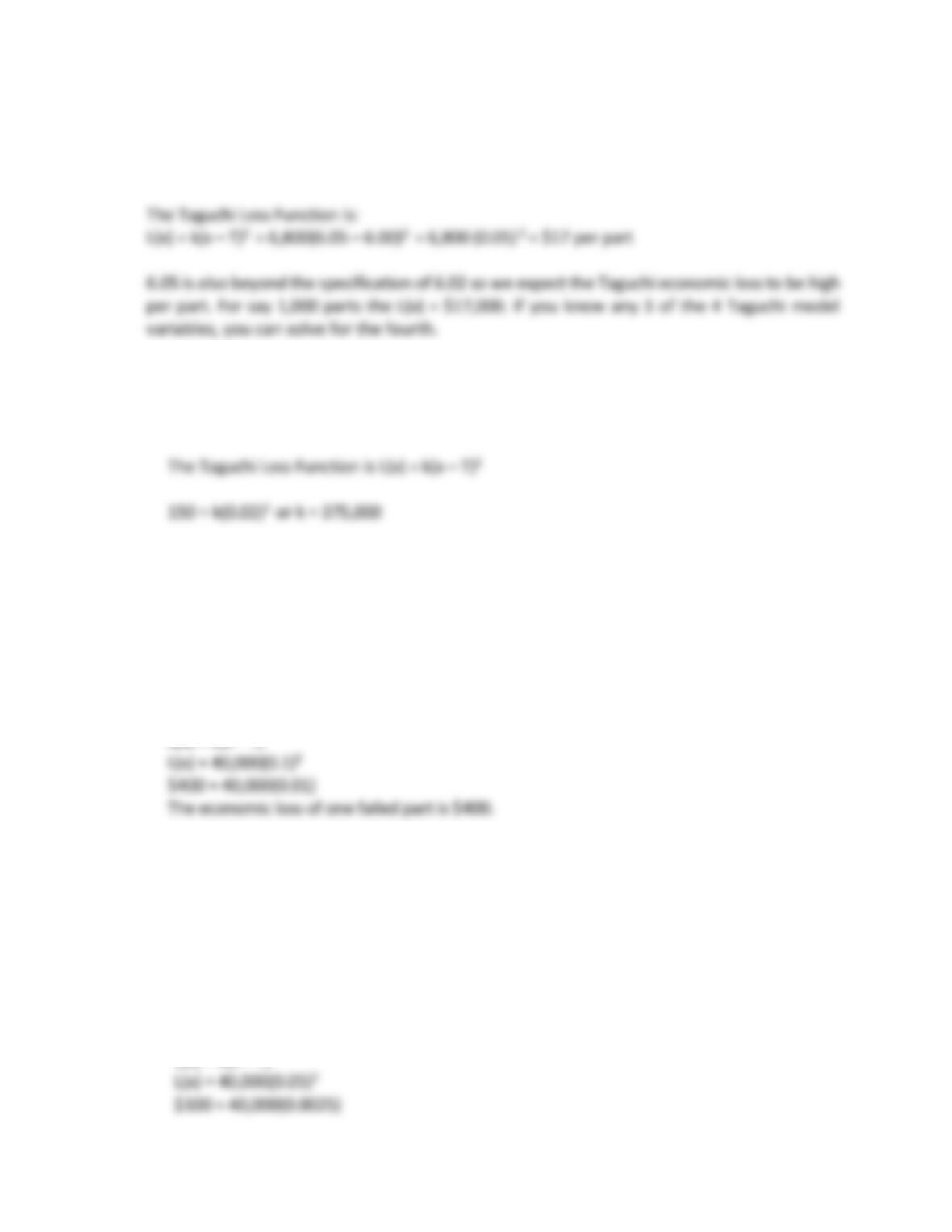
Below is a HOQ template that students can use (you can copy it and embed it on a
PowerPoint slide for class discussion). There is no one correct solution, but the answers
18
37. Suppose that the specification for a part (in inches) are 6.00 ± 0.02, and the Taguchi loss
function for some part is estimated to be L(x) = 6,800 (x – T)2. Determine the economic loss
if x = 6.05 inches.
38. A quality characteristic has a specification (in inches) of 0.200 0.020. If the value of the
quality characteristic exceeds 0.200 by the tolerance of 0.020 on either side, the product
will require a repair of $150. Develop the appropriate Taguchi loss function.
39. Vehicle transmission repairs for part number TAC45123 are costly to replace. A highly
skilled mechanic must disassemble the tranmission. If the part fails while it is in warranty,
the manufactuerer pays the full cost of the repair to the garage or dealer that did the
repair. The manufacturer uses the Taguchi loss function to set specification for the part
with k = 40,000. The dimensions for the part are 1.0 ± 0.10 centimeters.
(a) What is the economic value of one failed part?
(b) If the manufacturer of the part paid the full warranty cost on 1,862 failures last year
worldwide, what is the total econonmic cost of failure?
Total cost of failure = 1,862 failures x $400 per failure = $744,800
(c) If the manufacturer improved process and equipment capability so the part
specfications changed to 1.0 ± 0.05 centimeters, what is the econonmic cost of one
failure?
19
The economic loss of one failed part is $100
(d) Assuming failures were reduced by one half to 931 due to the more precise
specifications, what is the economic cost of failure?
(e) How much warranty cost is saved according to Taguchi esitmates by improving
specifications from ± 0.10 to ± 0.05?
Total savings = $744,800 – $93,100 = $651,700
40. Cameras Galore, Inc. wants the economic loss due to a failed part to be no more than $300
with a target (T) specification of 4.5 centimeters and a k= 12,000. Using the Taguchi loss
function, what is the value of x that meets these criteria?
L(x) = k(x – T)2
41. The manufacturing of compact disks requires four sequential steps. The reliability of each
of the steps is 0.96, 0.87, 0.92, and 0.89 respectively. What is the reliability of the
process?
42. The service center for a brokerage company provides three functions to callers: account
status, order confirmations, and stock quotes. The reliability was measured for each of
these services over one month with these results: 90%, 80% and 96% respectively. What
is the overall reliability of the call center?
Using Equation 5.2:
43. The system reliability for a two-component parallel system is 0.99968. If the reliability of
the first component is 0.992, determine the reliability of the second component.
Using Equation 5.3:
20
44. The system reliability for a three-component series system is 0.893952. If the reliability of
the first and third components is 0.96 and 0.97 respectively, determine the reliability of the
second component.
Using Equation 5.2:
45. Two cooling fans are installed in some laptop computers. Suppose the reliability of each
cooling fan is 0.98. What percent improvement in reliability does adding the second fan
provide?
Because this is a parallel system, reliability = 1 – (1 – 0.98)(1 – 0.98) = 1 – (0.02)(0.02) = 1 –
46. Given the following diagram, determine the total system reliability if the individual
component reliabilities are: A = 0.94, B = 0.82, and C = 0.87. (Hint: Use equations 5.2 and
5.3 and note that the reliabilities of the parallel components are different.)
First find the reliability of the parallel subsystem BC: Reliability = 1 – (1 – 0.82)(1 – 0.87) =
1 – (0.18)(0.13) = 1 – 0.0234 = 0.9766. This is the composite reliability of collapsing B and C into
one part.