
Page 1 of 14
Chapter 5: The Voice of the Customer
Chapter Outline
▪ Customer Driven Quality
▪ Customer-Relationship Management
▪ The “GAPS” Approach to Service Design
▪ Segmenting Customers and Markets
▪ Strategic Supply Chain Alliances between Customers and Suppliers
Overview
This chapter focuses on the “voice of the customer” in helping firms define their
quality programs. We know that customer service is important and there are many
reasons for this importance (from Kabodian, A., The Customer Is Always Right,
Cambridge, MA: Harvard University Press, 1996):
• Customers tell twice as many people about bad experiences as good experiences.
• A dissatisfied customer tells 8 to 10 people about the bad experience.
• Seventy percent of upset customers will remain your customer if you resolve the
complaint satisfactorily.
• It is easier to get customers to repeat than it is to find new business.
The chapter begins with a discussion of customer-driven quality and describes it as “a
proactive approach to satisfying customer needs by learning what customers want and
then designing products and services accordingly.”
The chapter discusses customer-relationship management and the “gap” approach to
service design. The focus of the chapter then shifts to a discussion on segmenting
customers and markets, strategic alliances between customers and suppliers, and
communicating with customers.
Page 2 of 14
Discussion Questions
1. Describe the difference between the internal and the external customers of a
business organization. Why is it important to distinguish between internal and
external customers?
On page 106, the text defines internal customers as “employees receiving goods or
services from within the same firm.” External customers are described as “the ultimate
2. Describe some of the potential pitfalls of customer-driven quality. Can you think
of any ways to avoid or lessen the impact of these potential pitfalls?
The text contrasts customer-driven quality with reactive customer-driven quality. The
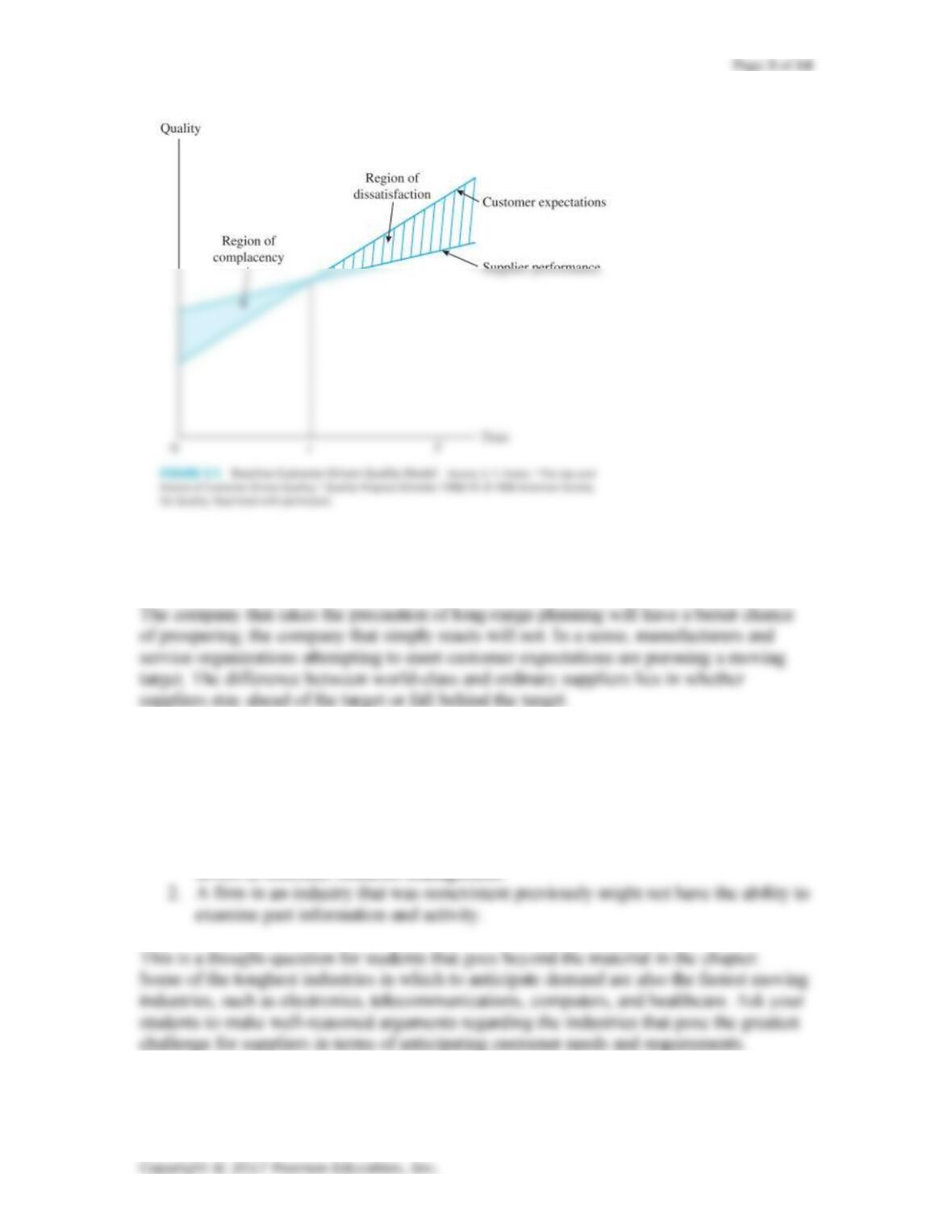
3. How can a supplier avoid settling into a reactive customer-driven quality (RCDQ)
mode?
4. What industries pose the greatest challenge for suppliers in terms of anticipating
customer needs and requirements? What are the distinctive characteristics of these
industries?
A couple of thoughts come to mind:
1. A company with an extremely small profit margin might think that it is unable to
invest in customer relations management.
5. When was the last time you purchased a product and were asked to provide the
Page 4 of 14
seller or manufacturer of the merchandise information about yourself, such as your
name, address, and telephone number? Did the request for information seem
intrusive to you? Did you have any idea why you were being asked for the additional
information?
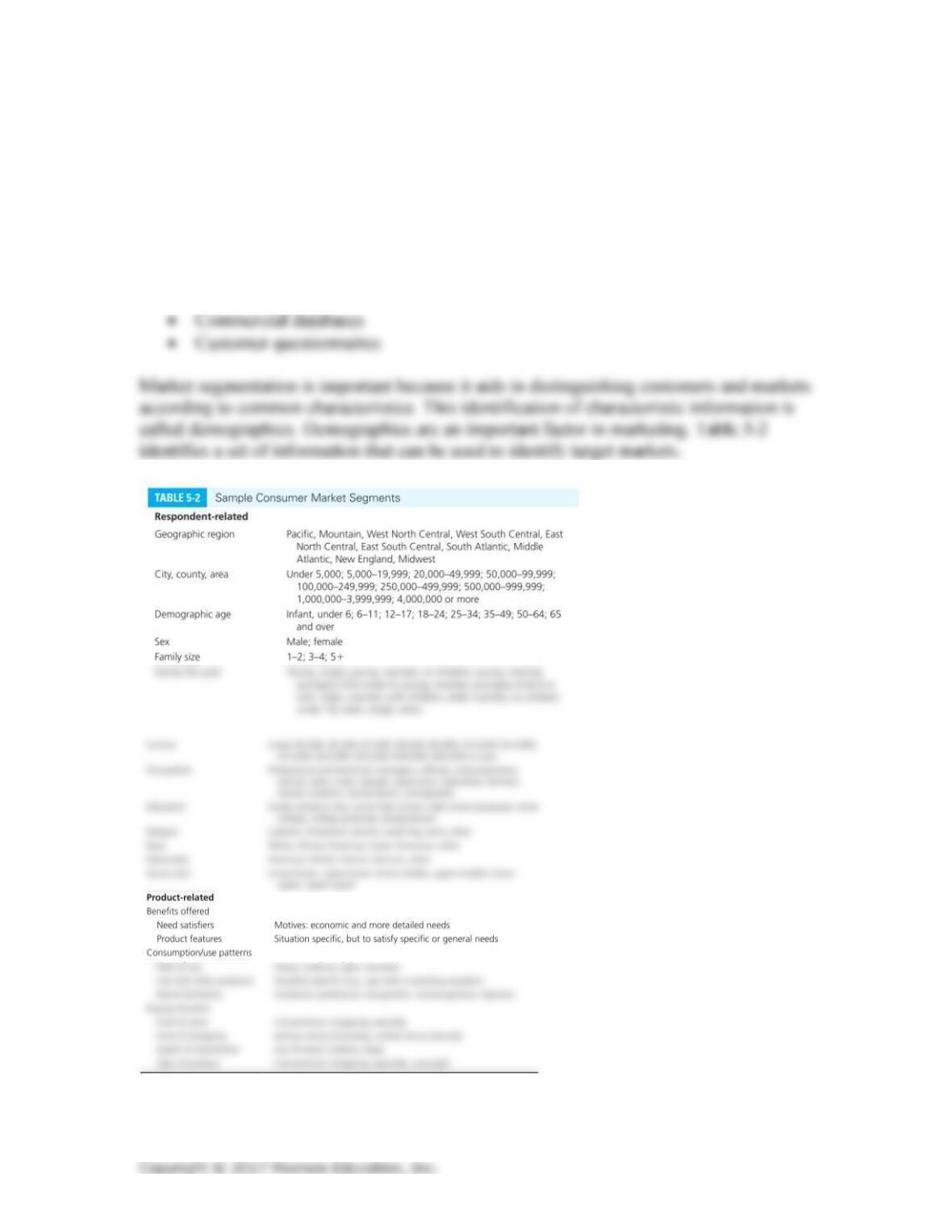
The Baldrige criteria emphasize identifying data segmentation of customers and customer
markets. This information can be gathered in many ways. The text lists:
• Industry groups
• The Internet
6. Reflect on the last time that you complained to the manager of a store, restaurant,

Page 5 of 14
or other business about something that dissatisfied you. Was the complaint resolved
to your satisfaction? Did the complaint-resolution process tell you something about
the quality of the organization that you were dealing with?
7. Can you think of an example of an experience that you have had with a firm in
which the difference between the espoused and the actual level of service provided
was great in either a positive or negative way? If so, did this experience influence
your perception of the business? Has this experience affected your willingness to do
business with this company again?
Today, many companies outsource their customer service. Quite a few brought the
customer service organizations back when problems surfaced. Specifically, Dell
Computers moved their customer service to India. However, problems with the move
forced Dell to look at this decision.
1
Good news for all those who worry about outsourcing—Dell’s experience with an
8. Describe the basic concept behind strategic alliances. In what ways can strategic
alliances facilitate a firm’s quest for quality?
The purpose of a strategic alliance is to provide a suppler and a buyer the opportunity to

Page 6 of 14
9. Describe some great service experiences and some horror stories that you have
experienced. What were the variables that in your mind differentiated between the
great and the horrible companies?
The Yugo comes to mind as an example. According to Wikipedia:
2
10. Suppose that the marketing department of a large manufacturing firm decided
to adopt the motto, “We will build a product to suit any buyer’s needs.” What type
of difficulties could this philosophy impose on the operations department? Through
what process could the marketing department and the operations department
determine which customers add the greatest advantage and profits over time?
There is a balancing act here: on one side is the demand for customer satisfaction;
however, on the other hand is the fact that a degree of control must be made on the
11. Describe the basic idea behind a focus group. Are focus groups an effective way
of gathering data about customer preferences and tastes?
The text defines a focus group as actively solicited customer feedback. Focus groups
gather customers and solicit their ideas and reactions to products or concepts. Focus

Page 7 of 14
12. Should focus group settings be formal and highly structured? Explain the
rationale for your answer.
The purpose of a focus group is to get people to share their opinions. A highly structured
13. How can firms gain an overall understanding of the market segments they
serve? Please make your answer as substantive as possible.
On page 108, the text states that much of the focus in marketing today is on maintaining
the existing customer base that a firm has established. For this to be effective, a firm must

Page 8 of 14
14. Why is it important that the facilitator of a focus group not bias the discussion in
any manner? How could the results of a focus group analysis be tainted if the
facilitator biased the discussion?
Any study, be it a statistical sample or a focus group, can be swayed by the questions
being asked. A question such as “Is this product worth its high cost?” would immediately
plant the idea that the product is expensive into the potential customer’s mind. The
textbook briefly covers this on page 118, with the statement:
15. Describe a situation in which the use of an Internet customer response might be
appropriate.
An Internet customer response might be appropriate when a firm is interested in
collecting passively solicited customer feedback about its customers. A well-constructed
Internet inquiry can provide a wealth of information. In today’s environment, email
addresses are almost as common as street addresses.

Page 9 of 14
16. Describe the difference between actively solicited customer feedback and
passively solicited customer feedback. Which type of feedback results in a lower
rating of quality? Explain why.
Active data collection is initiated by the supplier of the good or service. The three most
common forms are telephoning customers, conducting focus groups, and sending out
17. Describe the difference between hard data and soft data. What are the unique
advantages of each type of data in terms of obtaining information about customer
perceptions?
Soft data tends to be qualitative or non-measurable. Soft data includes information such
as phone contacts, focus groups, and survey results. Hard data is quantitative or
18. Are customer surveys better suited for accessing customer perceptions in
services or manufacturing? Explain your answer.
The text identifies customer surveys as an active data gathering technique. The text also
says that customer surveys are prone to bias. On Page 118, the statement is made:
The customer service survey is an important tool for determining customer perceptions of

Page 10 of 14
19. Explain the concepts of reliability and validity. Why is it important that survey
instruments be both reliable and valid?
Figure 5-11 illustrates the distinction between reliability and validity.
20. Why is it important to have open-ended questions in survey instruments?
“Do you like this shirt in blue?” or “What color would you like this shirt to be?” The first
question forces either a yes or no answer, and little information is gained. An open-ended
question allows the respondent to provide much more information. “What color would
you like this shirt to be?” allows the subject the freedom to respond with more questions.
The answers might me: “What colors do you have?” or “Do you have robins–egg blue?”
On page 122, the text says:

Case 5.1: Customer Quality Feedback at Apple Computer
Case Questions:
1. Explain how Apple’s Customer Quality Feedback program helps the firm hear
the voice of the customer?
Apple’s Customer Quality Feedback (CQF) program allows the engineers to “keep their
fingers on the pulse” of the consumer. The case discusses the members that are selected
as:
2. In your opinion, what are the most important aspects of Apple’s program?
Would you make any changes or modifications?
The case provides an excellent answer to this question:
The overriding objective of the program is to incorporate customer input into the
development of Apple products before they are shipped, rather than waiting for
3. If you were an Apple user, would you enjoy participating in the Customer Quality
Feedback program? Why or why not?
Most students will probably suggest that Apple users would enjoy participating in the
program. Participating in the program would provide an Apple enthusiast the opportunity

Case 5.2: Chaparral Steel: Achieving High Quality through a
Commitment to Both External and Internal Customers
Case Questions:
1. For a company like Chaparral Steel, why is a commitment to both its internal and
external customers necessary?
A commitment to its external customers is the most obvious. Chaparral relies on its
external customers to buy its products and keep the company in business. External
customers are the source of income for the firm. If there is no commitment to them, the
company might very well cease to exist.
Internal customers keep the company alive on a day-to-day basis. In the plant, the text
explains this as:
2. As mentioned in the case, Chaparral periodically sends front-line employees on
trips to visit the manufacturing sites of the company’s customers. In your opinion, is
this a justifiable expense? Why or why not?
Most students will argue that this is a justifiable expense. Not only do the trips give
3. Compare Chaparral’s level of employee commitment to your current employer or
a recent employer.
While there is no obvious answer to this question, it does provide the ability to get a class

Page 13 of 14
Suggested Answers to End of Chapter Problems
1. One of the problems encountered by universities is developing reliable and valid
course evaluation survey instruments. Choose a class you took last semester. For
that class, identify two dimensions relative to course delivery. Now, develop five
valid survey items for each of your two dimensions. Defend why you think these
items are valid.
The answers will vary by student. Here is an example of one course delivery choice
response:
Dimension: Instructor Preparedness
The instructor was prepared for class.
The instructor planned activities for class that were relevant to the subject matter covered.
2. For the class you chose in Problem 1, develop five valid critical-incident survey
items for each dimension. Defend why you believe your items are valid.
Answers will vary. Here we provide an example relative to Instructor Preparedness:
Prior to the class period, the instructor put the needed materials on the Blackboard.
The instructor arrived at class on time with the needed materials.
The lecture was well planned.
The lecture related well to the assigned reading material.
The instructor handed our papers back in a timely manner.

3. A manager for the Golden Bear publishing company found out that you are
taking quality management. The manager desires to improve her supply chain
performance by employing you as a consultant to provide quality improvement
training to the supply chain employees. As a result, you now have to create a survey
instrument to gauge the effectiveness of your training sessions. Choose four
dimensions relative to your quality management training and develop five valid
survey items for each dimension. Defend why you feel your survey items are valid.
Student answers may vary.
4. For your performance dimensions in Problem 3, develop five critical incident
survey items for each dimension. Explain how you would demonstrate that these
items are reliable.
Using the above two answers as a guide, the students should develop a short training
survey. Perhaps you could go to your college outreach department and obtain a copy of