
1
CHAPTER 5
Process Focus
Teaching Notes
This chapter delves into the fundamental concepts of processes and process management: process
design, control, and improvement. We also discuss quality aspects of supply chain management.
Key objectives for this chapter should include:
• To define a process as a sequence of linked activities that is intended to achieve some result,
such as producing a good or service for a customer within or outside the organization.
Generally, processes involve combinations of people, machines, tools, techniques, materials,
and improvements in a defined series of steps or actions.
• To introduce the concept of process management, which involves planning and
administering the activities necessary to achieve a high level of performance in value
creation and support processes, including their design, control, and improvement.
• To define value-creation processes (sometimes called core processes) as those most
important to “running the business” and maintaining or achieving a sustainable competitive
advantage. These processes frequently relate to an organization’s core competencies and
strategic objectives.
• To understand that projects are important value-creation processes in many organizations.
Projects generally cut across organizational boundaries and require the coordination of many
different departments and functions. Project management involves all activities associated
with planning, scheduling, and controlling projects.
• To appreciate the importance of Support processes which are those that are most important
to an organization’s value-creation processes, employees, and daily operations. They provide
infrastructure for value-creation processes but generally do not add value directly to the
product or service.
• To review a number of leading process management practices related to value creation and
support processes in closely coordinated, well structured, and highly effective product design
and development systems.

Process Focus 2
whereas, in pure service environments, processes are often designed around the five key
service dimensions: reliability, assurance, tangibles, empathy, and responsiveness.
• To understand that pure service processes are frequently designed around the five key service
dimensions of: reliability, assurance, tangibles, empathy, and responsiveness. Designing a
service essentially involves determining an effective balance of physical facilities, process
• To impress on students that as customer needs and expectations change, organizations must
design processes that are increasingly agile. Agility is a term that is commonly used to
characterize flexibility and short cycle times. Flexibility refers to the ability to adapt quickly
and effectively to changing requirements. It might mean rapid changeover from one product
to another, rapid response to changing demands, or the ability to produce a wide range of
customized services.
• To define Poka-yoke (POH-kah YOH-kay) as an approach for mistake-proofing processes
using automatic devices or methods to avoid simple human error. It might consist of
designing potential errors out of a process, identifying potential defects and stopping a
process before the defect is produced, or finding defects that enter or leave a process.
• To learn that control is the activity of ensuring conformance to requirements and taking
corrective action when necessary to correct problems and maintain stable performance. The
four components of a control system: (1) a standard or goal, (2) a means of measuring
accomplishment, (3) comparison of results with the standard to provide feedback, and (4) the
ability to make corrections as appropriate throughout a manufacturing or service process.
• To emphasize that control is the foundation for organizational learning. Many organizations,
after analyzing and solving a problem, conduct an after-action review, or debriefing, that
consists of understanding what was supposed to happen, what actually happened, why there
might have been a difference, and what could be learned from the experience.
• To encourage understanding and development of documented control procedures, which are
• To explore the concept of continuous improvement which refers to both incremental
changes, which are small and gradual, and breakthrough improvements, which are large and
rapid. Process improvement should be viewed as an opportunity, not simply a reaction to
problems. Kaizen, the Japanese philosophy of quality improvement, may be used in all areas
of business to make small, frequent, and gradual improvements over the long term. A kaizen
blitz, which is an intense and rapid improvement process in which a team or a department
throws all its resources into an improvement project over a short time period, may sometimes
be used, as opposed to traditional kaizen applications, which are performed on a part-time
basis.

Process Focus 3
breakthrough improvement; and 3) reengineering, the fundamental rethinking and radical
redesign of business processes to achieve dramatic improvements in performance.
• To explore the concepts of suppliers, supply chain management, supplier certification, and
supplier performance evaluation. Suppliers include not only companies that provide
materials and components, but also distributors, transportation companies, and information,
healthcare, and education providers. Supply chain management is based on three guiding
ANSWERS TO QUALITY IN PRACTICE FEATURES
K&N Management, Inc.
1. Review the Quality Profile at the beginning of Chapter 3. How do some of the things that
K&N does to capture the “voice of the customer” impact the steps taken in product and
process design?
K&N Management uses innovation and technology to create product offerings that meet or exceed
guest requirements. Guests can access store information and events via Web sites and social media,
as well as through innovative approaches such as an interactive system at each Mighty Fine location.
Feedback is collected with an iPad that administers short surveys around the main meal periods and
2. What is the purpose of process management at K&N, and how important are team members
in ensuring that process management activities are implemented flawlessly and seamlessly?
Customers require high-quality food served quickly and accurately by friendly team members
(K&N’s terminology for their employees) in a clean environment. Thus, the key purpose of process
management at K&N is to meet customer requirements. This is carried out by designing well-
defined processes with clearly-defined requirements and measurements. K&N uses a comprehensive
process for process management that incorporates design, control, and improvement.
Team members are very important to K&N as they apply lean principles and remove non-

Process Focus 4
Building Japanese Quality in North America
1. Discuss how the processes designed into the Cambridge plant support the achievement of
high product quality. What specific aspects of the process relate to design, control, and
improvement?
The key features designed into Lexus’s processes to support achievement of high product quality can
be summarized as:
1. Spottless Floors and Workspace
2. Bright colors and great lighting
3. Removal of “Hard” accessories and clothing
4. Personal Weld Testing
5. Initialing (accountability)
6. Dirt and Debris Prevention in Paint room
7. Quality Gates
8. Occasional Semi-Surgical Inspections
9. Prevention of Damage by removing doors
10. Arm to sit on when interior installation
11. Rain test
12. Rigorous mechanical and automotive performance testing
13. All parts from the same whole (consistency)
14. Individual can stop entire process for error
Design starts with training workers on the importance of using their skills and knowledge to make a
quality product. Skills are developed via cross-training on various jobs. Knowledge is used to invent
new kaizens. In addition, systems support comes in the form of visible production status systems and
production line status warnings that tell if the line has been stopped and help to keep production
moving smoothly and efficiently.
Control is achieved through policies, such as no watches, rings, or riveted pants on the
production floor, empowerment of workers to stop the line for quality problems, making each
worker a quality control inspector, and providing information for on-the-spot decision-making and
Here is a good summary of how their approaches fall into the three areas of process
management as proposed by one of our students:
Design
(Inputs: materials,
technology, work methods,
trained workforce)
Control
(Maintaining consistency in
output by assessing
performance & taking
Improvement
(continually seeking higher
levels of performance:
reduced variation, higher
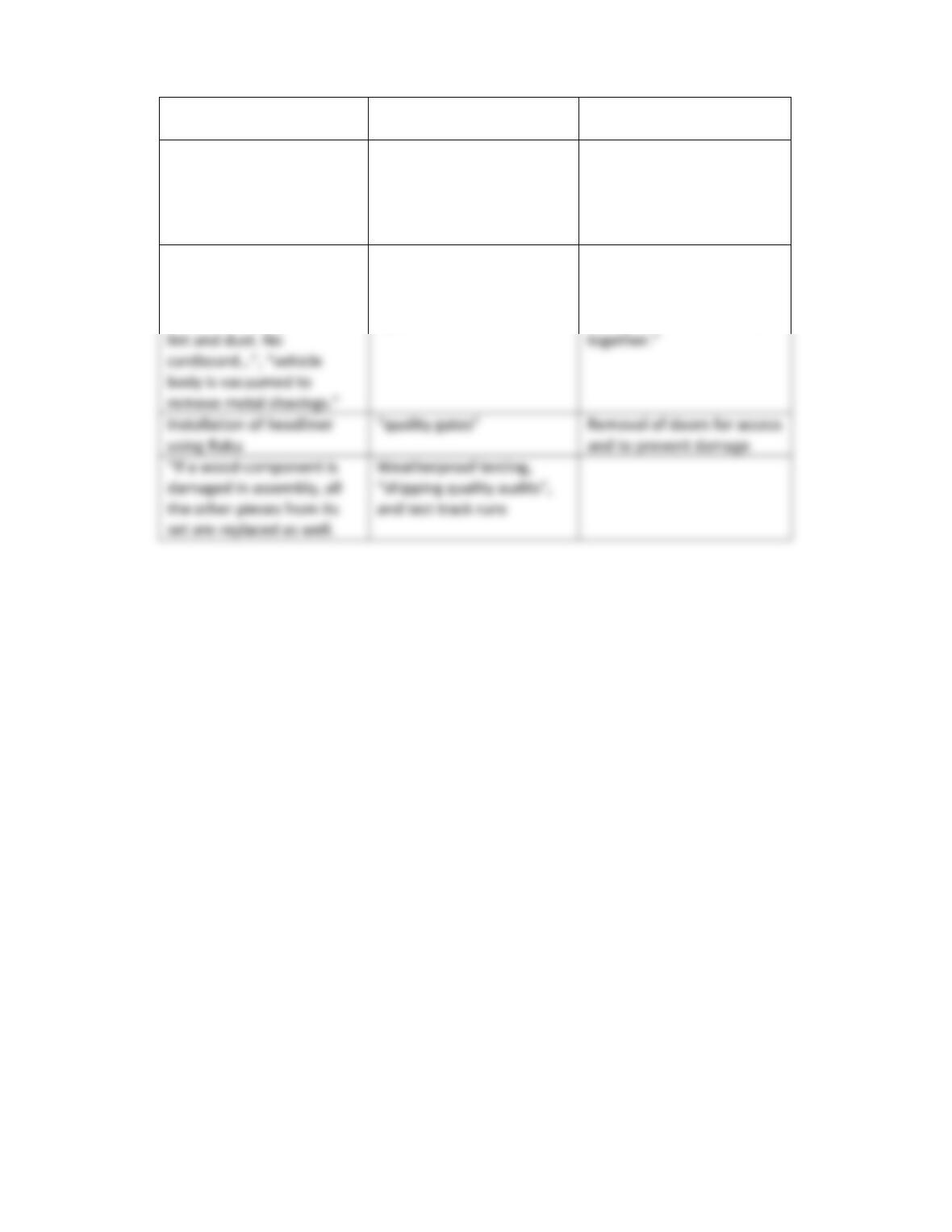
Process Focus 5
corrective action)
yields, fewer defects,
smaller cycle times)
“Teamwork … Teaching
workers about every stage
of the production process”
“Each worker is also a
quality control inspector of
his or her own work and
that of … fellow team
members”
Kaizen philosophy
Paint area: “airlock”,
“Downdrafts and grated
walkways with water
beneath catch particles of
“Pulling a cord allows team
members to stop the
line…” and “towers of
lights”
Cartridges of paint: “allows
for mixing colors on the line
– no longer must a batch of
blue or red vehicles be run
2. What lessons or best practices might be learned and applied to other companies (outside of
the automotive industry)?
The lessons and practices that might be learned and applied to other companies, even outside the
automotive industry include:
• Don’t be stingy with worker training.
• Build visual systems to help workers and managers keep track of progress.
• Empower workers to do a quality job.
• Pay attention to small details that may affect quality (worker’s jewelry and clothing,
small blemishes that may affect later processing, etc.)
• Design, control, and improvement quality are all important parts of the quality system.
One of our students suggested the following:
The fast food industry can incorporate the concept of interior design and cleanliness into
their kitchen. The industry focuses a lot of financial resources into the public dining. The
kitchen that is visible to consumers contains harsh metals, dark tinged microwaves and
fryers, and the kitchen staff often appear unkempt due to the high temperatures in the area.
Imagine as a customer looking to a fast food restaurant’s kitchen area that has non-porous,
decorative counter tops and uses color to create an environment of pride in the workplace.
Updated temperature control mechanisms to ensure employee comfort can be maintained as
well as their outward appearance. Employees are motivated to provide an excellent product

Process Focus 6
to the customer and will enjoy the experience of working at the restaurant if as much time
and money is spent upgrading their workspace as it is the public areas.
United States Post Office (USPS) could incorporate quality testing protocols to track mail
from point of receipt to delivery. The post office could initially focus on areas where they
receive the most complaints. This would allow them to detect processes within the system
where mail is most likely to be damaged or lost. USPS could incorporate Lexus’ concept that
every employee is a quality control inspector for his job and other team member’s duties to
help eliminate errors and defects as mail moves through the system and allow the employee
to stop the “line” when a defect is spotted. The USPS could incorporate a kaizen philosophy
into its processes to empower employees to make suggestions and propose innovations to
perform their tasks more efficiently and effectively.
ANSWERS TO REVIEW QUESTIONS
1. What is a process? Provide several examples.
A process is a sequence of linked activities that is intended to achieve some result, such as
producing a good or service for a customer within or outside the organization. Generally, processes
involve combinations of people, machines, tools, techniques, materials, and improvements in a
defined series of steps or actions. Examples include: Common types of production processes include
machining, mixing, assembly, filling orders, or approving loans. However, nearly every major
activity within an organization involves a process that crosses traditional organizational boundaries.
For example, an order fulfillment process might involve a salesperson placing the order; a marketing
representative entering it on the company’s computer system; a credit check by finance; picking,
packaging, and shipping by distribution and logistics personnel; invoicing by finance; and
installation by field service engineers. A process perspective links together all necessary activities
and increases one’s understanding of the entire system, rather than focusing on only a small part.
2. State several key process-focused practices for quality management.
Several key process-focused practices for quality management include:
• Identify vital work processes that relate to core competencies and deliver
customer value, profitability, organizational success, and sustainability.

Process Focus 7
• Determine key work process requirements, incorporating input from
customers, suppliers, partners, and collaborators.
• Design and innovate work processes to meet all requirements, incorporating
new technology, organizational knowledge, product excellence, the need for
agility, cycle time reduction, productivity, cost control, and other efficiency
and effectiveness factors.
• Seek ways prevent defects, service errors, and rework and minimize costs
associated with inspections, tests, and process or performance audits.
• Implement work processes and control their day-to-day operation to ensure
that they meet design requirements, using appropriate performance measures
along with customer, supplier, partner, and collaborator input as needed.
• Improve work processes to achieve better performance, reduce variability,
improve products and services, and keep processes current with business
needs and directions, and share improvements with other organizational units
and processes to drive organizational learning and innovation.
• Incorporate effective process management practices in the overall supply
chain.
3. Define process management and its three key activities. Why is process management
important to any business?
Process management involves planning and administering the activities necessary to achieve a high
level of performance in a process, identifying opportunities for improving quality and operational
performance, and ultimately, customer satisfaction. Processes typically fall into two categories –
4. Discuss how process management is addressed in the ISO 9000 criteria.
ISO 9000 deals with process management activities (in fact, the entire standards are focused on an
organization’s ability to understand, define, and document its processes.) For example, one of the
requirements is that organizations plan and control the design and development of products and
manage the interfaces between different groups involved in design and development to ensure
effective communication and clear assignment of responsibility. The standards also address the
5. Why is it important that processes be repeatable and measurable?

Process Focus 8
Processes need to be repeatable (the process must recur over time) so that enough data can be
gathered to show useful information. They must also be measurable so that patterns about the
process performance can be made clear. This ability to predict performance then leads to ability to
detect out-of-control conditions and helps in the search for improvements. Meeting these two
conditions ensures that sufficient data can be collected to reveal useful information for evaluation
and learning that lead to improvement and maturity.
6. Explain the differences between value-creation and support processes. Provide some
examples of each.
There are two major categories of processes – value creation processes and support processes. Four
major sub-processes of those categories are: 1) design processes, 2) production/delivery processes, 3)
support processes, 4) supplier and partner processes.
Value creation processes (sometimes called core processes) are those important to “running
the business” and maintaining or achieving a sustainable competitive advantage. They drive the
creation of products and services, are critical to customer satisfaction, and have a major impact on
the strategic goals of an organization. Value creation processes typically include design,
production/delivery, and other critical business processes. The ultimate value of the product, and
hence, the perceived quality to the consumer, depends on both these types of processes.
Support processes are those that are important to an organization’s value creation processes,
employees, and daily operations. They provide infrastructure for value creation processes but
7. Describe some organizations that use projects as their primary value-creation processes.
How might the project management process differ in such organizations, in comparison with
firms or departments that only use projects on an ad hoc or as-needed basis?
In many companies, value creation processes take the form of projects – temporary work structures
that start up, produce products or services, and then shut down. Some organizations are project–
focused because of the nature of their work. They tend to deliver unique, one-of-a-kind products or
services tailored to the specific needs of an individual customer. Others simply use projects as
8. What is process mapping? Why is it important in process design?
Process Focus 9
Basically, a process map is a flowchart. To develop a process map, AT&T recommends steps,
including:
1. Begin with the process output and ask, “What is the last essential subprocess that produces
the output of the process?”
2. For that subprocess, ask, “What input does it need to produce the process output?” For each
9. List important questions that should be asked when analyzing process maps to create a
more effective design.
Once a process map has been created, the following questions may be asked during the improvement
stage:
• Are the steps in the process arranged in logical sequence?
• Do all steps add value? Can some steps be eliminated and should others be added in order to
improve quality or operational performance? Can some be combined? Should some be
reordered?
• Are capacities of each step in balance; that is, do bottlenecks exist for which customers will
incur excessive waiting time?
• What skills, equipment, and tools are required at each step of the process? Should some steps
be automated?
For example, to determine if a process step has value, more detailed questions may be asked, such
as:
• Would the customer notice a loss of value if this step were eliminated?
• Would the product or service be obviously incomplete without this step?
• If you were forced to complete the product or service on an emergency basis, is this step too

Process Focus 10
10. Explain the differences between designing processes for manufactured goods and services.
How should the design of service processes be approached?
The fundamental differences between manufacturing and service processes deserve special attention.
This is especially important because support processes are basically services, so manufacturing firms
invariably are also required to become involved in service delivery. First, the outputs of service
processes are not as well defined as are manufactured products. Another way to think of this is that
manufactured goods are tangible, service goods are (at least to some degree) intangible. Second,
most service processes involve a greater interaction with the customer, often making it easier to
identify needs and expectations. On the other hand, customers often cannot define their specific
11. Why is agility important for processes in today’s business environment?
As customer needs and expectations change, organizations must design processes that are
increasingly agile. Agility is a term that is commonly used to characterize flexibility and short cycle
times. Flexibility refers to the ability to adapt quickly and effectively to changing requirements. It
might mean rapid changeover from one product to another, rapid response to changing demands, or
the ability to produce a wide range of customized services. Flexibility might demand special
strategies such as modular designs, sharing components, sharing manufacturing lines, and
specialized training for employees. It also involves outsourcing decisions, agreements with key
12. Why do people make inadvertent mistakes? How does poka-yoke help prevent such
mistakes?
People make inadvertent mistakes for a number of reasons, including the following:

Process Focus 11
• Forgetfulness due to lack of concentration
• Misunderstanding because of the lack of familiarity with a process or procedures
• Poor identification associated with lack of proper attention
• Lack of experience
• Absentmindedness
13. Describe the types of errors that service poka-yokes are designed to prevent.
Service poka-yokes are designed to prevent two major classes of errors: server errors and customer
errors. Server errors result from the task, treatment, or tangibles of the service. Customer errors
occur during preparation, the service encounter, or during resolution.
14. Define process control and tell why it is important.
Processes control has three requirements: 1) the owner has to have a means of knowing what is
expected of him or her through clear instructions and specifications; 2) he/she must have a means of
determining their actual performance via inspection or measurement; 3) they must have a means of
making corrections if they discover a variance between what is required (specification) and their
15. Describe the four elements of any control system.
The four elements of any control system are (1) a standard or goal, (2) a means of measuring
accomplishment, (3) comparison of results with the standard to provide feedback, and (4) the ability
to make corrections as appropriate.
16. Explain the concept of after-action review.
An after-action review consists of asking four basic questions:
1. What was supposed to happen?
2. What actually happened?
3. Why was there a difference?
4. What can we learn?
Process Focus 12
Thus, rather than simply correcting unacceptable events, the focus is on preventing them from
occurring again in the future.
17. How is process control generally implemented in manufacturing and in services? Describe
the similarities and differences.
Effective process control systems include documented procedures for all key processes; a clear
understanding of the appropriate equipment and working environment; methods for monitoring and
controlling critical quality characteristics; approval processes for equipment; criteria for
workmanship, such as written standards, samples, or illustrations; and maintenance activities.
Documented control procedures are usually written down in a process control plan. Of particular
importance in manufacturing is the ability to trace all components of a product back to process
18. What is continuous improvement? Provide several examples of the types of improvements
on which organizations should focus.
Continuous improvement refers to both incremental changes, which are small and gradual, and
breakthrough improvements, which are large and rapid. Continuous improvement is one of the
foundation principles of total quality. It is an important business strategy in competitive markets
because
• Customer loyalty is driven by delivered value.
• Delivered value is created by business processes.
19. List the four stages of a learning cycle. Why is organizational learning important?
Process Focus 13
Real improvement depends on learning, which means understanding why changes are successful
through feedback between practices and results, leading to new goals and approaches. A learning
cycle consists of four stages:
1. Planning
2. Execution of plans
3. Assessment of progress
4. Revision of plans based upon assessment findings
The concept of organizational learning is not new. It has its roots in general systems theory and
systems developed in the 1950s and 1960s, as well as theories of learning from organizational
psychology. Professor Peter Senge, the major advocate of the learning organization movement. He
20. Explain the concepts of kaizen and a kaizen event. How are they similar? How are they
different?
Kaizen, the Japanese philosophy of quality improvement, may be used in all areas of business to
make small, frequent, and gradual improvements over the long term. A kaizen event, which is an
21. How can reductions in cycle time lead to improvements in processes?
Cycle time refers to the time it takes to accomplish one cycle of a process – for instance, the time a
customer orders a product to the time that it is delivered, or the time to introduce a new product.
22. What is breakthrough improvement? How does it differ from kaizen?
Continuous improvement refers to both incremental changes, which are small and gradual, and
breakthrough improvements, which are large and rapid. Breakthrough improvement refers to
discontinuous change, as opposed to the gradual, continuous improvement philosophy of kaizen.

Process Focus 14
Breakthrough improvements result from innovative and creative thinking; often these are motivated
by stretch goals, or breakthrough objectives. Stretch goals force an organization to think in a
radically different way and to encourage major improvements as well as incremental ones.
Prior to the development of the TQ approach, most U.S. managers simply maintained
processes until replaced by new technology. Japanese managers generally focused on continually
improving products and processes through a process called kaizen. Often in the West, quality
improvement (sometimes mistakenly called kaizen by those who don’t really understand its
philosophy) is viewed as simply making improvements in product quality. In the kaizen philosophy,
improvement should take place in all areas of business—cost, meeting delivery schedules, employee
23. What is a stretch goal? How can stretch goals help an organization?
Stretch goals, also called breakthrough objectives, are urgent, short-term goals for improving products
or services which force a company to think radically, different, to encourage major improvements and
well as incremental ones. Such goals apply to all areas of a company. When a goal of 10 percent
improvement is set, managers or engineers can usually meet it with some minor improvements.
24. Define benchmarking and list its benefits.
Benchmarking is measuring an organization’s process performance against that of best–in–class
organizations, no matter what the industry, determining how they achieve their performance levels, and
using the information to improve on the organization’s own targets, strategies, and implementation.
Benefits include:
• The best practices from any industry may be creatively incorporated into a company’s
operations.
Process Focus 15
• Benchmarking is motivating. It provides targets that have been achieved by others.
Resistance to change may be lessened if ideas for improvement come from other industries.
• Technical breakthroughs from other industries that may be useful can be identified early.
Benchmarking broadens peoples’ experience base and increases knowledge. To be effective, it must
be applied to all facets of business. However, mere competitive comparison is not adequate for
25. What is reengineering? How can TQ principles assist in reengineering efforts?
Reengineering has been defined as “the fundamental rethinking and radical redesign of business
processes to achieve dramatic improvements in critical, contemporary measures of performance, such as
cost, quality, service, and speed.” Reengineering‘s incremental improvement and breakthrough
improvement are not incompatible, but rather are complementary approaches that fall under the TQ
26. Explain the factors associated with supplier selection.
The first step in supplier selection is to clarify the most important product requirements. After these are
established, organizations need processes for identifying suppliers that can provide the needed goods or
27. Why is it important to establish strong partnering relationships with suppliers?
Strong supplier partnering relationships are based on recognizing the strategic importance of
suppliers in accomplishing business objectives, developing win-win relationships through
partnerships, and establishing trust through openness and honesty.
28. Explain some of the common practices for supplier certification. How does ISO 9000
support these practices?
The purpose for supplier certification programs is to rate and certify suppliers who provide quality
materials in a cost effective and timely manner to their customers. Common practices for suppliers
generally include:
Process Focus 16
• Certified suppliers experience virtually no product-related lot rejections for a significant time
period, usually for 12 months, or in some cases two years.
• Certified suppliers have no nonproduct-related rejections for a stated period of time.
“Nonproduct-related” means mismarkings on a container, for example.
• Certified suppliers precipitate no production-related negative incidents for a stated period of
time, usually six months.
ANSWERS TO DISCUSSION QUESTIONS
1. A. Blanton Godfrey notes that many organizations are “wired for failure”; that is, their
processes are not designed effectively or aligned with each other. He cites several examples. One
is overscheduling at airports. During the 4:15 to 4:30 P. M. time slot, 35 arrivals are scheduled in
Atlanta, even though in optimal weather conditions the airport can handle only 25 in 15 minutes;
with bad weather, this number drops to 17. Another company celebrated its largest sales contract
in history only to discover that all qualified suppliers for critical materials were at capacity. A
third example is the unwillingness of departments to work together. When products fail in the
plant or in service, it isn’t because designers choose components they know will fail; they often
have insufficient information about the problems that result from their choices. Such problems
can be mitigated by good process management. Discuss his observations and cite examples of
your own to illustrate each of the three issues. Why do such things occur?
Godfrey painfully, but effectively, points out the blinds spots of process management that many
organizations have. One of the author’s personal examples is scheduling tee times on a golf course too
close together, resulting in bottlenecks on many of the tees. The three issues of overscheduling, lack of
effective capacity planning, and unwillingness of departments to work together create costly delays,
waste, lost time, and hard feelings. Overscheduling can occur in such situations as putting tickets on
sale at a single location for sporting events, such as the World Series, or the Super Bowl; lack of
capacity planning can take place when there are insufficient doses of a flu vaccine available during the
flu season; and unwillingness of departments to work together is frequently seen when local
Process Focus 17
governments refuse to work together to develop an integrated system of permits for building
construction projects.
When we examine the root causes of these planned failures, we quickly discover some strong
themes. Lack of communication, internal and external, is a primary cause. Purchasing departments don’t
intend to sabotage product quality or reliability by buying components with known problems; it’s just
that the problems are known only to the service departments, warranty departments or others—not the
purchasing department. No one has provided purchasing with any information about the performance of
these components. Designers don’t deliberately choose components or materials that will fail in the plant
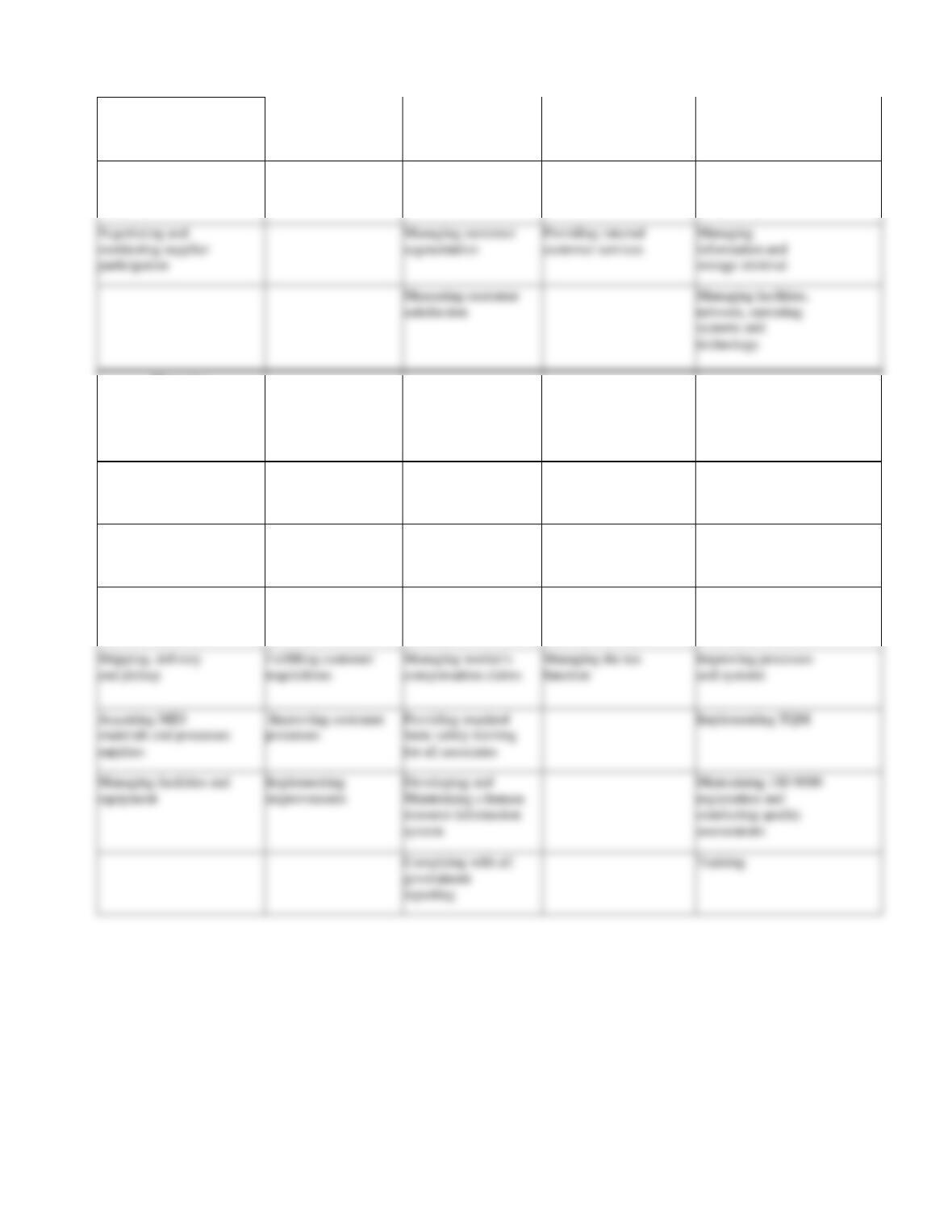
2. Identify some of the key processes associated with the following business activities for a typical
company: sales and marketing, supply chain management, managing information technology,
and managing human resources.
Key business processes for sales and marketing could include the process for identifying and selling
products/services to customers and another one for order handling and processing for repeat sales;
supply chain management requires processes for ordering routine and special materials and supplies;
information technology management requires processes to develop computer systems and programs and
other processes to handle routine, repetitive processing jobs, such as payrolls; and HRM requires
processes for recruiting, hiring, orienting new hires, performance review, and employee separation,
among others. See below for a more extensive view.
Understanding
Markets and
Customers (UMC)
Developing Vision
and Strategy (DVS)
Selling and
Customer Service
(SCS)
Acquiring Materials
and Supplies (AMS)
Managing
Information
Technology (MIT)
Determining
customers’ needs
and wants
Monitoring the
external environment
Responding to
customer inquiries
Evaluating and
selecting suppliers
Planning for
information systems
and technology
Monitoring changes in
market or customer
expectations
Defining the business
concept and
organizational strategy
Taking and processing
orders
Purchasing materials and
supplies
Developing and deploying
enterprise support systems
Process Focus 18
Providing technical
support relevant to
customer markets
Developing and
setting organizational
goals
Reconciling order
exceptions
Managing supplier
relationships
Supporting
information systems
and technology
Identifying and
securing new
suppliers
Improving customer
processes
Managing inventory
Facilitating
information sharing
and storage retrieval
Managing
Movement of
Inventories and
Making Deliveries (MId)
Managing Integrated
Supply (MIS)
Developing and
Managing Human
Resources (DHR)
Managing Financial
and Physical
Resources (MFR)
Managing Quality
Improvement and
Change (MIC)
Receiving/Stocking
Marketing and sales
Managing
deployment of
personnel
Managing financial
resources
Developing and
deploying the
Quality Plan
Controlling
inventory
Acquiring materials
and supplies
Interpreting
personnel policies
Processing finance
and accounting
transactions
Measuring
organization
performance
Picking material
Managing customer
inventories
Ensuring associate
well-being and
satisfaction
Reporting financial
information
Benchmarking
performance
Acquiring MID
materials and processes
supplies
Improving customer
processes
Providing required
basic safety training
for all associates
Implementing TQM
Complying with all
government
reporting
Training
3. Provide some examples of processes that are repeatable and measurable and some that are
not.
Processes should be repeatable (the process must recur over time) so that enough data can be gathered
to show useful information. They must also be measurable so that patterns about the process
performance can be made clear. This ability to predict performance then leads to ability to detect out–of–
control conditions and helps in the search for improvements. An example of the types of processes that
Negotiating and
participation
Managing customer
Providing internal
Managing
storage retrieval
Process Focus 19
4. List some of the common processes that your college or university has, and with which you
interact. How can these processes be improved?
Some examples are academic advising, registering for classes, obtaining technical support, paying bills,
etc. Students are not usually shy about identifying problems they encounter!
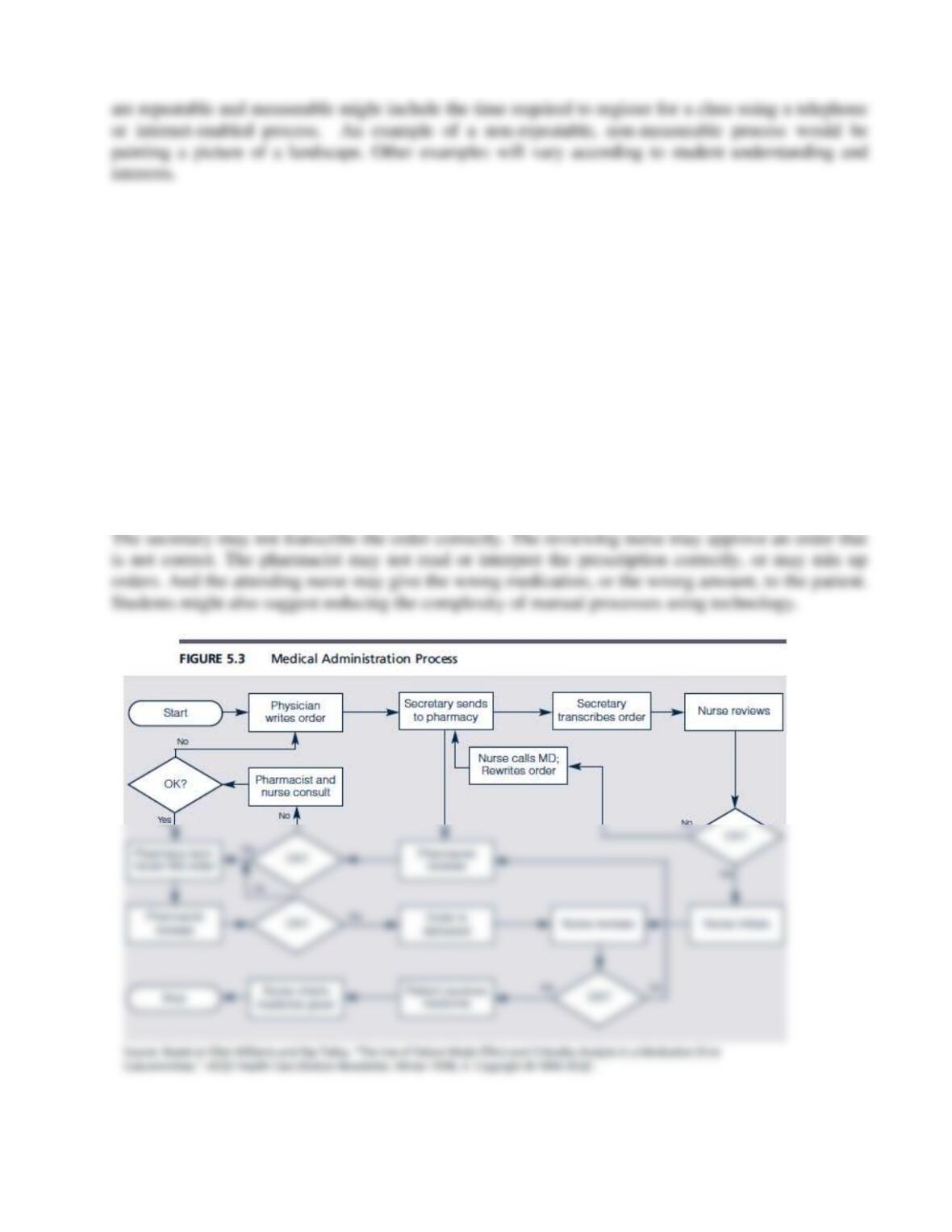
5. Refer to Example 5.1 and Figure 5.3:
a. Using the questions suggested in the chapter for process analysis and design following the
example, suggest any improvements to the process that might be made.
b. Discuss possible sources of errors and poka-yokes that might be used to prevent these
errors.
As can be seen in Example 5.1 and on the flowchart in Figure 5.3, the medication administration
process offers numerous possibilities for error at every step. The physician may not write legibly
(probably the most frequent source of physician error), or even specify the wrong drug or dosage.

Process Focus 20
6. How can a manager effectively balance the three key components of a service system
design?
Researchers have suggested that services have three basic components: physical facilities, processes,
and procedures; employees’ behavior; and employees’ professional judgment. Designing a service
essentially involves determining an effective balance of these components. The goal is to provide a
service whose elements are internally consistent and directed at meeting the needs of a specific
target market segment. Too much or too little emphasis on one component will lead to problems and
poor customer perceptions. For example, too much emphasis on procedures might result in timely
and efficient service, but might also suggest insensitivity and apathy toward the customer. Too much
emphasis on behavior might provide a friendly and personable environment at the expense of slow,
inconsistent, or chaotic service. Too much emphasis on professional judgment might lead to good
solutions to customer problems but also to slow, inconsistent, or insensitive service.
7. Legal Sea Foods…a. What are the major processes performed by Legal Sea Foods? How does
the process design support its goal of serving only the freshest, highest-quality seafood?
b. Where would Legal Sea Foods fall on the three-dimensional classification of service
organizations? Is its process design consistent with this classification?
This is a popular chain of restaurants with great food (try the clam chowder!) in the Boston area with a
few other locations.
a. Legal Sea Foods designs their process to include major steps of: 1) Supplier specifications (fresh,
local products from government certified beds) carefully monitored. 2) Closely controlled initial
processing (cutting and filleting in an environmentally controlled facility with an in-house microbiology