5 –
1
Chapter 5
Utility and Game Theory
Learning Objectives
1. Know what is meant by utility.
2. Understand why utility is a better criterion than monetary value in some decision making situations.
6. Be able to discuss the relative merits of expected monetary value and expected utility as decision
making criteria.
7. Know what is meant by a two-person, zero-sum game.
8. Be able to identify a pure strategy for a two-person, zero-sum game.
9. Be able to identify a mixed strategy and compute optimal probabilities for the mixed strategies.
10. Know how to use dominance to reduce the size of a game.
Markov Processes
Solutions:
1. a.
The largest expected value is provided by d2, so we choose d2 (Investment B).
b.
Decision Maker A
U(75) = 0.80(10) + (1-0.8)(0) = 8
U(50) = 0.60(10) + (1-0.60)(0) = 6
U(25) = 0.30(10) + (1-0.30)(0) = 3
Decision Maker A
Decision Maker B
EU(d1) = 0.40(10) + 0.30(3) = 4.9
EU(d1) = 0.40(10) + 0.30(1.5) = 4.45
EU(d2) = 0.40(8) + 0.30(6) + 0.30(3) = 5.9
EU(d2) = 0.40(6) + 0.30(3) + 0.30(1.5) = 3.75
EU(d3) = 0.40(6) + 0.30(6) + 0.30(6) = 6.0
EU(d3) = 0.40(3) + 0.30(3) + 0.30(3) = 3.0
For Decision Maker A, d3 is the best decision. For Decision Maker B, d1 is the best decision.
c. The difference is due to the different attitudes toward risk. Decision maker A tends to avoid risk,
while decision maker B tends to take a risk for the opportunity of a large payoff.
b. Lottery:
p = probability of a $0 Cost
1 – p = probability of a $200,000 Cost
c.
s1
s2
s3
None
Minor
Major
Insurance
d1
9.9
9.9
9.9
No Insurance
d2
10.0
6.0
0.0
Markov Processes
d. Use expected utility approach.
EV(d2) = 0
d2 – Do not purchase lottery ticket.
b.
s1
s2
Win
Lose
Purchase
d1
10
0
Do Not Purchase
d2
0.00001
0.00001
EU(d1) = 1/250,000(10) + 249,999/250,000(0) = 0.00004
EU(d2 ) = 0.00001
d1 – purchase lottery ticket.
c.
Route
Route
Open
Delays
Route A
d1
8.0
6.0
Route B
d2
Chapter 17
5. a.
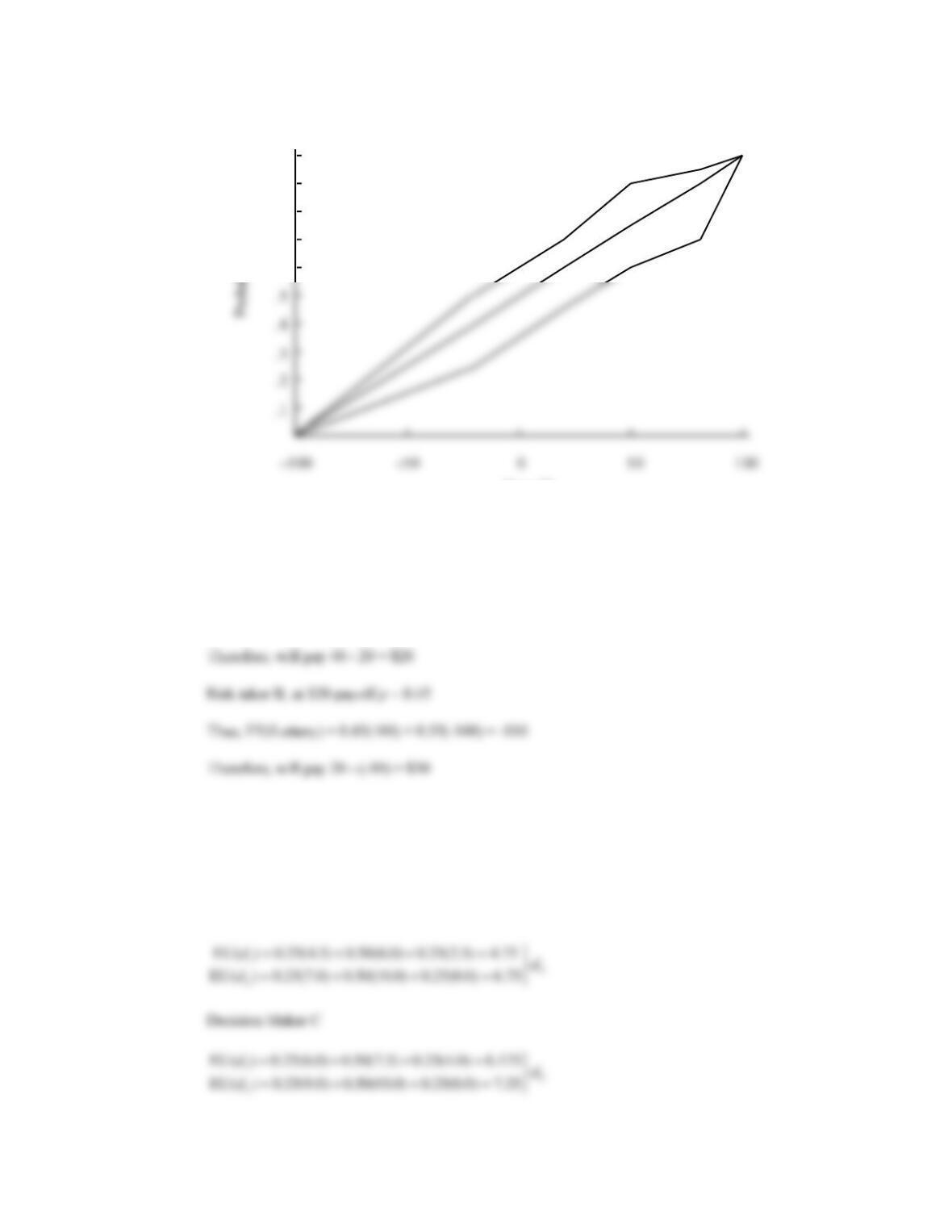
b. A – risk avoider
B – risk taker
C – risk neutral
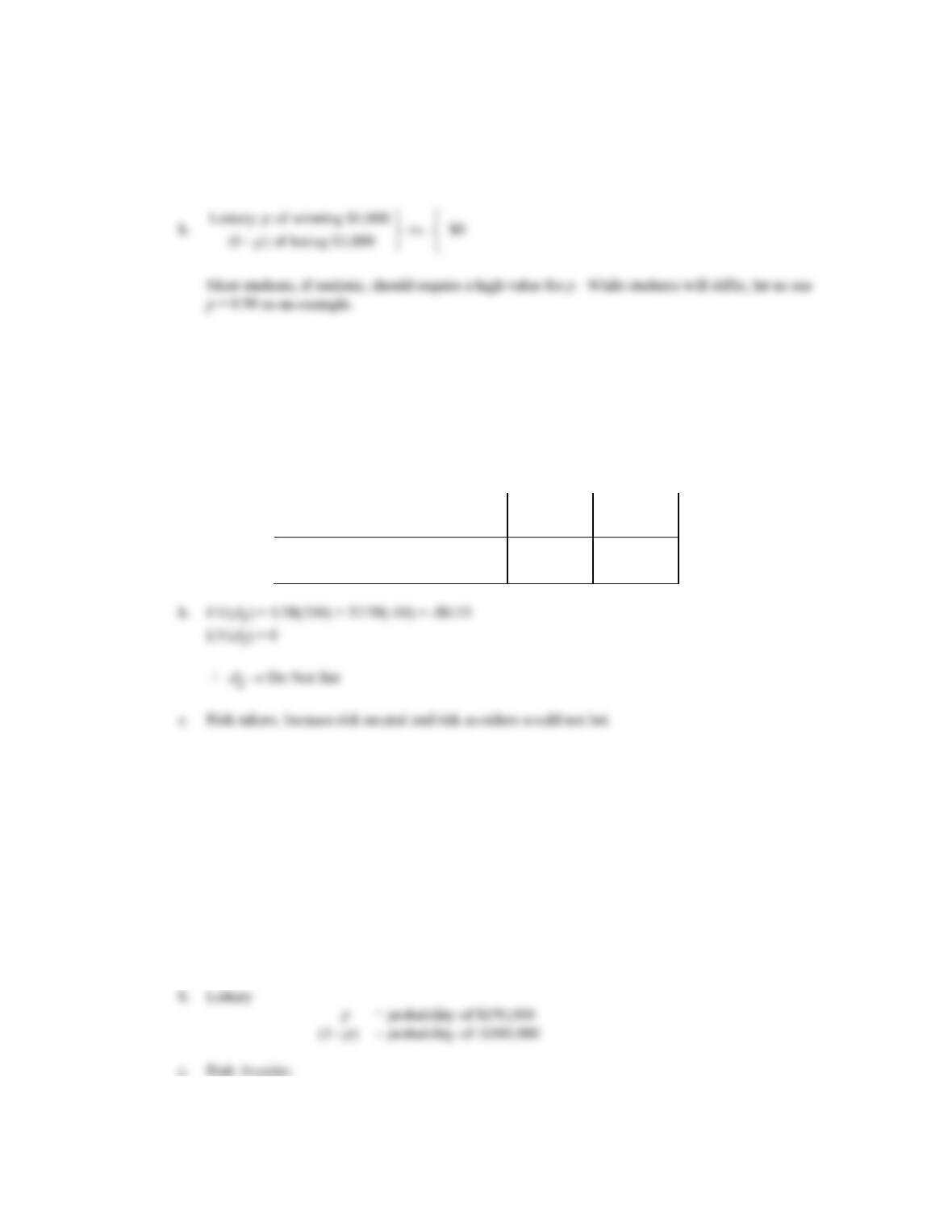
c. Risk avoider A, at $20 payoff p = 0.70
Thus, EV(Lottery) = 0.70(100) + 0.30(-100) = $40
6. Decision Maker A
11
2
EU( ) 0.25(7.0) 0.50(9.0) 0.25(5.0) 7.5
EU( ) 0.25(9.5) 0.50(10.0) 0.25(0.0) 7.375
dd
d
= + + =
= + + =
Decision Maker B
.
1.0
.9
.8
.7
.6
A
C
P ayoff
Markov Processes
7. a. EV(d1 ) = 0.60(1000) + 0.40(-1000) = $200
EV(d2) = $0
d1 Bet
c. EU(d1) = 0.60(10.0) + 0.40(0.0) = 6.0
EU(d2) = 0.60(9.0) + 0.40(9.0) = 9.0
d2 → Do Not Bet (Risk Avoider)
d. No, different decision makers have different attitudes toward risk, therefore different utilities.
8. a.
s1
s2
Win
Lose
Bet
d1
350
–10
Do Not Bet
d2
0
0
d. EU(d1) EU(d2) for decision maker to prefer Bet decision.
1/38(10.0) + 37/38(0.0) EU(d2)
0.26 EU(d2)
Utility of $0 payoff must be between 0 and 0.26.
9. a. EV = 0.10(150,000) + 0.25(100,000) + 0.20(50,000) + 0.15(0) + 0.20(-50,000)
+ 0.10(-100,000) = $30,000
Market the new product.
→
Chapter 17
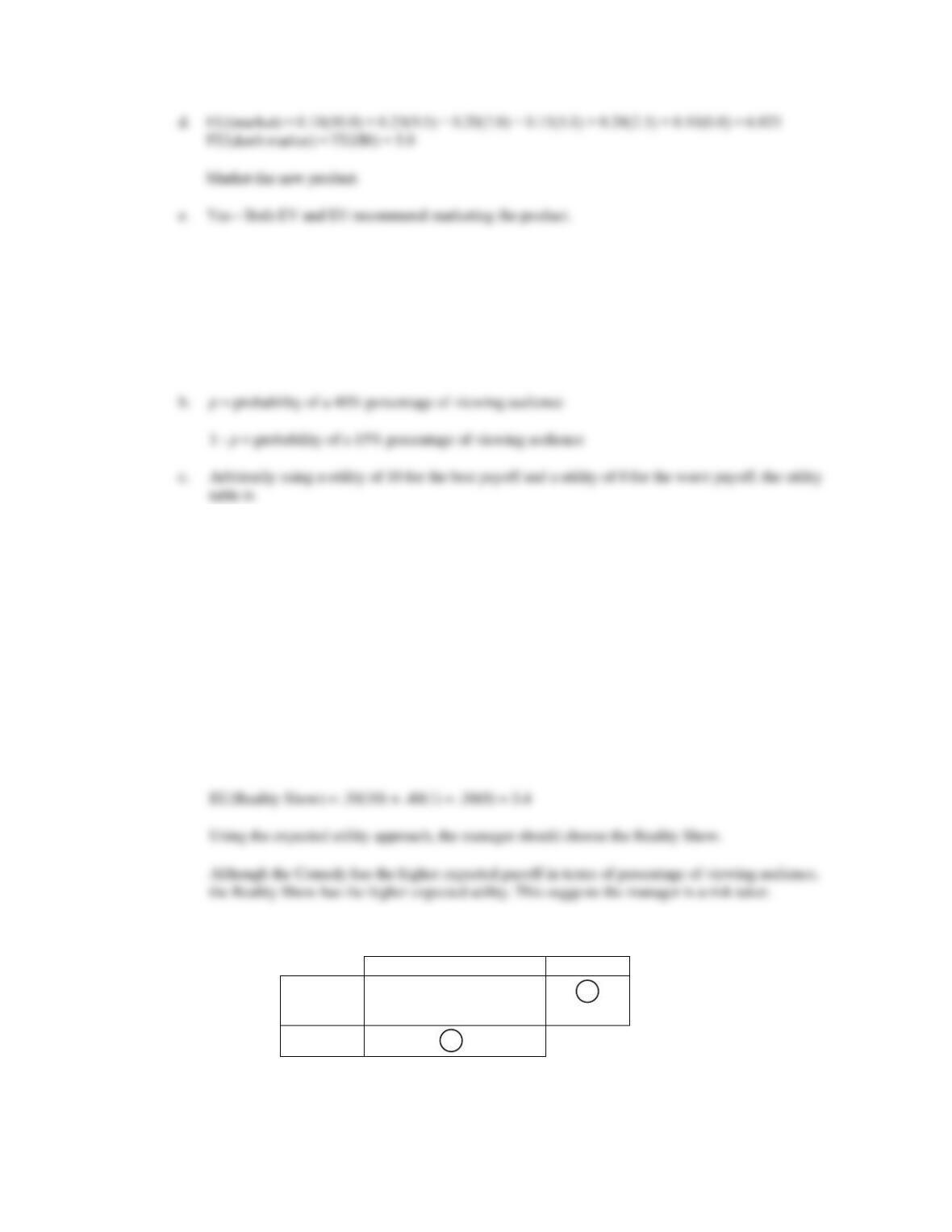
10. a. EV(Comedy) = .30(30%) + .60(25%) + .10(20%) = 26.0%
and
EV(Reality Show) = .30(40%) + .40(20%) + .30(15%) = 24.5%
Using the expected value approach, the manager should choose the Comedy.
Percentage of Viewing Audience
Indifference value of p
Utility Value
40%
Does not apply
10
30%
0.40
4
25%
0.30
3
20%
0.10
1
15%
Does not apply
0
and so the expected payoffs in terms of utilities are:
EU(Comedy) = .30(4) + .60(3) + .10(1) = 3.1
and
11.
Player B
b1
b2
b3
Minimum
a1
8
5
7
Player A
a2
2
4
10
2
Maximum
8
10
5
5
Markov Processes
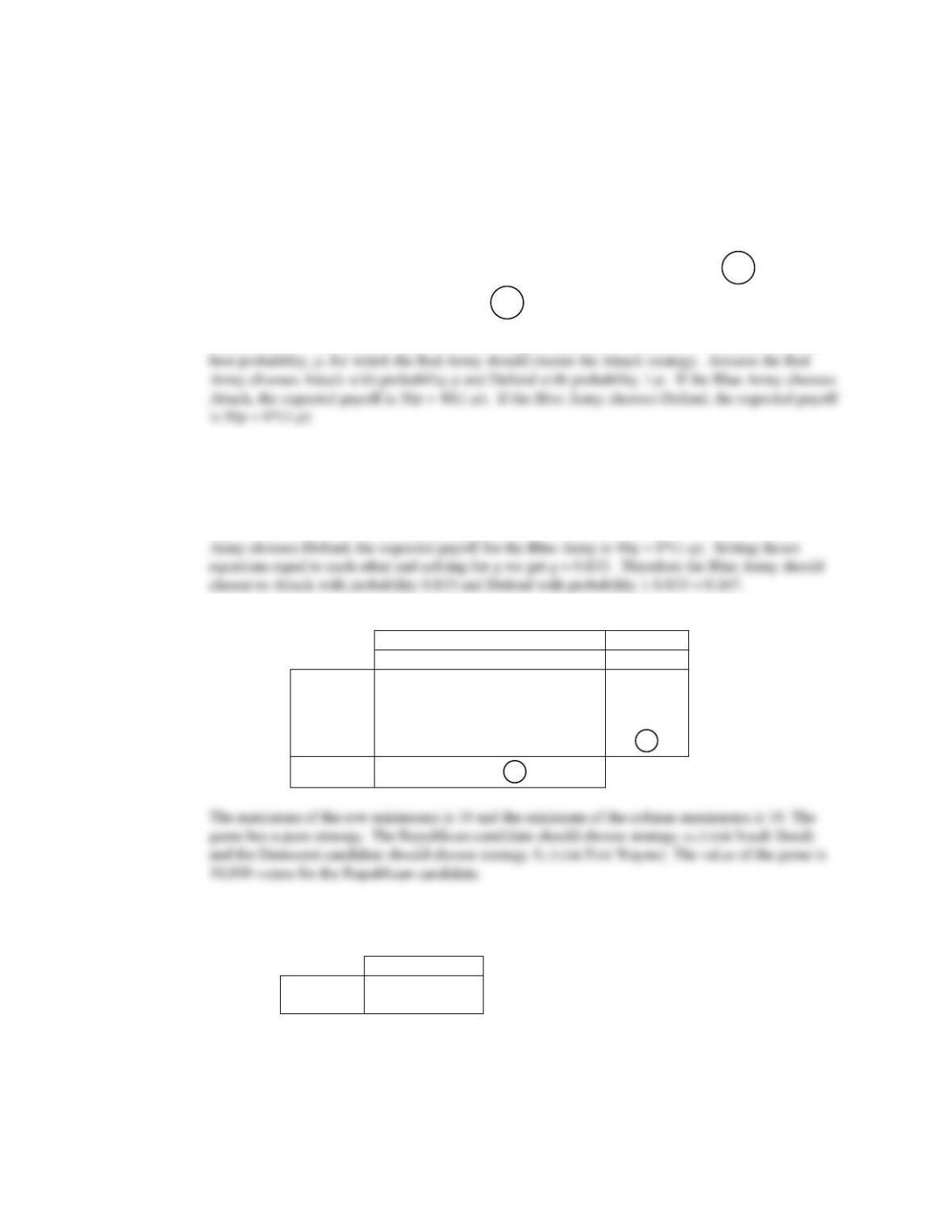
The maximum of the row minimums is 5 and the minimum of the column maximums is 5. The game
has a pure strategy. Player A should take strategy a1 and Player B should take strategy b2. The value
of the game is 5.
12. a. The payoff table is:
Blue Army
Attack
Defend
Minimum
Red Army
Attack
30
50
30
Defend
40
0
0
Maximum
40
50
The maximum of the row minimums is 30 and the minimum of the column maximums is 40.
Because these values are not equal, a mixed strategy is optimal. Therefore, we must determine the
Setting these equations equal to each other and solving for p, we get p = 2/3.
Red Army should choose to Attack with probability 2/3 and Defend with probability 1/3.
b. Assume the Blue Army chooses Attack with probability q and Defend with probability 1-q. If the
Red Army chooses Attack, the expected payoff for the Blue Army is 30q + 50*(1-q). If the Red
13.
Democrat Candidate
b1
b2
b3
b4
Minimum
a1
0
–15
-8
20
–15
Republican
a2
30
-5
5
–10
–10
Candidate
a3
10
–25
0
20
–25
a4
20
20
10
15
Maximum
30
20
20
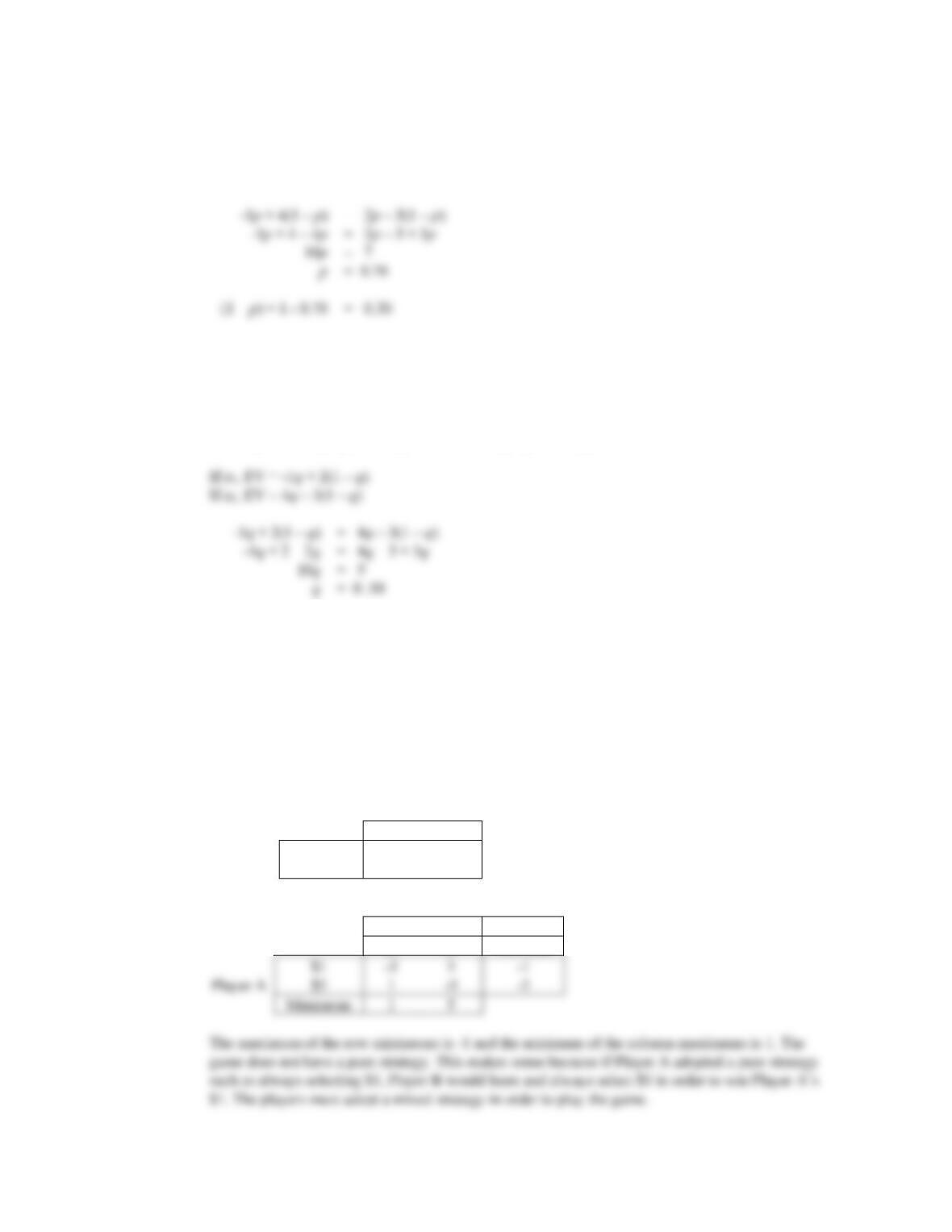
14. a. Strategy a3 is dominated by a2. Then strategy b1 is dominated by b2. The 2 x 2 game becomes:
Player B
b2
b3
a1
-1
2
Player A
a2
4
-3
10
10
Chapter 17
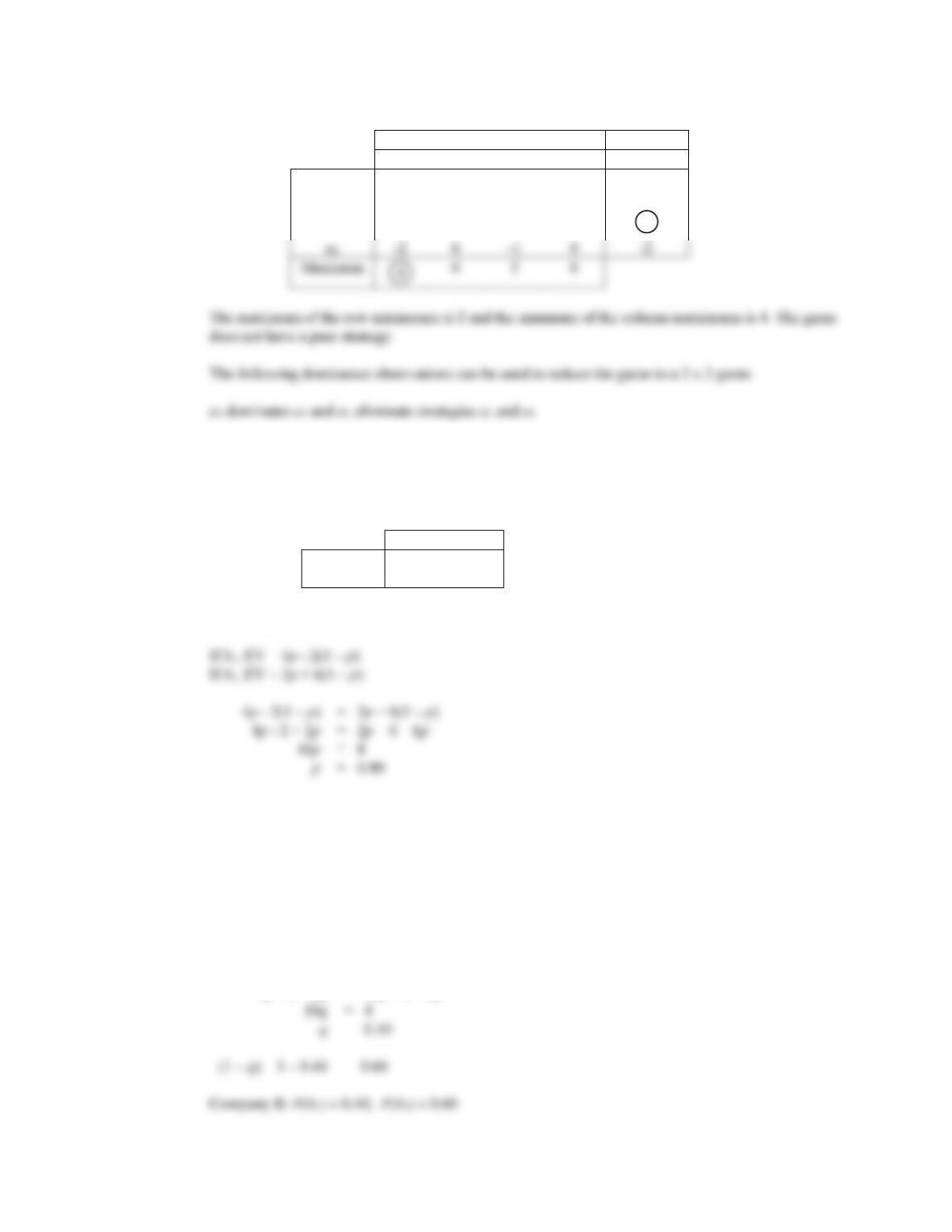
b. For Player A, let p = probability of a1 and 1 – p = probability of a2.
If b1, EV = -1p + 4(1 – p)
If b2, EV = 2p – 3(1 – p)
= 2p – 3(1 – p)
= 2p – 3 + 3p
= 7
= 0.70
= 0.30
For Player A, P(a1) = 0.70, P(a2) = 0.30, P(a3) = 0 as a3 was dominated.
So Player A should randomly choose a strategy with a1 having a probability of 0.7 and a2 having a
probability of 0.3.
For Player B, let q = probability of b2 and 1 – q = probability of b3.
= 4q – 3(1 – q)
= 4q – 3 + 3q
= 5
= 0 .50
(1 – q) = 1 – 0.50
= 0.50
For Player B, P(b1) = 0 because b1 was dominated. P(b2) = 0.50, P(b3) = 0.50.
c. Value of game using Player A
-1p + 4(1 – p)
= -1(0.70) + 4(1 – 0.70)
= 0.50
15. a.
Player B
$1
$5
$1
-1
5
Player A
$5
1
-5
b.
Player B
$1
$5
Maximum
-1
5
Player A
1
-5
1
5
Markov Processes
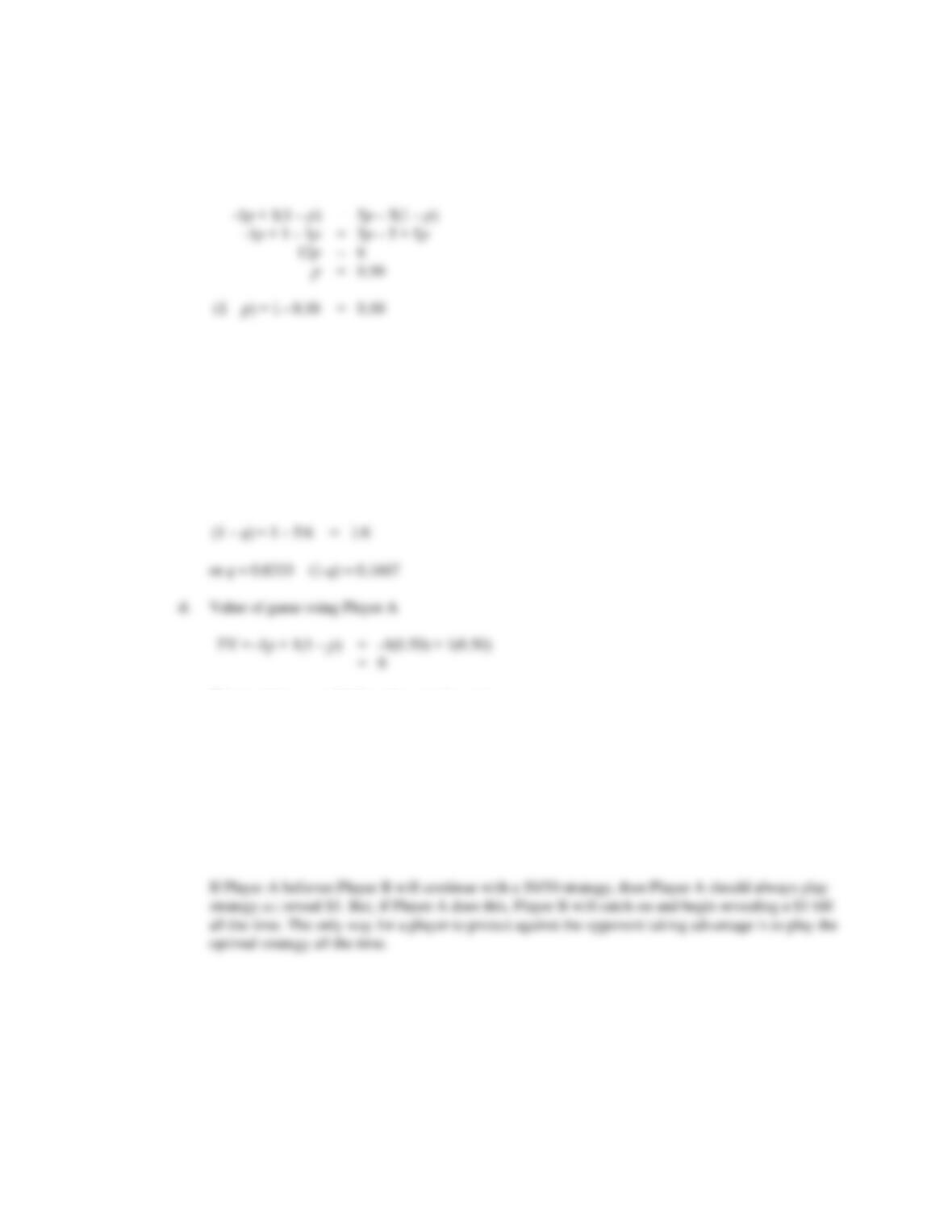
c. For Player A, let p = probability of $1 and (1 – p) = probability of $5
If b1 = $1, EV = –1p + 1(1 – p)
If b2 = $5, EV = 5p – 5(1 – p)
= 5p – 5(1 – p)
= 5p – 5 + 5p
= 6
= 0.50
= 0.50
For Player B, let q = probability of $1 and (1 – q) = probability of $5
If a1 = $1, EV = -1q + 5(1 – q)
If a2 = $5, EV = 1q – 5(1 – q)
-1q + 5(1 – q)
= 1q – 5(1 – q)
-1q + 5 – 5q
= 1q – 5 + 5q
12q
= 10
q
= 5/6
= 1/6
= -1(0.50) + 1(0.50)
= 0
This is a fair game. Neither player is favored.
e. If Player A realizes Player B is using a 50/50 strategy, we can use an expected value with these
probabilities to show:
EV(a1 = $1)
= -1(0.50) + 5(0.50) = 2.00
EV(a2 = $5)
= -1(0.50) – 5(0.50) = -2.00
Player A should see that the expected value of a1 is now larger than the expected value of a2.
Chapter 17
16.
Company B
b1
b2
b3
b4
Minimum
a1
3
0
2
4
0
Company A
a2
2
-2
1
0
-2
a3
4
2
5
6
a4
6
-1
0
-2
4
b1 dominates b3 and b4, eliminate strategies b3 and b4
The reduced game theory problem is as follows:
Company B
b1
b2
a3
4
2
Company A
a4
-2
6
For Company A, let p = probability of a3 and (1 – p) = probability of a4
= 2p + 6(1 – p)
= 2p + 6 – 6p
= 8
= 0.80
(1 – p) = 1 – 0.80
= 0.20
Company A: P(a3) = 0.80, P(a4) = 0.20
For Company B, let q = probability of b1 and (1 – q) = probability of b2
If a3, EV = 4q + 2(1 – q)
If a4, EV = -2q + 6(1 – q)
4q + 2(1 – q)
= -2q + 6(1 – q)
= -2q + 6 – 6q
= 4
= 0.40
= 0.60
2
Markov Processes
Value of the game
4p – 2(1 – p)
= 4(.80) – 2(0.20)
= 2.8
17. a. Center strategy for Shooter is dominated by Left, so we remove the Center row. We then see that
Center strategy is dominated by Right for Keeper, so we remove the Center column, leaving only
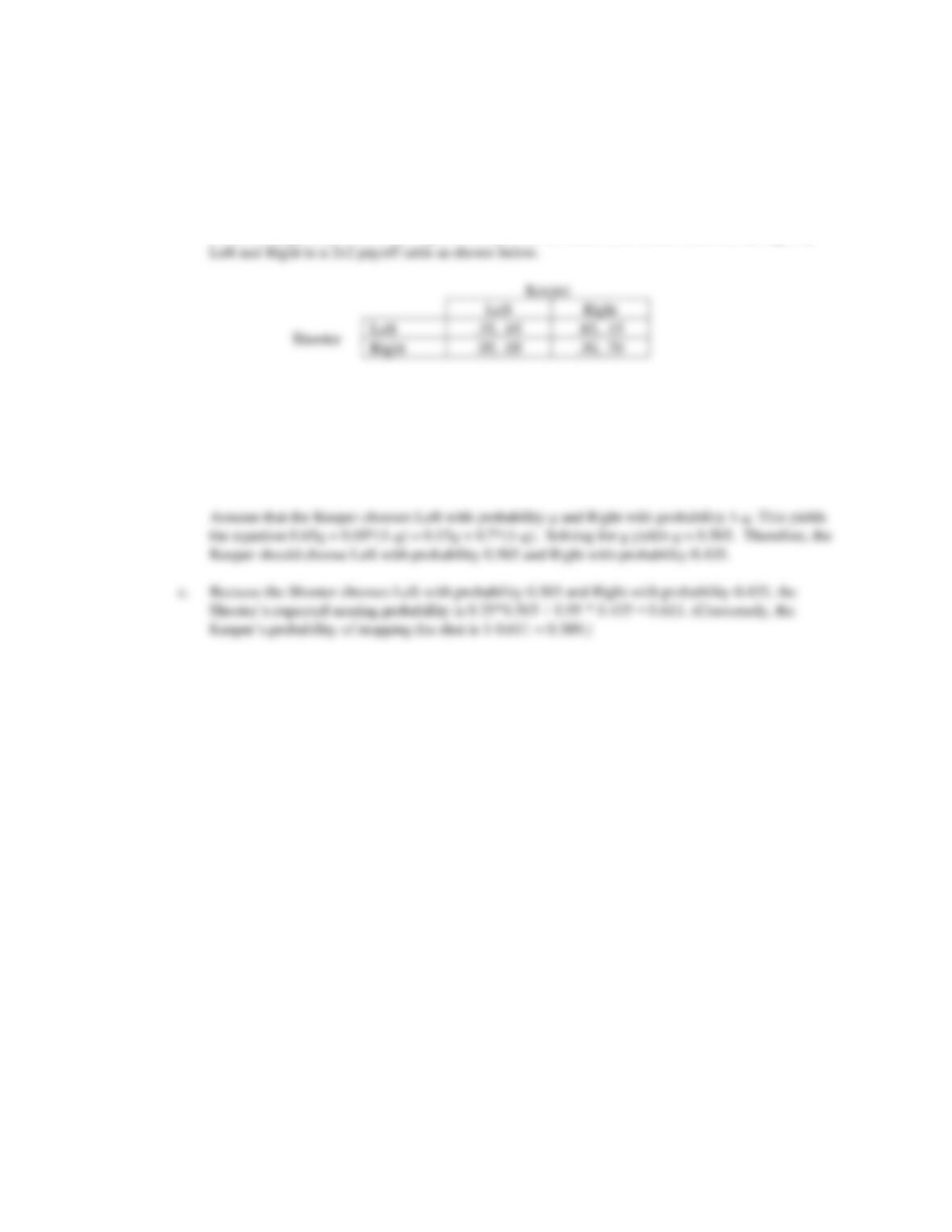
b. Here a mixed strategy is optimal. Assume the Shooter chooses Left with probability p and Right
with probability 1-p. If the Keeper chooses Left, the Shooter will score with probability 0.35*p +
0.95*(1-p). If the Keeper chooses Right, the Shooter will score with probability 0.85p + 0.30*(1-p).
Setting these equations equal yields 0.35*p + 0.95*(1-p) = 0.85p + 0.30*(1-p). Solving for p results
in p = 0.565. Therefore, the Shooter should choose Left with probability 0.565 and Right with
probability 1-0.565 = 0.435.