Chapter 05 – Electronic Commerce: Strategies for the New Economy
5-1
CHAPTER 5
ELECTRONIC COMMERCE:
STRATEGIES FOR THE NEW ECONOMY
JUMP TO THE SUPPORT YOU WANT
STUDENT LEARNING OUTCOMES
2. Identify the differences and similarities among customers and their perceived values of
products and services in the B2B and B2C e-commerce business models.
4. Summarize the ways of moving money in the world of e-commerce and related issues.
CHAPTER SUMMARY
This chapter focuses on the broad field of electronic commerce. After introducing the 9 major
e-commerce business models, the majority of the chapter focuses on B2C and B2B e–
commerce. The chapter concludes with a brief look at trend impacting e-commerce and society
in general.
The primary sections of this chapter include:
2. Understand Your Business, Products, Services, and Customers
4. Move Money Easily and Securely

Chapter 05 – Electronic Commerce: Strategies for the New Economy
5-2
LECTURE OUTLINE
INTRODUCTION (p. 128)
E-COMMERCE BUSINESS MODELS (p. 128)
1. B2B E-Commerce
3. C2B E-Commerce
5. B2G E-Commerce
7. G2B E-Commerce
9. G2G E-Commerce
UNDERSTAND YOUR BUSINESS, PRODUCTS, SERVICES, AND CUSTOMERS (p. 132)
1. Who Are Your Customers?
2. What Is the Value of Your Products and Services as Perceived by Your Customers?
FIND CUSTOMERS AND ESTABLISH RELATIONSHIPS (p. 137)
4. Business to Business
MOVE MONEY EASILY AND SECURELY (p. 140)
2. Business to Business Payment Systems
E-BUSINESS TRENDS (p. 144)
1. Youth
3. The Long Tail
END OF CHAPTER (p. 149)
2. Closing Case Study One
4. Key Terms and Concepts
6. Assignments and Exercises
Back to Jump List
Chapter 05 – Electronic Commerce: Strategies for the New Economy
5-3
MODULES, PROJECTS, AND DATA FILES
Supporting Modules
XLM/B The World Wide Web and the Internet – fast-paced tour of the Web and Internet. The
first focus is on learning just enough about the Web to be an effective surfer. Then, explore the
Group Projects
• Building Value Chains
• Advertising with Banner Ads
Electronic Commerce Projects
• Exploring Google Earth
• Learning about investing
Data Files
• There are no data files associated with this chapter. There may, however, be data files for
the Group Projects you select.
Back to Jump List
Chapter 05 – Electronic Commerce: Strategies for the New Economy
5-4
• These are the Student Learning Outcomes for the chapter.
• Use them as a road map to inform your students of what you will be
covering.
• These are the Student Learning Outcomes for the chapter.
• Use them as a road map to inform your students of what you will be
• This opening Outrageous industry transformation demonstrates how
• This slide discusses the previous slide and graph
• These are good questions to engage your class in a discussion.
• Most will spend most of their time on the Internet – Web surfing,
Chapter 05 – Electronic Commerce: Strategies for the New Economy
5-5
• This slide defines e-commerce and illustrates its many advantages
• This slide discusses the important notion and e-commerce is still
commerce
• You have to have a path-2-profitability
• This slide presents the organization for the chapter and the remaining
slides.
• It also very specifically identifies where each student learning
SLIDE 10
• This slide presents the organization for the chapter and the remaining
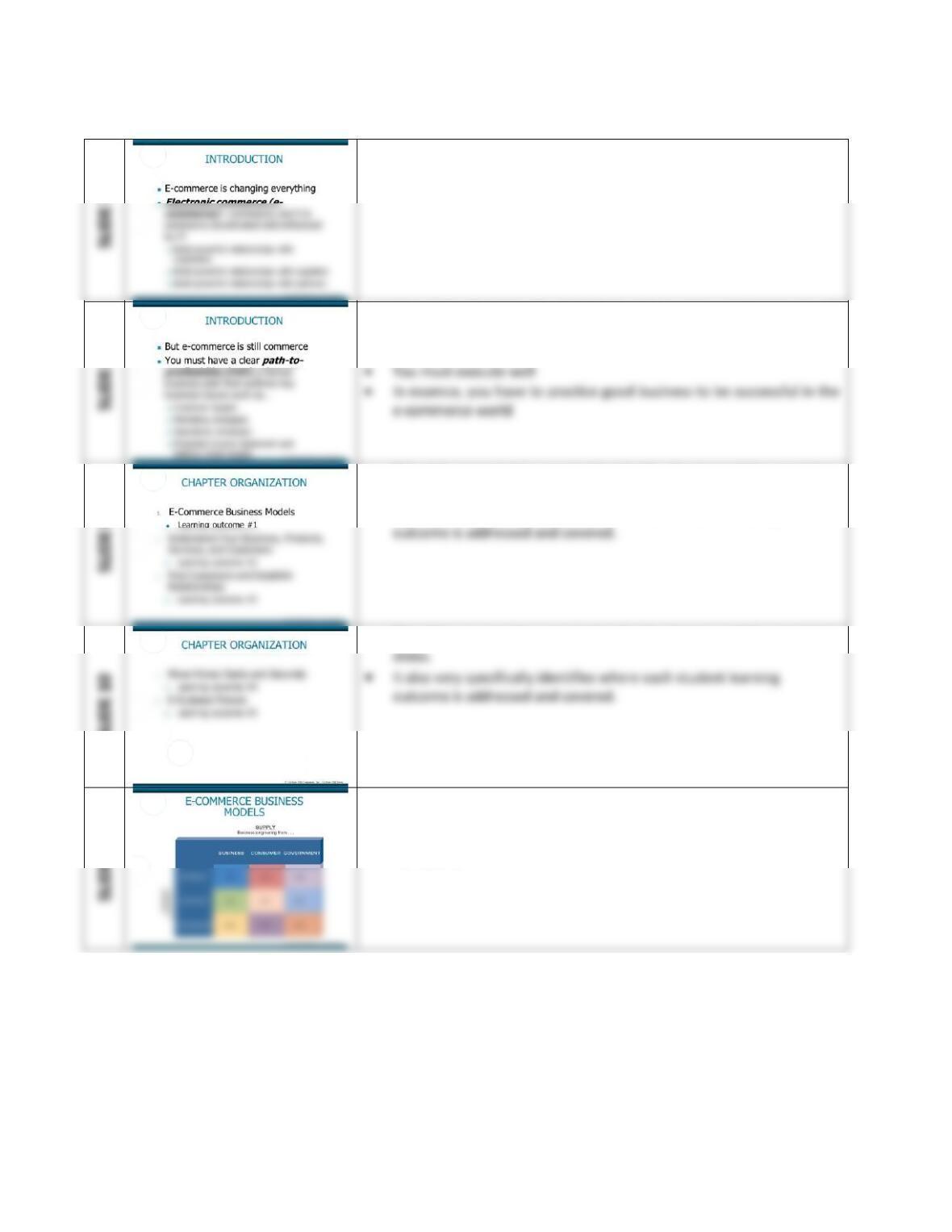
• This slide presents Figure 5.1 on page 129 (Student Learning Outcome
#1)
• It illustrates the nine major e-commerce business models, using “B”
“G” and “C”
Chapter 05 – Electronic Commerce: Strategies for the New Economy
5-6
• For each of the 9 major e-commerce business models, we devote a
single slide.
• Each slide introduces your students to an e-commerce business
• This slide is a very basic business slide
• To be successful and stay in business, you must understand your
• This slide discusses customers
• For B2B, it’s other businesses
• For B2C, it’s consumers
• This slide presents Figure 5.3 on page 133
• It illustrates the key differences in how consumers and businesses,
• This slide compares convenience and specialty items for consumers
Chapter 05 – Electronic Commerce: Strategies for the New Economy
5-7
• This slide discusses commoditylike and digital products for consumers
• Poll your class concerning what type of products they buy on the
Internet
• This slide discusses mass customization
• This is an important concept because it can give a business a
competitive advantage
• This slide defines MRO for businesses as customers
• This slide defines the notion of demand aggregation
• Point out to your students that demand aggregation is seldom seen in
B2C
• This slide defines direct material for businesses as customers
Chapter 05 – Electronic Commerce: Strategies for the New Economy
5-8
• This slide introduces the notion of a reverse auction
• Again, you seldom see reverse auctions in the B2C environment
• This slide defines e-marketplaces
• This is probably the most important distinction between B2B and B2C
in this section
• This slide presents Figure 5.4 on page 135
• It graphically illustrates the differences between horizontal e-
• This slide defines and discusses horizontal e-marketplaces
• This slide defines and discusses vertical e-marketplaces
Chapter 05 – Electronic Commerce: Strategies for the New Economy
5-9
• The final two slides in this section highlight the differences between
B2B and B2C with respect to perception of value, buying patterns, and
so on
• The final two slides in this section highlight the differences between
B2B and B2C with respect to perception of value, buying patterns, and
• This slide provides an overview of this section on finding customers
and establishing relationships (Student Learning Outcome #3)
• Again, these activities are very different in B2B and B2C
• In B2C, you develop a marketing mix (defined in this slide) that
• This slide lists the marketing mix tools we discuss in this chapter
Chapter 05 – Electronic Commerce: Strategies for the New Economy
5-10
• This slide discusses registering your site with a search engine for
• This slide provides the definitions for banner ads, pop-up ads, and
pop-under ads
• This slide presents Figure 5.5 on page 137, an example of a banner ad
• This slide defines and discusses viral marketing as a marketing mix tool
• Ask your students which type of viral marketing site they have used or
• This slide defines and discusses affiliate programs
• These can be very effective or very ineffective, depending on the
partnering site
Chapter 05 – Electronic Commerce: Strategies for the New Economy
5-11
• For financial arrangements, most affiliate programs keep careful track
of click-throughs and conversion rates
• These really determine the success (or failure) of an affiliate program
SLIDE 46
• This slide provides Figure 5.6 on page 138, a screen capture of a
description of Amazon’s affiliate program
SLIDE 47
• You can find customers in e-marketplaces
• These two slides discuss finding customers and establishing
relationships in B2B
SLIDE 48
• You can find customers in e-marketplaces
• These two slides discuss finding customers and establishing
relationships in B2B
• These final two slides for this section highlight the differences in
finding customers and establishing relationships for B2B and B2C
SLIDE 45
Chapter 05 – Electronic Commerce: Strategies for the New Economy
5-12
• These final two slides for this section highlight the differences in
finding customers and establishing relationships for B2B and B2C
• This slide highlights the fact that as commerce moves toward the
electronic frontier so must the movement of money (Student
• This slide lists the five major payment systems in B2C e-commerce
• We cover them on subsequent slides
• This slide defines a financial cybermediary
• PayPal is the most well-known
PayPal site
• This slide provides Figure 5.7 on page 142, screen capture of the
Chapter 05 – Electronic Commerce: Strategies for the New Economy
5-13
• This slide formally defines electronic checks
• Your students will probably be familiar with these under the term of
• This slide defines and discusses electronic bill presentment and
payment
• AOL, from the opening case study, is at the “presentment” level but
• This slide defines and discusses smart cards
• Again, your students will probably be familiar with these but under a
different term – debit card
• This slide talks about the fact that you need to move money easily but
also information
• This slide compares server-side and client-side digital wallets
Chapter 05 – Electronic Commerce: Strategies for the New Economy
5-14
• This slide introduces the discussion of B2B payment systems
• It also highlights some key differences from B2C payments systems –
lack of credit cards, no financial cybermediaries, aggregation of
SLIDE 61
• This slide defines EDI
• Your students will be familiar with EDI, as we have discussed it in
several previous places in this text
• EDI often occurs through a VAN
• This slide defines a VAN
SLIDE 63
• This slide defines and discusses financial EDI, the most common
payment method within the B2B model
SLIDE 64
• This slide introduces the notion of security when sending money
electronically
SLIDE 60
Chapter 05 – Electronic Commerce: Strategies for the New Economy
5-15
• This slide defines encryption and public key encryption, one
implementation of encryption
• This slide presents Figure 5.8 on page 143, a graphical depiction of
• This slide defines SSL
• Your students are probably familiar with SSL but may not have heard
• This slide presents Figure 5.9 on page 144, a screen capture showing
the lock icon and the https in the Web site name
• This slide defines and describes a secure electronic transaction (SET)
Chapter 05 – Electronic Commerce: Strategies for the New Economy
5-16
• The last three slides in this section highlight the key differences and
similarities in moving money easily and securely for B2B and B2C
• The last three slides in this section highlight the key differences and
similarities in moving money easily and securely for B2B and B2C
SLIDE 72
• The last three slides in this section highlight the key differences and
similarities in moving money easily and securely for B2B and B2C.
• This slide begins the discussion of important trends that are and will
greatly affect e-business and society in general (Student Learning
• Anderson’s work, The Long Tail, is a must read
• It describes how eB2C e-commerce businesses can make money
selling one-off and two-off merchandise
Chapter 05 – Electronic Commerce: Strategies for the New Economy
5-17
• This slide presents Figure 5.10 on page 145
• It illustrates how sites like Rhapsody and iTunes can make money by
carrying excessive inventory when compared to the likes of Wal-Mart
• This slide presents Figure 5.11 on page 146
• We talk about crowdsourcing throughout the text
• This slide lists some of those examples
• This slide defines crowdsourcing
• Goldcorp is a classic example of the effectiveness of crowdsourcing
• It invited people to review its geological data and recommend the

Chapter 05 – Electronic Commerce: Strategies for the New Economy
5-18
• Goldcorp is a classic example of the effectiveness of crowdsourcing
• It invited people to review its geological data and recommend the
• There are many other examples of crowdsourcing
• eBay, Facebook, Twitter, and YouTube are entirely crowdsourced
• This slide introduces the notion of virtual goods and provides a
definition
• This is a new, emerging economy
• The numbers don’t lie
• This slide provides Figure 5.12 on page 148 to support the growing
importance of virtual goods