
Chapter 05 – Planning: The Foundation of Successful Management
5-1
5
Chapter
Planning:
The Foundation of Successful Management
Major Questions the Student Should Be Able to Answer 2
Mapping the Class: Chapter Outline 3
Overview of the Chapter 4
Classroom Outline 5
CHAPTER CONTENTS
Chapter 05 – Planning: The Foundation of Successful Management
5-2
5.1 Planning and Strategy
MAJOR QUESTION: What are planning, strategy, and strategic management, and why
are they important to me as a manager?
5.3 Goals & Plans
MAJOR QUESTION: What are the three types of goals, and what are different kinds of
plans?
5.4 Promoting Goal Setting: SMART Goals & Management by
Objectives
MAJOR QUESTIONS THE STUDENT SHOULD BE ABLE TO ANSWER
Chapter 05 – Planning: The Foundation of Successful Management
5-3
5.1 Planning and Strategy
5.2 Fundamentals of Planning
• Mission & Vision Statements
5.3 Goals & Plans
• Three Types of Goals: Strategic, Tactical, & Operational
5.4 Promoting Goal Setting: SMART Goals & Management by
Objectives
• SMART Goals
5.5 The Planning/Control Cycle
• Using the Planning/Control Cycle
MAPPING THE CLASS: CHAPTER OUTLINE
Chapter 05 – Planning: The Foundation of Successful Management
5-4
5.1 Planning and Strategy
The first of four functions in the management process is planning, which involves
5.2 Fundamentals of Planning
Planning consists of translating an organization’s mission and vision into
5.3 Goals & Plans
The purpose of planning is to set a goal and then an action plan and an
operational plan. A goal, also known as an objective, is a specific commitment to
5.4 Promoting Goal Setting: SMART Goals & Management by
Objectives
5.5 The Planning/Control Cycle
The four-step planning/control cycle helps managers keep in control, to make
OVERVIEW OF THE CHAPTER

Chapter 05 – Planning: The Foundation of Successful Management
5-5
The Manager’s Toolbox: Setting Big Goals: Is This the Road to Success?
When people set challenging goals, they may achieve them less often, but yet they still
perform at a higher level. Stretch goals—ones that take you beyond what your mind
Possible Topics for Discussion:
• What would that “crazy” personal goal be for you?
• Think of a time that you set a “stretch goal” but did not achieve it fully. What did
you learn from this process?
Section 5.1 discusses planning, the first of four functions in the management process.
Planning involves setting goals and deciding how to achieve them, which is linked to
strategy. There are three reasons why planning and strategic management are
important: 1) providing direction and momentum, 2) encouraging new ideas, and 3)
developing a sustainable competitive advantage.
CLASSROOM OUTLINE
5.1 Planning & Strategy (pp. 136–139)
What are planning, strategy, and strategic management, and why are
they important to me as a manager?

Chapter 05 – Planning: The Foundation of Successful Management
5-6
Possible Topics for Discussion:
• Evaluate how well your company (or a previous one) does at the planning
process.
• Provide examples of how the planning process at your company (or a previous
Major Idea Outline:
A. Planning has been previously defined as setting goals and deciding how to
achieve them.
1. Another definition: Planning is coping with uncertainty by formulating
future courses of action to achieve specific results.

Chapter 05 – Planning: The Foundation of Successful Management
5-7
Interactive Classroom Material:
EXAMPLE: Is Planning Necessary? Launching a Vending-Machine Business on
$425 (p. 136)
Not every business is started with a plan. One study found that 41% of Inc.
magazine’s 1989 list of fastest–growing private firms didn’t have a business plan and
26% had only rudimentary plans, percentages essentially unchanged in 2002
YOUR CALL
If you had a few hundred dollars with which to launch a small business, do you
think writing a business plan would help you or just be a waste of time?
Writing a business plan is never a waste of time. The time it takes to write out the
different sections, whether strategic, financial or operations related, is time well
One way to build on this Example is to have the students read the Harvard Business
Review article “For Founders, Preparation Trumps Passion.” This article from the
July 2015 edition profiles recent research on hundreds of founders that reveals that
passion has nothing to do with results a few years after start-up. Rather, preparation
is more important to firm success. Consider using the following discussion questions:
How can founders strike the right balance between passion and preparation when
seeking outside sources of funding?

Chapter 05 – Planning: The Foundation of Successful Management
5-8
B. Strategy is a large-scale action plan that sets the direction for an organization.
1. Strategic management involves managers from all levels – top, middle, and
first-line – in the formulation, implementation, and execution of strategies
and strategic goals to advance the purposes of the organization.
D. Why Planning & Strategic Management Are Important
1. Provide direction and momentum

Chapter 05 – Planning: The Foundation of Successful Management
5-9
Interactive Classroom Material:
EXAMPLE: Developing Competitive Advantage: What’s the Best Strategy in an
E-Commerce Age? (p. 139)
E-commerce has completely changed retail shopping, as more Americans skip going
YOUR CALL
For what kinds of products is a visit to a physical store a more attractive
shopping experience for consumers than buying online? How realistic is the
prospect of the use of holograms (which could enable consumers to try clothes
on at home) and 3-D printers (which could print out three-dimensional products
remotely) in the shopping experience within the next 15 years?
There are still many products that people tend to prefer a visit to the store in order
to purchase. Usually large purchases, such as automobiles, are still made in
person. This does not mean that consumers do not do an initial search online first

Chapter 05 – Planning: The Foundation of Successful Management
5-10
Additional Activities:
One way to build on this Example is to have the students watch the video “Meet
Vincent – Harry Rosen’s New Virtual Clothing Advisor.” This 2-minute video
developed by ARHT Media profiles the use of a “HumaGram” by a retailer in Canada.
Consider using the following discussion questions:
What would be the benefits and disadvantages of shopping with a hologram such
as Vincent alongside you?
Thinking of your favorite retailer where you prefer to shop, discuss how e–
Section 5.2 discusses mission and vision statements, as well as the three types of
planning. Strategic planning determines what the organization’s long-term goals should
be for the next 1–5 years with the expected available resources. Tactical planning
determines what contributions departments or similar work units can make with their
given resources during the next 6–24 months. Lastly, operational planning determines
5.2 Fundamentals of Planning (pp. 140-143)
What are mission and vision statements, and what are three types of
planning?

Chapter 05 – Planning: The Foundation of Successful Management
5-11
Article Citation:
Possible Topics for Discussion:
• Locate the mission and vision statements for your company, a previous one, or
one for which you want to work after graduation. Evaluate the extent to which
these statements serve their purpose for the company.
Major Idea Outline:
Fundamentals of Planning.
A. The organization’s mission is translated into a vision, which is implemented
through strategic, tactical, and operational planning.
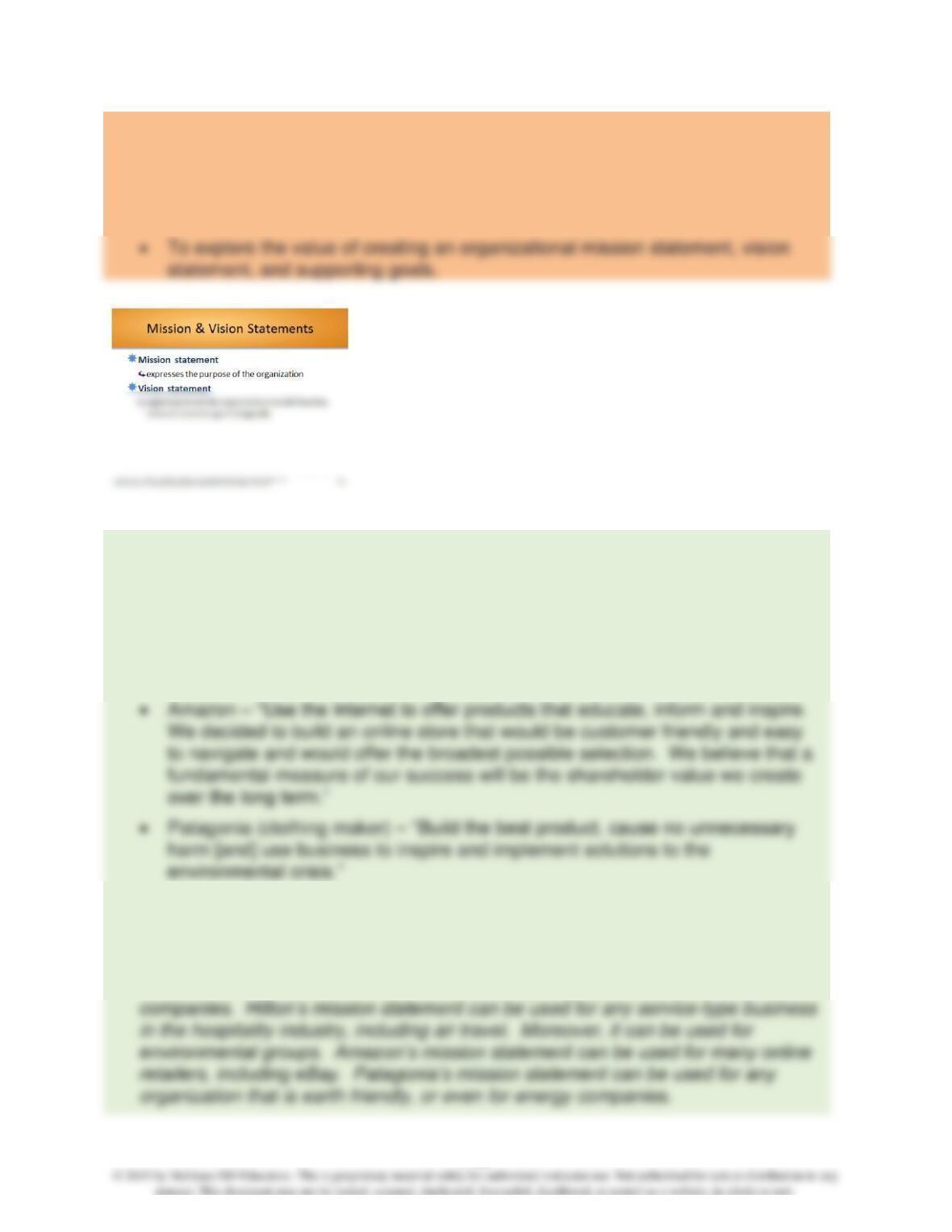
B. Mission and Vision Statements – The planning process begins with a mission
statement and a vision statement.
1. An organization’s mission is its purpose or reason for being.
a. A mission statement expresses the purpose of the organization.
Chapter 05 – Planning: The Foundation of Successful Management
5-12
Group Exercise #1: Investigating Corporate Mission and Vision Statements
There is a group exercise available at the end of this manual that allows students to
explore the importance of mission and vision statements.
Exercise Objectives
Interactive Classroom Material:
EXAMPLE: Mission Statements for Three Different Companies: Hilton, Amazon,
& Patagonia (p. 141)
Mission statements answer the question, “What is our reason for being?” Here are
the mission statements for three companies, drawn from their websites:
• Hilton – “To fill the earth with the light and warmth of hospitality.”
YOUR CALL
Do you think any of these mission statements could be adapted to different
companies offering different products or services? Give an example.
Yes, these mission statements are so broad that they can be adapted to different

Chapter 05 – Planning: The Foundation of Successful Management
5-13
Additional Activities:
One way to build on this Example is to profile Patagonia’s Worn Wear program. With
this program, the company offers free repairs on busted zippers, rips, tears, buttons,
and more and teaches people how to fix their own gear. You could have the students
watch the 4-minute video “Better Than New – Patagonia’s Worn Wear Repair Truck &
Facility” Consider using the following discussion questions:
Discuss how Patagonia’s Worn Wear program is consistent with the firm’s
mission.
Interactive Classroom Material:
EXAMPLE: Vision Statements for Three Different Companies: Hilton, Amazon, &
Patagonia (p. 141)
Vision statements answer the question, “What do we want to become?” or “Where do
we want to go? Here are the vision statements for three companies, drawn from their
websites:
• Hilton Hotels: “To be the first choice of the world’s travelers, building on the
rich heritage and strength of our brands by consistently delighting our
YOUR CALL
Do these vision statements work? Do they meet Fortune’s criterion of
describing “what’s happening in the world you compete in and what you want
to do about it. It should guide decisions”?
These vision statements vary on their degrees of incorporating Fortune’s criterion.

Chapter 05 – Planning: The Foundation of Successful Management
5-14
Additional Activities:
One way to build on this Example is to profile Patagonia’s decision to provide to the
rest of the surf industry free access to the technology Patagonia developed that
allows for wetsuits to be made from plant-based biorubbers rather than neoprene, a
SELF-ASSESSMENT 5.1 (p. 142)
Assessing Your Career Vision & Plan
Go to connect.mheducation.com and take Self-Assessment 5.1
Student Questions:
1. What is the qualitative status of your vision statement and plan? Are you
surprised by the results?
Student results will differ based on assessment results. Many students will be
Chapter 05 – Planning: The Foundation of Successful Management
5-15
2. Based on the three lowest rated survey items, what can you do in the near
term to enhance your vision and plan?
Though the lowest rated survey items will differ amongst students, it is
Additional Activities:
You can also consult the Connect Instructors Manual for the post-assessment activity
and corresponding PowerPoint slides used for this Self-Assessment in Connect. In
C. Three Types of Planning for Three Levels of Management: Strategic, Tactical,
and Operational.
1. Mission statements and vision statements provide the basis for the entire
planning process. Then three things happen:
a. Strategic planning by top management: Strategic planning is what
top managers do
Chapter 05 – Planning: The Foundation of Successful Management
5-16
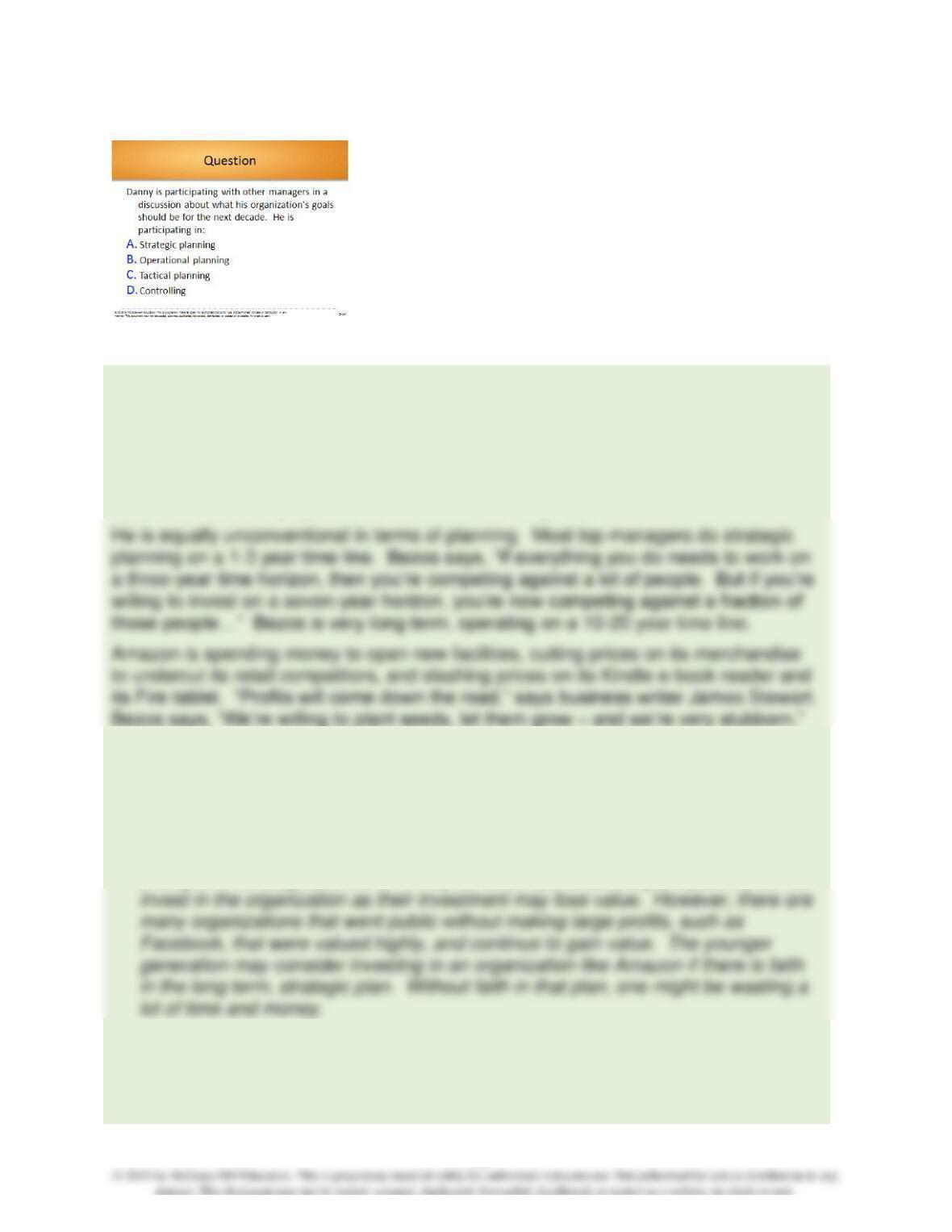
(Correct answer is A)
Interactive Classroom Material:
EXAMPLE: Strategic Planning by Top Management: Amazon Manages for the
Future, to the Frustration of Short-Term Investors (p. 142)
Amazon CEO Jeff Bezos has an unconventional opinion about profitability. In 1997,
Bezos warned shareholders that the company’s focus is not producing profits that will
boost the stock every quarter but rather over the long haul.
YOUR CALL
If Amazon’s strategy hurts short-run profits, should your parents or
grandparents invest in Amazon? Should you? What if Amazon’s strategic plan
is wrong?
If Amazon’s stock price is to be dictated by net profit as opposed to confidence in
a long-term strategic plan, then it may be best if parents and grandparents do not
Additional Activities:
One way to build on this Example is to profile Amazon’s “eighth generation” fulfillment
centers. These fulfillment centers utilize advanced robotics to fill orders faster. As of
July 2015, the company was operating 10 of these new generation of fulfillment

Chapter 05 – Planning: The Foundation of Successful Management
5-17
centers across the U.S. The eighth generation fulfillment centers were profiled in the
2-minute IGN News video “Amazon Reveals the Robots It‘s Using to Ship Your
Packages,” which you could show to the students Consider using the following
discussion questions:
Critique Amazon’s decision to invest in the “eighth generation” fulfillment centers.
b. Tactical planning by middle management: Tactical planning is what
middle managers do
(1) They determine what contributions their departments or similar
work units can make with their given resources during the next
6–24 months.
c. Operational planning by first-line management: Operational planning
is what first-line managers do

Chapter 05 – Planning: The Foundation of Successful Management
5-18
Section 5.3 discusses the three types of goals: strategic, tactical, and operational. The
goal should be followed by an action plan, which defines the course of action needed to
achieve the stated goal, such as a marketing plan or sales plan. The operating plan,
which is typically designed for a one-year period, defines how you will conduct your
business based on the action plan; it identifies clear targets such as revenues, cash
flow, and market share.
One way that you could begin your coverage of these topics is to have the students
5.3 Goals & Plans (pp. 144-146)
What are the three types of goals, and what are different kinds of plans?
Chapter 05 – Planning: The Foundation of Successful Management
5-19
Possible Topics for Discussion:
• Obtain a copy of the most recent annual report for your company or a company
about which you would like to learn. Read through the background information in
the report and identify examples of strategic, tactical or operational goals
discussed in the report.
Major Idea Outline:
Goals, Action Plans, and Operating Plans
1. Whatever its type—strategic, tactical, or operational—the purpose of
planning is to set a goal and then to formulate an action plan.
a. Goals are arranged in a hierarchy known as a means-end chain,
because in the chain of management (operational, tactical, and
strategic) the accomplishment of low-level goals is the means leading
to the accomplishment of high-level goals.
b. Goals are strategic, tactical, and operational.

Chapter 05 – Planning: The Foundation of Successful Management
(3) Operational goals are set by and for first-line managers and
are concerned with short-term matters associated with realizing
tactical goals.
3. The action plan and the operating plan:
a. The goal should be followed by an action plan, which defines the
b. The operating plan, which is typically designed for a one-year period,