
Chapter 05 – Decision Making, Learning, Creativity, and Entrepreneurship
5-18
Nonprogrammed decision making is required when a situation arises that is not easily resolved by a pre-
2. In what ways do the classical and administrative models of decision making help managers appreciate
the complexities involved in real-world decision making?
3. Why do capable managers sometimes make bad decisions? What can individual managers do to
improve their decision-making skills?
4. In what kinds of groups is groupthink most likely to be a problem? When is it least likely to be a
problem? What steps can group members take to ward off groupthink?
Chapter 05 – Decision Making, Learning, Creativity, and Entrepreneurship
5-19
Groupthink is a pattern of faulty and biased decision making that occurs in groups whose members strive
for agreement within the group at the expense of accurately assessing information relevant to a decision.
When this occurs, alternatives are not critically examined, potentially leading to a poor decision. Emotion,
5. What is organizational learning, and how can managers promote it?
6. What is the difference between entrepreneurship and intrapreneurship?
ACTION
7. Ask a manager to recall the best and the worst decisions he or she ever made. Try to determine why
these decisions were so good or so bad.

Chapter 05 – Decision Making, Learning, Creativity, and Entrepreneurship
5-20
(Note to Instructors: Students’ answers will vary. The answers given here are only indicative.)
Leslie Fox is the manager at a commercial bank. She described her worst managerial decision as the one
to establish a teller of the month program at her branch. This well-intentioned effort to motivate her
(Note to Instructors: Students’ answers will vary. The answers given here are only indicative.)
A local university is phasing out its hotel and hospitality management (HHM) program because of low
enrollment. University officials would like to continue the program but can no longer justify the
operational inefficiencies that result from doing so. Stakeholders include students, faculty, university
administrators, the Board of Regents that governs the university, and the local community. To save this
program, which is one of several offered by the university’s College of Commerce, faculty and university
administrators must identify the reasons behind low enrollment.

Chapter 05 – Decision Making, Learning, Creativity, and Entrepreneurship
5-21
Copyright © 2017 McGraw-Hill Education. All rights reserved. No reproduction or distribution without the prior written consent of McGraw-Hill
Education.
Residents of the local community could be asked: What can the HHM department do to make a
contribution to this community? By making a positive contribution to the community, the department’s
visibility is heightened, which will in turn, attract interest and increase the number of applications
received. Community contributions might include offering a seminar series for local restaurant owners,
offering cooking classes for kids, etc.
Faculty members could be asked: Which part of your HHM classes do students find most boring? This
question should stimulate faculty to think about new approaches that allow classroom material to be
presented in more creative and dynamic ways, thereby peaking the interest of students considering the
HHM as a major.
AACSB: Analytic
Notes for Building Management Skills
(Instructors Note: Below is an example of one possible problem (John’s) and how he considered the
problem and made his decision.)
1. Identify the criteria you used, either consciously or unconsciously, to guide your decision making.
John needed to decide if he should take a part-time job as a research assistant in the management
department in his second year in college. John decided that he would take the position because he thought
2. List the alternatives you considered. Were they all possible alternatives? Did you unconsciously (or
consciously) ignore some important alternatives?
2. take a different part-time job somewhere else, either within the university or the community.
BUILDING MANAGEMENT SKILLS

Chapter 05 – Decision Making, Learning, Creativity, and Entrepreneurship
5-22
Copyright © 2017 McGraw-Hill Education. All rights reserved. No reproduction or distribution without the prior written consent of McGraw-Hill
Education.
John did not consider any other alternatives. It seemed to him that these were all the alternatives that were
possible. One alternative that John did not consider was the option of taking out a student loan to cover
expenses. John did not think he would be eligible for such a loan, and it did not occur to him to go to the
financial aid office and see if it was possible for him to get a loan.
3. How much information did you have about each alternative? Were you making the decision on the
basis of complete or incomplete information?
4. Try to remember how you reached the decision. Did you sit down and consciously think through the
implications of each alternative, or did you make a decision on the basis of intuition? Did you use any
rules of thumb to help you make the decision?
5. In retrospect, do you think that your choice of alternative was shaped by any of the cognitive biases
discussed in this chapter?
6. Having answered the previous five questions,, do you think in retrospect that you made a reasonable
decision? What, if anything, might you do to improve your ability to make good decisions in the future?

Chapter 05 – Decision Making, Learning, Creativity, and Entrepreneurship
5-23
John made a reasonable decision based on the outcomes but also on the process he used. He consciously
weighed the alternatives and obtained information before deciding.
Notes for Managing Ethically
1. Either alone or in a group, think about the ethical implications of extreme decision making by groups.
2. When group decision making takes place, should members of a group each feel fully accountable for
outcomes of the decision? Why or why not?
AACSB: Ethics
Brainstorming
Form groups of three or four people and appoint one member as the spokesperson who will communicate
your findings to the whole class when called upon by the instructor. Then discuss the following scenario:
MANAGING ETHICALLY
SMALL GROUP BREAKOUT EXERCISE

Chapter 05 – Decision Making, Learning, Creativity, and Entrepreneurship
5-24
Copyright © 2017 McGraw-Hill Education. All rights reserved. No reproduction or distribution without the prior written consent of McGraw-Hill
Education.
You and your partners are trying to decide which kind of restaurant to open in a centrally located
shopping center that has just been built in your city. The problem confronting you is that the city already
has many restaurants that provide different kinds of food in all price ranges. You have the resources to
open any type of restaurant. Your challenge is to decide which type is most likely to succeed.
Use the brainstorming technique to decide which type of restaurant to open. Follow by following these
steps:
1. As a group, spend 5 or 10 minutes generating ideas about the alternative restaurants that the members
think will be most likely to succeed. Each group member should be as innovative and creative as possible,
and no suggestions should be criticized.
The following is a list of some alternative kinds of restaurants that students may suggest:
1. A sports bar and grill
3. A celebrity restaurant with memorabilia and entertainment
5. A cartoon character theme restaurant
2. Appoint one group member to write down the alternatives as they are identified.
3. Spend the next 10 to 15 minutes debating the pros and cons of the alternatives. As a group, try to reach
a consensus on which alternative is most likely to succeed.
While engaging in this exercise, students should consider the location of the restaurant, the neighborhood
4. After making your decision, discuss the pros and cons of the brainstorming method, and decide
whether any production blocking occurred.
Pros of brainstorming include: creative and innovative suggestions from more than one person who is
contemplating the same problem, improved evaluation of suggestions from other group members,

Chapter 05 – Decision Making, Learning, Creativity, and Entrepreneurship
5-25
Questions: What are you going to do?
BE THE MANAGER

Chapter 05 – Decision Making, Learning, Creativity, and Entrepreneurship
5-26
Case Synopsis: Aetna Sets Wage Floor: $16 an Hour
Amid signs of a tightening labor market, Aetna Inc. plans to boost the incomes of its lowest paid workers
1. Is the decision managers at Aetna made to have a $16 an hour wage floor a programmed
or nonprogrammed decision?
2. How did managers recognize the need to make this decision?
3. To what extent do you think satisficing was involved in making this decision?
THE WALL STREET JOURNAL CASE IN THE NEWS

Chapter 05 – Decision Making, Learning, Creativity, and Entrepreneurship
5-27
Copyright © 2017 McGraw-Hill Education. All rights reserved. No reproduction or distribution without the prior written consent of McGraw-Hill
Education.
of the rapidly changing insurance and economic landscape. Due to these limitations, Aetna’s
managers could not attempt to discover every alternative in an attempt to reach the optimum
decision. Instead, they had to search for and choose a satisfactory response to the problem.
4. How would you evaluate this decision according to the four criteria that managers use to
evaluate the advantages and disadvantages of different courses of action?
AACSB: Analytic
SUPPLEMENTAL FEATURES
MANAGER’S HOT SEAT (MHS)

Chapter 05 – Decision Making, Learning, Creativity, and Entrepreneurship
INSTRUCTOR’S POWERPOINT SLIDES
Chapter 05 – Decision Making, Learning, Creativity, and Entrepreneurship
5-29
INSTRUCTOR’S POWERPOINT
SLIDE 10
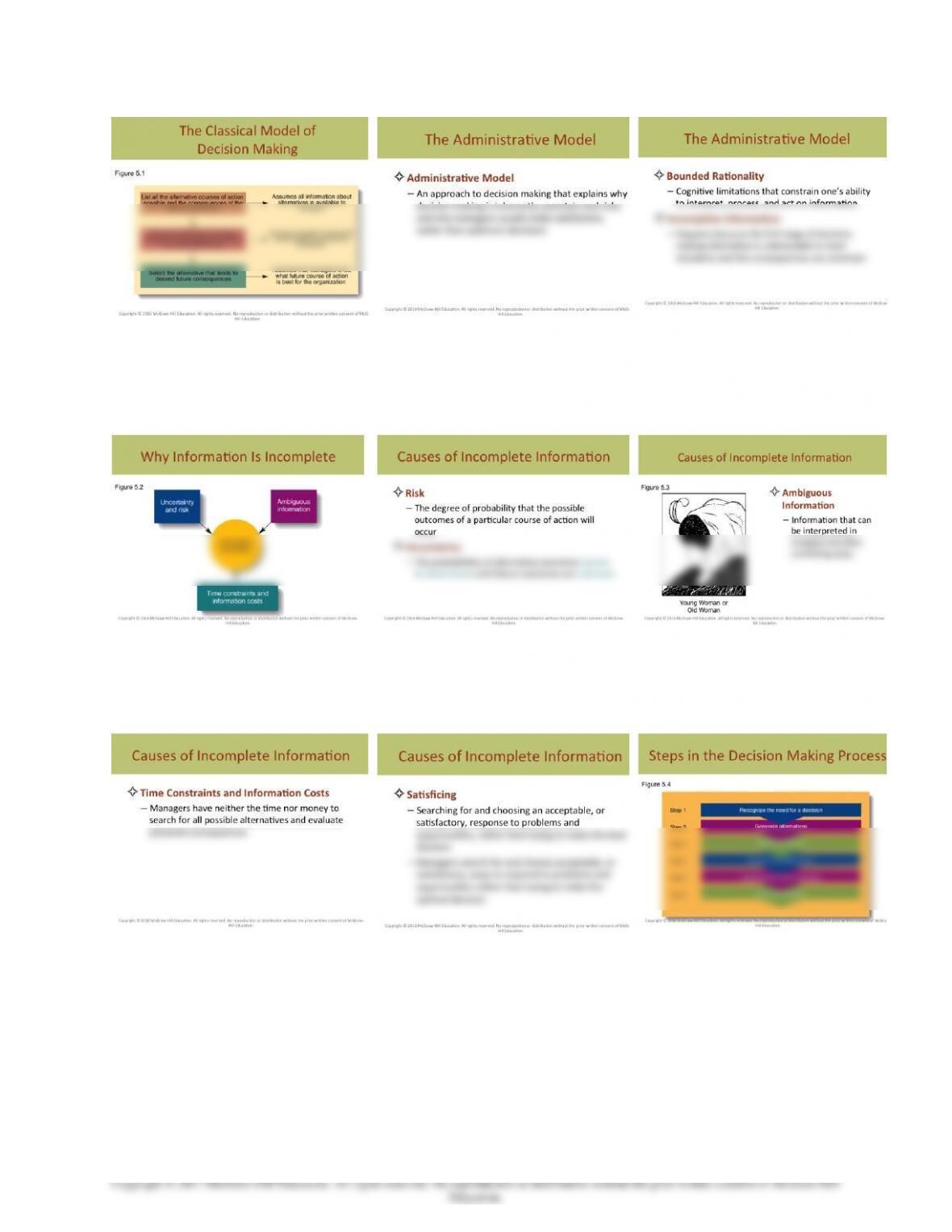
Figure 5.1 – The Classical Model of
Decision Making
INSTRUCTOR’S POWERPOINT
SLIDE 11
The Administrative Model
INSTRUCTOR’S POWERPOINT
SLIDE 12
The Administrative Model:
Bounded Rationality
INSTRUCTOR’S POWERPOINT
SLIDE 13
Figure 5.2 – Why Information is
Incomplete
INSTRUCTOR’S POWERPOINT
SLIDE 14
Causes of Incomplete Information:
Risk and Uncertainty
INSTRUCTOR’S POWERPOINT
SLIDE 15
Causes of Incomplete Information:
Ambiguous Information
INSTRUCTOR’S POWERPOINT
SLIDE 16
Causes of Incomplete Information:
Time Constraints…
INSTRUCTOR’S POWERPOINT
SLIDE 17
Causes of Incomplete Information:
Satisficing
INSTRUCTOR’S POWERPOINT
SLIDE 18
Figure 5.4 – Six Steps in Decision
Making

Chapter 05 – Decision Making, Learning, Creativity, and Entrepreneurship
5-30
INSTRUCTOR’S POWERPOINT
SLIDE 19
Discussion Question
INSTRUCTOR’S POWERPOINT
SLIDE 20
Step 1: Recognize Need for A
Decision
INSTRUCTOR’S POWERPOINT
SLIDE 21
Step 2: Generate Alternatives
INSTRUCTOR’S POWERPOINT
SLIDE 22
Step 3: Assess Alternatives
INSTRUCTOR’S POWERPOINT
SLIDE 23
Figure 5.5 – General Criteria for
Evaluating Possible courses of
Action
INSTRUCTOR’S POWERPOINT
SLIDE 24
Step 4: Choose Among Alternatives
INSTRUCTOR’S POWERPOINT
SLIDE 25
Step 5: Implement Chosen
Alternative
INSTRUCTOR’S POWERPOINT
SLIDE 26
Step 6: Learn from Feedback
INSTRUCTOR’S POWERPOINT
SLIDE 27
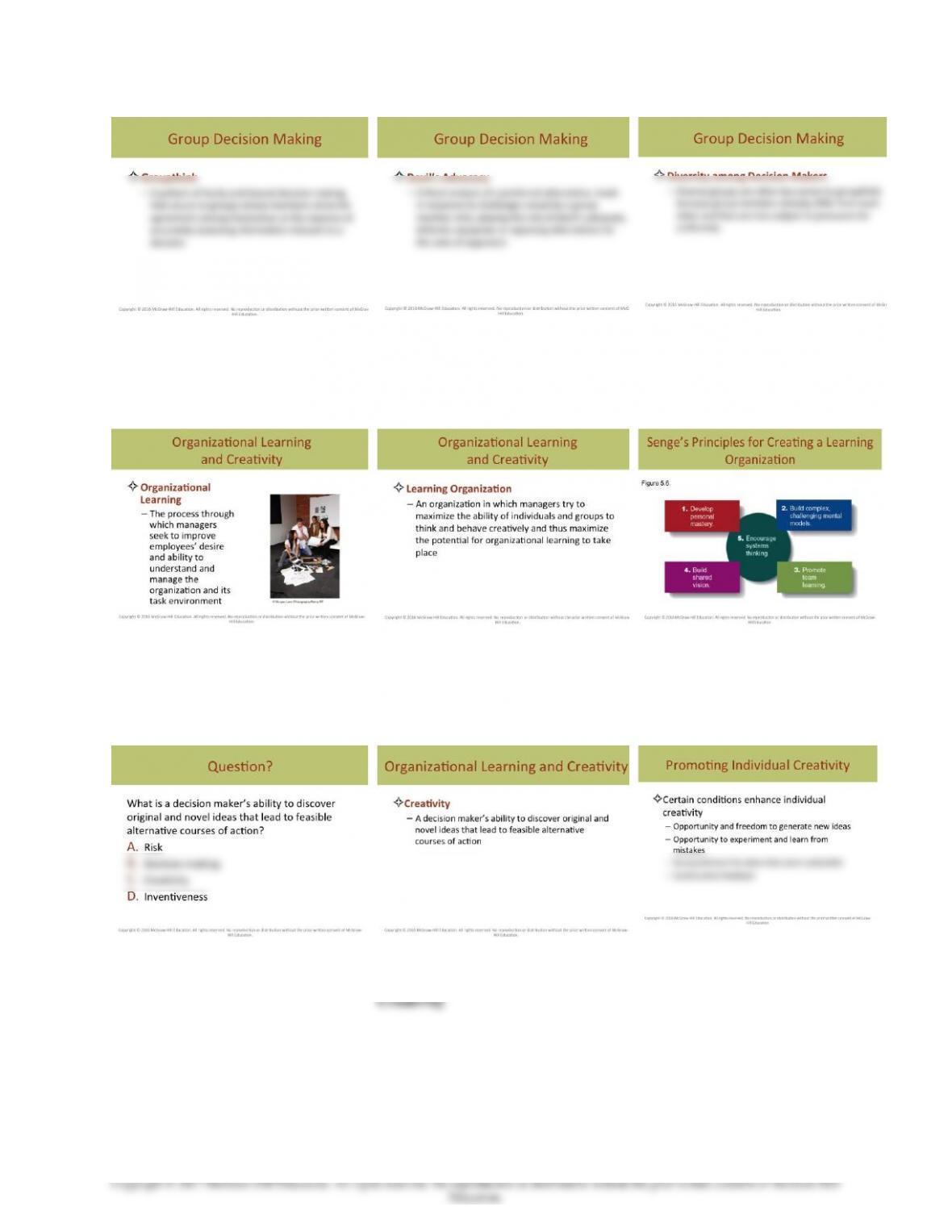
Group Decision Making
Chapter 05 – Decision Making, Learning, Creativity, and Entrepreneurship
5-31
INSTRUCTOR’S POWERPOINT
SLIDE 28
Groupthink
INSTRUCTOR’S POWERPOINT
SLIDE 29
Devil’s Advocacy
INSTRUCTOR’S POWERPOINT
SLIDE 30
Diversity Among Decision Makers
INSTRUCTOR’S POWERPOINT
SLIDE 31
Organizational Learning and
Creativity
INSTRUCTOR’S POWERPOINT
SLIDE 32
Organizational Learning and
Creativity
INSTRUCTOR’S POWERPOINT
SLIDE 33
Figure 5.6 – Senge’s Principles for
Creating a Learning Organization
INSTRUCTOR’S POWERPOINT
SLIDE 34
Question?
INSTRUCTOR’S POWERPOINT
SLIDE 35
Organizational Learning and
Creativity
INSTRUCTOR’S POWERPOINT
SLIDE 36
Promoting Individual Creativity
Chapter 05 – Decision Making, Learning, Creativity, and Entrepreneurship
5-32
INSTRUCTOR’S POWERPOINT
SLIDE 37
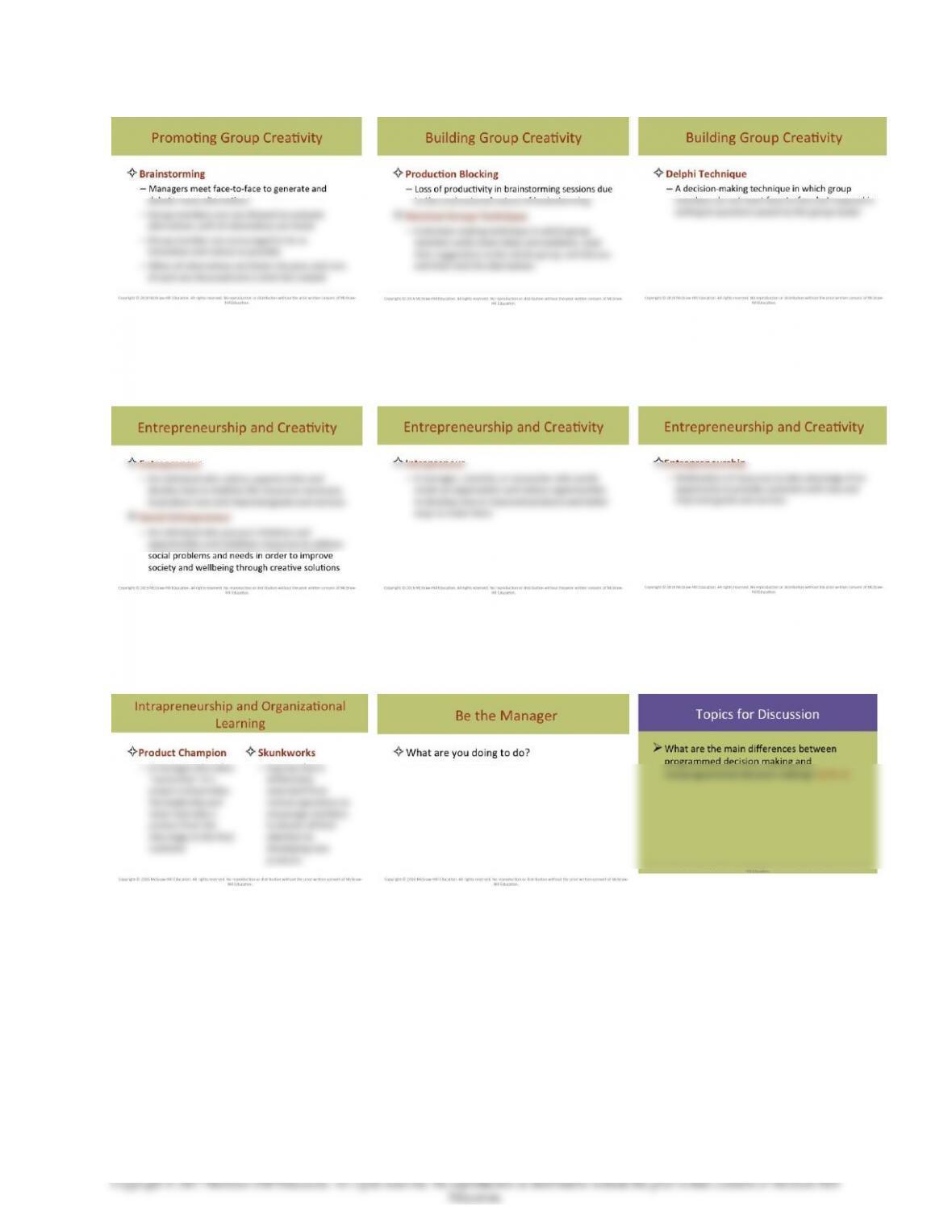
Promoting Group Creativity
INSTRUCTOR’S POWERPOINT
SLIDE 38
Building Group Creativity
INSTRUCTOR’S POWERPOINT
SLIDE 39
Delphi Technique
INSTRUCTOR’S POWERPOINT
SLIDE 40
Entrepreneurship and Creativity
INSTRUCTOR’S POWERPOINT
SLIDE 41
Intrapreneur
INSTRUCTOR’S POWERPOINT
SLIDE 42
Entrepreneurship
INSTRUCTOR’S POWERPOINT
SLIDE 43
Intrapreneurship and
Organizational Learning
INSTRUCTOR’S POWERPOINT
SLIDE 44
Be the Manager
INSTRUCTOR’S POWERPOINT
SLIDE 45
Topics for Discussion

Chapter 05 – Decision Making, Learning, Creativity, and Entrepreneurship
5-33
INSTRUCTOR’S POWERPOINT
SLIDE 46
Topics for Discussion
INSTRUCTOR’S POWERPOINT
SLIDE 47
Topics for Discussion
INSTRUCTOR’S POWERPOINT
SLIDE 48
Topics for Discussion
INSTRUCTOR’S POWERPOINT
SLIDE 49
Topics for Discussion
INSTRUCTOR’S POWERPOINT
SLIDE 50
Topics for Discussion