Chapter 04 – Computer Software
4-1
4 Computer Software
CHAPTER OVERVIEW
Chapter 4: Computer Software reviews the basic features and trends in the
major types of application software and system software used to support enterprise
and end-user computing.
LEARNING OBJECTIVES
After reading and studying this chapter, you should be able to:
1. Describe several important trends occurring in computer software.
2. Give examples of several major types of application and system software.
SUMMARY
• Software. Computer software consists of two major types of programs: (1) application software that directs the
performance of a particular use, or application, of computers to meet the information processing needs of users and
• Application Software. Application software includes a variety of programs that can be segregated into general
• System Software. System software can be subdivided into system management programs and system development
programs. System management programs manage the hardware, software, network, and data resources of a
Chapter 04 – Computer Software
• Operating Systems. An operating system is an integrated system of programs that supervises the operation of the
CPU, controls the input/output storage functions of the computer system, and provides various support services. An
• Programming Languages. Programming languages are a major category of system software. They require the use
of a variety of programming packages to help programmers develop computer programs and language translator
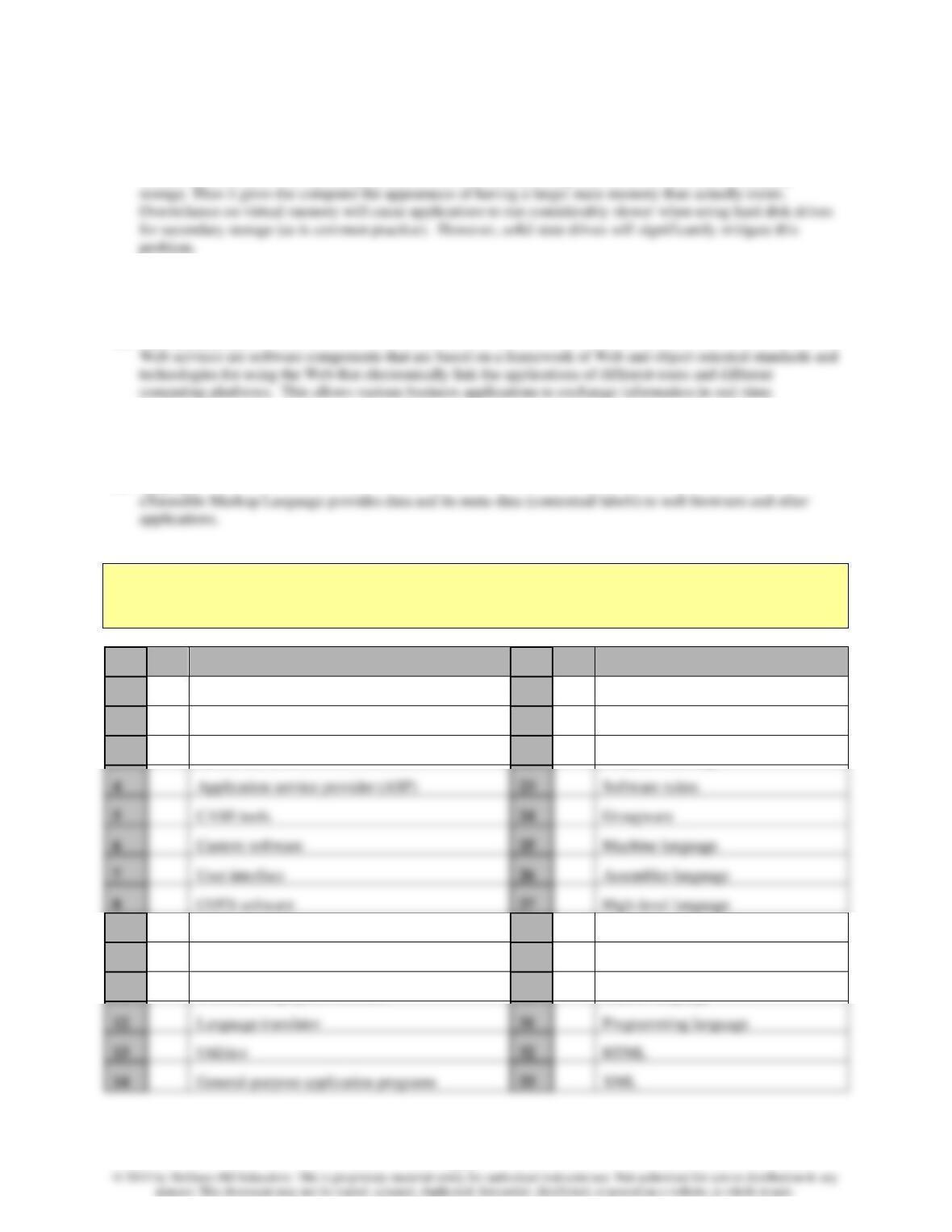
KEY TERMS AND CONCEPTS
1. Application service provider ():
An application service provider owns, operates, and maintains application software for access by others via the
Internet.
2. Application software ():
3. Assembler language ():
4. CASE tools ():
5. Cloud computing ()
Cloud computing provides hardware and software as a service over the Internet.
6. COTS software ():
7. Custom software ():
8. Desktop publishing – DTP ():
Desktop publishing uses computers, laser printers, and page layout software to produce a variety of printed
materials at a level formerly done only by professional printers.
Chapter 04 – Computer Software
4-3
9. E-mail ():
10. Fourth-generation language ():
4GLs are programming languages that are easier to use than high-level languages. They are also known as
nonprocedural, natural, or very high-level languages.
11. Function-specific application software ():
12. General-purpose application programs ():
13. Groupware ():
14. High-level language ():
15. HTML ():
Hypertext Mark-up Language is a language that creates formatted hypertext or hypermedia documents.
16. Instant messaging (IM) ():
Instant messaging enables users to communicate textually in real time with other online users.
17. Integrated package ():
18. Java ():
19. Language translator ():
20. Machine language ():
Machine language is a first generation language where instructions are expressed in the binary code
immediately recognizable for execution by a computer’s CPU.
21. Middleware ():
Chapter 04 – Computer Software
22. Multitasking ():
Multitasking is a computing approach that uses the same computer to accomplish more than one information
processing task concurrently.
23. Natural language ():
24. Object-oriented language ():
25. Operating system ():
26. Personal information manager (PIM) ():
Personal information managers help end users store, organize, and retrieve text and numerical data in the form
of notes, lists, memos, tasks, calendars, schedules, and contact lists.
27. Presentation graphics software ():
28. Programming language ():
29. Software suites ():
30. Spreadsheet package ():
31. System software ():
32. User interface ():
The user interface sends and receives information between the computer and the person using it. It includes
keyboard, monitor, pointing device, and related software.
33. Utilities ():
Chapter 04 – Computer Software
4-5
34. Virtual memory ():
Virtual memory allows an operating system to use a secondary storage device as an extension of primary
35. Web browser ():
A web browser provides the user interface for accessing Internet, intranet, and extranet web sites.
36. Web services ():
37. Word processing software ():
Word processing software enables the creation, editing, revision, and printing of documents.
38. XML ():
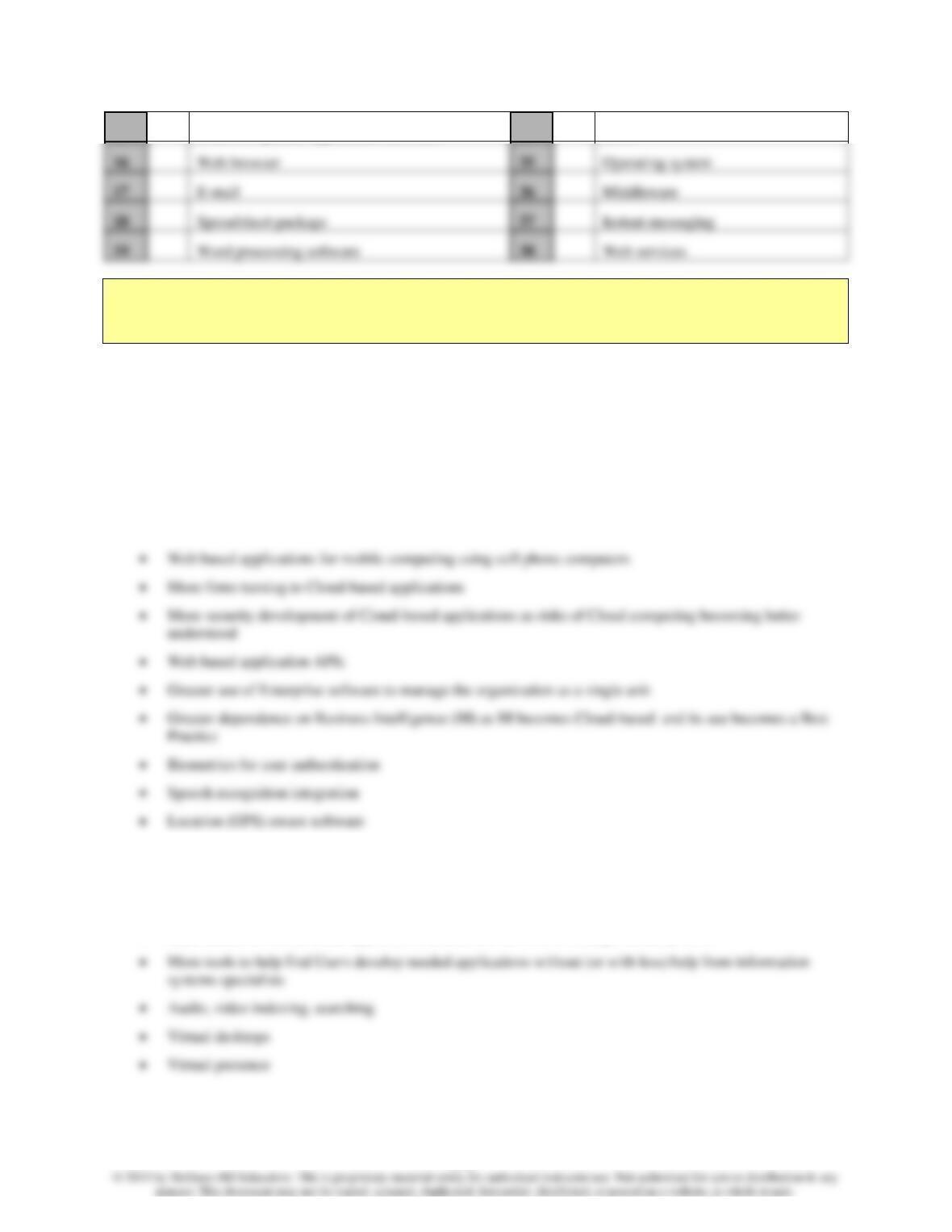
ANSWERS TO REVIEW QUIZ
Q.
A.
Key Term
Q.
A.
Key Term
1
Cloud computing
20
Desktop publishing (DTP)
2
Application software
21
Personal information manager (PIM)
3
System software
22
Integrated package
4
Application service provider (ASP)
23
Software suites
5
CASE tools
24
Groupware
6
Custom software
25
Machine language
7
User interface
26
Assembler language
9
Virtual memory
28
Fourth-generation language
10
Multitasking
29
Object-oriented language
11
Presentation graphics software
30
Natural language
12
Language translator
31
Programming language
13
Utilities
32
HTML
14
General-purpose application programs
33
XML
Chapter 04 – Computer Software
4-6
15
Function-specific application software
34
Java
16
Web browser
35
Operating system
17
E-mail
36
Middleware
18
Spreadsheet package
37
Instant messaging
19
Word processing software
38
Web services
ANSWERS TO DISCUSSION QUESTIONS
1. What major trends are occurring in software? What capabilities do you expect to see in future software
packages?
Trends
• Americans with Disabilities Act (ADA) compliance
• Applications updates and error reporting
• Applications interoperability via open source standards
• Open source applications
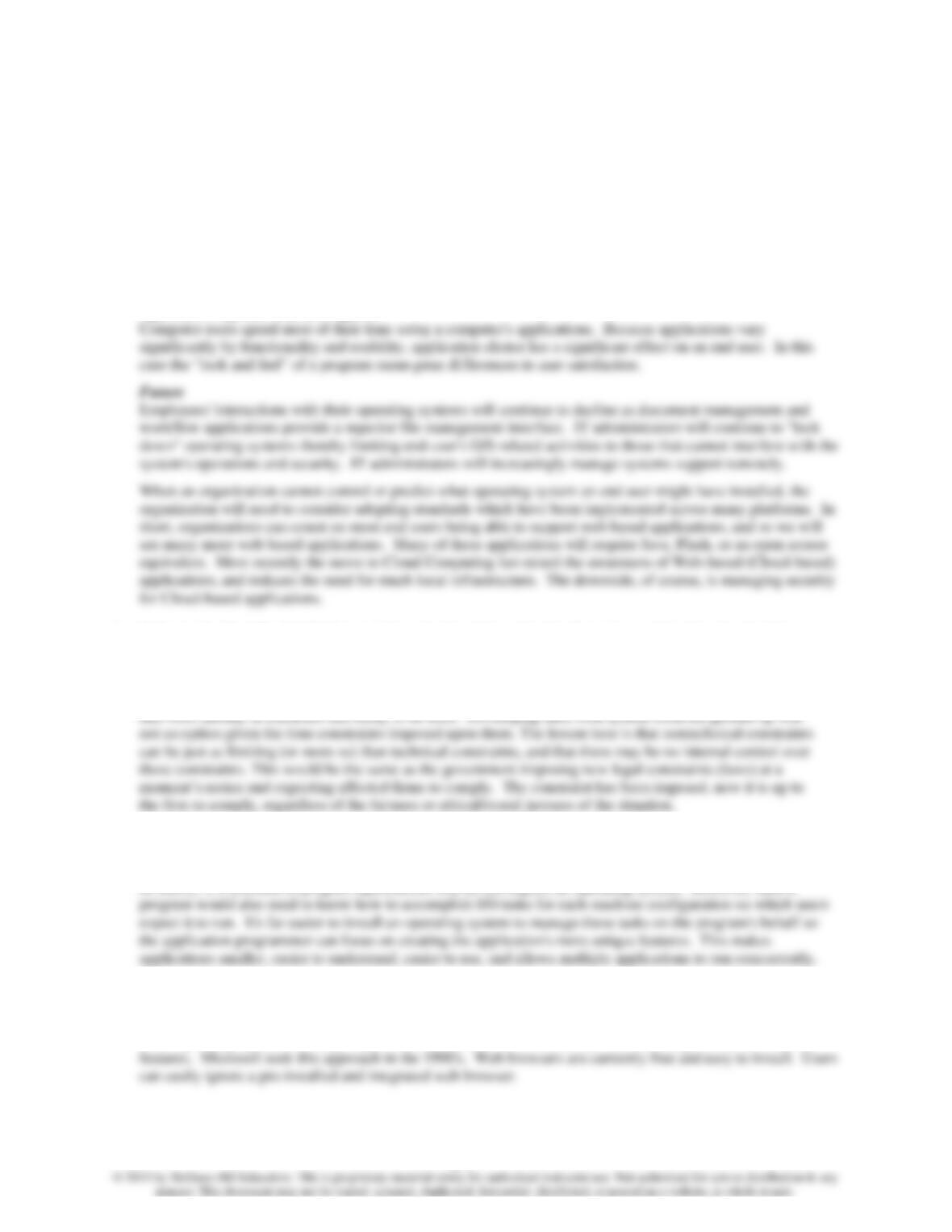
Future capabilities
• Ad-hoc workflow design and collaboration tools supporting instant teams and team management.
• At home medical diagnostics and monitoring with various input devices for vital signs and at home tests
• Dependence on Cloud-based applications and mobile devices to manage our daily lives
Chapter 04 – Computer Software
4-7
2. How do the different roles of system software and application software affect you as a business end user?
How do you see this changing in the future?
System software end-user effects
O/S choice affects a machine’s look and feel, but these differences are relatively minor. Therefore an
organization’s operating system choice should have little effect on the end user. The O/S choice impacts which
applications can run on a computer, but even that limitation is fading with the increasing popularity of virtual
machines and web based applications.
Application software end-user effects
3. Refer to the Real World Challenge in the chapter. Given the timelines imposed by the privatization
process, were there really any alternatives from which Japan Post Network could choose? What is the
lesson here about nontechnical constraints that are imposed on this type of project?
No, in all actuality, there was not enough time for Japan Post Network to do anything but look at products
4. Why is an operating system necessary? That is, why can’t an end user just load an application program
into a computer and start computing?
In theory, it is possible to program applications that do not require an operating system. However, such a
5. Should a Web browser be integrated into an operating system? Why or why not?
Pro
If the operating system isn’t fully “open“, then a bundled web browser can take advantage of the OS’s secret
Chapter 04 – Computer Software
4-8
6. Refer to the Real World Solution in the chapter. Is there a danger that the development expertise of
companies may slowly atrophy as they rely more and more on predesigned, external components for
assembling their applications? Is this a good thing or a bad thing?
If a firm relies more and more on predesigned external components, then it will have less experience with full
systems development as a natural response to the reality of its chosen mode of systems development. However,
7. Are software suites, Web browsers, and groupware merging together? What are the implications for a
business and its end users?
Yes.
Implication for business
• Increased ability to partner with customers/suppliers
8. How are HTML, XML, and Java affecting business applications on the Web?
Effects
• These standards enable more sophisticated applications with larger user bases.
• These are vital tools for building multimedia web pages, web sites, and web-based applications.
Chapter 04 – Computer Software
4-9
9. Do you think Linux will surpass, in adoption and use, other operating systems for network and Web
servers? Why or why not?
Organizations are increasingly purchasing commercial versions of Linux such as Red Hat Enterprise Linux for
several reasons.
• Stability (very high mean-time between failures)
10. Which application software packages are the most important for a business end user to know how to use?
Explain the reasons for your choices.
Important applications:
Groupware (and messaging) – enables basic collaboration activities such as e-mail (including sending and
receiving attachments), calendar, schedule, task, and discussion (or “chat”) capabilities. This allows people to
Chapter 04 – Computer Software
4-10
ANSWERS TO ANALYSIS EXERCISES
1. Desktop Application Recognition: Tool Selection
a. Surf the Web and their intranets and extranets.
Web browser
b. Send messages to one another’s computer workstations.
E-Mail
f. Type correspondence and reports.
Word processing software
g. Analyze rows and columns of sales figures.
Spreadsheet software
h. Develop a variety of graphical presentations.
Graphics software package
2. Y2K Revisited: The End of Time
Note: this is our chance to learn from history. This is especially significant as this problem will manifest itself
during our student’s careers.
a. If 1 represents 1 second and 2 represents 2 seconds, how many seconds can be represented in a binary
number 32 bits long? Use a spreadsheet to show your calculations.
b. Given that POSIX time starts at midnight, January 1, 1970, in what year will time “run out”? Remember
that half the available numbers represent dates before 1970. Use a spreadsheet to show your calculations.
c. As a business manager, what can you do to minimize this problem for your organization?
Mitigation steps come directly from lessons learned from past experience. Do not trust your organization’s IT
Chapter 04 – Computer Software
4-11
Tips:
1) Develop and maintain an inventory of all affected hardware and software systems upon which your
organization depends.
3. Tracking Project Work
a. Build a database table to store the data shown and enter the records as a set of sample data.
See Data Solutions Disk for a sample database application [Chapter 04 – Solutions.mdb]
b. Create a query that will list the hours worked for all workers who worked more than 40 hours during
production week 20.
See Data Solutions Disk for a sample database application [Chapter 04 – Solutions.mdb]
4. Matching Training to Software Use: 3-D Graphing
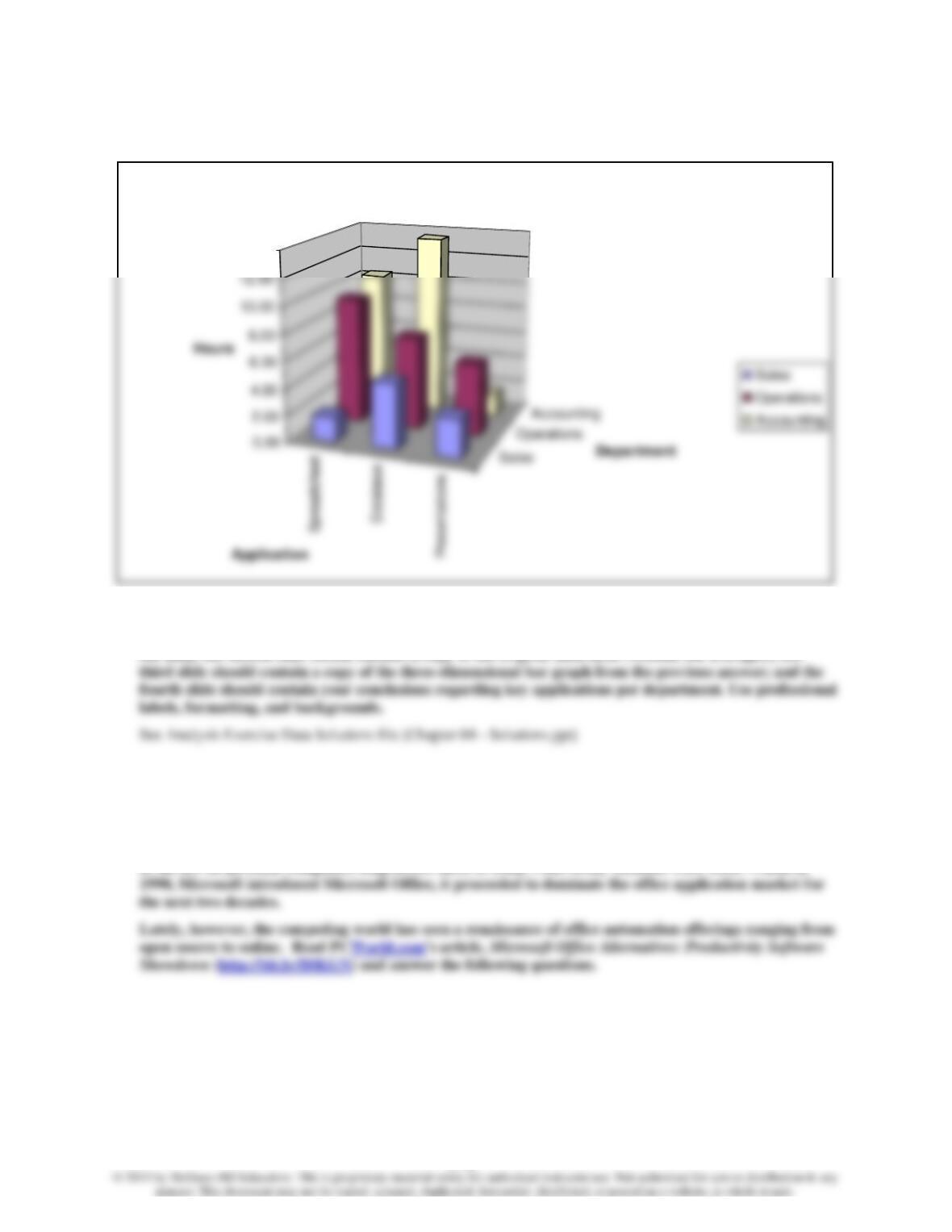
a. Create a spreadsheet illustrating each application’s average use per department. To do this, you will first
enter the data shown above. Then compute the average weekly spreadsheet use by dividing spreadsheet
hours by the number of Sales workers. Do this for each department. Repeat these three calculations for
both database and presentation use. Round results to the nearest 1/100th.
Department
Spreadsheet
Database
Presentations
Sales
1.82
4.89
2.89
9.47
6.93
5.40
Chapter 04 – Computer Software
4-12
b. Create a three-dimensional bar graph illustrating the averages by department and software package.
14.00
Hours Per Week
c. A committee has been formed to plan software training classes at your company. Prepare a slide
presentation with four slides illustrating your findings. The first slide should serve as an introduction to
the data; the second slide should contain a copy of the original data table (without the averages); the
5. Office Automation Suites: Not Always Microsoft
WordStar, VisiCalc, dBase, Harvard Graphics – does any of this software sound familiar? These were
word processing, spreadsheet, database and presentation software applications that represented the state
of the art on personal computers long before most of today’s university students were born. When, in
Chapter 04 – Computer Software
a) Have you used any of the products mentioned in the article? If so, briefly describe your experience.
This author has used Google Docs and Open Office. Both were easy to use, and both could accomplish basic
b) Use a spreadsheet to create a table to make side–by-side comparisons of each product listed in the article.
Organize the products in columns and the features in rows. Sort the features logically. Use an “X” to
indicate which products have which features.
c) Select one of the five products mentioned in the article, explore it in detail, and report your results. Do
your results match up with the matrix you created in the previous question?
ANSWERS TO REAL WORLD CHALLENGE/SOLUTION
Real World Challenge
1. What will be the business model of the new Japan Post Network? How will it be different from what was
done when all companies worked together as Japan Post? How will the new applications support, or
enable, that business model?
a) New business model
• one holding company
Chapter 04 – Computer Software
4-14
2. What are some of the challenges that Japan Post Network and its employees and customers will face as
the company seeks to roll out these new applications in such a short time frame?
Challenges
• training
3. Why do you think Japan Post Network opted for a formal, public, competitive bidding process? What
are the advantages and disadvantages of taking this approach? What were they looking to accomplish?
a) Why a public process?
• transparency (public opinion)
• optimal price/solution
Real World Solution
1. What are the disadvantages, if any, of relying on cloud computing and Software as a Service for the
provision of mission-critical applications such as the one enabling the cross-selling of products and
services from other companies in the group? What are the most important factors that management
should assess as they select these providers?
a) Disadvantages
• lack of direct oversight, management, and accountability over mission critical systems
Chapter 04 – Computer Software
4-15
b) Important factors
These are all components of “risk”
• reliability
2. The majority of the development for the two systems discussed here was achieved by putting together
components that already existed in the Force.com platform. Is this the best approach – or even possible
one – for all kinds of systems (e.g., strategic, functional, and so forth)?
Building from components
• decreases development time
ANSWERS TO REAL WORLD CASES
RWC 1: GE, H.B. Fuller Co., and Others
Case Study Questions
1. What factors should companies take into consideration when making the decision between developing their own
applications, purchasing them from a vendor, or taking the SaaS route, as discussed here? Make a list of factors
and discuss their importance to this decision.
Factors:
• Security
• Flexibility
Chapter 04 – Computer Software
4-16
2. What risks did GE take on when they contracted with a small and less experienced vendor? What contingencies
could have been put in place to prevent any problems from arising? Provide several examples.
Risks:
Ordinarily, potential customers would worry about whether or not the small company would stay in business or be able
to scale up operations as its client base grows.
Contingencies:
As a general practice, an organization can protect itself by working closely with the small vendor. This would help
3. What should companies do if none of the “configuration options” perfectly fits with their needs? Should they
attempt to customize, or select the least-worst alternative? When would they do each?
Options:
• Customize
• Influence the next release
Real World Activities
1. The case mentions that GE’s implementation of SaaS was, at the time, the largest rollout of the technology in
the world. What other companies have started using SaaS extensively since? Go online and research recent
implementations. How are those different from GE’s experience? Prepare a report to share your findings.
2. By implementing systems based on SaaS, companies are relinquishing control over ownership of the technology
and are putting access to valuable data on the hands of a third party. What are the perils of taking this
approach? How could companies guard against them? Break into small groups to discuss these issues and
provide some suggestions and recommendations.
Chapter 04 – Computer Software
4-17
Perils:
• Theft
RWC 2: U.S. Department of Defense
Case Study Questions
1. Given the critical nature of defense activities, security in this environment is a primary concern. How do
the agencies discussed in the case address this issue? Can you think of anything else they could be doing?
Provide some recommendations.
Security
2. The U.S. Department of Defense is arguably one of the largest organizations in the world. Managing
technology for such an organization is certainly a major endeavor. Does the shift toward open-source
initiatives help in this regard? Does it hurt? Discuss the advantages and disadvantages of adopting open–
source applications in large organizations.
Advantages
• Increased programmer pool
3. After reading the case, do you think the shift to opensource software involved a major cultural change for
the Department of Defense? Would you expect the same to be the case for large companies? Justify your
answer.
Cultural impact
Yes, the shift to opensource software involves a major cultural shift for any large organization. Required
Chapter 04 – Computer Software
Real World Activities
1. Small open-source applications have been around for quite some time, but large-scale open-source
systems have begun to emerge. Go online and search the Internet for examples of businesses adopting
open-source technologies for major organizational systems. Prepare a presentation to highlight several
examples from your research.
2. How does the open-source model of application development and distribution differ from the more
common, proprietary approach? Do open-source applications present a legitimate threat to commercial
software development, or will they remain niche applications? Break into small groups to discuss various
reasons that the companies may or may not want to adopt opensource technologies.
Propriety software differences
Note that proprietary software differs depending on whether or not a 3rd party developed and supports the
software or the organization developed its own proprietary software in-house.