1 Instructor’s Manual – Chapter 4 | Ferrell / Hirt / Ferrell: Business © 2016 by McGraw-Hill Education.
Ferrell / Hirt / Ferrell:
Business
Instructor’s Manual – Chapter 4
Chapter 4: Options for Organizing Business
Use this Instructor’s Manual to facilitate class discussion and incorporate the unique features of the text’s
highlights. Follow-up via the Connect exercises is then encouraged to provide a holistic understanding of the
chapter.
C H A P T E R F O R E C A S T
This chapter examines three primary forms of business ownership—sole proprietorship, partnership, and
corporation—and weighs the advantages and disadvantages of each. These forms are the most often used
L E A R N I N G O B J E C T I V E S
LO 4-2 Identify two types of partnership and evaluate the advantages and disadvantages of the
partnership form of organization.
LO 4-4 Define and debate the advantages and disadvantages of mergers, acquisitions, and leveraged
buyouts.
LO 4-5 Propose an appropriate organizational form for a startup business.
L E A R N T H E T E R M S
acquisition (p. 135)
articles of partnership (p. 121)
corporate charter (p. 127)
initial public offering (IPO) (p.
128)
joint venture (p. 133)
limited partnership (p. 121)
partnership (p. 120)
preferred stock (p. 130)
129)
S corporation (p. 133)
Ferrell / Hirt / Ferrell:
Business
Instructor’s Manual – Chapter 4
K E Y T E R M S A N D D E F I N I T I O N S
acquisition
The purchase of one company by another, usually by buying its
stock.
articles of partnership
Legal documents that set forth the basic agreement between
partners.
board of directors
A group of individuals, elected by stockholders to oversee the
general operation of the corporation, who set the corporation’s
long-range objectives.
common stock
Stock whose owners have voting rights in the corporation, yet do
not receive preferential treatment regarding dividends.
cooperative (co-op)
An organization composed of individuals or small businesses that
have banded together to reap the benefits of belonging to a larger
organization.
corporate charter
A legal document that the state issues to a company based on
information the company provides in the articles of incorporation.
corporation
A legal entity, created by the state, whose assets and liabilities are
separate from its owners.
dividends
Profits of a corporation that are distributed in the form of cash
payments to stockholders.
general partnership
A partnership that involves a complete sharing in both the
management and the liability of the business.
initial public offering
(IPO)
Selling a corporation’s stock on public markets for the first time.
joint venture
A partnership established for a specific project or for a limited time.
leveraged buyout (LBO)
A purchase in which a group of investors borrows money from banks
and other institutions to acquire a company (or a division of one),
using the assets of the purchased company to guarantee repayment
of the loan.
limited liability company
Form of ownership that provides limited liability and taxation like a
partnership but places fewer restrictions on members.
3 Instructor’s Manual – Chapter 4 | Ferrell / Hirt / Ferrell: Business © 2016 by McGraw-Hill Education.
Ferrell / Hirt / Ferrell:
Business
Instructor’s Manual – Chapter 4
limited partnership
A business organization that has at least one general partner, who
assumes unlimited liability, and at least one limited partner, whose
liability is limited to his or her investment in the business.
merger
The combination of two companies (usually corporations) to form a
new company.
nonprofit corporations
Corporations that focus on providing a service rather than earning a
profit but are not owned by a government entity.
partnership
A form of business organization defined by the Uniform Partnership
Act as “an association of two or more persons who carry on as co-
owners of a business for profit.”
preferred stock
A special type of stock whose owners, though not generally having a
say in running the company, have a claim to profits before other
stockholders do.
private corporation
A corporation owned by just one or a few people who are closely
involved in managing the business.
public corporation
A corporation whose stock anyone may buy, sell, or trade.
quasi-public
corporations
Corporations owned and operated by federal, state, or local
government.
S corporation
Corporation taxed as though it were a partnership with restrictions
on shareholders.
sole proprietorships
Businesses owned and operated by one individual; the most
common form of business organization in the United States.
stock
Shares of a corporation that may be bought or sold.
Ferrell / Hirt / Ferrell:
Business
Instructor’s Manual – Chapter 4
C O N T E N T O U T L I N E
The following section provides the flow of information using the LEARNING OBJECTIVES as a guide, KEY TERMS
learners will need to take away from the course and a notation of when to use POWERPOINT SLIDES with
LECTURE NOTES to drive home teaching points. There is also a reminder on when CONNECT activities can be
used. This is created so that you can facilitate in–class or online discussion effectively.
LO 4-1
Define and examine the advantages and disadvantages of the sole
proprietorship form of organization.
• Introduction
• Sole Proprietorships
• Advantages of Sole Proprietorships
• Disadvantages of Sole Proprietorships
Key Terms:
• Sole proprietorships
PowerPoint Slides
PPT 4.4
connect
Need help
understanding Forms
of Business? Visit
your Connect ebook
video tab for a brief
animated
explanation.
Lecture Outline and Notes:
I. Introduction
A. There are three principal forms of organizing a business, whether it is a
traditional “brick and mortar” organization, or a virtual corporation that
does business exclusively through the Internet.
B. The three primary forms of business that we will examine are Sole
proprietorship, Partnership, and Corporation. (Table 4.1 & Figure 4.1))
1. Proprietorships far outnumber corporations, but they net far fewer
sales and less income.
2. Partnerships are the least used form of business.
3. Corporations account for the majority of all U.S. sales and income
but represent a relatively small number of organizations in the
2. Typically small businesses employing fewer than 50 people.
5 Instructor’s Manual – Chapter 4 | Ferrell / Hirt / Ferrell: Business © 2016 by McGraw-Hill Education.
Ferrell / Hirt / Ferrell:
Business
Instructor’s Manual – Chapter 4
PPT 4.6
B. Advantages of Sole Proprietorships
1. They have the advantage of a simple management structure and the
ability to make quick decisions.
2. Ease and Cost of Formation
a. Forming a proprietorship is easy and inexpensive, requiring only
state and local licenses and permits where applicable.
suitable site from which to operate the business.
c. Many small businesses started out in their founders’ garages.
3. Sole proprietorships have the advantage of secrecy as operating
a. This control allows the proprietor to respond quickly to
competitive conditions or to changes in the economy.
6. Sole proprietorships have the greatest degree of freedom from
government regulation.
a. Nonetheless, proprietors must ensure that the follow all laws
7. Taxation
a. Profits from the business are considered the personal income of
or profit-sharing account, which is exempt from current income
tax.
8. A sole proprietorship can be dissolved easily; the only legal condition
business; if the business cannot pay its obligations, the owner’s
personal, nonbusiness holdings might have to be used to pay the
debt.
Ferrell / Hirt / Ferrell:
Business
Instructor’s Manual – Chapter 4
PPT 4.7
2. Limited Sources of Funds
a. There are a limited number of financial sources from which the
sole proprietor can borrow (bank, friends, family, and the Small
Business Administration).
c. The proprietor may have to pledge personal assets to guarantee
loans.
3. The sole proprietor must be able to perform many functions and
possess skills in diverse areas such as management, marketing,
finance, accounting, and personnel.
4. The life expectancy of a sole proprietorship is directly related to that
of the owner and his or her ability to work.
5. It is usually difficult for a small sole proprietorship to offer the same
wages, benefits, and advancement possibilities that are often found
in a large corporation.
6. Taxation
a. Under current tax rates, sole proprietors pay a higher marginal
tax rate than do small corporations on income of less than
LO 4-2
Identify two types of partnership and evaluate the advantages and
disadvantages of the partnership form of organization.
o Types of Partnership
o Articles of Partnership
o Taxation of Partnerships
Key Terms:
• Partnership
• Limited partnership
• Articles of partnership

Ferrell / Hirt / Ferrell:
Business
Instructor’s Manual – Chapter 4
PPT 4.9
PPT 4.10
III. Partnerships
A. Most states have a model law governing partnerships based on the
Uniform Partnership Act, which defines a partnership as “an association
of two or more persons who carry on as co-owners of a business for
profit.”
1. Partnerships are the least used form of business organization.
B. Keys to success in a partnership include: (Table 4.2)
1. Keeping profit sharing and ownership equal
2. Partners’ skill sets should complement each other
3. Honesty is critical
4. Maintain face-to-face communication
5. Maintain transparency
6. Be aware of funding constraints so one partner does not get stuck
with additional debt
7. To be successful, you need experience. So, tailor your business to
your skills.
can enjoy your family.
9. Do not fall in love with “the idea” and forget to actually implement
10. Be optimistic but also realistic in terms of sales, growth, and
planning.
C. Types of Partnership
1. A general partnership involves partners sharing completely the
management of a business and the liability for its debts.
2. A limited partnership has at least one general partner who assumes
unlimited liability and at least one limited partner whose liability is
a. Limited partnerships exist for risky investment projects where
the chance of loss is great.
management of the business, but they share in the profits.

Ferrell / Hirt / Ferrell:
Business
Instructor’s Manual – Chapter 4
PPT 4.11
D. Articles of Partnership (Table 4.3)
1. Articles of partnership are legal documents that set forth the basic
agreement between partners.
2. Usually specify the money or assets each partner has contributed to
the partnership (called partnership capital); each partner’s
individual management role or duty; how the profits and losses of
the partnership will be divided among the partners; and how a
partner may leave the partnership and any other restrictions that
might apply to the agreement.
E. Advantages of Partnerships
1. Ease of Organization
c. The name of the partnership should be registered with the
state.
2. Availability of Capital and Credit
d. When a business has several partners, the partnership can rely
3. Partnerships can provide diverse skills because partners are able to
specialize in their areas of expertise.
the public corporation.
F. Disadvantages of Partnerships
2. Partnerships may be subject to disagreements when the goals and
objectives of one partner change; many partnership disputes wind
up in court.
3. Unlimited Liability
a. In general partnerships, the general partners have unlimited
liability for total debts the business incurs; this disadvantage
increases if one partner has greater personal financial resources.
lose their initial investment.
4. All partners are responsible for the business actions and decisions of
all other partners.

Ferrell / Hirt / Ferrell:
Business
Instructor’s Manual – Chapter 4
PPT 4.12
5. Life of Partnership
a. A partnership is terminated upon the death or withdrawal of a
partner.
b. In very large partnerships, provisions for continuation of the
7. Limited Sources of Funds
a. There are limits to sources of funds (capital) available to a
partnership because there is no public value placed on the
G. Taxation of Partnerships
1. Partnerships are quasi-taxable organizations, which means they do
not pay taxes; the individual partners report their share of the profits
top search engine.
LO 4-3
Describe the corporate form of organization and cite the
advantages and disadvantages of corporations.
o Disadvantages of Corporations
Key Terms:
• Corporation
• Quasi-public corporations
• Nonprofit corporations
• Board of directors
• Limited liability company
• Cooperative (co-op)
10 Instructor’s Manual – Chapter 4 | Ferrell / Hirt / Ferrell: Business © 2016 by McGraw-Hill Education.
Ferrell / Hirt / Ferrell:
Business
Instructor’s Manual – Chapter 4
PPT 4.15
PPT 4.16
IV. Corporations
A. A corporation is a legal entity created by the state, with assets and
liabilities distinct from those of the owner of the corporation.
1. Legally, a corporation has many of the rights, duties, and powers of a
2. Represent the majority of sales and income in the U.S.
3. Corporations are typically owned by many individuals and
organizations who own shares of the business, called stock. Thus,
corporate owners are called stockholders or shareholders.
business.
11 Instructor’s Manual – Chapter 4 | Ferrell / Hirt / Ferrell: Business © 2016 by McGraw-Hill Education.
Ferrell / Hirt / Ferrell:
Business
Instructor’s Manual – Chapter 4
PPT 4.18
PPT 4.20
PPT 4.21
d. Articles of incorporation contain basic information about the
business, including:
1) Name and address of the corporation.
2) Objectives of the corporation.
3) Classes of stock (common, preferred, voting, nonvoting) and
the number of shares of each class of stock to be issued.
4) Expected life of the corporation (usually forever).
5) Financial capital required at the time of incorporation.
7) Provisions for the regulation of internal corporate affairs.
9) Names and addresses of the initial board of directors.
2. Based on the information in the articles of incorporation, a
The then owners establish the corporation’s bylaws and elect a
board of directors.
C. Types of Corporations
1. A corporation doing business in the state in which it is chartered is a
domestic corporation.
2. When a corporation does business in other states, it is then referred
incorporated, it is termed an alien corporation. (Table 4.4)
4. A private corporation is owned by only one person or a few people
closely involved in its management.
a. Private corporations do not offer stock for sale to the public.
Ferrell / Hirt / Ferrell:
Business
Instructor’s Manual – Chapter 4
PPT 4.22
5. A public corporation is one whose stock anyone may buy, sell, or
trade.
a. Publicly-owned corporations must disclose financial information
to the public under specific laws that regulate the trade of stocks
and other securities.
b. A private corporation may “go public” through an initial public
offering (IPO) by selling its stock so that it can be traded in
public markets.
c. Public corporations may be “taken private” when one or a few
individuals purchase all of the firm’s stock so that it can no
longer be traded publicly.
American Lung Association, the American Red Cross, museums, and
private schools.
1. The Board of Directors
a. The board of directors is elected by the stockholders to oversee
the general operation of the corporation.
schedule.
c. The board members are legally liable for the mismanagement of
the firm or for any misappropriation of funds.
13 Instructor’s Manual – Chapter 4 | Ferrell / Hirt / Ferrell: Business © 2016 by McGraw-Hill Education.
Ferrell / Hirt / Ferrell:
Business
Instructor’s Manual – Chapter 4
PPT 4.24
PPT 4.25
PPT 4.26
2. Corporations issue two types of stock: preferred and common.
a. Preferred stock usually allows no voting rights but confers
preference in the distribution of company profits.
1) Owners of preferred stock are a special class of owners
because, although they generally do not have any say in
running the company, they have a claim to profits before
other stockholders do.
2) Most preferred stock carries a cumulative claim to
dividends, which means that if preferred stock dividends are
not paid in one year, they accumulate to the next year.
b. Common stock allows the owner voting rights.
say in the operation of the corporation by voting on board
members and other important issues.
new shares of the common stock directly from the
corporation.
E. Advantages of Corporations
2. Stockholders can sell or trade shares of stock without causing the
termination of the corporation.
owners agree to sell it or to liquidate its assets.
4. External Sources of Funds
a. Long-term funds can be raised more easily by a public
corporation than by partnerships or sole proprietorships.
the public.
5. Readily available external financing makes it easier for a business to
expand into national and international markets.
Ferrell / Hirt / Ferrell:
Business
Instructor’s Manual – Chapter 4
PPT 4.29
F. Disadvantages of Corporations
1. The corporation pays taxes on its income, and stockholders pay
taxes on the dividend distributions they receive from the company.
2. The formation of a corporation can be costly and may require the
services of an attorney.
3. Financial and other proprietary information must be disclosed to
shareholders, creditors, and the Securities and Exchange
Commission (SEC)—which oversees the securities of corporations—
4. Employee-Owner Separation
a. Nonowner employees may feel that their work benefits only the
owners.
b. Employee stock ownership plans (ESOPs) give shares of the
boost productivity.
V. Other Types of Ownership
A. Joint Ventures
3. Control of a joint venture may be shared equally, or one partner may
control decision-making.
B. S Corporations
1. An S corporation is a form of business ownership that is taxed as
though it were a partnership.
(individuals, estates, and certain trusts) of shareholders and the
difficulty of formation and operation.
Ferrell / Hirt / Ferrell:
Business
Instructor’s Manual – Chapter 4
PPT 4.30
PPT 4.31
A. Limited Liability Companies
1. A limited liability company (LLC) is a form of business ownership
that provides limited liability but is taxed like a partnership.
2. A major reason for using the LLC form is to protect members’
personal assets; they are also flexible, simple to run, and do not
require the members to hold meetings, keep minutes, or make
resolutions.
B. Cooperatives
1. A cooperative (co-op) is an organization composed of individuals or
small businesses that have banded together to reap the benefits of
belonging to a larger organization. Examples are Oglethorpe Power
Corp., Ocean Spray, and REI.
2. The co-op is set up not to make money for itself but to help its
members make money.
3. The most common example of a co-op is found in farming or
agricultural organizations.
4. Purchasing, distribution, and advertising savings can benefit the co-
op members.
LO 4-4
Define and debate the advantages and disadvantages of mergers,
acquisitions, and leverage buyouts.
Key Terms:
• Merger
• Leverage buyout (LBO)
PPT 4.33
VI. Trends in Business Ownership: Mergers and Acquisitions (Table 4.5)
A. Companies achieve growth and improve profitability by expanding their
operations, often by developing and selling new products or by merging
B. A merger occurs when two companies combine to form a new company
1. Horizontal merger: When firms that make and sell similar products
merge.
3. Conglomerate merger: When firms in unrelated industries merge.

16 Instructor’s Manual – Chapter 4 | Ferrell / Hirt / Ferrell: Business © 2016 by McGraw-Hill Education.
Ferrell / Hirt / Ferrell:
Business
Instructor’s Manual – Chapter 4
PPT 4.36
PPT 4.37
D. An acquisition occurs when one company purchases another usually by
buying its stock.
1. Corporate raider: A company or individual who wants to acquire or
take over another company and first offers to buy some or all of its
stock at a premium in a tender offer.
2. Poison pill: The firm allows stockholders to buy more shares of a
stock at lower prices than the current market value to head off a
hostile takeover.
3. Shark repellant: Management requires a large majority of
stockholders to approve a takeover.
threatened company.
E. A leveraged buyout (LBO) is the purchase of a company by a group of
guarantee repayment of the loan.
1. Merger mania is what happened in the 1980s and 1990s during a
prolonged wave of mergers and acquisitions.
2. Some people view mergers and acquisitions favorably, pointing out
benefit of their stockholders.
3. Mergers can be controversial, with critics arguing that they hurt
companies because management has to focus excessively on
avoiding takeovers.
17 Instructor’s Manual – Chapter 4 | Ferrell / Hirt / Ferrell: Business © 2016 by McGraw-Hill Education.
Ferrell / Hirt / Ferrell:
Business
Instructor’s Manual – Chapter 4
PPT 4.38
PPT 4.39
VII. Build Your Skills—Selecting a Form of Business
A. Ali Bush sees an opportunity to start her own website development
business
B. Ali has a master’s degree in computer science
C. Has most of the computer equipment necessary
1. She needs additional software
D. She feels that she has the ability to take this start-up firm and create a
2. As the business grows, hire the additional full- and/or part-time help
needed and reassess the location of the business
E. Task
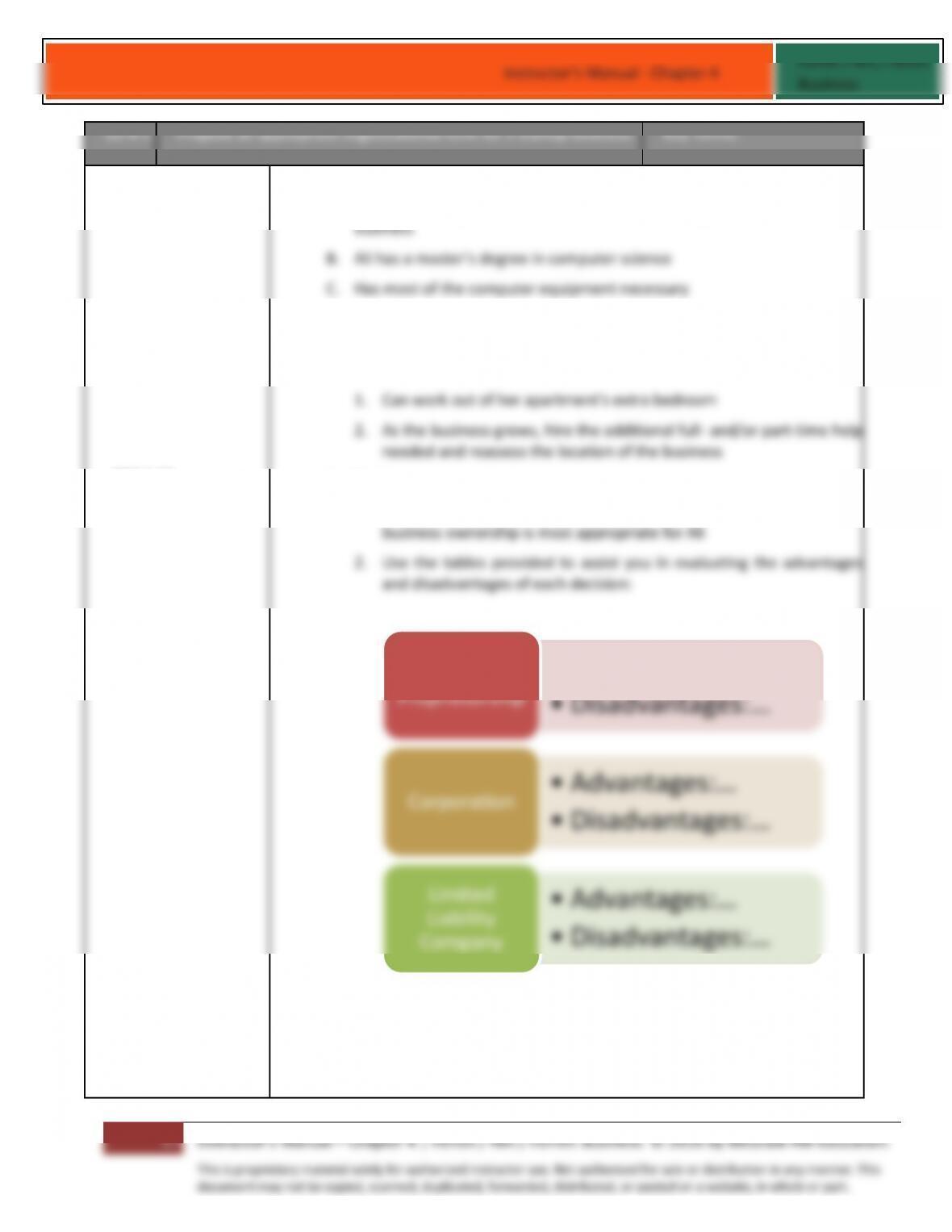
1. Using what you’ve learned in this chapter, decide which form of
• Advantages:…
• Disadvantages:…
Corporation