Solutions for Chapter 4: Questions and Problems
– 23 –
CHAPTER 4
SECURITIES MARKETS AND THE ECONOMY
Answers to Questions
1. A market is a means whereby buyers and sellers are brought together to aid in the transfer
of goods and/or services. It generally has a physical location but does not necessarily
have one. Secondly, there is no requirement of ownership by those who establish and
2. This is a good discussion question for class because you could explore with students what
are some of the alternatives that are used by investors with regards to other assets such as
art and antiques. One primary concern is that you as seller may not know what a fair price
3. Liquidity is the ability to sell an asset quickly at a price not substantially different from
the current market assuming no new information is available. A share of AT&T is very
4. The primary market in securities is where new issues are sold by corporations to acquire
new capital via the sale of bonds, preferred stock or common stock. The sale typically
takes place through an investment banker.
Solutions for Chapter 4: Questions and Problems
5. An example of an initial public offering (IPO) would be a small company selling
company stock to the public for the first time. By contrast, a seasoned equity refers to an
6. Student Exercise
7. In competitive bid the issuer is responsible for specifying the type of security to be
offered, the timing, etc. and then soliciting competitive bids from investment banking
8. As of 2007, The NYSE had approximately 3,000 issues traded, including common and
preferred. NASDAQ NMS had about 2,800 issues and NASDAQ Small Cap had about
9. Level 1 provides a current quote on NASDAQ stocks for brokerage firms that are not
regular OTC customers. It is a median quote that is representative of the quotes of the
several market makers in the particular security. Level 2 is for serious traders who desire
not only current trends but also specific quotes of different market makers. This enables
the broker to make a deal with the market maker offering the best price. Level 3 is for
Solutions for Chapter 4: Questions and Problems
10(b). The fourth market is the direct trading between two parties without a broker intermediary.
Institutions trade in the fourth market since these trades are large volume and
consequently substantial savings can be made by trading directly with a buyer, thus
avoiding commissions.
11(a). A market order is an order to buy/sell a stock at the most profitable ask/bid prices
prevailing at the time the order hits the exchange floor. A market order implies the
11(b). A limit order specifies a maximum price that the individual will pay to purchase the stock
or the minimum he will accept to sell it. Example: Shoppers is selling for $40 – I would
put in a limit buy order for one week to buy 100 shares at $39.
12. The specialist acts as a broker in handling limit orders placed with member brokers.
Being constantly in touch with current prices, he is in a better position to execute limit
orders since it is entered in his books and executed as soon as appropriate. Second, he
13. The purpose of security-market indices is to provide a general indication of the aggregate
market changes or market movements. More specifically, the indices are used to derive
market returns for a period of interest and then used as a benchmark for evaluating the
performance of alternative portfolios. A second use is in examining the factors that
Solutions for Chapter 4: Questions and Problems
– 26 –
influence aggregate stock price movements by forming relationships between market
(series) movements and changes in the relevant variables in order to illustrate how these
14. A characteristic that differentiates alternative market indices is the sample – the size of
the sample (how representative of the total market it is) and the source (whether securities
15. A price-weighted series is an arithmetic average of current prices of the securities
included in the sample – i.e., closing prices of all securities are summed and divided by
16. A value-weighted index begins by deriving the initial total market value of all stocks used
in the series (market value equals number of shares outstanding multiplied by current
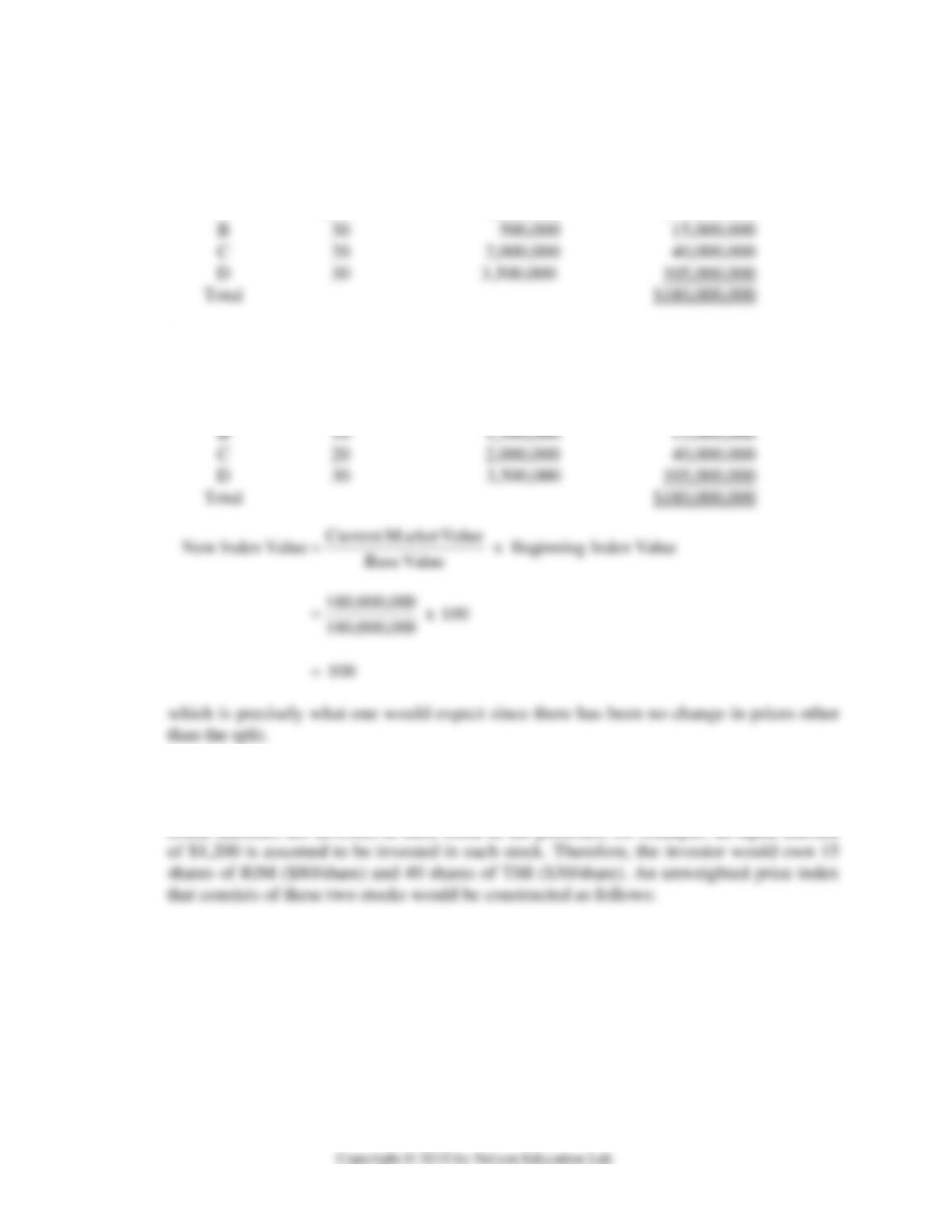
17. Given a four security series and a 2-for-1 split for security A and a 3-for-1 split for
security B, the divisor would change from 4 to 2.8 for a price-weighted series.
Stock Before Split Price After Split Prices
A $20 $10
Solutions for Chapter 4: Questions and Problems
– 27 –
decrease in stock price is offset by an increase in the number of shares outstanding.
Before Split
Stock Price/Share # of Shares Market Value
A $20 1,000,000 $20,000,000
The $180,000,000 base value is set equal to an index value of 100.
After Split
Stock Price/Share # of Shares Market Value
A $10 2,000,000 $20,000,000
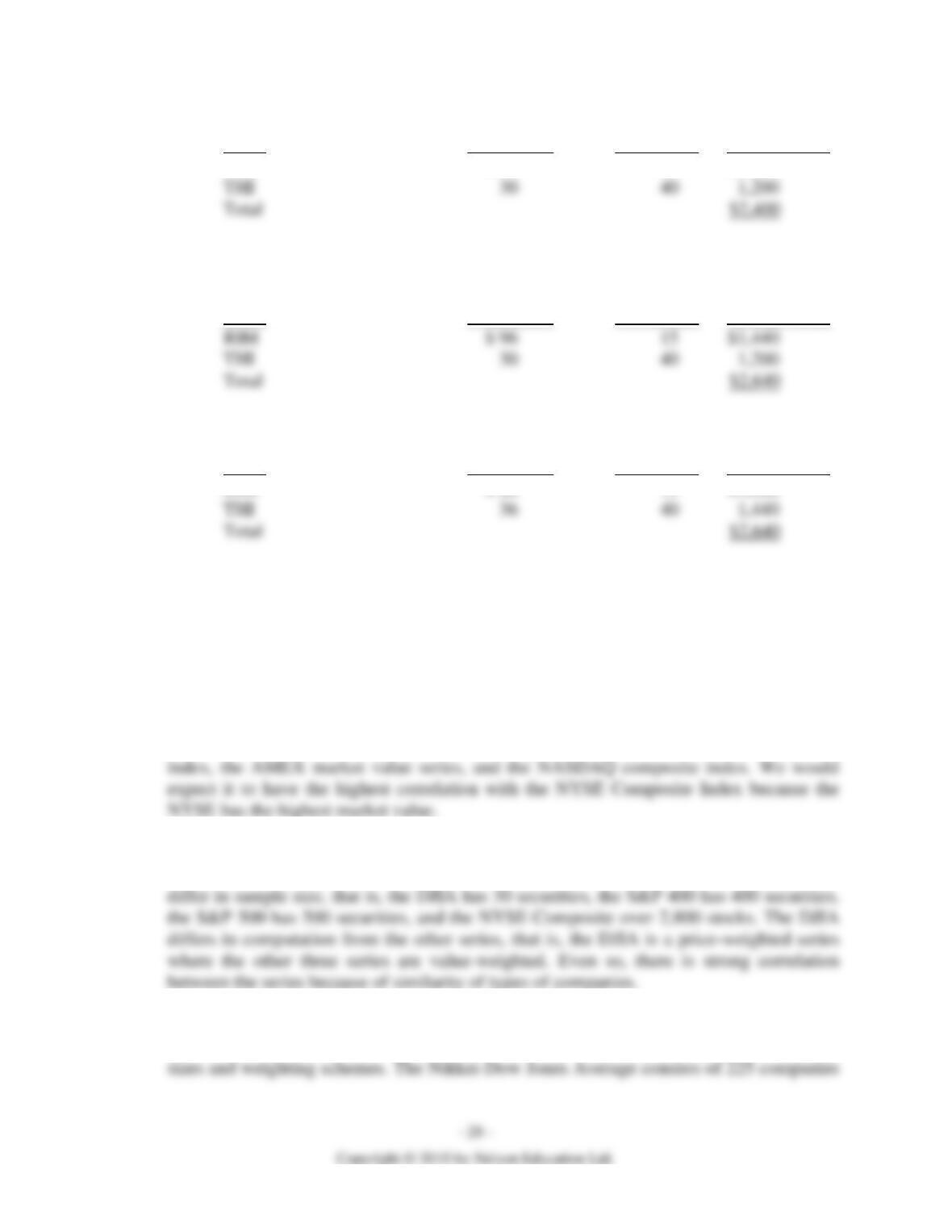
18. In an unweighted price index series (perhaps more appropriately called an “unweighted”
or “equally–weighted” index), all stocks carry equal weight irrespective of their price
and/or their value. One way to visualize an unweighted series is to assume that equal
dollar amounts are invested in each stock in the portfolio, for example, an equal amount
Solutions for Chapter 4: Questions and Problems
Stock Price/Share # of Shares Market Value
RIM $ 80 15 $1,200
A 20% price increase in RIM:
Stock Price/Share # of Shares Market Value
A 20% price increase in THI:
Stock Price/Share # of Shares Market Value
RIM $ 80 15 $1,200
Therefore, a 20% increase in either stock would have the same impact on the total value
of the index (i.e., in all cases the index increases by 10%. An alternative treatment is to
compute percentage changes for each stock and derive the average of these percentage
changes. In this case, the average would be 10% [(20% + 0%) / 2 = 10%]. So in the case
of an unweighted price-index series, a 20% price increase in RIM would have the same
impact on the index as a 20% price increase of THI.
19. Based upon the sample from which it is derived and the fact that is a value-weighted
index, the Wilshire 5000 Equity Index is a weighted composite of the NYSE composite
20. The high correlations between returns for alternative NYSE price index series can be
attributed to the source of the sample (i.e. stock traded on the NYSE). The four series
21. The two price indices (Tokyo SE and Nikkei) for the Tokyo Stock Exchange show a high
positive correlation even though the two indices represent substantially different sample
Solutions for Chapter 4: Questions and Problems
– 29 –
The correlation between the Tokyo SE and the S&P 500 is substantially lower at
0.328.These results support the argument for diversification among countries.
22. Since the equal-weighted series implies that all stocks carry the same weight, irrespective
of price or value, the results indicate that on average all stocks in the index increased by
23. The bond-market series are more difficult to construct due to the wide diversity of bonds
available. Also bonds are hard to standardize because their maturities and market yields
24. Since the Merrill Lynch-Wilshire Capital Markets index is composed of a distribution of
25. One would expect that the level of correlation between the various world indices should
26. High yield bonds (ML High Yield Bond Index) have definite equity characteristics.
27. Indices with the broadest representation of U.S. stocks include the Wilshire 5000, the
NYSE Composite, and possibly the NASDAQ composite. These indices would be
Solutions for Chapter 4: Questions and Problems
– 30 –
CHAPTER 4
Answers to Problems
1(a). Assume you pay cash for the stock:
Number of shares you could purchase = $40,000/$80 = 500 shares.
1(b). Assuming you use the maximum amount of leverage in buying the stock, the leverage
factor for a 60% margin requirement is = 1/percentage margin requirement = 1/.60 = 5/3.
Thus, the rate of return on the stock if it is later sold at $100 a share = 25.00% × 5/3 =
41.67%. In contrast, the rate of return on the stock if it is sold for $40 a share:
= -50.00% × 5/3 = -83.33%.
2(a). Since the margin is 40% and Shali currently has $50,000 on deposit in her margin
account, if Shali uses the maximum allowable margin her $50,000 deposit must represent
Solutions for Chapter 4: Questions and Problems
– 31 –
2(c).
where Market Value = Price per share × Number of shares.
Initial Loan Value = Total Investment – Initial Margin.
= $125,000 – $50,000 = $75,000
3. Profit = Ending Value – Beginning Value + Dividends – Transaction Costs – Interest
Beginning Value of Investment = $20 × 100 shares = $2,000
Your Investment = margin requirement
= (.55 × $2,000) = $1,100
Ending Value of Investment = $27 × 100 shares
= $2,700
ValueMarket
BalanceDebit – ValueMarket
Margin =
Solutions for Chapter 4: Questions and Problems
– 32 –
4. Profit on a Short Sale = Begin.Value – Ending Value – Dividends – Trans. Costs – Interest
Beginning Value of Investment = $56.00 × 100 shares = $5,600
(sold under a short sale arrangement)
Your investment = margin requirement
= (.45 × $5,600) = $2,520
5(a). I want to protect some of the profit I have; should prices drop I will still have a profit of
$15/share.
5(b). With the stop loss: ($40 – $25)/$25 = 60%
Without the stop loss: ($30 – $25)/$25 = 20%
6(b). Assuming that you used the maximum leverage in buying the stock, the leverage factor
for a 60% margin requirement is = 1/margin requirement = 1/.60 = 1.67. Thus, the rate of
Solutions for Chapter 4: Questions and Problems
– 33 –
8(a). Given a three security series and a price change from period t to t+1, the percentage
change in the series would be 42.85%.
Period t Period t+1
A $ 60 $ 80
B 20 35
8(b). Period t
Stock Price/Share # of Shares Market Value
A $60 1,000,000 $ 60,000,000
B 20 10,000,000 200,000,000
C 18 30,000,000 540,000,000
Total $800,000,000
Solutions for Chapter 4: Questions and Problems
– 34 –
8(c). The percentage change for the price-weighted series is a simple average of the
differences in price from one period to the next. Equal weights are applied to each price
change.
The percentage change for the value-weighted series is a weighted average of the
9(a). Period t
Stock Price/Share # of Shares Market Value
A $60 16.67 $ 1,000,000
B 20 50.00 1,000,000
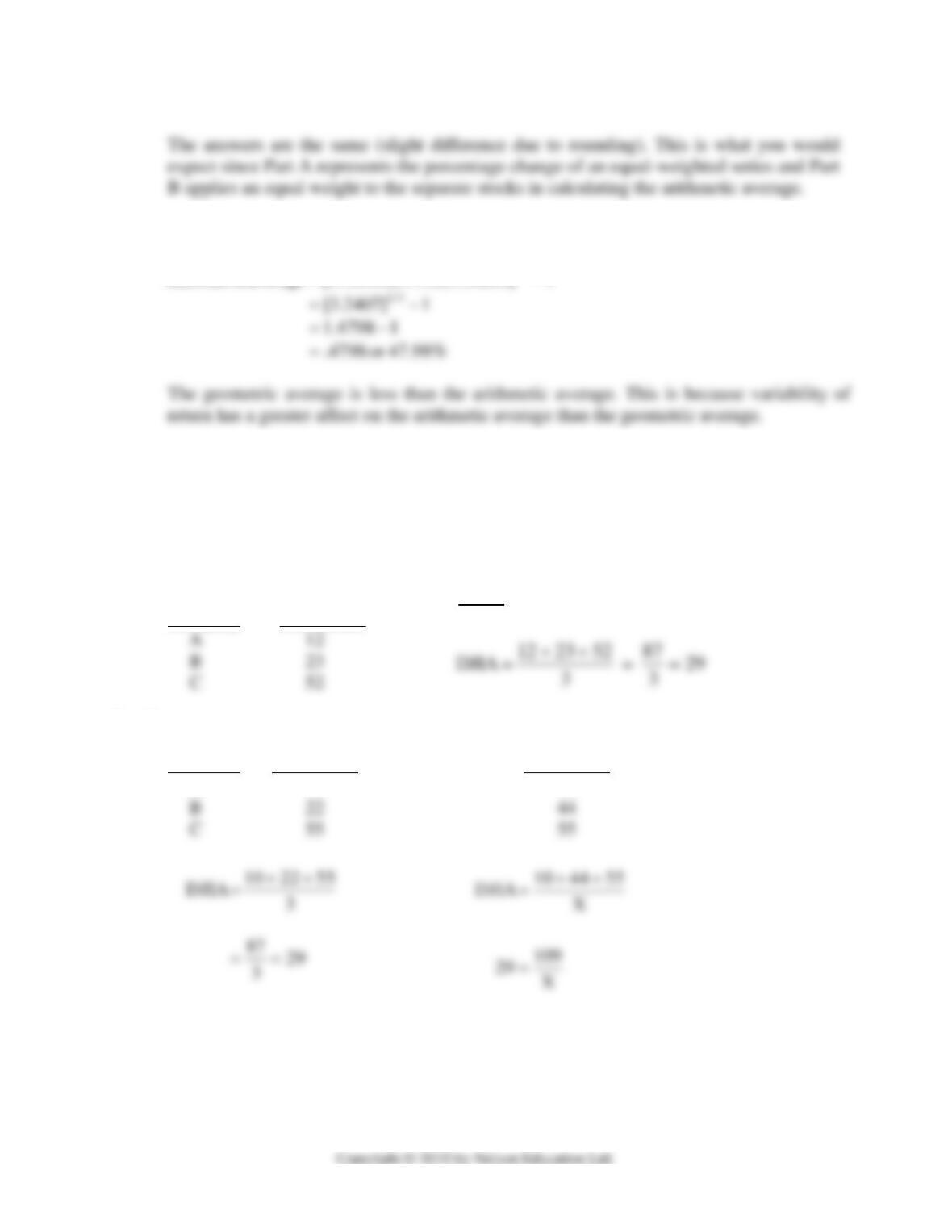
9(b).
%33.33
60
20
60
6080
A
==
−
=
Solutions for Chapter 4: Questions and Problems
– 35 –
9(c). Geometric average is the nth root of the product of n items.
10. Student Exercise
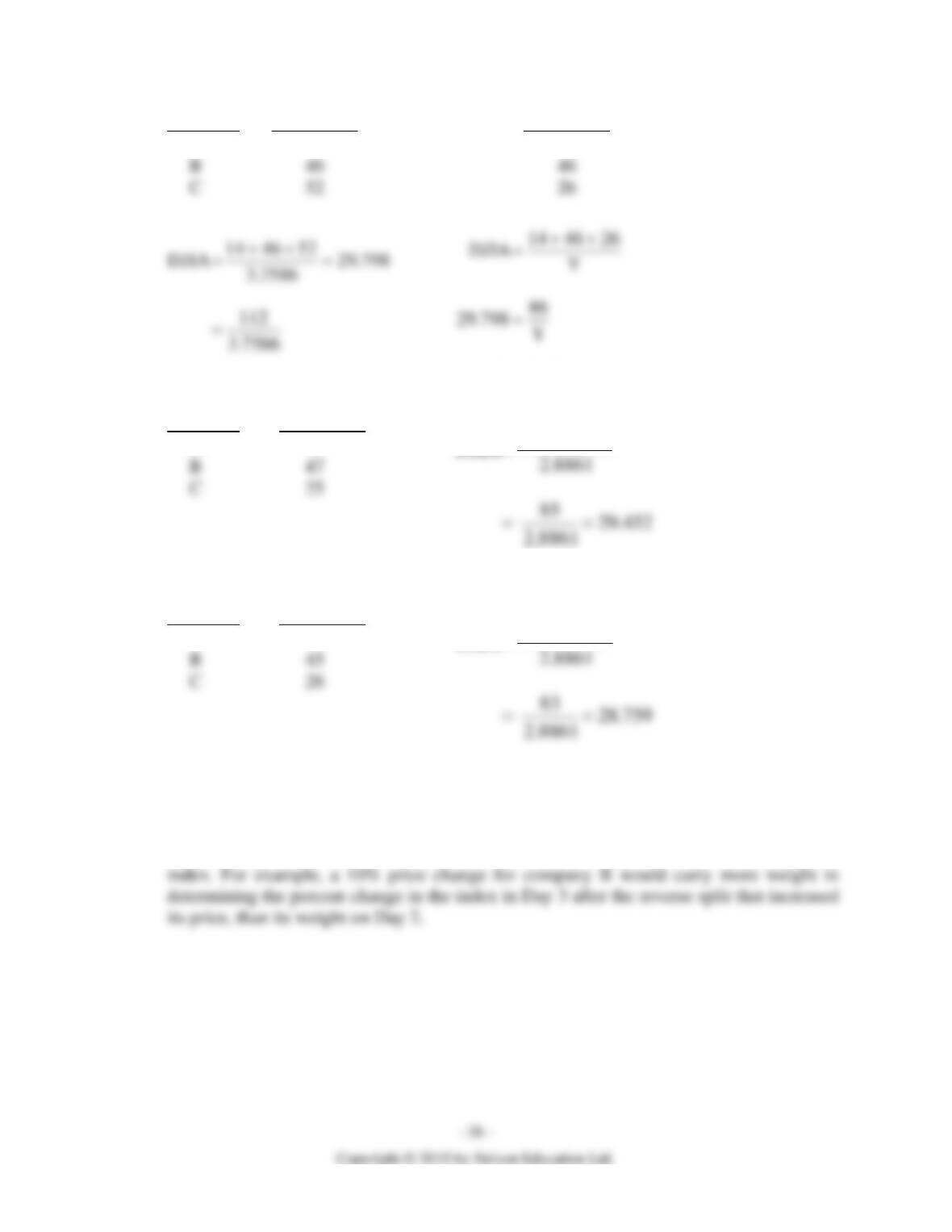
11(a).
Day 1
Company Price/Share
Day 2
(Before Split) (After Split)
Company Price/Share Price/Share
A 10 10
Day 3
(Before Split) (After Split)
1(1.3889)] (1.75) [(1.3333) average Geometric
1/3
−=
=
=
30
1i adjit D/P DJIA
divisor) (new 3.7586X
=
Solutions for Chapter 4: Questions and Problems
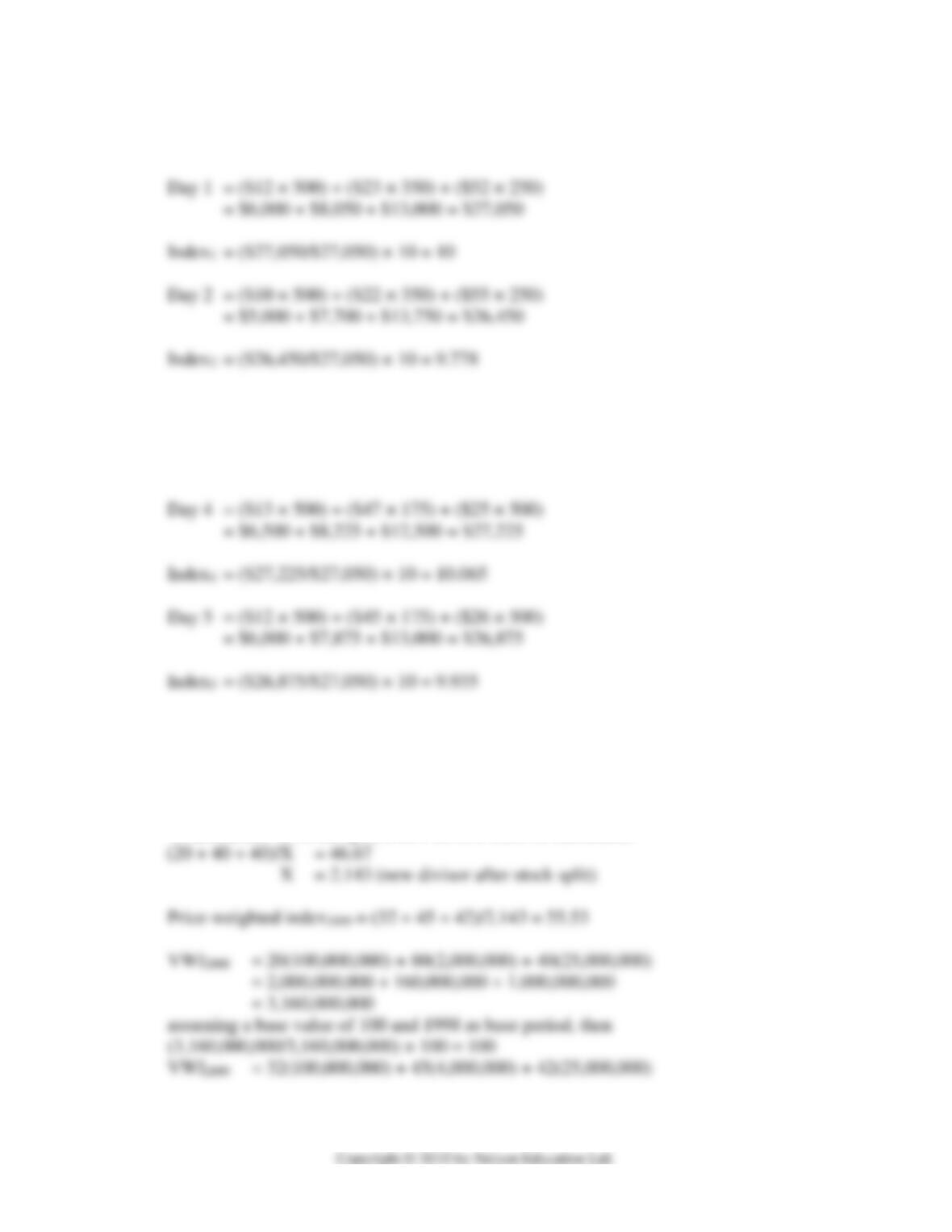
Company Price/Share Price/Share
A 14 14
Day 4
Company Price/Share
A 13
Day 5
Company Price/Share
A 12
11(b). Since the index is a price-weighted average, the higher priced stocks carry more weight.
But when a split occurs, the new divisor ensures that the new value for the series is the
same as it would have been without the split. Hence, the main effect of a split is just a
repositioning of the relative weight that a particular stock carries in determining the
divisor) (new 2.8861Y
=
25 47 13
++
26 45 12
DJIA
++
=
Solutions for Chapter 4: Questions and Problems
– 37 –
12(a). Base = ($12 × 500) + ($23 × 350) + ($52 × 250)
= $6,000 + $8,050 + $13,000 = $27,050
Day 3 = ($14 × 500) + ($46 × 175) + ($52 × 250)
= $7,000 + $8,050 + $13,000 = $28,050
Index3 = ($28,050/$27,050) × 10 = 10.370
12(b). The market values are unchanged due to splits and thus stock splits have no effect. The
index, however, is weighted by the relative market values.
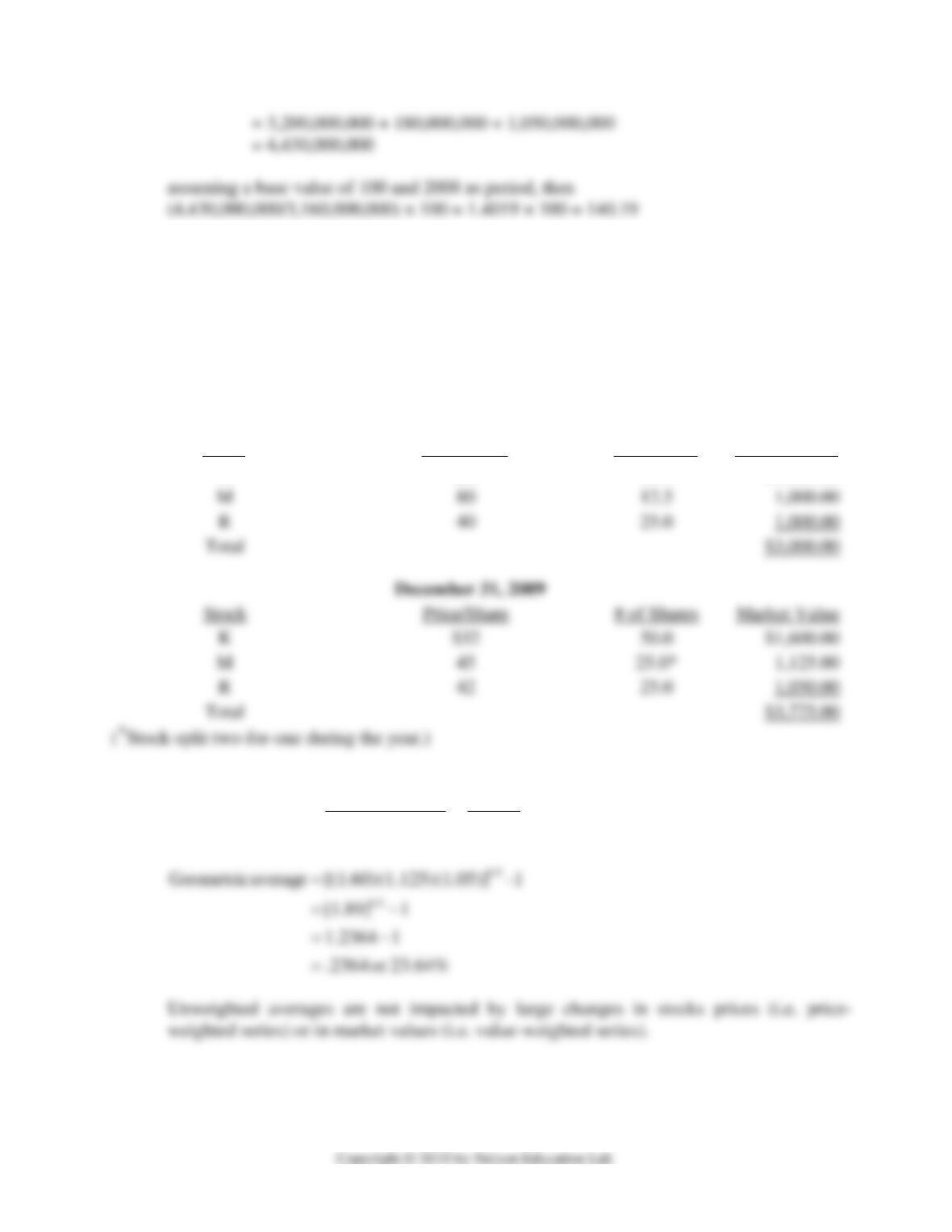
13. Price-weighted index (PWI)2008 = (20 + 80+ 40)/3 = 46.67
To accounted for stock split, a new divisor must be calculated:
Solutions for Chapter 4: Questions and Problems
– 38 –
13(a). Percentage change in PWI = (55.53 – 46.67)/46.67 = 18.99%
Percentage change in VWI = (140.19 – 100)/100 = 40.19%
13(b). The percentage change in VWI was much greater than the change in the PWI because the
stock with the largest market value (K) had the greater percentage gain in price (60%
increase).
13(c). December 31, 2008
Stock
Price/Share
# of Shares
Market Value
K
$20
50.0
$1,000.00
12.5
R
25.0
$3,000.00
Stock
Price/Share
# of Shares
Market Value
K
$32
50.0
$1,600.00
R
25.0
$3,775.00
%83.25
000,3
00.775
000,3
3,000–3,775.00
change Percentage ===