4-1
Chapter 4
Activity-Based Costing
Concept Questions
1. (LO1—ABC and Cooper’s Hierarchy)
The four categories of overhead are unit-level, batch-level, product-level, and
2. (LO2—ABC and Cooper’s Hierarchy)
Activity-based costing, or ABC, assigns costs on the basis of activities that drive
3. (LO2—Basic ABC: Stage 1 and Stage 2)
The first stage of cost allocation is the identification of activities and the tracing of
4. (LO2—The choice of cost driver)
5. (LO2—ABC in a JIT environment)
Factories are typically redesigned in a JIT environment such that most overhead
Solutions Manual
4-2
6. (LO2—ABC for selling and administration activities)
ABC can be adapted to allocate the cost of selling and administrative activities by
7. (LO3—Eliminating cross subsidies by using ABC)
Cross subsidies occur when a product is allocated less (more) overhead than it
actually consumes, resulting in other products being allocated more (less)
8. (LO4—Benefits of ABC)
The following are benefits of activity-based costing:
• ABC systems provide more accurate cost information that focuses managers
9. (LO4—Limitations of ABC)
Chapter 4: Activity-Based Costing
4-3
Brief Exercises
1. (LO1—Cost classifications)
a. batch-level
b. product-level
2. (LO2—ABC activities and cost drivers)
a. 1
b. 1
3. (LO3—ABC overhead calculation)
4. (LO4—Benefits and limitations of ABC)
a. False
Solutions Manual
Exercises
5. (LO2—ABC activities and cost drivers)
a. 3
6. (LO3—ABC overhead calculation)
A. Purchasing:
Receiving:
Sales:
$300,000 ÷ 15,000 = $20 per purchase order
$150,000 ÷ 20,000 = $7.50 per shipment
$150,000 ÷ 15,000 = $10 per sales order
7. (LO3—ABC overhead calculation)
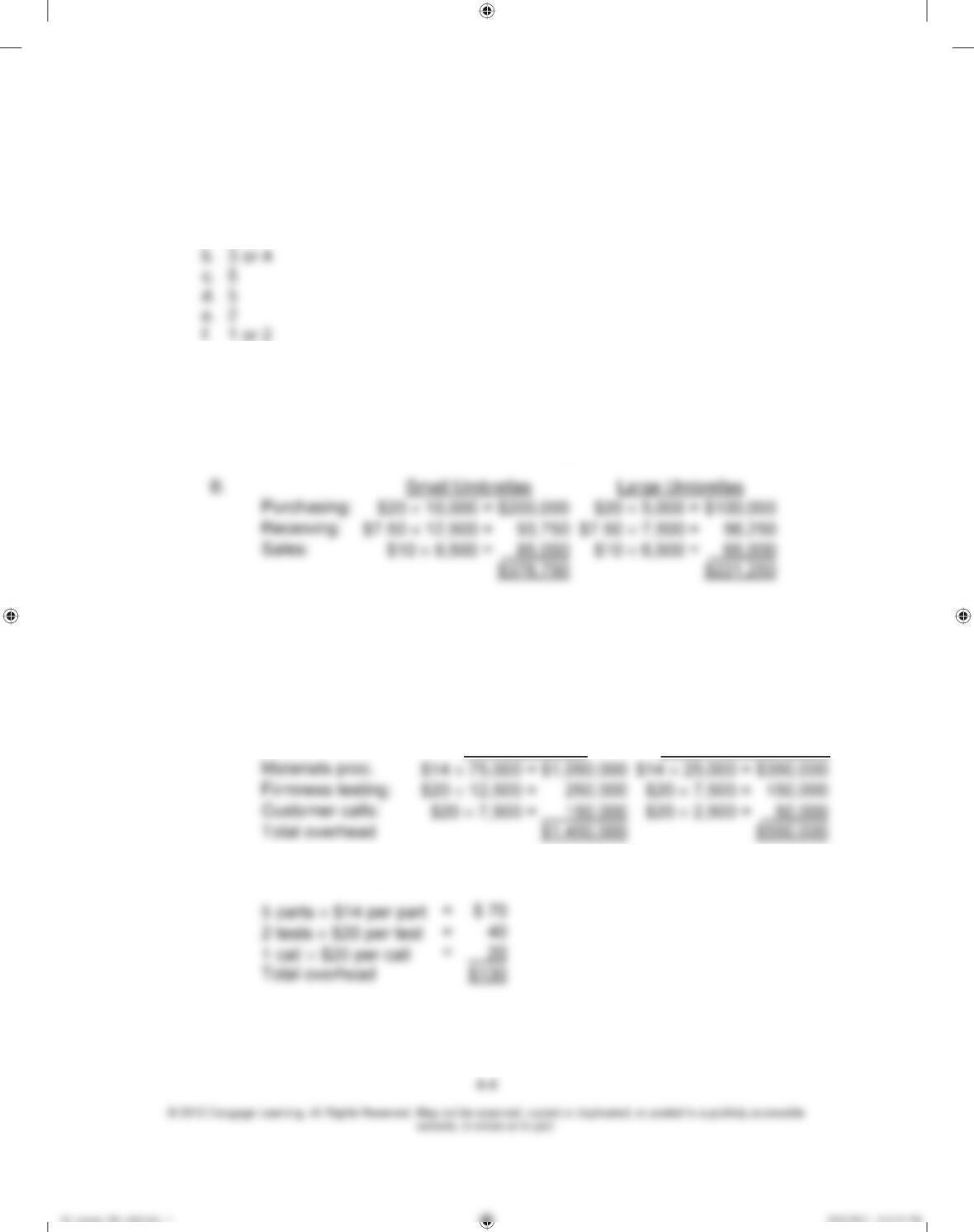
A. Materials proc. $1,400,000 ÷ 100,000 = $14 per part handled
Firmness testing: $400,000 ÷ 20,000 = $20 per test
Customer calls: $200,000 ÷ 10,000 = $20 per call
Firm Mattresses Extra-Firm Mattresses
B. Overhead assigned to a specific mattress:
Chapter 4: Activity-Based Costing
4-5
8. (LO3—ABC overhead calculation: Traditional versus ABC)
A. $1,050,000 total overhead ÷ 10,000 direct labor hours = $105 per DL hour
B.
Purchasing: $400,000 ÷ 8,000 = $50 per purchase order
9. (LO3—ABC overhead calculation: Traditional versus ABC)
A. $1,000,000 total overhead ÷ 10,000 direct labor hours = $100 per DL hour
B.
Purchasing: $400 × 7 purchase orders = $2,800.00
Receiving: $333.33 × 12 shipments = 3,999.96
Machine setups: $500 × 2 setups = 1,000.00
Assembly: $12.50 × 50 direct labor hours = 625.00
10. (LO3—ABC overhead calculation: Traditional versus ABC)
A. $1,050,000 total overhead ÷ 10,000 direct labor hours = $105 per DL hour
$105 per DL hour × 7 DL hours/batch = $735 (overhead allocated for the
batch)
B.
Solutions Manual
4-6
Quality control: $150,000 ÷ 7,500 = $20
11. (LO2, 3, and 4—ABC overhead calculation)
A. Recruitment: $250,000 ÷ 2,000 = $125 per applicant
Problems
12. (LO2, 3, and 4—ABC: Comparison with traditional costing)
A. $1,664,000 ÷ 50,000 = $33.28 per direct labor hour
B. With traditional costing, the cost to produce one unit of each product is as
follows:
C. With ABC, the overhead rates for each activity center are as follows:
D.
Big Board Small Board
Chapter 4: Activity-Based Costing
4-7
Overhead cost to produce one unit:
E. The shift in overhead cost is the result of the implementation of the ABC
system. More specifically, the low-volume (and more complex) big board
requires a disproportionate amount of design costs. This fact is ignored
when using only direct labor hours as a cost driver.
13. (LO2, 3, and 4—Traditional costing versus ABC)
A. The conventional costing system allocates overhead costs solely on the
B. If prices are based on the cost of the product, then using the traditional
costing system will lower profits. This is because the markup would be
the same under both pricing systems.
14. (LO2, 3, and 4—Traditional versus ABC)
A. Traditional allocation: The overhead rate based on direct labor hours is
$40.00 per direct labor hour ($500,000 total overhead ÷ 12,500 direct
labor hours).
Solutions Manual
4-8
B. Traditional allocation: 8 direct labor hours × $40 = $320
ABC allocation:
Purchasing: $ 20.00 (4 purchase orders × $5)
C. ABC allocates less overhead to the batch than traditional costing does.
Because ABC allocates overhead to products on the basis of the activities
that cause overhead costs to be incurred, rather than on the basis of an
arbitrary driver associated with volume, ABC results in more accurate
product costing.
15. (LO2, 3, and 4—Traditional versus ABC: Advantages of ABC)
A. With ABC, the overhead rates for each cost driver are as follows:
Purchase orders: $200,000 ÷ 25,000 = $8.00 per order
C. One would expect the new ABC system to allocate overhead differently
than the old system. Although direct labor may have been an appropriate
cost driver in the past, the more automated processes used this year are
likely to result in more batch, product, and facility level costs, and fewer
unit-level costs, than the old system produced.
Chapter 4: Activity-Based Costing
4-9
16. (LO2, 3, and 4—Decision focus: Traditional versus ABC)
A. The total cost of the job, in accordance with a traditional overhead
application based on direct labor hours = $28,700, calculated as follows:
B.
Calculation of overhead rate (ABC):
C. With ABC, the total cost of the job is higher. This additional cost should be
reflected in the bid.
17. (LO2, 3, and 4—Decision focus: ABC)
A. Overhead rate = Estimated overhead cost ÷ Estimated activity
Purchase orders: $200,000 ÷ 25,000 = $8.00 per order
Setup costs: $300,000 ÷ 15,000 = $20.00 per setup
Solutions Manual
C. Machine hours are the primary driver of overhead costs relating to
18. (LO2 and 4—The impact of ABC and JIT)
A.
Reduction of raw material purchase costs:
($1,000,000 × 0.02) $ 20,000
Reduction of purchase order costs ($200,000 × 0.70) 140,000
Chapter 4: Activity-Based Costing
4-11
19. (LO3—ABC)
Computation of the bid to allow for profit margin:
Regular Deluxe
Total cost (see next) $1,515.00 $2,080.00
The overhead rate for each activity is as follows:
Total $375.00
1 Calculation of overhead allocated to the regular units:
2 Calculation of overhead allocated to the deluxe units:
Solutions Manual
4-12
20. (LO3 and 4—Traditional versus ABC)
A. Assuming that the traditional system uses direct labor hours as the cost
driver and that inspection costs are the only overhead cost, the
predetermined overhead rate would be $10.00 per direct labor hour
($50,000/5,000 direct labor hours).
direct labor hours × $10 per direct labor hour).
B. Under ABC, Kennedy Rockers would be allocated $37,500 of inspection
costs (3,000 inspections × $12.50 per inspection).
Chapter 4: Activity-Based Costing
Cases
21. (LO1, 2, 3, and 4—Traditional versus ABC)
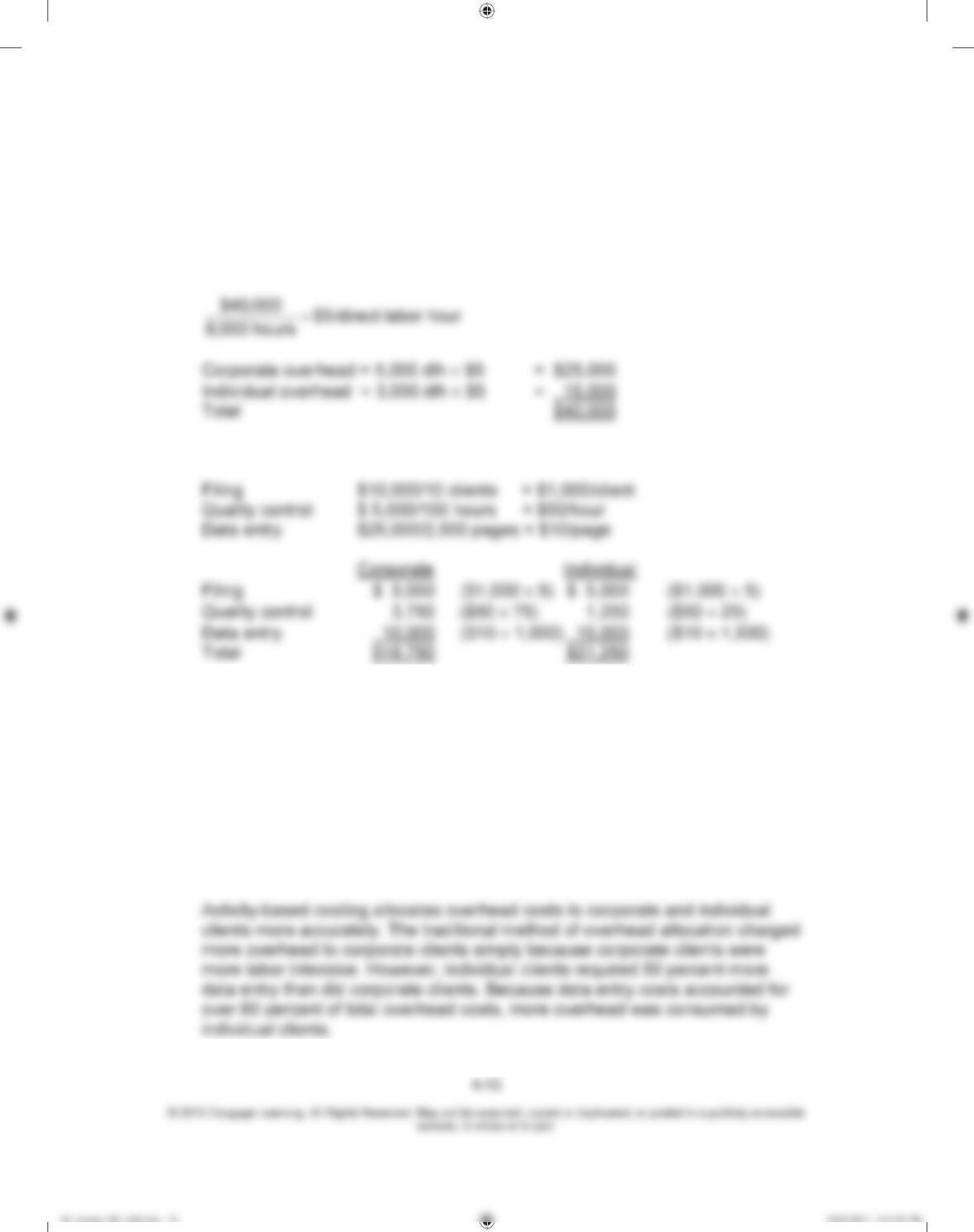
The predetermined overhead rate in a traditional overhead allocation system
based on direct labor hours is $5 per direct labor hour:
The predetermined overhead rates with ABC are as follows:
ABC more accurately reflects the manner in which costs were incurred and
allocates costs by using drivers related to the activities that cause overhead
costs to be incurred. Interestingly, while Duffy thought that services to corporate
clients cost more than services to individuals, ABC allocates less overhead to
corporate clients than did traditional costing while allocating more overhead to
individual clients. Accordingly, while traditional costing methods indicated that
individual clients contributed $85,000 toward the operating profits of the
company, ABC indicates that individual clients contributed only $78,750 to the
overall profits of the company. At the same time, corporate clients appear to be
more profitable by $6,250.

Solutions Manual
4-14
22. (LO1, 2, 3, and 4—Decision focus: ABC)
A. Factory overhead rates are needed in order to allocate indirect overhead
costs to products in a timely fashion. Traditionally, these costs were
B. The increase in the overhead rate is due to the reduction in the amount of
direct labor dollars in the denominator. The reduction in the amount of
C. Instead of using a traditional overhead allocation system based on direct
labor dollars, Worth Hawes Manufacturing could implement an ABC
D. The use of an ABC system will result in more accurate product cost
information, enabling management to make better decisions.