4-1
Chapter 4
Ethical and Social Issues in Information Systems
Student Learning Objectives
1. What ethical, social, and political issues are raised by information systems?
2. What specific principles for conduct can be used to guide ethical decisions?
3. Why do contemporary information systems technology and the Internet pose
challenges to the protection of individual privacy and intellectual property?
4. How have information systems affected everyday life?
Chapter Outline
4.1 Understanding Ethical and Social Issues Related to Systems
4.2 Ethics in an Information Society
Basic Concepts: Responsibility, Accountability, and Liability
4.3 The Moral Dimensions of Information Systems
Information Rights: Privacy and Freedom in the Internet Age
Key Terms
The following alphabetical list identifies the key terms discussed in this chapter. The
page number for each key term is provided.
Accountability, 160
Carpal tunnel syndrome (CTS), 182
Computer abuse, 180
Computer crime, 178
4-2
Due process, 160
Ethical “no free lunch” rule, 161
Ethics, 155
Fair Information Practices (FIP), 163
Golden Rule, 161
Privacy, 162
Profiling, 157
Repetitive stress injury (RSI), 182
Responsibility, 159
Risk Aversion Principle, 161
Safe harbor, 165
Spam, 178
Teaching Suggestions
This is an interesting, stimulating chapter to present in class with the opportunity to
create dynamic discussions. Your students will have a variety of opinions about the
ethical issues presented in this chapter. You may want to open the discussion by asking if
any students have had first-hand experiences with personal data compromises. You may
also ask students how they defend themselves against misuse of information systems and
data. Most of them probably don’t.
4-3
Section 4.1, “Understanding Ethical and Social Issues Related to Systems” Many
people do not want to discuss or even think about technology-related ethical and social
issues, at least not until a large scandal takes place such as the ClickPoint data
compromise that happened several years ago. However, the use of new technology
always presents these kinds of problems. Throughout this chapter it is imperative that you
discuss these issues so that students can see both the positive and negative sides of
technology. It’s important for students to understand that almost every technology
improvement opens the door to potential misuse and abuse. Table 4-2 discusses
technology trends that have helped create some of the ethical issues our society is now
facing.
Section 4.2, “Ethics in an Information Society” This section provides the basic concepts
of responsibility, accountability, and liability as they apply to information system issues.
It’s easy to blame problems on a computer system but you should remind students that
behind every computer is a human being. People have the responsibility to make wise
decisions about how information systems are used and how data are protected against
abuse and misuse. Using the five-step process outlined in the subsection “Ethical
Analysis” leads the way to abiding by the ethical principles. You may want to review
how codes of conduct apply to each information system user and manager.
4-4
Section 4.3, “The Moral Dimensions of Information Systems” This section is designed
to teach students how they should protect information systems and data. Although most
people immediately think of their own data, students should understand they will have a
responsibility to protect other people’s data once they enter the workforce.
Regardless of how many laws governments pass, they are only as effective as those
people who abide by them. Compare the opt-out privacy practices of U.S. companies vs.
Because most students probably have a Facebook account, it’s a good way to discuss how
involved they should be in determining a company’s privacy policies. Facebook has had
thousands of customers complain about its lack of concern for users’ privacy; in fact,
Interactive Session: Technology: Life on the Grid: iPhone Becomes iTrack
Case Study Questions:
1. Why do mobile phone manufacturers (Apple, Google, and BlackBerry) want to
track where their customers go?
There is a great deal of money to be made knowing where people are at any given
time. Mobile technologies based on the smartphone make it possible to locate people
4-5
2. Do you think mobile phone customers should be able to turn tracking off?
Should customers be informed when they are being tracked? Why or why not?
Student answers will vary based on personal preference and experiences. The
drawback of turning tracking capabilities off is that people may not get the
3. Do you think mobile phone tracking is a violation of a person’s privacy? Why or
why not?
Privacy concerns are growing with the proliferation of location-based services like
Foursquare that allows users to check in to a restaurant or other location and the app
Interactive Session: Organizations: Monitoring in the Workplace
Case Study Questions:
1. Do you consider that the approach taken by Blackburn Rovers is too strict on
employees, too lenient or just about right?
Obviously this is a matter of personal judgement but some of the pros and cons that
4-6
Against
• Whilst most employees realise that excessive personal use of company equipment
must be discouraged, excessive restriction can be counterproductive. How many
people work through their lunch hour when an important deadline needs to be
2. Consider the five moral dimensions described in the text. Which are involved
in the case of Copeland v the United Kingdom?
Privacy
The major moral dimension relating to this case is privacy, the freedom of the
individual to be left alone. Usually this is concerned with the rights of the general
4-7
Intellectual property
There is no real issue with intellectual property rights as Carmarthenshire College
Liability
The only way in which this aspect would be relevant is if the private correspondence
System errors
Once again this only has a bearing if, due to spending too much time on private
Quality of life
The issues of work-life balance could be considered in this case. Was Ms Copland
3. Consider the following scenario. Your 14 year old son attends a football
academy. Whilst there he downloads pornographic images which he later sells
to his friends. He would not have been able to download the images at home as
you have installed parental control software. Who is to blame for his
indiscretion?
There are obviously several sides to this. On the one hand it could be said that it is
Review Questions
1. What ethical, social, and political issues are raised by information systems?
Explain how ethical, social, and political issues are connected and give some
examples.
4-8
List and describe the key technological trends that heighten ethical concerns.
Table 4-2 summarizes the four key technological trends responsible for heightening
ethical concerns. These trends include:
• Computing power doubles every 18 months
Differentiate between responsibility, accountability, and liability.
Responsibility is a key element of ethical actions. Responsibility means that you
2. What specific principles for conduct can be used to guide ethical decisions?
List and describe the five steps in an ethical analysis.
4-9
The five steps in ethical analysis include:
• Identify and describe clearly the facts.
Identify and describe six ethical principles.
Six ethical principles are available to judge conduct. These principles are derived
independently from several cultural, religious, and intellectual traditions and include:
3. Why do contemporary information systems technology and the Internet pose
challenges to the protection of individual privacy and intellectual property?
Define privacy and fair information practices.
Privacy is the claim of individuals to be left alone, free from surveillance or
Explain how the Internet challenges the protection of individual privacy and
intellectual property.
Contemporary information systems technology, including Internet technologies,
Explain how informed consent, legislation, industry self-regulation, and
technology tools help protect the individual privacy of Internet users.
The online industry prefers self-regulation rather than having state and federal
governments passing legislation that tightens privacy protection.
In February 2009, the FTC began the process of extending its fair information
practices doctrine to behavioral targeting. The FTC held hearings to discuss its
Privacy protections have also been added to recent laws deregulating financial
services and safeguarding the maintenance and transmission of health information
about individuals. The Gramm-Leach-Bliley Act of 1999, which repeals earlier
restrictions on affiliations among banks, securities firms, and insurance companies,
includes some privacy protection for consumers of financial services. All financial
institutions are required to disclose their policies and practices for protecting the
privacy of nonpublic personal information and to allow customers to opt out of
information-sharing arrangements with nonaffiliated third parties.
List and define three different regimes that protect intellectual property rights?
Intellectual property is subject to a variety of protections under three different legal
traditions:
4-11
4. How have information systems affected everyday life?
Explain why it is so difficult to hold software services liable for failure or injury.
In general, insofar as computer software is part of a machine, and the machine injures
someone physically or economically, the producer of the software and the operator
can be held liable for damages. Insofar as the software acts like a book, storing and
List and describe the principal causes of system quality problems?
Three principle sources of poor system performance are:
• Software bugs and errors
4-12
Name and describe four quality-of-life impacts of computers and information
systems.
Four quality of life impacts of computers and information systems include:
• Jobs can be lost when computers replace workers or tasks become
information technology.
Technostress is defined as stress induced by computer use; symptoms include
aggravation, hostility toward humans, impatience, and fatigue.
Discussion Questions
1. Should producers of software-based services, such as ATMs, be held liable for
economic injuries suffered when their systems fail?
If a system fails, it is foreseeable that the producers of the software-based services
could potentially be held liable for economic injuries. This could even extend to
4-13
2. Should companies be responsible for unemployment caused by their information
systems? Why or why not?
Answers for this question will vary, as will student discussions of the ethics of
various issues in information systems, including social responsibility, environmental
3. Discuss the pros and cons of allowing companies to amass personal data for
behavioral targeting.
The pros of this issue include:
• The FTC is trying to extend the principles of fair information practices to
4-14
The cons of this issue include:
• Most Internet businesses do very little to protect individual user privacy.
• Users do very little to protect their own privacy and data. The majority of
Hands-on MIS Projects
Management Decision Problems
1. USAData’s Web site: This Web site sells personal data on millions of people
without much prior vetting. That is, just about anyone can purchase the data in
whatever organized way they want. Do data brokers such as USAData raise privacy
issues? Why or why not? If your name and other personal information were in this
database, what limitations on access would you want in order to preserve your
privacy?
To answer these questions, students should be clear on what constitutes an ethical
dilemma. As such, a dilemma is described as two diametrically opposed courses of
4-15
2. Small insurance company: Examines the options businesses have for monitoring
employee usage of the Internet. What kind of ethical dilemmas are created for
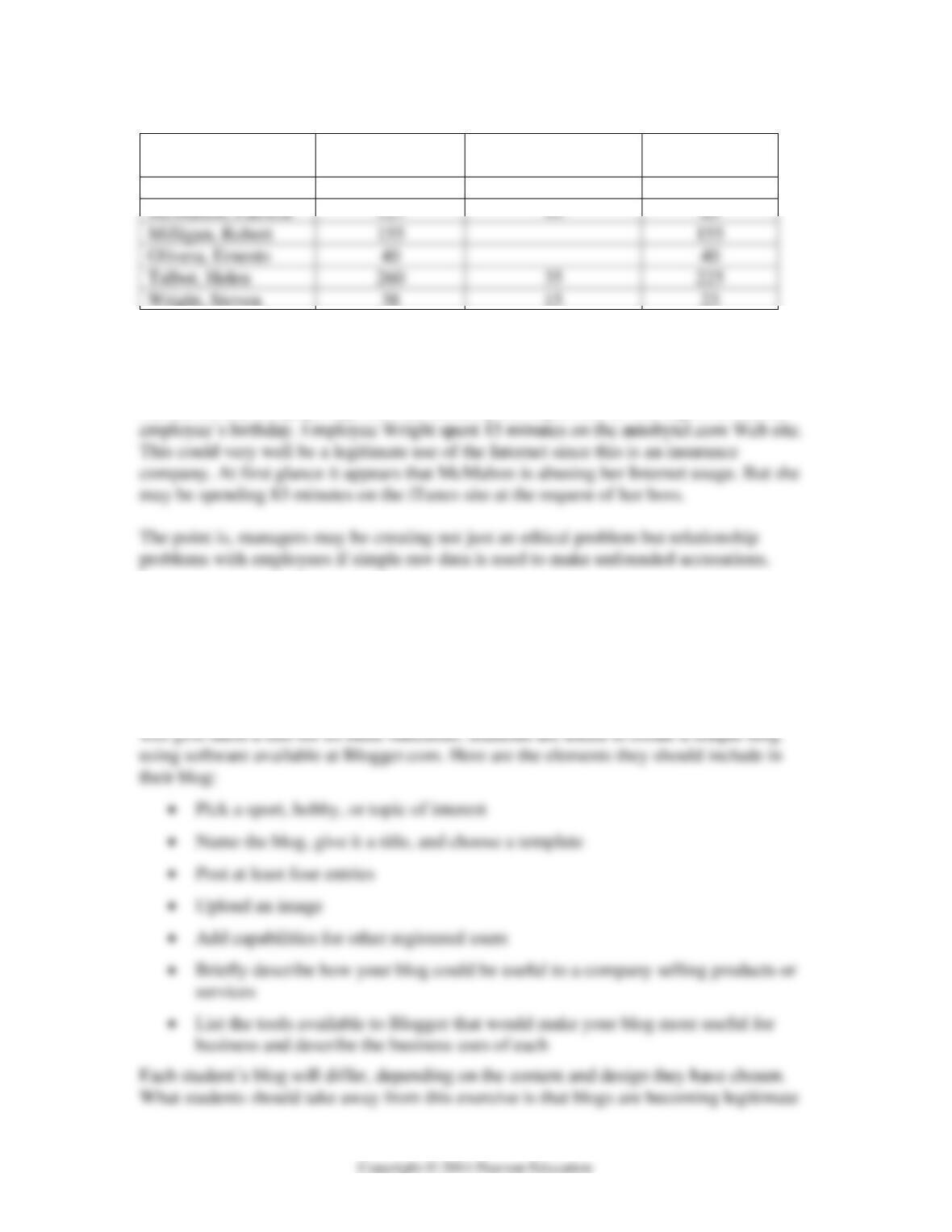
4-16
User Name
Total minutes
Legitimate minutes
Suspect
minutes
Kelleher, Claire
248
96
152
McMahon, Patricia
127
44
83
Milligan, Robert
155
155
Olivera, Ernesto
40
40
Talbot, Helen
260
35
225
Wright, Steven
38
15
23
Although it appears that most of the employees are using the Internet for non-business
reasons, managers must be cautious about making accusations based on raw data. For
instance, while Talbot may clearly be visiting personal, non-business Web sites like
Nordstrom and eBay, perhaps she was asked by her supervisor to find a gift for another
Achieving Operational Excellence: Creating a Simple Blog
Software skills: Blog creation
Business skills: Blog and Web page design
This exercise will not turn students into professional bloggers (although it might), but it
4-17
Improving Decision Making: Using Internet Newsgroups for Online Market
Research
Software skills: Web browser software and Internet newsgroups
Business skills: Using Internet newsgroups to identify potential customers
Video Case Questions
You will find a video case illustrating some of the concepts in this chapter on the Laudon
Collaboration and Teamwork: Developing a Corporate Ethics Code
With three or four of your classmates, develop a corporate ethics code on privacy
that addresses both employee privacy and the privacy of customers and users of the
corporate Web site. Be sure to consider email privacy and employer monitoring of
worksites, as well as corporate use of information about employees concerning their
off-the-job behavior (e.g., lifestyle, marital arrangements, and so forth). If possible,
use Google Sites to post links to Web pages, team communication announcements,
and work assignments; to brainstorm; and to work collaboratively on project
documents. Try to use Google Docs to develop your solution and presentation for
the class.
There are a vast number of examples students can access on existing corporate Web sites
to use as models. Elements they should include are:
4-18
Other items you may want to require for inclusion in the ethics code include:
• Protecting and using company intellectual property—trade secrets, copyrights,
Case Study: Facebook: It’s about the Money
1. Perform an ethical analysis of Facebook. What is the ethical dilemma presented
by this case?
The stakeholders involved in an ethical analysis of Facebook include Facebook
2. What is the relationship of privacy to Facebook’s business model?
The less privacy Facebook offers to its users, the more valuable and useful its
business model becomes. By providing more privacy to its users, the less data it
4-19
3. Describe the weaknesses of Facebook’s privacy policies and features. What
management, organization, and technology factors have contributed to those
weaknesses?
Management: Ninety-three percent of people polled believe that Internet companies
should be forced to ask for permission before using their personal information.
Seventy-two percent want the ability to opt out of online tracking. Executives and
4. Will Facebook be able to have a successful business model without invading
privacy? Explain your answer. Are there any measures Facebook could take to
make this possible?
Opinions will vary on this question. Certainly, Facebook’s ability to leverage as much
as possible from advertisers may be diminished if it cannot collect every nugget of