Chapter 4: Ethics and Social Responsibility
84
3. In cases such as this, how would you justify the decision to fulfill the responsibility and face certain
loss? How would you justify the decision to ignore the responsibility for the sake of staying in
business?
The response to this question depends on whether students believe that the hotel company should
adopt the shareholder model or the stakeholder model. According to the shareholder model, the only
Practice Being a Manager
DISCERNING UNETHICAL BEHAVIOR
Exercise Overview and Objective
This exercise offers students a scenario for analysis and response. The scenario involves a newly hired
portfolio manager who is hired to manage a remarkably successful mutual fund (Pioneer Fund). Over the
Preparation
At least one session prior, you should assign Steps 1-3 of the exercise. These steps require students to
study the situation, reflect on possible approaches and scenarios, and to develop a plan of action
(including anticipating responses of Pioneer Fund employees). Encourage students to use this exercise as
In-Class Use
Students should be assigned to small discussion groups in a manner that best facilitates engagement and
vigorous discussion. If you know students well enough at this point in the class, you may want to assign
groups that include individuals who are likely to have different viewpoints on the problem and its
Chapter 4: Ethics and Social Responsibility
85
3) What is different about acting ethically/responsibly within an organizational environment/culture like
that of the Pioneer Fund, vs. acting ethically/responsibly as an individual? What are the particular
challenges and dynamics associated with ethical and responsible behavior in an organization?
Organizational cultures reinforce individual behavior—for better or worse. How an organization doles out
rewards and punishments can also signal what is desirable behavior and what is undesirable behavior. For
Develop Your Career Potential
EXAMINING NONPROFITS
This is a good assignment for students to do in pairs or small groups. But it also works well as an
individual assignment. Alternatively, if you have a large section, this assignment is an opportunity to
invite the local leaders of charitable or nonprofit groups to your class to discuss the questions in the
assignment.
In addition to inviting local leaders, this assignment can be processed by having students do brief
presentations on each organization (no more than 2-5 minutes depending on class size and the number of
Besides these questions, it’s also important to engage students in a discussion about which
organization they would choose to support. So ask students, “If you were the CEO of a local company
(pick a substantial company), how would you decide who to support? You can’t provide corporate funds
and resources to all of these causes. Which one or two will you associate with your company, and why?”
Discuss the merits of the various organizations, and then take a class vote to decide which one or two
organizations they would choose to support.
Another set of questions to present to students is, “Many companies now view corporate philanthropy
1. Board Governance: The board is responsible for policy setting, fiscal guidance, and ongoing
governance, and should regularly review the organization’s policies, programs and operations.
2. Purpose: The organization’s purpose, approved by the board, should be formally and specifically
stated.
Chapter 4: Ethics and Social Responsibility
86
5. Financial Support and Related Activities: Fund-raising practices should encourage voluntary
giving and should not apply unwarranted pressure. Descriptive and financial information for all
substantial income and for all revenue-generating activities conducted by the organization should
be disclosed on request.
The PIC also evaluates charities in five general areas: public accountability, use of funds, solicitations
and informational materials, fund raising practices, and governance. In many ways, the PIC standards are
similar. However, they offer more guidelines regarding the finances of charitable organizations.
Reasonable use of funds requires the following:
a. At least 50% of total income from all sources should be spent on programs and activities directly
Reel to Real – Biz Flix
Because they are so short, the Biz Flix videos are best used to supplement your lesson plans. They are
designed to illustrate the content rather than convey all of the chapter concepts.
Video: The Emperor’s Club
Segment Summary:
William Hundert (Kevin Kline), a professor at Saint Benedict’s preparatory school, believes in teaching
his students about living a principled life as well as teaching them his beloved classical literature.
Discussion Questions from Text:
1. Based on the clip, what ethical principles do you think most inform William Hundert’s thinking?
The ethical principles that affect how individuals solve ethical dilemmas include: long-term self
interest, personal virtue, religious injunctions, government requirements, utilitarian benefits,
Chapter 4: Ethics and Social Responsibility
87
2. Describe Sedgewick Bell’s level of moral development.
The six stages of moral development described in chapter four fall into three broad categories: 1)
Preconventional moral development involves making decisions based on selfish reasons. In this
Additional Discussion Questions:
1. List three steps that Hundert can take to encourage an ethical climate, as described in chapter four?
What is the likelihood of Hundert following through on these steps?
The first step of encouraging an ethical climate is for leaders to act ethically themselves. Hundert has
worked his entire career as a teacher to demonstrate good ethical behavior, and for this reason he feels
2. Suppose that Hundert decided to blow the whistle on Bell and expose that he was cheating during the
competition. In your opinion, which social responsiveness strategy should Bell take to minimize the
damage that this might cause?
The four social responsiveness strategies that Bell could take include reactive, defensive,
accommodative, and proactive. By being reactive, Bell would deny cheating and suggest that
Reel to Real – Management Workplace
Management Workplace videos can support several in-class uses. In most cases you can build an entire
50-minute class around them. Alternatively, they can provide a springboard into a group lesson plan.
Video: Theo Chocolate
Managing Social Ethics and Social Responsibility
Summary:
Chapter 4: Ethics and Social Responsibility
88
Joe Whinney exudes a sense of mission in everything he does. After a trip to cacao farms in Central
America, Whinney decided to build the first organic fair trade chocoloate factory in the U.S. By building
Discussion Questions from Text:
1. Which of the four strategies for responding to social responsibility best reflects Theo Chocolate?
Theo Chocolate’s strategy for social responsibilty is best described as proactive. As defined in the
text, a company using a proactive strategy will anticipate responsibility for a problem befre it
2. How does Theo Chocolate’s business practices reflect the stakeholder model of social
responsibility?
According to the stakeholder model, management’s most important responsibility is the firm’s
long-term survival (not just maximizing profits), which is achieved by satisfying the interests of
3. What would happen if fair trade goals conflicted with a company’s primary responsibility to be
profitable?
Fair trade is a financial relationship between producers, sellers, and consumers based on the
principle of equity within the exchange of goods. Joe Whinney says that fair trade is important
Chapter 4: Ethics and Social Responsibility
89
Workplace Video Quiz
Video Segment 1
Video segment title
Corporate Social Responsibility
Start time (in sec)
0:00
Stop time (in sec)
2:17
Quiz Question 1
Theo Chocolate’s goal to operate business in a way that provides wide
ranging benefits to society is called:
Option a
Social responsibility
Option b
Code of ethics
Quiz Question 2
Managers at Theo Chocolate address social and environmental issues at
work using all of the following means except:
Option a
Sourcing organically grown cocoa beans
Option b
Monitoring the environmental impact of the manufacturing process
Option c
Making profitability the sole measure of success
Option d
Emphasizing conservation throughout the company’s supply chain
Correct option
c: Making profitability the sole measure of success
Feedback for option a
Incorrect. Theo Chocolate pursues a triple bottom line in which profit is
Feedback for option c
Correct. Theo Chocolate pursues a triple bottom line in which profit is just
one measure of success.
Feedback for option d
Incorrect. Theo Chocolate pursues a triple bottom line in which profit is
just one measure of success.
Quiz Question 3
Option a
Businesses always create social and environmental problems
Option b
Businesses always solve social and environmental problems
Option c
Businesses have no impact on social and environmental problems
Option d
Businesses can be managed in a way that either solves or causes or social
and environmental problems
Correct option
d: Businesses can be managed in a way that either solves or causes or
social and environmental problems
Feedback for option b
Incorrect. According to Whinney, businesses can not only make money but
Option c
Personal philanthropy
Option d
Entrepreneurship
Correct option
a: social responsibility
Feedback for option b
Feedback for option c
make decisions, and take action that benefit society.
Feedback for option d
Chapter 4: Ethics and Social Responsibility
90
Video Segment 2
Video segment title
Corporate Social Responsibility
Start time (in sec)
2:17
Stop time (in sec)
4:30
Quiz Question 1
Theo Chocolate measures its value to society by:
Option a
The efficiency of its chocolate making process
Option b
The company’s impact on consumers, farmers, and the natural
environment
Option c
The ability to maximize profits
Option d
The ability to provide low cost goods
Correct option
Feedback for option a
Incorrect. Theo Chocolate measures its success by how it affects its entire
supply chain.
Feedback for option b
Correct. Theo Chocolate measures its success by how it affects its entire
supply chain.
Feedback for option c
Incorrect. Theo Chocolate measures its success by how it affects its entire
supply chain.
Feedback for option d
Incorrect. Theo Chocolate measures its success by how it affects its entire
supply chain.
Quiz Question 2
According to CEO Joe Whinney, Theo Chocolate’s commitment to fair
trade is intended to offer maximum benefit to:
Option a
Shareholders
Option b
Employees
Option c
The natural environment
Option d
Cocoa farmers
Correct option
d: Cocoa farmers
Feedback for option a
Incorrect. Theo Chocolate aims to provide benefits to the entire supply
Feedback for option b
Incorrect. Theo Chocolate aims to provide benefits to the entire supply
chain, including the farmers.
Feedback for option c
Incorrect. Theo Chocolate aims to provide benefits to the entire supply
chain, including the farmers.
Feedback for option d
Correct. Theo Chocolate aims to provide benefits to the entire supply
chain, including the farmers.
Quiz Question 3
Joe Whinney’s ethical approach to managerial decision making is best
categorized as:
Option a
Principle of personal virtue
Option b
Principle of government intervention
Option c
Principle of utilitarian benefits
Option d
Principle of long-term self-interest
Feedback for option c
Incorrect. According to Whinney, businesses can not only make money but
take action to solve social and environmental problems.
Chapter 4: Ethics and Social Responsibility
91
Correct option
c: principle of utilitarian benefits
Feedback for option a
Incorrect. According to the principle of utilitarian benefits, a company
should take actions that produce the greatest good for the greatest number.
Video Segment 3
Video segment title
Corporate Social Responsibility
Start time (in sec)
4:30
Stop time (in sec)
6:34
Quiz Question 1
Vice President Debra Music evaluates Theo Chocolate’s performance
based on the company’s ability to meet a triple bottom line. Which of the
following is not a component of the triple bottom line?
Option a
Planet
Option b
People
Option c
Profits
Option d
Partners
Correct option
d: partners
Feedback for option a
Incorrect. The triple bottom line has three elements, planet, people, and
profits.
Feedback for option d
Correct. The triple bottom line has three elements, planet, people, and
Quiz Question 2
Which of the following would not likely be an example of “doing well by
doing good” in the eyes of Theo Chocolate managers?
Option a
Hold company accountable to fair trade standards
Option b
Use recycled packaging
Option c
Promote habitat preservation and reforestation in cocoa growing regions
Option d
Use pesticides to protect cocoa crops
Correct option
d: Use pesticides to protect cocoa crops
Feedback for option a
Incorrect. The use of pesticides would help increase profits, but would
have little benefit for farmers or consumers.
Feedback for option b
Incorrect. The use of pesticides would help increase profits, but would
have little benefit for farmers or consumers.
Quiz Question 3
What should managers at Theo Chocolate do if the company’s social
objectives come into severe conflict with the company’s economic
Feedback for option b
Incorrect. According to the principle of utilitarian benefits, a company
should take actions that produce the greatest good for the greatest number.
Feedback for option d
Incorrect. According to the principle of utilitarian benefits, a company
Chapter 4: Ethics and Social Responsibility
92
objectives?
Option a
Focus on meeting economic objectives to avert bankruptcy
Option b
Focus on meeting social objectives and risk bankruptcy
Option c
Create a code of ethics
Option d
Create executive-level sustainability position in the company
Review Questions
1. How does the nature of management jobs create the possibility for ethical abuses?
2. Identify and describe the most common forms of workplace deviance.
Workplace deviance is unethical behavior that violates organizational norms about right and wrong.
Three types workplace deviance are:
3. What are the U.S. Sentencing Commission Guidelines? How do they punish unethical behavior?
The U.S. Sentencing Commission Guidelines are federal laws that cover areas such as invasion of
4. What influences ethical decision-making?
Ethical decisions depend on the following:
Correct option
a: Focus on meeting economic objectives to avert bankruptcy
5. What steps can managers take to improve ethical decision making?
Managers can improve ethical decision making by:
• Selecting and hiring ethical employees. Managers can screen for ethical employees through a
6. Outline a basic model for ethical decision-making.
Even though ethical decision-making includes many relativist aspects, there are some practical,
concrete steps managers can follow to maximize their decision making. There are 6 steps that form a
basic model of ethical decision making:
• Identify the problem. What makes it an ethical problem? Think in terms of rights, obligations,
7. Contrast the two models of social responsibility.
There are two accepted models of social responsibility: the shareholder and stakeholder models. The
shareholder model of social responsibility holds that the only responsibility that business has is to
maximize profits. Therefore, shareholders are the only people who really matter.
Chapter 4: Ethics and Social Responsibility
94
8. What are a company’s total social responsibilities?
A company’s total social responsibility can be subdivided into four essential components:
• Economic responsibility: the expectation that a company will make a profit by producing a
9. What choices does a company have when responding to demands for social responsibility?
Social responsiveness is the strategy chosen by a company to respond to stakeholders’ economic,
10. Are socially responsible companies economically successful? In other words, does it pay to be
socially responsible?
Previous research showed that sometimes it cost, and sometimes it paid. Recently, however, that has
Additional Assignments and Activities
Out-of-Class Project: “Ethics Test.” Divide the class into small groups. Each group should create an
Out-of Class Project: “Socially Responsible Investing.” Have students research several socially
responsible investment funds and then compare the results against the Dow Jones Industrial Average
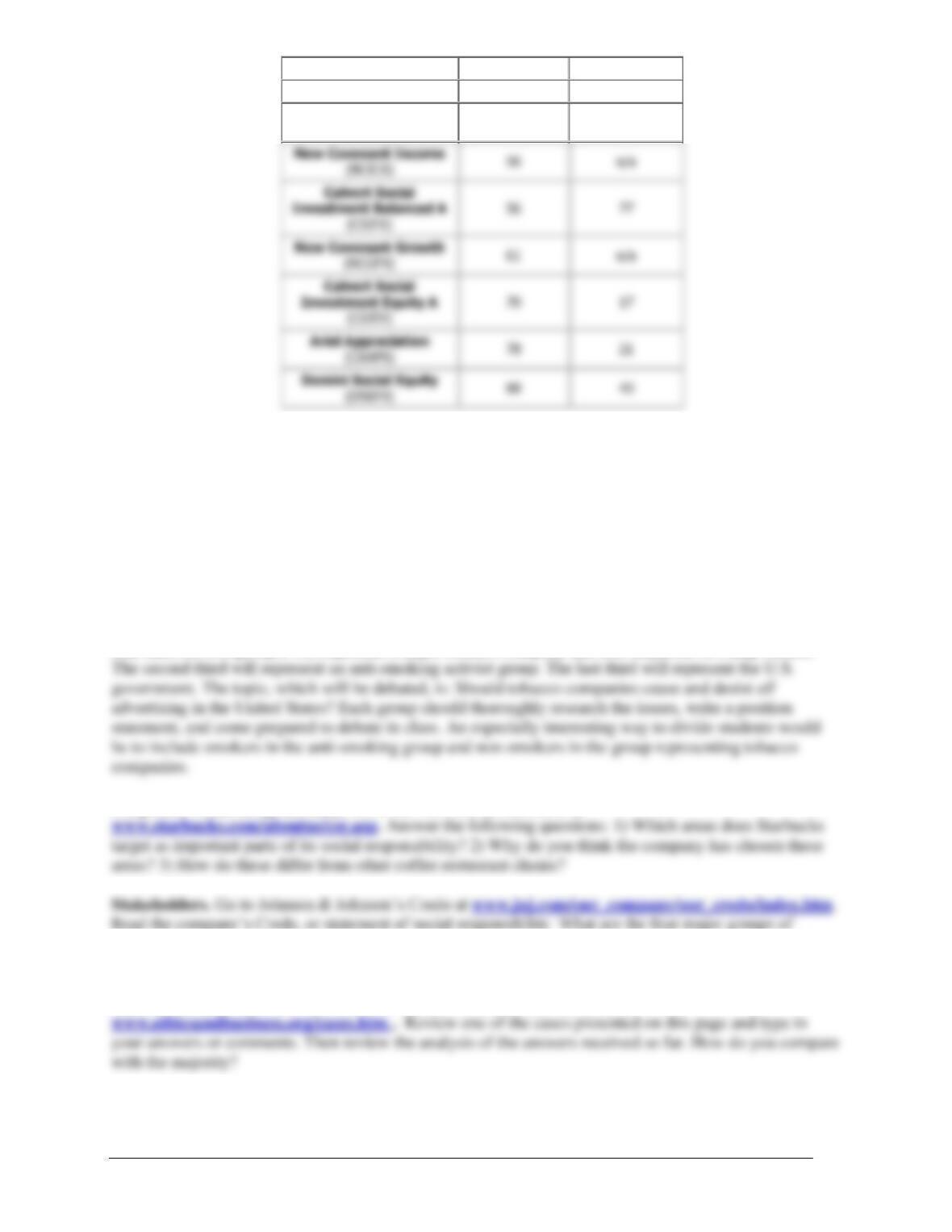
(DJIA), Standard & Poor’s (S & P) 500, and the antithesis of SRI, the Vice Index. Here is a list of SR
funds that students can investigate:
The good, the bad and the ugly: Top SRI funds
Fund
Performance
rank: 1-year
Performance
rank: 10-year
Chapter 4: Ethics and Social Responsibility
95
Ariel (ARGFX)
23
19
Parnassus (PARNX)
51
67
Parnassus Equity Income
(PRBLX)
54
12
Notes: One-year data as of March 30, 2005. 10-year data as of Feb. 28, 2005. n/a-Not applicable; less
than five years of performance data. Excludes institutional portfolios. Morningstar category ranking, 1 =
best, 100 = worst.
Source: Morningstar Inc.
Compare this with the stated objective of the Vice Fund (VICEX): This Fund deliberately intends to
invest in products often considered socially irresponsible such as these: alcohol, tobacco,
defense/weapons, gaming, etc.
In–Class Project: “Ethics Debate.” Divide the class into thirds (or into six groups, if your class is large).
One third (or two groups) will represent a major tobacco company like R.J. Reynolds or Philip Morris.
Corporate Social Responsibility. Go to the web site of Starbucks at
Read the company’s Credo, or statement of social responsibility. What are the four major groups of
stakeholders stated in the Credo? Describe each group and how important they are to the company. What
is the reasoning behind the order in which the stakeholders are listed?
Business Ethics. Go to the web site of the Center for Ethics and Business at
56
61
78
21
88
40

Corporate Code of Ethics. Select a well-known corporation and find its code of ethics online. Write a
short paper listing or describing the company’s code. How much of it relates specifically to the
company’s business or industry? How much is related to basic human morality?