Chapter 04 – Managing in the Global Environment
4-17
Notes for Topics for Discussion and Action
DISCUSSION
1. Why is it important for managers to understand the forces in the global environment that are acting
on them and their organizations?
2. Which organization is likely to face the most complex task environment—a biotechnology company
trying to develop a new cure for cancer or a large retailer like the Gap or Macy’s? Why?
3. The population is aging because of a combination of declining birth rates, declining death rates,
and the aging of the baby boom generation. What might some of the implications of this demographic
trend be for (a) a pharmaceutical company, and (b) the home construction industry?
MANAGEMENT IN ACTION
Chapter 04 – Managing in the Global Environment
4-18
The aging population is an example of a demographic force in an organization’s general environment.
The aging of the population has increased many opportunities for organizations that provide goods and
4. How do political, legal, and economic forces shape national culture? What characteristics of
national culture do you think have the most important effect on how successful a country is in doing
business abroad?
5. After the passage of NAFTA, many U.S. companies shifted production operations to Mexico to take
advantage of lower labor costs and lower standards for environmental and worker protection. As a
result, they cut their costs and were better able to survive in an increasingly competitive global
environment. Was their behavior ethical—that is, did the ends justify the means?
Chapter 04 – Managing in the Global Environment
4-19
The problem with the decision to shift production operations to low-wage countries, like Mexico, is
that eventually the wages will increase due to increased demand for workers, and companies will be
ACTION
6. Choose an organization, and ask a manager in that organization to list the number and strengths of
forces in the organization’s task environment. Ask the management to pay particular attention to
identifying opportunities and threats that result from pressures and changes in customers,
competitors, and suppliers.
The text defines the task environment as consisting of forces from suppliers, distributors,
Chapter 04 – Managing in the Global Environment
4-20
Copyright © 2017 McGraw-Hill Education. All rights reserved. No reproduction or distribution without the prior written consent of
McGraw-Hill Education.
Competitors are other organizations that produce goods and services that are similar to a particular
organization’s goods and services. Since they are vying for the same customers, competitors are
potentially the most threatening force that a manager must deal with. They provide a threat to
organizations when they engage in price competition. If an organization is forced to lower its prices to
compete with a competitor, this could result in lower profits, which limits their ability to access further
resources in the future. Besides existing competitors, potential competitors also provide a threat in the
task environment. Potential competitors are those organizations that are not presently in a task
environment but could be if they chose to be. The fewer competitors in an organization’s task
environment, the lower the threat of competition. With fewer competitors, it is easier to obtain
customers and keep prices high, which results in greater profits and success for the organization.
AACSB: Analytic
Analyzing an Organization’s Environment
(Note to Instructors: The answers to this exercise are based on a university, since this is an
organization with which students are familiar.)
1. Describe the main forces in the global task environment that are affecting the organization.
The main forces in the task environment that affect the university are its suppliers, customers and
competitors.
The faculty and staff of the university are its primary suppliers. They supply the necessary inputs that
are needed in order to provide the service of a quality education to the customer (students). If the
BUILDING MANAGEMENT SKILLS
Chapter 04 – Managing in the Global Environment
4-21
The university is affected by economic, technological, demographic, and legal-political forces. The
economy is a very powerful force to the University. When the economy is in a downturn, universities
face an increase in graduate enrollment but a decrease in undergraduate enrollment. When the
in their industry. Professors of the University must keep current in their research and teach their
students the latest skills, techniques and knowledge in order for them to be marketable upon
graduation. If this is not provided then graduating students are at a disadvantage, which affects the
University in a negative manner.
The demographic environment is constantly changing. People of many different nationalities,
programs to meet the needs of the non-traditional student.
Since many universities receive funding by their respective states, the legal-political
environment plays an important role in their general environment. In many states the state legislature
determines how much money each university receives. This money is very important to the university
and can even determine the salaries it pays to the professors (suppliers) and the tuition it charges the
3. Explain how these environmental forces affect the job of an individual manager within this
organization. How do they determine the opportunities and threats that its managers must confront?
Chapter 04 – Managing in the Global Environment
4-22
1. What could Home Depot have done to avoid its mistake in China?
2. In what cultures might Home Depot find better success?
AACSB: Ethics
How to Enter the Copying Business
1. Decide what you must know about (a) your future customers, (b) your future competitors, and (c)
other critical forces in the task environment if you are to be successful.
To enter the copying business in a college town, we must know the needs of our customer, the
student. We need to know where customers are located, since we should be easily accessible to them.
2. Evaluate the main barriers to entry into the copying business.
MANAGING ETHICALLY
SMALL GROUP BREAKOUT EXERCISE
Chapter 04 – Managing in the Global Environment
4-23
Barriers to entry are the factors that make it very difficult and costly for an organization to enter a
particular task environment or industry. Barriers to entry result from two main sources: economies of
3. Based on this analysis, list some of the steps you will take to help your new copying business
succeed.
Some of the steps that we will take include:
(2) Ensuring that we secure a location that is conveniently located to our customers.
(4) Remain open 24 hours a day so that we will always be available for our customers.
(6) Offer specials and provide coupons designed to entice customers to give us a try.
AACSB: Analytic
Questions:
1. Analyze the major forces in the task environment of a retail clothing store.
Retail clothing is by definition a representation of old and new. The old is represented by those
consumers who do not care about the latest fashions and purchase the same styles they always have.
2. Devise a program that will help other managers and employees to better understand and respond to
their store’s task environment.
BE THE MANAGER
Chapter 04 – Managing in the Global Environment
4-24
One approach would be to look at the web sites of online retailers such as L.L. Bean and Lands End.
questionnaires.
AACSB: Analytic
Why Auto Makers Are Building New Factories in Mexico, Not the U.S.
Mexico has accelerated past the U.S. South in the global competition for auto investment. Mexico’s
low wages and improved logistics were part of the draw. Also, many companies, such as Audi, are
attracted by Mexico’s unrivaled trade relationships. Mexico has more than 40 different free-trade
agreements. The pacts give exporters from Mexico duty-free access to markets that contain 60% of the
world’s economic output.
The United States is negotiating to expand its own array of free-trade agreements, but progress has
been slow amid congressional opposition to giving the White House special trade authority known as
“fast track.” Foes worry that the trade agreements could drive jobs to low-wage countries.
Mexico’s trade pacts give it allure in the global car market, threatening the industrial renewal of the
U.S. South. The wave of investment has turned Mexico into the world’s seventh-largest producer of
cars and the fourth-largest exporter. Mexico currently produces 3.2 million cars annually. That would
still be far below U.S. annual production of 11.4 million. But it has been more than six years since an
auto maker picked the U.S. South for a “greenfield” plant, meaning one where the company didn’t
already have facilities. Such projects have all gone to Mexico lately.
Questions
1. Explain the reasons behind Audi’s decision to build its Q5 SUV in Mexico rather than in the
United States.
THE WALL STREET JOURNAL CASE IN THE NEWS
Chapter 04 – Managing in the Global Environment
4-25
2. Describe how Audi’s strategy to train supervisory staff from the Mexican plant in Germany
will have a positive impact on the operations at the new facility.
3. Audi took the unusual step of preparing a source list for every part of the Q5 model that local
suppliers must use. What is the advantage of this management decision? Is there a
disadvantage?
AACSB: Analytic
• Cultural Differences: Let’s Break a Deal
SUPPLEMENTAL FEATURES
MANAGER’S HOT SEAT (MHS)
Chapter 04 – Managing in the Global Environment
Chapter 04 – Managing in the Global Environment
4-27
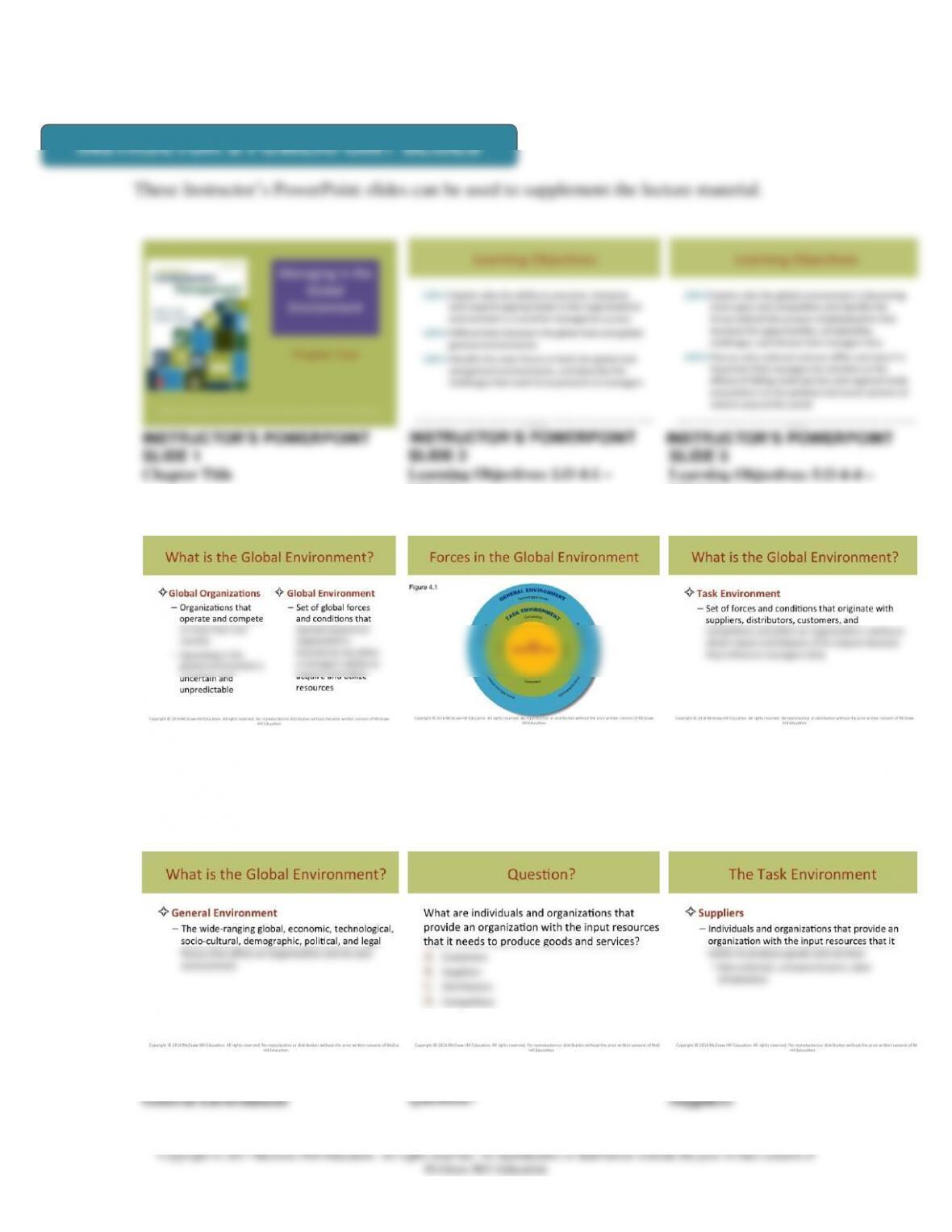
INSTRUCTOR’S POWERPOINT
SLIDE 10
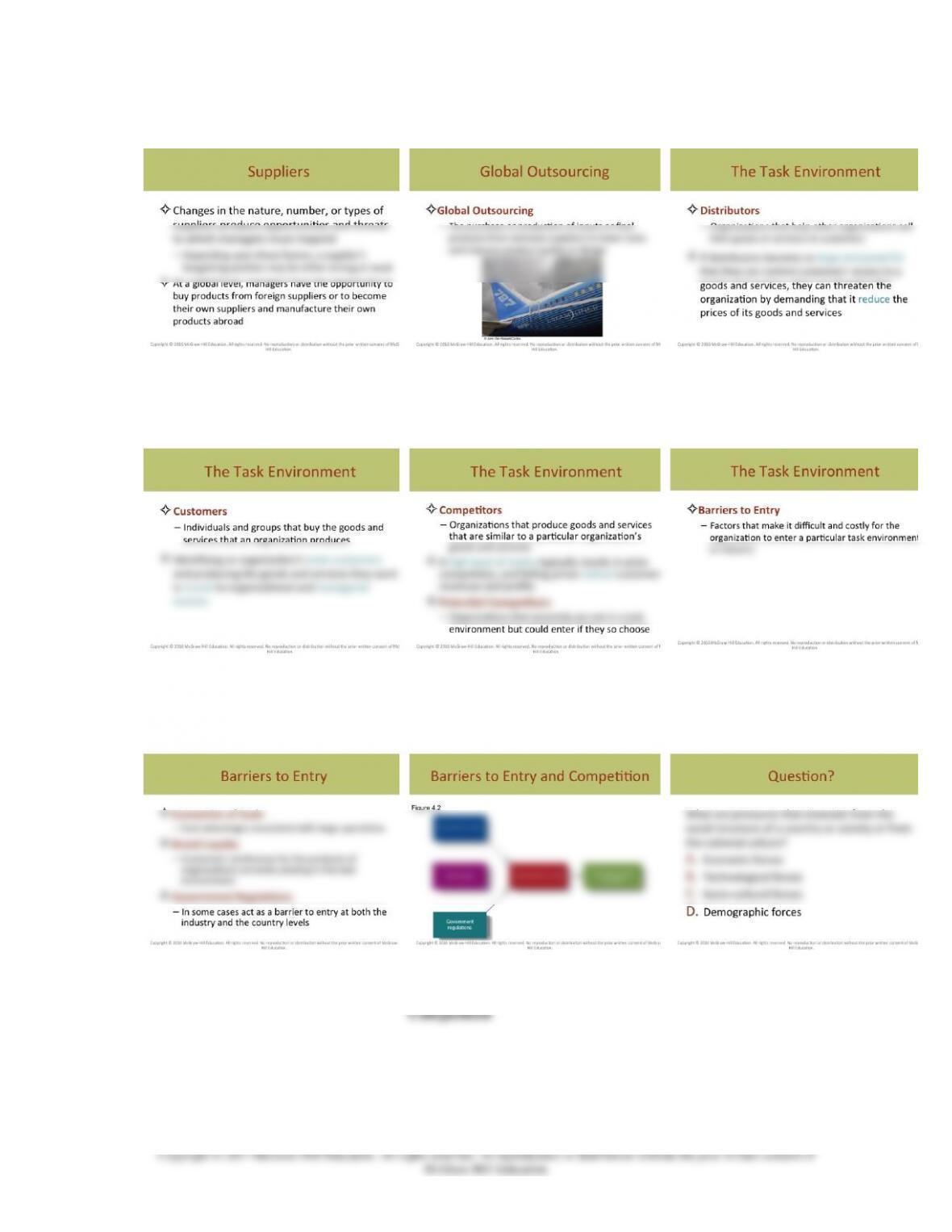
Suppliers
INSTRUCTOR’S POWERPOINT
SLIDE 11
Global Outsourcing
INSTRUCTOR’S POWERPOINT
SLIDE 12
Distributors
INSTRUCTOR’S POWERPOINT
SLIDE 13
Customers
INSTRUCTOR’S POWERPOINT
SLIDE 14
Competitors
INSTRUCTOR’S POWERPOINT
SLIDE 15
Barriers to Entry
INSTRUCTOR’S POWERPOINT
SLIDE 16
Barriers to Entry
INSTRUCTOR’S POWERPOINT
SLIDE 17
Figure 4.2 – Barriers to Entry and
Competition
INSTRUCTOR’S POWERPOINT
SLIDE 18
Question?
Chapter 04 – Managing in the Global Environment
4-28
INSTRUCTOR’S POWERPOINT
SLIDE 19
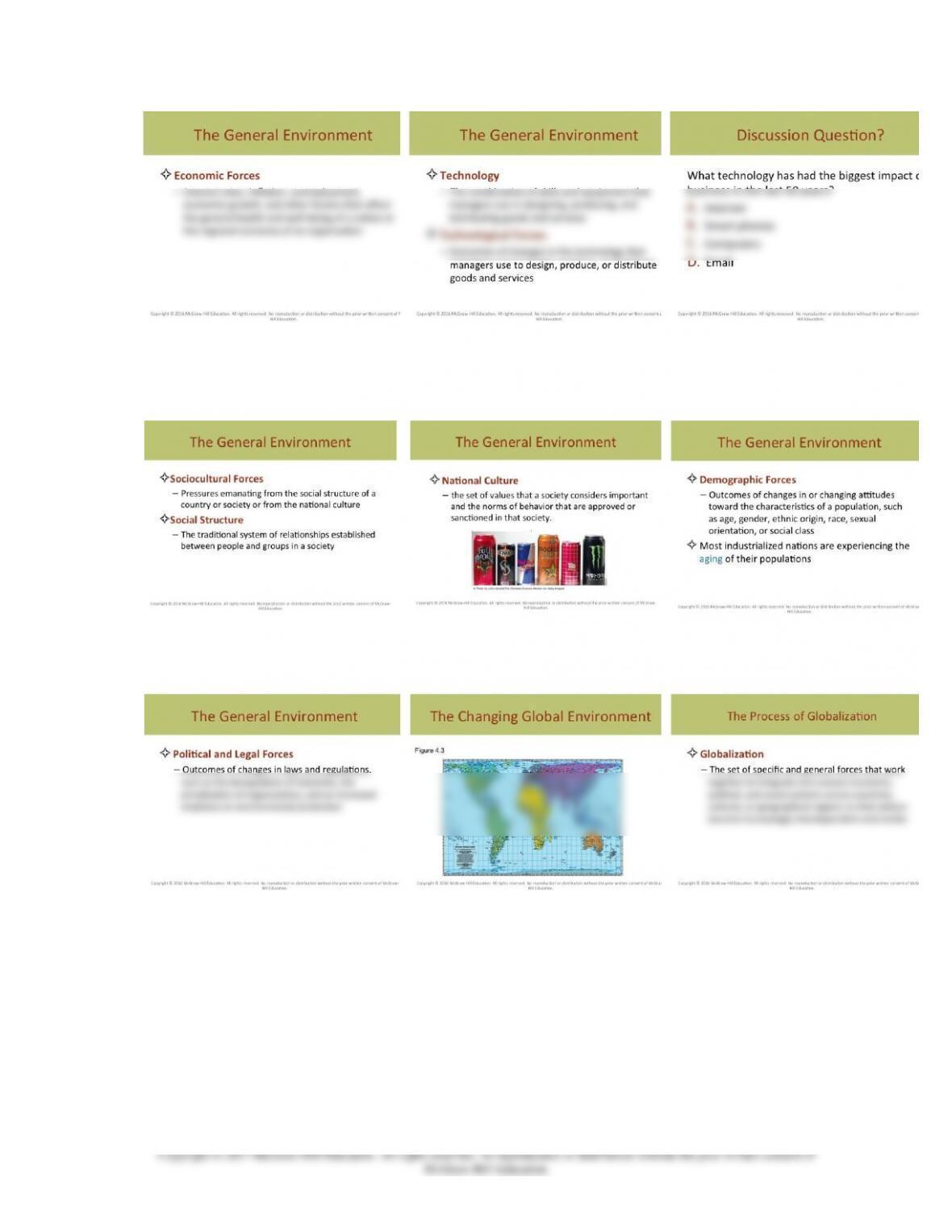
The General Environment
INSTRUCTOR’S POWERPOINT
SLIDE 20
The General Environment
INSTRUCTOR’S POWERPOINT
SLIDE 21
Discussion Question?
INSTRUCTOR’S POWERPOINT
SLIDE 22
Sociocultural Forces
INSTRUCTOR’S POWERPOINT
SLIDE 23
[CHANGE fwd]
INSTRUCTOR’S POWERPOINT
SLIDE 24
Demographic Forces
INSTRUCTOR’S POWERPOINT
SLIDE 25
The Global Environment
INSTRUCTOR’S POWERPOINT
SLIDE 26
Figure 4.3 – The Global
Environment
INSTRUCTOR’S POWERPOINT
SLIDE 27
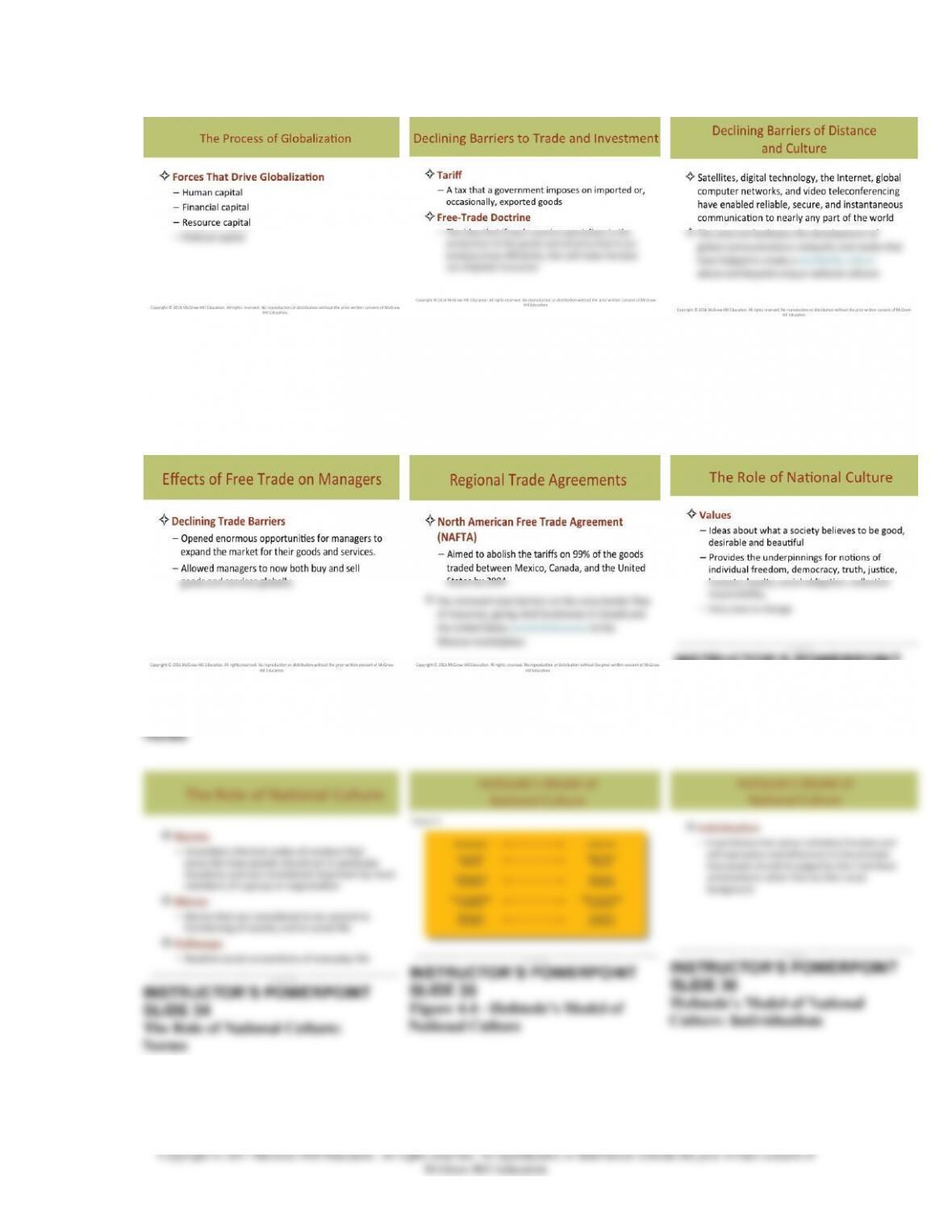
The Process of Globalization
Chapter 04 – Managing in the Global Environment
4-29
INSTRUCTOR’S POWERPOINT
SLIDE 28
Forces That Drive Globalization
INSTRUCTOR’S POWERPOINT
SLIDE 29
Declining Barriers to Trade and
Investment
INSTRUCTOR’S POWERPOINT
SLIDE 30
Declining Barriers of Distance and
Culture
INSTRUCTOR’S POWERPOINT
SLIDE 31
Effects of Free Trade on Managers
Norms
INSTRUCTOR’S POWERPOINT
SLIDE 32
Regional Trade Agreements
INSTRUCTOR’S POWERPOINT
SLIDE 33
The Role of National Culture:
Values
INSTRUCTOR’S POWERPOINT
SLIDE 34
The Role of National Culture:
Norms
INSTRUCTOR’S POWERPOINT
SLIDE 35
Figure 4.4 – Hofstede’s Model of
National Culture
INSTRUCTOR’S POWERPOINT
SLIDE 36
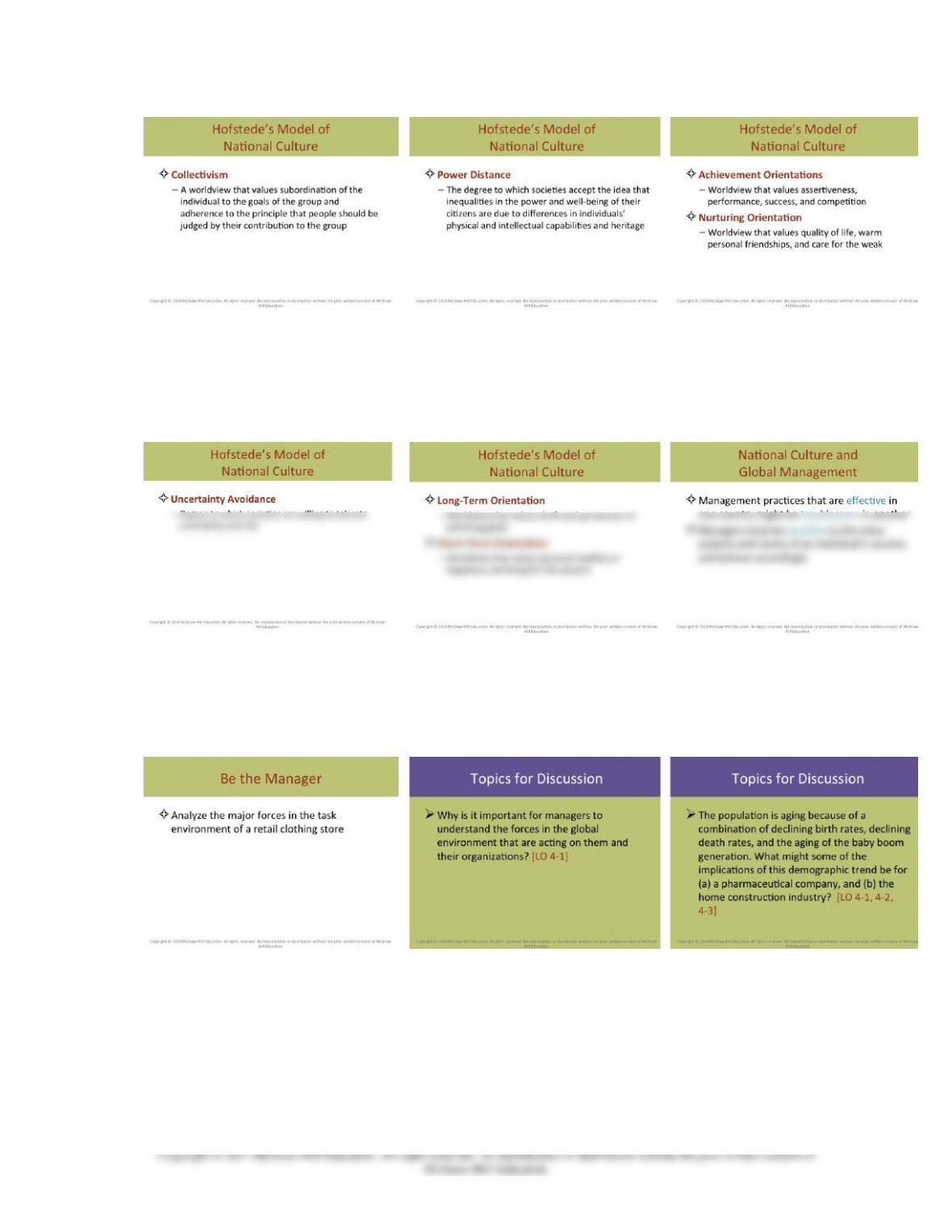
Hofstede’s Model of National
Culture: Individualism
Chapter 04 – Managing in the Global Environment
4-30
INSTRUCTOR’S POWERPOINT
SLIDE 37
Hofstede’s Model of National
Culture: Collectivism
INSTRUCTOR’S POWERPOINT
SLIDE 38
Hofstede’s Model of National
Culture: Power Distance
INSTRUCTOR’S POWERPOINT
SLIDE 39
Hofstede’s Model of National
Culture:
Achievement and Nurturing
Orientations
INSTRUCTOR’S POWERPOINT
SLIDE 40
Hofstede’s Model of National
Culture: Uncertainty Avoidance
INSTRUCTOR’S POWERPOINT
SLIDE 41
Hofstede’s Model of National
Culture: Long- and Short-Term
Orientation
INSTRUCTOR’S POWERPOINT
SLIDE 42
National Culture and Global
Management
INSTRUCTOR’S POWERPOINT
SLIDE 43
Be the Manager
INSTRUCTOR’S POWERPOINT
SLIDE 44
Topics for Discussion
INSTRUCTOR’S POWERPOINT
SLIDE 45
Topics for Discussion
Chapter 04 – Managing in the Global Environment
INSTRUCTOR’S POWERPOINT
SLIDE 46
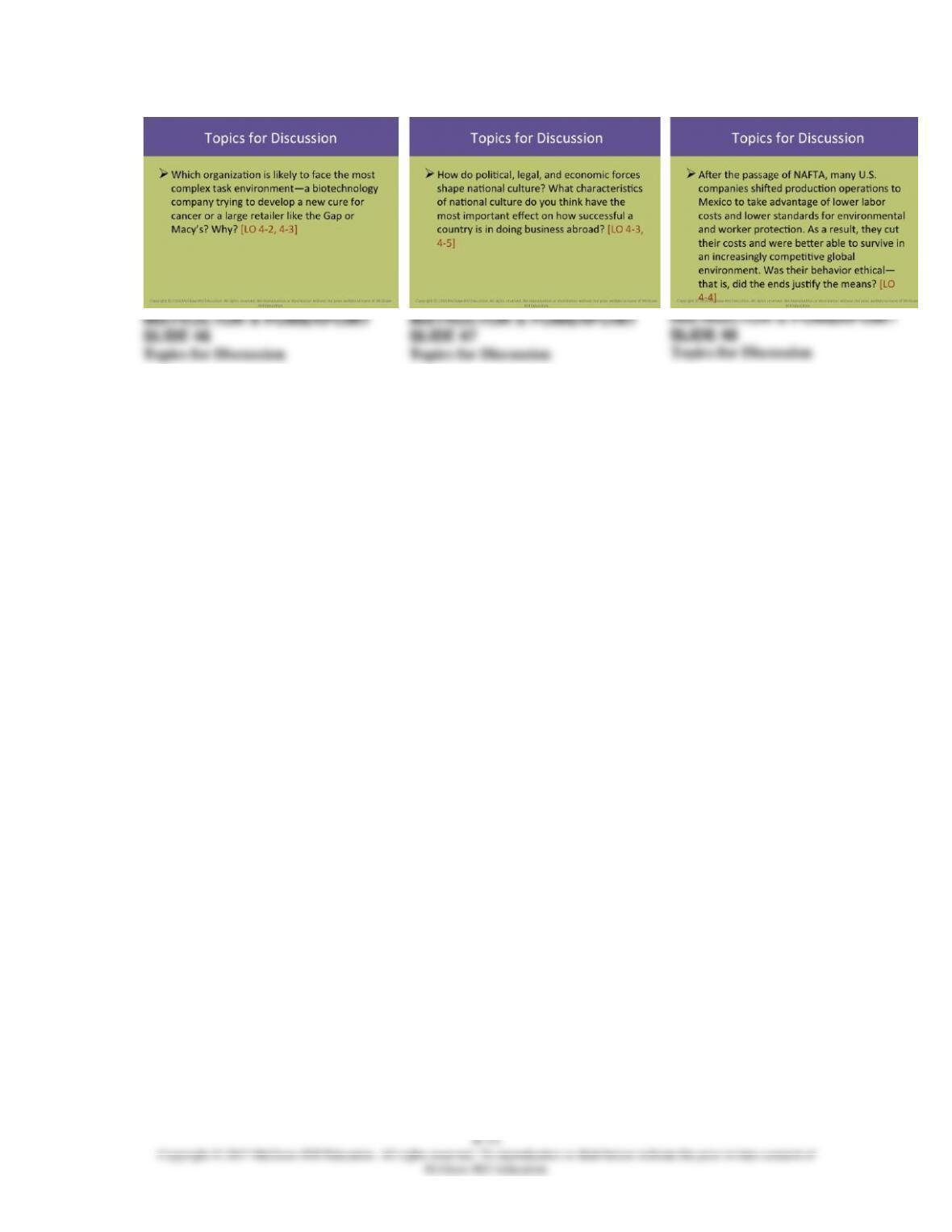
Topics for Discussion
INSTRUCTOR’S POWERPOINT
SLIDE 47
Topics for Discussion
INSTRUCTOR’S POWERPOINT
SLIDE 48
Topics for Discussion