
Chapter 04 – Global Management: Managing Across Borders
4-1
4
Chapter
Global Management:
Managing Across Borders
Major Questions the Student Should Be Able to Answer 2
Mapping the Class: Chapter Outline 3
Overview of the Chapter 4
CHAPTER CONTENTS
Chapter 04 – Global Management: Managing Across Borders
4-2
4.1 Globalization: The Collapse of Time and Distance
MAJOR QUESTION: What three important developments of globalization will probably
affect me?
4.2 You and International Management
MAJOR QUESTION: Why learn about international management, and what characterizes
the successful international manager?
MAJOR QUESTIONS THE STUDENT SHOULD BE ABLE TO ANSWER
Chapter 04 – Global Management: Managing Across Borders
4-3
4.1 Globalization: The Collapse of Time and Distance
• Competition & Globalization: Who Will Be No. 1 Tomorrow?
4.2 You and International Management
• Why Learn about International Management?
4.3 Why and How Companies Expand Internationally
4.4 The World of Free Trade: Regional Economic Cooperation
• Barriers to International Trade
4.5 The Importance of Understanding Cultural Differences
• The Importance of National Culture
• Cultural Dimensions: The GLOBE Project
MAPPING THE CLASS: CHAPTER OUTLINE
Chapter 04 – Global Management: Managing Across Borders
4-4
4.1 Globalization: The Collapse of Time and Distance
Globalization is the trend of the world economy toward becoming a more
interdependent system. Globalization is reflected in three developments: 1) the
4.2 You and International Management
Studying international management prepares you to work with foreign customers
4.3 Why and How Companies Expand Internationally
Multinational companies expand internationally to explore new markets, secure low
subsidiaries.
4.4 The World of Free Trade: Regional Economic Cooperation
Barriers to free trade include tariffs, import quotas, and embargoes.
4.5 The Importance of Understanding Cultural Differences
Managers trying to understand other cultures need to understand the importance
OVERVIEW OF THE CHAPTER
Chapter 04 – Global Management: Managing Across Borders
4-5
The Manager’s Toolbox: Learning to Be a Success Abroad: How Do You Become
a World Citizen?
When traveling or working abroad, it is important to follow the tips outlined in this
toolbox to enhance your experience. People from the United States often are perceived
Possible Topics for Discussion:
• Have you done much traveling? What tricks have you discovered to make it
more satisfying?
• Assume you are going to be traveling internationally after you graduate. How
can you best learn what behaviors and customs are considered appropriate in
the countries you will visit?
Section 4.1 describes globalization, which is the trend of the world economy moving
more toward an interdependent system. Globalization includes the rise of the “global
CLASSROOM OUTLINE
4.1 Globalization: The Collapse of Time & Distance (pp. 102-
105)
What three important developments of globalization will probably affect
me?
Chapter 04 – Global Management: Managing Across Borders
4-6
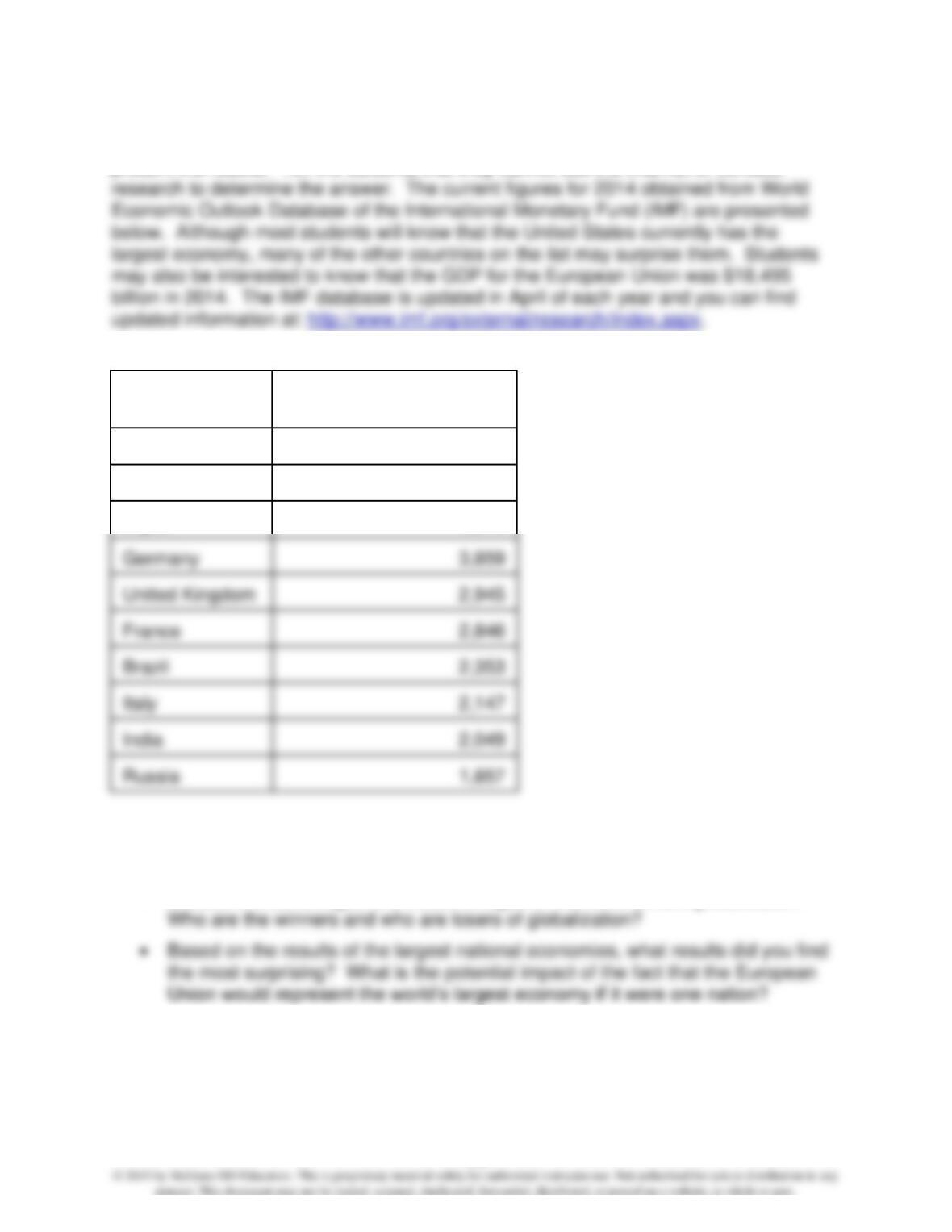
economies based on gross domestic product (GDP) last year. Give the students a few
minutes to work with another student in the class to prepare their estimates and then
present the results. Tell the students that they cannot use the Internet or conduct
Country
2014 GDP Current Prices
(in billions)
United States
17,418
China
10,380
Japan
4,616
United Kingdom
2,945
Brazil
2,353
Italy
2,147
Russia
1,857
Possible Topics for Discussion:
• Discuss the factors that have contributed to the trend of globalization.
• Discuss the advantages and disadvantages of the trend toward globalization.
Major Idea Outline:
A. The world today is being rapidly changed by globalization—the trend of the
world economy toward becoming a more interdependent system.
Chapter 04 – Global Management: Managing Across Borders
4-7
1. Time and distance have virtually collapsed, as reflected in the three
important developments given below.
B. The Rise of the “Global Village” and Electronic Commerce
1. Centuries ago, communication was based on transportation, such as the
Roman Empire’s network of roads; later, the airplane reduced travel time.
4. One big factor is the Internet, a worldwide computer-linked “network of
networks.”
b. The coding system, linkages and addressing scheme known as the
World Wide Web turned the Internet into a mass medium.
Chapter 04 – Global Management: Managing Across Borders
4-8
C. One Big World Market: The Global Economy
1. The demise of communism, the opening of economies to foreign trade by
Asian countries and deregulation of economies have created a global
2. Positive effects of a global economy:
a. With increased income, consumers in other regions of the world
3. Negative effects of a global economy:
a. Financial crises throughout the world helped spark a housing-and-
Chapter 04 – Global Management: Managing Across Borders
4-9
D. Cross-Border Business: The Rise of Megamergers and Minifirms Worldwide
1. The global market, driven by electronic information, has fueled the growth
of two opposite kinds of businesses:
a. Megamergers operating worldwide:
(1) Certain industries (oil, telecommunications, automobiles, etc.)
are not suited to being midsize, so companies try to become
Chapter 04 – Global Management: Managing Across Borders
4-10
(Correct answer is A)
Section 4.2 describes how studying international management prepares you to work
with foreign customers or suppliers, or to work for a foreign firm in the US or abroad.
Successful international managers aren’t ethnocentric or polycentric but geocentric.
Possible Topics for Discussion:
• Discuss the reasons why you should become more savvy about international
management, even if you never want to work internationally.
Interactive Classroom Material:
EXAMPLE: Americans Working Overseas (p. 106)
Many Americans are finding work overseas for major US and foreign corporations.
These individuals are seeking an edge that will pay off in career boosts at home.
Moreover, individuals can learn a different perspective on diversity by working abroad.
4.2 You & International Management (pp. 106-109)
Why learn about international management, and what characterizes the
successful international manager?
Chapter 04 – Global Management: Managing Across Borders
4-11
YOUR CALL
How do you feel about following these intrepid travelers? How can you begin
to prepare yourself for working overseas?
Many of us fear living overseas because we do not know a foreign culture. There
Additional Activities:
One way to build on this Example is to have the students watch the Capture Your
Flag video “Why Working Internationally is a Good Career Move.” In this 2-minute
video, strategist and management consultant Hammans Stallings discusses how
Major Idea Outline:
A. Working overseas is an advantage to your career.
1. Foreign experience demonstrates independence, resourcefulness,
entrepreneurship.
B. Why Learn About International Management?
1. International management is management that oversees the conduct of
operations in or with organizations in foreign countries.
Chapter 04 – Global Management: Managing Across Borders
4-12
Interactive Classroom Material:
PRACTICAL ACTION: Being an Effective Road Warrior (pp. 107-108)
Business travel is often a necessity. Three key lessons regarding business travel are
(1) Personal encounters are essential; (2) Travel may be global, but understanding
must be local; (3) Frequent travel requires frequent adjustments.
YOUR CALL
Does this give you cause for concern? What do you think you should do about
it?
For those who have not traveled a lot, international travel aimed at meeting clients
and/or suppliers, or to negotiate contracts, may seem like a daunting task. Many
Additional Activities:
One way to build on this Example is to have the students read the Harvard Business
Review blog article by “A Successful International Assignment Depends on these
Factors” by Boris Groysberg and Robin Abrahams. This article from February 13,
2014, discusses work and family issues that can impact international assignments.
Consider using the following discussion questions:
Chapter 04 – Global Management: Managing Across Borders
4-13
clients.
Article Link:
2. Whether or not you travel overseas, the global market will come to you.
a. You may deal with foreign customers or partners.
(1) A foreign company may be a partner in a joint venture.
(2) Success may depend on understanding other cultures.
b. You may deal with foreign employees or suppliers.
(1) You may have to purchase raw materials, components or
C. The Successful International Manager: Geocentric, Not Ethnocentric or
Polycentric
1. Three attitudes predominate among managers.
a. Ethnocentric managers—“we know best.”
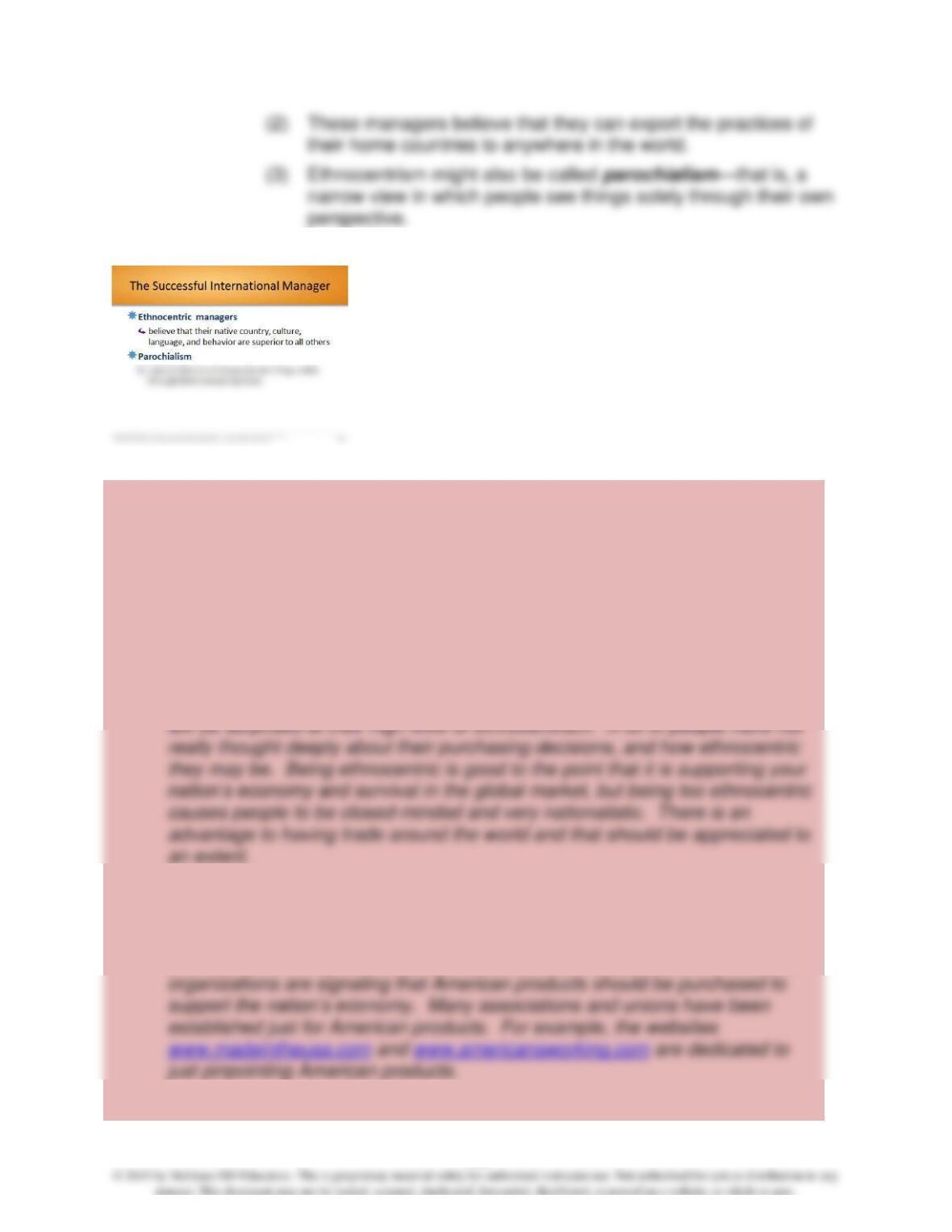
Chapter 04 – Global Management: Managing Across Borders
4-14
SELF-ASSESSMENT 4.1 (p. 109)
Assessing Your Consumer Ethnocentrism
Go to connect.mheducation.com and take Self-Assessment 4.1.
Student Questions:
1. Are you surprised by the results? What do they suggest about your
purchasing decisions? What are the pros and cons of being an ethnocentric
consumer?
Student responses will differ based on assessment results. Many students
2. How do American companies, associations, and unions encourage us to be
ethnocentric consumers?
Many American companies label products “Made in the USA” in order to
promote American products as the standard of excellence. Moreover, these
Additional Activities:
Chapter 04 – Global Management: Managing Across Borders
4-15
You can also consult the Connect Instructors Manual for the post-assessment activity
and corresponding PowerPoint slides used for this Self-Assessment in Connect. In
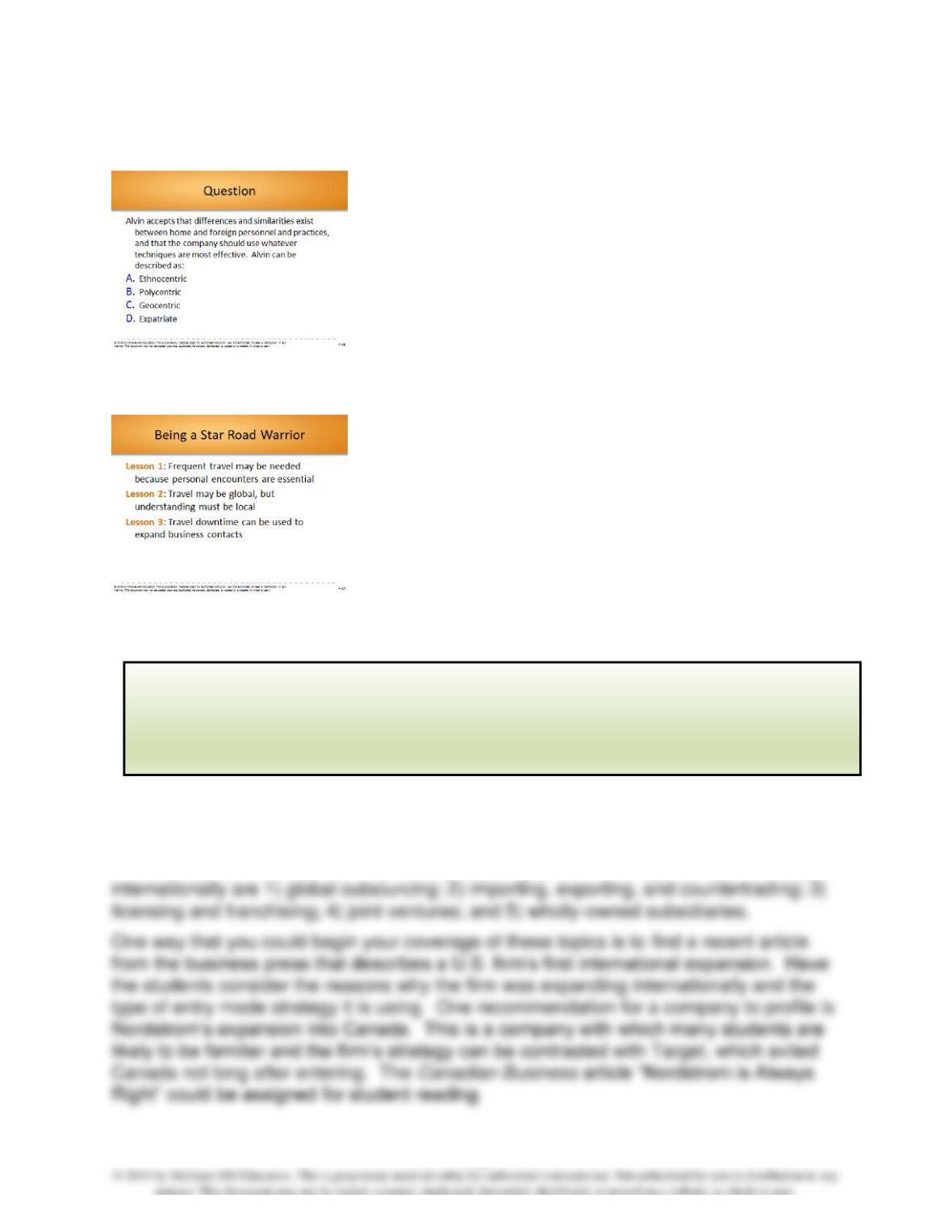
b. Polycentric managers—“they know best.”
(1) These managers believe that native managers in the foreign
c. Geocentric managers—“what’s best is what’s effective, regardless of
origin.”
(1) These managers accept that there are differences and
similarities between home and foreign personnel and practices.
Chapter 04 – Global Management: Managing Across Borders
4-16
(Correct answer is C)
Section 4.3 discusses why and how companies expand abroad. Multinationals expand
to take advantage of availability of supplies, new markets, lower labor costs, access to
finance capital, or avoidance of tariffs and import quotas. Five ways companies expand
4.3 Why & How Companies Expand Internationally (pp. 110-
114)
Why do companies expand internationally, and how do they do it?
Chapter 04 – Global Management: Managing Across Borders
Article Citation:
Possible Topics for Discussion:
• Describe the advantages and disadvantages of each of the five ways of
expanding internationally described in the chapter.
• Using the article “Nordstrom is Always Right” as your foundation, discuss the
Major Idea Outline:
A. The text uses the example of Apple iPhones, Ethan Allen furniture, and
Procter & Gamble consumer products to demonstrate how much of American
business is global.
B. Why Companies Expand Internationally
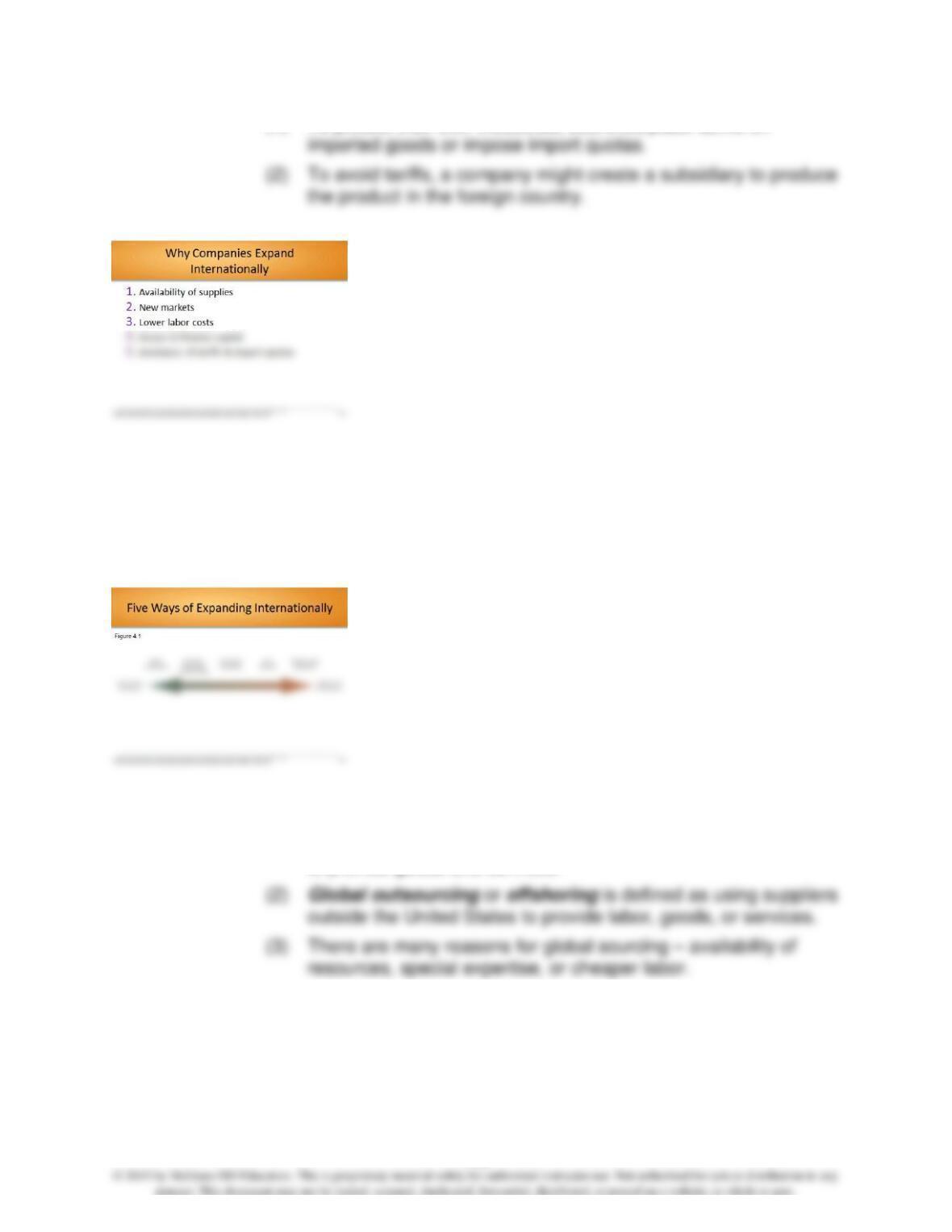
1. There are at least five reasons why companies expand internationally, all
of which have to do with making or saving money:
a. Availability of supplies – Companies have to go where their basic
c. Lower labor costs – Many American companies have found it cheaper
to do their manufacturing outside the U.S.
(1) Maquiladoras are manufacturing plants allowed to operate in
Mexico with special privileges in return for employing Mexican
citizens, providing less expensive labor.
(2) Even professional or service jobs may be shipped overseas.
Chapter 04 – Global Management: Managing Across Borders
4-18
(1) To protect their own industries, countries place tariffs on
C. How Companies Expand Internationally
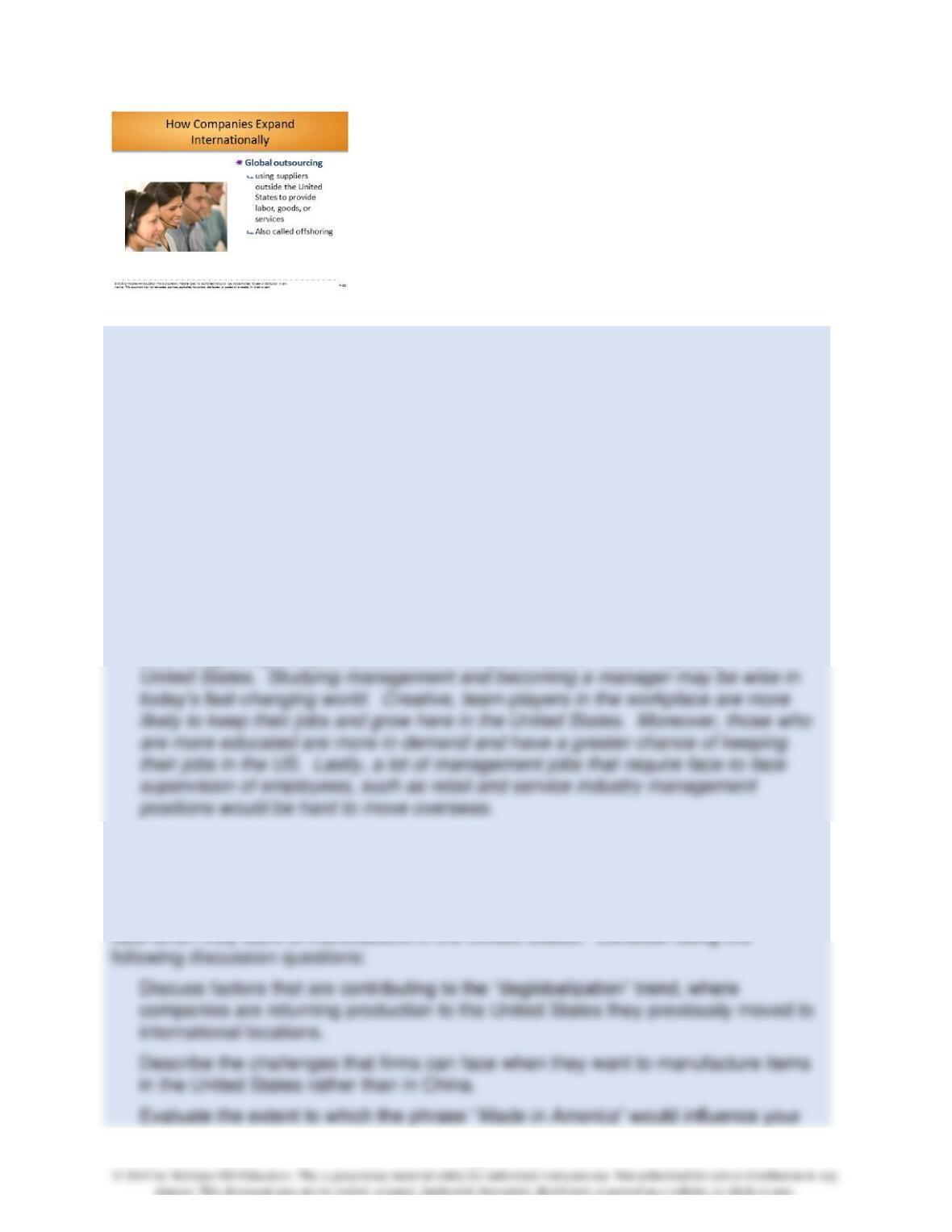
1. Most companies enter into international business in one of five ways.
Figure 4.1 shows the ways ranging from the lowest risk and investment to
the highest risk and investment.
a. Global outsourcing
(1) Outsourcing is defined as using suppliers outside the company
to provide goods and services.
Chapter 04 – Global Management: Managing Across Borders
4-19
Interactive Classroom Material:
PRACTICAL ACTION: Global Outsourcing: Which Jobs Are Likely to Fall Victim
to Offshoring? (pp. 112-113)
Companies are increasingly outsourcing manufacturing, blue-collar and white-collar
jobs to other countries. Productivity gains are also eliminating jobs in the U.S. Jobs
that will remain in the U.S. include those that are face to face, involve physical
contact, and recognize complex patterns. To survive offshoring, managers should
remember three ideas: (1) teamwork and creativity, (2) flexibility, and (3) education.
YOUR CALL
What kind of job or jobs are you interested in that would seem to provide you
with some hopes of prevailing in a fast-changing world?
Jobs that fall within the pattern of being face to face, involving physical contact,
and recognizing complex patterns are the jobs that will most likely stay in the
Additional Activities:
One way that you could build on this Practical Action is to have the students read the
Wall Street Journal article “Companies Tiptoe Back Toward ‘Made in the U.S.A.” This
article focuses on the trend toward “deglobalization” and the challenges that firms can
Chapter 04 – Global Management: Managing Across Borders
4-20
decision-making process and the products that you would buy. Defend your
position.
Article Citation:
b. Importing, exporting, and countertrading
(1) When importing, a company buys goods outside the country
and resells them domestically.
c. Licensing and franchising
(1) In licensing, a company allows a foreign company to pay a fee
to make or distribute the first company’s product or service.