Chapter 04 – Power and Influence
4-16
Because of these tensions, the plant manager has decided to have members of each unit meet with each
other to decide what to do about the temperature in the plant. Each unit will have 10 minutes to read their
Note to Instructors: After the initial 10 minute session, divide the three groups up into three or four
equally sized focus groups (these groups should be listed on a chalk board or flip chart, but students
should not see their assignments until just before the focus group session). There should be at least one
This exercise takes about 45 minutes without video tape; it may take closer to 90 minutes if videotaping is
used.
This exercise may also be used in the Advanced Leadership Skills chapter after discussing negotiation.
Chapter 04 – Power and Influence
4-17
The Production Unit
You have worked in the worst conditions you have ever experienced, and the intense heat and humidity
both inside and outside the plant have gone on entirely too long. Although you know management cannot
do anything about the outside temperatures, they sure can do a better job lowering the temperature on the
inside of the plant. Lowering the temperature by a lousy two degrees was just a joke! The heat is starting
to compromise safety, production, and quality—two members of the unit were recently treated for heat
Chapter 04 – Power and Influence
4-18
The Administration and Support Unit
You spend most of the time behind a desk, completing requisition and sales forms, processing time cards,
typing reports and memos, working on budget estimates, maintaining data bases, answering the phones,
and other general clerical work. The temperature has always been a problem at the plant, and most of the
The Administrative and Support Unit is tired of being seen as second class citizens at the plant. Don’t the
Production and Sales Unit staff know that they couldn’t get paid, submit insurance or travel claims, fill
orders, get supplies, or take vacations without our help? Maybe we should just walk off the job—then
Chapter 04 – Power and Influence
The Sales Unit
Your main concern is to create a comfortable environment for the many clients who come to the plant.
Because your Whatchamacallit and Thingamijig boxes are so revolutionary, clients must spend a
considerable amount of time being educated about the Greenmat environmentally-friendly materials from
which they are made. You really don’t want your clients complaining that your plant is too hot or too cold,
as it may eventually disrupt sales. And with all the hard work the sales force does just to get potential
clients interested in these products, you’d hate to lose sales just because of the temperature in the plant.
You were all pretty upset by the plant manager’s decision to lower the plant’s temperature by two degrees,
Chapter 04 – Power and Influence
4-20
Exercise 4-5
Exercise Title: Bases of Power Inventory
Purpose: Provides self-ratings of power bases.
Summary: The Bases of Power Inventory takes about five minutes to complete, and can be done in class
or as a homework assignment. Students should complete the inventory, calculate their scores, and read the
suggestions for improving their power bases.
Chapter 04 – Power and Influence
4-21
Bases of Power Inventory
Gordon J. Curphy, Ph.D.
Use the following scale to respond to the items:
1———————2———–———3—————–-4——————-5
Strongly Disagree Disagree So-So Agree Strongly Agree
1. I have the education and training needed to be successful in my job. _____
2. I have relevant knowledge, experience, and skills for my job. _____
6. I can leverage relationships in order to get others to take action. _____
7. I have a lot of latitude in deciding how or when work gets done. _____
8. I have a lot of formal authority in my current position. _____
12. I control a large number of potential rewards or benefits to give to others. _____
13. I can withhold perks and privileges if others are not doing a good job. _____
Chapter 04 – Power and Influence
4-22
Power and Leadership: Building Your Power Bases
Leaders have the potential to change followers’ attitudes, opinions, and behaviors. However, followers
can also change the attitudes and behaviors of their leaders. Moreover, characteristics of the situation can
affect the capacity of leaders and followers to influence each other. The potential to change others’
Expert Power: The ability to influence others based on one’s skills, knowledge,
experience, or expertise.
Coercive Power: The ability to influence others through the administration of negative
sanctions or the removal of positive events.
Chapter 04 – Power and Influence
4-23
Expert Power
Definition: The ability to influence others based on one’s skill, knowledge, or expertise.
Expert power is a function of the amount of knowledge one possesses relative to rest of the members in
the group.
Total of Items 1-3: __________ Total Expert Power Score
• 12-15 You can exert considerable influence based on what you know.
To increase Expert Power:
• Enroll in training courses.
Chapter 04 – Power and Influence
4-24
Referent Power
Definition: The ability to influence others based on the strength of shared relationships.
Referent power can counteract the effects of having relatively little expert power.
The more and stronger the relationships, the more referent power you have. Thus, networking is important
if you want to get things done in an organization.
Total of Items 4-6: __________ Total Referent Power Score
• 12-15 You can exert considerable influence based on who you know.
To increase referent power, one has to be willing to spend time honing interpersonal skills and building
Chapter 04 – Power and Influence
4-25
Legitimate Power
Definition: The ability to influence others based on the authority vested in one’s position in the
organization.
Legitimate power allows you to make decisions and take action relatively quickly.
Total of Items 7-9: __________ Total Legitimate Power Score
• 12-15 You can exert considerable influence based on your position.
The farther one moves up the corporate ladder, the more legitimate power one will have. Of course,
moving up the corporate ladder will depend to some extent on how well you use the other four bases of
power.
Chapter 04 – Power and Influence
4-26
Reward Power
Definition: The ability to influence others based on control over desired resources.
Reward power is affected by the types of rewards followers want and leaders can give.
Total of Items 10-12: __________ Total Reward Power Score
• 12-15 You can influence others via the rewards you control.
One key to using reward power is determining what type of rewards subordinates want. All too often,
leaders mistakenly assume that the rewards they appreciate are the same rewards their subordinates would
appreciate. Spending time building relationships with subordinates not only builds referent power, but can
also give you clues as to the types of rewards that will best motivate individual followers.
Chapter 04 – Power and Influence
4-27
Coercive Power
Definition: The ability to influence others through the administration of negative sanctions or the
removal of positive events.
There are several myths surrounding the use of coercive power or punishment. None of these myths have
stood up to scientific research.
Total of Items 13-15: __________ Total Coercive Power Score
• 12-15 You can influence others using punishment or threats.
To use punishment or coercive power correctly, think of the “hot stove” rule.
Chapter 04 – Power and Influence
4-28
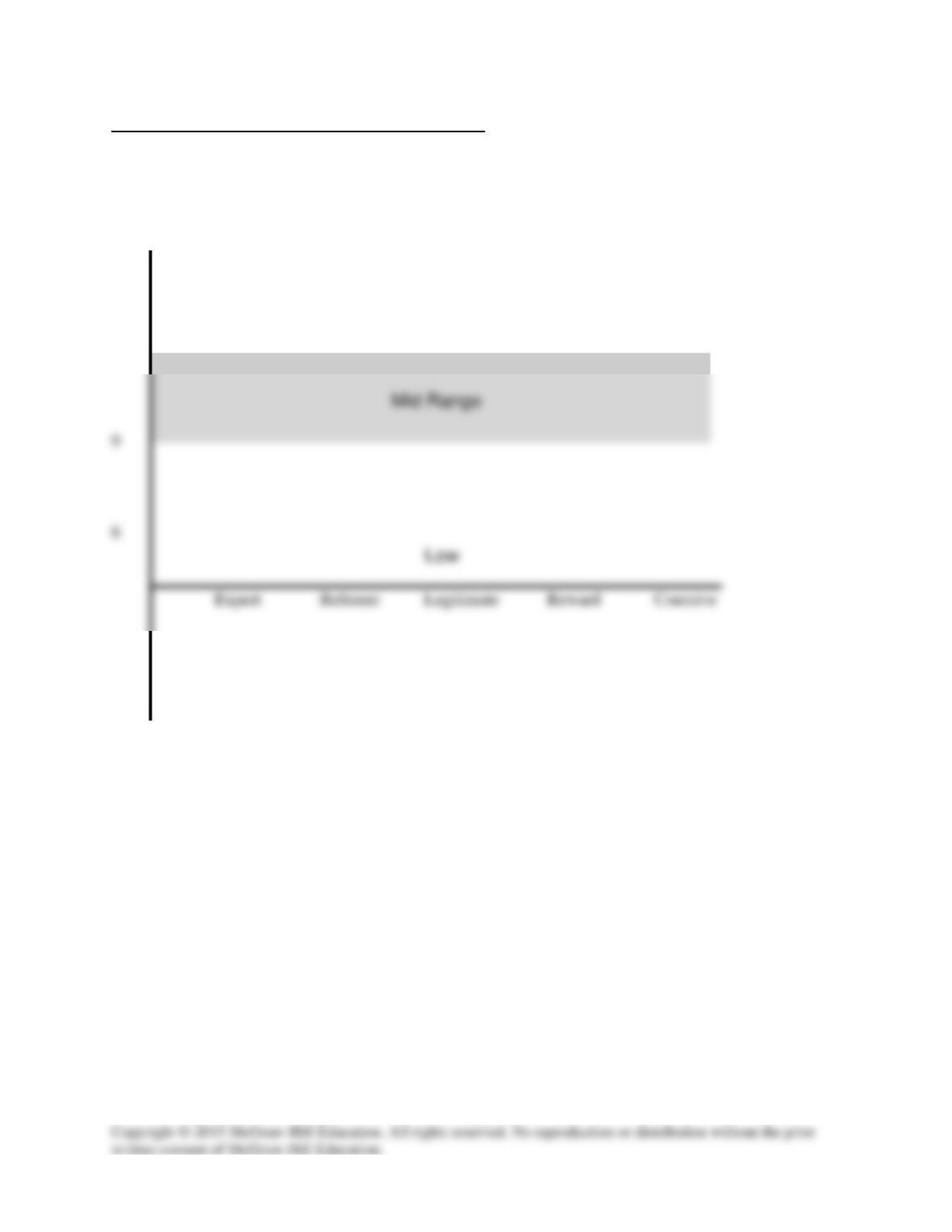
Plotting Your Bases of Power Inventory Scores
15
12
High
Chapter 04 – Power and Influence
4-29
Additional References/Resources
Bono, J. E., & Anderson, M. H. (2005). The advice and influence networks of transformational
leaders. Journal of Applied Psychology, 90, 1306-1314.
Brass, D.J. (2001). Social capital and organizational leadership. In S.J. Zaccaro & R.J. Klimoski
(Eds.), The nature of organizational leadership (pp. 132-152). San Francisco, CA: Jossey-
Bass.
Katzenbach, J.R. (2003). Why pride matters more than money: The power of the world’s greatest
motivational force. New York: Crown Business.
McClelland, D.C. & Burnham, D.H. (2003). Power is the great motivator. Harvard Business
Review, 81, 117-126.
Thomas, J.L., Dickson, M.W., & Bliese, P.D. (2001). Values predicting leader performance in
the U.S. army reserve officer training corps assessment center: Evidence for a personality-
mediated model. Leadership Quarterly, 12, 181-196.
Yagil, D. (2002). Substitution of a leader’s power bases by contextual variables. International
Journal of Organization Theory and Behavior, 5, 383-399.

Chapter 04 – Power and Influence