18 Instructor’s Manual – Chapter 4 | Ferrell / Hirt / Ferrell: Business © 2016 by McGraw-Hill Education.
Ferrell / Hirt / Ferrell:
Business
Instructor’s Manual – Chapter 4
B O X E D T E X T D I S C U S S I O N Q U E S T I O N S
Enter the World of Business—Shareholder Activism
Investors are increasingly clashing with board members of major corporations. Shareholder activism occurs
when shareholders use their ownership to put pressure on management. The majority of activist campaigns
1. What are some of the major reasons for shareholder activism?
2. Do you feel that large shareholders such as David Einhorn are justified in filing lawsuits against
corporations sitting on large cash reserves?
Students’ answers will vary.
3. What are some of the benefits of shareholder activism? Disadvantages?
GOING GREEN—Sustainably Organized: Crimson Renewable Energy Crimson Midstream Limited Liability
Corporation (LLC) is a holding company specializing in petroleum pipelines, the shipping of petro-chemicals,
and specialty asphalt products. As a holding company, it is able to generate independent business units with
19 Instructor’s Manual – Chapter 4 | Ferrell / Hirt / Ferrell: Business © 2016 by McGraw-Hill Education.
Ferrell / Hirt / Ferrell:
Business
Instructor’s Manual – Chapter 4
1. Crimson Midstream organized as a limited liability corporation. What are some of the advantages of an
LLC?
2. What protections does Crimson Renewable receive by organizing as a limited partnership?
3. What does it mean that Crimson Midstream holds unlimited liability for Crimson Renewable LP?
RESPONDING TO BUSINESS CHALLENGES—The Evolution of Sears Holdings Company
Sears Holdings began as a sole proprietorship in 1886 known as R.W. Sears Watch Company in Minneapolis.
Sears wanted to establish his company in Chicago and needed a partner to do so. He put an advertisement in
the local paper, and Alvah C. Roebuck responded. They formed Sears, Roebuck, and Co. as a corporation and
expanded the business to offer more product lines through mail order catalogs. Sears became a public
corporation in 1901 to secure financing for growth. Expansion continued with the introduction of retail stores
1. Why did Sears become a public corporation? What benefits does this form of organization have to
offer Sears?
2. Describe some reasons for why the firm is struggling.
20 Instructor’s Manual – Chapter 4 | Ferrell / Hirt / Ferrell: Business © 2016 by McGraw-Hill Education.
Ferrell / Hirt / Ferrell:
Business
Instructor’s Manual – Chapter 4
3. What is Sears doing to bounce back from its losses?
In 2004, Kmart acquired Sears for $11 billion and adopted the name Sears Holdings Company. The
merged company continues to struggle with losses and is selling off its best-known business units and
underperforming stores.
S U P P L E M E N T A L L E C T U R E
Organizing a Business
To the owners of a business, the form of business organization is of great importance. Whether a business is
organized as a sole proprietorship, a partnership, or a corporation, the form will have a real impact on taxes,
Scenario 1:
David and Linda Johnson decided to join with their close friend Pat Barton to form a new business to market
pet products. The partners purchased the exclusive license to market a patented insecticide-dispensing comb
that kills fleas and ticks on dogs and cats. The comb contains a special insecticide that saturates the comb’s
sturdy teeth and coats the animal’s skin and fur, killing fleas and ticks on contact. The product has been
21 Instructor’s Manual – Chapter 4 | Ferrell / Hirt / Ferrell: Business © 2016 by McGraw-Hill Education.
Ferrell / Hirt / Ferrell:
Business
Instructor’s Manual – Chapter 4
1. What form of business organization should they use?
(Note to the instructor: The corporate form of organization is the most obvious form of organization
because of the risk of lawsuits resulting from the widespread distribution of an insecticide. It is possible
Scenario 2:
Susan Schmitt recently quit working for a major publishing company and has decided to become a freelance
editor and writer for a number of publishing companies who might need her services. Susan plans to
purchase a new computer, word-processing software, and other equipment that she will need to write and
edit manuscripts. She plans to work in her home office so she can be closer to her family and use extra time
during the day to work on manuscripts.
2. What do you think Susan should do?
Scenario 3:
Margaret Stern and Janet Seglin have decided to fulfill a life-long dream of opening their own retail store.
They live in a town with a population of less than 50,000, and they are interested in opening a gourmet
coffee and tea store. Margaret and Janet plan to call their business The Gourmet Coffee Store.
22 Instructor’s Manual – Chapter 4 | Ferrell / Hirt / Ferrell: Business © 2016 by McGraw-Hill Education.
Ferrell / Hirt / Ferrell:
Business
Instructor’s Manual – Chapter 4
The Gourmet Coffee Store will serve fresh-roasted gourmet coffee and tea to generate traffic. They are also
considering serving pastries and desserts to encourage people to come to the store and look at the gourmet
coffee products that they plan to sell. Some of the gourmet coffees the store will offer include Hawaiian
3. How do you think The Gourmet Coffee Store should be organized? Should it be organized as a
partnership or as a corporation?
Based on the information given, it is likely that a partnership would suffice for the women at this stage of
their involvement. This case presents a number of issues discussed in the book to explain advantages and
C O N T R O V E R S I A L I S S U E
What Is a Partnership Worth?
The textbook relates that a disadvantage of a partnership is the sometimes difficult situation that arises when
a partner wants to sell his or her interest in the business. The tough question arises about how much one
partner’s interest in the firm is worth. This issue tells of an impasse reached by two partners, with names
disguised. Ask students to decide what would be the fairest settlement of the problem of the partnership.
23 Instructor’s Manual – Chapter 4 | Ferrell / Hirt / Ferrell: Business © 2016 by McGraw-Hill Education.
Ferrell / Hirt / Ferrell:
Business
Instructor’s Manual – Chapter 4
Nancy and Arthur were partners in a new printing establishment in a medium-sized community in the
Northwest. Each put up $40,000 to launch the firm. Things didn’t go terribly well the first year, and the
business lost $8,000. This meant that Nancy’s interest in the business dropped to $36,000 and likewise for
Arthur. At this point, Nancy expressed the desire to get out of the business, but Arthur didn’t see how he
could buy her out because his supply of ready cash was far short of $36,000. Nancy understood but
continued to state unequivocally that when the time was right she wanted out.
Despite her stand on withdrawing, Nancy continued to work diligently to make a success of the firm, as did
Arthur. The second year resulted in a loss of $2,000, thus reducing each partner’s interest to $35,000. Nancy
became even more determined to dissolve the partnership. During the third year, Nancy and Arthur
purchased a state–of–the-art press that would enable them to attract clients whom they had never
1. What is the problem with this partnership?
2. What is Nancy’s reasoning in asking for $80,000 rather than the $41,000 that her share of the business
is presently worth?
24 Instructor’s Manual – Chapter 4 | Ferrell / Hirt / Ferrell: Business © 2016 by McGraw-Hill Education.
Ferrell / Hirt / Ferrell:
Business
Instructor’s Manual – Chapter 4
3. What do you think would be an equitable settlement of this impasse?
S O Y O U ’D L I K E T O S T A R T A B U S I N E S S
Why would you choose to form a limited partnership?
C H E C K Y O U R P R O G R E S S
1. Name five advantages of a sole proprietorship.
a. Sole proprietorships are easy and inexpensive to form.
2. List two different types of partnerships and describe each.
A general partnership is a complete sharing in the management of the business, and each partner has
25 Instructor’s Manual – Chapter 4 | Ferrell / Hirt / Ferrell: Business © 2016 by McGraw-Hill Education.
Ferrell / Hirt / Ferrell:
Business
Instructor’s Manual – Chapter 4
3. Differentiate among the different types of corporations. Can you supply an example of each type?
A private corporation is owned by just one or a few people who are closely involved in managing the
business. These people, often a family, own all of the corporation’s stock, and no stock is sold to the
4. Would you rather own preferred stock or common stock? Why?
5. Contrast how profits are distributed in sole proprietorships, partnerships, and corporations.
6. Which form of business organization has the least government regulation? Which has the most?
7. Compare the liability of the owners of partnerships, sole proprietorships, and corporations.
Sole proprietors have the greatest liability because, as sole owners, they have no one to share the
26 Instructor’s Manual – Chapter 4 | Ferrell / Hirt / Ferrell: Business © 2016 by McGraw-Hill Education.
Ferrell / Hirt / Ferrell:
Business
Instructor’s Manual – Chapter 4
8. Why would secrecy in operating a business be important to an owner? What form of organization
would be most appropriate for a business requiring great secrecy?
9. Which form of business requires the most specialization of skills? Which requires the least? Why?
10. The most common example of a cooperative is a farm co-op. Explain the reasons for this and the
benefits that result for members of cooperatives.
Cooperatives are organizations composed of individuals or small businesses that have banded together
to reap the benefits of belonging to a larger organization. Farm co-ops are beneficial because they can
G E T I N V O L V E D
1. Select a publicly owned corporation and bring to class a list of its subsidiaries. These data should be
available in the firm’s corporate annual report, Standard and Poor’s Corporate Records, or Moody
Corporate Manuals. Ask your librarian for help in finding these resources.
Students’ responses will vary depending upon the companies they chose. One example might be
27 Instructor’s Manual – Chapter 4 | Ferrell / Hirt / Ferrell: Business © 2016 by McGraw-Hill Education.
Ferrell / Hirt / Ferrell:
Business
Instructor’s Manual – Chapter 4
2. Select a publicly owned corporation and make a list of its outside directors. Information of this nature
can be found in several places in your library; the company’s annual report; its list of corporate
directors; and various financial sources. If possible, include each director’s title and the name of the
company that employs him or her on a full-time basis.
Students’ responses will vary depending upon the companies they choose. One example might be
Procter & Gamble. As of this writing, its outside directors include Ernesto Zedillo Ponce de Leon, former
President of Mexico (Chair of the Governance & Public Responsibility Committee and member of the
B U I L D Y O U R S K I L L S
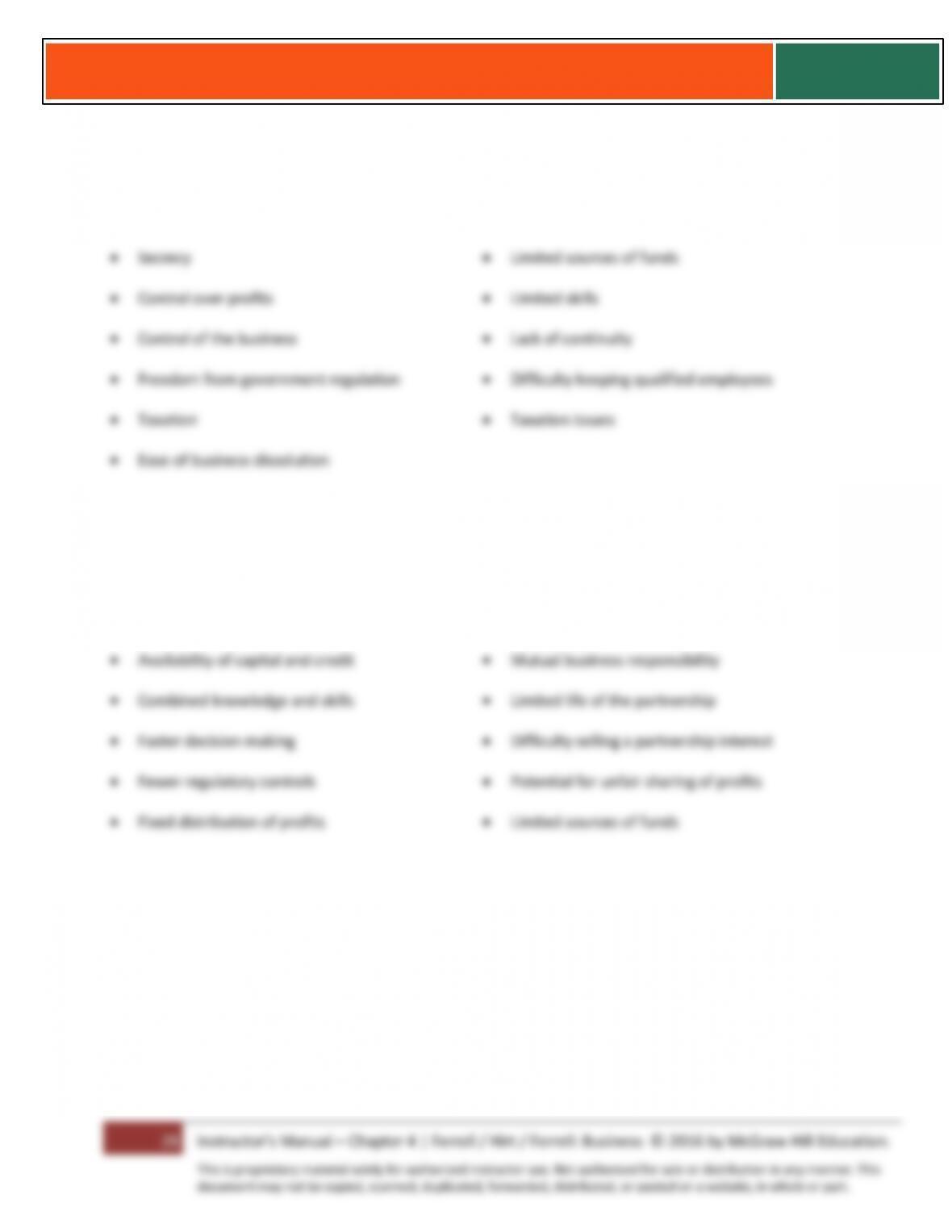
Suggestions for Use: You could broaden the focus of this exercise, depending on class size and time available,
Ferrell / Hirt / Ferrell:
Business
Instructor’s Manual – Chapter 4
SOLE PROPRIETORSHIPS
Advantages
Disadvantages
• Ease and low cost of formation
• Secrecy
• Control over profits
• Control of the business
• Freedom from government regulation
• Taxation
• Ease of business dissolution
• Unlimited liability
• Limited sources of funds
• Limited skills
• Lack of continuity
• Difficulty keeping qualified employees
• Taxation issues
PARTNERSHIPS
Advantages
Disadvantages
• Ease of organization
• Availability of capital and credit
• Combined knowledge and skills
• Faster decision making
• Fewer regulatory controls
• Fixed distribution of profits
• Unlimited liability
• Mutual business responsibility
• Limited life of the partnership
• Difficulty selling a partnership interest
• Potential for unfair sharing of profits
• Limited sources of funds
Ferrell / Hirt / Ferrell:
Business
Instructor’s Manual – Chapter 4
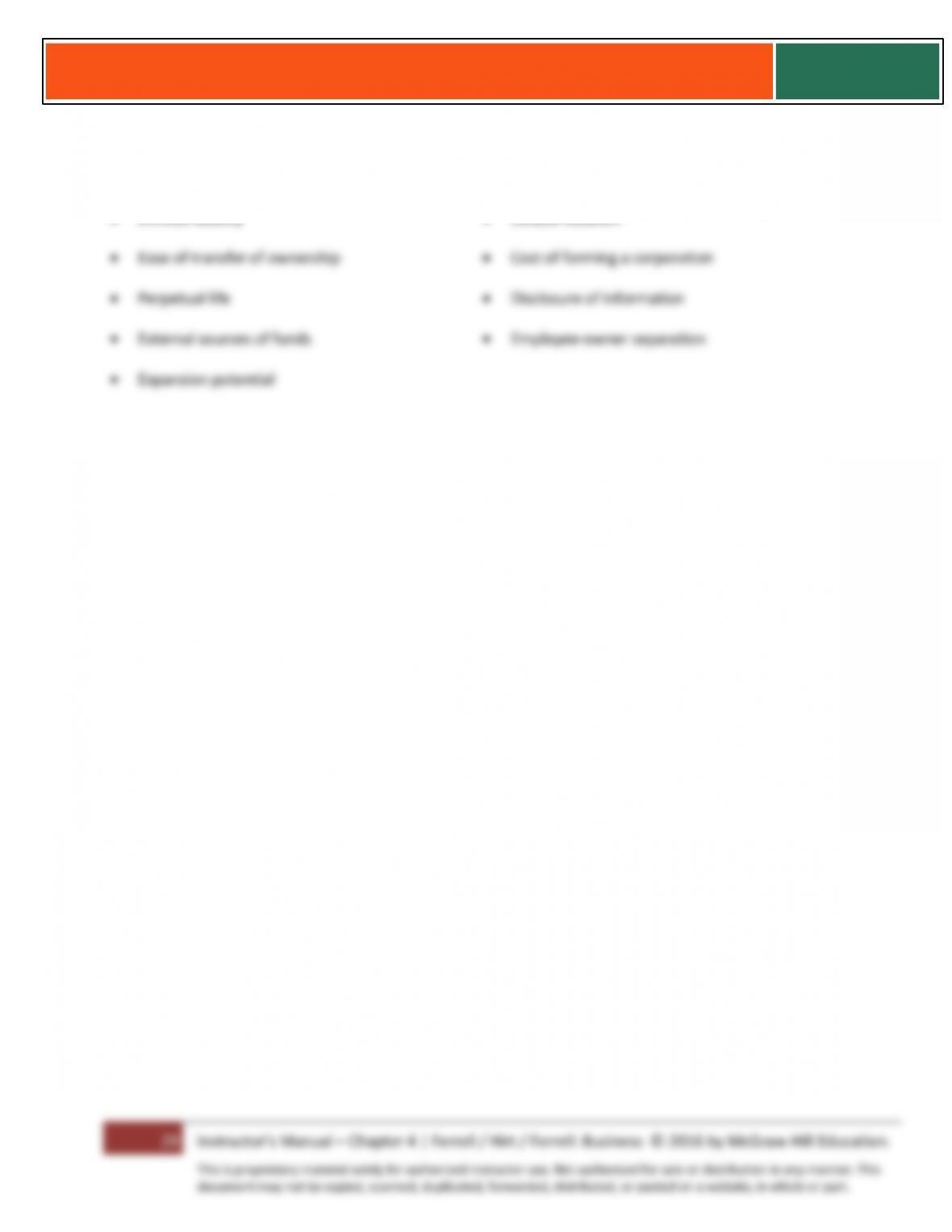
CORPORATIONS
Advantages
Disadvantages
• Limited liability
• Ease of transfer of ownership
• Perpetual life
• External sources of funds
• Expansion potential
• Double taxation
• Cost of forming a corporation
• Disclosure of information
• Employee-owner separation
30 Instructor’s Manual – Chapter 4 | Ferrell / Hirt / Ferrell: Business © 2016 by McGraw-Hill Education.
Ferrell / Hirt / Ferrell:
Business
Instructor’s Manual – Chapter 4
B U I L D Y O U R B U S I N E S S P L A N
Ask the students how many of their families are involved in a family business. Why did their family decide to
start their own business? How have the students been affected by the involvement of the family in the
S E E F O R Y O U R S E L F V I D E O C A S E:
P O D S E X C E L S A T O R G A N I Z I N G A B U S I N E S S
Case Overview
This case discusses the background of PODS, as well as how its decisions to organize contributed to its
success. PODS, short for Portable On Demand Storage, was founded after a group of firemen noticed a need
1. What are some advantages of sole proprietorships for PODS? What are some disadvantages?
Advantages of the sole proprietorship model for PODS included the ease of formation, the greater
amount of control that the owners had over operations, the flexibility of sole proprietorships, the fact
31 Instructor’s Manual – Chapter 4 | Ferrell / Hirt / Ferrell: Business © 2016 by McGraw-Hill Education.
Ferrell / Hirt / Ferrell:
Business
Instructor’s Manual – Chapter 4
2. What are some advantages of private corporations for PODS? What are some disadvantages?
Advantages of a private corporation organization for PODS include limited liability, ease in the transfer of
3. How has adopting a franchise model made PODS more adaptable?
T E A M E X E R C I S E
Students will form groups and find examples of mergers and acquisitions. Mergers can be broken down into
traditional mergers, horizontal mergers, and conglomerate mergers. When companies are found, students
T E R M P A P E R O R P R O J E C T T O P I C S
These topics may be assigned as individual or collaborative projects:
1. Requirements for Incorporation (in your state)
2. Advantages and Disadvantages of Leveraged Buyouts
32 Instructor’s Manual – Chapter 4 | Ferrell / Hirt / Ferrell: Business © 2016 by McGraw-Hill Education.
Ferrell / Hirt / Ferrell:
Business
Instructor’s Manual – Chapter 4
G U E S T S P E A K E R S U G G E S T I O N S
2. A member of a partnership in your local area to discuss formation, management, advantages, and
disadvantages of partnerships.
4. A representative of a bank or financial institution to speak—from a lender’s perspective—about the
differences between sole proprietorships, partnerships, and corporations.
T E A C H I N G S U G G E S T I O N S
1. This chapter is very important to students’ understanding of business organizations. Most instructors will
stress the chapter content in lectures by using the “Lecture Outline and Notes.”
3. Focusing on the boxed material and the case study will help students achieve the objectives of the
4. The “Check Your Progress” section in the textbook will help in understanding chapter content. These
topics may be assigned as an outside class assignment. One of the problems in giving textbook questions
as outside assignments is that students frequently do not do the assignments and wait for the instructor
33 Instructor’s Manual – Chapter 4 | Ferrell / Hirt / Ferrell: Business © 2016 by McGraw-Hill Education.
Ferrell / Hirt / Ferrell:
Business
Instructor’s Manual – Chapter 4
5. Bring some copies of telephone Yellow Pages to class. Divide the class into small groups. Have them look
at selected pages (the instructor chooses the page numbers). Have them answer these questions:
a. How can you tell if a firm is incorporated?