4-15
4. What role can geographic information systems (GISs) play in the use of predictive analytics?
As you answer this question, specifically reference FedEx’s use of predictive analytics to (1)
determine which customers will not respond positively to a price increase and (2) project
additional revenues from proposed drop-box locations.
DISCUSSION
• Predictive analytics can be applied to all types and formats of information, including
5. The Department of Defense (DoD) and the Pacific Northwest National Laboratory are
combining predictive analytics with visualization technologies to predict the probability that
a terrorist attack will occur. For example, terrorists caught on security cameras who loiter
too long in a given place might signal their intent to carry out a terrorist attack. How can
this type of predictive analytics be used in an airport? At what other buildings and
structures might this be used?

Chapter 04 – Analytics, Decision Support, and Artificial Intelligence: Brainpower for Your Business
4-16
CLOSING CASE STUDY TWO
Decision Support Is Good for Your Health (p. 121)
In this second closing case study, your students will explore how the health care industry is
using decision support to provide better and more affordable healthcare
QUESTIONS
1. The system discussed in this case was a decision support system. However, other types of
computer aided support are utilized in medicine. Can you think of ways that the medical
profession could use AI systems? For example, how about pattern recognition? Could that
help in diagnosing illness?
DISCUSSION
• Neural networks are already used in the detection of cancer cells in mammograms and
2. A big worry in the collating and aggregation of medical information across departments and
even medical institutions is that the more access there is to a person’s medical information,
the more exposed that personal information becomes. HIPAA (Health Insurance Portability
and Accountability Act), signed into law in 1996, addresses the security and privacy of your
health data. The law was enacted to try to ensure that medical records, electronically
stored and transferred, would be protected. Do you think that making your medical records
available to the various branches of the medical industry (doctors, therapists, insurance
companies, hospital billing, etc.) is, on the whole, good or bad? Why? Can you think of any
instances where disclosure of medical information could cause problems for a patient?
DISCUSSION
• Answers here will vary according to each student’s stance on privacy.
• The advantages of one file per patient across all departments is that copies don’t have
3. Could analytics be a part of the HHC decision support system? If so, what sort of data
would it analyze? What might it tell medical staff? Would it be useful only to those who
are already ill or could it help healthy people? How?
Chapter 04 – Analytics, Decision Support, and Artificial Intelligence: Brainpower for Your Business
4-17
DISCUSSION
• Predictive analytics could be used in many medical situations
4. A clinical study has shown that telemonitoring, discussed briefly in this case, helps in
keeping down medical costs. In fact, monitored patients were hospitalized about half as
often as those with the same illnesses who were not monitored. Emergency room visits
were five times more likely among those who were unmonitored. What types of illnesses
could be monitored this way (think chronic diseases like high blood pressure)? Would it
make sense to use the system as follow-up care? How could this data be utilized to help
those might become sick in the future? Into what part of Isabel would this data fit?
DISCUSSION
• Diabetes is one such illness
5. Could an automated medical diagnosis system ever replace live doctors? Why or why not?
Would you trust an experienced doctor over a database that you could query yourself?
Why or Why not?
Back to Jump List
Chapter 04 – Analytics, Decision Support, and Artificial Intelligence: Brainpower for Your Business
4-18
SHORT-ANSWER QUESTIONS (p. 123)
1. What are the four types of decision discussed in this chapter? Give an example of each.
ANSWER: Nonrecurring, or ad hoc, decision is one that you make infrequently (perhaps
2. What are the four steps in making a decision?
3. What are the three components of a decision support system?
4. What type of information is a geographic information system designed specifically to work
with?
5. What are the five intelligence-related tasks that data-mining tools and models help you
address?
6. What is predictive analytics?
7. What are the roles of a prediction goal and prediction indicators in predictive analytics?
8. What is text analytics?
Chapter 04 – Analytics, Decision Support, and Artificial Intelligence: Brainpower for Your Business
4-19
9. What sort of problems is an expert system used for?
10. What sort of problem does a neural network solve?
11. Why is fuzzy logic important to text analytics?
12. What is an agent-based technology?
13. How are biomimicry and swarm intelligence related?
Back to Jump List

Chapter 04 – Analytics, Decision Support, and Artificial Intelligence: Brainpower for Your Business
4-20
ASSIGNMENTS & EXERCISES (p. 123)
1. MAKE A GIS. Make a GIS-type map using transparencies. Draw a map of your campus on
one plastic transparency sheet. You can use software or felt-tip pens to do the actual
drawing of the map. Next, use a second sheet as an overlay and mark on it what classes you
have taken in what buildings. Take a third sheet and enter the type of classroom you had
the course in (i.e. auditorium, lab, small, medium, large room). Make a fourth layer with
special facilities, like a computer lab or a biology lab, and so on. What problems did you
encounter while designing your GIS? What other information would you like to see in a real
GIS of this type? Would this hand-made GIS be helpful for new students? What layers
would you keep for general use? What layers would you keep for sentimental value when
your college days are over?
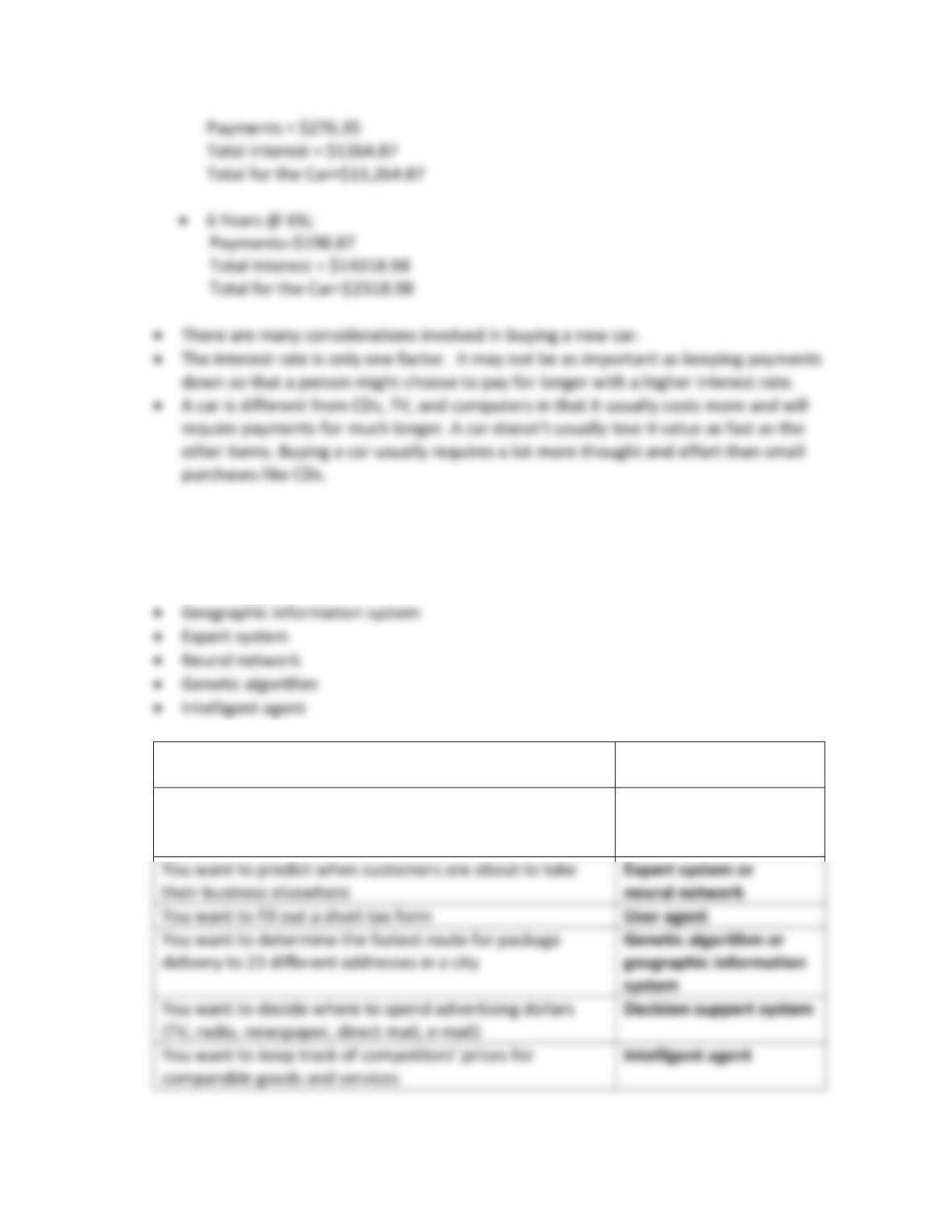
2. CHOOSE A FINANCING OPTION. Using a spreadsheet (like Excel, for example) evaluate your
options for a $12,000 car. Compare the payments (use the =pmt function in Excel), the total
amount of interest, and the total you’ll pay for the car under the following four options:
a. 3 years at 0% interest
b. 2 years at 1.99% annual percent rate (APR)
c. 4 years at 5% APR
d. 6 years at 6% APR
What other considerations would you take into account if you’re going to buy a new car?
Are there considerations other than the interest rate and the other parts that can be
calculated? What are they? How is a car different from other purchases, such as CDs or TV
sets or computers?
DISCUSSION
Chapter 04 – Analytics, Decision Support, and Artificial Intelligence: Brainpower for Your Business
4-21
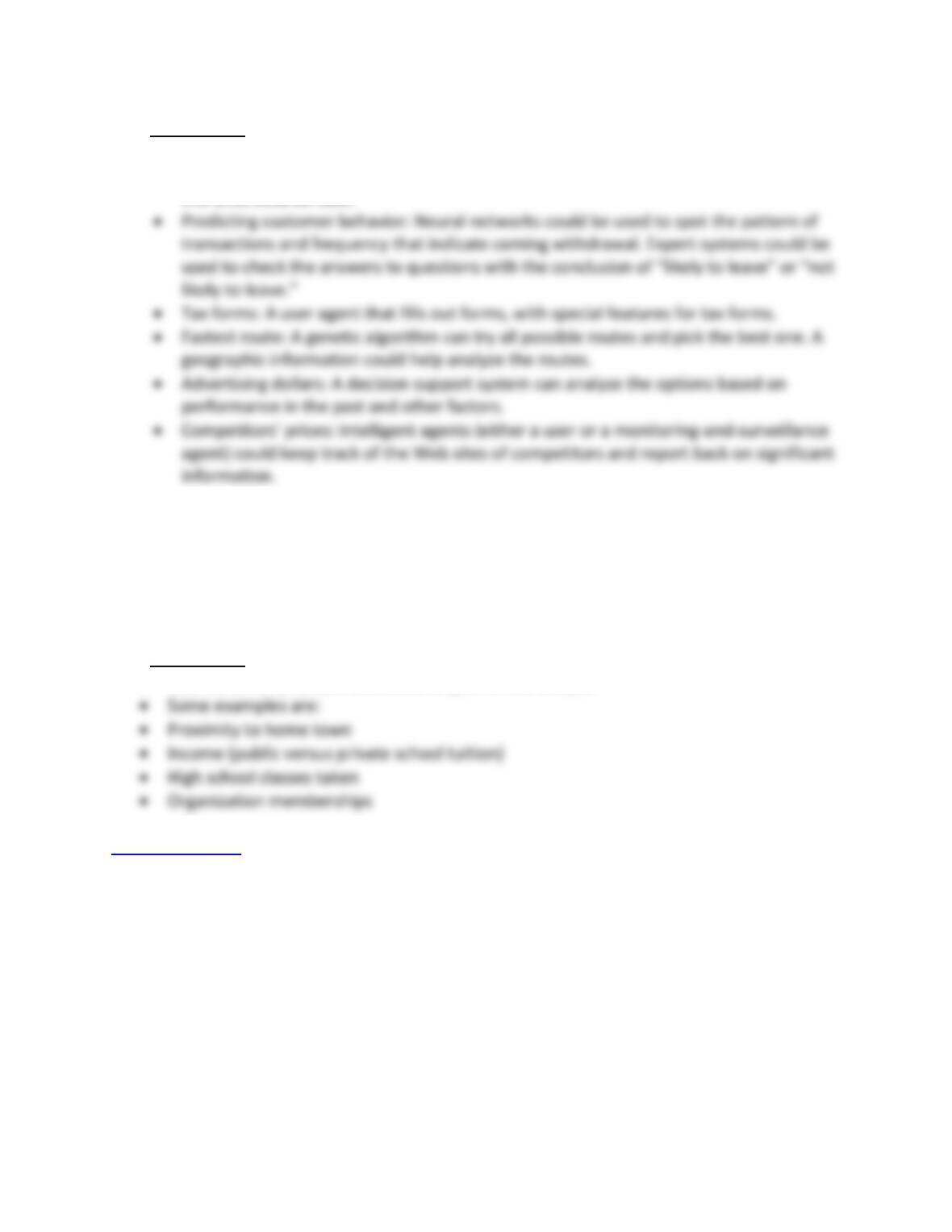
3. WHICH SOFTWARE WOULD YOU USE? Which type or types of computer-aided decision
support software would you use for each of the situations in the following tasks? Note
why you think each of your choices is appropriate. The decision support alternatives are:
• Decision support system
Problem
Type of Decision
Support
You and another marketing executive on a different
continent want to develop a new pricing structure for
products
Decision support system
You want to fill out a short tax form
You want to determine the fastest route for package
delivery to 23 different addresses in a city
Genetic algorithm or
Decision support system
Chapter 04 – Analytics, Decision Support, and Artificial Intelligence: Brainpower for Your Business
4-22
DISCUSSION
• Marketing executives on two continents: A decision support system, especially
together with collaboration software, would enable executives to make a decision in
this unstructured case.
4. IDENTIFYING PREDICTIVE INDICATORS Think about your school and its building of a
predictive analytics model. What do you believe would be the ten most important
predictive indicators for determining whether or not an applicant to your school will
attend if accepted? Think very broadly here in terms of all the factors a potential student
might use in making his or her choice.
DISCUSSION
• There are many factors that could be part of the analysis
Back to Jump List
Chapter 04 – Analytics, Decision Support, and Artificial Intelligence: Brainpower for Your Business
4-23
DISCUSSION QUESTIONS (p. 124)
1. Some experts claim that if a business gets 52 percent of its decisions right, it will be
successful. Would using a decision support system guarantee better results? Why or why
not? What does the quality of any decision depend on? Do you think it matters what type of
decisions are included in this 52%? For example, would getting the right type of paper clips
be as influential a decision as deciding where to locate the business? Can you think of a
situation where the type of paper clip matters a great deal?
DISCUSSION
• A decision support system will by no means guarantee better results.
2. Consider the topic of data warehouses in Chapter 3. In the future, AI systems will be
increasingly applied to data warehouse processing. Which AI systems do you think might be
helpful? For which tasks, or situations, might they best be applied? Do you think that AI
systems will someday play a greater role in the design of databases and data warehouses?
Why or why not?
DISCUSSION
• Intelligent agents are already being used as data mining tools, since their strength lies
3. Consider the differences and similarities among the four AI techniques discussed in this
chapter. Name some problems that might be amenable to more than one type of AI system.
Say you sell baseballs from your Web site. What types of AI systems could you use to
generate information that would be useful to you in deciding what direction to take your
company in the future? If you were pretty successful at selling baseballs, would you expect
to have the amount of information on customers that, say Wal-Mart, has? Why or why
not?
DISCUSSION
Chapter 04 – Analytics, Decision Support, and Artificial Intelligence: Brainpower for Your Business
4-24
4. AI systems are relatively new approaches to solving business problems. What are the
difficulties with new IT approaches in general? For each of the systems we discussed,
identify some advantages and disadvantages of AI systems over traditional business
processes. Say you were selling specialty teas and had brick and click stores. Would you
use the same type of AI systems for each part of your business? In what way would you
use them or why would you not? Is there a place for decision support and artificial
intelligence techniques in small specialty businesses? In what way would decision support
add value? Can you think of how a DSS or an AI system would be value reducing (in terms
of Porter’s value chain theory)? What do you see as the major differences between
running a mammoth concern and a small specialty business?
DISCUSSION
• New IT approaches generally present several problems.
5. Neural networks recognize patterns. If someone were to have a neural network that could
scan information on all aspects of your life, where would that neural network potentially
be able to find information about you? Consider confidential (doctor’s office) as well as
publicly available (department of motor vehicles) information.

Chapter 04 – Analytics, Decision Support, and Artificial Intelligence: Brainpower for Your Business
4-25
DISCUSSION
6. What type of AI systems could your school use to help with registration? Intelligent agents
find vast amounts of information very quickly. Neural networks can classify patterns
simultaneously. What sort of information might your school administration be able to
generate using these (or other AI systems)?
DISCUSSION
• There many possible answers to this question
Chapter 04 – Analytics, Decision Support, and Artificial Intelligence: Brainpower for Your Business
4-26
INDUSTRY & GLOBAL PERSPECTIVES
INDUSTRY PERSPECTIVE – Pinning Photos at HistoryPin (p. 104)
• This is a great Web site to visit in class.
INDUSTRY PERSPECTIVE – Using Predictive Analytics to Reduce Loan Default Rates
• Good IP on the effective use of predictive analytics.
GLOBAL PERSPECTIVE – Neural Network Art Expert (p. 108)
• Van Gogh paintings are harder than most to authenticate.
INDUSTRY PERSPECTIVE – DON’T TELL SANTA; TELL GOOGLE (p. 117)
• This truly demonstrates the power of information, and specifically simple information that
Back to Jump List
Chapter 04 – Analytics, Decision Support, and Artificial Intelligence: Brainpower for Your Business
4-27
ADDITIONAL ASSIGNMENTS AND EXERCISES
TRAFFIC LIGHTS REVISITED
Note: Use this in the expert system section
Create a table similar to Figure 4.6 to extend the traffic light expert system. Include the
following situations in the table:
HOW WOULD YOU CLASSIFY PEOPLE?
Note: Use this in the neural network section
Some people have suggested that neural networks could be applied to people to indicate how
likely they are to develop a disease or even become criminals. The idea is to input a child’s
personal characteristics, demographics, and genealogy into a neural network, and the neural
Chapter 04 – Analytics, Decision Support, and Artificial Intelligence: Brainpower for Your Business
4-28
BE A GENETIC ALGORITHM AND PUT NAILS IN BOXES
Note: Use this in the genetic algorithm section
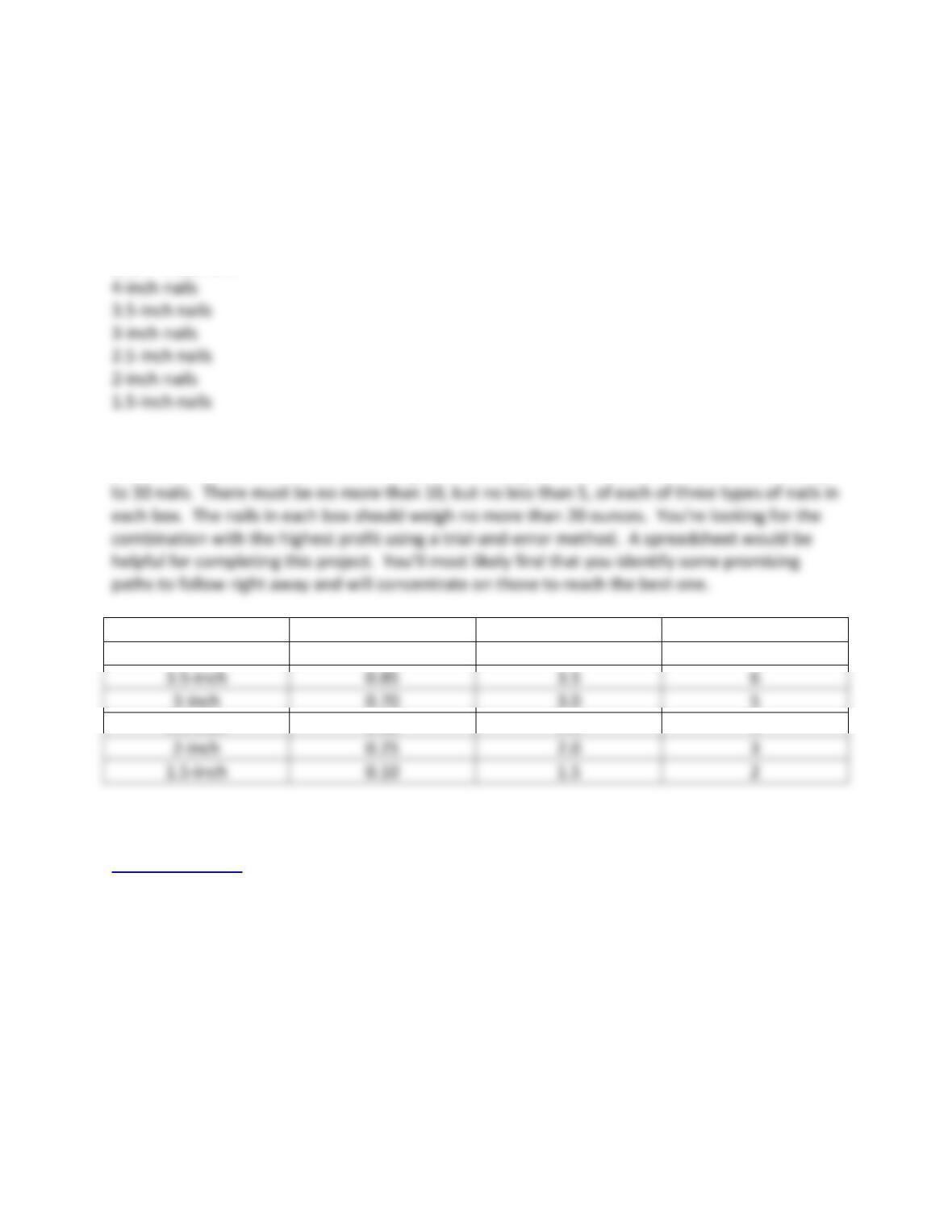
This project involves packaging nails so that you make the most profit possible (this is a profit
maximizing problem). Say you have six types of nails and can make as many as you need of
each. These are:
The cost of making each type of nail depends on how big a nail it is. Those costs and selling
prices are listed in the table below along with the weights. The nails will be sold in boxes of up
NAIL
WEIGHT (in ounces)
COST (in cents)
SELLING PRICE (cents)
4-inch
1.00
4.0
8
3.5-inch
0.85
3.5
6
3-inch
0.70
3.0
5
2.5-inch
0.50
2.5
4
2-inch
0.25
2.0
3
1.5-inch
0.10
1.5
2
Back to Jump List