Markov Processes
c. EV (Plant Chardonnay) = 0.55(20) +0.45(70) = 42.5
EV (Plant both grapes) = 0.05(22) + 0.50(40) + 0.25(26) + 0.20(60) = 39.6
EV (Plant Riesling) = 0.30(25) + 0.70(45) = 39.0
Optimal decision: Plant Chardonnay grapes only.
e. Only the expected value for node 2 in the decision tree needs to be recomputed.
EV (Plant Chardonnay) = 0.55(20) + 0.45(50) = 33.5
This change in the payoffs makes planting Chardonnay only less attractive. It is now best to plant
both types of grapes. The optimal decision is sensitive to a change in the payoff of this magnitude.
14. a. If s1 then d1 ; if s2 then d1 or d2; if s3 then d2
b. EVwPI = .65(250) + .15(100) + .20(75) = 192.5
15. a. EV (Small) = 0.1(400) + 0.6(500) + 0.3(660) = 538
EV (Medium) = 0.1(-250) + 0.6(650) + 0.3(800) = 605
EV (Large) = 0.1(-400) + 0.6(580) + 0.3(990) = 605
Best decision: Build a medium or large-size community center.
Probability
0.4
0.6
Chapter 17
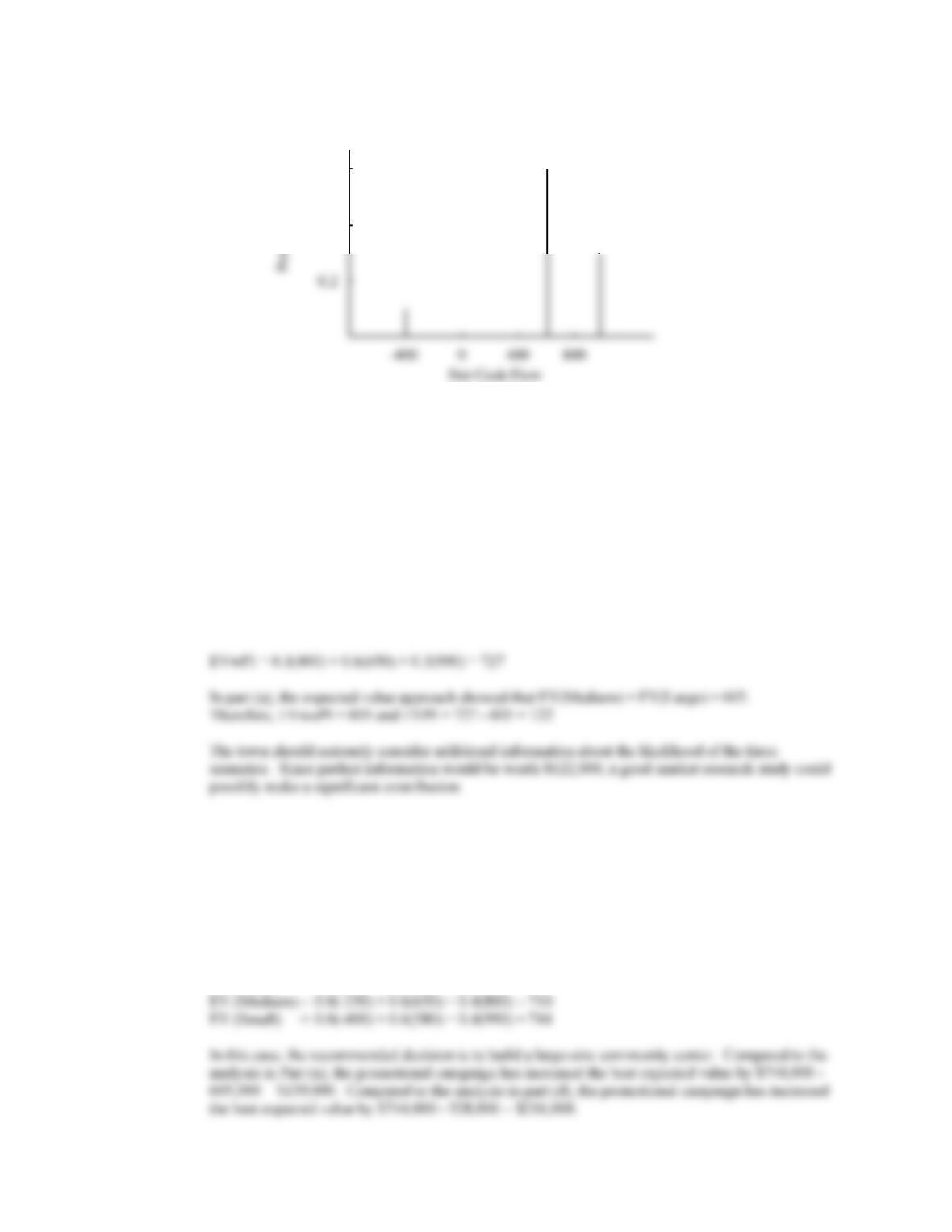
Risk profile for large-size community center:
Given the mayor’s concern about the large loss that would be incurred if demand is not large enough
to support a large-size center, we would recommend the medium-size center. The large-size center
has a probability of 0.1 of losing $400,000. With the medium-size center, the most the town can lose
is $250,000.
c. The Town’s optimal decision strategy based on perfect information is as follows:
If the worst-case scenario, build a small-size center
If the base-case scenario, build a medium-size center
If the best-case scenario, build a large-size center
Using the consultant’s original probability assessments for each scenario, 0.10, 0.60 and 0.30, the
expected value of a decision strategy that uses perfect information is:
d. EV (Small) = 0.2(400) + 0.5(500) + 0.3(660) = 528
EV (Medium) = 0.2(-250) + 0.5(650) + 0.3(800) = 515
EV (Small) = 0.2(-400) + 0.5(580) + 0.3(990) = 507
Best decision: Build a small-size community center.
e. If the promotional campaign is conducted, the probabilities will change to 0.0, 0.6 and 0.4 for the
worst case, base case and best case scenarios respectively.
EV (Small) = 0.0(400) + 0.6(500) + 0.4(660) = 564
0.4
0.6
Markov Processes
Even though the promotional campaign does not increase the expected value by more than its cost
($150,000) when compared to the analysis in part (a), it appears to be a good investment. That is, it
16. a.
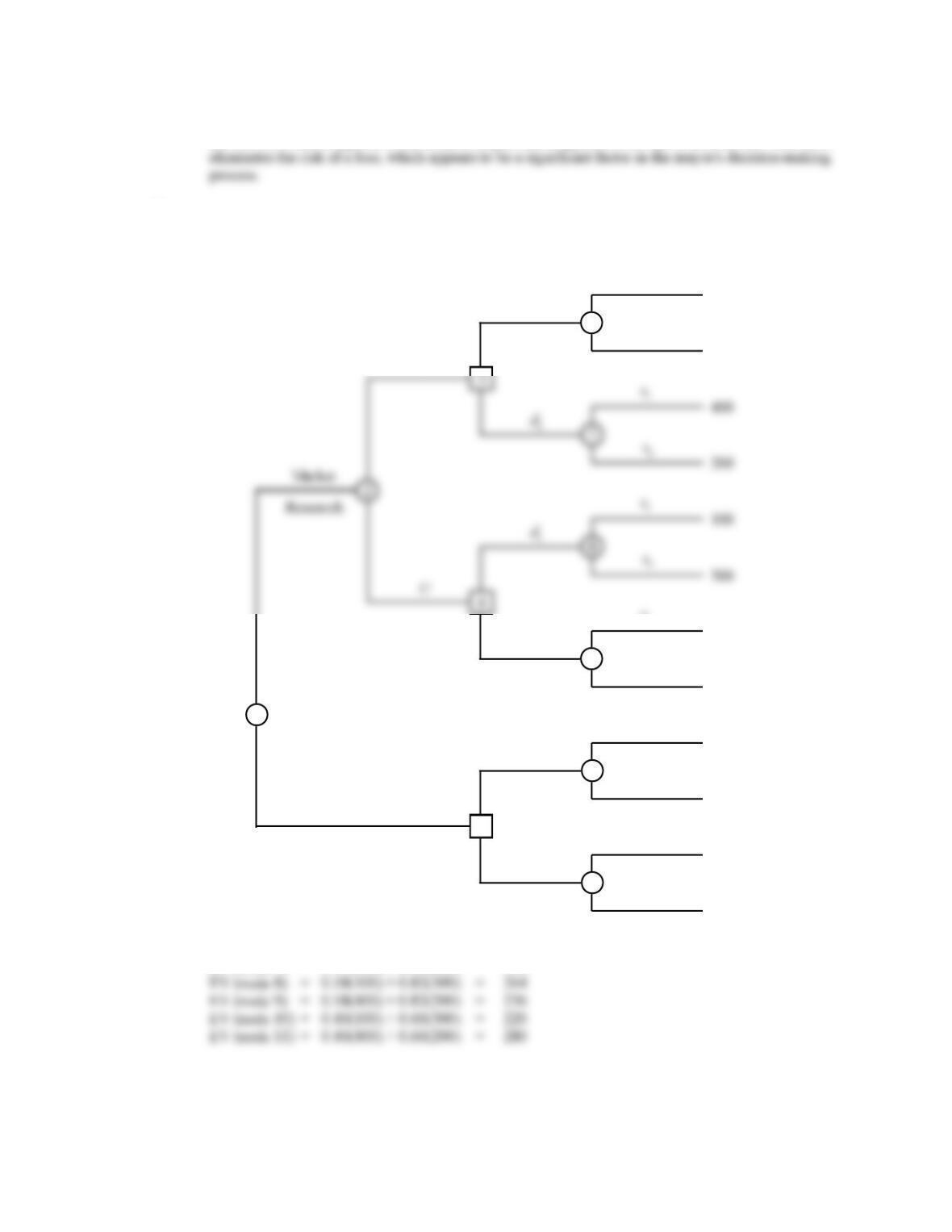
b. EV (node 6) = 0.57(100) + 0.43(300) = 186
EV (node 7) = 0.57(400) + 0.43(200) = 314
9s2
d2
F
s1
6s2
d1
s1
10 s2
d1
5s1
11 s2
d2
1
No Market
Research
Profit
Payoff
100
300
400
200
100
300
400
200
Chapter 17
EV (node 3) = Max(186,314) = 314 d2
EV (node 4) = Max(264,236) = 264 d1
EV (node 5) = Max(220,280) = 280 d2
17. a. EV(node 4) = 0.5(34) + 0.3(20) + 0.2(10) = 25
EV(node 3) = Max(25,20) = 25 Decision: Build
Expected value = $10M
b. At node 3, payoff for sell rights would have to be $25M or more. In order to recover the $5M R&D
cost, the selling price would have to be $30M or more.
c.
Possible Profit
$34M
(0.5)(0.5) =
$20M
(0.5)(0.3) =
$10M
(0.5)(0.2) =
18. a. Outcome 1 ($ in 000s)
Bid
-$200
Contract
-2000
Market Research
–150
High Demand
+5000
$2650
Bid
-$200
Contract
-2000
Market Research
–150
Moderate Demand
+3000
$650
Markov Processes
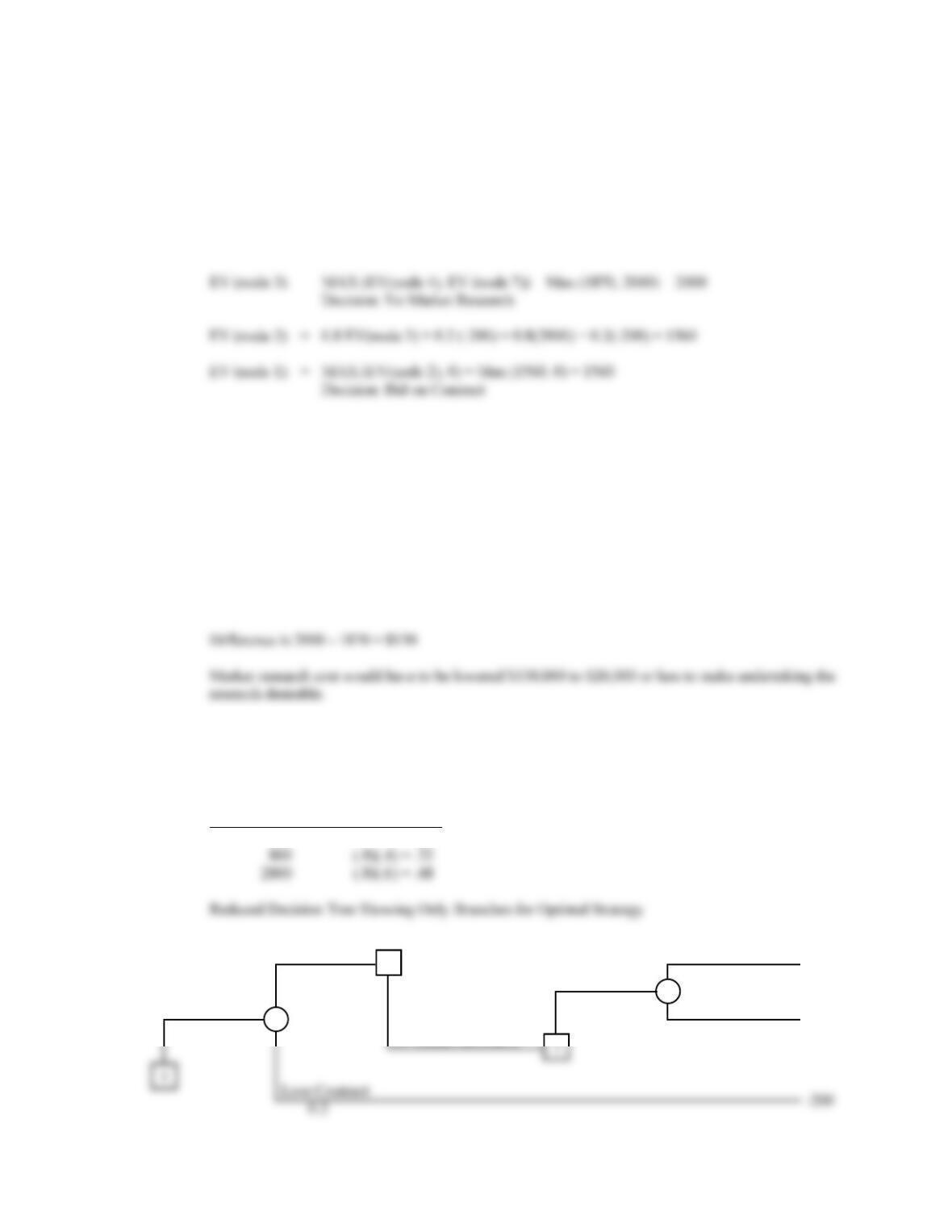
b. EV (node 8) = 0.85(2650) + 0.15(650) = 2350
EV (node 5) = Max(2350, 1150) = 2350 Decision: Build
EV (node 9) = 0.225(2650) + 0.775(650) = 1100
EV (node 6) = Max(1100, 1150) = 1150 Decision: Sell
EV (node 10) = 0.6(2800) + 0.4(800)= 2000
EV (node 7) = Max(2000, 1300) = 2000 Decision: Build
EV (node 4) = 0.6 EV(node 5) + 0.4 EV(node 6) = 0.6(2350) + 0.4(1150) = 1870
Decision Strategy:
Bid on the Contract
Do not do the Market Research
Build the Complex
Expected Value is $1,560,000
c. Compare Expected Values at nodes 4 and 7.
EV(node 4) = 1870 Includes $150 cost for research
EV (node 7) = 2000
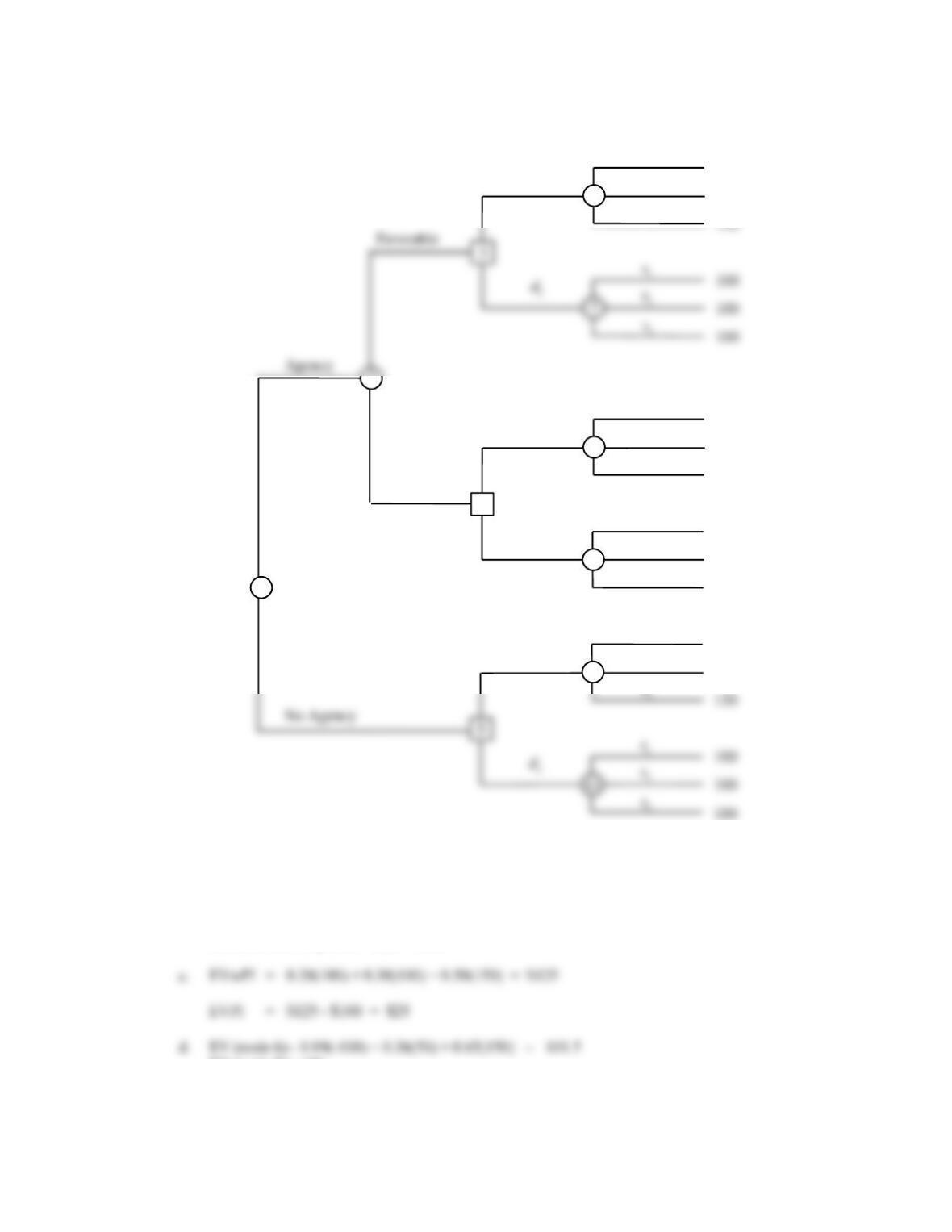
d. Shown below is the reduced decision tree showing only the sequence of decisions and chance events
for Dante’s optimal decision strategy. If Dante follows this strategy, only 3 outcomes are possible
with payoffs of –200, 800, and 2800. The probabilities for these payoffs are found by multiplying the
probabilities on the branches leading to the payoffs. A tabular presentation of the risk profile is:
Payoff ($million)
Probability
-200
.20
2800
Bid
3
2
Win Contract
0.8
10
Build Complex
High Demand
0.6
Moderate Demand
0.4
2800
800
Chapter 17
19. a.
s
1
6
s
2
s
3
d
1
-100
50
3
1
s
2
s
3
d
2
2
1
1
s
1
8
s
2
s
3
d
1
-100
50
150
4
s
1
9
s
2
s
3
d
2
100
100
100
Unfavorable
s
1
10
s
2
d
1
-100
50
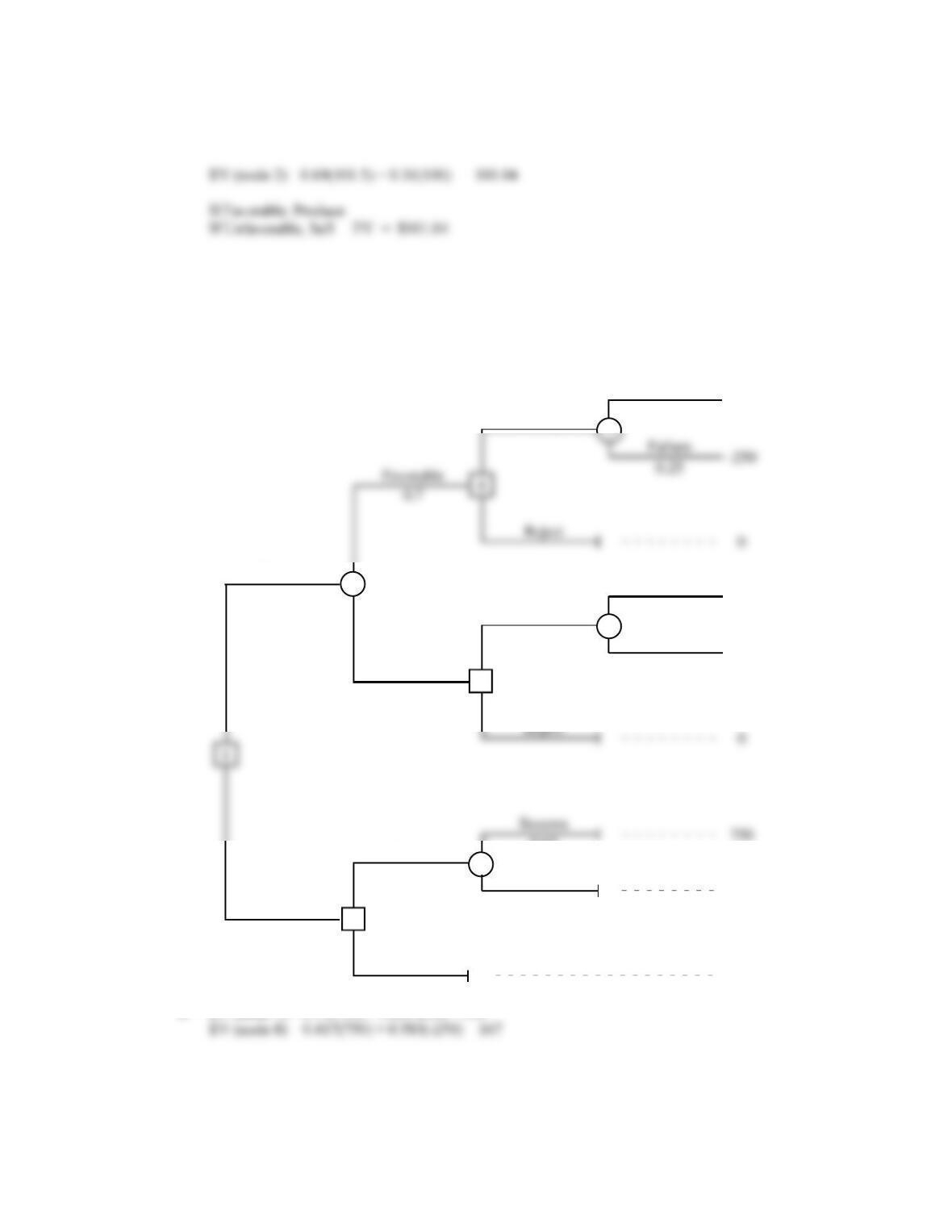
b. Using node 5,
EV (node 10) = 0.20(-100) + 0.30(50) + 0.50(150) = 70
EV (node 11) = 100
Decision Sell Expected Value = $100
EV (node 7) = 100
EV (node 8) = 0.45(-100) + 0.39(50) + 0.16(150) = -1.5
EV (node 9) = 100
Markov Processes
EV (node 3) = Max(101.5,100) = 101.5 Produce
EV (node 4) = Max(-1.5,100) = 100 Sell
e. EVSI = $101.04 – 100 = $1.04 or $1,040.
f. No, maximum Hale should pay is $1,040.
g. No agency; sell the pilot.
20. a.
3
-250
Failure
0.65
0.35
6
Unfavorable
0.3
2
Accept
Reject
Review
Do Not Review
5
Accept
-250
750
Success
Failure
0.417
0.583
8
0
Accept
750
Success
0.75
Chapter 17
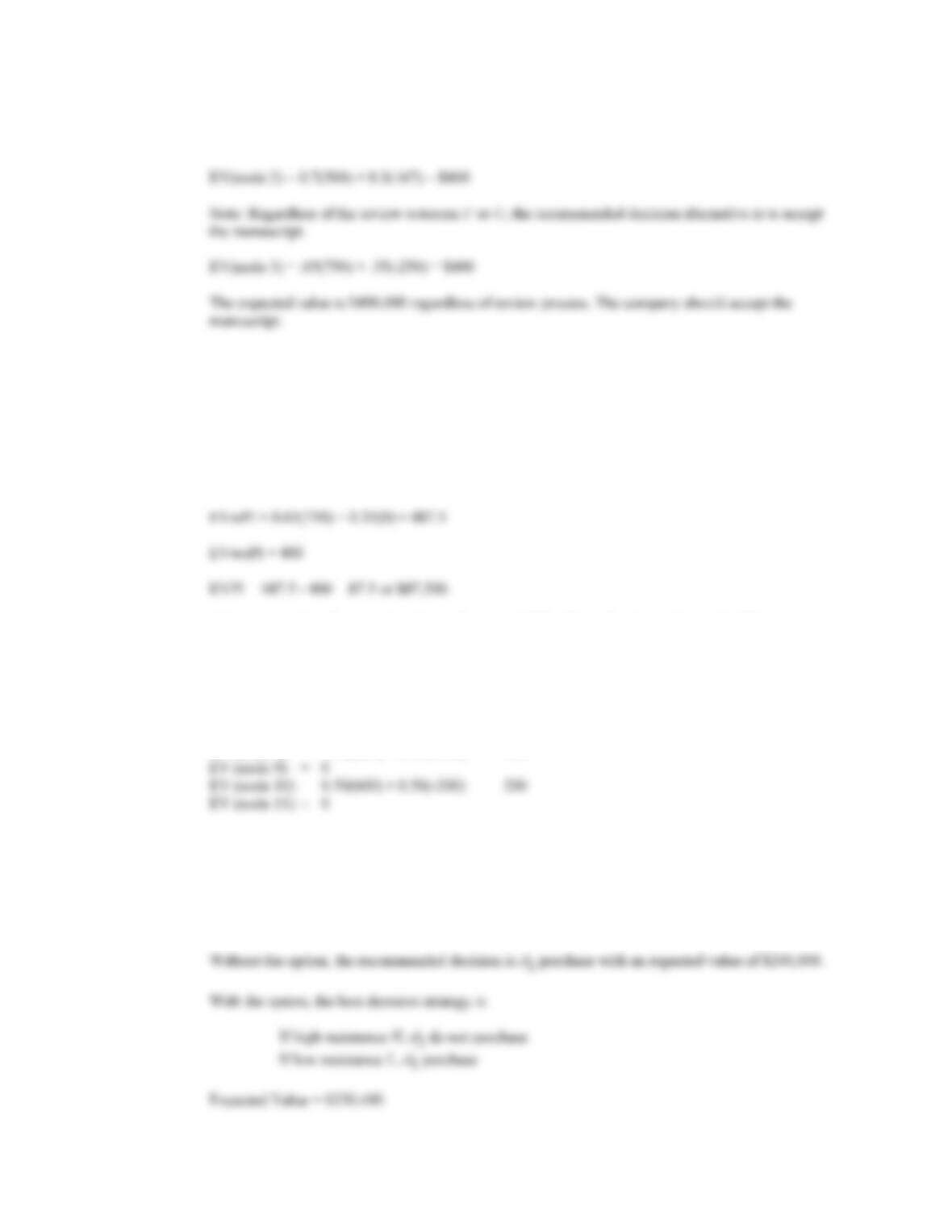
Decision (node 4)
→
Accept EV = 500
Decision (node 5)
→
Accept EV = 167
c. The manuscript review cannot alter the decision to accept the manuscript. Do not do the manuscript
review.
d. Perfect Information.
If s1, accept manuscript $750
If s2, reject manuscript -$250
A better procedure for assessing the market potential for the textbook may be worthwhile.
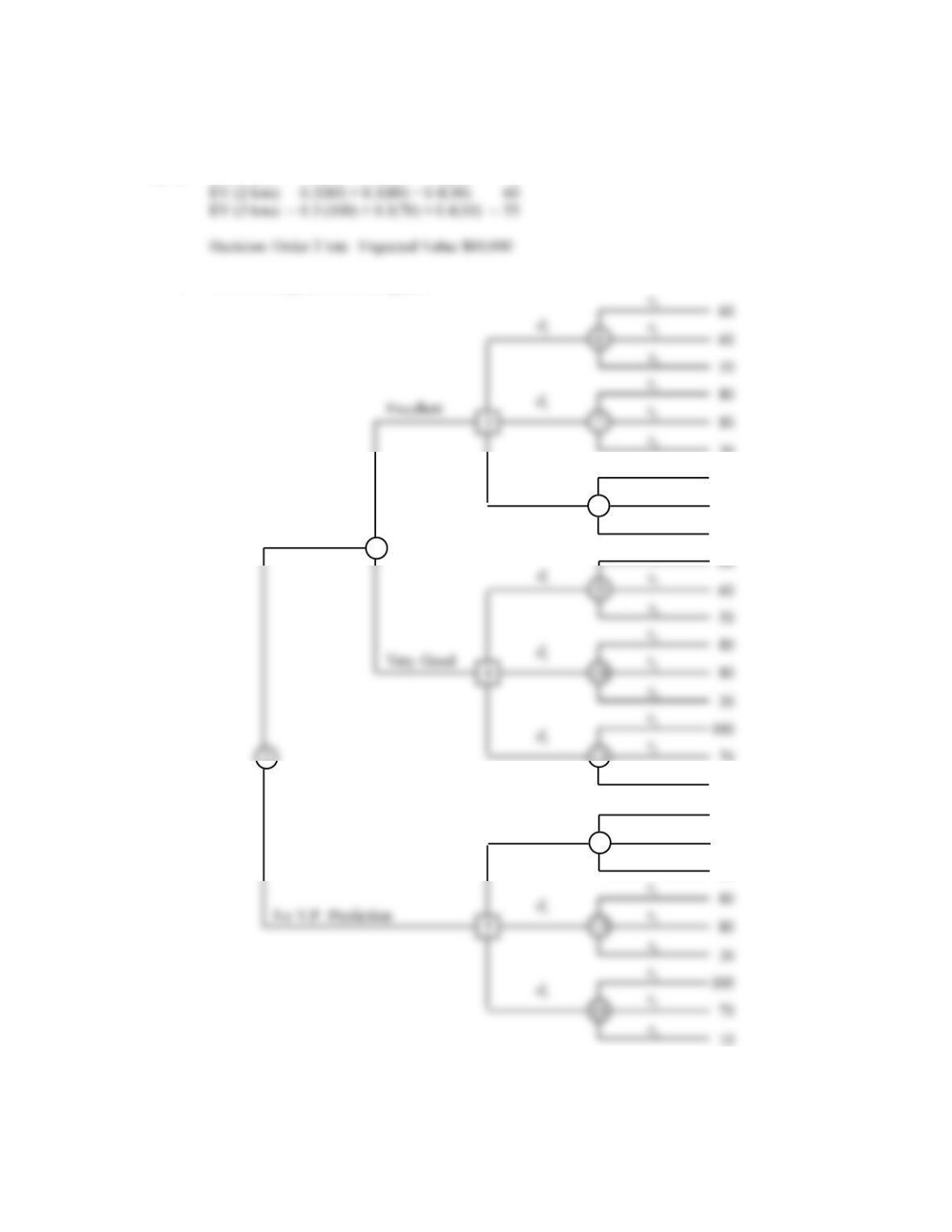
21. The decision tree is as shown in the answer to problem 16a. The calculations using the decision tree
in problem 16a with the probabilities and payoffs here are as follows:
a,b. EV (node 6) = 0.18(600) + 0.82(-200) = –56
EV (node 7) = 0
EV (node 8) = 0.89(600) + 0.11(-200) = 512
EV (node 3) = Max(-56,0) = 0 d2
EV (node 4) = Max(512,0) = 512 d1
EV (node 5) = Max(200,0) = 200 d1
EV (node 2) = 0.55(0) + 0.45(512) = 230.4
Markov Processes
c. EVSI = $230,400 – $200,000 = $30,400. Since the cost is only $10,000, the investor should
purchase the option.
22. a. EV (1 lot) = 0.3(60) + 0.3(60) + 0.4(50) = 56
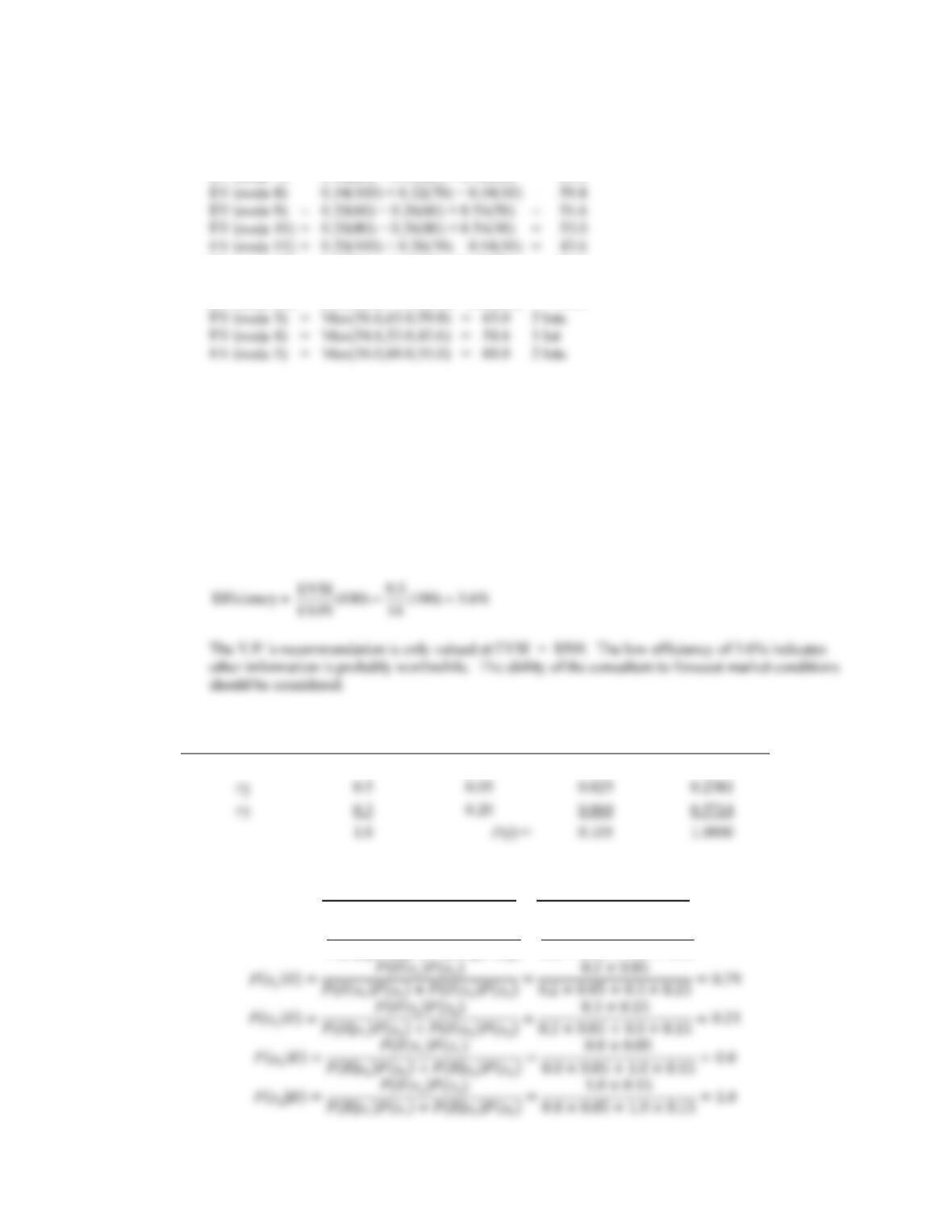
b. The following decision tree applies.
30
s1
8
s2
s3
d3
100
70
10
2
1
V.P. Prediction
s1
11
s3
70
10
s1
12
s2
s3
d1
60
60
50
Chapter 17
Calculations
EV (node 6) = 0.34(60) + 0.32(60) + 0.34(50) = 56.6
EV (node 12) = 0.30(60) + 0.30(60) + 0.40(50) = 56.0
EV (node 13) = 0.30(80) + 0.30(80) + 0.40(30) = 60.0
EV (node 2) = 0.70(63.0) + 0.30(54.6) = 60.5
EV (node 1) = Max(60.5,60.0) = 60.5 Prediction
Optimal Strategy:
If prediction is excellent, 2 lots
If prediction is very good, 1 lot
c. EVwPI = 0.3(100) + 0.3(80) + 0.4(50) = 74
EVPI = 74 – 60 = 14
EVSI = 60.5 – 60 = 0.5
23.
State of Nature
P(sj)
P(I sj)
P(I sj)
P(sj I)
s1
0.2
0.10
0.020
0.1905
s2
0.5
0.05
0.025
0.2381
s3
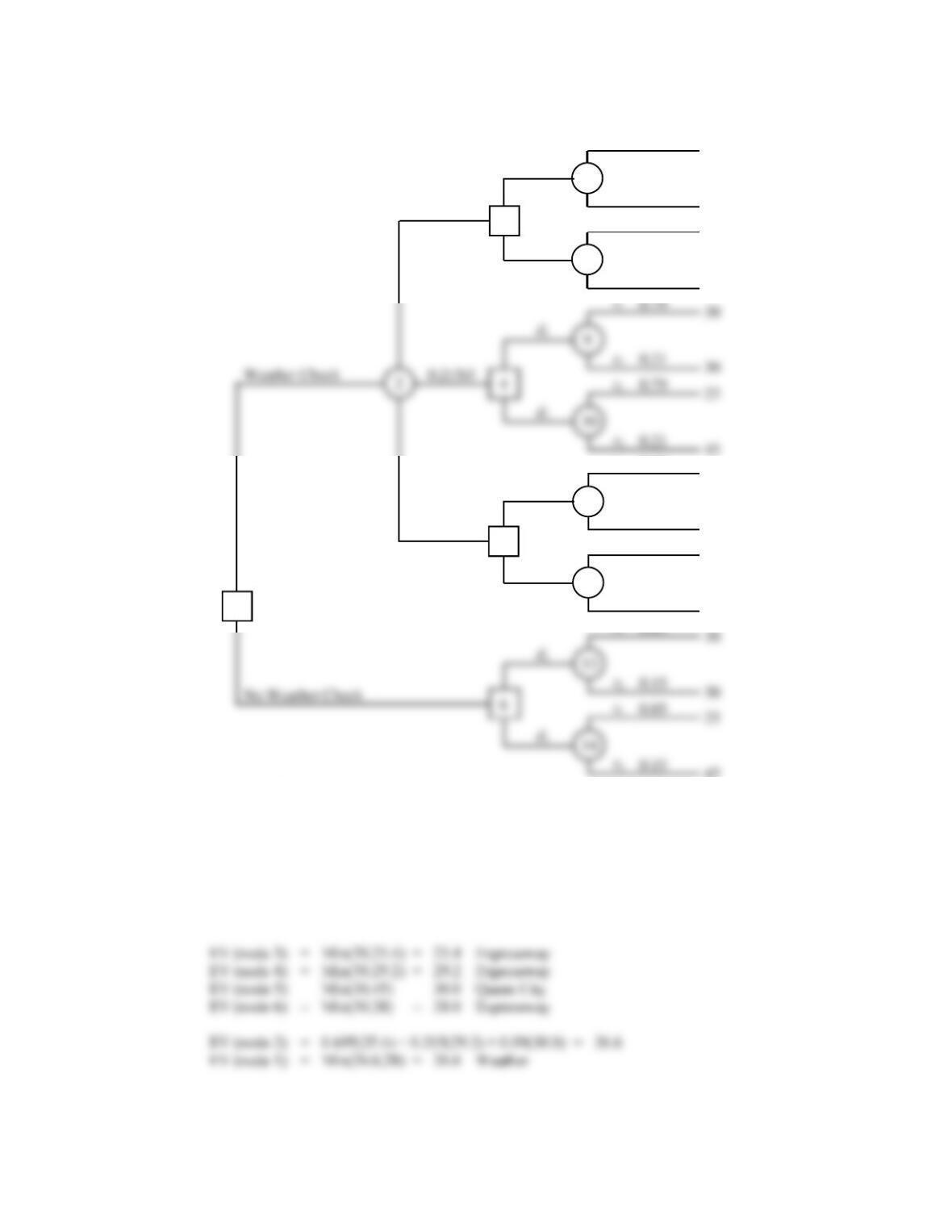
24. a. Using Bayes’ Theorem:
𝑃(𝑠1|𝐶)=𝑃(𝐶|𝑠1)𝑃(𝑠1)
𝑃(𝐶|𝑠1)𝑃(𝑠1)+ 𝑃(𝐶|𝑠2)𝑃(𝑠2)=0.8 × 0.85
0.8 × 0.85 + 0.1 × 0.15 = 0.98
𝑃(𝑠2|𝐶)=𝑃(𝐶|𝑠2)𝑃(𝑠2)
𝑃(𝐶|𝑠1)𝑃(𝑠1)+ 𝑃(𝐶|𝑠2)𝑃(𝑠2)=0.1 × 0.15
0.8 × 0.85 + 0.1 × 0.15 = 0.2
Markov Processes
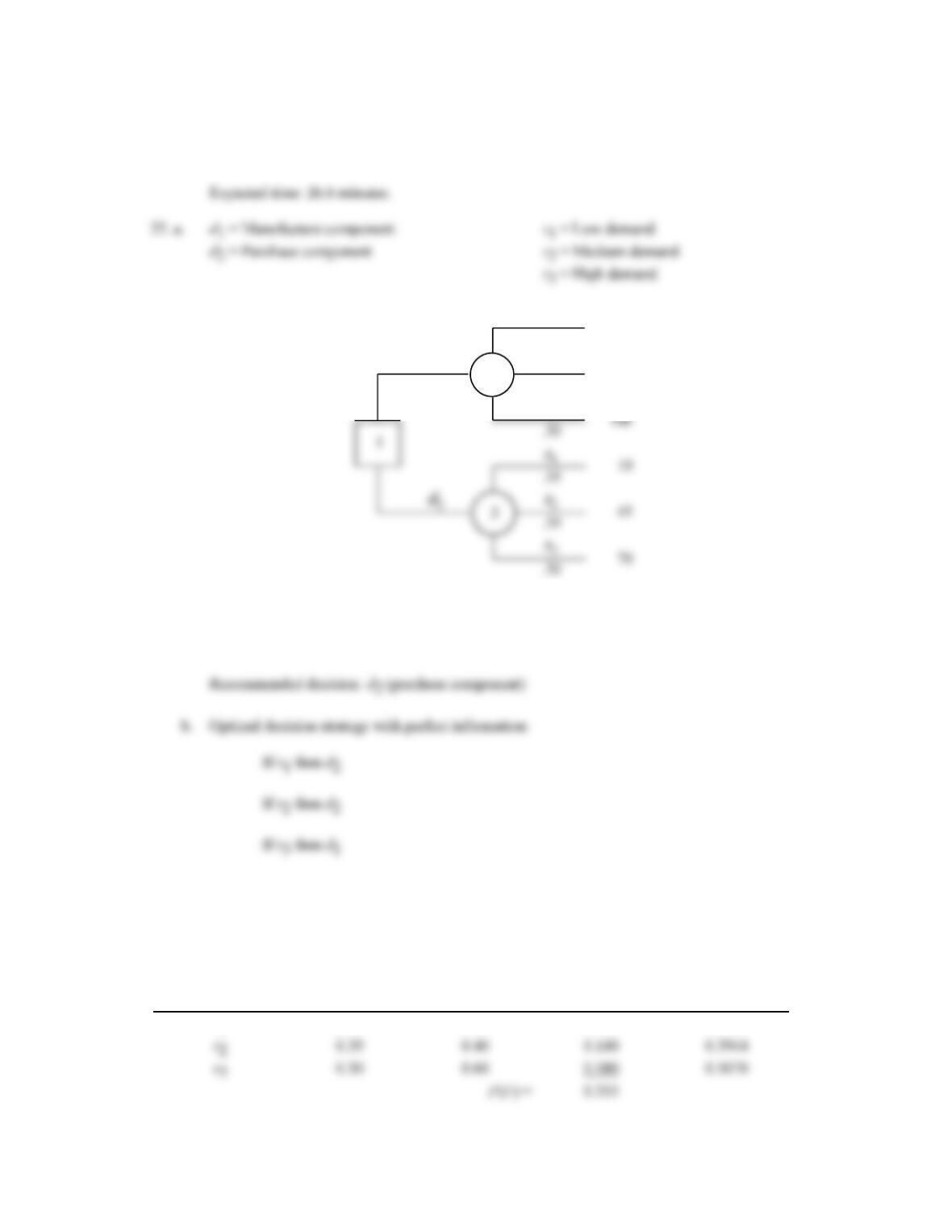
b.
EV (node 7) = 30
EV (node 8) = 0.98(25) + 0.02(45) = 25.4
EV (node 9) = 30
EV (node 10) = 0.79(25) + 0.21(45) = 29.2
EV (node 11) = 30
EV (node 12) = 0.00(25) + 1.00(45) = 45.0
EV (node 13) = 30
EV (node 14) = 0.85(25) + 0.15(45) = 28.0
7
8
11
12
1
3
5
0.695C
0.09R
d1
d2
d1
d2
s1
s2
s1
s2
s1
s2
s1
s2
0.98
0.02
0.98
0.02
0.00
1.00
0.00
1.00
30
30
25
45
30
30
25
45
45
Chapter 17
c. Strategy:
Check the weather, take the expressway unless there is rain. If rain, take Queen City Avenue.
EV(node 2) = (0.35)(-20) + (0.35)(40) + (0.30)(100) = 37
EV(node 3) = (0.35)(10) + (0.35)(45) + (0.30)(70) = 40.25
Expected value of this strategy is 0.35(10) + 0.35(45) + 0.30(100) = 49.25
EVPI = 49.25 – 40.25 = 9 or $9,000. Therefore, additional information could be worth up to $9,000
for Gorman in this problem.
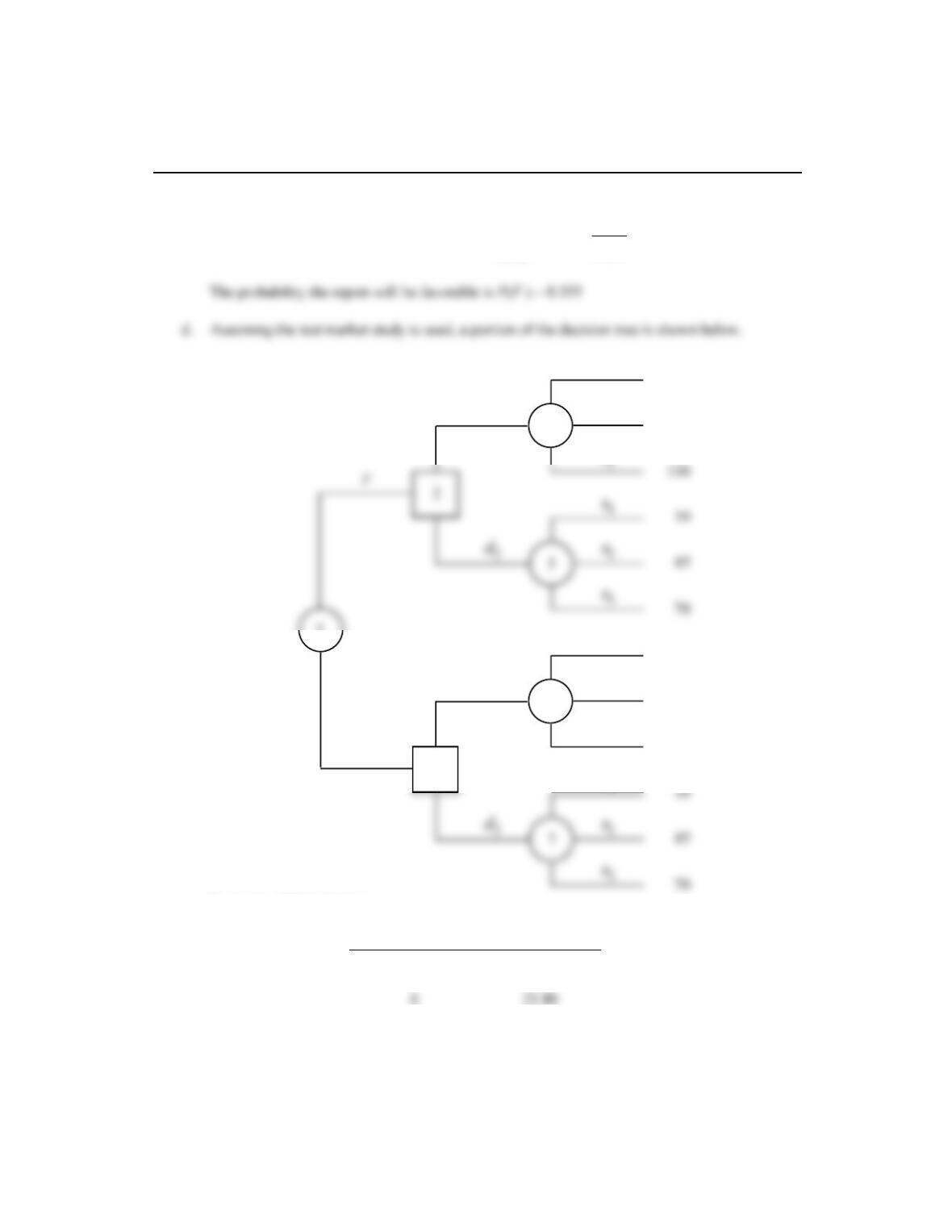
c. If F – Favorable
State of Nature
P(sj)
P(F sj)
P(F sj)
P(sj F)
s1
0.35
0.10
0.035
0.0986
s2
s1
s3
s2
d1
-20
40
.35
.35
2
Markov Processes
If U – Unfavorable
State of Nature
P(sj)
P(U sj)
P(U sj)
P(sj U)
s1
0.35
0.90
0.315
0.4884
s2
0.35
0.60
0.210
0.3256
s3
0.30
0.40
0.120
0.1860
P(U) =
0.645
Summary of Calculations
Node
Expected Value
4
64.51
5
54.23
6
21.86
7
32.56
s1
s2
d1
-20
40
4
s1
s3
s2
s1
d1
-20
40
100
3
6
U
1
Chapter 17
Decision strategy:
If F then d1 since EV(node 4) > EV(node 5)
e. With no information, from part a):
EV(d1) = 0.35(-20) + 0.35(40) + 0.30(100) = 37
EV(d2) = 0.35(10) + 0.35(45) + 0.30(70) = 40.25