Chapter 4
Planning and Forecasting
DISCUSSION QUESTIONS
4-1. Q: Why is planning said to have “primacy” among the managerial functions?
4-2. Q: Develop your own model of the steps in the planning process
4-3. Q: Select a company (other than Sears) whose apparent mission or purpose has changed over
its history and describe the change.
A: This question will produce a variety of answers, depending on the experience and prior
education of students. Sample student answers:
4-4. Q: Select a company or industry for which the strategic management of technology is
important. Describe some of the base, key, and pacing technologies that are important for their
strategic management of technology.
4-5. Q: Pick a company with which you are familiar and estimate from their actions what their
objectives appear to be in each of Drucker’s “key result areas.”
4-6. Q: Briefly outline the concept of management by objectives (MBO) and the steps involved in
implementing this technique in organizations.
4-7. Q: For what types of employees or positions do you think management by objectives (MBO)
should prove particularly effective? Ineffective?
4-8. Q: For a given product and company (such as automobiles from Ford) list a set of premises
4-9. Q: What length of planning horizon would you recommend for planning (a) the forest
resources of a large paper company; (b) construction of a new automobile plant; (c) creation
of a new housing development of 15 homes?
A: (a) Fast-growing pines for paper products still take 20 to 25 years to mature, which defines
4-10. Q: Create an extended list of the plans and decisions for a large manufacturing company that
will depend on the sales forecast for the next year.
A: Plans and the decisions underlying them that depend on the sales forecast might be divided
into four general areas;
4-11. Q: Cite another example (in addition to Xerox and Osborne’s computer) showing the difficulty
of transforming a technical idea into a successful product (innovation).
A: Some examples in student responses: Difficulty in marketing the digital audio tape recorder
4-12 Q: Describe an entrepreneur you either know or have read about. What personal characteristics
led to or limited his or her success?
PROBLEMS
4-1. Q: Sales of a particular product (in thousands of dollars) for the years 2009 through 2012 have
been 48, 64, 67, and 83, respectively.
a) What sales would you predict for 2013 using a simple four-year moving average?
(b) What sales would you predict for 2013 using a weighted moving average with weights of
0.50 for the immediate preceding year and 0.30, 0.15, and 0.05 for the three years before that?
A: (a) Simple moving average:
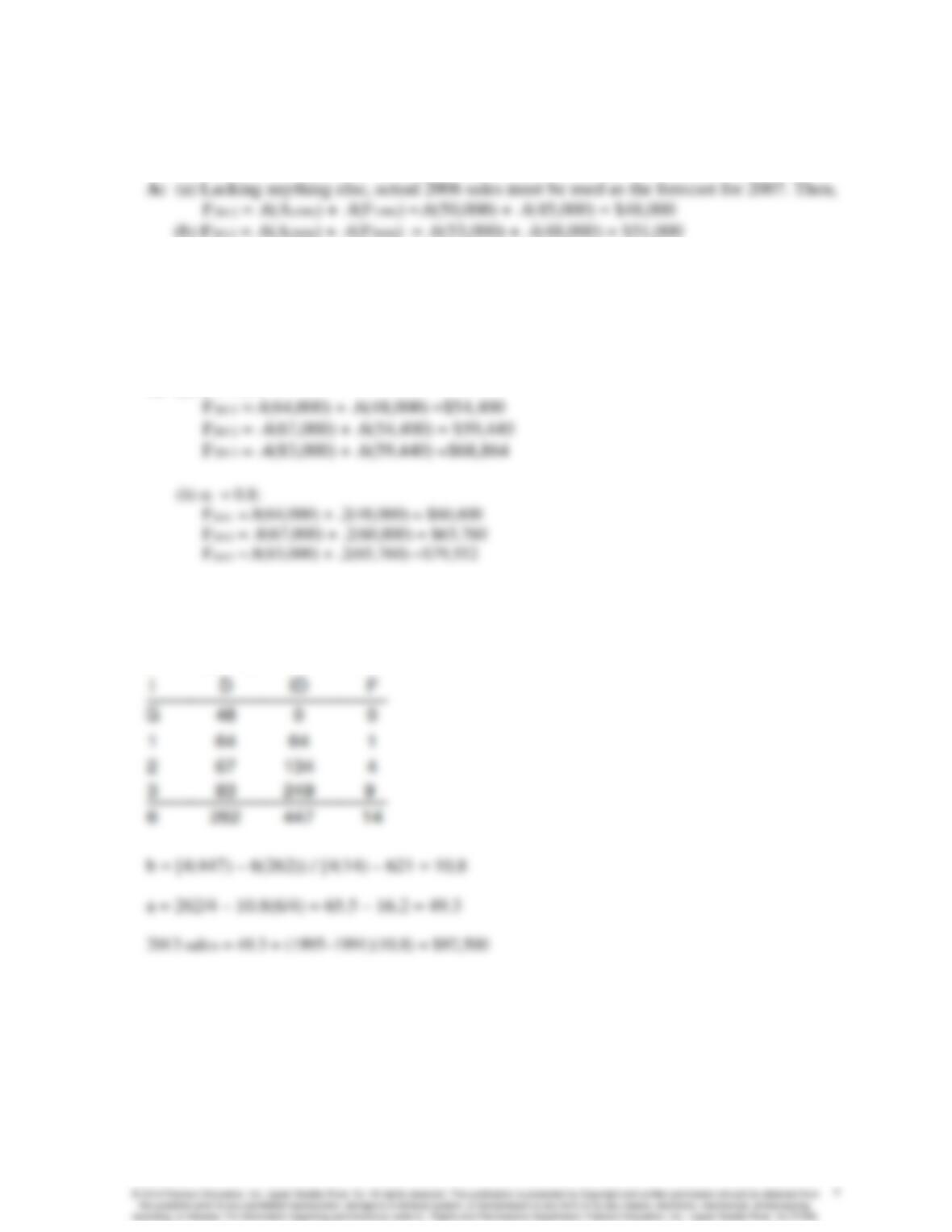
4-2. Q: Using exponential smoothing with a weight ex of 0.6 on actual values:
(a) if sales are $45,000 and $50,000 for 2010 and 2011, what would you forecast for 2012?
(b) given this forecast and actual 2012 sales of $53,000, what would you then forecast for
2009?
4-3. Q: In Question 4-2, taking actual 2009 sales of $48,000 as the forecast for 2010, what sales
would you forecast for 2011, 2012, and 2013 using exponential smoothing and a weight
based on actual values of (a) 0.4; (b) 0.8?
A: (a) = 0.4:
4-4. Q: In Question 4-2, what sales would you forecast for 2013 using the simple regression (least
squares) method?
A: Using I = (year 2009) and D = sales (in $thousands),