Chapter 04 – Product and Service Design
4-1
CHAPTER 04
PRODUCT AND SERVICE DESIGN
In planning the production system, major decisions are made concerning the design of the product or
services as well as the design of the production processes. Entrepreneurs usually formulate new
businesses based on a unique product or a service idea. In existing firms, new products or services are
introduced when the competition for existing products increases or as existing products approach the end
of their product life cycle. Even after a few new products are launched, and even if these products are
1. The reasons, trends, and objectives of Product and Service Design.
2. The Design Process (Designing for mass customization, reliability, robust design, etc.).
4. Standardization.
6. Service Design.
8. Operations Strategy.
There aren’t many things more important to an organization than its products and/or services and there is
a rather obvious connection between the design of those products and/or services and the organization’s
Answers to Discussion and Review Questions
1. Organizations redesign their products and services for a variety of reasons. Among them are
2. Applied research is research with a specific “commercial” application goal; basic research is
intended to increase knowledge about a subject or area.
3. CAD refers to computer-aided design: computer graphics used for product design. A designer
4. The main advantages of standardization are:
Chapter 04 – Product and Service Design
c. Enables production to stock, which allows filling orders from inventory, and potentially long
production runs.
Among the main disadvantages of standardization are the following:
5. Modular design refers to viewing a product (and sometimes a service) as being composed of a
number of “chunks” or sections instead of a collection of individual parts. In effect, it is one form
6. Product designers must take into consideration the organization’s manufacturing capabilities to
produce a particular product. Operations people should be involved early in the design process to
7. Some of the competitive advantages of concurrent engineering are:
a. Manufacturing personnel are able to identify production capabilities and capacities. Very
often, they have some latitude in design in terms of selecting suitable materials and processes.
Knowledge of production capabilities can help in the selection process. In addition, cost and
quality considerations can be greatly influenced by design, and conflicts during production
can be greatly reduced.
e. The emphasis can be on problem resolution instead of conflict resolution.
8. Remanufacturing involves removing some of the parts and components of old products and
reusing them in new products. The advantages of remanufacturing include the following:
a. Remanufactured products are cheaper to make than new products.
Chapter 04 – Product and Service Design
4-3
9. The term “life cycle” refers to a sequence of stages of demand that products or services go
through. A typical sequence consists of incubation, growth, maturity, saturation and decline.
10. Research and development can contribute to productivity by helping to uncover new and better
11. Mass customization is a strategy of producing standardized goods or services while incorporating
a certain degree of customization in the final product or service. Mass customization can be
achieved using a couple of different tactics. These tactics are delayed differentiation and modular
design.
12. Differences between service design and product design:
a. Products are generally tangible; services are generally intangible. Consequently, service
design often focuses more on intangible factors (e.g., peace of mind, ambiance) than does
product design.
b. Services are often produced and received at the same time (e.g. a haircut, a car wash). Thus,
there is less latitude in finding and correcting errors before the customer has a chance to
discover them. Consequently, training, process design, and customer relations are
particularly important.
Chapter 04 – Product and Service Design
4-4
13. Robust design is a design that results in products or services that can function over a broad range
of conditions. The more robust a product the less likely it will fail due to a change in the
14. Quality function deployment (QFD) is a structures approach for integrating the “voice of the
15. Reverse engineering is the dismantling and inspecting a competitor’s product to discover product
improvements.
17. Life cycle assessment, also known as life cycle analysis, is the assessment of the environmental
impact of a product or service throughout its useful life. For products, this “cradle to grave”
analysis takes into account impacts in every phase of a product’s life cycle, from raw material
18. The 3 R’s are re-use, remanufacture, and recycle. They relate to sustainability by avoiding or
reducing the impact on the environment that would accompany new production or, in the case of
recycling, a reduction in the waste stream.
Taking Stock
1. In designing a product, one of the trade-offs that we should consider is marketability of the
product vs. the manufacturability of the product. In many cases, the more options and interesting
Chapter 04 – Product and Service Design
2. In designing products and services, we need input from the marketing group because they
generally have the closest relationship with the customers and the best understanding of the
market demand for various products. We need a design engineer (especially in manufacturing) to
3. The technology had a very significant impact on product service and design. The Computer
Aided Design systems enabled many firms to reduce their product development lead time and
Critical Thinking Exercise
The answers will vary for #1 and #2.
3. Actual or potential impacts include:
a. Determine the amount of trans fat in each product.
b. Decide if a reduction in trans fat is desirable.
c. If desirable, conduct research to determine how to accomplish that at a reasonable cost and
still retain product key product attributes such as taste, consistency, appearance, etc.
4 The four phases of the service life cycle are introduction, growth, maturity, and decline. The fact
5. Student answers will vary but most should state that they would have honored the NDA.
Memo Writing Exercises
1. Sometimes the goods and services offered by the company exist in combination such as
installation (service) and purchase of a carpet (product). The more intertwined the service and

Chapter 04 – Product and Service Design
4-6
2. Service blueprinting enables the company to analyze the steps of the proposed service. Including
a flowchart as a part of service blueprinting will assist in identifying potential failure points and
3. In order to give the customer more variety, the concept of delayed differentiation can be utilized
where the customer can choose one item from each of the following four modules.
Module 1 (meat) – Select one item from the following list:
Roast Leg of Lamb
Filet Mignon
Fried Chicken, etc.
Module 3 (vegetables) – Select one item from the following list:
Garden Peas
Garden Salad
Fruit Salad, etc.
Therefore, instead of having three fixed items to choose from on the menu there are 3*3*3*3 =
81 possible combination of food items. This modular approach improves choice and flexibility for
the customer. The main possible disadvantage is that there may be additional time required in
preparing the different customized packages. However, since the options have already been
prepared for separate menu items, the additional cost of package preparation is minimal.
Chapter 04 – Product and Service Design
4-7
Solutions to Problems
Answers to 1 and 2 will vary.
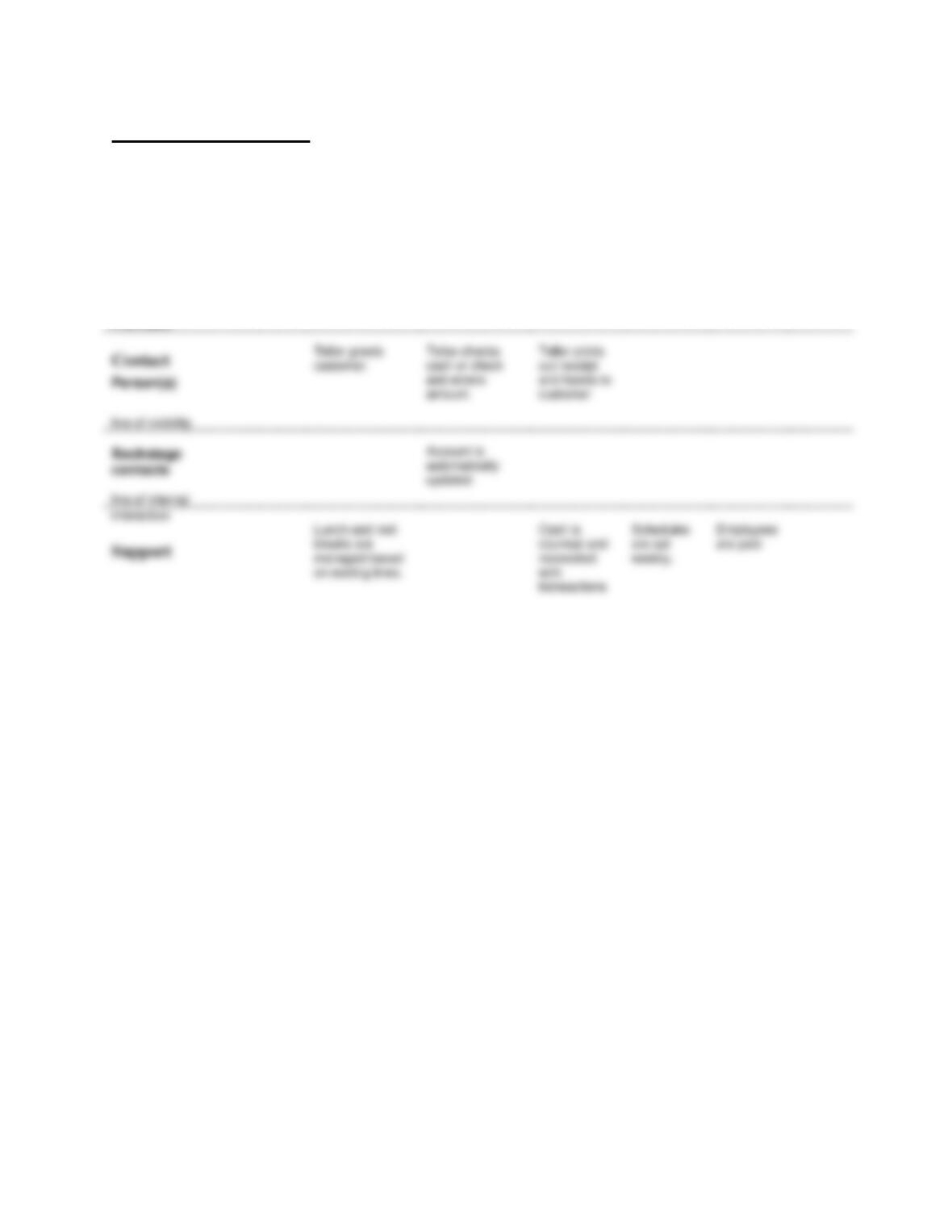
3.a. Make a savings deposit using a teller.
Customer
actions
Arrive and
Fill out deposit
ticket.
Wait in line if
necessary
Hand teller cash
or check and
deposit ticket
Receive
receipt
Leave
C
line of
information
and enters
amount.
and hands to
customer
line of visibility
line of internal
interaction
managed based
reconciled
transactions
weekly.
Chapter 04 – Product and Service Design
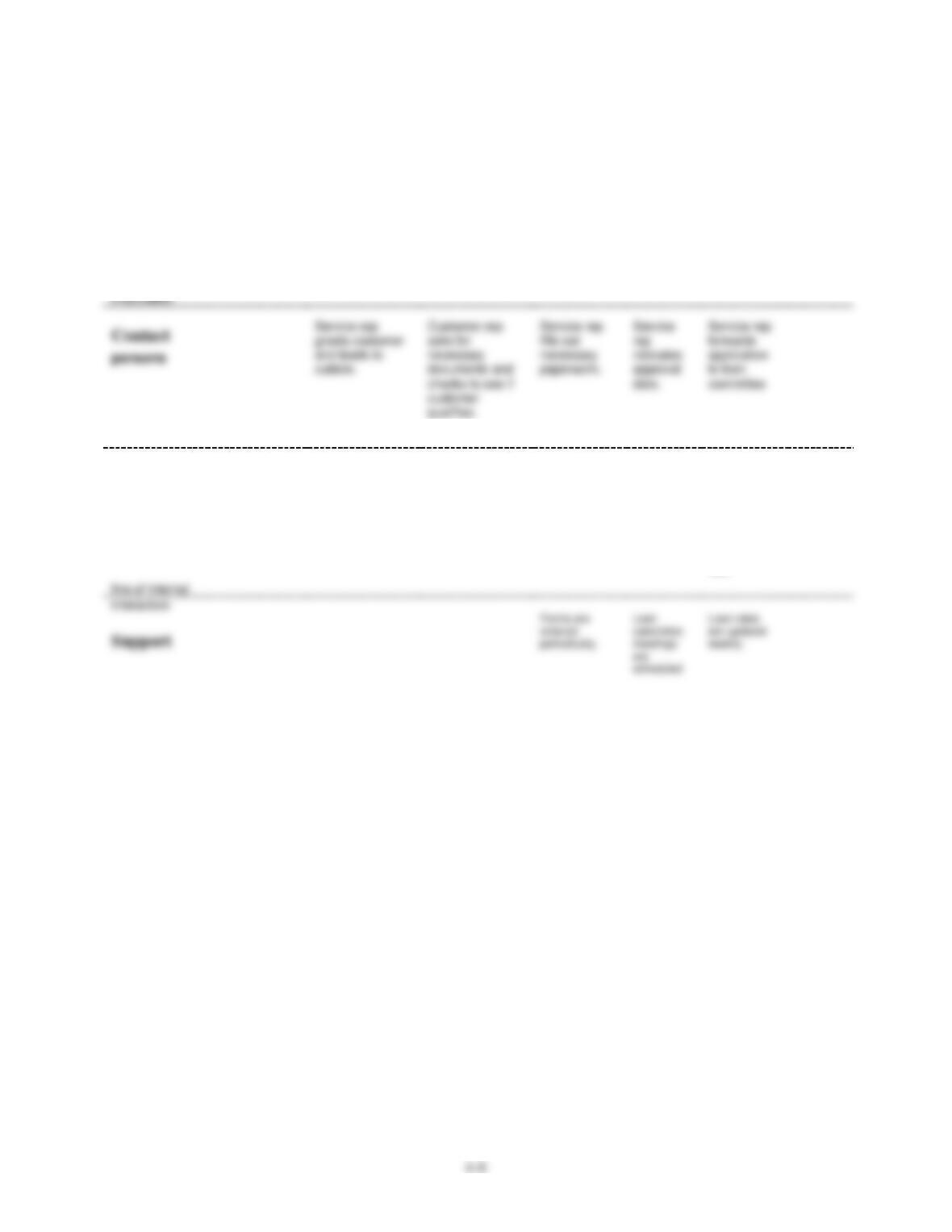
3.b. Apply for a home equity loan.
Customer
actions
Arrive and
wait in line if
necessary
Greets service
rep and follows
to cubicle.
Tells service rep
type of loan
wanted.
Customer
signs for
loan.
Customer
leaves.
information
checks to see if
customer
qualifies.
date.
committee
line of
line of visibility
line of internal
interaction
Backstage
contacts
Loan
committee
evaluate
application
and makes a
decision to
approves or
not approve
loan.
Customer
is
informed
of
decision.
Chapter 04 – Product and Service Design
4-9
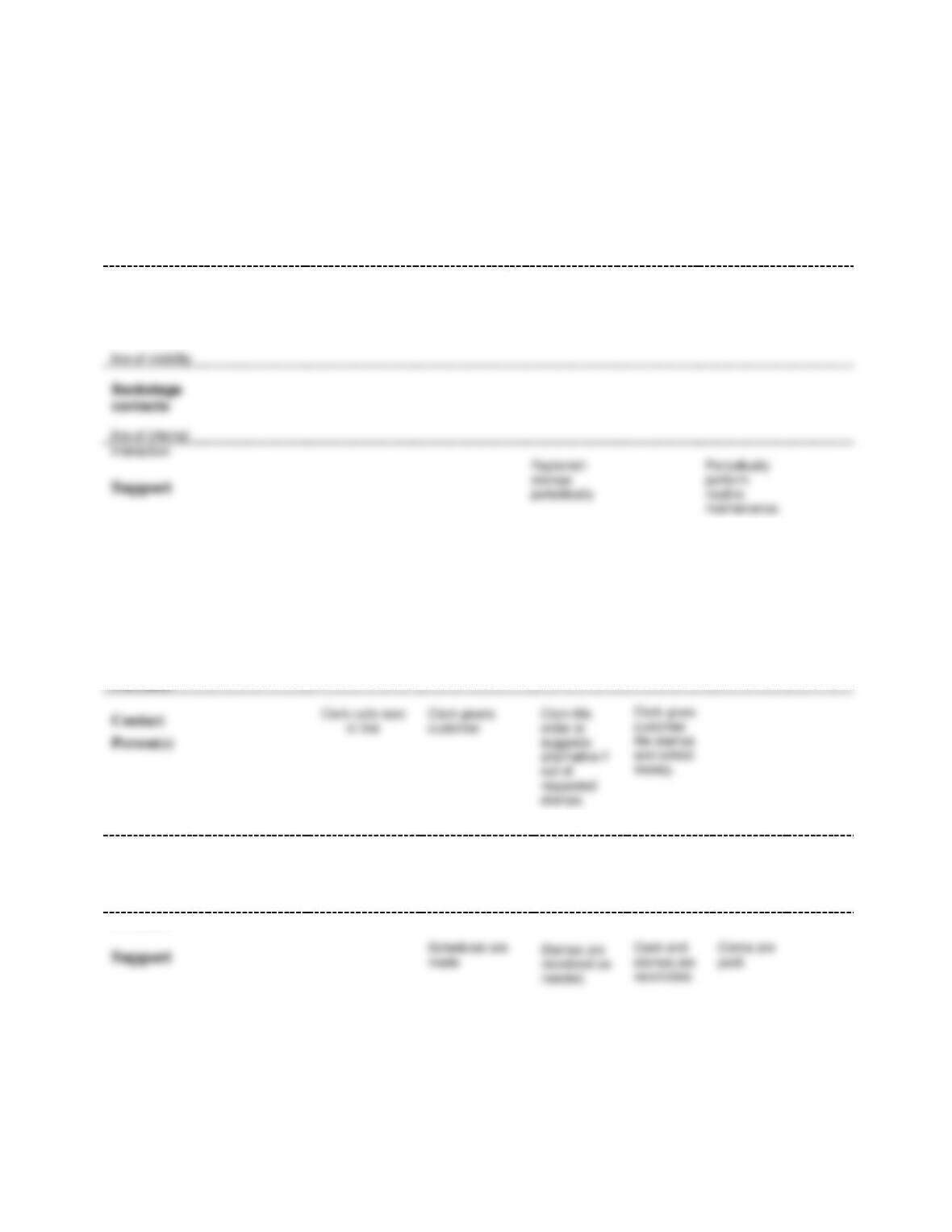
4.a. Buy stamps from a machine.
Customer
actions
Arrive and
Wait in line if
necessary
Insert cash.
Make a
selection
Receive
stamps and
any change.
Count
change
Leave
line of
information
Contact
(machine)
Receive and
record cash
amount
Verify cost does
not exceed
recorded cash
amount.
Dispense
stamps
4.b. Buy stamps from a postal clerk.
Customer
actions
Arrive and
Wait in line if
necessary
Customer
approaches clerk
Customer
requests
stamps
Customer
pays for
stamps
Leaves
line of
information
alternative if
requested
stamps.
line of visibility
Backstage
contacts
line of internal
interaction
Stamps are
line of visibility
line of internal
interaction
stamps
perform
maintenance.
Chapter 04 – Product and Service Design
4–10
5. a. Steps for Self-Service
1. Customer Selects Station
2. Select Octane Level
b. Steps for Full Service
1. Customer Selects Station
2. Tell Attendant Type and Amount of Gas and Services Desired
6. Steps for Making Cash Withdrawal from an ATM
1. Insert Card: Magnetic Strip Should be Facing Down
2. Watch Screen for Instructions
3. Select Transaction Options:
1) Deposit
4. Enter Information:
1) PIN Number
5. Deposit/Withdrawal:
2) Withdrawal—lift the “Withdrawal Door,” being careful to remove all cash
6. Remove card and receipt (which serves as the transaction record)
Chapter 04 – Product and Service Design
4–11
7. a. Roll Roundness and Tensile Strength
b.
Technical
Type of
Paper
Internal
Paper
Feed
Print
Element
Requirements
Customer Requirements
Paper doesn’t wrinkle
√
√
Technical
Type of
Paper
Internal
Paper
Feed
Print
Element
Requirements
Customer Requirements
Paper doesn’t wrinkle
.
.
8.
Technical
Requirements
Ingredients
Handling
Preparation
Customer Requirements
Taste
√
√
√
√
.
√
√
√