1
Instructor’s Manual – OMSC2 – Collier/Evans – C4 Technology and Operations Management
This chapter introduces students to technology in both goods-producing and service-providing
value chains. We describe different types of technology and their roles in manufacturing and
service operations, explain how manufacturing and service technology strengthen the value
chain, explain the benefits and challenges of using technology, and describe key technology
decisions and how analytics can support them.
Two Excel spreadsheet templates – Decision Analysis and Break-Even are available in MindTap
and illustrated in solved problems.
Questions and problems are provided in four categories:
1. Review questions
2. Discussion questions and experiential activities
The chapter has three cases:
1. RoboJet Car Wash is the first case study. It focuses on defining the firm’s strategy and
competitive priorities, the processes necessary to run the business, and break-even analysis.
2. The second case, Bracket International – The RFID Decision, a decision must be made on
KEY TERMS
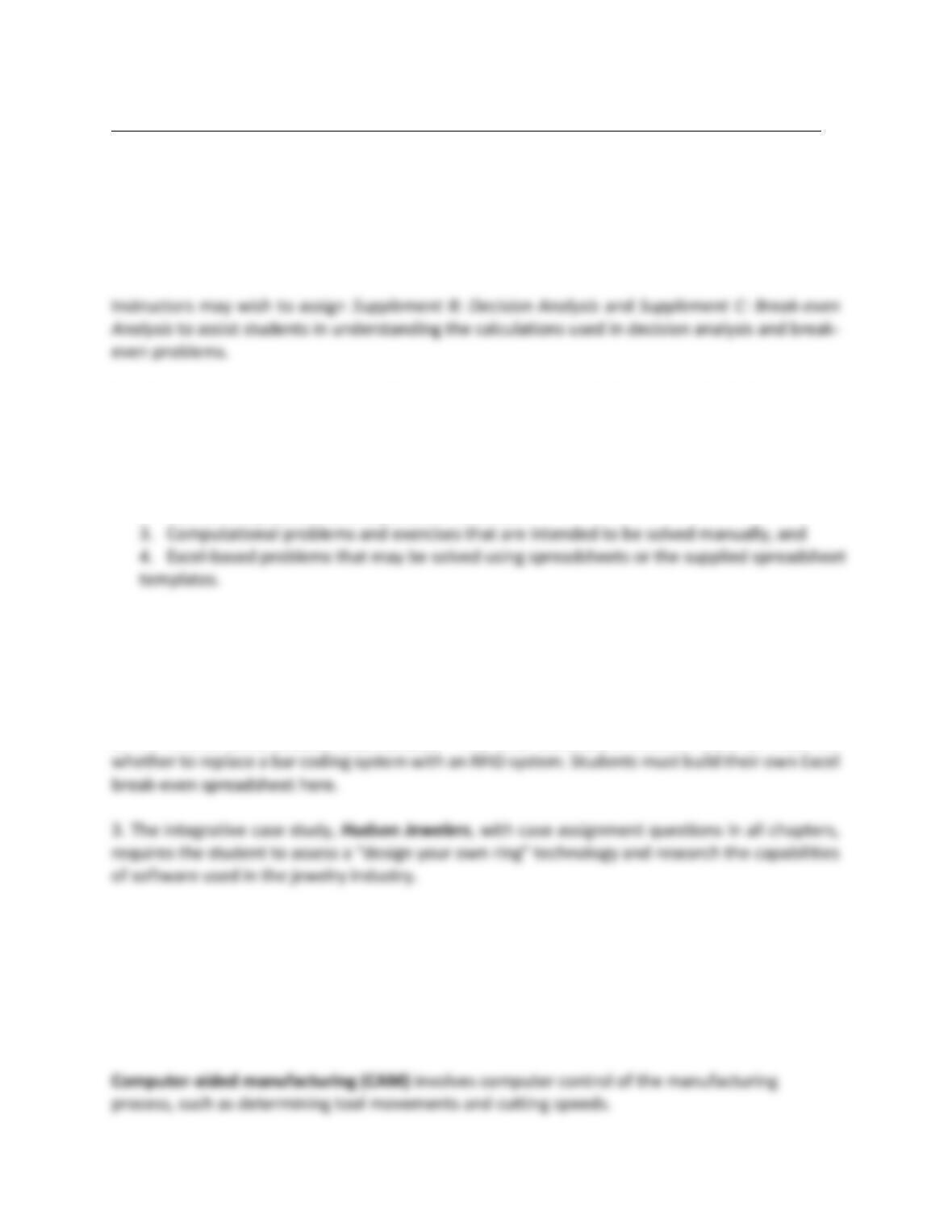
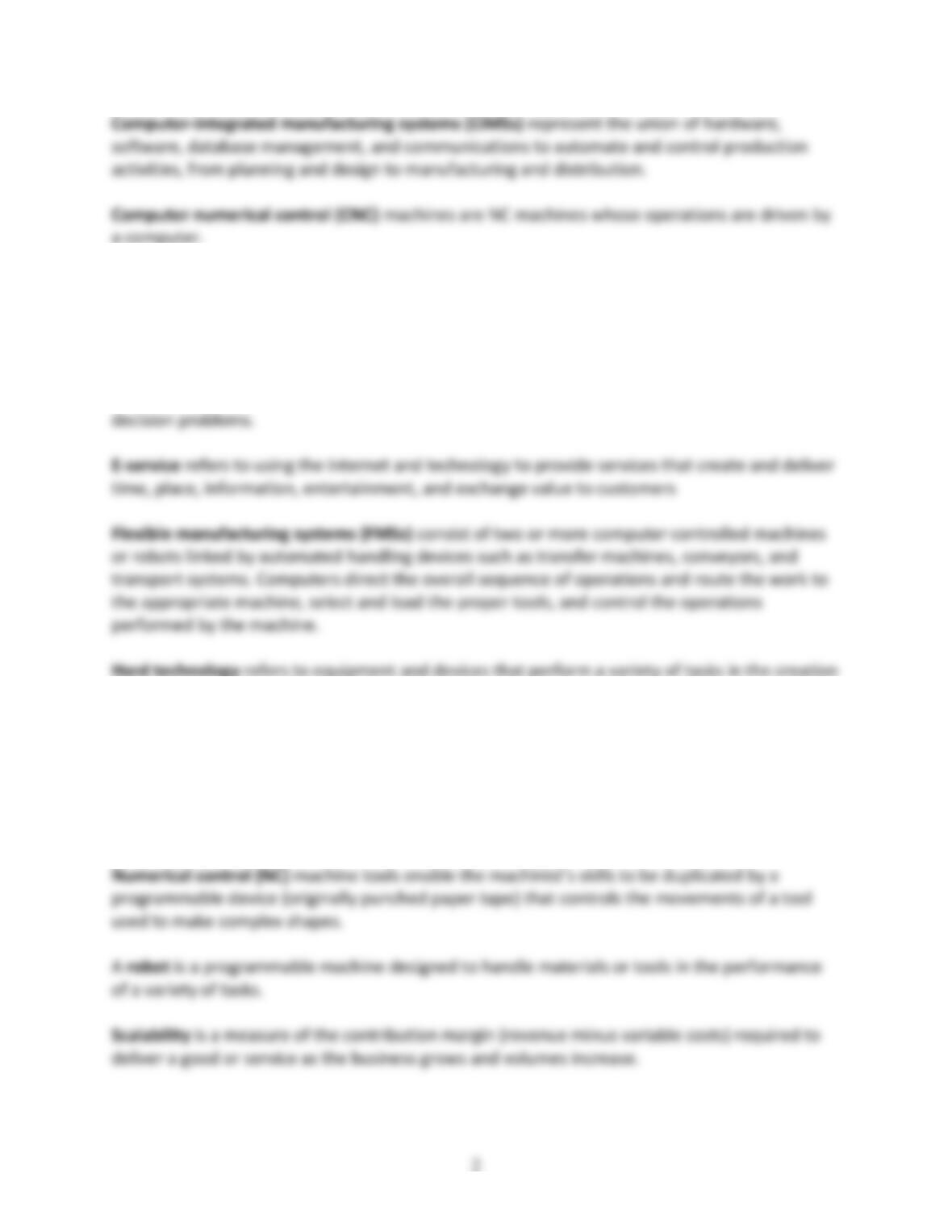
Computer-aided design/computer-aided engineering (CAD/CAE) enables engineers to design,
analyze, test, simulate, and “manufacture” products before they physically exist, thus ensuring
that a product can be manufactured to specifications when it is released to the shop floor.
Customer relationship management (CRM) is a business strategy designed to learn more about
customers’ wants, needs, and behaviors in order to build customer relationships and loyalty,
and ultimately enhance revenues and profits.
Decision analysis is the formal study of how people make decisions, particularly when faced
with uncertain information, as well as a collection of techniques to support the analysis of
and delivery of goods and services.
High scalability is the capability to serve additional customers at zero or extremely low
incremental costs.
Low scalability implies that serving additional customers requires high incremental variable
costs.
3
REVIEW QUESTIONS
1. Describe different types of technology and their role in manufacturing and service
operations.
Some examples of hard technology are computers, computer chips and microprocessors,
optical switches and communication lines, satellites, sensors, robots, automated machines,
2. Define hard and soft technology and give an example.
Hard technology refers to equipment and devices that perform a variety of tasks in the
creation and delivery of goods and services. Examples of hard technology are computers,
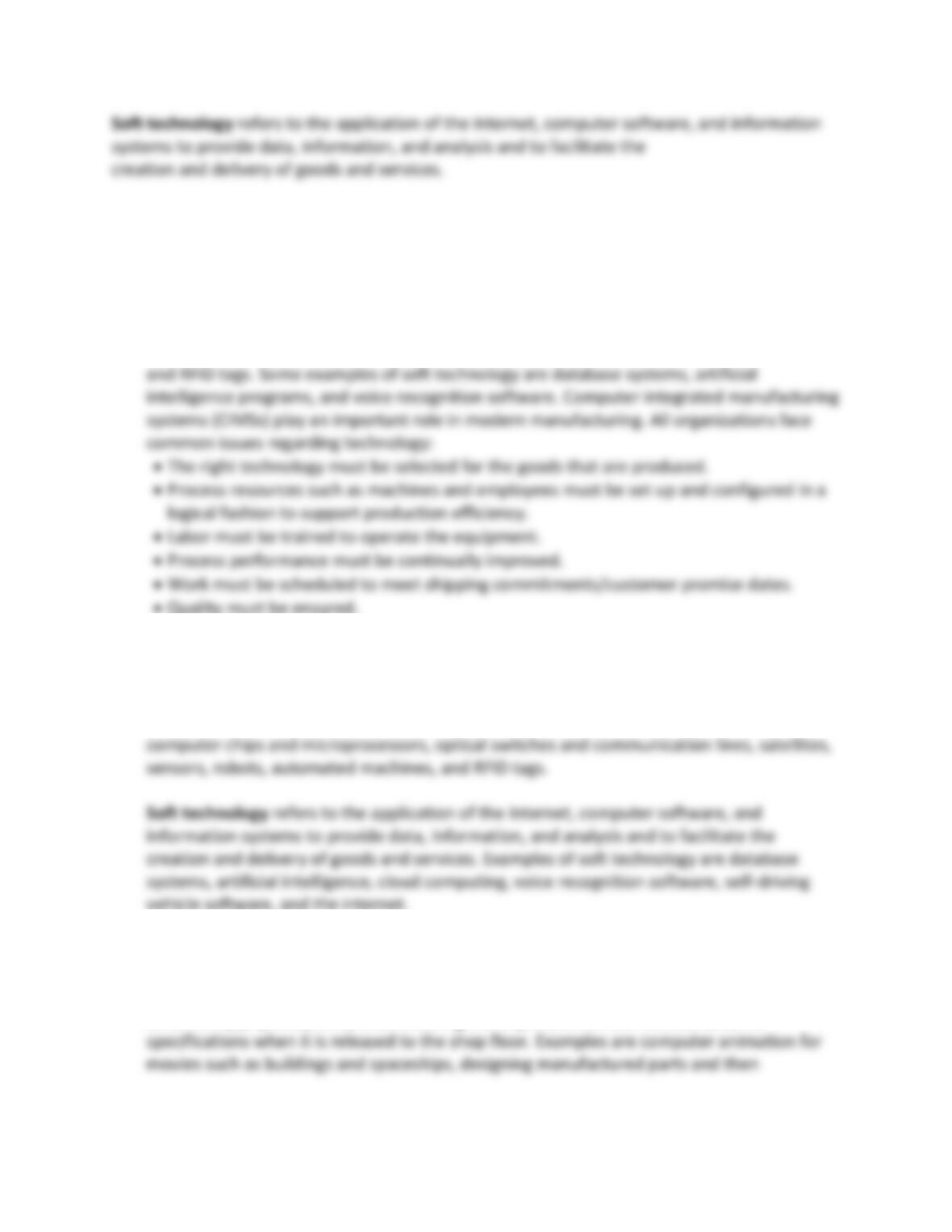
3. What is CAD/CAE? Provide one non-textbook example.
CAD/CAE enables engineers to design, analyze, test, simulate, and “manufacture” products
before they physically exist, thus ensuring that a product can be manufactured to
4
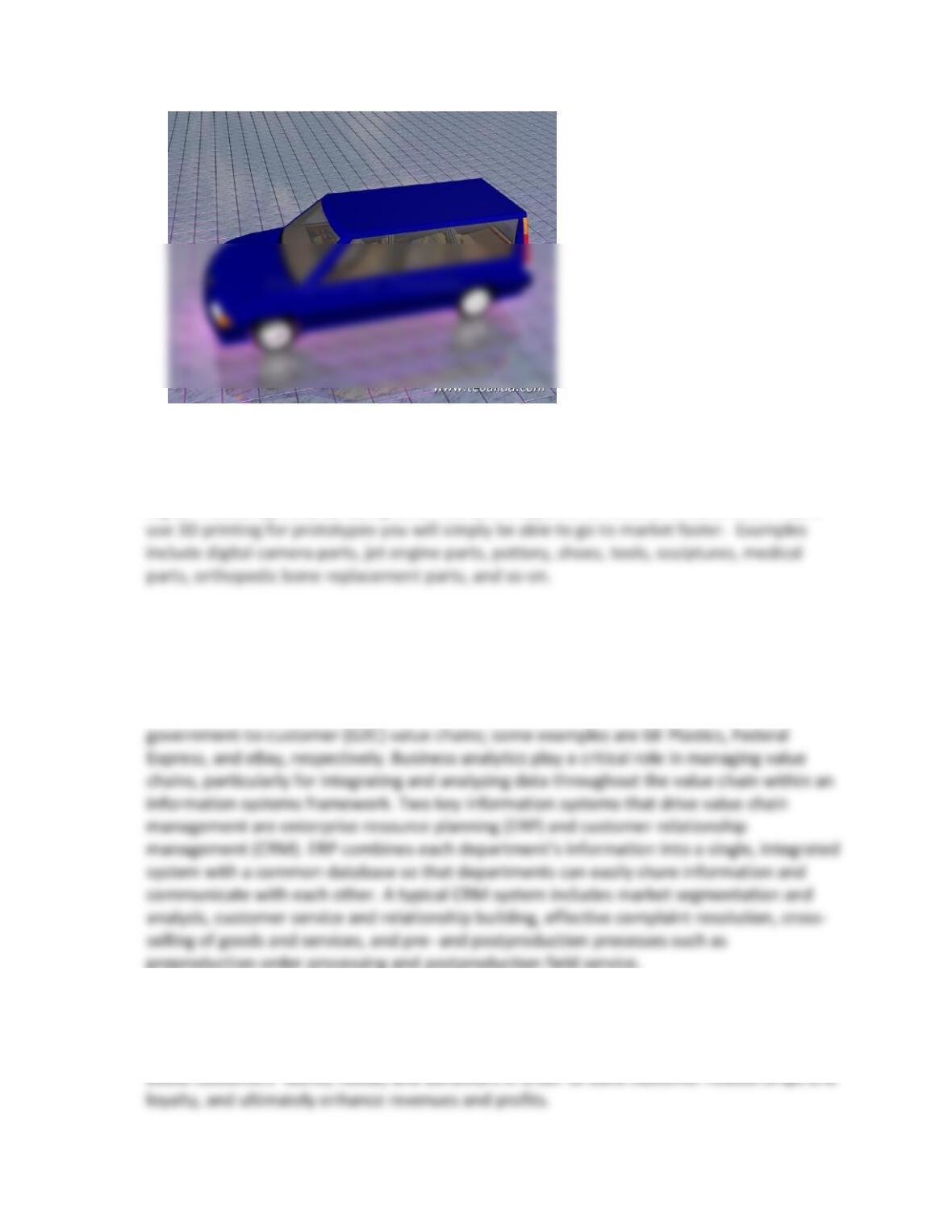
producing them using 3D printing (a PC mouse is an example), buildings, vehicles, furniture
design, and so on.
5
4. What is 3-D printing? Provide two examples.
3D printing is the action or process of making a physical object from a three-dimensional
digital model, typically by laying down many thin layers of a material in succession. If you
5. Explain how manufacturing and service technology strengthen the value chain.
With all the new technology that has evolved, a new perspective and capability for the
value chain has emerged—the e-commerce view of the value chain. This includes business-
to-business (B2B), business-to-customer (B2C), customer-to-customer (C2C), and
6. What is CRM? How does it help OM do its job?
Customer relationship management (CRM) is a business strategy designed to learn more
7. What types of technology might a major hotel chain use to enhance the customer
experience?
• On-line reservations
• Electronic keys and room door locks
8. Explain the benefits and challenges of using technology.
Benefits and challenges are summarized in Exhibit 4.1.
Students will highlight many other benefits and challenges.
9. Explain the concept of scalability. Identify one low and one highly scalable organization and
explain why you categorize them as such.
Scalability is a measure of the contribution margin (revenue minus variable costs) required
to deliver a good or service as the business grows and volumes increase. Scalability is a key
7
10. How can decision analysis be used in making technology decisions?
Decision analysis is the formal study of how people make decisions, particularly when faced
11. How can break-even analysis help managers make decisions? Explain how the break-even
point is found.
Break-even analysis is a simple approach to analyze profit or loss, or to make an economical
choice between two options that vary with volume. Common applications of break-even
DISCUSSION QUESTIONS AND EXPERIENTIAL ACTIVITIES
The article states:
As countries and economies shifted into more sophisticated industries such as
electronics (think Japan), poor countries took their place in textiles and shoes. The latter
offered cheap labor that low-tech factories required. Manufacturers got inexpensive
8
Today, Bangladesh, Cambodia, and Myanmar are in the early stages of climbing the
ladder but automation threatens to block the traditional ladder. The window is closing
on developing countries. More than 80 percent of garment workers face losing their job
to automation. Robots are becoming capable of picking up and working with flexible
13. Describe at least one application of modern technology in each of these service industries:
a. Financial services
b. Public and government services
c. Transportation services
d. Educational services
e. Hotel and motel services
How does your example application improve things, or does it?
These should be easy to identify with a bit of literature or web-based research. Hotels, for
example, use electronic keys that improve patron security while a one-person automated
phone apps such as Uber are good candidates for this assignment.
14. Identify and describe (maximum of one typed page) a service encounter where technology
helps create and deliver the service in total or in part. What hard and soft technology most
likely is involved?
Many examples can come to mind. For instance, reserving a hotel room relies mostly on
the hotel’s computer system to identify whether a room is available, process a credit card,
15. Research radio frequency identification devices (RFID) and provide examples of how they
are or might be used to improve productivity in operations.
A Google search results in over 65 million hits on “RFID” so students have plenty to write
about. RFID has been one of the hottest topics in recent years and numerous articles can be
16. Investigate the current technology available for laptop computers, cell phones, or tablets.
Select two different models and compare their features and operational characteristics, as
well as manufacturer’s support and service. Briefly explain how you might advise (a) a
college student majoring in art, and (b) a salesman for a high-tech machine tool company in
selecting the best device for his or her needs. (maximum of two typed pages)
Consumer Reports (www.ConsumerReports.org) is good web site to see the criteria the
experts use. For example, Consumer Reports rates laptop computers on many criteria such
17. Identify and describe (maximum of two typed pages) a business that uses ERP to manage
its value chain (if possible, draw a picture of key elements of the value chain such as
sourcing, production, shipping, sales, billing, and so on). What benefits and challenges
does ERP bring to this business?
18. Explain how manufacturing and service technology, and business analytics strengthen the
value chain.
With all the new technology that has evolved, a new perspective and capability for the
value chain has emerged—the e-commerce view of the value chain. This includes business-
Business analytics play a critical role in managing value chains, particularly for integrating
and analyzing data throughout the value chain within an information systems framework.
19. Discuss each of these statements. What might be wrong with each of them?
a. “We’ve thought about computer integration of all our manufacturing functions, but when
we looked at it, we realized that the labor savings wouldn’t justify the cost.”
c. “Each of my manufacturing departments is authorized to invest in whatever technologies
are necessary to perform its function more effectively. As a result, we have state–of–the-art
equipment throughout our factories – from CAD/CAM to automated materials handling to
robots on the line. When we’re ready to migrate to a CIM environment, we can just tie all
these pieces together.”
a. Today, labor accounts for only a fraction of total expense in many industries. Traditional
cost justification techniques cannot always be used. Instead of measuring payback or
ROI only in terms of labor costs, management needs to judge technology investments
against a global competitive cost advantage. Would firm survival justify the cost of
technology?
11
20. Describe a situation where self-service and technology help create and deliver the
customer benefit package to the customer. Provide examples of how such a system can
cause a defect, mistake or service upset.
An automatic picture kiosk is an example of where technology and customer labor create
hard copy prints. Kodak, for example, has a freestanding kiosk where you put in your
21. How can social media enhance the sale of a physical good? A service? Provide examples.
Explain.
A web search of “social media relationship to physical goods” results in 2.2 million hits. No
matter what you’re selling, a good social media presence will help you in some way—direct
sales, customer service, or brand awareness. Companies in these industries see a much
more significant sales increase through social media:
▪ Books (links to Amazon/Audible; this is a grey area in terms of strategy because you
probably aren’t doing the fulfillment yourself)
▪ “Daily deals” sites, such as Groupon, AppSumo, LivingSocial, and Restaurant.com
12
Advertising can be customized to a single individual customer based on their buying
behavior and other social and economic factors.
The Internet of Things (IoT) is the network of physical objects—devices, vehicles,
buildings and other items—embedded with electronics, software, sensors, and network
connectivity that enables these objects to collect and exchange data.
computing. Cognitive IoT is our best opportunity to fully exploit this resource.
22. Research and write a short paper (maximum of two typed pages) on the impact of electric
vehicles on the three dimensions of sustainability.
Ford Motor Company and Toyota, an unlikely couple, recently agreed to jointly develop the
next generation of gas-electric hybrid systems for pickup trucks and SUVs. Toyota has built
more hybrids, but it has no hybrid pickup trucks while Ford has been a leader in first–
generation hybrids for SUVs. Their partnership includes swapping patents, research and
13
Pros:
• Cheap fuel. Nissan estimates it will cost approximately $2.75 at average utility rates to
charge its Leaf from empty to full. The Leaf has a range of around 100 miles, a distance
that would cost about $10 to drive in a compact car getting 30 mpg (3.33 gallons x the
average gas price of $3.089). That gap will become even wider if gas prices rise in the
Cons:
• Short range. Current battery technology can’t yet match the energy stored in a regular
old tank of unleaded. That means in the near future, electric cars will have significantly
less range than comparable combustion cars.
• Few independent mechanics. I spoke to a mechanic I know over the weekend, and we
got on the topic of upsides and downsides to electric cars. He said one major sticking
point of ownership would be finding an independent shop that would work on all-
electric vehicles, since the cars are both very different from their combustion
counterparts and still quite rare. That will likely mean higher maintenance costs, since
dealerships often charge more for the same repair than independent shops.
• Less existing infrastructure. It’s not uncommon to see a gas station on every corner, but
I haven’t yet laid eyes on one public car charger. Even if sales of electric cars take off,
there won’t be public chargers widely available in most cities for years to come.
14
see how electric cars react to being subjected to the tremendous forces at work in an
auto accident.
23. Identify and describe (maximum of two typed pages) two apps for your cell phone or
electronic reader and how they improve your productivity and quality of life.
A Google search results in over 11 million hits on “cell phone apps” so students have plenty
to write about, not to mention their own personal use of apps. Students know more about
24. Research what jobs are most and least likely to be replaced by technology and automation.
Bloomberg Businessweek, June 26, 2017 pages 52-53 has a two-page map that answers this
question, but it is too complex to place here. According to this source the most likely jobs
25. Research and write a short paper (maximum of two typed pages) on the advantages and
disadvantages of “technology transfer” when a firm partners with a firm in another
country.
A Google search found over 1.5 billion hits on the words “technology transfer.” One
definition of this term is “the transfer of new technology from the originator to a
Advantages
• Host country firms become more competitive than the country and firm that invented
the technology. Jobs expand for the host country. Growth.
Disadvantages
• Host country firms learn the technology and then compete against the original firm
that taught them the technology.
• Over the long term, humans become dependent on technology. When technology
26. Research and write a short paper about how business analytics or advances in information
systems influence the use of technology and decision making in operations management.
ERP and CRM systems use many business analytic methods to support decision making (also see
answer to P&A #8). Business analytics plays a critical role in managing value chains, particularly for
16
COMPUTATIONAL PROBLEMS AND EXERCISES
These exercises require you to apply the formulas and methods described in the chapter. The
problems should be solved manually.
27. Southland Corporation’s decision to produce a new line of recreational products has
resulted in the need to choose one of two automated manufacturing systems based on
proposals from two vendors, A and B. The economics of this decision depends on the
market reaction to the new product line. The possible long-run demand has been defined
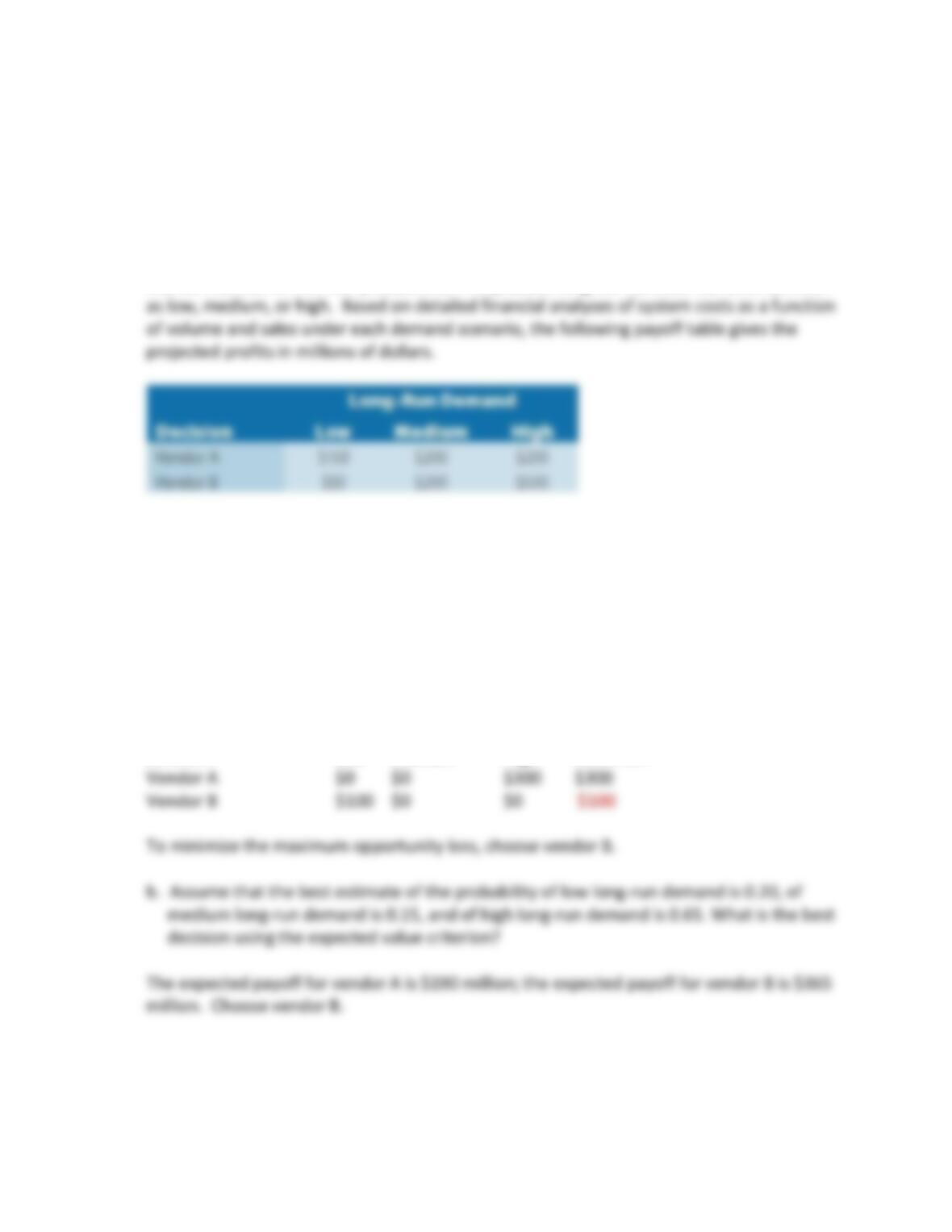
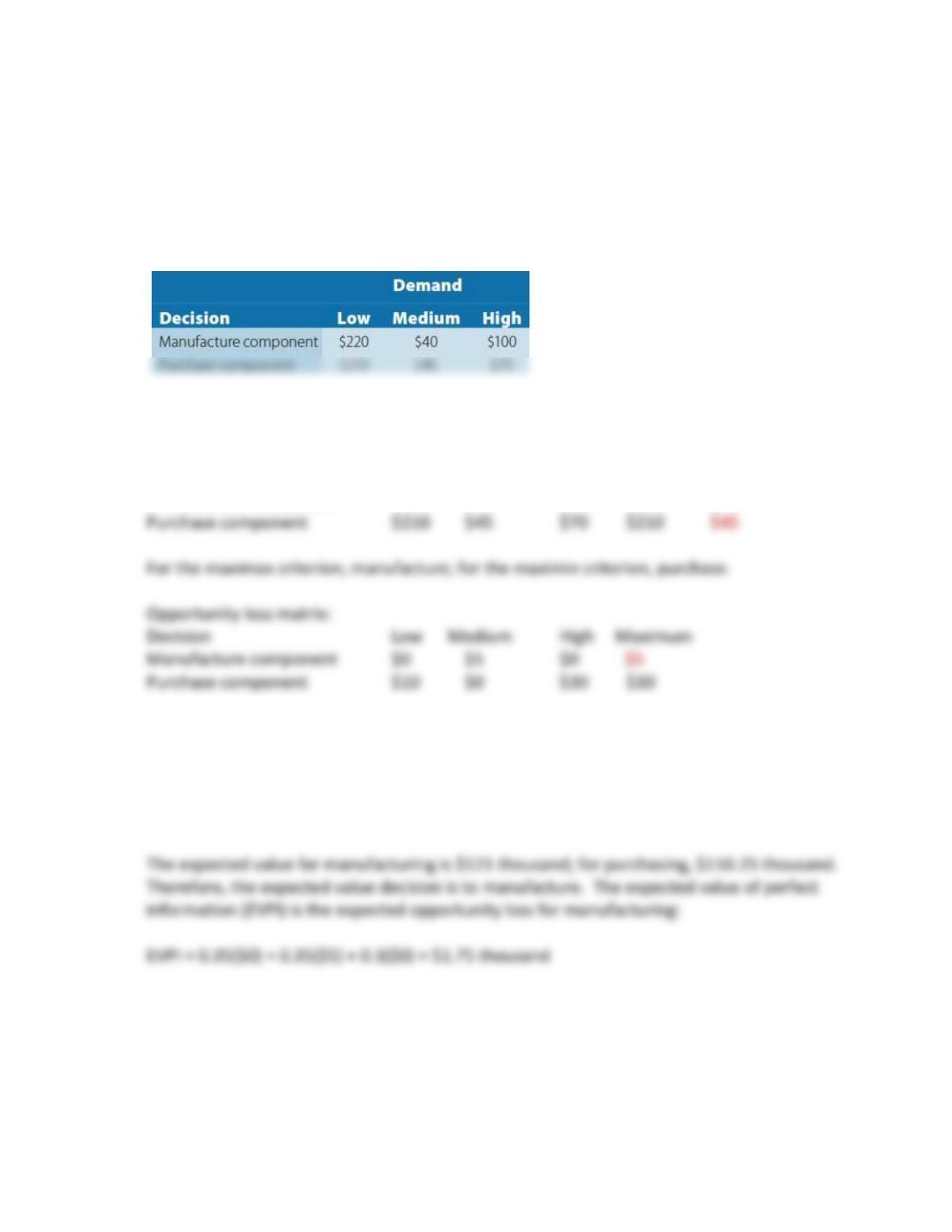
a. Determine the best decisions using the maximax, maximin, and opportunity loss decision
criteria.
Decision Low Medium High Maximum Minimum
Vendor A $150 $200 $200 $200 $150
Vendor B $50 $200 $500 $500 $50
Using the maximax criterion, choose Vendor B. For the maximin criterion, choose vendor
A. Opportunity Loss Matrix:
Decision Low Medium High Maximum
17
28. The Gorman Manufacturing Company must decide whether to purchase a component part
from a supplier or to manufacture the component at its own plant. If demand is high, it
would be to Gorman’s advantage to manufacture the component. If demand is low,
however, Gorman’s unit manufacturing cost will be high because of underutilization of
equipment. The projected profit in thousands of dollars for Gorman’s make–or-buy decision
is as follows.
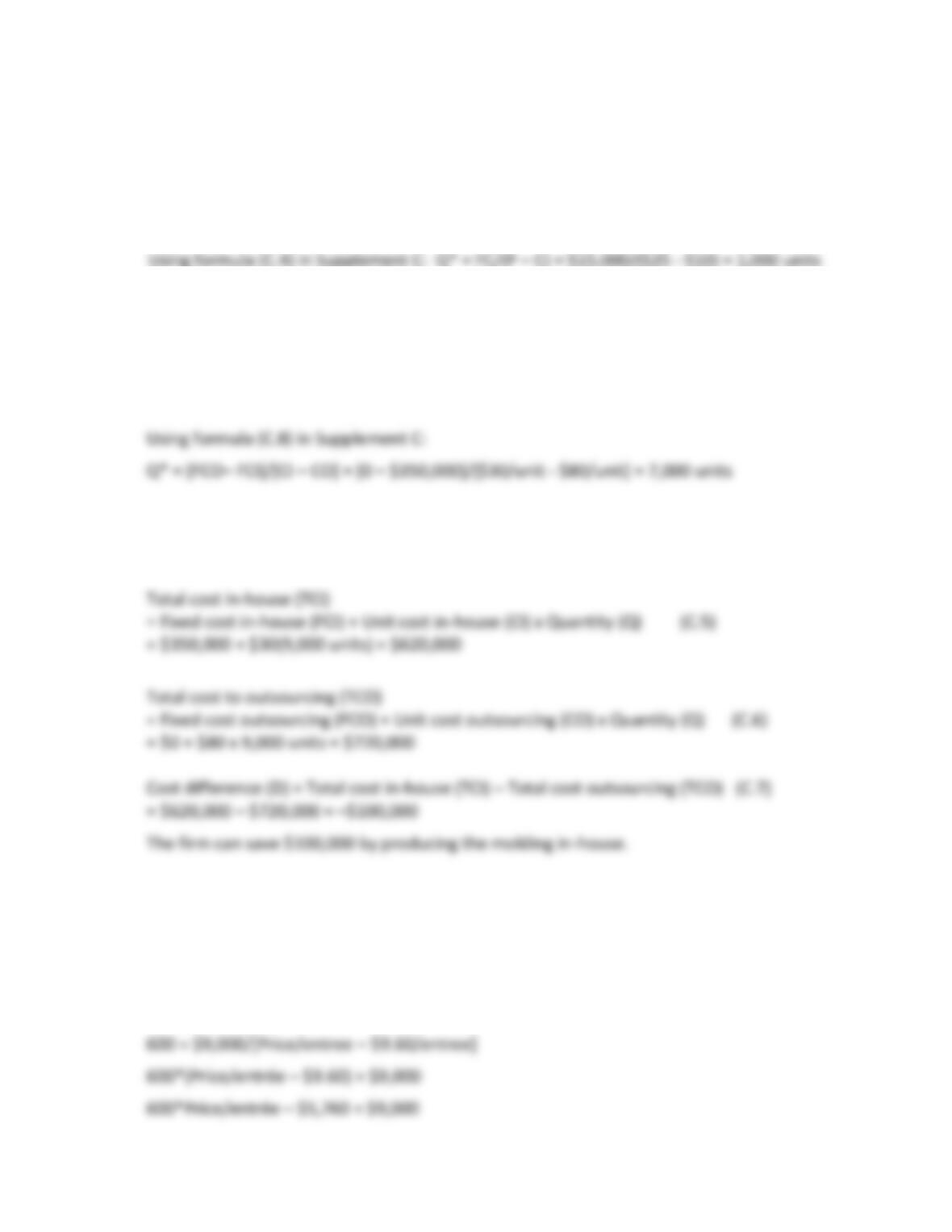
a. Determine the best decisions using the maximax, maximin, and opportunity loss decision
criteria.
Decision Low Medium High Maximum Minimum
Manufacture component $220 $40 $100 $220 $40
To minimize the maximum opportunity loss, manufacture.
b. Assume that the probability of low demand is 0.35, of medium demand is 0.35, and of high
demand is 0.30. What is the best decision using the expected value criterion and what is the
expected value of perfect information?
18
29. You need to expand your small business, Paddle Incorporated that manufactures paddle
board rackets. The fixed cost for the new technological advanced equipment is $15,000.
The variable cost to produce each unit using the new equipment is $10, and the selling
price for the finished product is $25. What quantity needs to be produced and sold to
break even?
30. The Vera Molding company has two alternatives for meeting a customer requirement for
9,000 units of a specialty molding. If done in-house, fixed cost would be $350,000 with
variable cost at $30 per unit. Alternative two is to outsource for a total cost of $80 per unit.
a. What is the breakeven quantity?
b. Should the firm make the 9,000 units in-house or outsource?
Using formulas (C.5) – (C.7) in Supplement C:
31. Luke’s Ristorante wants to add a sea bass dinner to their menu. A small grill and oven
would be added to the kitchen cooking area at a fixed cost of $9,000. The variable cost per
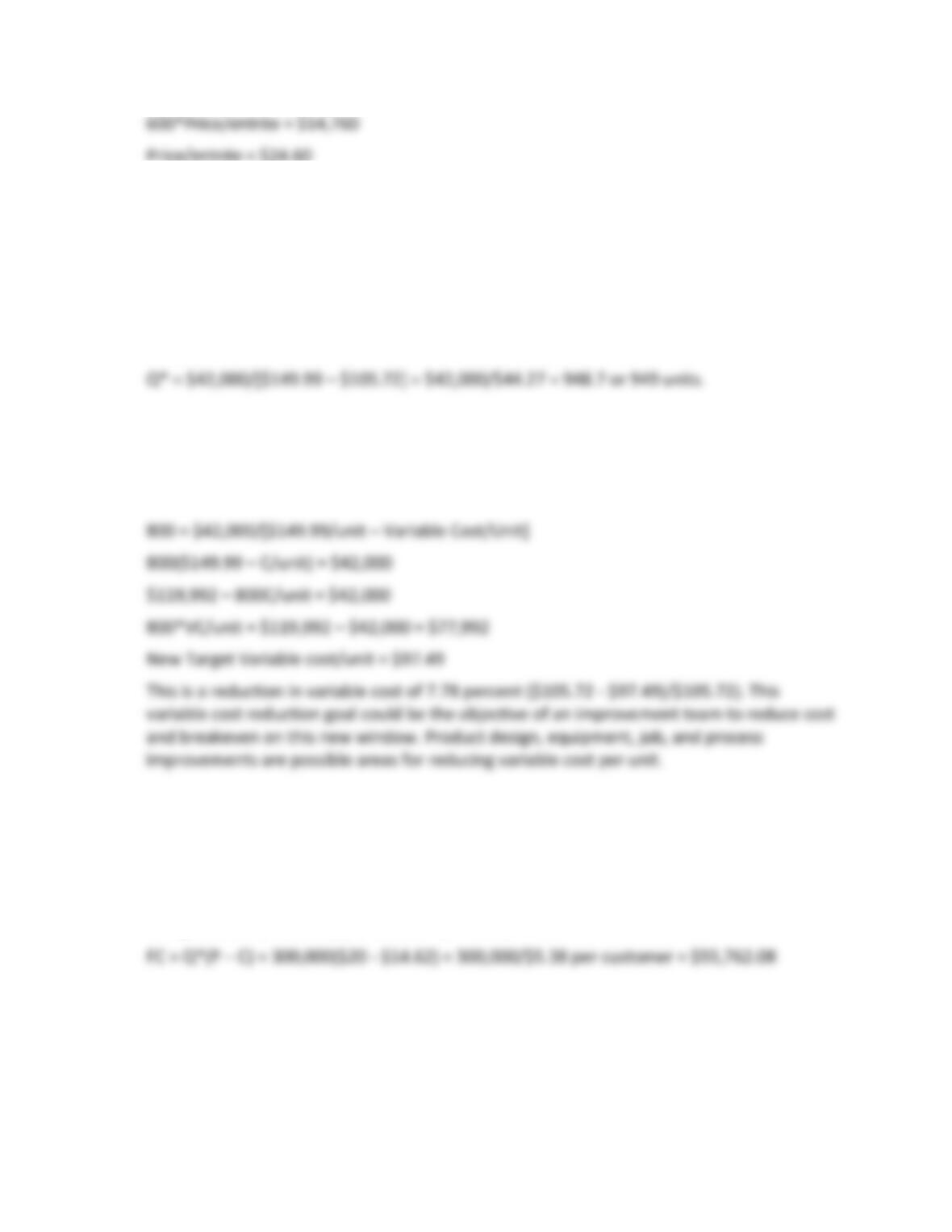
fish dish is estimated to be $9.60 per entrée. If 600 fish dinners are sold per year to break
even, what should be the price of the new fish entrée?
Using formula (C.4) in Supplement C: Q* = FC/[P – C]
19
32. Meyers Window Company introduced a new window design but sales were below
expectations. Sales in units last year were 800 units. Variable cost per unit averaged
$105.72, the fixed cost was $42,000, and the selling price was $149.99.
a. What is the breakeven quantity for this new window?
Using formula (C.4) in Supplement C: Q* = FC/[P – C]
b. If sales stayed the same next year, how much would the variable cost have to be
reduced to breakeven?
Q* = FC/[P – VC]
33. MovieFix is a video streaming company that sells to a potential audience of 300,000
customers. The selling price is $20 per month and its variable cost is $14.62 per month.
What is the most the company should spend on annual fixed costs to acquire and maintain
the firm’s equipment if it serves 300,000 customers?
Using formula (C.4) in Supplement C: Q* = FC/(P – C)
34. Pesto Restaurant must decide between two types of technology in its kitchen. Option A is
to use an induction oven process with a fixed cost of $20,000 and a variable cost of $6.51
per meal. Option B is to use a gas-fired oven process with a fixed cost of $12,000 and a
variable cost of $7.86 per meal. The average selling price per meal is $18.60.
20
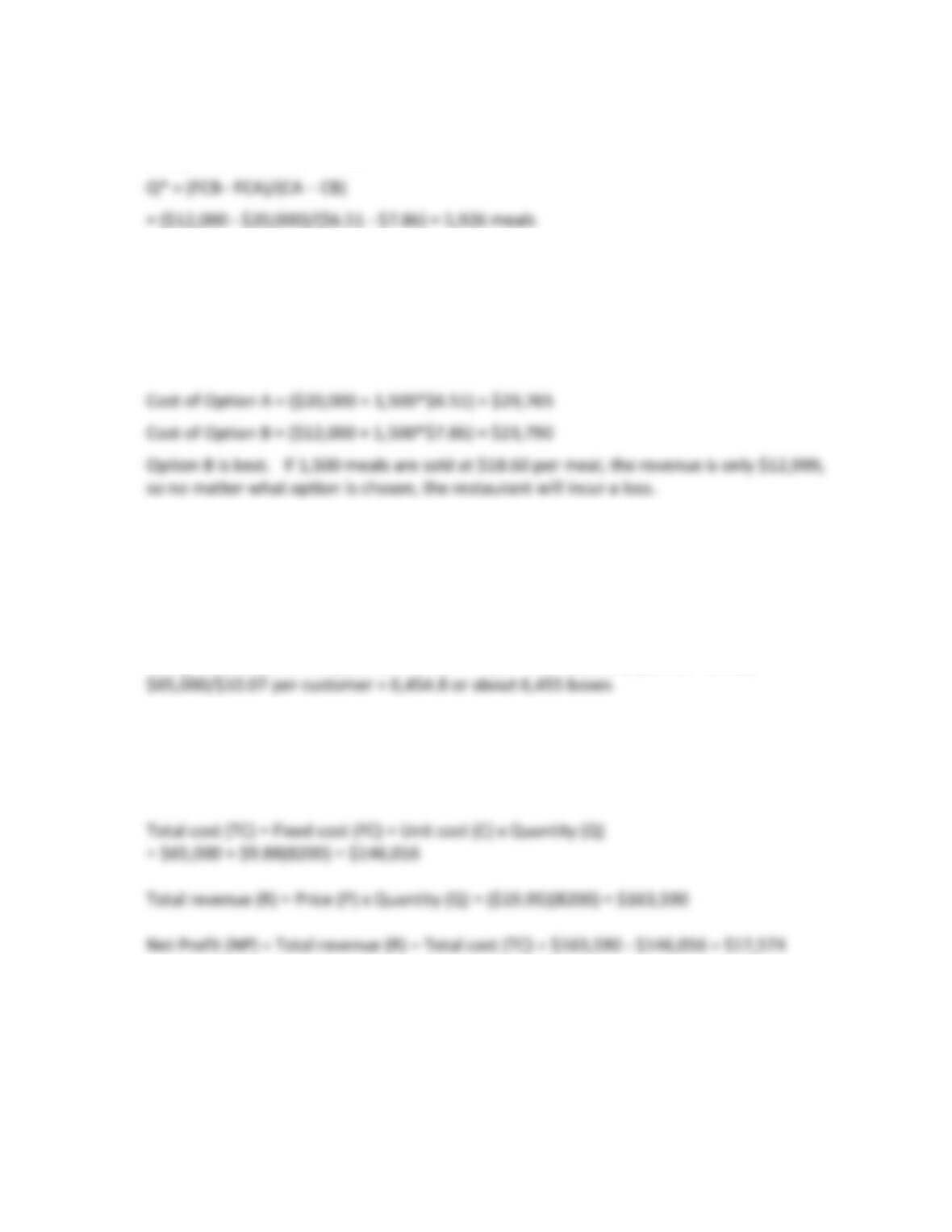
a. What is the breakeven quantity?
Using formula (C.11) in Supplement C:
b. If the restaurant manager expects to sell 1,500 meals, which option, A or B, is best?
Revenue = Demand (Q)*Price
Using Total cost (TC) = fixed cost (FC) + variable cost (VC) = FC + Q*VC1
35. The selling price per box for Cynthia’s Cookies selling price per box is $19.95. Fixed costs
are $65,000 and the variable cost per box is $9.88.
a. What is the breakeven quantity?
Using formula (C.4) in Supplement C: Q* = FC/(P – C) = $65,000/($19.95 – $9.88) =
b. If sales last year were 8,200 boxes, what was the net profit?
Using formulas (C.1)-(C.3) in Supplement C:
36. In Problem 35, Cynthia’s Cookies must decide between two improvement options. Option
1 is spending $10,000 on a new online marketing campaign that is expected to increase last
year’s sales (units) by 20 percent. Option 2 is to reduce variable costs by 10 percent by
spending $10,000 on equipment and process improvements. For Option 2, sales remain at
8,200 boxes. (The assumption here is that each option is equally costly to implement.)
What option provides the higher profits?