Page 1 of 17
Chapter 4: Strategic Quality Planning
Chapter Outline
• Strategy Content
• Importance of Time in Quality Improvement
• Leadership for Quality
• Quality and Ethics
• Quality as a Strategy
• Quality Strategy Process
• Deploying Quality (Hoshin Kanri)
• Does Quality Lead to Better Business Results?
• Supply Chain Strategy
Overview
Quality is strategic. This may seem somewhat obvious, but the actions of
companies implementing quality measures often obscure this fact. This is especially true
when a company is in a reactive mode and does not use effective planning. In this
chapter, aspects of strategic quality planning are discussed.
Strategic planning has two important dimensions: content and process. Strategic
content answers the question of what is to be contained in the strategic plan. Strategy
Discussion Questions
1. Recently, the Malcolm Baldrige Award changed the name of the
“Strategic Quality Planning” category to simply “Strategic Planning.” Why was this
change made? Do you agree or disagree with the committee’s rationale?
Traditionally, quality was an adjunct effort. Quality inspections were made as the product
went out of the door. The philosophy expressed by Deming, Juran, and others is that
strategy is integrally attached to the entire process. Strategic planning implies long-term
planning. The Malcolm Baldrige Award stresses that continuous quality control is part of
2. A study by the U.S. General Accounting Office reported that, on average, a firm
takes 3.5 years to see significant results from a quality improvement program. Why
do you think it takes so long to see significant results? Please make your answer as
substantive as possible.
In the play Macbeth (V, v, 19) the character Macbeth says: Tomorrow, and tomorrow,
and tomorrow, creeps in this petty pace from day to day to the last syllable of recorded
In the section The Importance of Time in Quality Improvement, the length of time that it
takes for implementing an effective quality program is discussed. The estimates vary
from 3.5 years (US General Accounting Office) to 25 years (Shigeo Shingo). In the
discussion, however, the point is made that a slower process is more effective than a
rapid one. The Management by Dictate model is also discussed. In this case, management
specifies a time frame and an expected level of accomplishment. On page 83, the text
says:
According to Donald Wheeler, a quality expert, when goals such as these are set, one of
three things will occur:
1. People will achieve the goals and incur positive results.
3. According to the quality literature, without top management leadership, quality
improvement will not occur. Why do you believe this is the case?
The text maintains that leadership equates with power. This power is defined as:
• Power of expertise
• Reward power
• Coercive power
• Referent power
• Legitimate power
The text also states that for the employees to feel empowered, power must be shared.
This establishes an environment wherein a leader can effectively influence the
organization through mutual trust.
Employees also must trust that if they make recommendations for improvement, the
4. Explain the hazards of the “management by dictate” model.
Management by dictate typically involves setting goals and insisting that the goals be
met. For example, as illustrated in the chapter, a top management team might set the
goals of “a 50% reduction in defects during the next year.” This is a numerical goal for
lower-level managers to meet.
On page 85, the text’s definition of leadership is: the process by which a leader influences
5. Trust has been identified as a very important attribute for leaders who are
initiating quality improvement efforts. Why do you believe trust is such an
important attribute?
As quality becomes a continuing part of the line, the worker is, by default, more visible.
For a genuine quality environment, an employee must feel that he is part of the solution,
not the problem. An employee who feels that he is not trusted might not show the
6. Why is commitment an important variable in quality improvement initiatives?
Commitment to quality means that leaders provide funding, slack time, and resources
7. Discuss some of the ways leaders resolve conflict in organizations. Which of these
ways have you found to be most effective? Why?
Conflict has been present in relationships as long as people have been around. While our
knee-jerk reaction to conflict is that it is unhealthy, when properly managed and
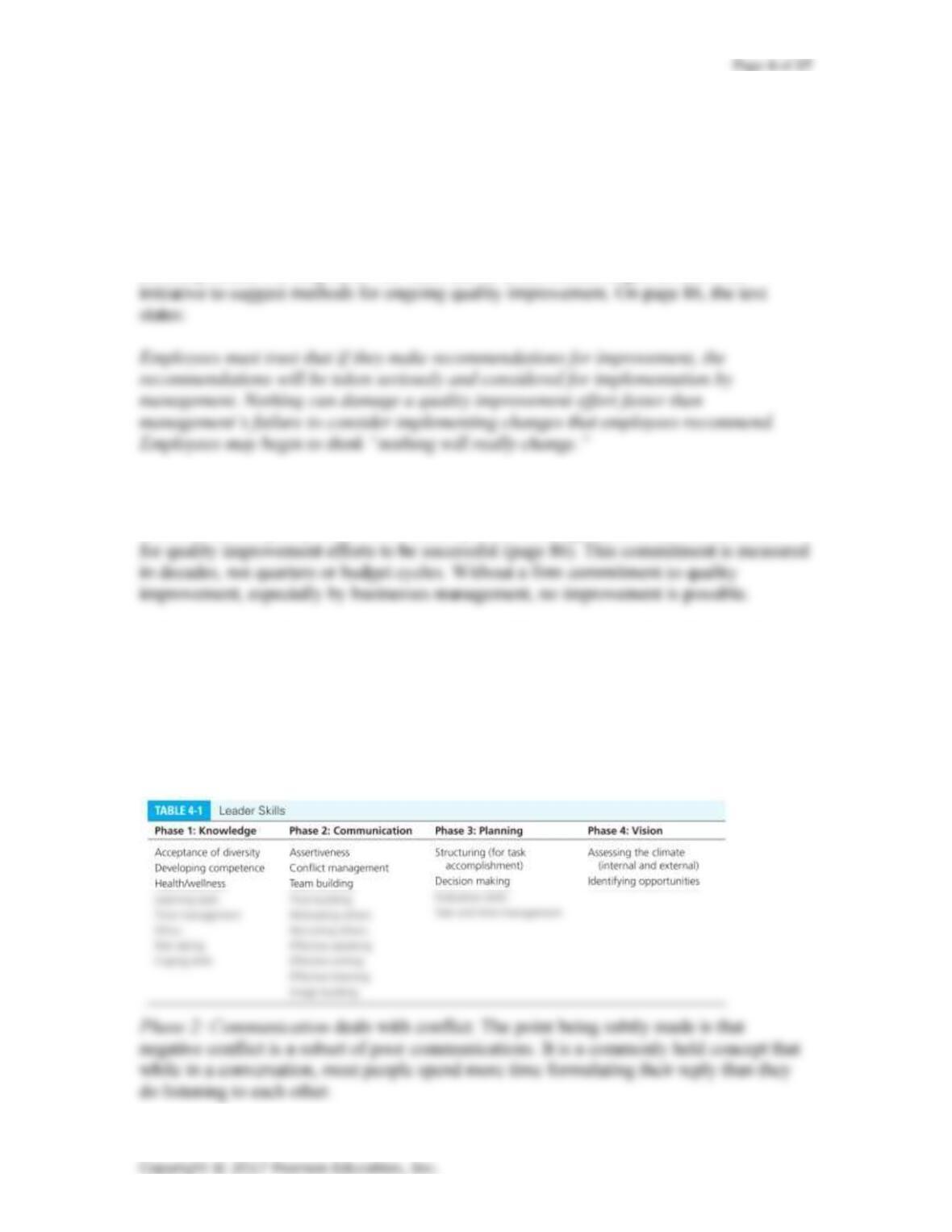
encouraged, conflict can help improve product or service quality. Table 4-1 identifies the
set of leader skills.
Page 5 of 17
8. Do you agree with the statement “quality is good ethics”? Please explain your
answer.
On page 88, the following statement is made:
Reliable products and low defect rates reflect an ethical approach of management’s care
9. Why do companies that focus on their customers often develop a set of ethics that
includes valuing employees? Please make your answer as substantive as possible.
Question 9 can be formulated from page 88 of the textbook. The text goes on to state:
This is reflected in education, training, health, wellness, and compensation programs that
show empathy for the employees… Integrity gets down to honesty. Are we honest to our
customers, employees, colleagues, family members, and ourselves? This must be the basis
10. Discuss the concept of prevention cost. Why is prevention cost such a pervasive
consideration in quality programs?
An old nursery rhyme says:
For want of a shoe the horse was lost.
For want of a horse the rider was lost.
Page 6 of 17
Prevention costs are those costs associated with preventing defects and imperfections
from occurring. Prevention costs include:
• The cost of setting up, planning, and maintaining a documented quality system
• Quality planning
11. Describe the difference between external and internal failure costs. Is one cost
more important than the other? Explain your answer.
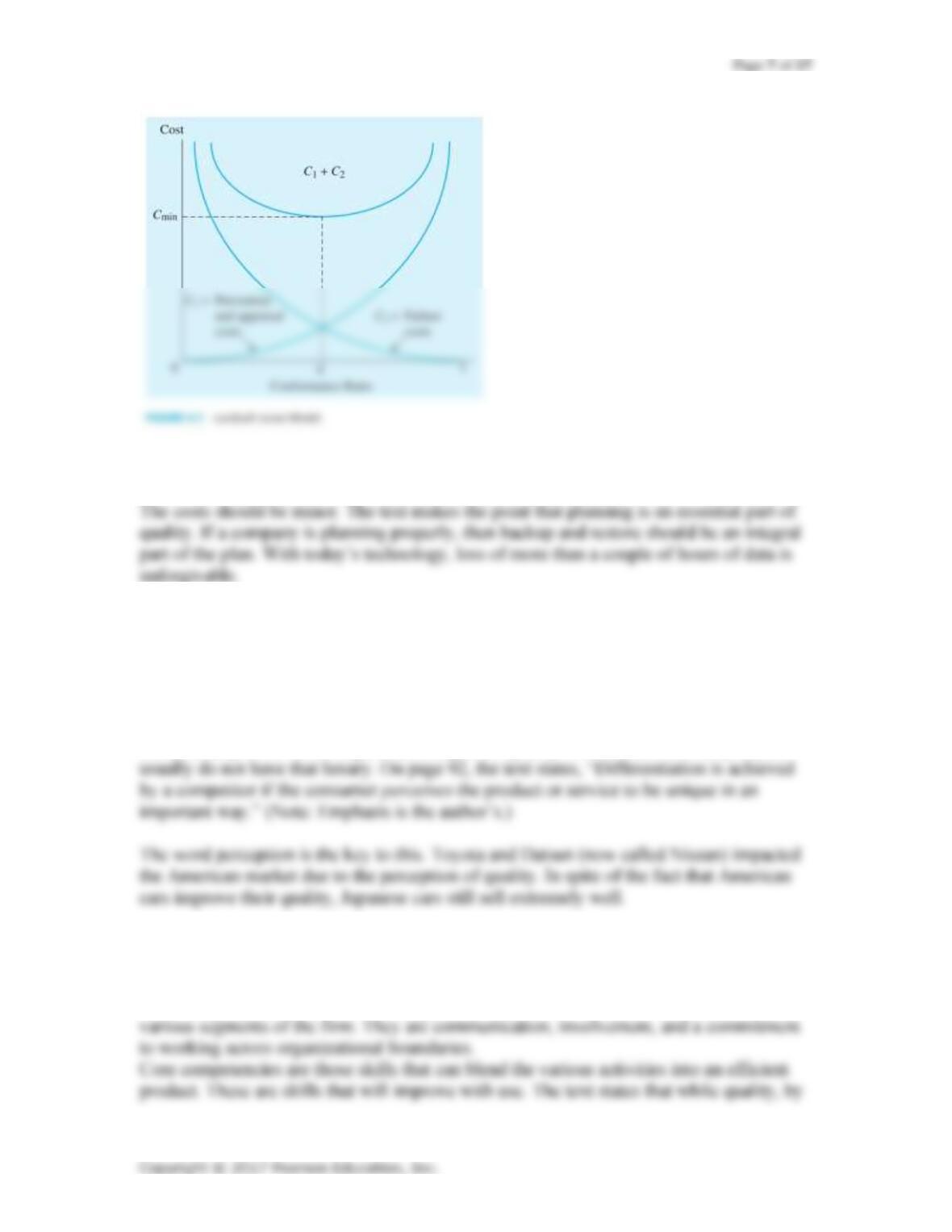
The table and figure below illustrate the situation. They are associated with product
failure after the production process. External failure costs include failure after the
customer takes possession of the product. While the cost of failure may vary across
circumstances, common sense says that external failure costs are the most expensive. It is
always better to catch mistakes as soon as possible. The worst possible scenario is to find
out that a part is defective after the customer has already started using it.
12. What are the quality costs incurred when your hard disk crashes?
13. Think of a product you buy that is differentiated through quality. Do you believe
the manufacturer’s strategy to differentiate this product through quality is
sustainable, or will the manufacturer eventually have to find other ways to attract
you to the product? Explain your answer.
The answer depends greatly upon the industry and technology. Rolex and Rolls Royce
will probably never lose the generated respect of quality. However, consumer products
14. Describe the concept of core competency. Can quality be considered a core
competency? Why or why not?
Core competencies involve those competencies that remove the barriers between the
15. Describe the difference between “strategy content” and “strategy process.”
Describe examples of quality-related strategy content and strategy process issues.
The word strategy has its roots in the military. Strategy is the set of high-level plans of
action that will be used to accomplish a specified goal. Strategy content is the set of
actions at which a long-range plan is aimed. The text speaks to cost, differentiation, and
16. Describe the benefits of strategic planning.
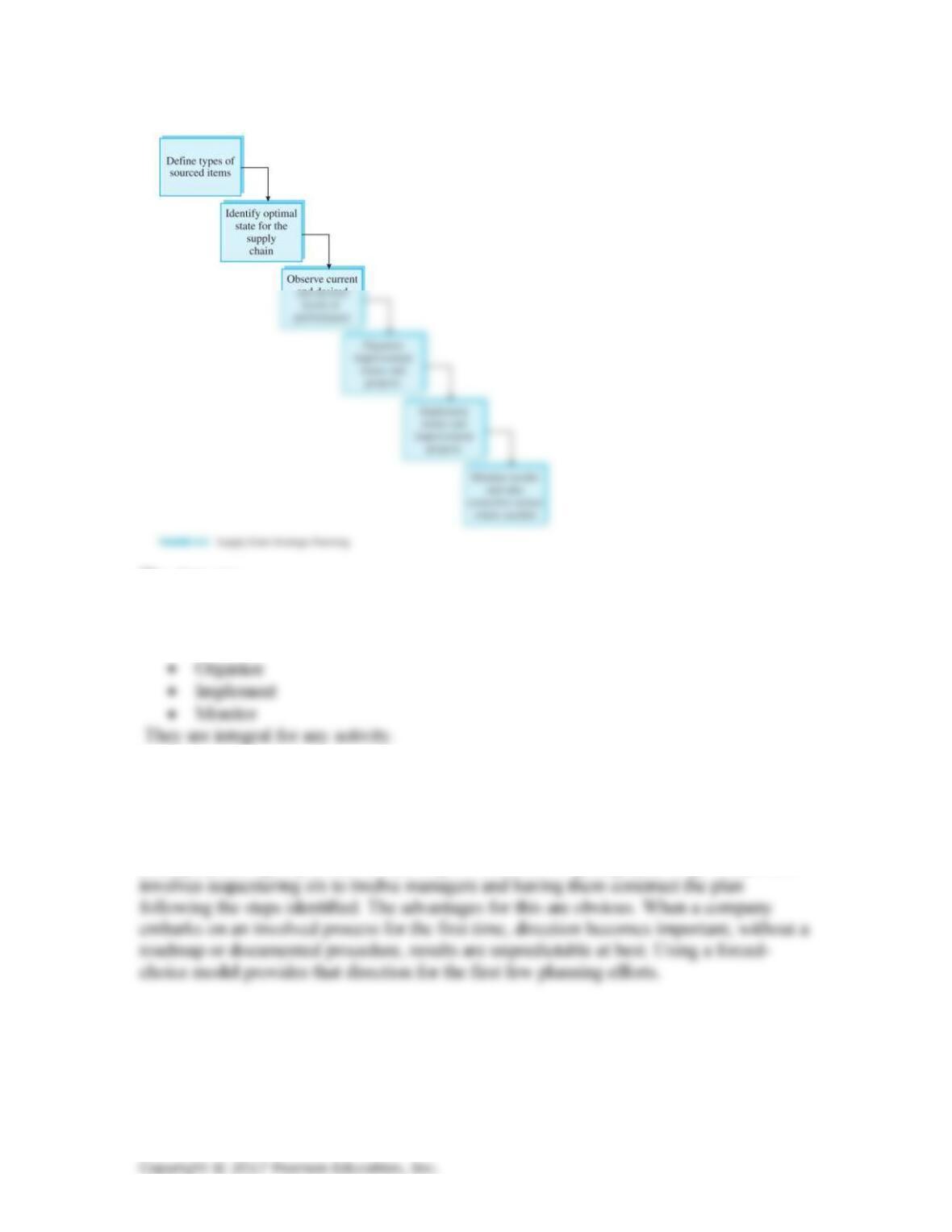
On page 81, the text outlines the basic reasons for strategic planning:
The basis for assuring quality is strategic planning that prioritizes and plans quality
improvement. The question is: “If we want to achieve our goals, how are we going to get
there?”
Page 9 of 17
The steps are:
• Define
• Identify
• Observe
17. Why is the forced-choice model particularly useful for companies that are
relatively inexperienced in strategic planning? Explain your answer.
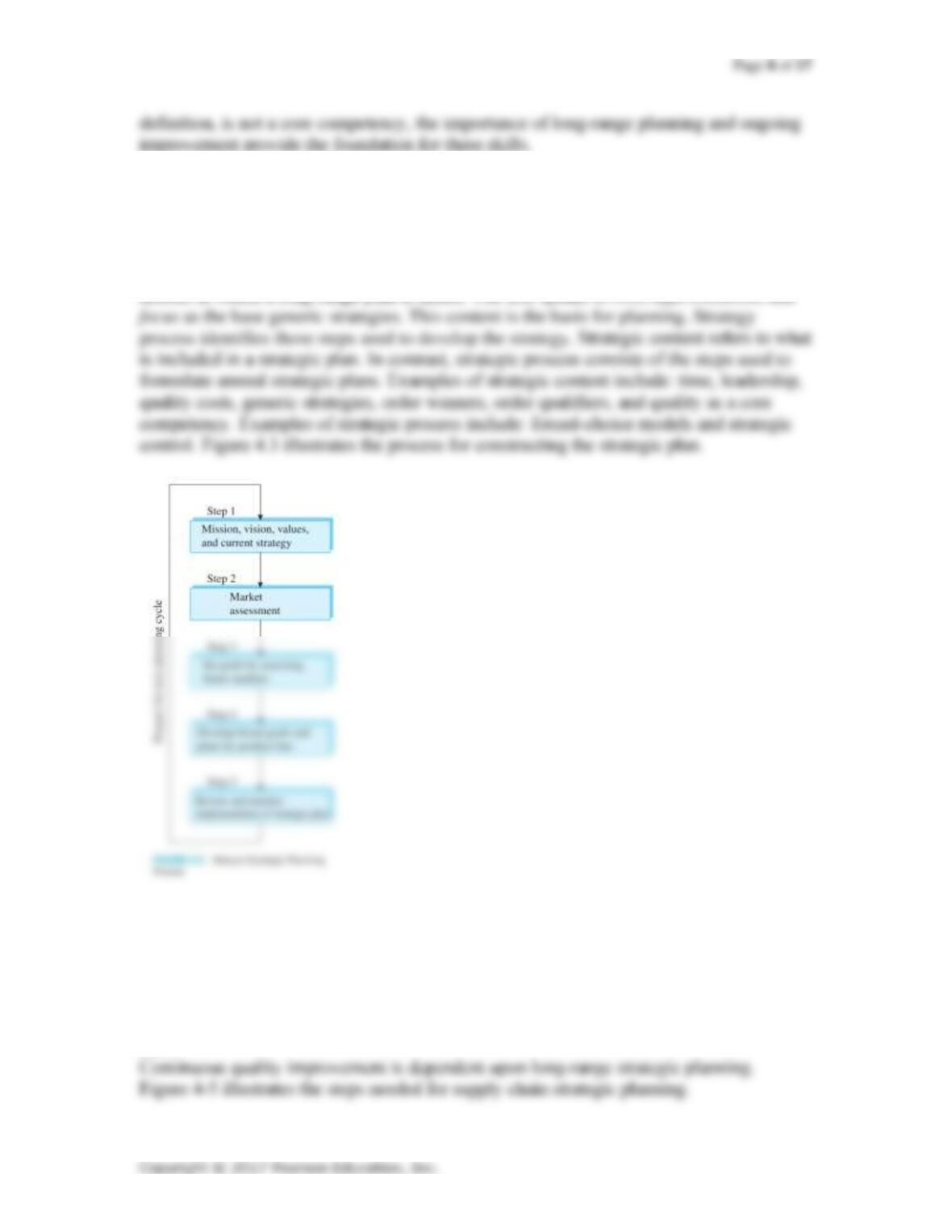
The forced-choice model, illustrated below in Figure 4-2, is an organized approach to
strategic planning. It provides a road map for effective long range planning. The process
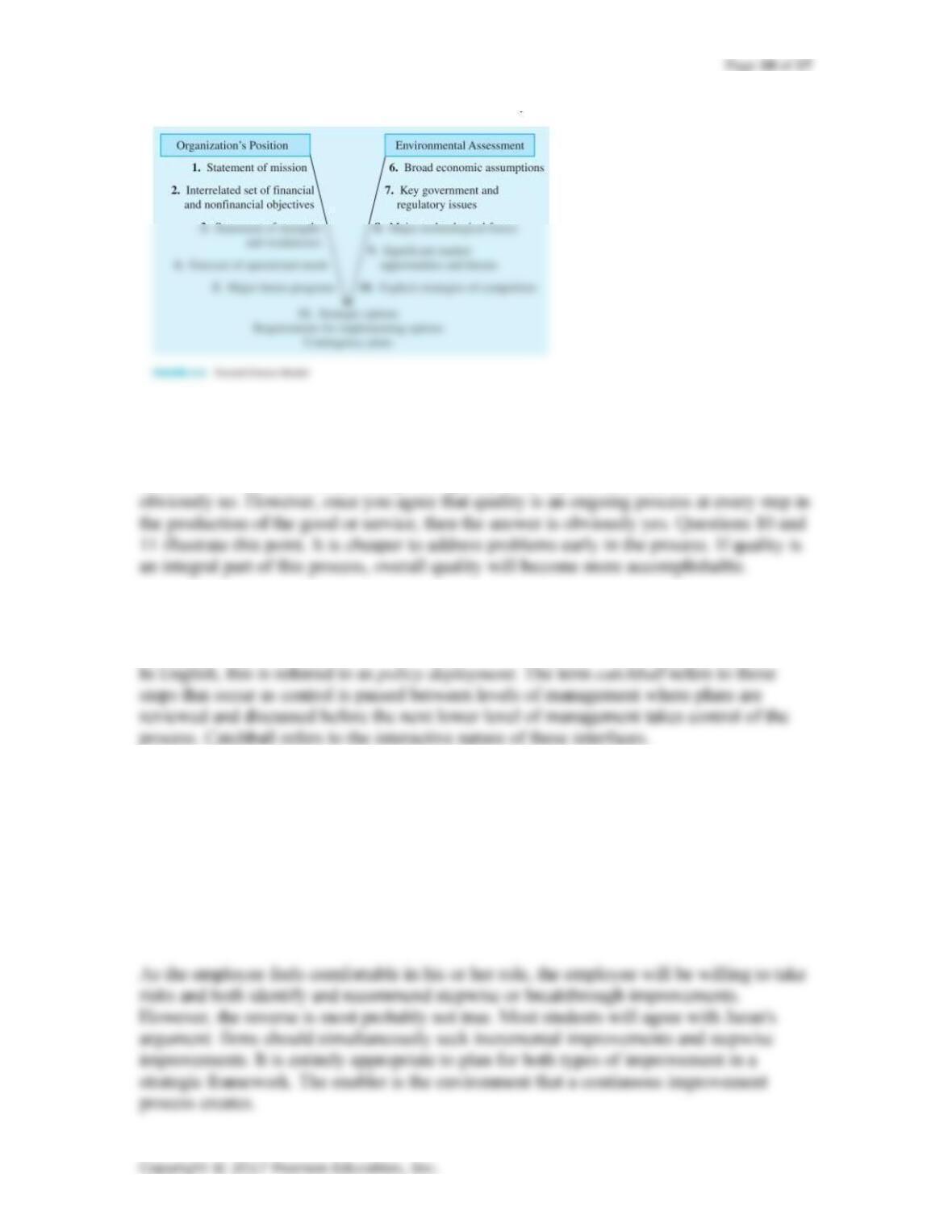
18. Should the strategic planning process consider quality concerns at every step of
the process? Why or why not?
If you follow the traditional concept that quality is an adjunct, then the answer is
19. Describe the concept of catchball.
Catchball is a process taken from the Japanese “Hoshin Kanri” school of management.
20. Juran argues that both incremental (continuous) improvements and stepwise
(breakthrough) improvements are needed in a strategic framework. Do you agree
with Juran’s assessment? Why or why not?
Actually, continuous and breakthrough improvements are somewhat different. The focus
of the book is an emphasis on continuous improvement. Continuous improvement implies
making quality an integral part of the entire process. As a side effect of this action, the
employee is empowered and will feel a part of the system.
Case 4-1: Ames Rubber Corporation: Realizing Multiple
Benefits through Improved Quality
1. In developing its Excellence through Quality program, Ames initially
benchmarked against Xerox. Is benchmarking against another company’s quality
program a good idea? What are the potential hazards and benefits involved?
In general, benchmarking is a good idea. It helps a firm emulate the practices of a
company that is very good at a particular activity (like quality), and as a result, helps a
2. Discuss the manner in which Ames implemented its Excellence through Quality
program. Did the company place its emphasis in the right areas? Please explain
your answer.
The company did an excellent job implementing its Excellence Through Quality
program. The emphasis of its initiatives seemed to be equally split on systems issues
3. Discuss the benefits that Ames Rubber achieved from its quality program. Are
these benefits more encompassing than you would have expected? Why or why not?
Most students will be impressed with what Ames Rubber has accomplished, and will
argue that the benefits have been more encompassing than they would have expected.
Case 4-2: MidwayUSA
1. How does MidwayUSA engage the customer in its focus on quality?
2. MidwayUSA has incorporated quality and customer focus into its culture. How
does MidwayUSA ensure employees support the culture? Also, how do employees
contribute to quality customer service?
By adopting the Baldrige Core Values and Concepts and making them an integral part of
the company’s culture, MidwayUSA has shown its employees that they are serious about
3. MidwayUSA wants to be the best-run company in America. Is this a useful vision
statement? Are there benefits to this vision Instead of being the best-run company in
the industry?
Although a very broad vision statement, MidwayUSA has set a goal to be the best and
has involved its workforce in helping them achieve this vision. The employees can
4. Effective quality and strategic planning are not a onetime event. In looking at
MidwayUSA and other companies, what can companies do to make these a
continual process?

Page 13 of 17
“You see, as a company grows, it’s important to formalize the planning, processes, systems, training and
communications; and to develop a great team of leaders throughout the organization. This is the hardest part of running
a business and they don’t teach it much in business school.
Page 14 of 17
Suggested Answers to End of Chapter Problems
1.
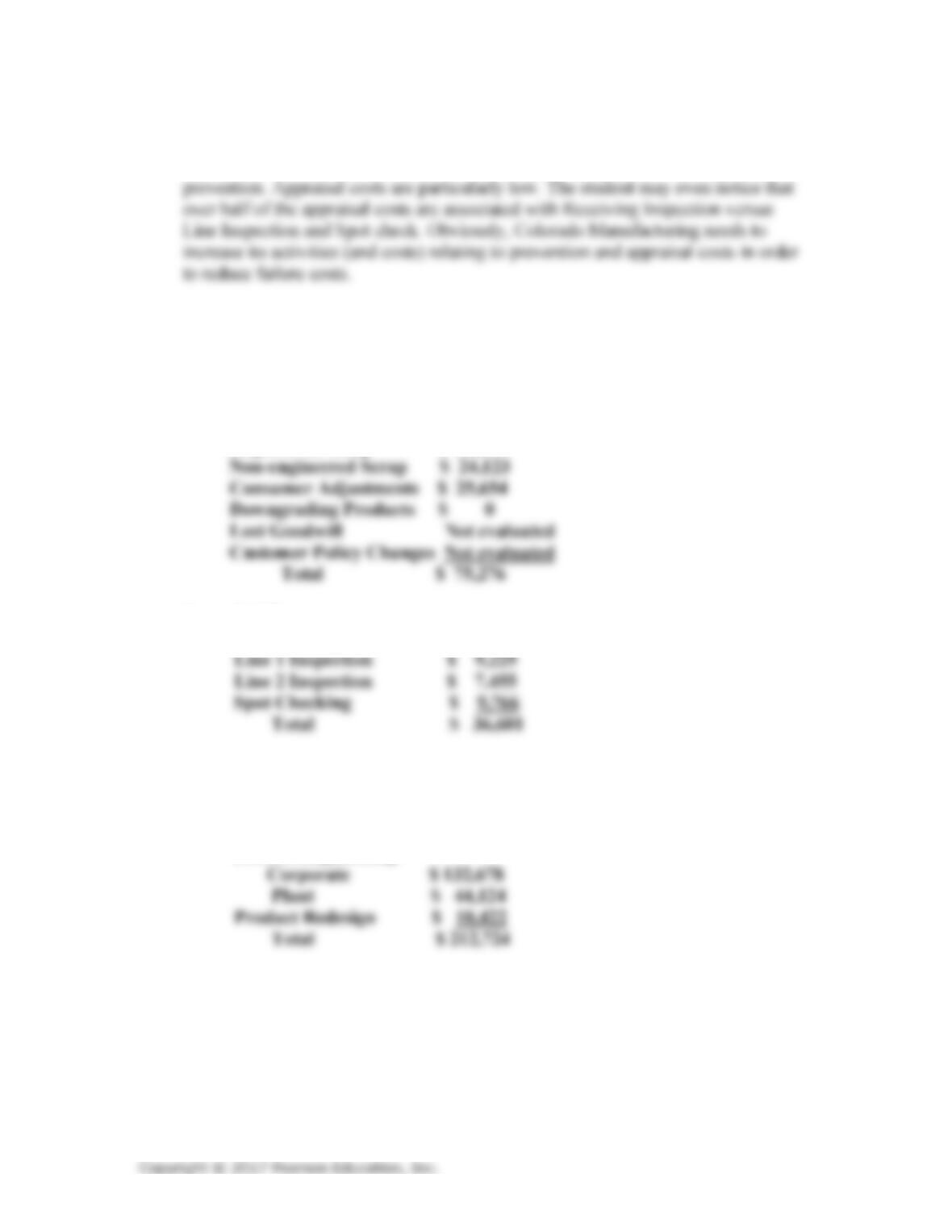
The Colorado Manufacturing Company of Boulder, CO has gathered the
following quality-related costs. You are hired as a consultant to evaluate these
costs and to make recommendations to management.
Annual Quality Costs
Downgrading Products $ 2,125,328
Lost Goodwill Not evaluated
Customer Policy Changes Not evaluated
Total $ 2,500,604
Failure Costs
Defective Products $ 4,234
Engineered Scrap $ 21,265
Total $ 42,703
Appraisal Costs
Receiving Inspection $ 24,138
Corporate $ 132,678
Plant $ 44,124
Product Redesign $ 10,422
Total $ 212,724
Prevention Costs
Quality Training $ 25,500
a.
Ratio of Prevention and Appraisal to Failure Cost = 255,427/2,500,604 = .102
Compute the ratio of prevention and appraisal costs to failure costs:
Ratio of Prevention to Failure Cost = 212,724 / 2,500,604 = .0851
Page 15 of 17
b.
What would you recommend that this company do?
This analysis indicates that failure costs are high as compared to both appraisal and
2.
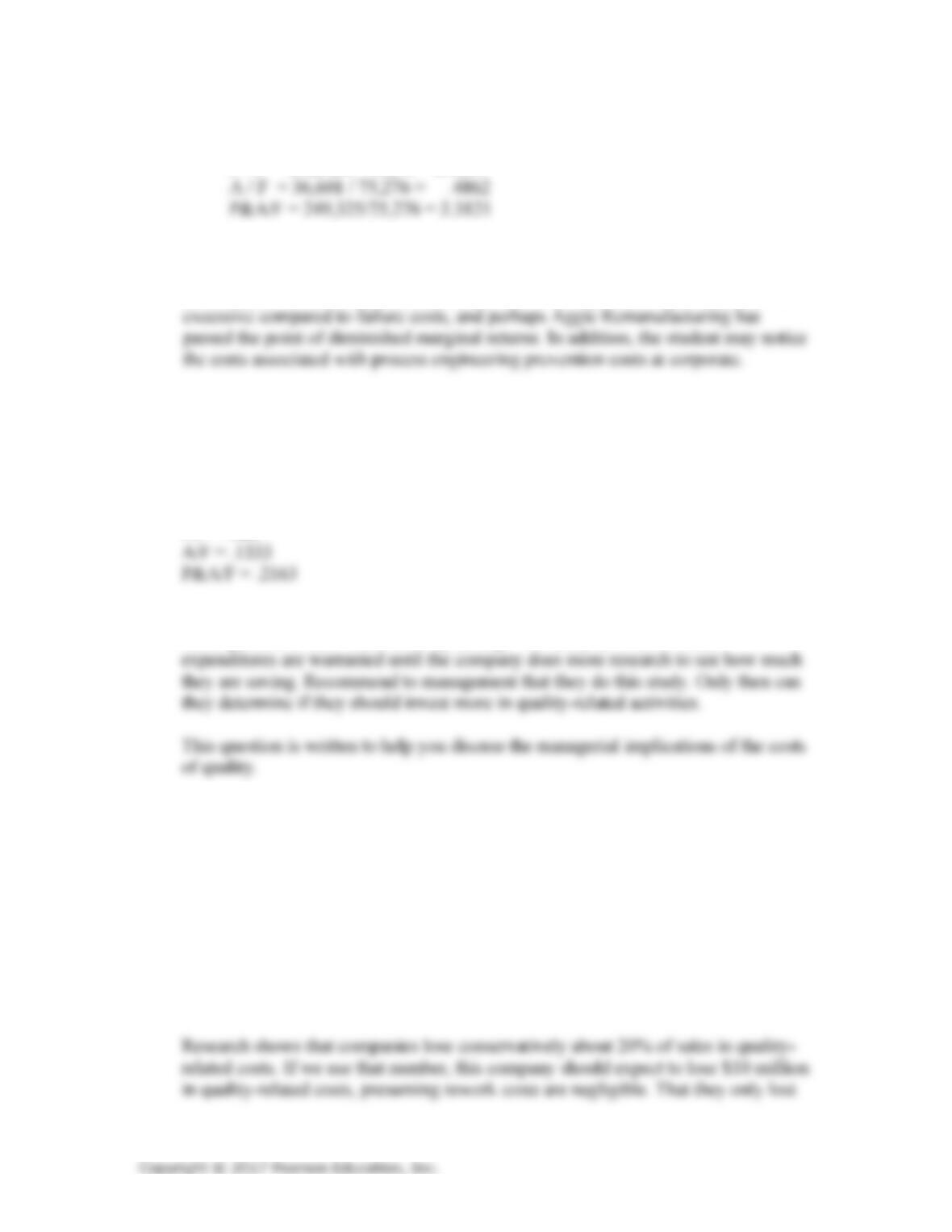
The Aggie Remanufacturing Company of College Station, TX has gathered the
Following quality-related costs data:
Annual Quality Costs
Customer Policy Changes Not evaluated
Total $ 75,276
Failure Costs
Defective Products $ 4,234
Engineered Scrap $ 21,265
Spot Checking $ 9,766
Total $ 36,601
Appraisal Costs
Receiving Inspection $ 10,155
Product Redesign $ 10,422
Total $ 212,724
Prevention Costs
Quality Training $ 25,500
Process Engineering
Page 16 of 17
a.
Compute the ratio of prevention and appraisal costs to failure costs.
P / F = 212,724 / 75,276 = 2.8259
b.
the costs associated with process engineering prevention costs at corporate.
What would you recommend that this company do?
As compared to the Lundvall Juran model, the cost of prevention and appraisal are
3. The Gorilla Manufacturing Company of Pittsburgh, Kansas recently studied its
expenditures and losses relative to quality for the month of October. They
found that they had lost $300,000 in scrap and rework. They had spent $40,000
for inspection and $25,000 in prevention-related activities. Evaluate their cost
ratios and suggest whether or not the expenditures are warranted.
P/F = .083
They are spending $65,000 and are still incurring $300,000 in loss. This brings up
more questions. How much are they saving? We really can’t tell if these
4. The Buffalo Machine Works of Boulder, CO was evaluating its cost structure
relating to quality costs. In the prior year, the company had lost $500,000 in
warrantee and scrap. They didn’t have good numbers for rework costs. In the
prior year, they had spent $100,000 training employees in quality tools and
$200,000 for quality assurance personnel. Inspection costs were 2% of sales of
$50,000,000. Evaluate these costs and recommend what actions should be
taken to upper management.
This question is designed to allow you to discuss managerial issues relative to the
cost of quality.