Chapter 04 – Global Management: Managing Across Borders
4-21
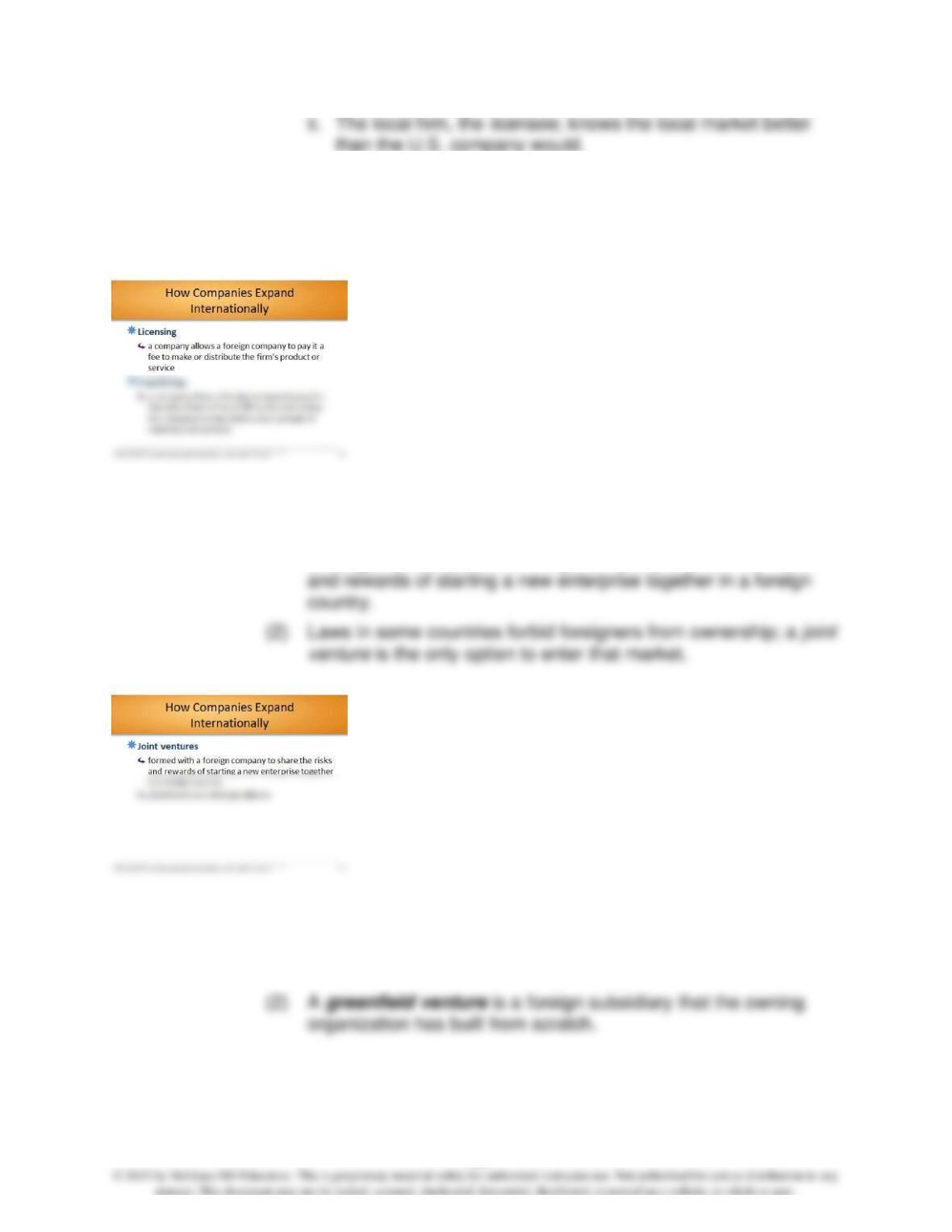
(2) Franchising is a form of licensing in which a company allows a
foreign company to pay it a fee and share of the profit in return
for using the first company’s brand name and a package of
materials and services.
d. Joint ventures
(1) A U.S. firm may form a joint venture, also known as a
strategic alliance, with a foreign company to share the risks
e. Wholly-owned subsidiaries
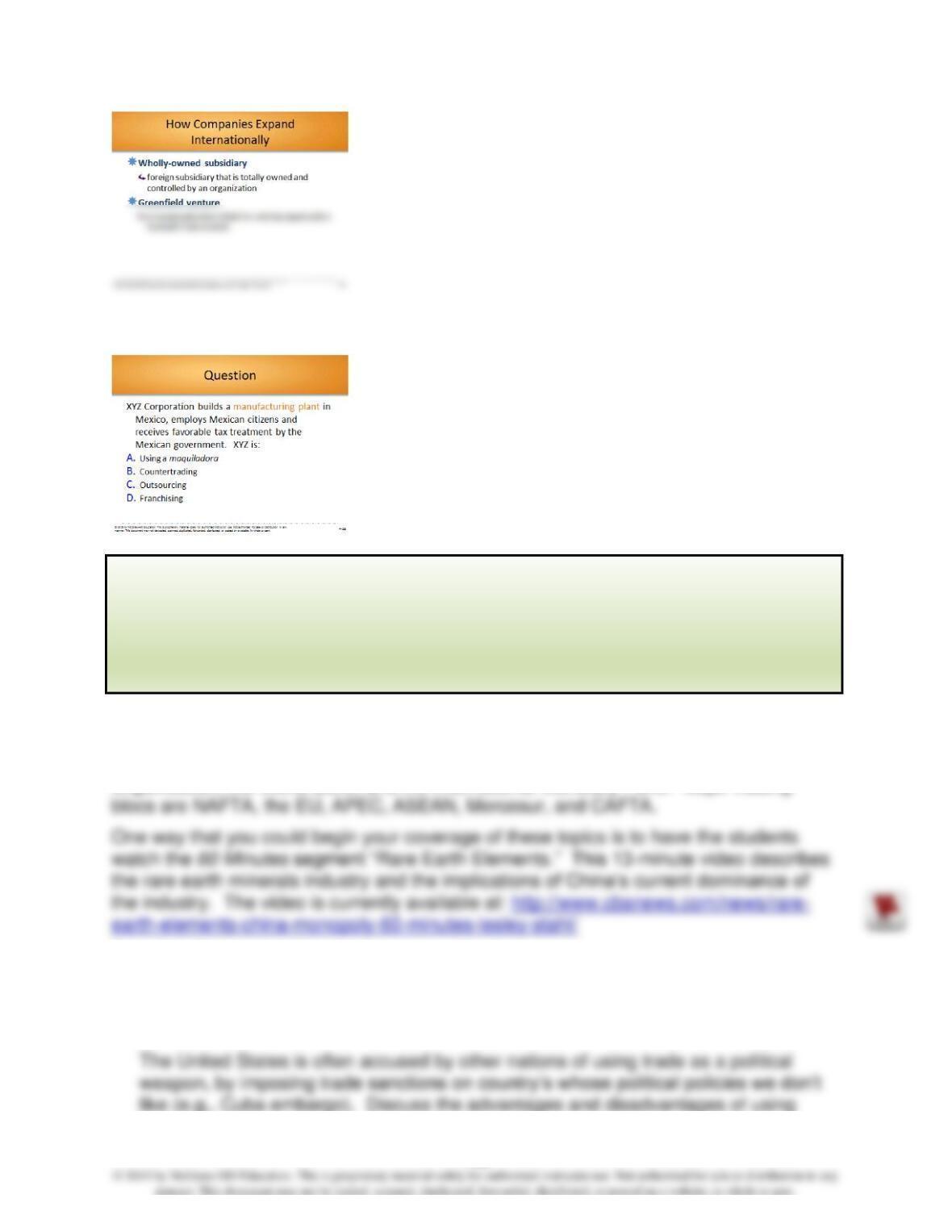
(1) A wholly-owned subsidiary is a foreign subsidiary that is
totally owned and controlled by an organization.
Chapter 04 – Global Management: Managing Across Borders
4-22
(Correct answer is A)
Section 4.4 discusses barriers to free trade, which include tariffs, import quotas, and
embargoes. Organizations promoting international trade are the World Trade
Organization, the World Bank, and the International Monetary Fund. Major trading
Possible Topics for Discussion:
The United States has imposed tariffs on solar panels imported from China. Discuss
the advantages and disadvantage of using these tariffs to respond to the competitive
threat from China.
4.4 The World of Free Trade: Regional Economic
Cooperation (pp. 115–120)
What are barriers to free trade, and what major organizations and trading
blocs promote trade?
Chapter 04 – Global Management: Managing Across Borders
4-23
Major Idea Outline:
A. Free trade is the movement of goods and services among nations without
political or economic obstruction.
B. Barriers to International Trade
1. Countries often use trade protection – the use of government regulations
2. There are three devices by which countries exert protectionism:
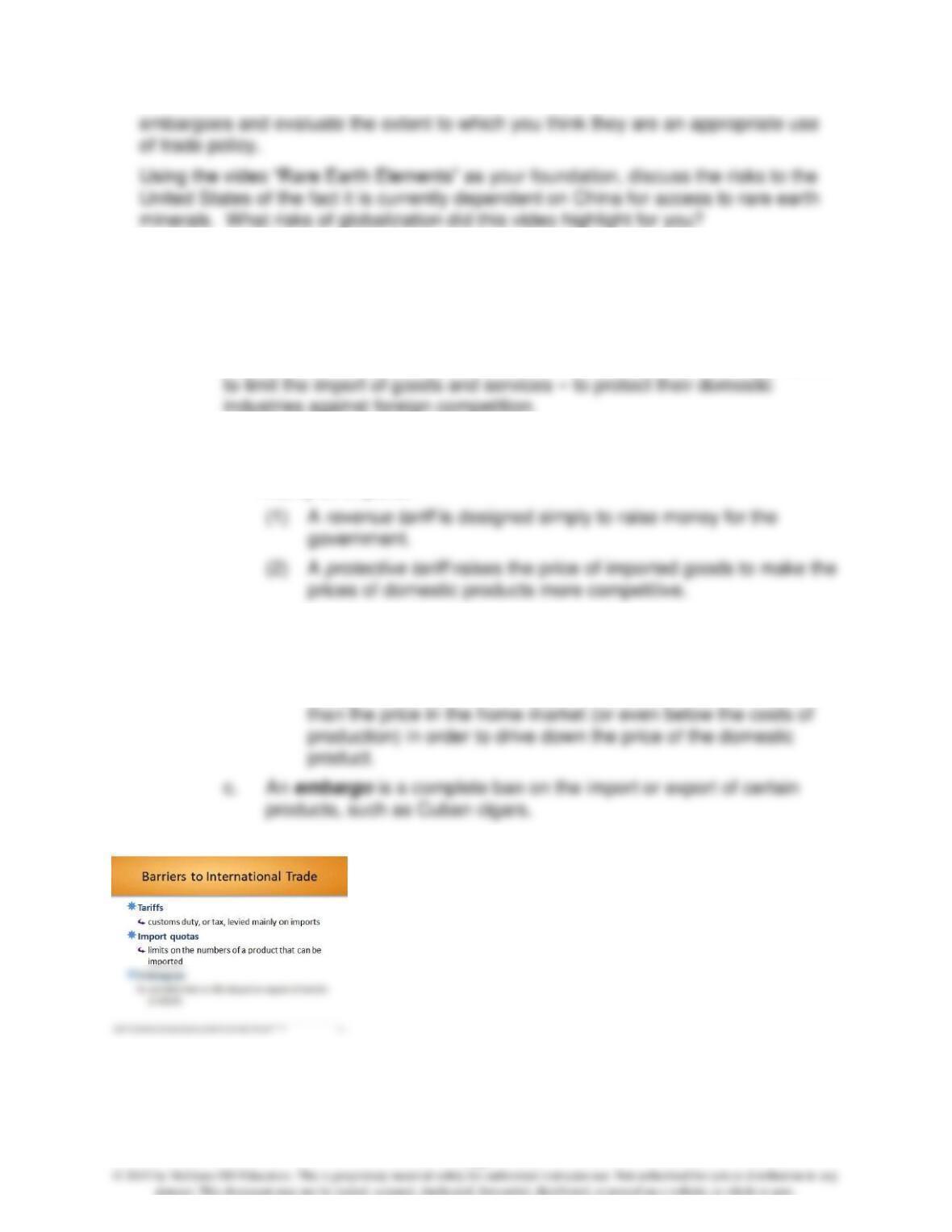
a. Tariffs – a trade barrier in the form of a customs duty or tax levied
mainly on imports.
b. An import quota is a trade barrier in the form of a limit on the
number of a product that can be imported.
(1) Quotas are designed to prevent dumping, the practice of a
foreign company’s exporting products abroad at a lower price
C. Organizations Promoting International Trade
1. Three principal organizations are designed to facilitate international trade:
Chapter 04 – Global Management: Managing Across Borders
4-24
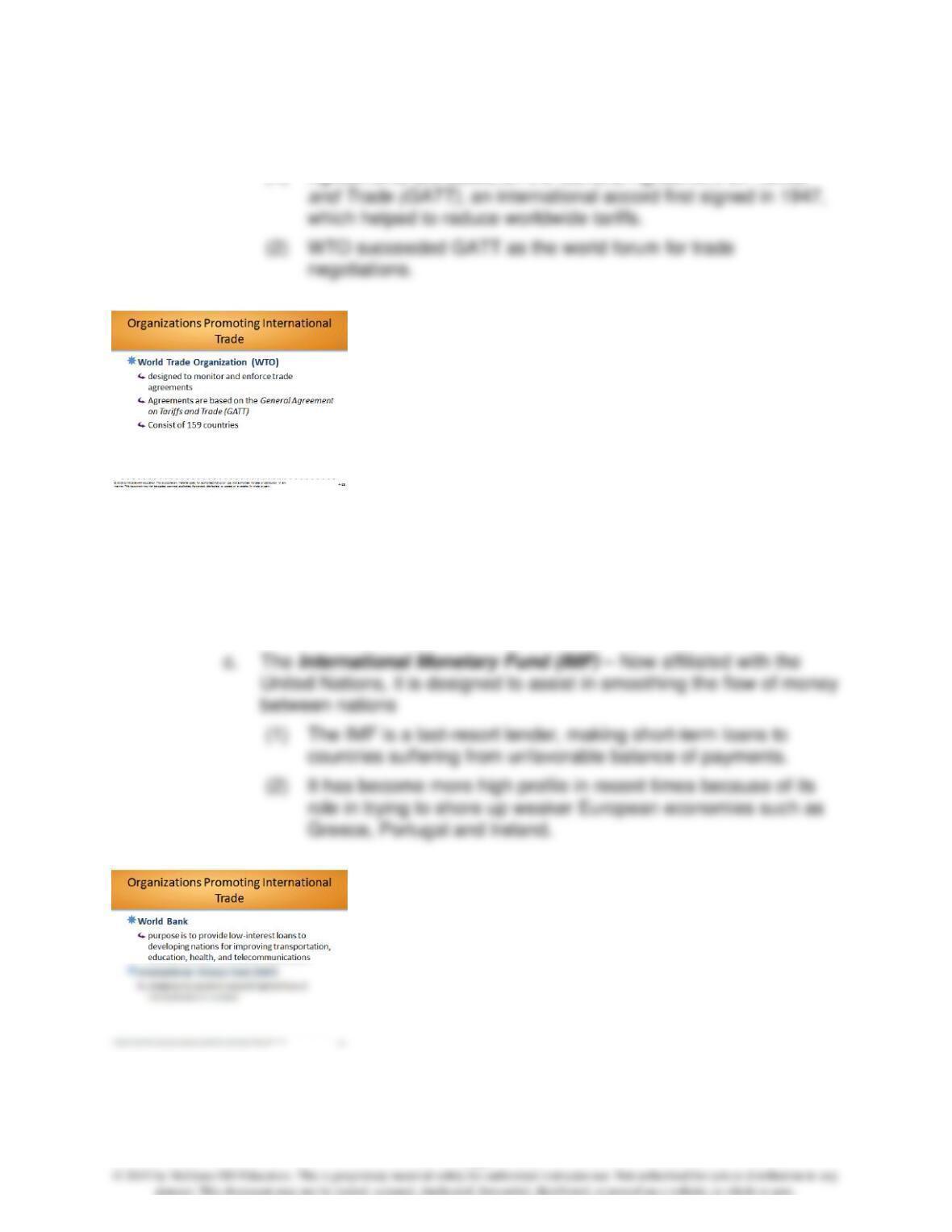
a. World Trade Organization (WTO) – 159 member organization
designed to monitor and enforce trade agreements
(1) Agreements are based on the General Agreement on Tariffs
b. The World Bank – 188 member organization whose purpose is to
provide low-interest loans to developing nations for improving
transportation, education, health and telecommunications
(1) Critics believe it finances projects that damage the ecosystem
and supports countries that permit low-paying sweatshops
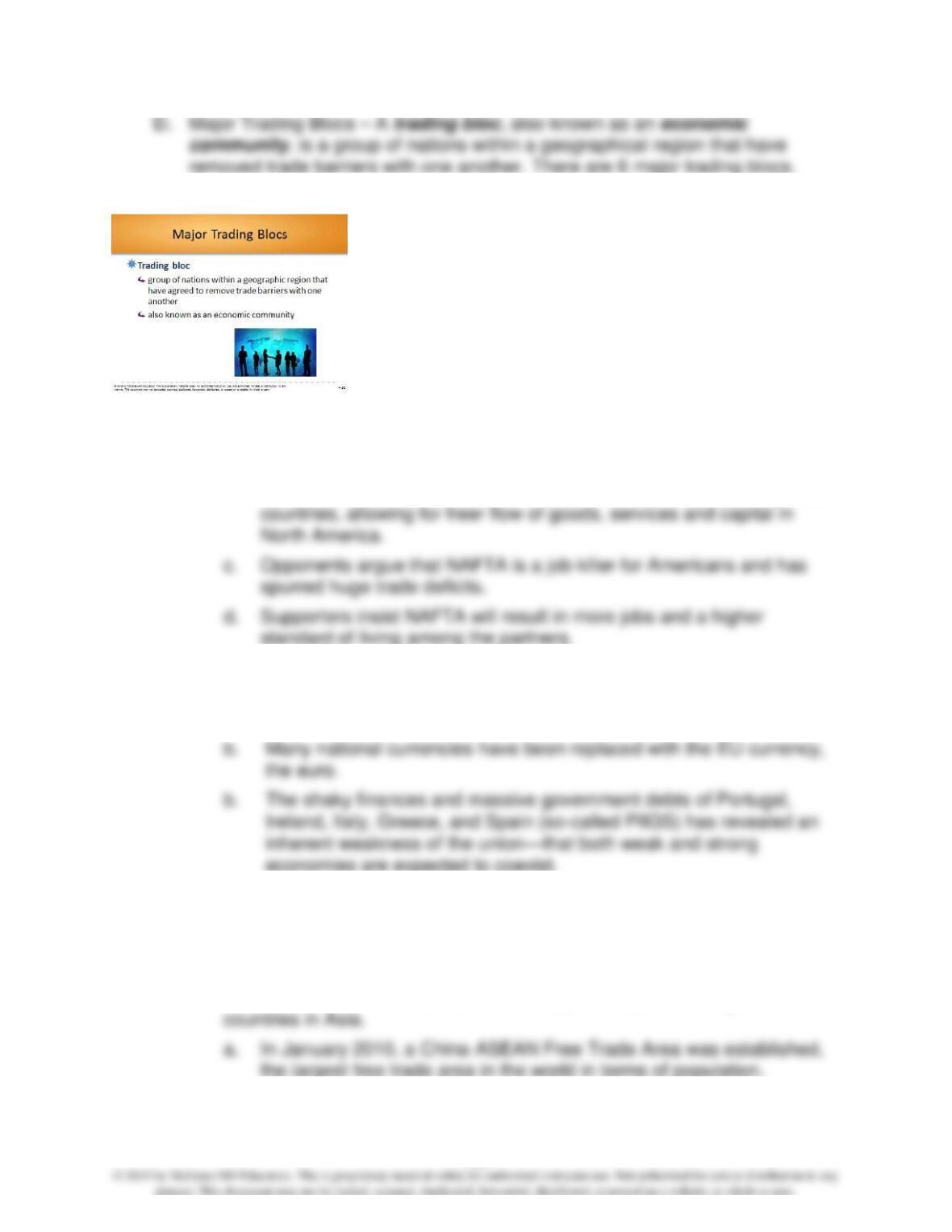
Chapter 04 – Global Management: Managing Across Borders
4-25
1. The North American Free Trade Agreement (NAFTA) – a trading bloc
consisting of the U.S., Canada and Mexico, formed in 1994
b. It is supposed to eliminate 99% of the tariffs and quotas among these
2. The European Union (EU) – a trading bloc consisting of 28 countries in
Europe
a. Nearly all internal trade barriers have been eliminated.
3. The Asia-Pacific Economic Cooperation (APEC) – 21 Pacific-Rim
countries whose purpose is to improve economic and political ties
b. APEC is working to reduce tariffs and other trade barriers across the
Pacific region.
4. The Association of Southeast Nations (ASEAN) – a trading bloc of 10
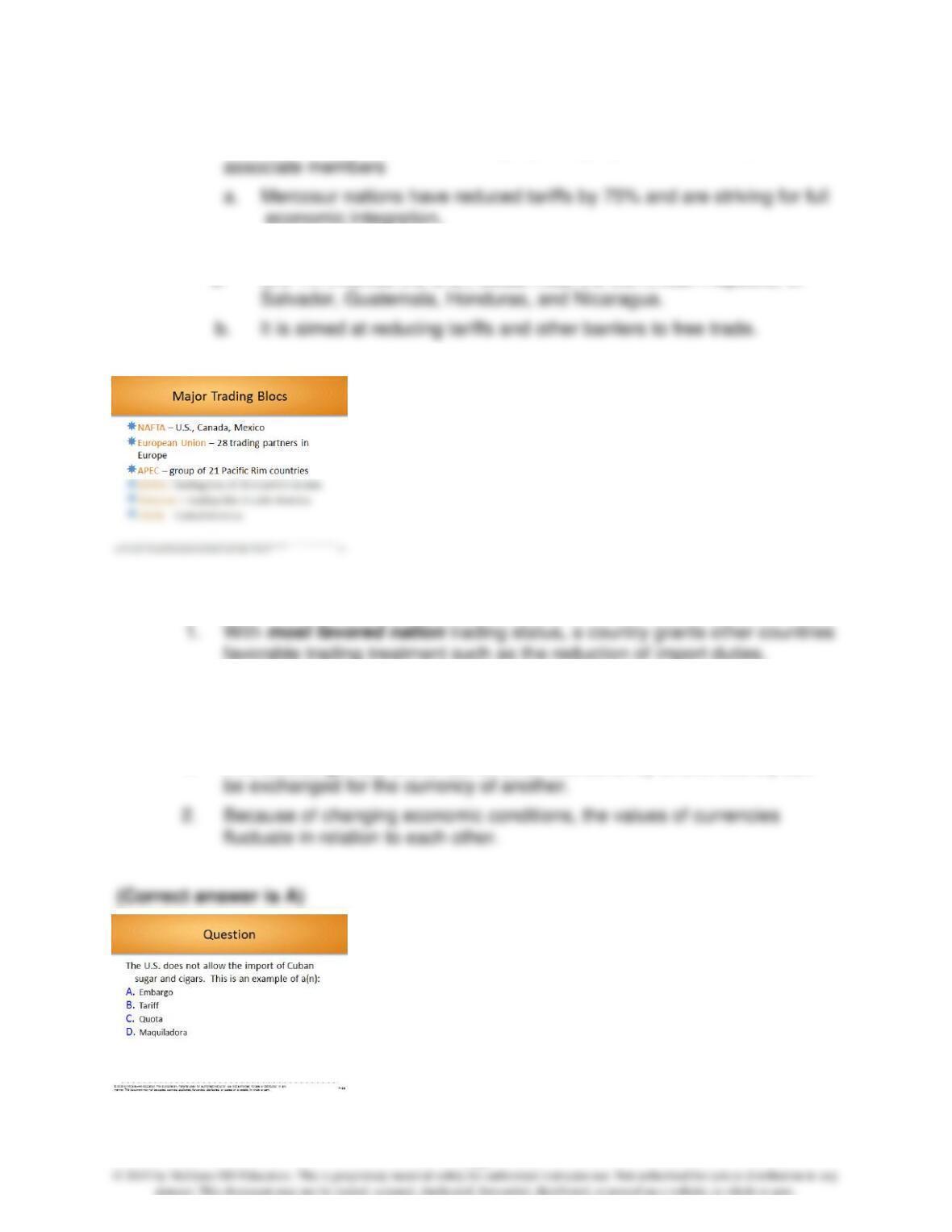
Chapter 04 – Global Management: Managing Across Borders
4-26
5. The Mercosur – the largest trade bloc in Latin America with 5 core
members (Argentina, Brazil, Paraguay, Uruguay and Venezuela) and 7
6. CAFTA-DR – The Central America Free Trade Agreement
a. CAFTA involves the U.S., Costa Rica, the Dominican Republic, El
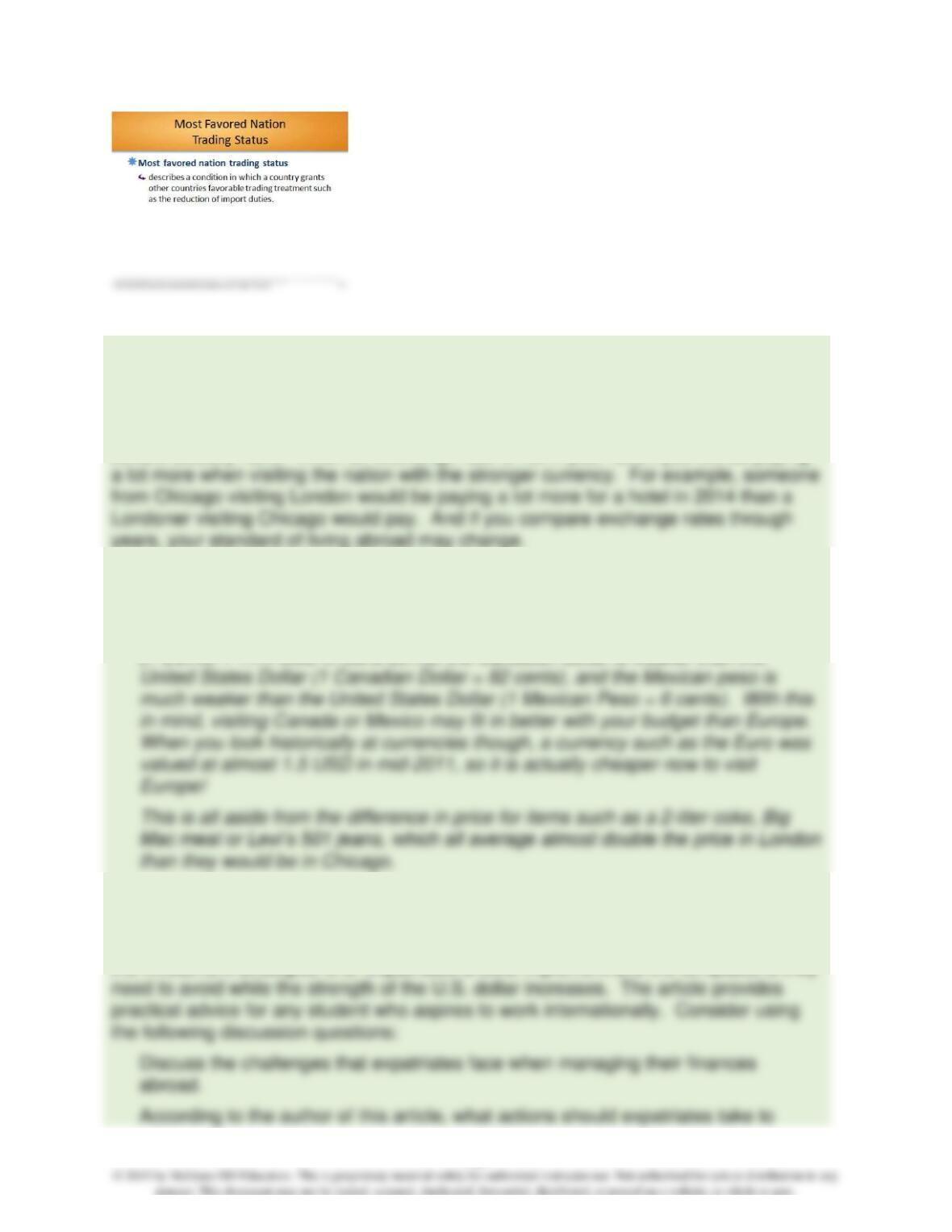
E. Most Favored Nation Trading Status
2. The purpose is to promote stronger and more stable ties between the
countries.
E. Exchange Rates
1. The exchange rate is the rate at which the currency of one country can
Chapter 04 – Global Management: Managing Across Borders
4-27
Interactive Classroom Material:
EXAMPLE: An American in London Dealing with Currency Exchange—How
Much Are Those Jeans, Really? (p. 120)
It’s important to understand how exchange rates work and what value your U.S.
dollars actually have. When an exchange rate is not in your favor, you will be paying
YOUR CALL
Could you afford to go?
Based on 2015 valuations, the Euro is a bit stronger than the United States Dollar
(1 EURO = 1.14 USD in June 2015), the Canadian dollar is weaker than the
Additional Activities:
One way to build on this Example is to have the students read the Wall Street Journal
article “What the Dollar’s Strength Means for Expats.” This article discusses some of
the investment strategies U.S. expatriates should implement and the temptations they
Chapter 04 – Global Management: Managing Across Borders
4-28
effectively deal with the current value of the U.S. dollar?
One of the most difficult aspects for a firm sending a manager to an international
location to work is developing an effective compensation package. Discuss
Section 4.5 describes the importance of national culture and cultural dimensions. Basic
cultural perceptions are embodied in language, interpersonal space, communication,
time orientation, religion, and law and political stability.
One way that you could begin your coverage of these topics is to have the students
read the Industrial Management article “Managing across Cultures.” The article
provides three scenarios that can be used for an in-class discussion of cultural
differences that impact management style. The scenarios focus on differences in views
of leaders, communication styles and perceptions of time.
Possible Topics for Discussion:
Describe the nine cultural dimensions of the GLOBE project and give an example of
how each dimension may impact management practices.
Major Idea Outline:
4.5 The Importance of Understanding Cultural Differences
(pp. 121-128)
What are the principal areas of cultural differences?
Chapter 04 – Global Management: Managing Across Borders
4-29
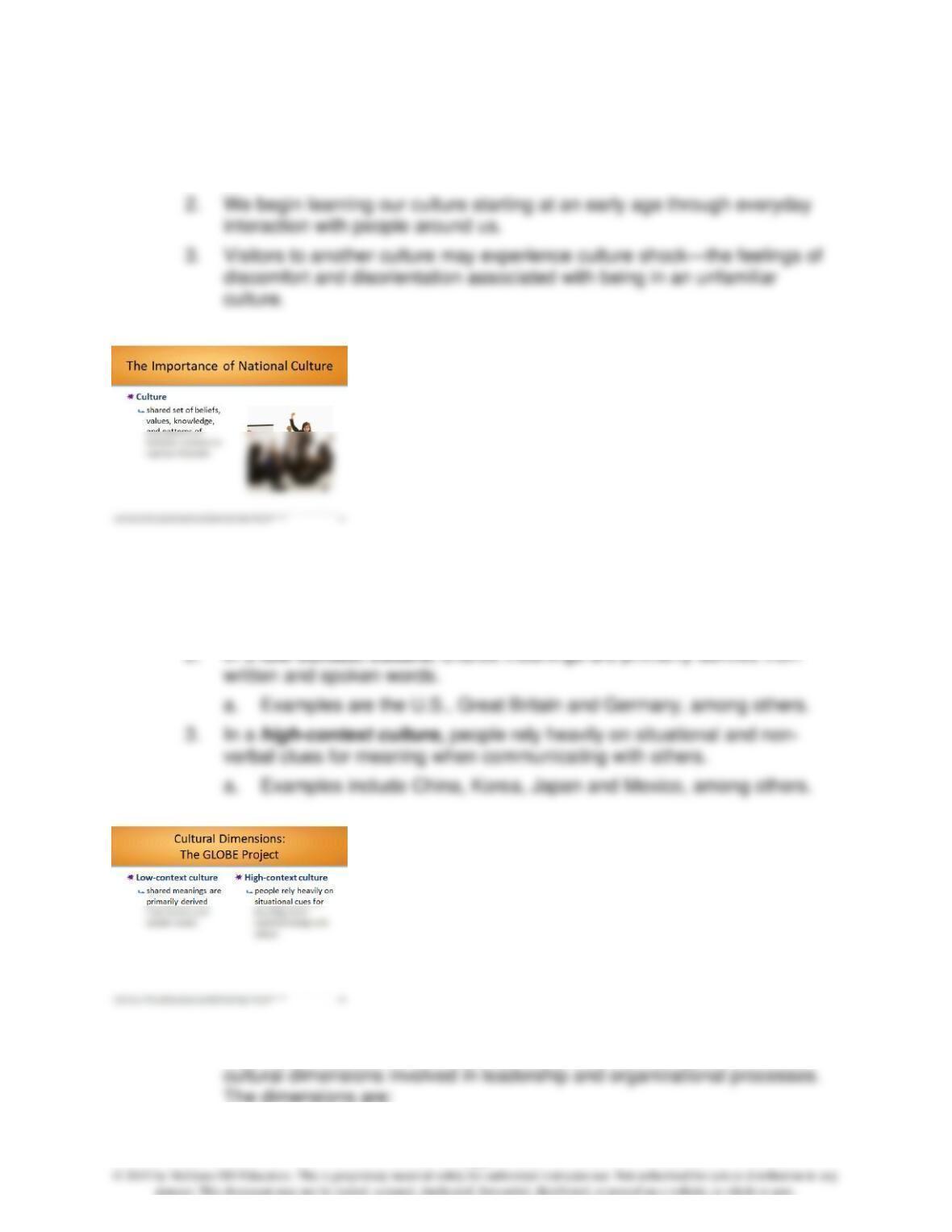
A. The Importance of National Culture
1. A nation’s culture is the shared set of beliefs, values, knowledge, and
patterns of behavior common to a group of people.
B. Cultural Dimensions: The GLOBE Project
1. Misunderstandings often arise in international business relationships
because people don’t understand the expectations of the other side.
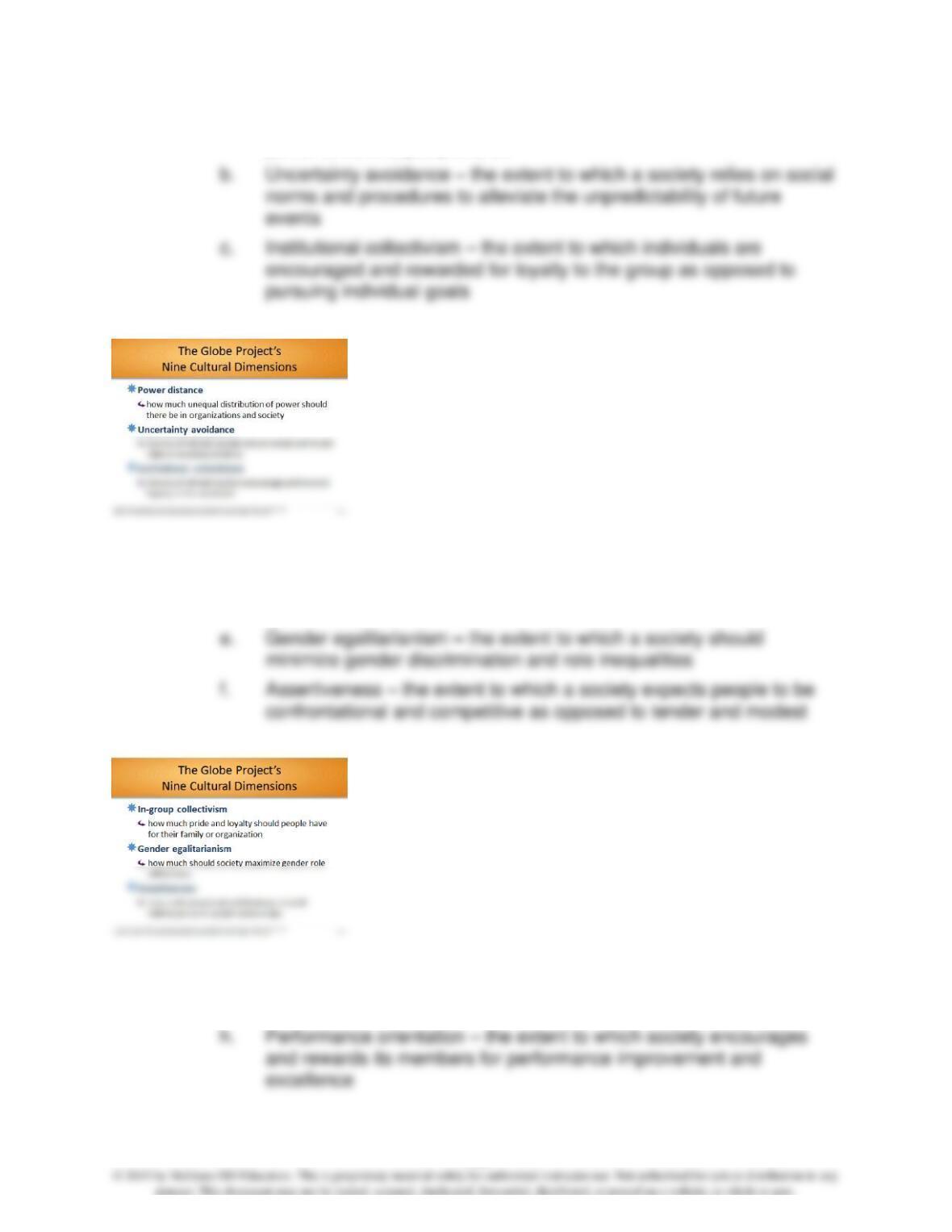
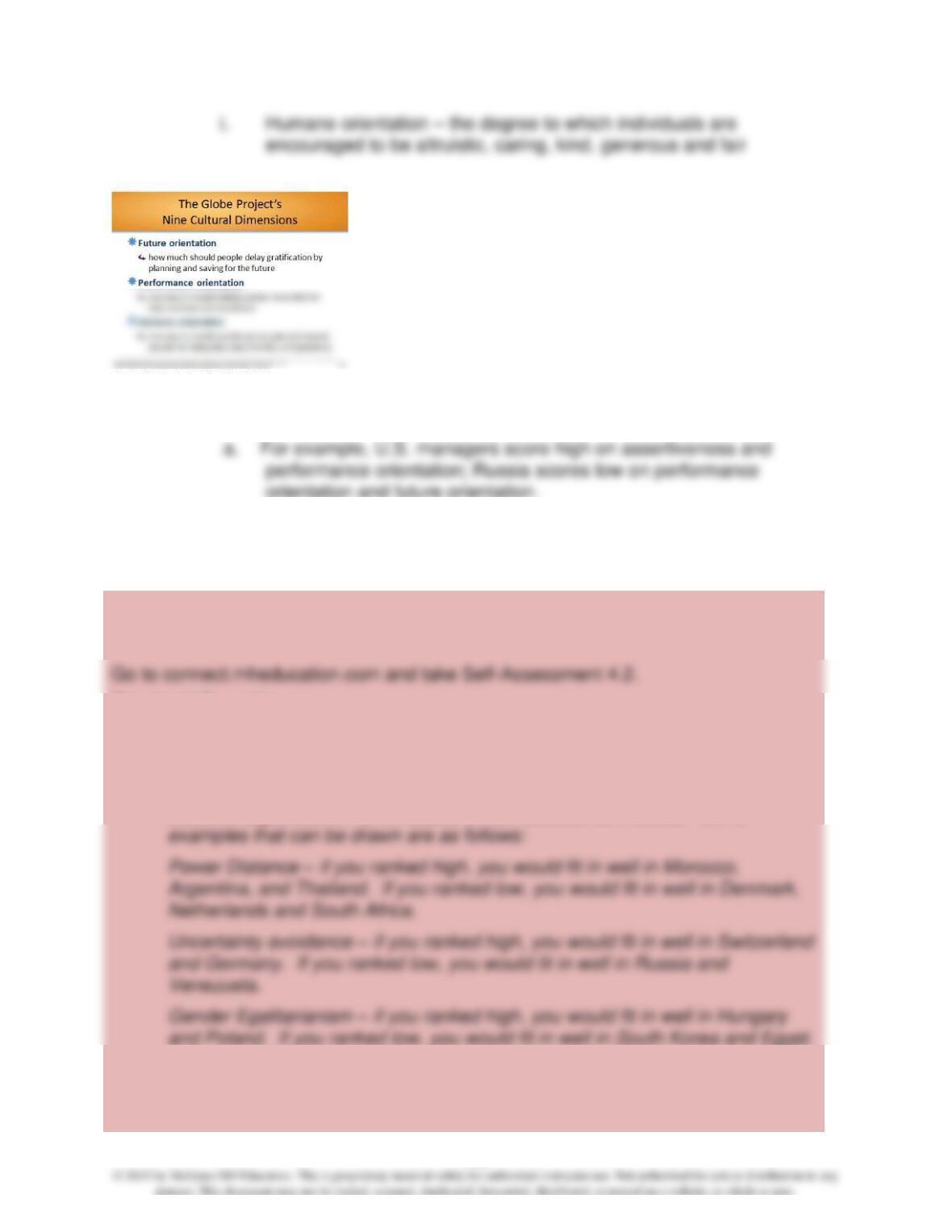
4. The GLOBE project is an ongoing cross-cultural investigation of nine
Chapter 04 – Global Management: Managing Across Borders
4-30
a. Power distance – the degree to which a society’s members expect
power to be unequally shared
d. In-group collectivism – the extent to which people should take pride
in being members of their family, circle of close friends, and work
organization
g. Future orientation – the extent to which a society encourages
investment in the future, as by planning and saving
Chapter 04 – Global Management: Managing Across Borders
4-31
5. The GLOBE dimensions show how cultural patterns vary.
6. Knowing how the cultural tendencies of foreign business partners and
competitors can give you a strategic competitive advantage.
SELF-ASSESSMENT 4.2 (p. 124)
Assessing Your Consumer Ethnocentrism
Student Questions:
1. What are your three highest and lowest rated dimensions? How might these
beliefs affect your ability to work with people from Europe, Asia, and South
America?
Student responses will differ based on self-assessment results. Some
2. How do your dimensional scores compare to the norms for Americans shown
in Table 4.4?
Some examples are provided above. Further examples are shown in the
Chapter 04 – Global Management: Managing Across Borders
4-32
Additional Activities:
You can also consult the Connect Instructors Manual for the post-assessment activity
and corresponding PowerPoint slides used for this Self-Assessment in Connect. In
this activity, students should be assigned to groups based on their Self-Assessment
C. Other Cultural Variations: Language, Interpersonal Space, Time Orientation,
and Religion
1. There are variations in five basic culture areas, but these are tendencies,
not absolutes:
a. Language – There are more than 3,000 different languages spoken
throughout the world, and you have 4 options in communicating:
(1) Speak your own language
b. Interpersonal space – how close or far away one should be when
communicating with another person.
(1) North Americans and Europeans conduct business conversations
c. Communication – The key to doing business in different cultures is to
remember that you don’t know what you don’t know.
d. Time orientation – There are two different time orientations:
(1) Monochronic time – a preference for doing one thing at a time
Chapter 04 – Global Management: Managing Across Borders
4-33
(2) Polychronic time – a preference for doing more than one thing at
a time
e. Religion – There are wide variations in work-related values for different
religious affiliations.
(1) Examples: Among Catholics, the primary work-related value was
for Buddhists, social responsibility.
f. Law & political stability – Firms operating abroad must deal with other
countries’ laws and business practices and make calculations about
political risk.
(1) Firms must anticipate risks for political instability, expropriation
Interactive Classroom Material:
EXAMPLE: Dinner at 10? Spain’s Cultural Differences in Time (p. 126)
Spaniards generally start work at 9, pause for a late-morning snack (which cuts into
work productivity), then quit for lunch around 2 or 2:30 to take a siesta break—
although fewer and fewer people actually take naps. They then return to work around
4 or so and work well into the evening. Most workplaces close at 9. Every culture
has its own tempo and Spain seems to be on “event time.”
YOUR CALL
Where does Spain fit in here in terms of tempo? If you were starting a business
in Spain that depended on close interaction with nearby European countries
Chapter 04 – Global Management: Managing Across Borders
4-34
observing different business times, how would you ask your Spanish staff to
adjust?
Spain is running on “event time” instead of “clock time.” Their work times are not
Additional Activities:
One way to build on this Example is to have the students read the FT.com article
“Seoul’s City Officials Encouraged to Take Siestas.” This article profiles some of the
cultural barriers to a plan in South Korea to minimize the impact of long-work hours.
You can also use the article as a way to discuss differences in work hours and
Article Citation:
Jung-a, S. (2014). Seoul’s city officials encouraged to take siestas. FT.Com.
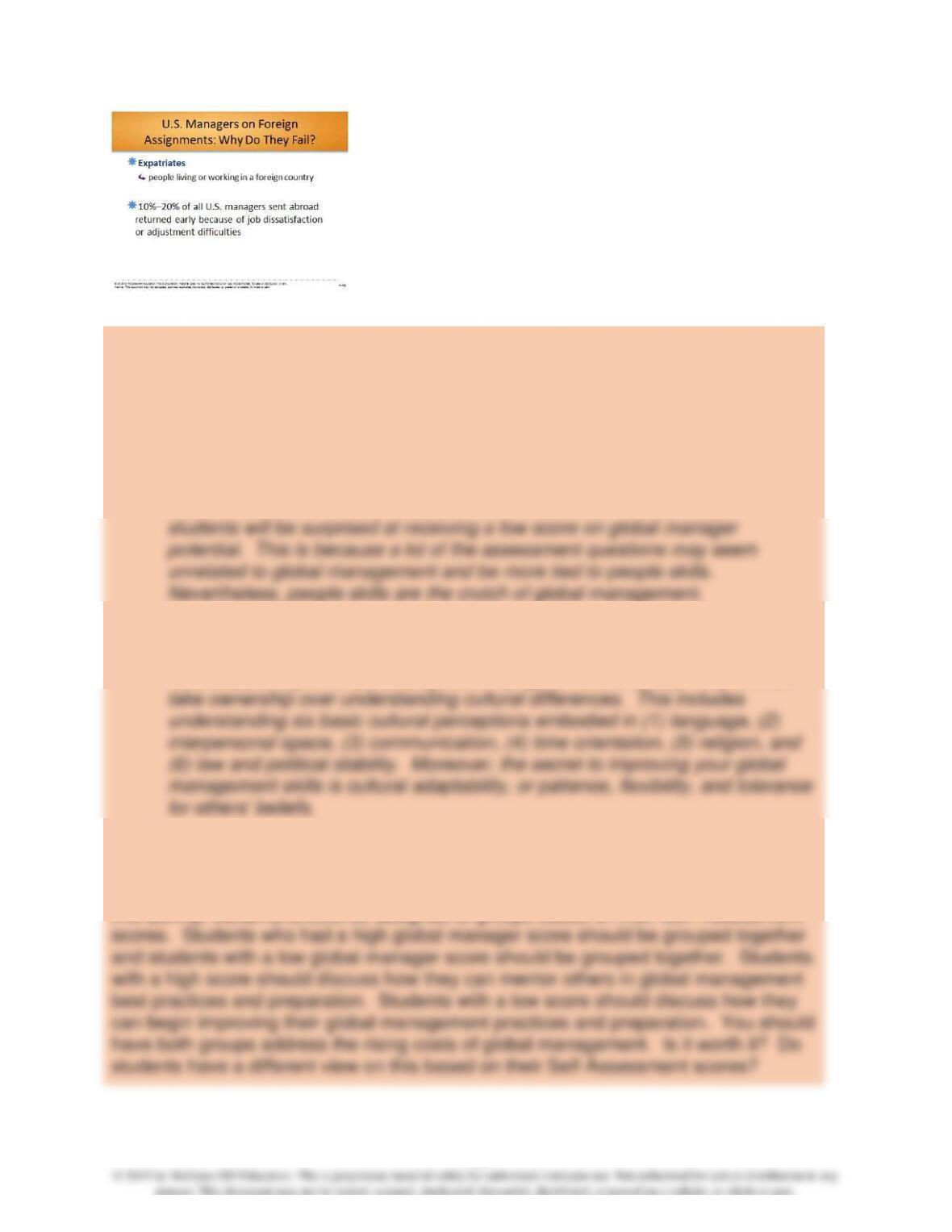
5. U.S. Managers on Foreign Assignments: Why do They Fail?
a. There are between 2.2 and 6.8 million Americans who are living or
working in a foreign country – known as expatriates
Chapter 04 – Global Management: Managing Across Borders
4-35
SELF-ASSESSMENT 4.3 (p. 128)
Assessing Your Global Manager Potential
Go to connect.mheducation.com and take Self-Assessment 4.3.
Student Questions:
1. What is your reaction to the results?
Student reactions will differ based on their assessment results. Some
2. Based on considering your five lowest-rated survey items, what can you do to
improve your global manager potential?
Notwithstanding what students got low ratings on in the survey, they should
Additional Activities:
You can also consult the Connect Instructors Manual for the post-assessment activity
and corresponding PowerPoint slides used for this Self-Assessment in Connect. In
this activity, students should be assigned to groups based on their Self-Assessment
Chapter 04 – Global Management: Managing Across Borders
Group Exercise: When in Rome, Do as the Romans Do!
There is a group exercise available at the end of this manual that applies international
management principles.
Exercise Objectives