4-1
Management Information Systems, 13E, Global Editions
Laudon & Laudon
Lecture Files by Barbara J. Ellestad
Chapter 4 Ethical and Social Issues in Information Systems
It probably goes without saying that the security and ethical issues raised by the
Information Age, and specifically the Internet, are the most explosive to face our society
in decades. It will be many years and many court battles before socially acceptable
policies and practices are in place.
4.1 Understanding Ethical and Social Issues Related to Systems
You may love the idea that a gardening Web site or a mail order catalog gives you
information about what grows best in your backyard (literally your backyard). You might
4-2
A lot of personal information about us has always been available, just not as easily and as
readily as today. Massive databases maintained by commercial companies and
governments at all levels now allow profiling like that above to be accomplished easier
and faster than ever before.
“The information that companies gather is anonymous, in the sense that
Internet users are identified by a number assigned to their computer, not
A Model For Thinking About Ethical, Social, and Political Issues
Many of these issues not only touch our society as a whole, but also raise lots of
questions for organizations, companies, and the workplace in general. We hear arguments
for free speech, personal responsibility, and corporate responsibility. There are
discussions about the government’s role in all this. At the beginning of Chapter 4,
4-3
of the development of “acceptable usage” of this new medium and will help define the
direction in which it goes.
Figure 4.1: The Relationship between Ethical, Social, and Political Issues in An
Information Society
Figure 4-1 shows the relationship between ethical, social, and political issues in an
information society. You could change this diagram somewhat to avoid the impression
that the five dimensions are separate. You’d show significant overlap of each area, and
most of the diagram would be in shades of gray.
Five Moral Dimensions of the Information Age
The five dimensions we’ll discuss are: information rights and obligations, property
Key Technology Trends that Raise Ethical Issues
Information technologies pose problems and threats to established societal rules, and
technological advances pose new situations and possible threats to privacy and ethics.
4-4
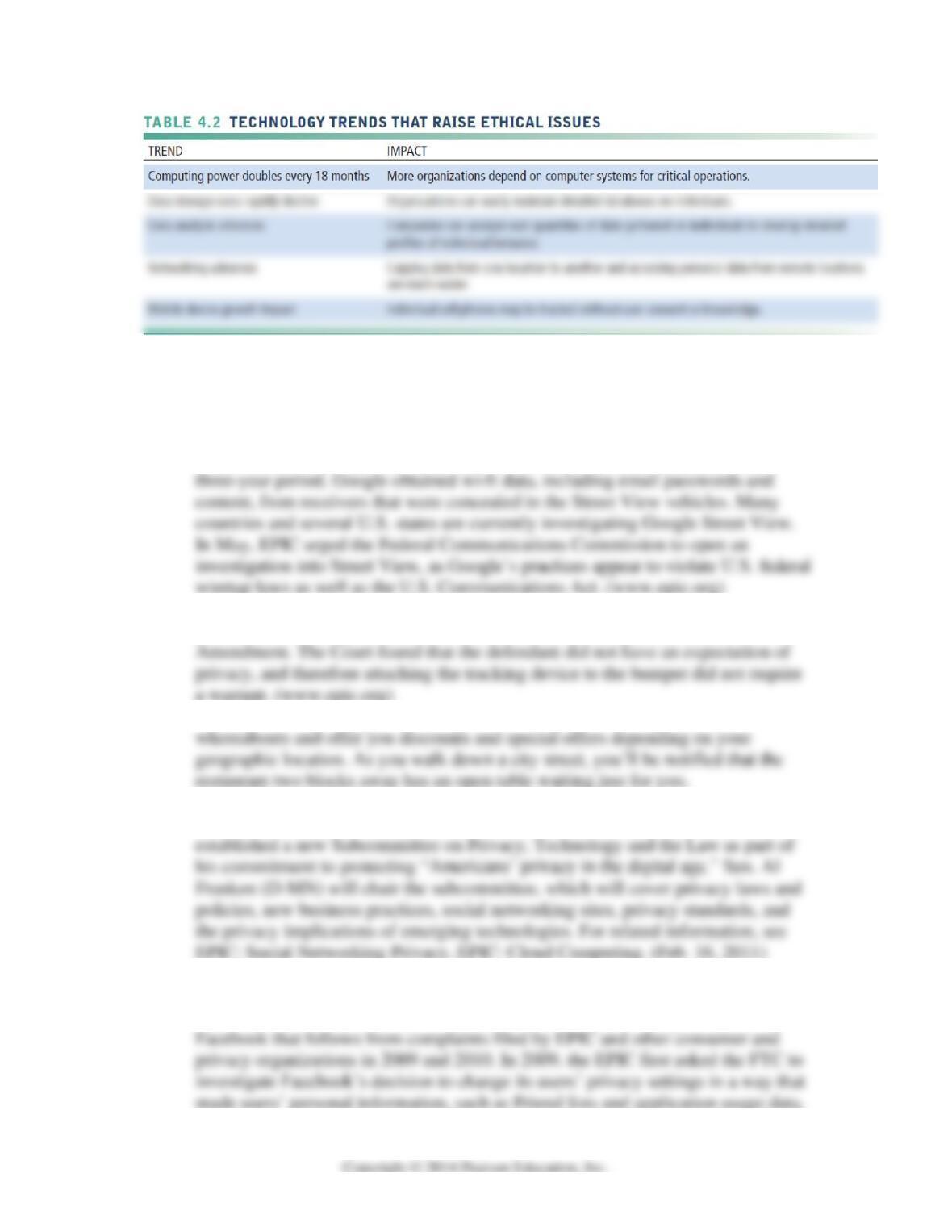
In addition to the technologies described in Table 4-2, you need to understand the most
recent technological threats to your privacy in cyberspace:
1. Google’s “Street View” is controversial mapping tool that has allowed Google to
capture wi-fi signals in addition to street level imagery in thirty countries over a
2. In Foltz v. Virginia, the Virginia Court of Appeals held that law enforcement may
place a GPS tracking device on a vehicle without violating the Fourth
3. New handheld Web appliances will allow businesses to track your physical
4. Chairman Leahy Announces New Subcommittee on Privacy and Technology:
Sen. Patrick Leahy (D-VT), Chairman of the Senate Judiciary Committee, has
5. Federal Trade Commission Announces Settlement in EPIC Facebook Privacy
Complaint: The Federal Trade Commission has announced an agreement with
4-5
A few of the news items in the list above came from a Web site maintained by the
Electronic Privacy Information Center (www.epic.org), an organization devoted to
The scenario at the beginning of this section about profiling is possible through the
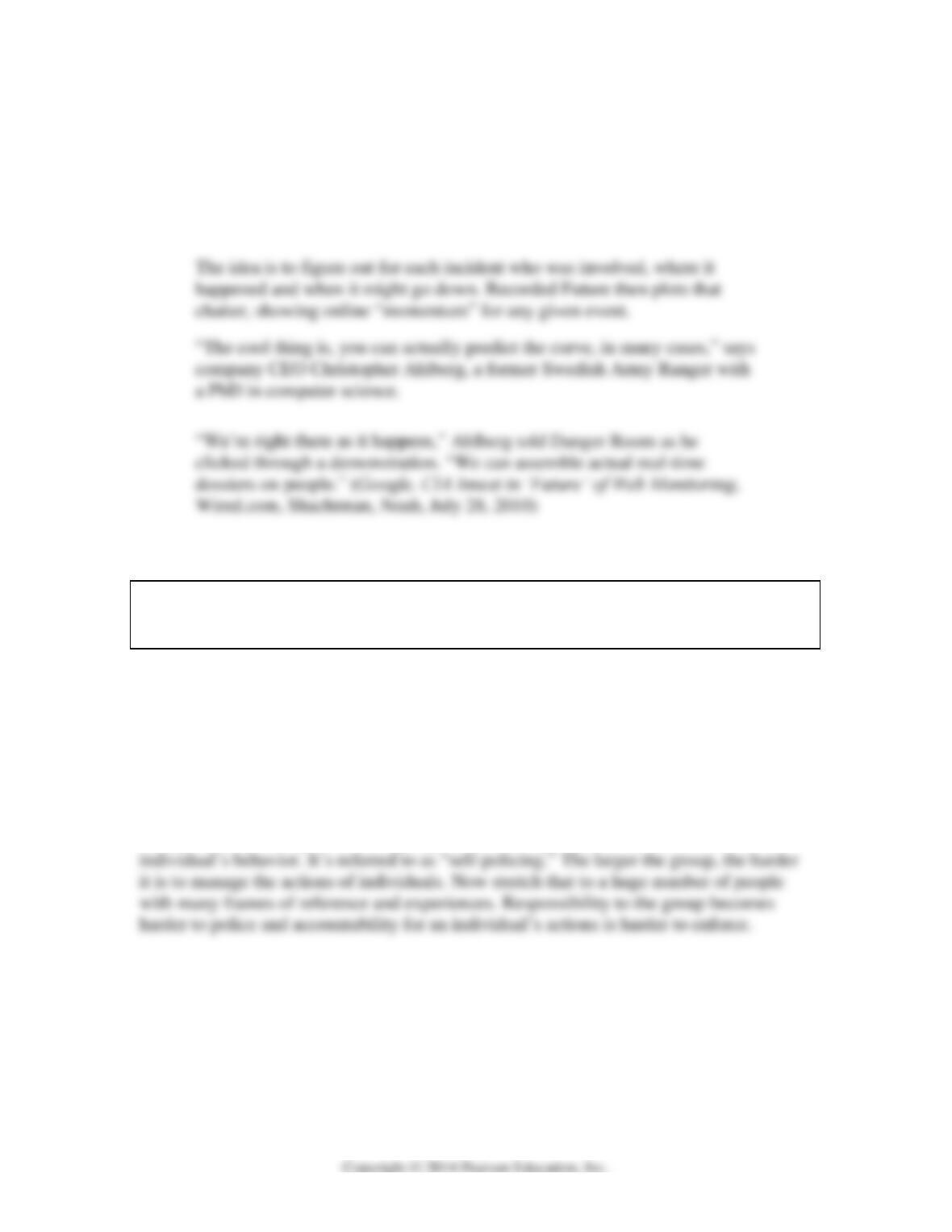
technique called datamining. Add to that the capabilities of nonobvious relationship
awareness (NORA) data analysis technology, as shown in Figure 4-2, and complete
strangers might know just as much about you as you do. It can and has been done. So you
should be concerned and you should care.
4-6
The company is called Recorded Future, and it scours tens of thousands of
websites, blogs and Twitter accounts to find the relationships between
people, organizations, actions and incidents—both present and still-to–
come. In a white paper, the company says its temporal analytics engine
“goes beyond search” by “looking at the ‘invisible links’ between
documents that talk about the same, or related, entities and events.”
Bottom Line: Technological trends are posing new situations and questions we
haven’t had to deal with before. As it’s your world and your future, you should be
concerned and become involved in their resolution.
4.2 Ethics in An Information Society
Did you ever hear the old warning: “Just because you can, doesn’t mean you should?”
Well, a lot of things are possible on the Internet nowadays, but that doesn’t mean you
should do them.
Ethics is easily managed in small groups because the group itself tends to control the
Basic Concepts: Responsibility, Accountability, and Liability
Every action causes a reaction. When you’re using the Internet, computers on campus, or
your employer’s computer, you should be aware of the following:
• Responsibility: Accepting potential costs, duties, and obligations for your
decisions.
4-7
Responsibility, accountability, and liability are all yours when it comes to your actions in
cyberspace. Every Internet Service Provider has a “usage policy,” even the so-called
anonymous emailers that hide your real identity. Hotmail is a popular Internet email
Just because you think you can, doesn’t mean you should. Would you stand in the middle
of campus and shout insults? Laudon and Laudon point out, “Using information
technology in a socially responsible manner means that you can and will be held
accountable for the consequences of your actions.” Just as you are subject to rules,
whether you like them or not, on Main Street, USA, in public, you are subject to societal
rules in cyberspace. Anonymity isn’t a license for socially unacceptable behavior.
4-8
Ethical Analysis
It’s safe to say you’ll find yourself in situations where your ethics are continually
challenged online and offline. What should you do? Try the following:
• Separate fact from fiction.
• Remember, no matter how thin you slice it, there’s always two sides.
Candidate Ethical Principles
In the early days of the Internet, just about anything was acceptable. The phrase “Wild
Wild Web” was an appropriate cliché. But as the technology becomes more mainstream,
the less wild it becomes.
The principles listed in the text are deeply rooted in cultures around the world. We
seriously doubt the authors of these guidelines had the Internet in mind when they
developed them. But, when you think about it, they work nicely, even in cyberspace!
1. Do unto others as you would have them do unto you
2. If an action is not right for everyone, perhaps it’s not right for anyone
Professional Codes of Conduct
Most professional organizations have a code of conduct by which they expect their
members to abide. The Association of Computing Machinery (www.acm.org) has an
excellent set of standards that apply to all of us, whether we belong to ACM or not.
Some Real-World Ethical Dilemmas
Individuals, companies, and corporations are being forced to deal with these new ethical
and social issues in ways never before imagined. Employ the ethical analysis we just
4-9
So in your opinion, what is right? Is it okay for an employee to download the latest
picture from Playgirl’s Web site and use it as a screensaver? Is it okay to run a personal
commercial Web site from your workplace computer using the company’s computer
resources? Is it okay to email discriminatory jokes over the company’s network that
wouldn’t be allowed over the water cooler? Is it okay to send email telling everyone that
the boss is a jerk, then get mad when the company fires you?
What is the best way for companies and employees to handle these situations? What is
the right thing to do?
Bottom Line: Ethics in an information society holds each person responsible for his
or her actions. Each person is accountable for everything he or she does, no matter
or her actions may inflict on other people and society as a whole.
4.3 The Moral Dimensions of Information Systems
This section examines the five moral dimensions (information rights; property rights;
accountability, liability, and control; system quality; and the quality of life) by asking you
to examine them from a personal standpoint.
Information Rights: Privacy and Freedom in the Internet Age
Many of us take our privacy and freedom for granted. You should be aware of how
technology is changing and challenging our basic assumptions about these issues.
4-10
This whole issue doesn’t bother some people at all. In fact, they don’t even think about it.
The issue doesn’t bother others until the intrusions are used against them. Think about
this: If information is supposedly collected for one purpose, is it ethical for that
information to be used for a totally different purpose without you knowing it? Is it fair to
require you to provide medical information that is primarily intended to be used to pay
your insurance bills and then have that same information used against you when the
insurance company deems you too expensive and cancels your policy? Is it fair to have
that same information used against you in denying you employment because you’re too
expensive to hire?
“Information about people’s moment-to-moment thoughts and actions, as
revealed by their online activity, can change hands quickly. Within
seconds of visiting eBay.com or Expedia.com, information detailing a
Consumer tracking is the foundation of an online advertising economy that
racked up $23 billion in ad spending last year. Tracking activity is
exploding. Researchers at AT&T Labs and Worcester Polytechnic
Institute last fall found tracking technology on 80% of 1,000 popular sites,
up from 40% of those sites in 2005.
4-11
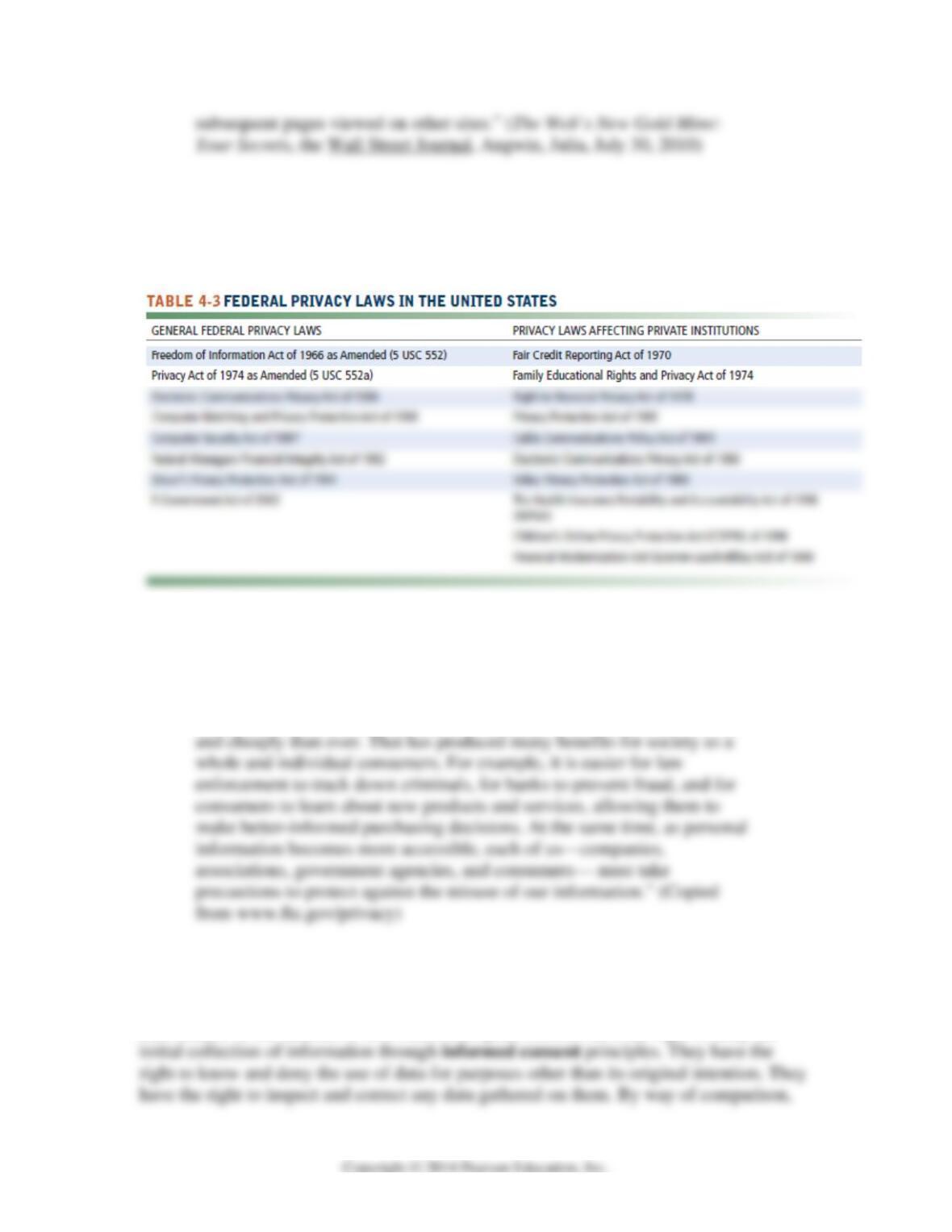
The federal government is taking steps to help protect individual privacy in the United
States by passing laws based on Fair Information Practices (FIP) as you can see in
Table 4-3. However, the wheels of government turn slowly and the first line of defense
should be yours.
The Federal Trade Commission has stepped up their efforts to protect consumers’
personal information on the Internet. An excerpt from their explains their mission.
“Privacy is a central element of the FTC’s consumer protection mission. In
recent years, advances in computer technology have made it possible for
detailed information about people to be compiled and shared more easily
The European Directive on Data Protection
European countries have much stricter restrictions on gathering data about private
individuals, on the Internet or elsewhere. European citizens have the right to deny the