
Instructor Resource
Rowe, Cases in Leadership 5e
SAGE Publications, Inc., 2019
Case Notes
Case 4.2: Huo’s Group: A Professional Manager in a Family Firm in China
Wang Ting, Paul W. Beamish, Zhou Liman and Luo Jingjing wrote this teaching note as an aid
to instructors in the classroom use of the case Huo’s Group: A Professional Manager in a
Family Firm in China, No. 9B14C009. This teaching note should not be used in any way that
would prejudice the future use of the case.
This publication may not be transmitted, photocopied, digitized or otherwise reproduced in any
form or by any means without the permission of the copyright holder. Reproduction of this
material is not covered under authorization by any reproduction rights organization. To order
copies or request permission to reproduce materials, contact Ivey Publishing, Ivey Business
Teaching Note
Synopsis
It is often difficult to realize a good partnership between a professional manager and a family
firm. However, Li Jia and Huo Zhenxiang’s so-called “perfect partnership” in Tongyi Petroleum
overturns this judgment and provides a successful model for such cooperation. After the merger
between Tongyi and Shell, Li Jia stayed at Shell Tongyi to continue as the general manager
according to the merger agreement. He spent five years with the transnational enterprise.
Meanwhile, Huo Zhenxiang built up the Huo’s Group family firm. When Huo invites Li and his
Instructor Resource
Rowe, Cases in Leadership 5e
SAGE Publications, Inc., 2019
Basic Issues
1. Utilize trait and behavioural theories of leadership to analyze Huo Zhenxiang’s leader
style.
2. Draw from research on individual behavior to discuss Li Jia’s qualities as a
professional manager.
Courses and Positioning
This case is mainly intended for use in courses such as organizational behavior, human resource
management, family business and entrepreneurship.
Organizational behavior: The case can be used in the middle of an organizational behavior
Human resources: The case can be used at the beginning of a human resources course to
Family business: The case can be used to introduce the fundamental differences between non–
Teaching Objectives
This case enables students to:
1. Understand the key elements for successful cooperation between a private family firm
and a professional manager at the beginning stage of entrepreneurship, including the

2. Analyze the advantages and disadvantages of introducing external personnel during
the rapid development process of an enterprise. Realize that the personal charisma of
3. Understand the leadership characteristics that a private family firm leader should be
4. Understand the needs in individual behavior, especially the personality traits and
behavioural characteristics of the individual with overachievement demands. The
Suggested Readings
Instructors may wish to assign a reading in advance:
1. Nahavandi, A. (2011). The art and science of leadership (6th ed.). Upper Saddle River,
NJ: Prentice Hall.
2. Drucker, P. F., Goleman, D., & Bill, G. (2011). HBR’s 10 must reads on leadership
3. Stewart, A., & Hitt, M. A. (2012). Why can’t a family business be more like a
nonfamily business? Modes of professionalization in family firms. Family Business
Instructor Resource
Rowe, Cases in Leadership 5e
SAGE Publications, Inc., 2019
Suggested Teaching Strategy
Through Li Jia’s two experiences in joining with private entrepreneur Huo Zhenxiang, the basic
elements for successful cooperation between a professional manager and a private family firm
are discussed. First, we lay the groundwork for the subsequent discussion by reviewing the key
differences between non-family and family businesses, according to eight criteria. Second, we
Assignment Questions
1. What are the fundamental differences between non-family and family enterprises?
2. At the early stage of entrepreneurial development, why would Li Jia accept Huo
Zhenxiang’s invitation to join the little-known private family firm Tongyi Petroleum?
What kind of organizational environment did Huo create for Li to enable him to give
full play to his talents?
3. Which positive qualities could be seen in Li Jia as a professional manager through his
operation and management in the entrepreneurship and development processes of
Tongyi? After the merger between Tongyi and Shell, what kinds of influences did Li
1. What are the fundamental differences between non-family and family enterprises?
2. Analysis of Huo Zhenxiang’s leader style.
At the early stage of entrepreneurship of Tongyi, it was just a little-known private firm. Li Jia, a
college graduate in the 1990s, chose to join Tongyi not just because he was confident about the
future prospects of the lubricating oil industry, but more importantly because of the personal
3. Analysis of Li Jia’s qualities as a professional manager.
Huo fully recognized and trusted Li from the very beginning. Huo felt that Li had some valuable
business qualities. Li’s business qualities as a professional manager continued to develop and his
professional abilities improved in the process of helping Huo to realize Tongyi’s business
success and in staying in the joint venture to cooperate with Shell. Li Jia’s professional qualities
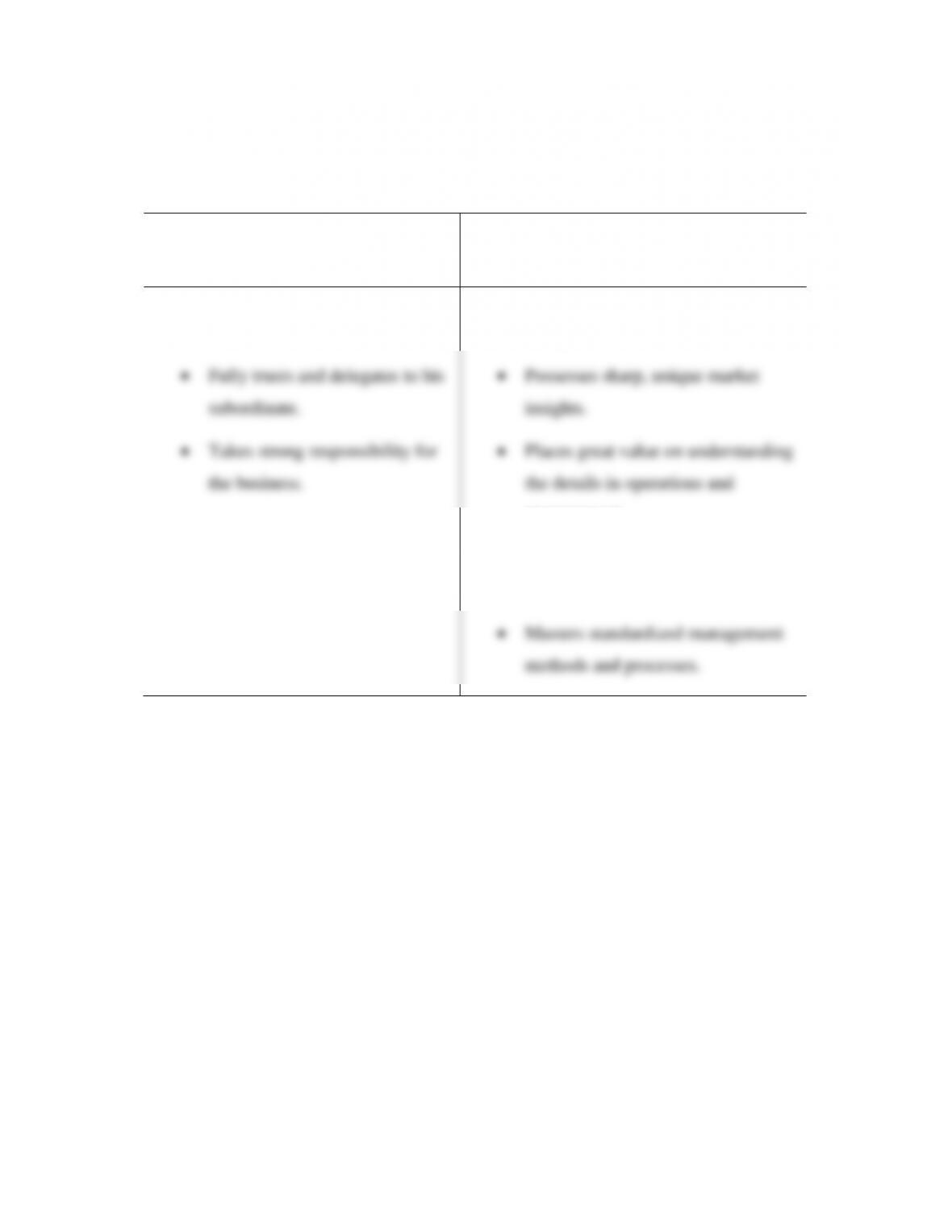
mainly include those highlighted below and in Exhibit TN-3:
a. He is loyal and responsible to the enterprise. Li created a first impression in Huo of
being shrewd, courageous, resolute, loyal and responsible. He retained each quality.
Jia does better in saving money for the enterprise.”
d. He is good at communication and handling interpersonal relationships. Although Li
won his boss’s trust, he also paid great attention to communication with his
subordinates, especially family members, in operations and management. In his
tenure at Shell Tongyi, he experienced many differences between the cultures of
4. Compare the differences in Li’s individual demands in the first and second periods of
cooperation with Huo.
Li Jia has chosen to work with Huo Zhenxiang again. However, after the success he achieved in
Tongyi and five years of professional experience in a transnational enterprise, Li’s individual
demands are obviously different from the time when he accepted Huo’s invitation to join Tongyi
twenty years earlier.
a. The initial experience was during the period when Li was choosing a career after
Instructor Resource
Rowe, Cases in Leadership 5e
SAGE Publications, Inc., 2019
and the satisfaction of being respected and recognized for his personal values. After
obtaining Huo’s recognition and trust, and seeing Huo’s passion for making the
business a success and his personal charisma as an enterprise leader, Li was attracted
5. Influences that might have caused Li to work with Huo a second time, and the major
future considerations for both parties.
The two periods of cooperation between Li Jia and Huo Zhenxiang feature different
organizational environments. At the early stage of Tongyi’s development, it was small in scale
with a shortage of funds and professional management talent. But now, Huo’s Group is already a
Instructor Resource
Rowe, Cases in Leadership 5e
SAGE Publications, Inc., 2019
important issue that both Huo and Li must face. This will be the fundamental premise of
guaranteeing success between the two.
a. Effective communication is required. To the rapidly developing Huo’s Group, Li and
his team join the Group as external personnel. This requires not only effective
communication with Huo, but also clear understanding about the development idea
of, and actual expectations for, this team by Huo, so as to avoid deviation on strategic
What Happened
To motivate Li and the senior executive team, Huo invited consultants to analyze the group’s
strategy and establish key performance indicators for the next five years at the end of 2012.
Based on the defined goals for the future, a stock option program was designed and implemented
at Huo’s Group. Huo Zhenxiang wanted to share the value of the company’s growth with Li Jia
Instructor Resource
Rowe, Cases in Leadership 5e
SAGE Publications, Inc., 2019
and the core teams, in order to motivate the professional managers to achieve their goals and
cooperate with the company over the long term.
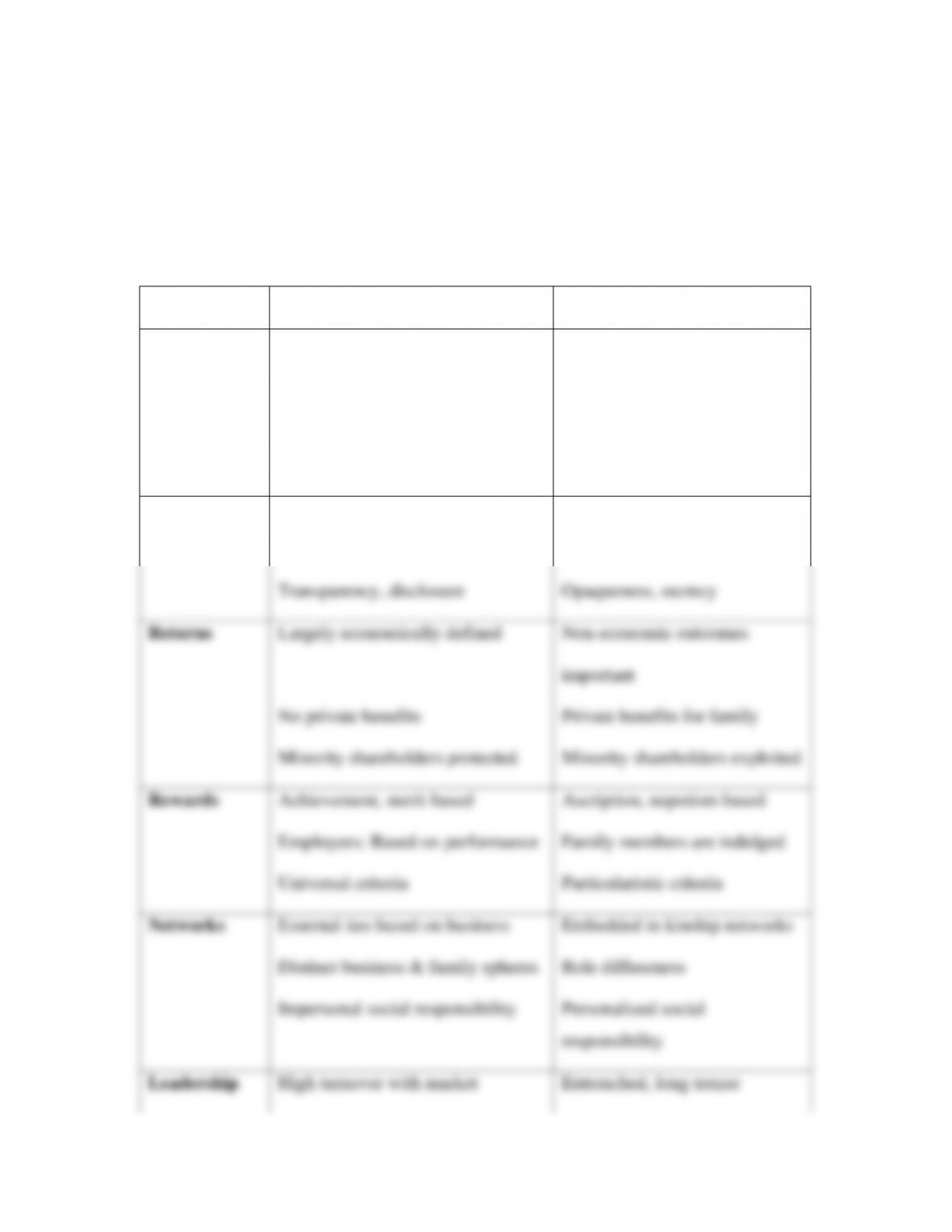
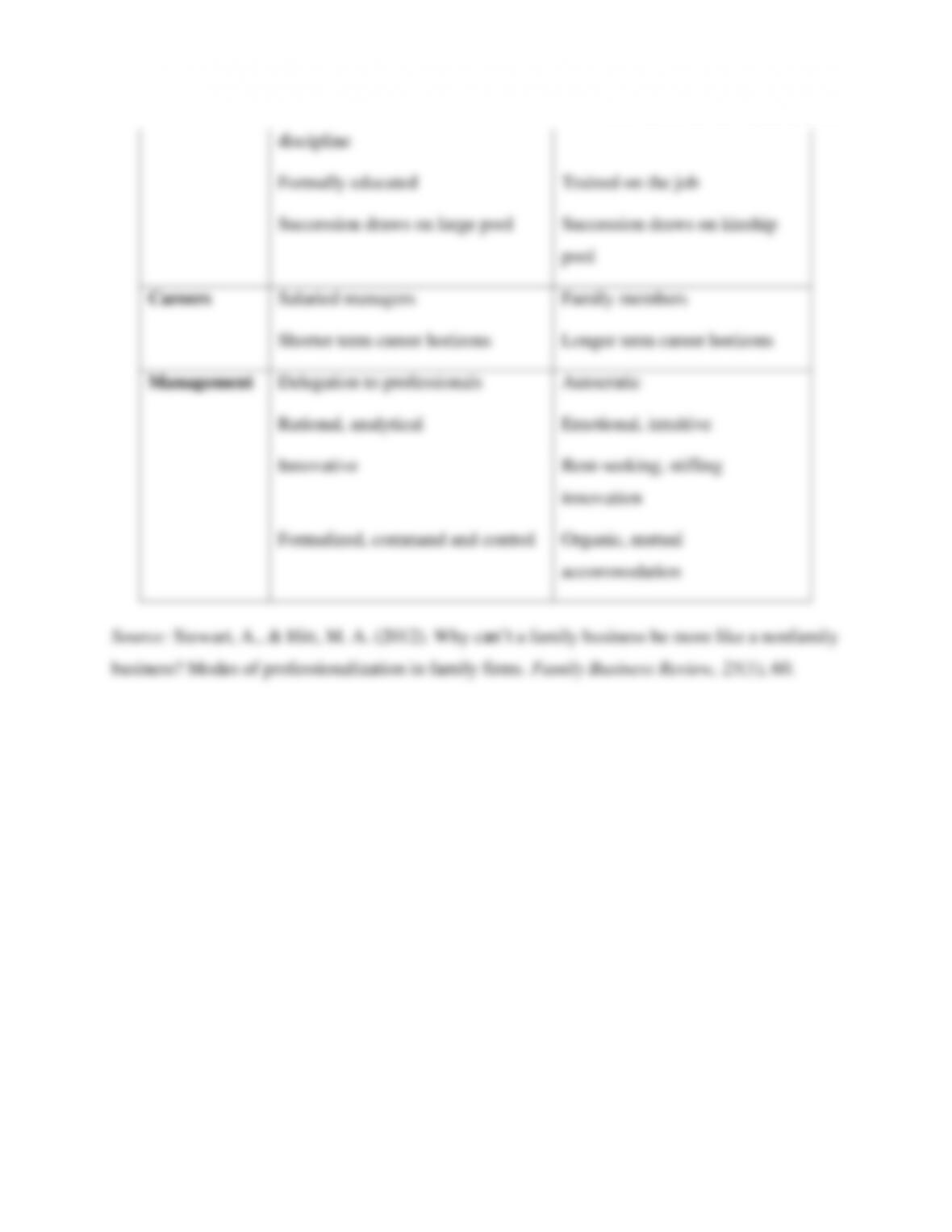
Exhibit TN-1
Stereotypical Dichotomies for Non-Family and Family Businesses
Non-Family Business
Family Business
Ownership
Dispersed, non-kinship based
Concentrated, kinship based
No wedge between cash flow and
ownership rights
Wedge between cash flow and
ownership rights
Well diversified
Non-diversified
Governance
Ownership and control split
Ownership and control united
External influences on board
Internal dominance of board
Transparency, disclosure
Opaqueness, secrecy
Returns
Largely economically defined
Non-economic outcomes
important
No private benefits
Private benefits for family
Minority shareholders protected
Minority shareholders exploited
Rewards
Achievement, merit based
Ascription, nepotism based
Employees: Based on performance
Family members are indulged
Universal criteria
Particularistic criteria
Networks
External ties based on business
Embedded in kinship networks
Distinct business & family spheres
Role diffuseness
Impersonal social responsibility
Personalized social
responsibility
Leadership
High turnover with market
Entrenched, long tenure
Instructor Resource
Rowe, Cases in Leadership 5e
SAGE Publications, Inc., 2019
discipline
Formally educated
Trained on the job
Succession draws on large pool
Succession draws on kinship
pool
Careers
Salaried managers
Family members
Shorter term career horizons
Longer term career horizons
Management
Delegation to professionals
Autocratic
Rational, analytical
Emotional, intuitive
Innovative
Rent-seeking, stifling
innovation
Formalized, command and control
Organic, mutual
accommodation
Source: Stewart, A., & Hitt, M. A. (2012). Why can’t a family business be more like a nonfamily
business? Modes of professionalization in family firms. Family Business Review, 25(1), 60.

Instructor Resource
Rowe, Cases in Leadership 5e
SAGE Publications, Inc., 2019
Exhibit TN-2
Stereotypical Dichotomies for Non-Family and Family Businesses
Non-Family Business
Family Business
Ownership
Governance
Returns
Rewards
Networks
Leadership
Careers

Instructor Resource
Rowe, Cases in Leadership 5e
SAGE Publications, Inc., 2019
Management
Source: Stewart, A., & Hitt, M. A. (2012). Why can’t a family business be more like a nonfamily
business? Modes of professionalization in family firms. Family Business Review, 25(1), 60.
Instructor Resource
Rowe, Cases in Leadership 5e
SAGE Publications, Inc., 2019
Exhibit TN-3
Individual Character Analysis
Huo Zhenxiang’s leadership traits as
an entrepreneur in a private firm
Li Jia’s positive traits as a professional
manager
• Good at identifying excellent
talent.
• Fully trusts and delegates to his
subordinate.
• Takes strong responsibility for
the business.
• Shows his leadership power and
prestige.
• Loyal and responsible to the
enterprise.
• Possesses sharp, unique market
insights.
• Places great value on understanding
the details in operations and
management.
• Good at communication and
handling interpersonal relationships.
• Masters standardized management
methods and processes.