Hitt 13e Case Teaching Notes
Case 3: Future of the Autonomous Automobile: A Strategy for BMW
Case Synopsis
In business for more than 100 years, BMW began as an aircraft engine manufacturer but turned
into a car and motorcycle manufacturer in 1928. Since then, the iconic brand has become
recognized the world over for its exceptional, award-winning engineering and forward-thinking
The technology for autonomous driving ranges from self-parking, which is already commercially
available, all the way up to complete autonomy, in which the “driver” would actually be more
like a passenger, free to talk, work, read, and relax while being transported. Among experts,
there seems to be some debate whether cars will ever become fully autonomous, and yet
several major automotive brands are pursuing that goal. BMW, Audi, Mercedes-Benz, and
Chevrolet, for example, all have fully autonomous cars in development, and other firms,
including Google, are also investing in R&D in this space.
Despite the uncertainties and other obstacles, BMW is forging ahead with the development of
autonomous vehicles with the aim of becoming a leader in this new industry.
Learning Objectives
• Describe the competitive landscape and explain how globalization and technological
changes shape it. (Chapter 1)
• Discuss the risks associated with using each of the business-level strategies. (Chapter 4)
• Describe how strategic actions and tactical actions drive competitive rivalry between
firms. (Chapter 5)
• Explain factors affecting the likelihood a firm will respond to actions its competitors
take. (Chapter 5)
Strategic Issues and Suggested Discussion Questions & Answers
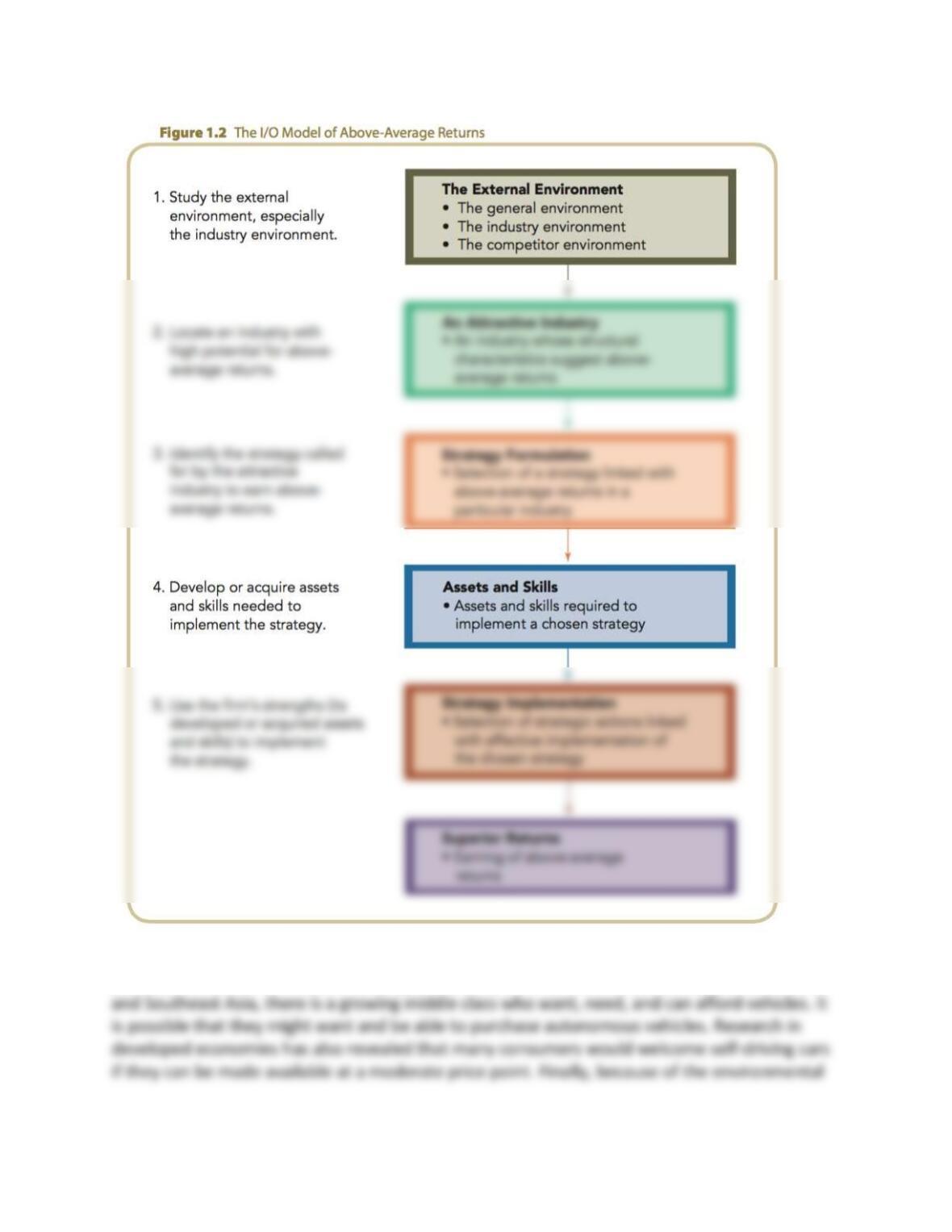
1. Use the I/O model to evaluate BMW’s entry into the self–driving car business. Based on
your analysis, what recommendations do you have for BMW?
Students should work through the I/O model (Figure 1.2) one step at a time.
The external environment: The concept of autonomous vehicles has been around for quite
An attractive industry: Populations around the world are expected to grow exponentially in
years to come, and in many developing economies, such as in the Middle East, South America,
and safety benefits, a few nations have indicated a willingness to invest in supporting the
development of this new class of vehicles. All of this suggests eventual above-average returns.
Assets and skills: As stated, BMW has been recognized by industry leaders with awards for its
engineering, design, and craftsmanship. The firm also has strengths in manufacturing,
marketing, sales, and other key functional areas. These skills and assets are being used in the
development of autonomous vehicles. Additionally, the firm’s connections with technology-
industry leaders in the United States, China, and beyond are enabling the creation of strategic
alliances that will give BMW access to new kinds of technology and other knowledge needed to
perfect its self-driving cars.
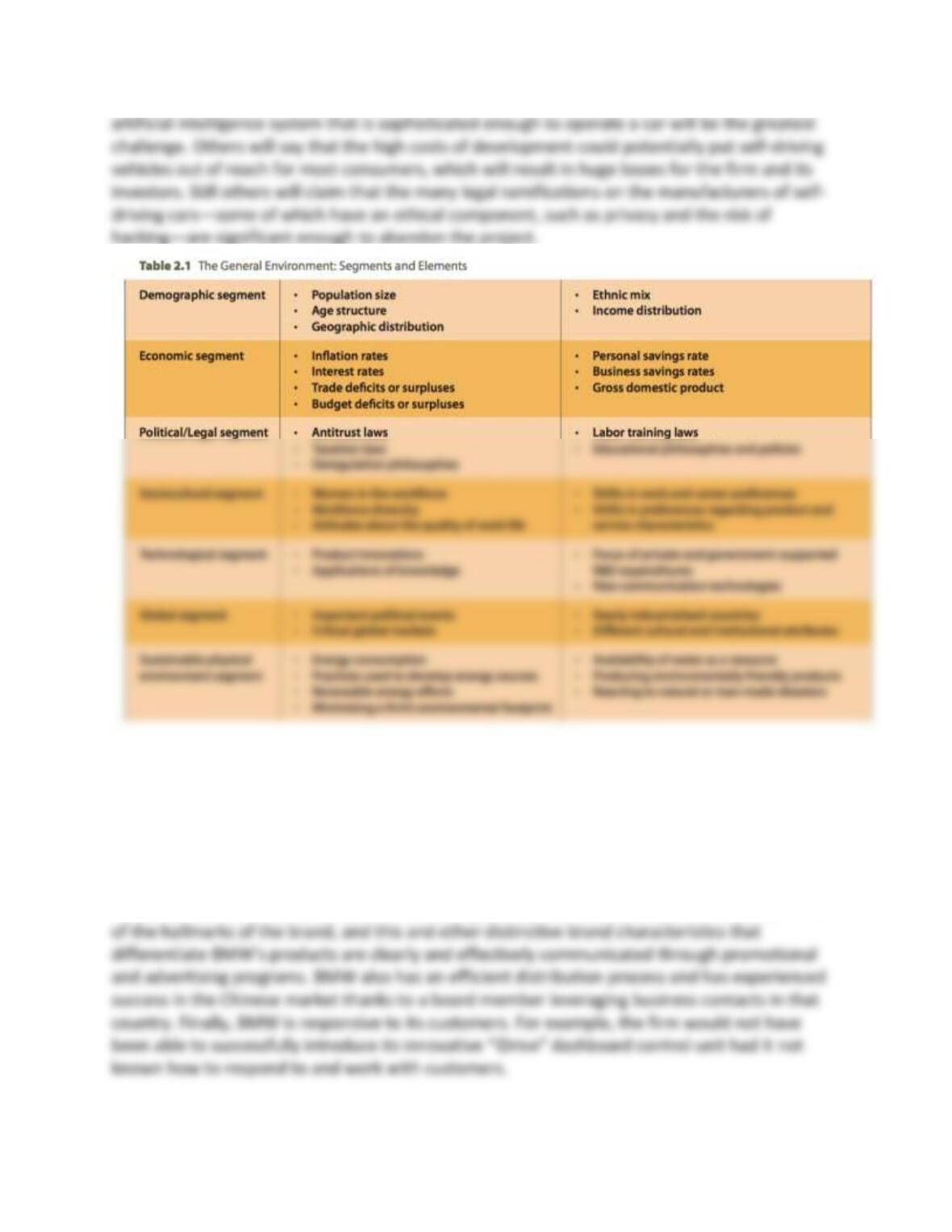
2. The case identifies quite a few issues and questions in the various segments of BMW’s
general environment. Which of these do you think BMW’s top leadership should be
most concerned about? Why?
Students will have varying opinions on this question, but they should be able to support their
answers with logical reasoning. Many will say that technology and the need to create an
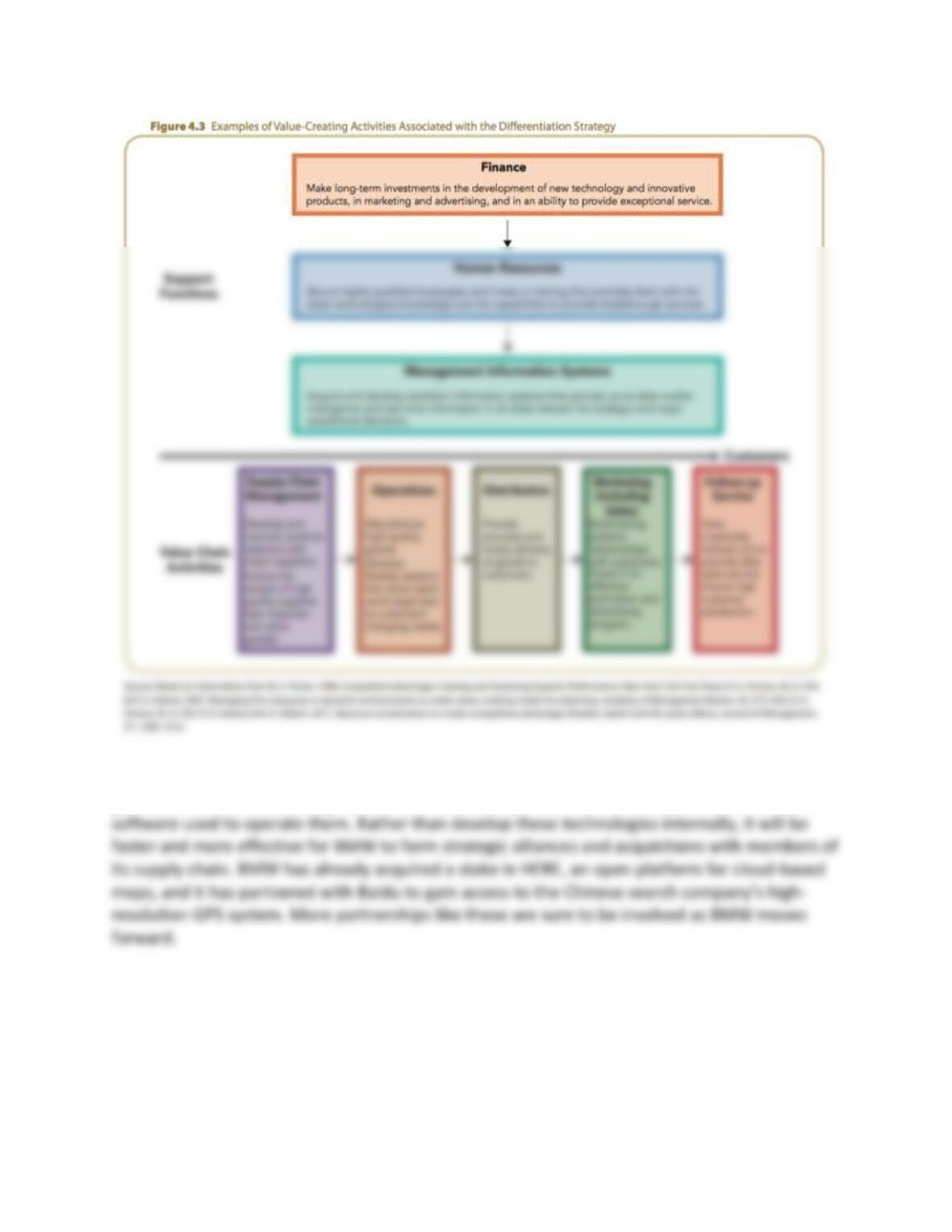
3. In the past, BMW has been able to successfully differentiate its products by engaging
in value-adding value chain activities. What are some of these specific activities? How
can BMW ensure its ability to continue with value-adding activities as it evolves into a
maker of self-driving cars?
BMW’s current manufacturing of high-end vehicles includes many instances of value chain
activities that add value to the product. Exacting quality in manufacturing craftsmanship is one
For BMW to assume a leadership position in autonomous vehicles, it will most likely need to
gain access to new technologies, both the hardware placed within its vehicles as well as the
4. Using the two major aspects of competitor analysis—market commonality and
resource similarity—conduct a brief analysis of several of BMW’s competitors’
currently developing autonomous vehicles. Conduct the same type of analysis on
Alphabet’s (Google’s) self-driving car division.
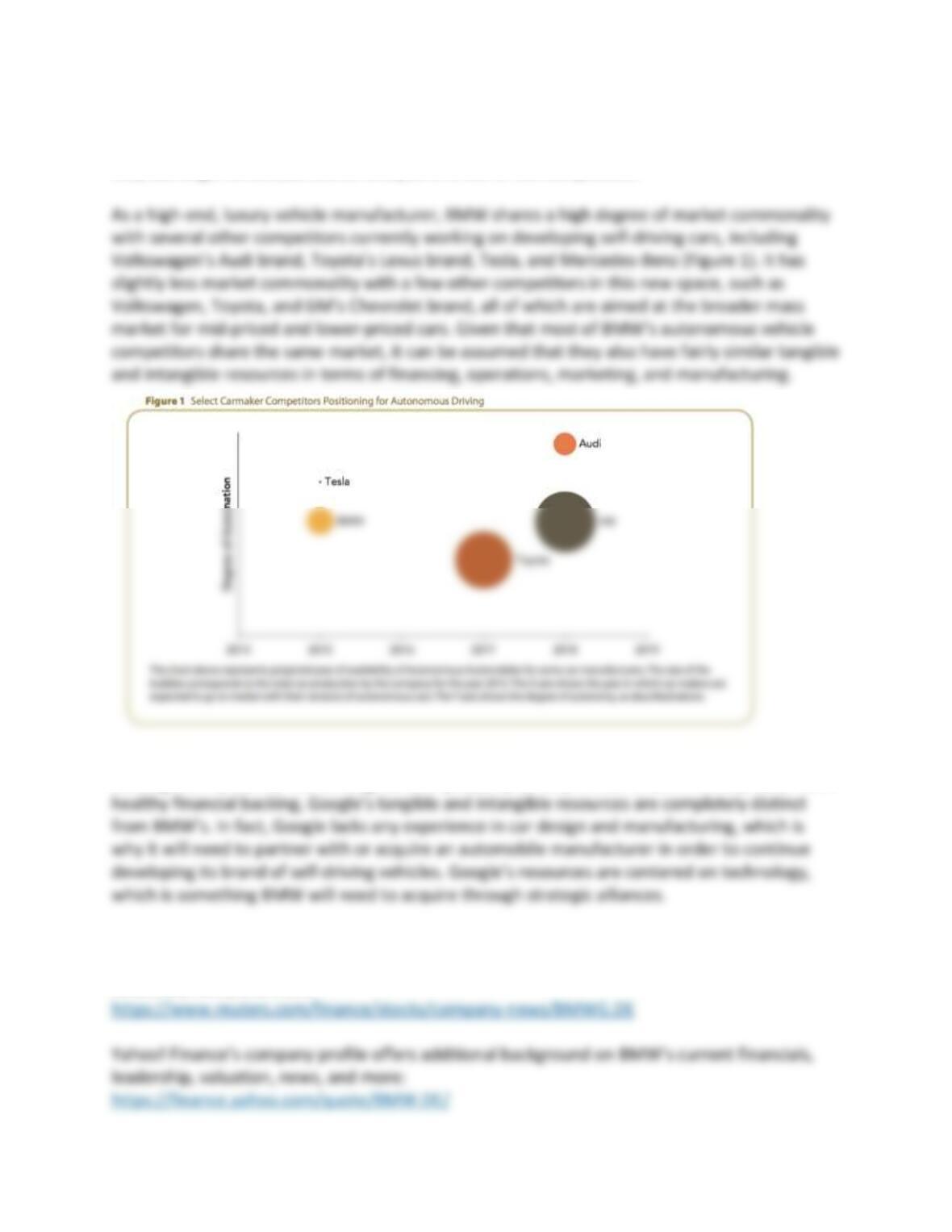
Without further information beyond what has been provided in the case, it would be
challenging for students to predict any move that BMW’s competitors may make. However,
they can begin to conduct a brief analysis of a few of the competitors.
On the other hand, Google’s market for its overall set of existing products is radically different,
although its market for self-driving cars will probably be very similar to BMW’s. And, other than
Additional Resources
Reuters’s company profile gives in-depth background on BMW’s current financials, leadership,
valuation, news, and more:
BMW’s website provides an in–depth explanation of the meaning of “autonomous driving”:
In September 2018, CNN Business offered this report on BMW’s electric self-driving car
scheduled for release in 2021:
BMW created this April 2018 insider’s look at its campus where autonomous driving is under
development: