Chapter 3: Job Costing, Process Costing, and Operations Costing
3-17
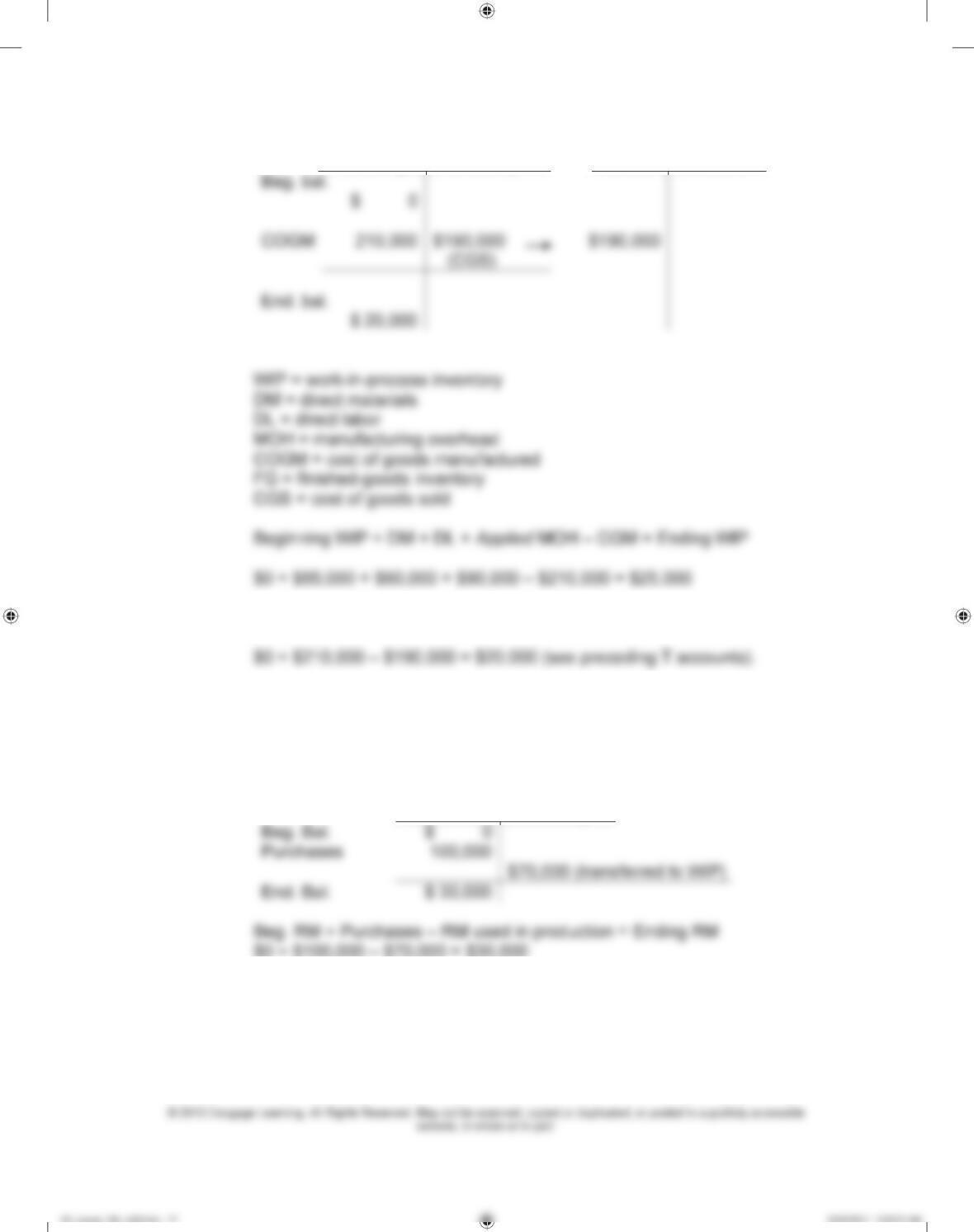
Finished-goods Inventory Cost of Goods Sold
C. Beginning FG + CGM – CGS = Ending FG
D. Overhead is overapplied by $10,000 (see preceding T account).
32. (LO2, 4, and 5—Comprehensive job costing)
A. The direct materials ending inventory is equal to $30,000:
Raw Materials Inventory
Solutions Manual
3-18
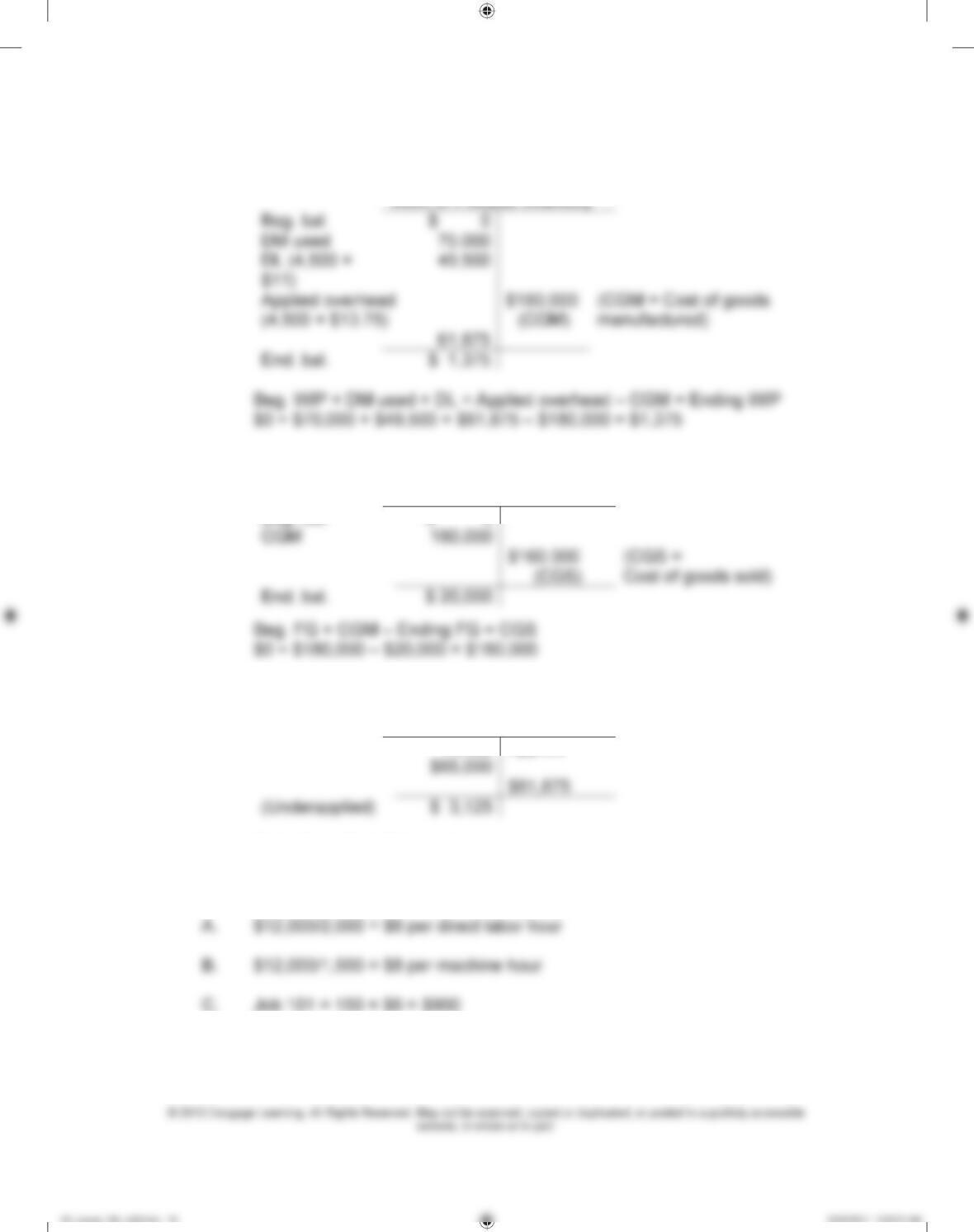
B. The work in process ending inventory is equal to $1,375:
C. The finished-goods ending inventory is equal to $20,000:
Finished-goods Inventory
Beg. bal. $ 0
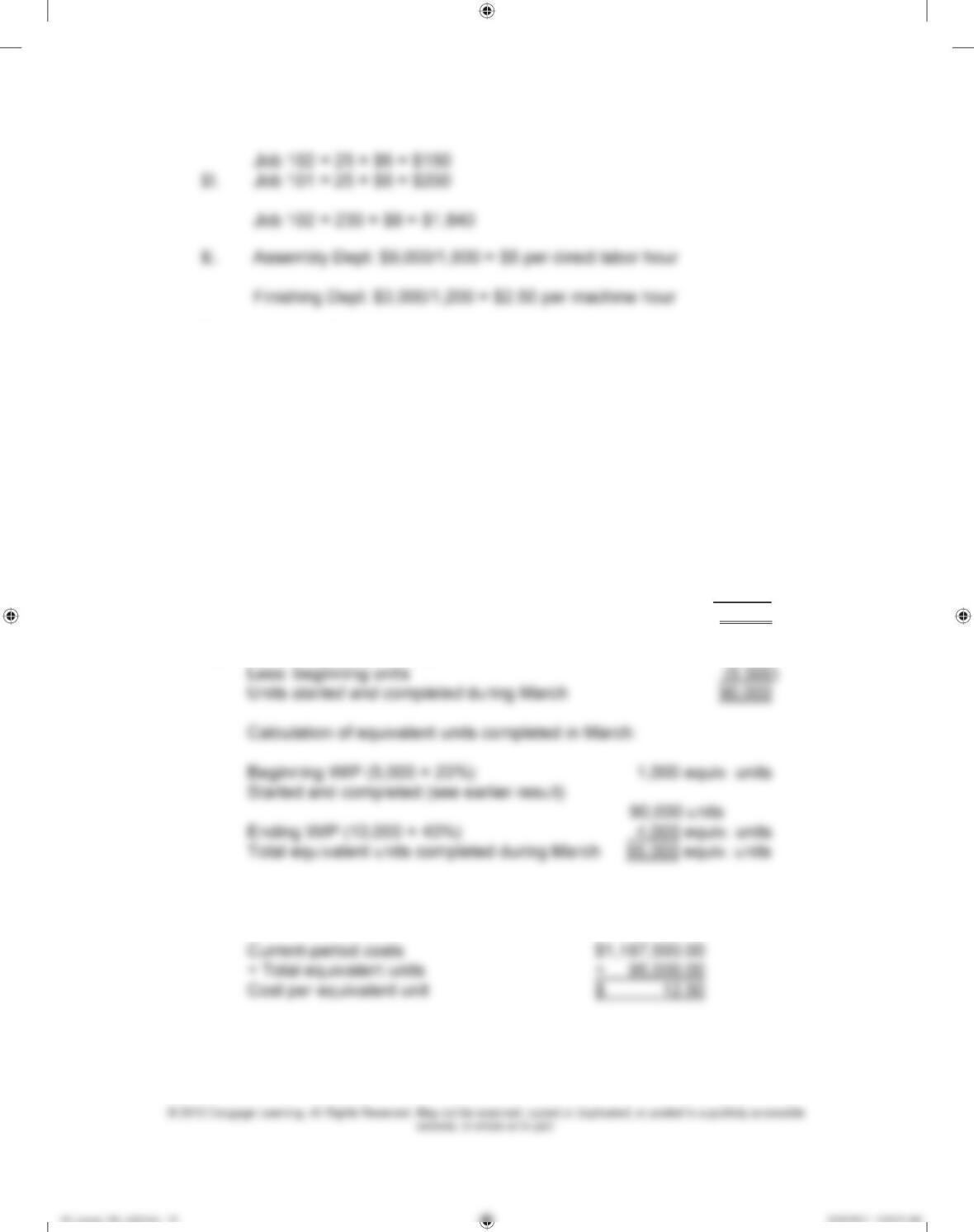
D. Overhead was underapplied by $3,125:
Manufacturing Overhead
Actual Applied
Cost of goods sold is too low.
33. (LO3, 4—Plantwide versus departmental overhead rates)
Chapter 3: Job Costing, Process Costing, and Operations Costing
3-19
F. It is clear from the information given in the problem that
different products require vastly different amounts of direct
labor time and machine time. If the company were to use a
single plantwide overhead rate, then products that use a
greater proportion of one type of time relative to the other
would not receive their proportionate share of overhead
costs. Essentially, products would cross-subsidize one
another.
34. (LO6, 7—Comprehensive process costing: FIFO method)
A. Beginning units 5,000
Add: units started 100,000
Less: ending units (10,000)
Units completed in March 95,000
B. Units completed in March 95,000
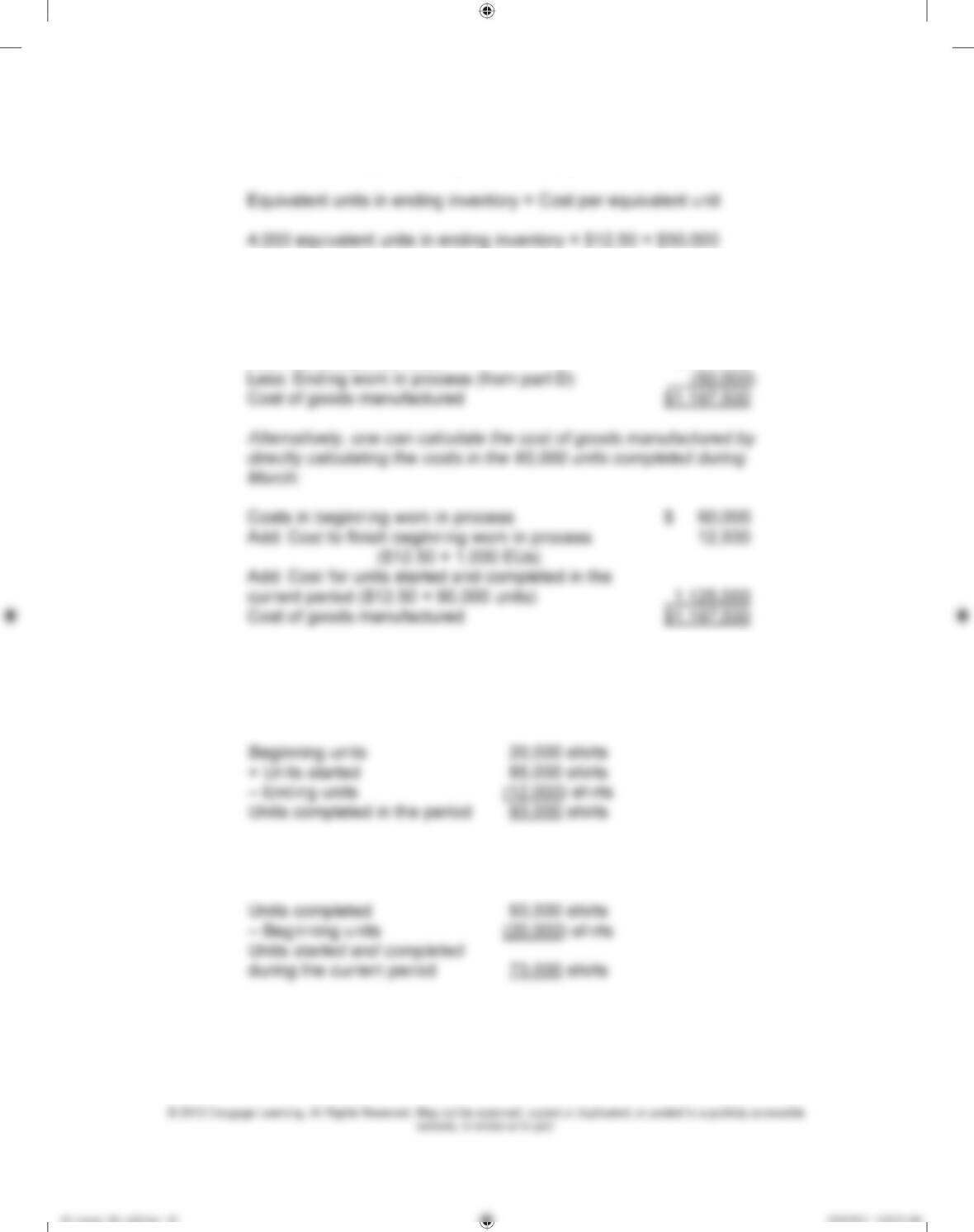
C. Calculation of cost per equivalent unit:
Solutions Manual
3-20
D. Calculation of cost of ending WIP inventory:
E. Calculation of cost of goods manufactured:
Beginning work in process $ 60,000
Add: Current-period costs 1,187,500
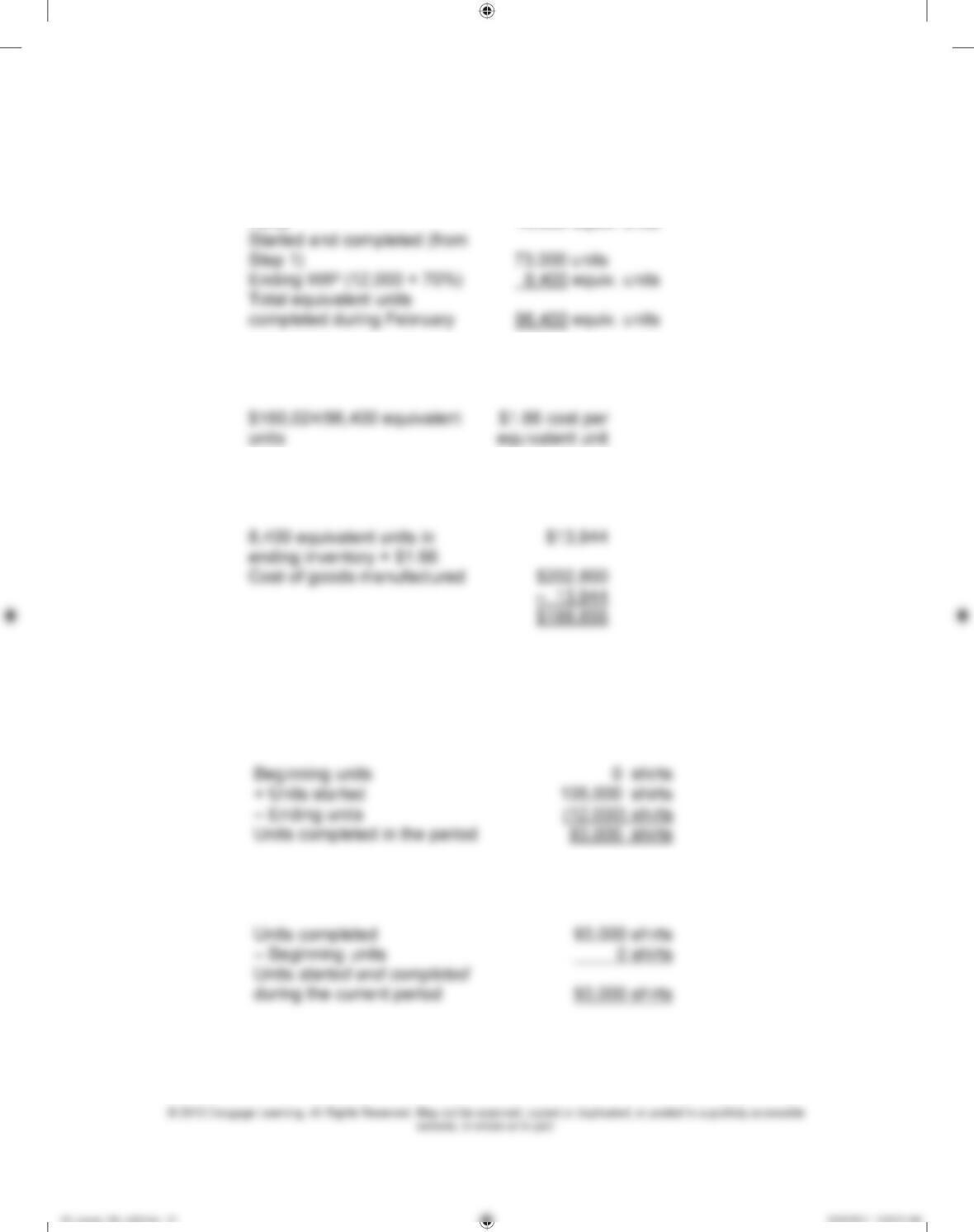
35. (LO6, 7—Process costing using FIFO)
A. Step 1: The physical flow of units:
Calculation of units completed:
B. Calculation of units started and completed:
Chapter 3: Job Costing, Process Costing, and Operations Costing
3-21
C. Step 2: Calculation of equivalent units:
Beginning WIP (20,000 ×
75%) 15,000 equiv. units
D. Step 3: Calculation of cost per equivalent unit:
E. Step 4: Calculation of cost of ending WIP
inventory and cost of goods manufactured:
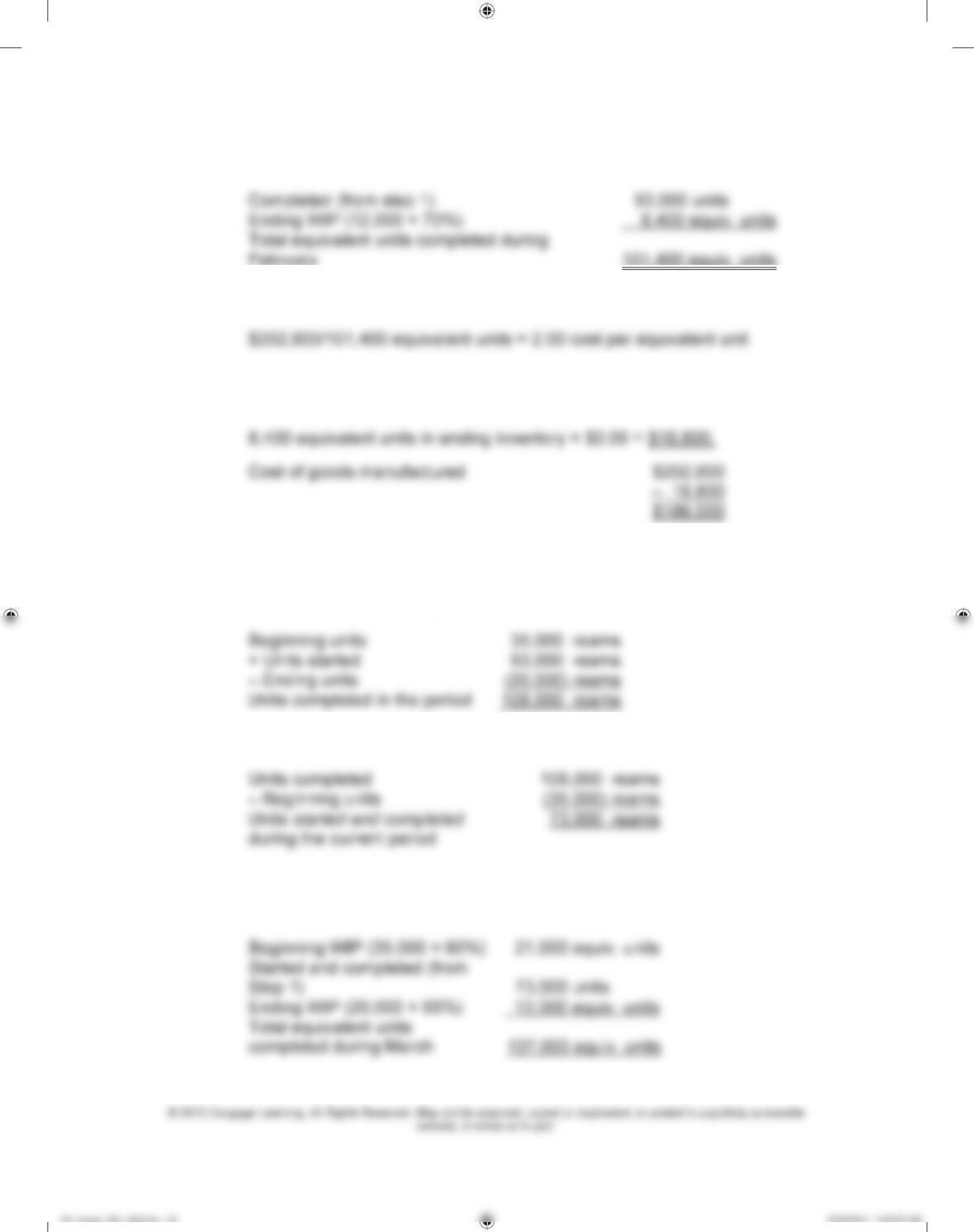
36. (LO6, 7—Process costing using weighted-average)
A. Step 1: The physical flow of units
Calculation of units completed:
B. Calculation of units started and completed:
Solutions Manual
3-22
C. Step 2: Calculation of equivalent units
February
101,400 equiv. units
D. Step 3: Calculation of cost per equivalent unit
E. Step 4: Calculation of cost of ending WIP inventory and
cost of goods manufactured:
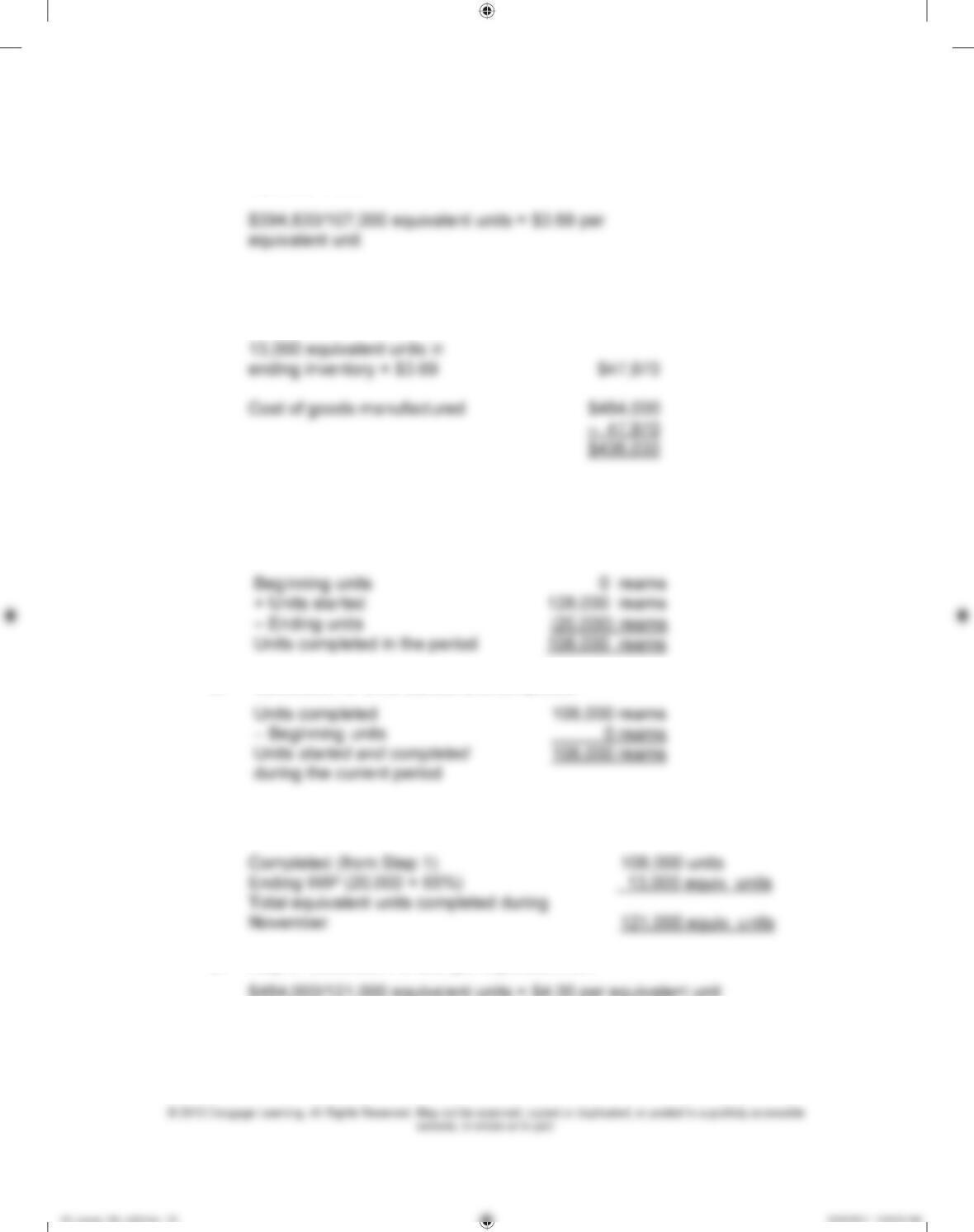
37. (LO6, 7—Process costing using FIFO)
A. Step 1: The physical flow of units
Calculation of units completed:
B. Calculation of units started and completed:
C. Step 2: Calculation of
equivalent units
Chapter 3: Job Costing, Process Costing, and Operations Costing
3-23
D. Step 3: Calculation of cost per
equivalent unit
E. Step 4: Calculation of cost of
ending WIP inventory and cost
of goods manufactured
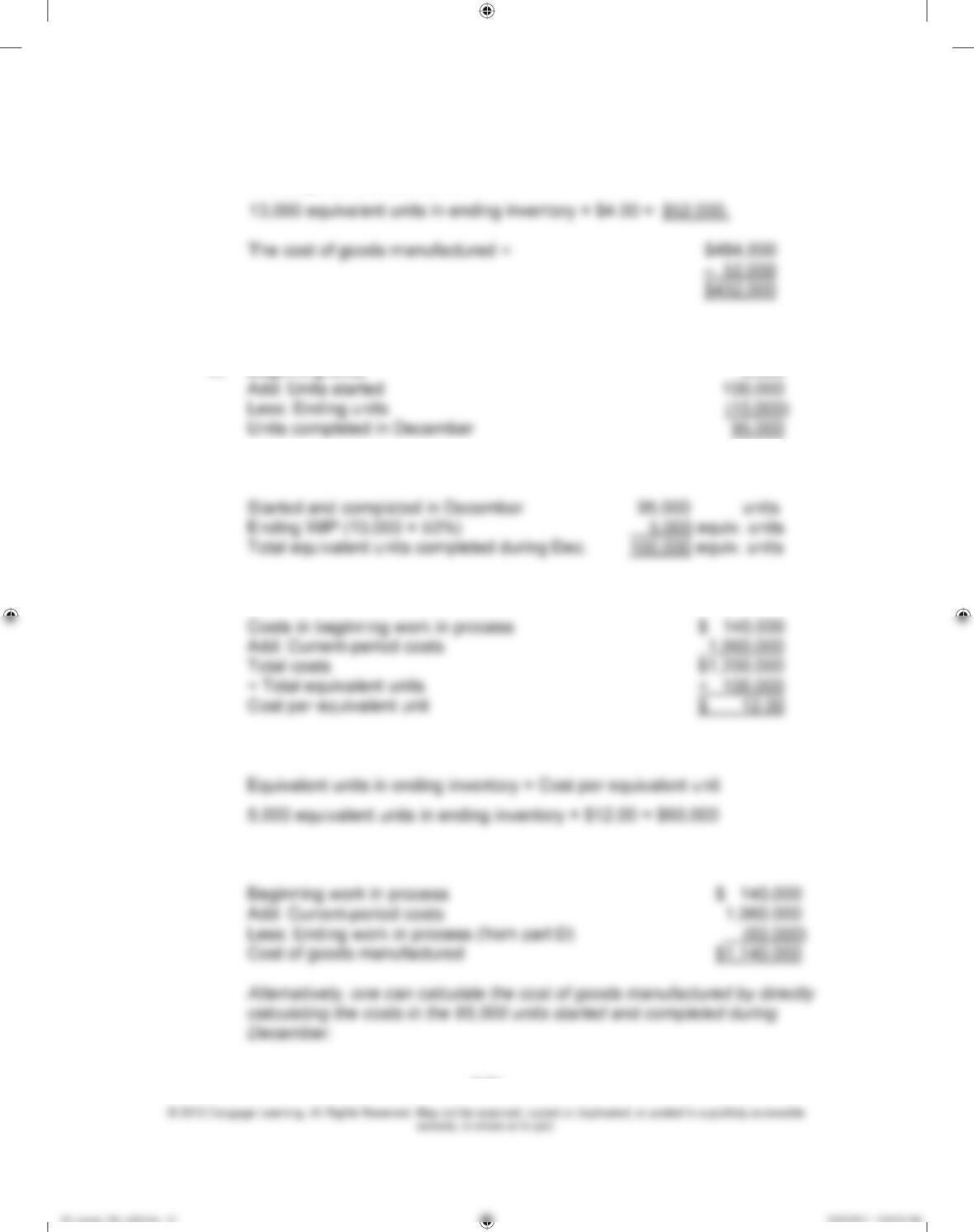
38. (LO6, 7—Process costing using weighted-average)
A. Step 1: The physical flow of units
Calculation of units completed:
B. Calculation of units started and completed:
C. Step 2: Calculation of equivalent units
D. Step 3: Calculation of cost per equivalent unit
$484,000/121,000 equivalent units = $4.00 per equivalent unit
Solutions Manual
3-24
E. Step 4: Calculation of cost of ending WIP inventory and
cost of goods manufactured:
39. (LO6, 7—Comprehensive process costing: Weighted-average)
A. Beginning units 5,000
B. Calculation of equivalent units competed in December:
C. Calculation of cost per equivalent unit:
D. Calculation of cost of ending WIP inventory:
E. Calculation of cost of goods manufactured:
Chapter 3: Job Costing, Process Costing, and Operations Costing
40. (LO6, 7—Comprehensive process costing: FIFO method)
A.
Beginning units 4,000
Add: Units started 50,000
Less: Ending units (11,000)
Units complete 43,000
B.
Calculation of equivalent units completed in December Materials Conversion Costs
Beginning work in process 400 1,600
C.
Calculation of cost per equivalent unit Materials Conversion Costs
D.
Calculation of cost of ending work in process inventory Materials Conversion Costs Total
Equivalent units in ending inventory 9,900 6,600
E.
Cost of goods transferred out Materials Conversion Costs Total
Beginning work in process 2,132$ 1,168$ 3,300$
Solutions Manual
3-26
41. (LO6, 7—Comprehensive process costing: Weighted-average method)
A.
Beginning units 4,000
Add: Units started 50,000
Less: Ending units (11,000)
Units complete 43,000
B.
Calculation of equivalent units completed in December Materials Conversion Costs
Completed in December 43,000 43,000
C.
Calculation of cost per equivalent unit Materials Conversion Costs
Costs in beginning work in process 2,132$ 1,168$ 3,300$
D.
Calculation of cost of ending work in process inventory Materials Conversion Costs Total
E.
Cost of goods transferred out Materials Conversion Costs Total
Beginning work in process 2,132$ 1,168$ 3,300$
Chapter 3: Job Costing, Process Costing, and Operations Costing
42. (LO6, 7—Comprehensive process costing: FIFO method)
A.
B.
Calculation of equivalent units completed in January Materials Conversion Costs
Beginning work in process 2,400 6,000
C.
Calculation of cost per equivalent unit Materials Conversion Costs
Current period costs 2,998,860$ 4,080,000$
D.
Calculation of cost of ending work in process inventory Materials Conversion Costs Total
Equivalent units in ending inventory 18,000 14,000
E.
Cost of goods transferred out Materials Conversion Costs Total
Beginning work in process 331,140$ 24,000$ 355,140$
Solutions Manual
3-28
43. (LO6, 7—Comprehensive process costing: Weighted-average method)
A.
Beginning units 12,000
B.
Calculation of equivalent units completed in January Materials Conversion Costs
Started and completed in January* 130,000 130,000
* 142,000 units completed, less 12,000 units in beg. inventory
C.
Calculation of cost per equivalent unit Materials Conversion Costs Total
D.
Calculation of cost of ending work in process inventory Materials Conversion Costs Total
Equivalent units in ending inventory 18,000 14,000
E.
Cost of goods transferred out to finished goods Materials Conversion Costs Total
Beginning work in process 331,140$ 24,000$ 355,140$
Chapter 3: Job Costing, Process Costing, and Operations Costing
3-29
Cases
44. (LO3, 4, and 5—Problems with overhead application: Decision focus)
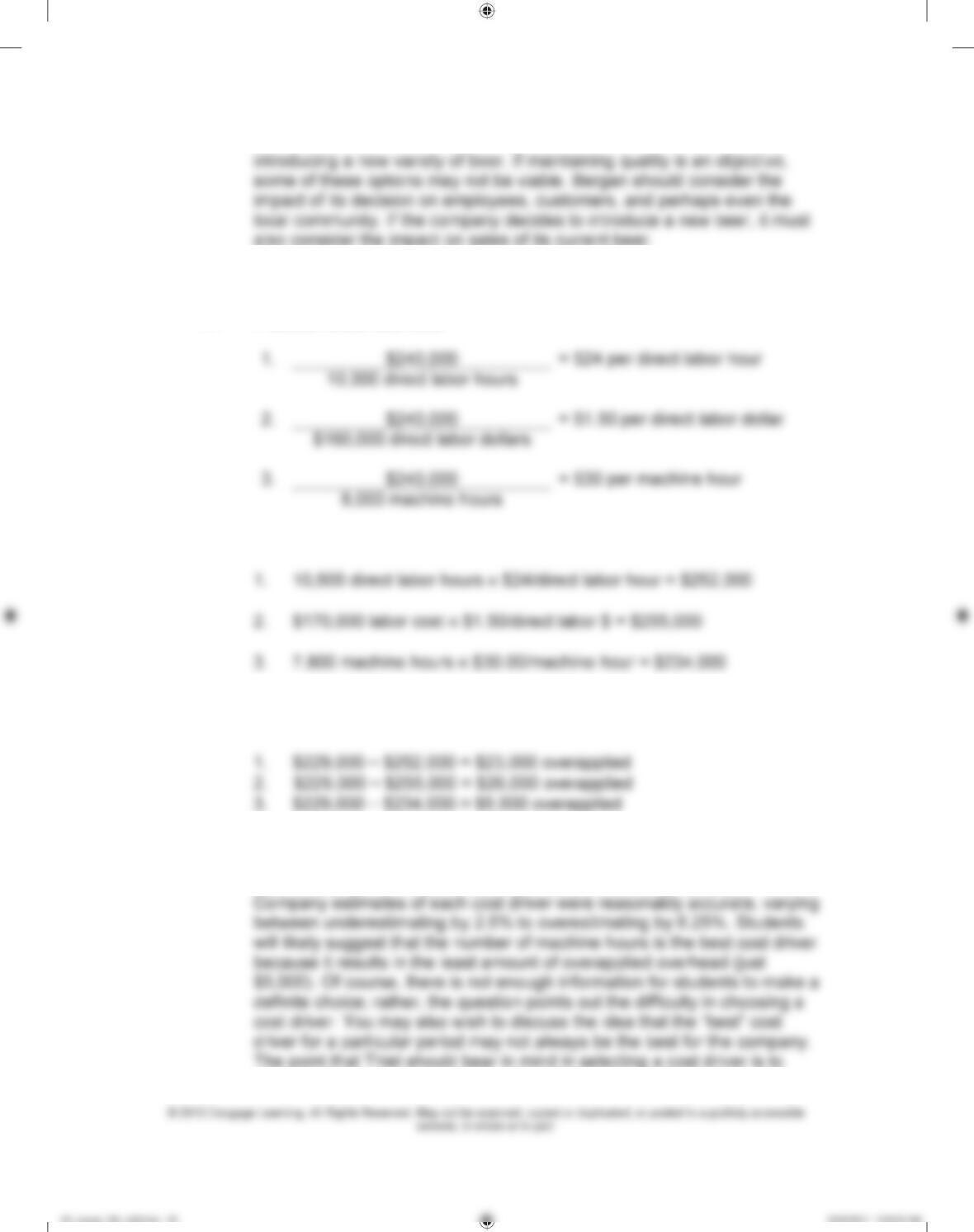
A. Gross profit has increased because overhead is substantially
underapplied. The change from direct labor to machines in the
B. Direct labor is no longer an appropriate base for applying overhead. A
more appropriate cost driver for overhead is machine hours.
C. Applied overhead for the year is equal to $290,000 ($58.00 × 5,000
machine hours).
Bergan Brewery
Income Statement
For the Year Ending December 31, 2012
Sales $1,000,000
D. Step 1—Bergan’s problem is how to increase income to $550,000 in 2012
while faced with stagnant sales.
Step 2—Objectives include increasing income. However, Bergan is also
Solutions Manual
3-30
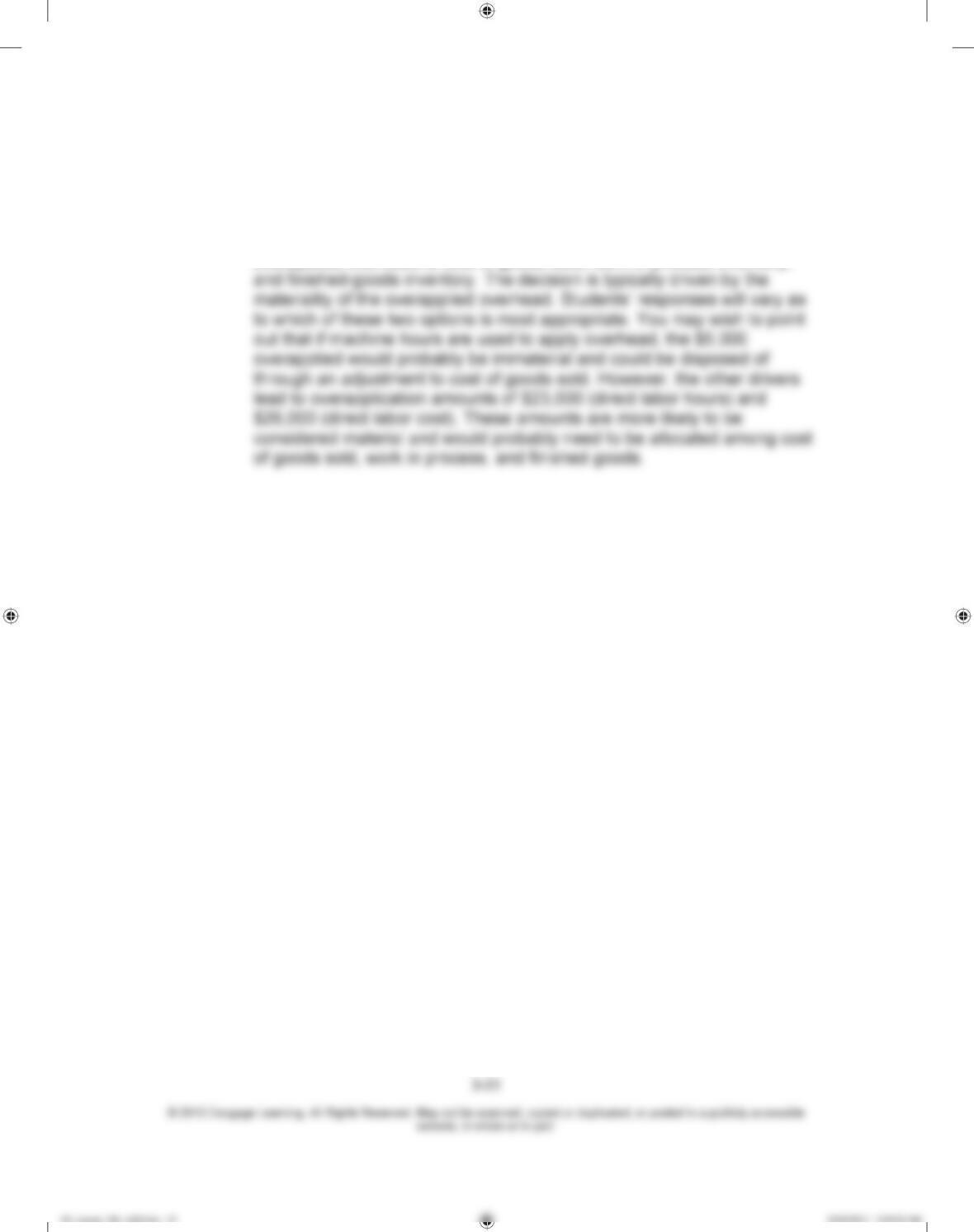
45. (LO3, 4, and 5—Decision focus: The choice of cost driver)
A. Predetermined overhead =
B. Applied overhead =
C. If actual overhead is $229,000, the over- or underapplied overhead is as
follows:
D. Companies use different cost drivers because they assume that overhead
costs are the result of various drivers. In this problem, Thiel had three
options: direct labor hours, direct labor cost, and machine hours.
Chapter 3: Job Costing, Process Costing, and Operations Costing
make sure that there is a strong causal relationship between changes in
the activity of the cost driver and overhead costs.
E. Thiel has two options to dispose of the overapplied overhead: (1) close the
overapplied overhead directly to cost of goods sold and (2) allocate the
overapplied overhead to cost of goods sold, work in process inventory,